
Goods and Services Tax GST Awareness Session for

- Slides: 18
“Goods and Services Tax (GST) Awareness Session for Vendors” Bangi Golf Resort 5 th August 2014 1
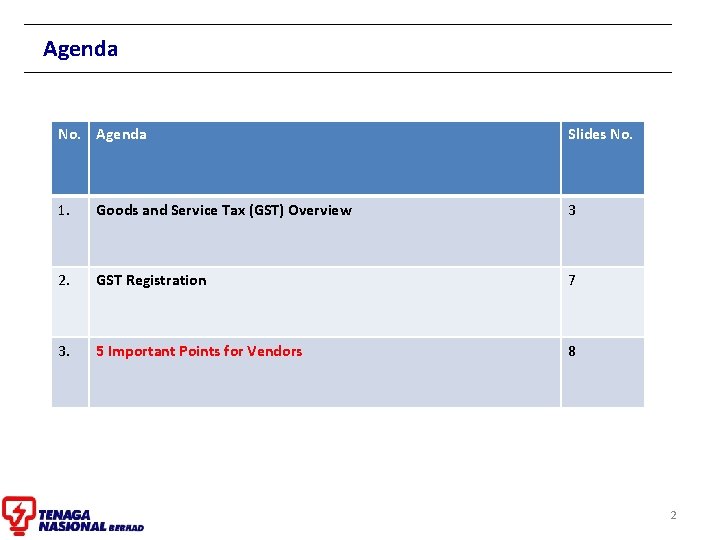
Agenda No. Agenda Slides No. 1. Goods and Service Tax (GST) Overview 3 2. GST Registration 7 3. 5 Important Points for Vendors 8 2
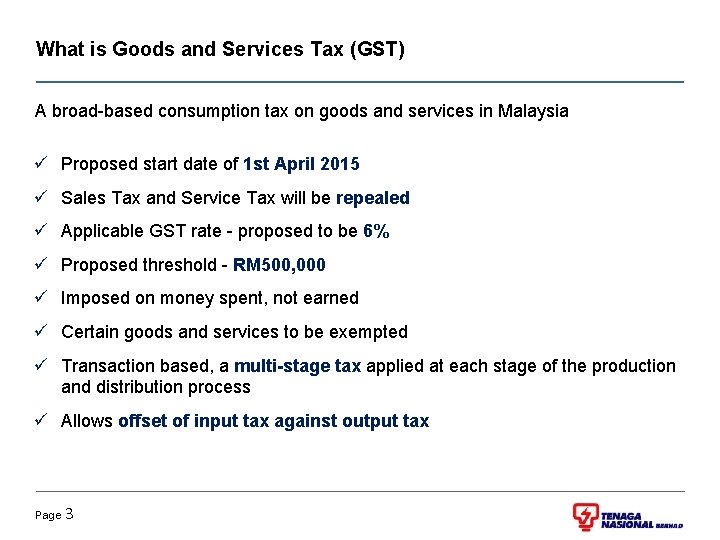
What is Goods and Services Tax (GST) A broad-based consumption tax on goods and services in Malaysia ü Proposed start date of 1 st April 2015 ü Sales Tax and Service Tax will be repealed ü Applicable GST rate - proposed to be 6% ü Proposed threshold - RM 500, 000 ü Imposed on money spent, not earned ü Certain goods and services to be exempted ü Transaction based, a multi-stage tax applied at each stage of the production and distribution process ü Allows offset of input tax against output tax Page 3
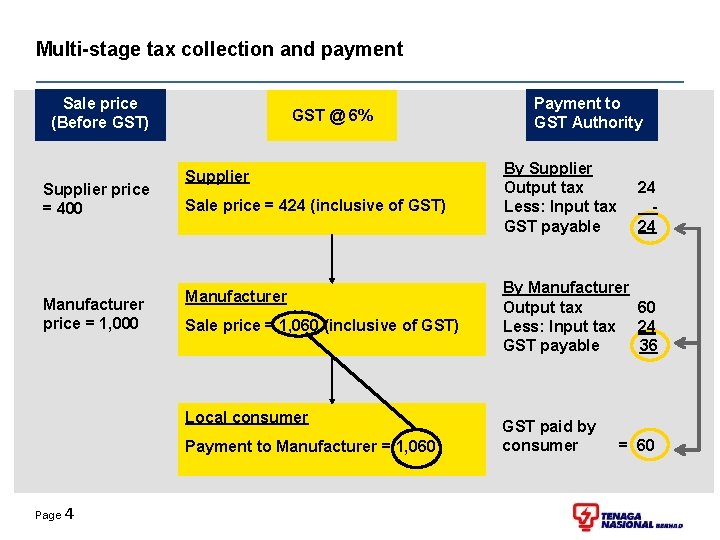
Multi-stage tax collection and payment Sale price (Before GST) Supplier price = 400 Manufacturer price = 1, 000 GST @ 6% Supplier Sale price = 424 (inclusive of GST) Manufacturer Sale price = 1, 060 (inclusive of GST) Local consumer Payment to Manufacturer = 1, 060 Page 4 Payment to GST Authority By Supplier Output tax Less: Input tax GST payable 24 24 By Manufacturer Output tax 60 Less: Input tax 24 GST payable 36 GST paid by consumer = 60
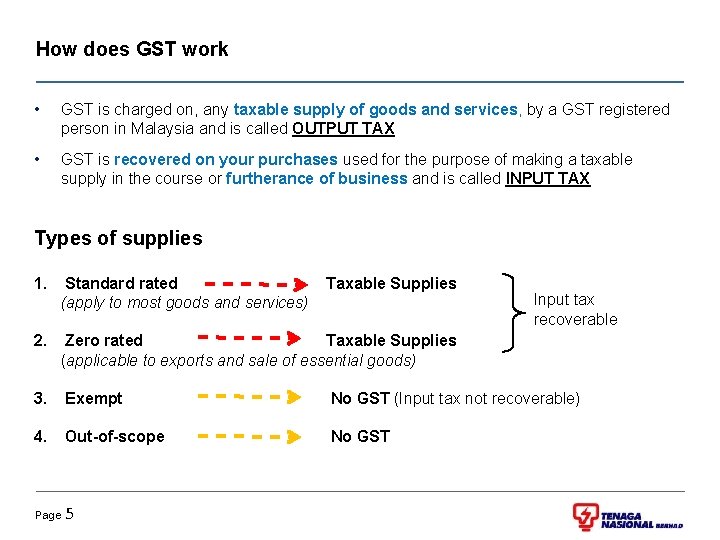
How does GST work • GST is charged on, any taxable supply of goods and services, by a GST registered person in Malaysia and is called OUTPUT TAX • GST is recovered on your purchases used for the purpose of making a taxable supply in the course or furtherance of business and is called INPUT TAX Types of supplies 1. Standard rated (apply to most goods and services) Taxable Supplies 2. Zero rated Taxable Supplies (applicable to exports and sale of essential goods) 3. Exempt No GST (Input tax not recoverable) 4. Out-of-scope No GST Page 5 Input tax recoverable
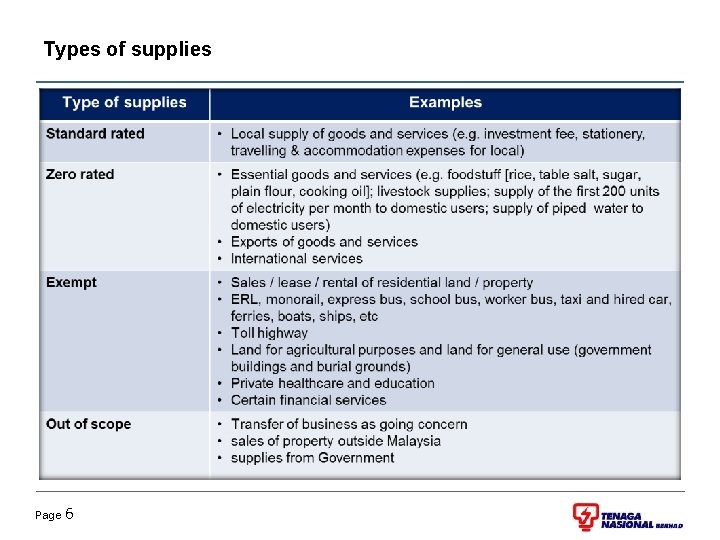
Types of supplies Page 6
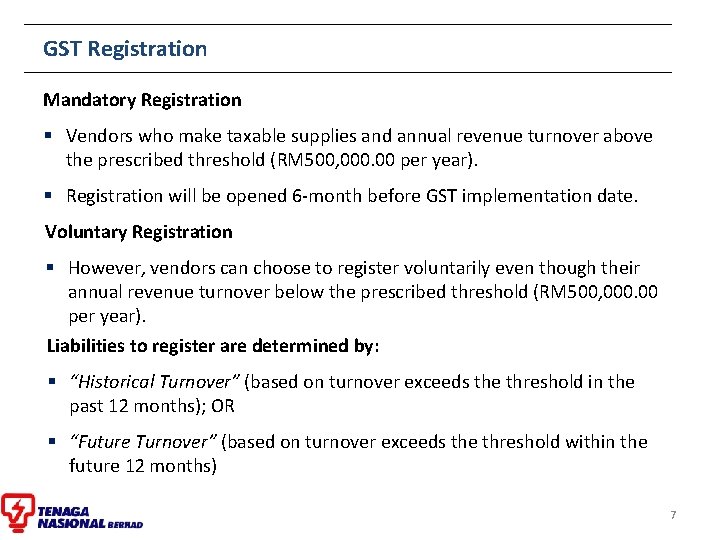
GST Registration Mandatory Registration § Vendors who make taxable supplies and annual revenue turnover above the prescribed threshold (RM 500, 000. 00 per year). § Registration will be opened 6 -month before GST implementation date. Voluntary Registration § However, vendors can choose to register voluntarily even though their annual revenue turnover below the prescribed threshold (RM 500, 000. 00 per year). Liabilities to register are determined by: § “Historical Turnover” (based on turnover exceeds the threshold in the past 12 months); OR § “Future Turnover” (based on turnover exceeds the threshold within the future 12 months) 7
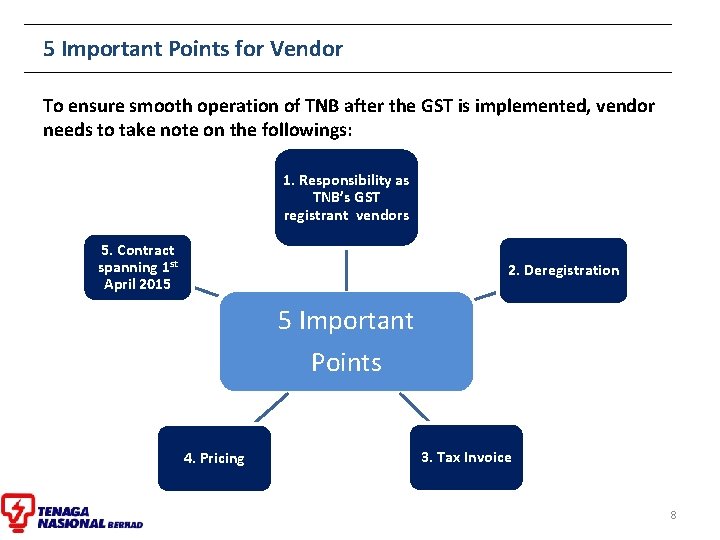
5 Important Points for Vendor To ensure smooth operation of TNB after the GST is implemented, vendor needs to take note on the followings: 1. Responsibility as TNB’s GST registrant vendors 5. Contract spanning 1 st April 2015 2. Deregistration 5 Important Points 4. Pricing 3. Tax Invoice 8
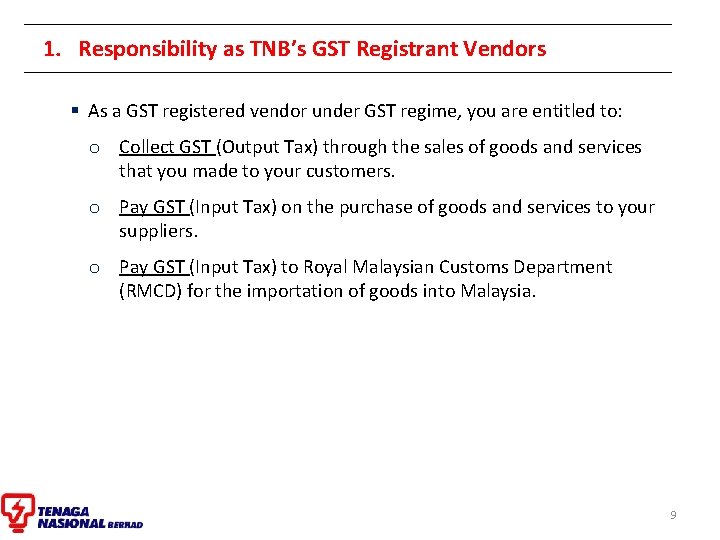
1. Responsibility as TNB’s GST Registrant Vendors § As a GST registered vendor under GST regime, you are entitled to: o Collect GST (Output Tax) through the sales of goods and services that you made to your customers. o Pay GST (Input Tax) on the purchase of goods and services to your suppliers. o Pay GST (Input Tax) to Royal Malaysian Customs Department (RMCD) for the importation of goods into Malaysia. 9
1. Responsibility as TNB’s GST Registrant Vendors (continue…) § Once registered, you are required to submit to TNB the followings: o GST registration number; and o GST registration certificate/document as proof of registration. § This is to allow TNB to record your GST registration number in its database. 10
2. Deregistration § Kindly inform TNB if you have deregistered or your GST registration is cancelled. All with documentary evidences must be provided as well. § This will allow TNB to change your business entity status in our database from “GST registered” to “Non-GST registered. § Once deregistered, you are not allowed to charge GST (input tax) on supplies made to TNB and also you are not required to issue a tax invoice/debit note/credit note showing GST components. 11
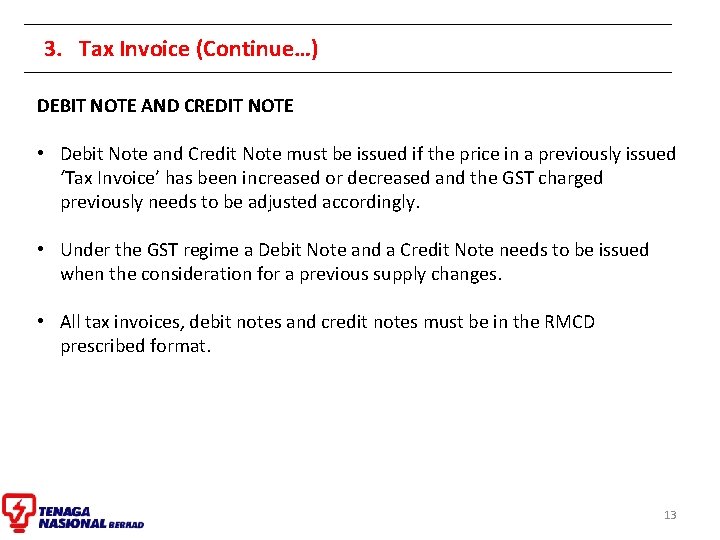
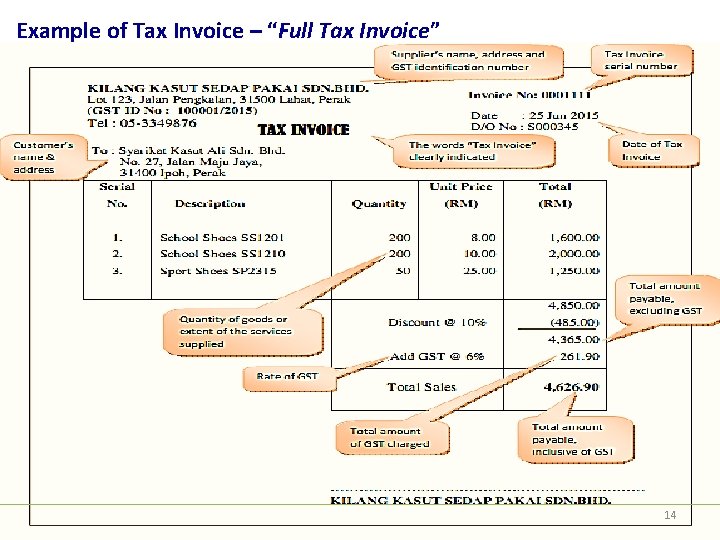
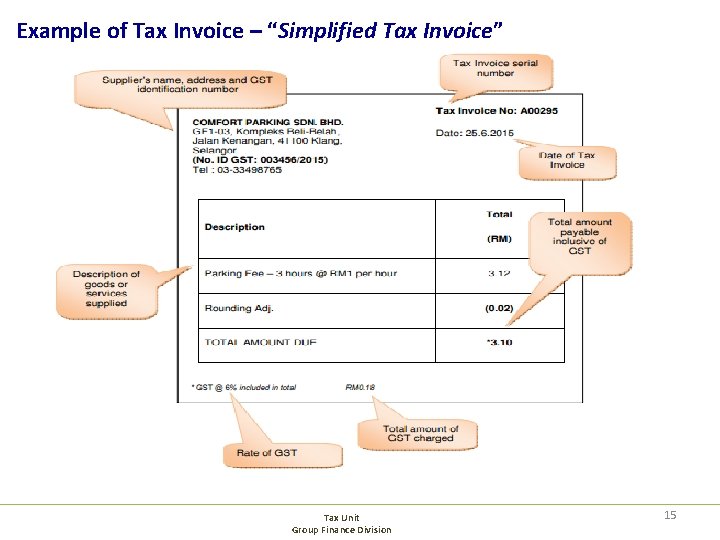
3. Tax Invoice TAX INVOICE • A GST registered vendor must provide a valid ‘Tax Invoice’ to TNB. • The ‘Tax Invoice’ can either be a ‘Full Tax Invoice’ or a ‘Simplified Tax Invoice’ depending on the value of the supplies but both must be in the format required by RMCD. • Both types of ‘Tax Invoice’ will allow TNB to claim input tax credit (ITC). 12
3. Tax Invoice (Continue…) DEBIT NOTE AND CREDIT NOTE • Debit Note and Credit Note must be issued if the price in a previously issued ‘Tax Invoice’ has been increased or decreased and the GST charged previously needs to be adjusted accordingly. • Under the GST regime a Debit Note and a Credit Note needs to be issued when the consideration for a previous supply changes. • All tax invoices, debit notes and credit notes must be in the RMCD prescribed format. 13
Example of Tax Invoice – “Full Tax Invoice” 14
Example of Tax Invoice – “Simplified Tax Invoice” Tax Unit Group Finance Division 15
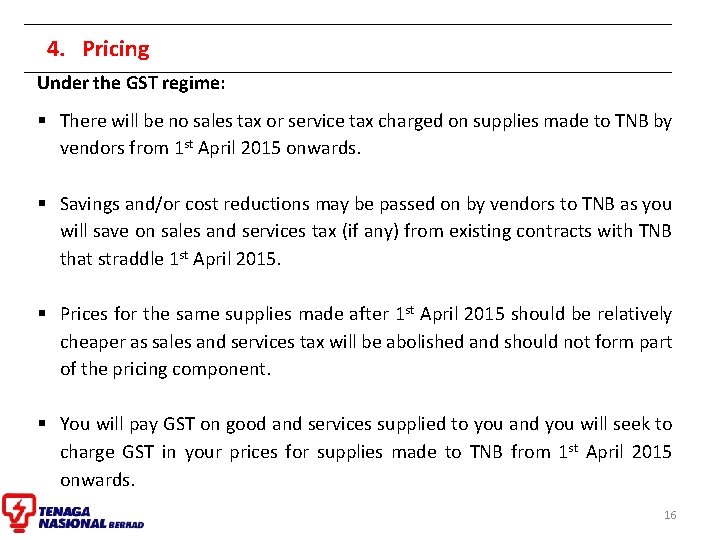
4. Pricing Under the GST regime: § There will be no sales tax or service tax charged on supplies made to TNB by vendors from 1 st April 2015 onwards. § Savings and/or cost reductions may be passed on by vendors to TNB as you will save on sales and services tax (if any) from existing contracts with TNB that straddle 1 st April 2015. § Prices for the same supplies made after 1 st April 2015 should be relatively cheaper as sales and services tax will be abolished and should not form part of the pricing component. § You will pay GST on good and services supplied to you and you will seek to charge GST in your prices for supplies made to TNB from 1 st April 2015 onwards. 16
5. Contract spanning 1 st April 2015 All pre- GST contracts that spanning on/after 1 st April 2015 entered into between the vendors and TNB are treated in the following manner under the proposed GST Law: § All contracts that are entered into after 1 st April 2013 will be standard rated. § All contracts that are entered into before 1 st April 2013 with an opportunity to review will be standard rated after 1 st April 2015. § All contracts that are entered into before 1 st April 2013 for a fixed price with no opportunity to review will be zero-rated for 5 years until 31 st March 2020 or until the first opportunity to review takes place whichever is earlier. 17
18