
Goodreads Review of Literary Classics Nitisha Lotun References
- Slides: 11
Goodreads Review of Literary Classics Nitisha Lotun References: "Sense and Sensibility (Annotated). " Goodreads. N. p. , n. d. Web. 10 Feb. 2014. https: //www. goodreads. com/book/show/18732961 -sense-and-sensibility "War and Peace. " Goodreads. N. p. , n. d. Web. 10 Feb. 2014. https: //www. goodreads. com/book/show/8131057 -war-and-peace. "Pride and Prejudice. " Goodreads. N. p. , n. d. Web. 10 Feb. 2014. https: //www. goodreads. com/book/show/1885. Pride_and_Prejudice? from_search=true. "The Great Gatsby. " Goodreads. N. p. , n. d. Web. 10 Feb. 2014. https: //www. goodreads. com/book/show/4671. The_Great_Gatsby? from_search=true. "Jane Eyre. " Goodreads. N. p. , n. d. Web. 10 Feb. 2014. <https: //www. goodreads. com/book/show/10210. Jane_Eyre? from_search=true. 11/28/2020 1
Tags: Reader Writer and Purpose, Content, Design, Structure, Linguistic Features Technically, anyone could write a Goodreads book review, but due to the nature of the media (being on the Internet), the writers on Goodreads tend to be the young to middle-aged section of the population. In general, book reviews, at least impartial ones, are intended to inform the reader of what to expect in a novel, often to help the reader make a decision as to whether the book is worth reading or not. With Goodreads however, it could be argued that the purpose is to entertain as much as, if not more than to inform. Goodreads gives a platform for everyone and anyone to give their opinions on a particular book, without the need to be a professional book reviewer or to be associated with any major organization to give reviews. It is supposed to give the view of the “common man, ” and not just a professional. Yet, the Goodreads model of having the reviews with the most likes and comments at the top, and with certain books, especially those with thousands of written reviews, the competition to get to the top can be tough. Having the review near the top increases the probability of an outsider, who is not a “friend” on Goodreads, of actually reading the review. Therefore the readership for the reviews on Goodreads in general comes in two stages. The initial readership is a much smaller group of people who the writer has as a “friend” on Goodreads. Eventually, people outside the writer’s network, who are interested in other people’s opinions on the book, may read it, the likelihood of which increases. So, the reviews at the top are the ones which people in general seem to like best. Given the nature of Goodreads, a website where anyone can post a review of a book with no formal rules and etiquette, each review should be almost unique. However, when analyzing the reviews, some trends can be seen. In particular, the top five reviews of five famous classic novels were chosen and analyzed. It turned out that while each review did offer some unique characteristics, more often than not, they were similar in numerous ways.
Tags: Reader Writer and Purpose, Content, Design, Structure, Linguistic Features Reader, Writer and Purpose That is all fine, if I want to know whether the latest Man Booker Prize Winner is actually enjoyable or if I can’t wait for professional reviewers to review a book I have been excited to read. But who would want to read or write reviews of classics in literature from Goodreads? It’s not as if there have not been many professional critical literary reviews that people can just look up. The viewers who read the reviews of classics on Goodreads do not want a critical review. Instead, it could be argued that people who are thinking about reading the book want to know more about the experience that reading the book will bring, not just purely from the literary critic’s point of view. Goodreads offers information that goes beyond the synopsis of the book, but the focus is more about the experiences of each reader rather than the book itself, which is what professional critics mostly focus on.
Tags: Reader Writer and Purpose, Content, Design, Structure, Linguistic Features However, reviews are not only for those who have yet to read a book. It is also a place for readers who have finished a novel to go and see other people’s opinions and compare the experiences of others with that of their own. People will probably do this only if they feel strongly about a book-either having strong adoration for the book or a strong hatred for it. Hence, this is probably the explanation as to why the top reviews for each book are usually either five stars or one star. People want a validation of their own feelings, so they are likely to comment on those that match their own, and the people who look for the validation in the first place are likely to have strong opinions. Similarly, the people who write the review rather than just give a star rating are more likely than not to have strong feelings either way towards the book. They feel the need to add something to their star review and most often, they talk about their own experiences with the book rather than feel the need to make objective literary statements.
Tags: Reader Writer and Purpose, Content, Design, Structure, Linguistic Features Content Looking at the reviews for Pride and Prejudice, three of the first five reviews are written by men. Two of the first four reviews for Sense and Sensibility are written by men. What they all have in common is the need to justify their reason for reading a Jane Austen book, and contrast it to their usual preferences. They feel the need to reinforce the cultural notion that men do not enjoy subjects such as “marriages” and “petticoats. ” The favorable reviews then go on to state the merits of the Jane Austen novels that lead them to enjoy the books despite the detractors. It seems that even in Goodreads, where the majority of readers are strangers to the reviewer, the writer feels the need to address social gender expectations, and in most cases, assure everyone that he does actually adhere to these social expectations. While this pattern in the justification for reading seems to only apply to “chick flick” novels like Sense and Sensibility and Pride and Prejudice, having the reviewer’s personal story with the novel is a common feature of the reviews. Often, the reviewer will write a chronological narrative of their encounters with the book, often contrasting the experience of reading it in their youths versus reading the book now. The majority of the time, the narrative follows the general theme of hating the book in the reviewer’s youth, in contrast with their appreciation of the novel in the present day.
Tags: Reader Writer and Purpose, Content, Design, Structure, Linguistic Features The reason for this might be because society views the reading of certain classics as a right of passage. There is a cultural notion that reading, enjoying and understanding classics for their true meanings is an indication of sophistication and maturity. Hence, these narratives conform to that social notion. So, while the reviews do not have a central thesis around which arguments are made, they have a sense of structure in that they read more like a narrative of the reviewer’s experiences with the novels. Pop culture references are often made during the reviews. These references were both self referential with respect to the book itself or to other aspects of pop culture. Self-references can be made because although not everyone has read all of the popular classics, there is enough awareness in our culture of main plot points and concepts from the novels for the references to be self-referential. Both types of references help to convey the context of the novel. Whereas some more traditional reviews attempt to add context by talking about the times in which the classics where written, the references add places the book in a modern context. The self-references links modern culture back to the book and references to other aspects of pop culture helps to show certain parallels with modern pop culture and current events. This helps to make the book and the review more personal, both to the reviewer and the reader of the review.
Tags: Reader Writer and Purpose, Content, Design, Structure, Linguistic Features Structure The “bookshelf” tag is generally used as an indicator of the tone of the piece, if not the specific contents of the review. This is sometimes expanded to the “recommends for” section of the review. These generally act as a very short summary of the piece, only using few key words to give the reader a general indication, and in this sense, the genre is similar to the newspaper style. These features on the Goodreads reviews may be fueled by the format of Goodreads- that the entire review does not appear and viewers who are scrolling the reviews have to click on the “read more” link to read the entire review. Therefore, like in the newspaper format, the reader has to be persuaded to read the entire review from the beginning few lines that he or she can see. The tags on the “bookshelves” and “recommends for” are sometimes used to give a general idea as to either the tone of the review or the general opinions of the reviewer in order to grab the reader.
Tags: Reader Writer and Purpose, Content, Design, Structure, Linguistic Features As well as acting as a device to entice the reviewer, the tags can also act as a quick summary to the viewer who does not want to read entire reviews and just want a general consensus (this person really did not like the book). Yes, the star ratings act as a quick visual way to get the general opinion on a book, but this says nothing as to the specific contents of the book. The tags act as a quick way for the reader to get a sense of the general opinions of several reviewers. The highest rated reviews at the top are often around four to five paragraphs. These paragraphs are usually not very dense, being about three to four sentences long. Each paragraph is broken down into various themes, such as the reviewer’s personal experience with the book over different stages in their life, movie adaptations, characters etc. The actual organization of the contents varies between the reviews, but the majority of the reviews do seem to have a sense of a beginning, middle and end. The beginning paragraphs seem to almost always focus on the reviewer and his or her own personal experiences or general opinions with the book, rather than making objective statements about the book itself. This reinforces the idea that with these reviews in general, the reader does not want objective statements about the book, but rather he or she is more interested in the type of experience this book has to offer and the best way to gage this is by immersing in the experience of the reviewer.
Tags: Reader Writer and Purpose, Content, Design, Structure, Linguistic Features The tones of the reviews for classics are generally conversational and very informal and sometimes using swear words. The swear words are generally used for emphasis or to reinforce the conversational tone, rather than used in derogatory terms. This, together with the first person case and active verbs, along with the use of ellipsis and transitional phrases that are used almost exclusively in conversations, such as “see I…, ” creates the impression that the reviewer is talking about his or her experiences with the book rather than a written piece of work. It helps create a degree of intimacy between the reader and the reviewer and abolish the academic tones in order to distinguish itself from more academic reviews. Moreover, there is frequent use of hyperboles in the reviews and there primary purpose is to create humor. This use of humor helps to fortify the casual conversational tone of the reviews as well as help to establish the voice of the reviewer. The exaggeration to create humor is not only limited to the main body of texts, but can sometimes be seen in the tags section at the top of the review, in order to start generating the tone of the review. Furthermore, the hyperboles are sometimes used with onomatopoeia, “BAM, ” to create a vivid image in the readers mind and to help engage the reader more and make the reader less distant and objective towards the review.
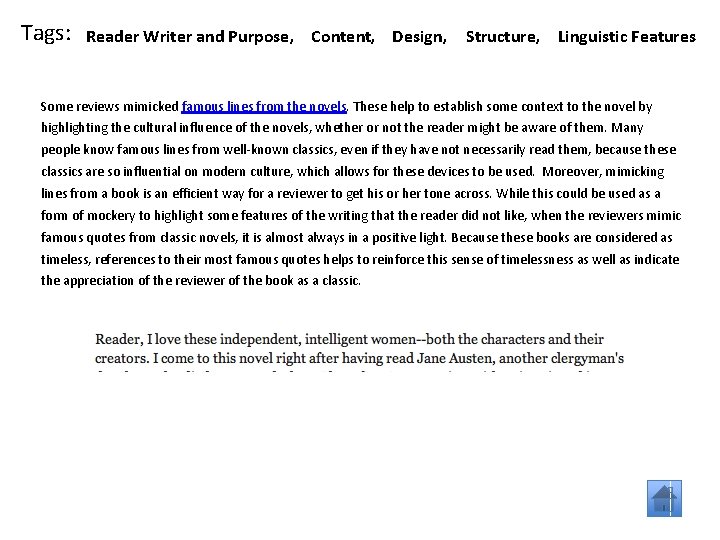
Tags: Reader Writer and Purpose, Content, Design, Structure, Linguistic Features Some reviews mimicked famous lines from the novels. These help to establish some context to the novel by highlighting the cultural influence of the novels, whether or not the reader might be aware of them. Many people know famous lines from well-known classics, even if they have not necessarily read them, because these classics are so influential on modern culture, which allows for these devices to be used. Moreover, mimicking lines from a book is an efficient way for a reviewer to get his or her tone across. While this could be used as a form of mockery to highlight some features of the writing that the reader did not like, when the reviewers mimic famous quotes from classic novels, it is almost always in a positive light. Because these books are considered as timeless, references to their most famous quotes helps to reinforce this sense of timelessness as well as indicate the appreciation of the reviewer of the book as a classic.
Tags: Reader Writer and Purpose, Content, Design, Structure, Linguistic Features Design The reviews display several uses of non-logo centric tools of conveying information. These include images and gifs, often of scenes from the on screen adaptation of the book, as well as the use of different fonts. The images from adaptations are often used to reinforce certain points made in the review because the images can often portray exactly what the reader wants to say. They can also be used to add humor in the review, as well as purely for aesthetic reasons, since not only do they add a visual aide, but they also help to enhance the breaks between paragraphs, so that the writing appears less dense, and thus helping the review to flow more easily. Since these reviews are designed for entertainment purposes more than they are for academic purposes, an ease of flow and a breakdown of pieces of text are highly favored by the reader. The use of word formatting tools is used to add another layer of meaning to the word itself. The types of formatting used are making the words bold, in italics and crossing out some words. These tools are also used to create the tone for the review, most often a humorous tone. For example, the use of crossing out certain words indicate something that shouldn’t really be mentioned in polite society, but the reviewer makes it anyway adding a sense of humor to the piece. The use of italics and bolded words and ALL CAPS help to enforce certain words and change the timbre in which the reader reads those words and these fluctuations help to reinforce the conversational tone of the reviews.