
Good Scientific Practice and its Pitsfalls in Research
- Slides: 58
Good Scientific Practice (and its Pitsfalls in Research) Nicole Föger, Vienna Helga Nolte, Hamburg Gerlinde Sponholz, Berlin Estonian Research Council – September 17 th/18 th, 2015 – Tartu and Tallinn
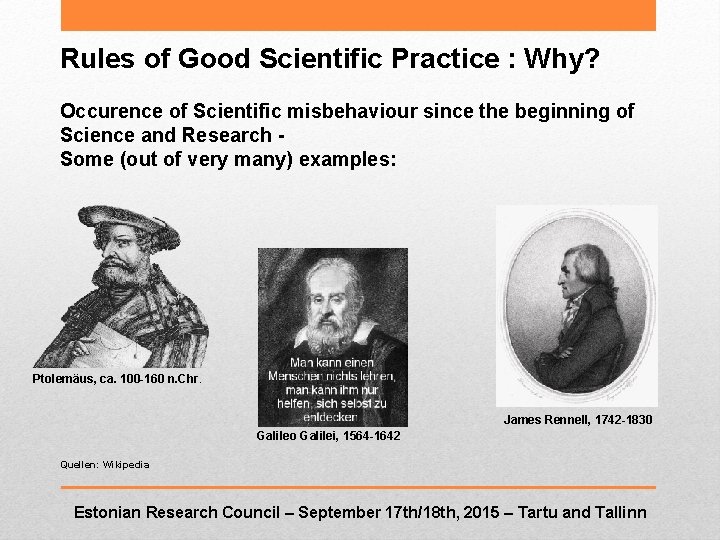
Rules of Good Scientific Practice : Why? Occurence of Scientific misbehaviour since the beginning of Science and Research Some (out of very many) examples: Ptolemäus, ca. 100 -160 n. Chr. James Rennell, 1742 -1830 Galileo Galilei, 1564 -1642 Quellen: Wikipedia Estonian Research Council – September 17 th/18 th, 2015 – Tartu and Tallinn
Rules of Good Scientific Practice : Why? Occurence of Scientific misbehaviour since the beginning of Science and Research and: Haeckel, Herrmann and Brach, Schön, Woo-Suk Hwang, zu Guttenberg, Stapel. . . • Increasing numbers of known/publicised cases • More public interest and discussions about scientific integrity and scientific misconduct • More regulations for handling cases with suspicious scientific misconduct • Sanctions of scientific misconduct • Gap between knowledge/rules and reality • Obligation of Teaching GSP in some countries (e. g. USA) Estonian Research Council – September 17 th/18 th, 2015 – Tartu and Tallinn
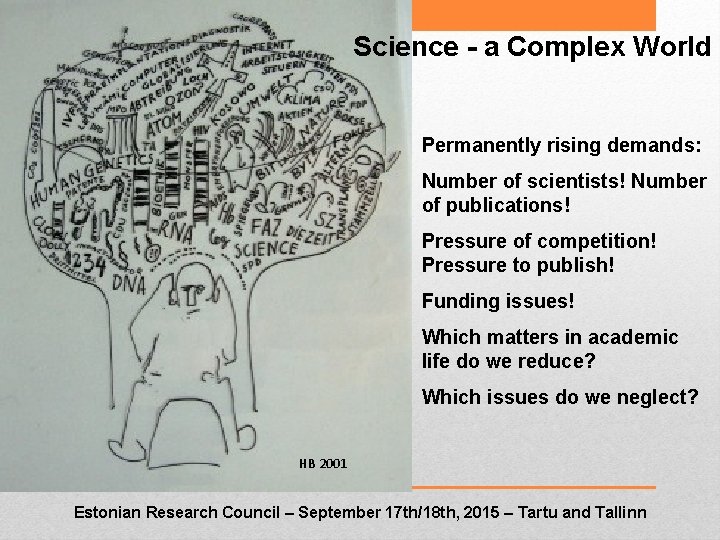
Science - a Complex World Permanently rising demands: Number of scientists! Number of publications! Pressure of competition! Pressure to publish! Funding issues! Which matters in academic life do we reduce? Which issues do we neglect? HB 2001 Estonian Research Council – September 17 th/18 th, 2015 – Tartu and Tallinn
Estonian Research Council – September 17 th/18 th, 2015 – Tartu and Tallinn
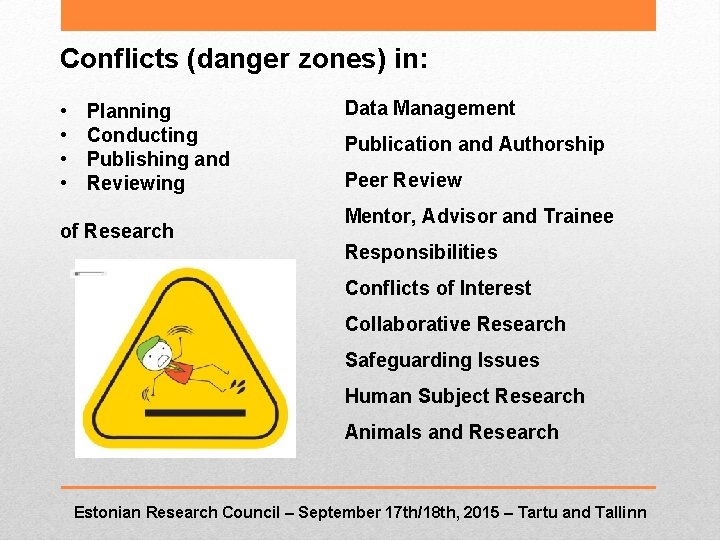
Conflicts (danger zones) in: • • Planning Conducting Publishing and Reviewing of Research Data Management Publication and Authorship Peer Review Mentor, Advisor and Trainee Responsibilities Conflicts of Interest Collaborative Research Safeguarding Issues Human Subject Research Animals and Research Estonian Research Council – September 17 th/18 th, 2015 – Tartu and Tallinn
What is Good Scientific Practice ? Estonian Research Council – September 17 th/18 th, 2015 – Tartu and Tallinn
What is Good Scientific Practice What are the “No-gos” In Research? Estonian Research Council – September 17 th/18 th, 2015 – Tartu and Tallinn
Good Scientific Practice • Honesty in performing research • Observance and adherence of professional standards (“lege artis”) • Responsibility for performing the own tasks • Responsibility for the team, society, future Estonian Research Council – September 17 th/18 th, 2015 – Tartu and Tallinn
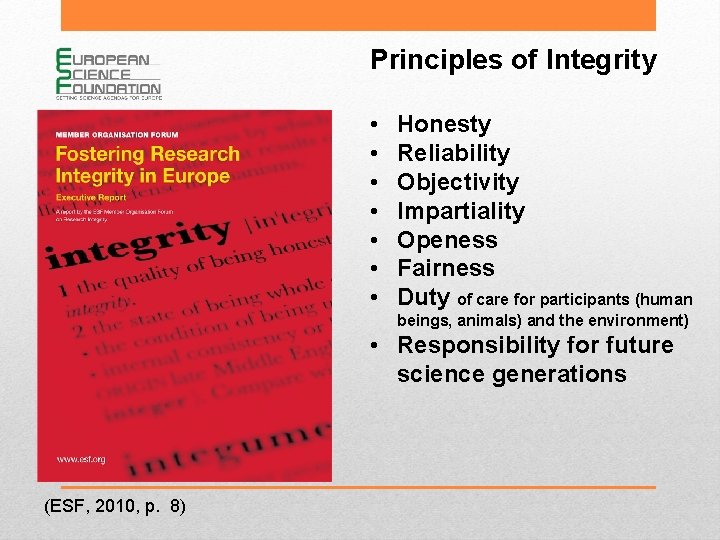
Principles of Integrity • • Honesty Reliability Objectivity Impartiality Openess Fairness Duty of care for participants (human beings, animals) and the environment) • Responsibility for future science generations (ESF, 2010, p. 8)
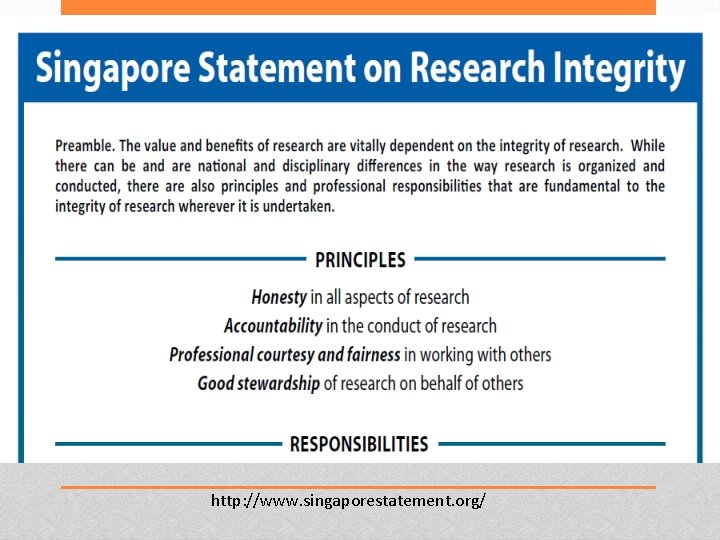
http: //www. singaporestatement. org/
Research Integrity International Development Estonian Research Council – September 17 th/18 th, 2015 – Tartu and Tallinn
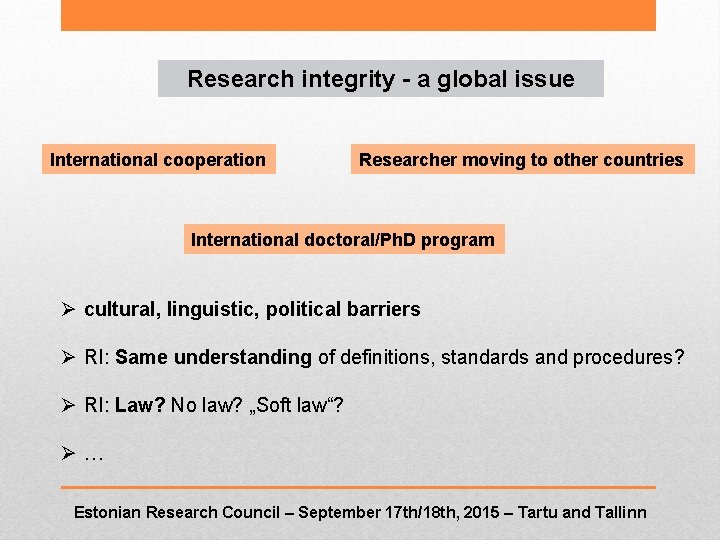
Research integrity - a global issue International cooperation Researcher moving to other countries International doctoral/Ph. D program Ø cultural, linguistic, political barriers Ø RI: Same understanding of definitions, standards and procedures? Ø RI: Law? No law? „Soft law“? Ø… Estonian Research Council – September 17 th/18 th, 2015 – Tartu and Tallinn
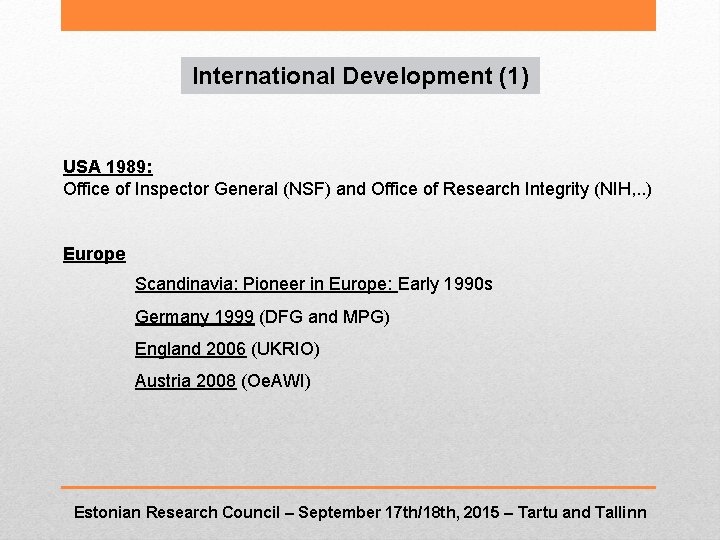
International Development (1) USA 1989: Office of Inspector General (NSF) and Office of Research Integrity (NIH, . . ) Europe Scandinavia: Pioneer in Europe: Early 1990 s Germany 1999 (DFG and MPG) England 2006 (UKRIO) Austria 2008 (Oe. AWI) Estonian Research Council – September 17 th/18 th, 2015 – Tartu and Tallinn
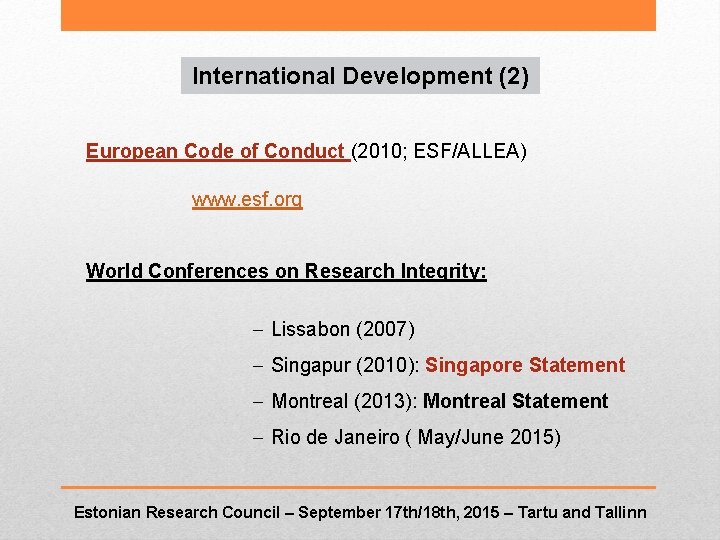
International Development (2) European Code of Conduct (2010; ESF/ALLEA) www. esf. org World Conferences on Research Integrity: - Lissabon (2007) - Singapur (2010): Singapore Statement - Montreal (2013): Montreal Statement - Rio de Janeiro ( May/June 2015) Estonian Research Council – September 17 th/18 th, 2015 – Tartu and Tallinn
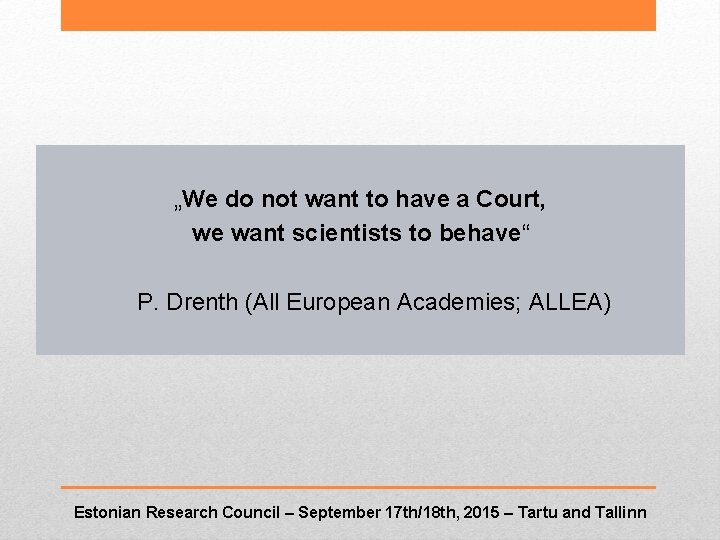
„We do not want to have a Court, we want scientists to behave“ P. Drenth (All European Academies; ALLEA) Estonian Research Council – September 17 th/18 th, 2015 – Tartu and Tallinn
www. enrio. eu Estonian Research Council – September 17 th/18 th, 2015 – Tartu and Tallinn
ENRIO: Members Founded in 2007/2008 Representatives from 23 European countries: Members belong to: Ø national organisations responsible for investigation and/or oversight of allegations of research misconduct Ø organisations providing funding for research Ø national organisations with a special interest in promoting RI Estonian Research Council – September 17 th/18 th, 2015 – Tartu and Tallinn
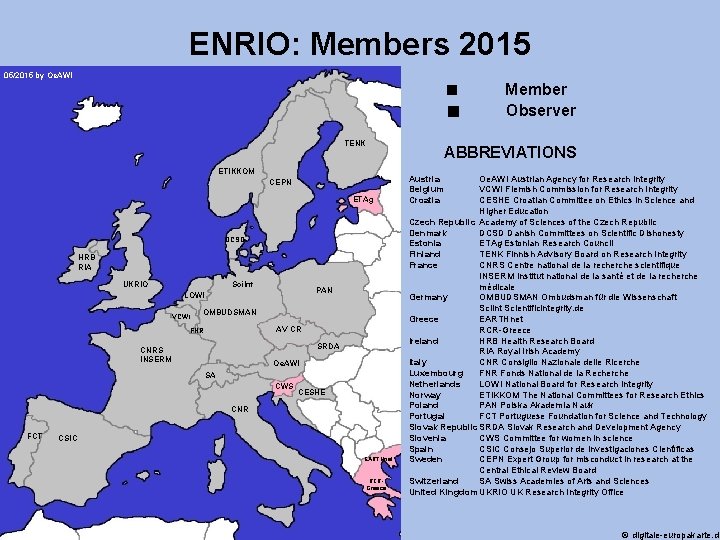
ENRIO: Members 2015 05/2015 by Oe. AWI TENK ETIKKOM CEPN ETAg DCSD HRB RIA UKRIO Sci. Int PAN LOWI VCWI OMBUDSMAN AV CR FNR SRDA CNRS INSERM Oe. AWI SA CWS CESHE CNR FCT CSIC EARTHnet RCRGreece Member Observer ABBREVIATIONS Austria Belgium Croatia Oe. AWI Austrian Agency for Research Integrity VCWI Flemish Commission for Research Integrity CESHE Croatian Committee on Ethics in Science and Higher Education Czech Republic Academy of Sciences of the Czech Republic Denmark DCSD Danish Committees on Scientific Dishonesty Estonia ETAg Estonian Research Council Finland TENK Finnish Advisory Board on Research Integrity France CNRS Centre national de la recherche scientifique INSERM Institut national de la santé et de la recherche médicale Germany OMBUDSMAN Ombudsman für die Wissenschaft Sci. Int Scientificintegrity. de Greece EARTHnet RCR-Greece Ireland HRB Health Research Board RIA Royal Irish Academy Italy CNR Consiglio Nazionale delle Ricerche Luxembourg FNR Fonds National de la Recherche Netherlands LOWI National Board for Research Integrity Norway ETIKKOM The National Committees for Research Ethics Poland PAN Polska Akademia Nauk Portugal FCT Portuguese Foundation for Science and Technology Slovak Republic SRDA Slovak Research and Development Agency Slovenia CWS Committee for women in science Spain CSIC Consejo Superior de Investigaciones Científicas Sweden CEPN Expert Group for misconduct in research at the Central Ethical Review Board Switzerland SA Swiss Academies of Arts and Sciences United Kingdom UKRIO UK Research Integrity Office © digitale-europakarte. de
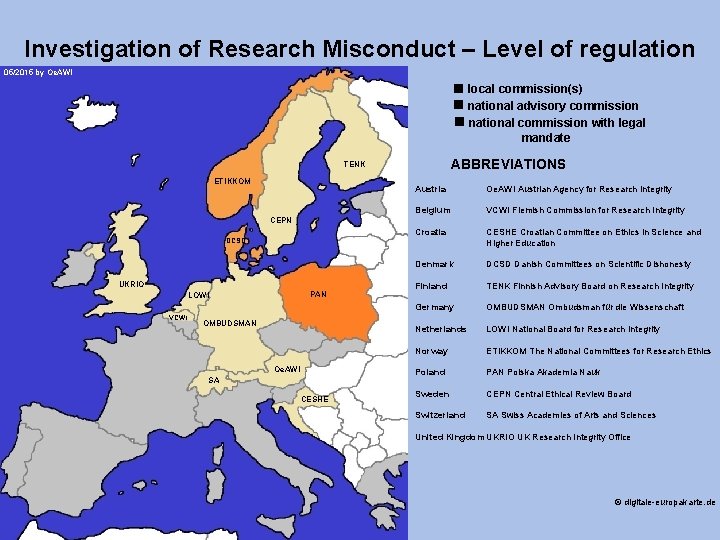
Investigation of Research Misconduct – Level of regulation 05/2015 by Oe. AWI local commission(s) national advisory commission national commission with legal mandate ABBREVIATIONS TENK ETIKKOM Austria Oe. AWI Austrian Agency for Research Integrity Belgium VCWI Flemish Commission for Research Integrity Croatia CESHE Croatian Committee on Ethics in Science and Higher Education Denmark DCSD Danish Committees on Scientific Dishonesty Finland TENK Finnish Advisory Board on Research Integrity Germany OMBUDSMAN Ombudsman für die Wissenschaft Netherlands LOWI National Board for Research Integrity Norway ETIKKOM The National Committees for Research Ethics Poland PAN Polska Akademia Nauk Sweden CEPN Central Ethical Review Board Switzerland SA Swiss Academies of Arts and Sciences CEPN DCSD UKRIO PAN LOWI VCWI OMBUDSMAN Oe. AWI SA CESHE United Kingdom UKRIO UK Research Integrity Office © digitale-europakarte. de
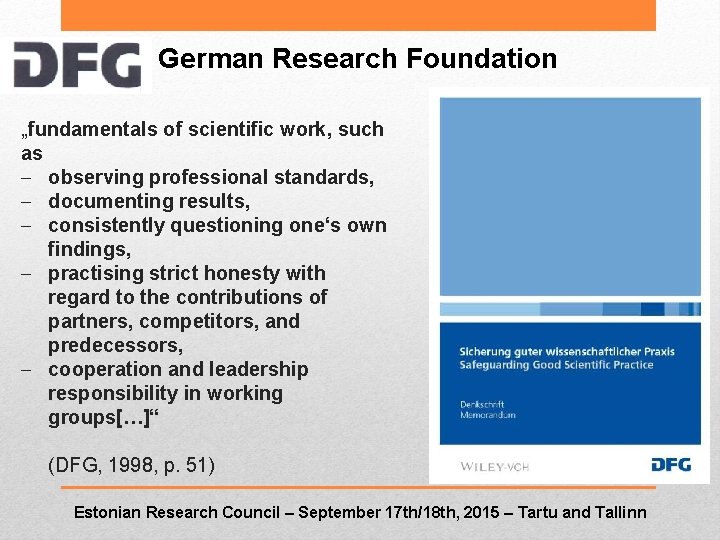
DFG = German Research Foundation „fundamentals of scientific work, such as - observing professional standards, - documenting results, - consistently questioning one‘s own findings, - practising strict honesty with regard to the contributions of partners, competitors, and predecessors, - cooperation and leadership responsibility in working groups[…]“ (DFG, 1998, p. 51) Estonian Research Council – September 17 th/18 th, 2015 – Tartu and Tallinn
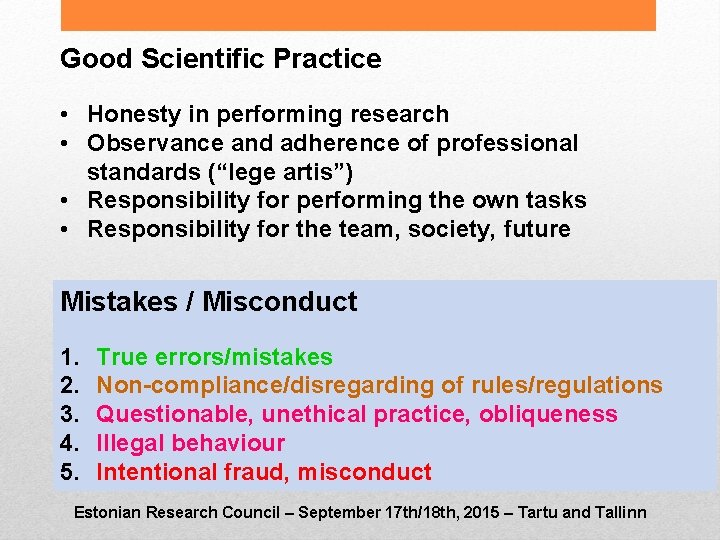
Good Scientific Practice • Honesty in performing research • Observance and adherence of professional standards (“lege artis”) • Responsibility for performing the own tasks • Responsibility for the team, society, future Mistakes / Misconduct 1. 2. 3. 4. 5. True errors/mistakes Non-compliance/disregarding of rules/regulations Questionable, unethical practice, obliqueness Illegal behaviour Intentional fraud, misconduct Estonian Research Council – September 17 th/18 th, 2015 – Tartu and Tallinn
Which behaviour is in your opinion scientific misconduct? ? Estonian Research Council – September 17 th/18 th, 2015 – Tartu and Tallinn
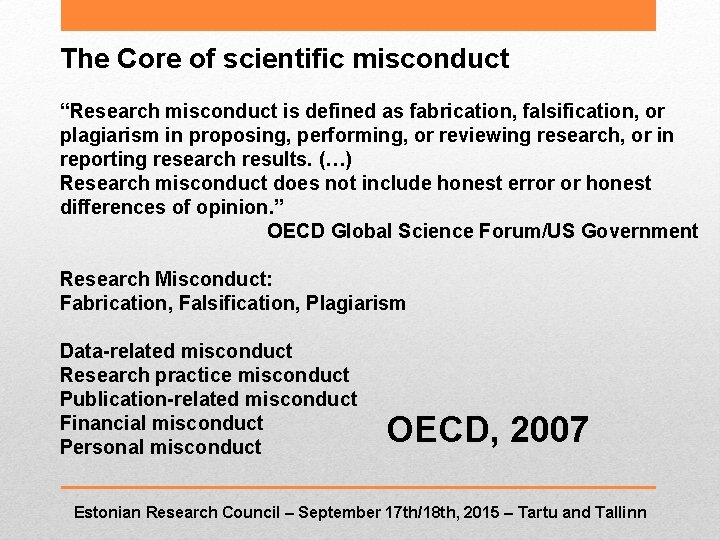
The Core of scientific misconduct “Research misconduct is defined as fabrication, falsification, or plagiarism in proposing, performing, or reviewing research, or in reporting research results. (…) Research misconduct does not include honest error or honest differences of opinion. ” OECD Global Science Forum/US Government Research Misconduct: Fabrication, Falsification, Plagiarism Data-related misconduct Research practice misconduct Publication-related misconduct Financial misconduct Personal misconduct OECD, 2007 Estonian Research Council – September 17 th/18 th, 2015 – Tartu and Tallinn
Correctible vs non-correctible misconduct ! Estonian Research Council – September 17 th/18 th, 2015 – Tartu and Tallinn
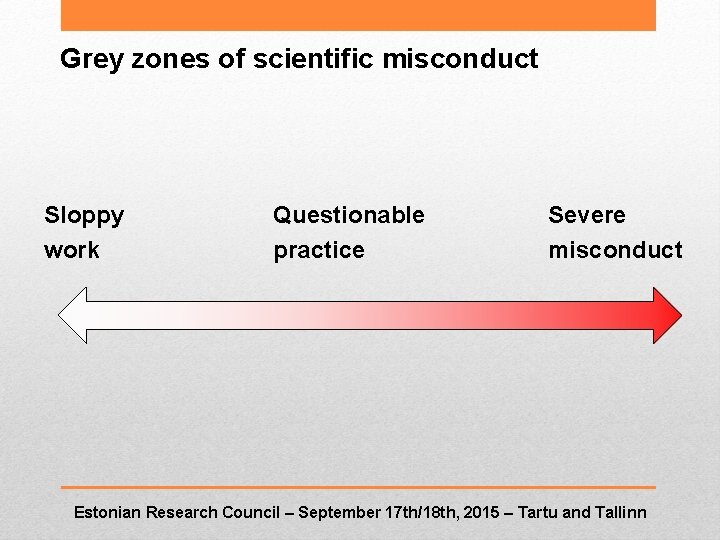
Grey zones of scientific misconduct Sloppy work Questionable practice Severe misconduct Estonian Research Council – September 17 th/18 th, 2015 – Tartu and Tallinn
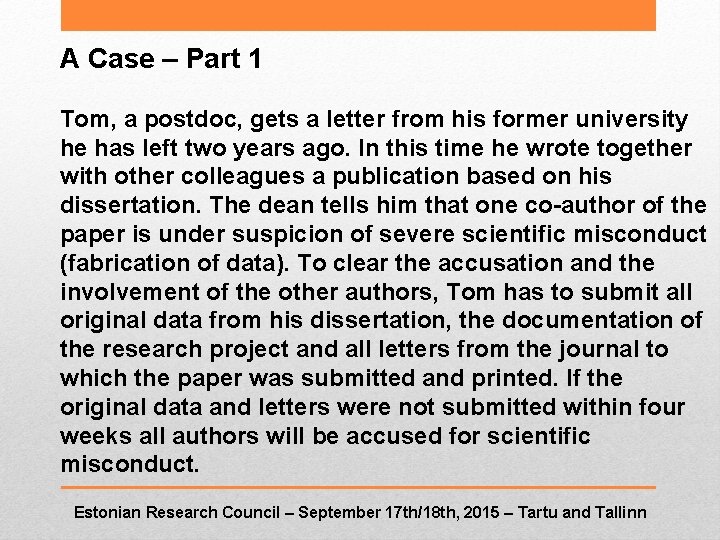
A Case – Part 1 Tom, a postdoc, gets a letter from his former university he has left two years ago. In this time he wrote together with other colleagues a publication based on his dissertation. The dean tells him that one co-author of the paper is under suspicion of severe scientific misconduct (fabrication of data). To clear the accusation and the involvement of the other authors, Tom has to submit all original data from his dissertation, the documentation of the research project and all letters from the journal to which the paper was submitted and printed. If the original data and letters were not submitted within four weeks all authors will be accused for scientific misconduct. Estonian Research Council – September 17 th/18 th, 2015 – Tartu and Tallinn
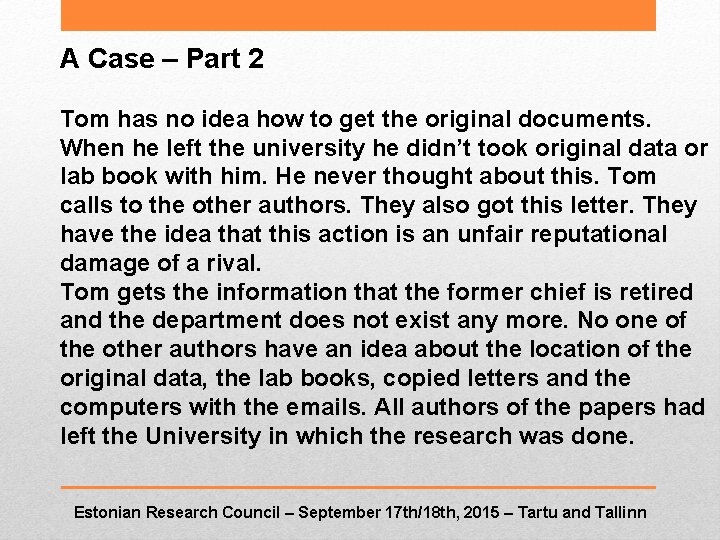
A Case – Part 2 Tom has no idea how to get the original documents. When he left the university he didn’t took original data or lab book with him. He never thought about this. Tom calls to the other authors. They also got this letter. They have the idea that this action is an unfair reputational damage of a rival. Tom gets the information that the former chief is retired and the department does not exist any more. No one of the other authors have an idea about the location of the original data, the lab books, copied letters and the computers with the emails. All authors of the papers had left the University in which the research was done. Estonian Research Council – September 17 th/18 th, 2015 – Tartu and Tallinn
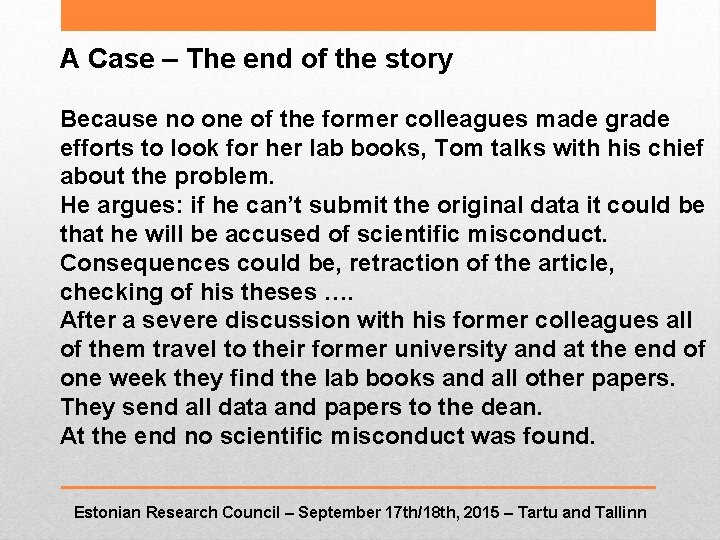
A Case – The end of the story Because no one of the former colleagues made grade efforts to look for her lab books, Tom talks with his chief about the problem. He argues: if he can’t submit the original data it could be that he will be accused of scientific misconduct. Consequences could be, retraction of the article, checking of his theses …. After a severe discussion with his former colleagues all of them travel to their former university and at the end of one week they find the lab books and all other papers. They send all data and papers to the dean. At the end no scientific misconduct was found. Estonian Research Council – September 17 th/18 th, 2015 – Tartu and Tallinn
What are primary or original data ? Estonian Research Council – September 17 th/18 th, 2015 – Tartu and Tallinn
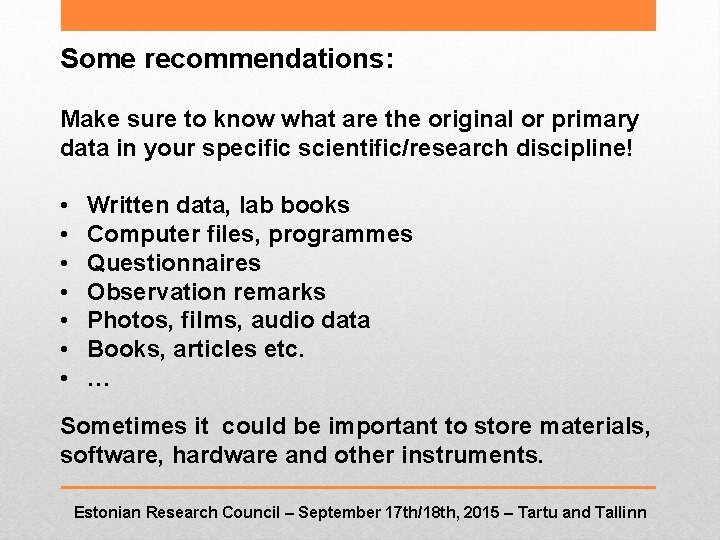
Some recommendations: Make sure to know what are the original or primary data in your specific scientific/research discipline! • • Written data, lab books Computer files, programmes Questionnaires Observation remarks Photos, films, audio data Books, articles etc. … Sometimes it could be important to store materials, software, hardware and other instruments. Estonian Research Council – September 17 th/18 th, 2015 – Tartu and Tallinn
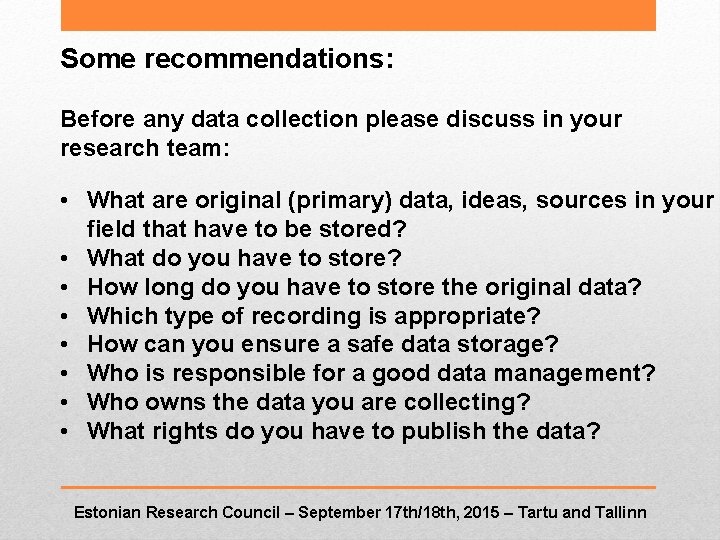
Some recommendations: Before any data collection please discuss in your research team: • What are original (primary) data, ideas, sources in your field that have to be stored? • What do you have to store? • How long do you have to store the original data? • Which type of recording is appropriate? • How can you ensure a safe data storage? • Who is responsible for a good data management? • Who owns the data you are collecting? • What rights do you have to publish the data? Estonian Research Council – September 17 th/18 th, 2015 – Tartu and Tallinn
Data Ownership of data is the result of a negotiation process. Data and ideas are the cash for your career in science. Please handle them carefully. Revised version of the Memorandum, July 2013, p. 74: Recommendation 7: Safeguarding and Storing of Primary Data Primary data as the basis for publications shall be securely stored for ten years in a durable form in the institution of their origin. Estonian Research Council – September 17 th/18 th, 2015 – Tartu and Tallinn
Data Ownership of data is the result of a negotiation process. Data and ideas are the cash for your career in science. Please handle them carefully. Revised version of the Memorandum, July 2013, p. 74: Recommendation 7: Safeguarding and Storing of Primary Data Commentary „A distinction must be observed between the use and the retention of primary data. Researcher(s) who collect the data are entitled to use it. During a research project, those entitled to use the data (possibly subject to data protection regulations) decide whether third parties should have access to it. If more than one institution is involved in collecting the data, an agreement must be drawn up to regulate the matter. “ Estonian Research Council – September 17 th/18 th, 2015 – Tartu and Tallinn
Keywords and questions about authorship Ø Responsibility of an author Ø Authorship criteria – and exclusion Estonian Research Council – September 17 th/18 th, 2015 – Tartu and Tallinn
Publication process and authorship Publications are the currency of science Revised version of the Memorandum, July 2013, p. 82: Recommendation 11: Authorship „Authors of scientific publications are always jointly responsible for their content. Only someone who has made a significant contribution to a scientific publication is deemed to be its author. A so-called “honorary authorship” is inadmissible. “ Estonian Research Council – September 17 th/18 th, 2015 – Tartu and Tallinn
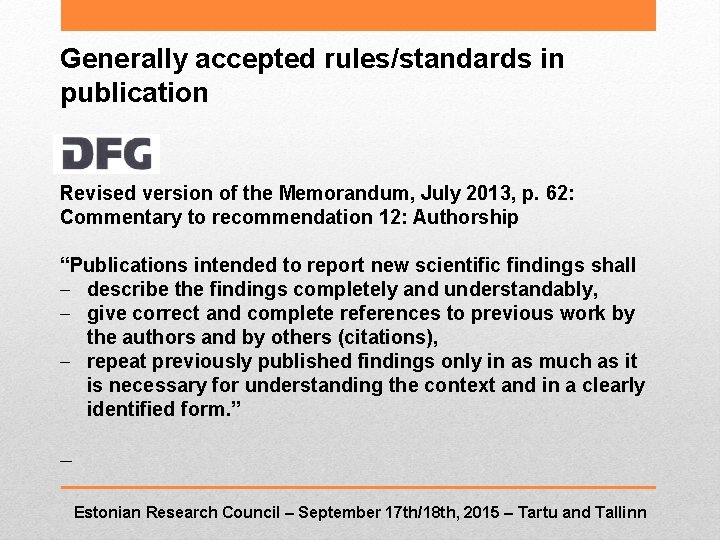
Generally accepted rules/standards in publication Revised version of the Memorandum, July 2013, p. 62: Commentary to recommendation 12: Authorship “Publications intended to report new scientific findings shall - describe the findings completely and understandably, - give correct and complete references to previous work by the authors and by others (citations), - repeat previously published findings only in as much as it is necessary for understanding the context and in a clearly identified form. ” Estonian Research Council – September 17 th/18 th, 2015 – Tartu and Tallinn
Keywords and questions about authorship Ø Responsibility of an author Ø Authorship criteria – and exclusion Ø Decision about authorship and position Estonian Research Council – September 17 th/18 th, 2015 – Tartu and Tallinn
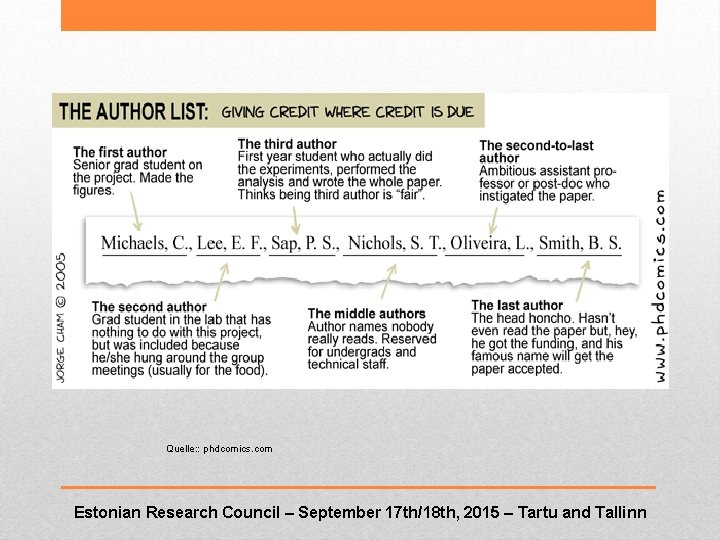
Quelle: : phdcomics. com Estonian Research Council – September 17 th/18 th, 2015 – Tartu and Tallinn
Keywords and questions about authorship Ø Responsibility of an author Ø Authorship criteria – and exclusion Ø Decision about authorship and position Ø Role of journals/editors Estonian Research Council – September 17 th/18 th, 2015 – Tartu and Tallinn
http: //www. publicationethics. org The Committee on Publication Ethics (COPE) was established in 1997 by a small group of medical journal editors in the UK but now has over 9000 members worldwide from all academic fields. Membership is open to editors of academic journals and others interested in publication ethics. Estonian Research Council – September 17 th/18 th, 2015 – Tartu and Tallinn
What is a conflict of interest? • Financial matters • Intellectual matters • Personal matters Advice: Report possible Co. I and funding agencies, journal editors, … should make final decision Estonian Research Council – September 17 th/18 th, 2015 – Tartu and Tallinn
Peer review Problems Bias Misuse of peer review function Estonian Research Council – September 17 th/18 th, 2015 – Tartu and Tallinn
Keywords and questions about authorship Ø Responsibility of an author Ø Authorship criteria – and exclusion Ø Decision about authorship and position Ø Role of journals/editors Ø Role of senior scientists Estonian Research Council – September 17 th/18 th, 2015 – Tartu and Tallinn
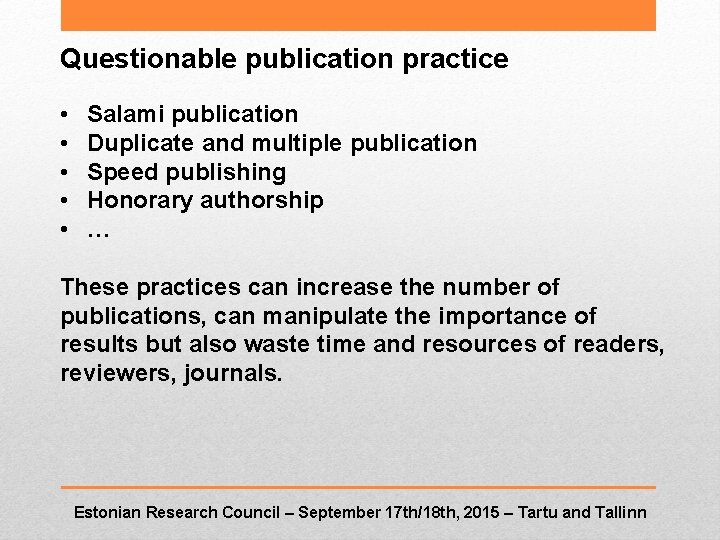
Questionable publication practice • • • Salami publication Duplicate and multiple publication Speed publishing Honorary authorship … These practices can increase the number of publications, can manipulate the importance of results but also waste time and resources of readers, reviewers, journals. Estonian Research Council – September 17 th/18 th, 2015 – Tartu and Tallinn
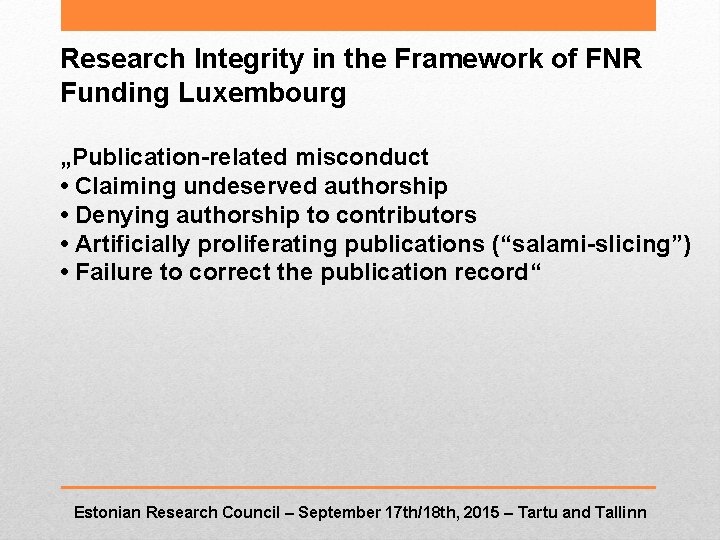
Research Integrity in the Framework of FNR Funding Luxembourg „Publication-related misconduct • Claiming undeserved authorship • Denying authorship to contributors • Artificially proliferating publications (“salami-slicing”) • Failure to correct the publication record“ Estonian Research Council – September 17 th/18 th, 2015 – Tartu and Tallinn
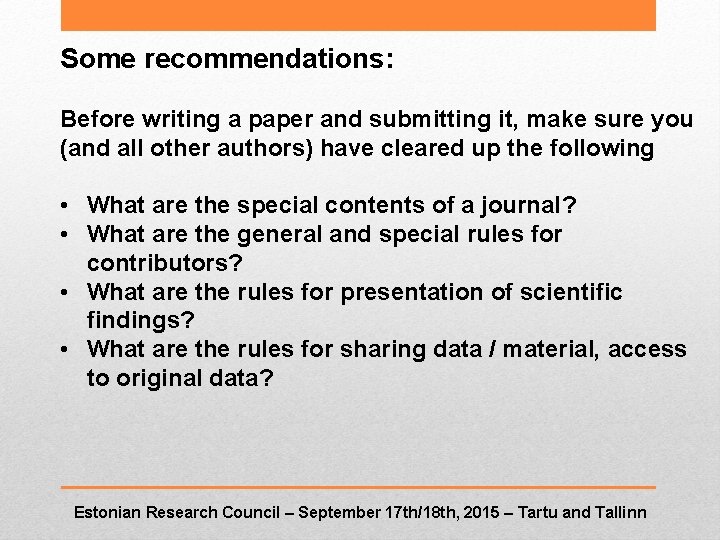
Some recommendations: Before writing a paper and submitting it, make sure you (and all other authors) have cleared up the following • What are the special contents of a journal? • What are the general and special rules for contributors? • What are the rules for presentation of scientific findings? • What are the rules for sharing data / material, access to original data? Estonian Research Council – September 17 th/18 th, 2015 – Tartu and Tallinn
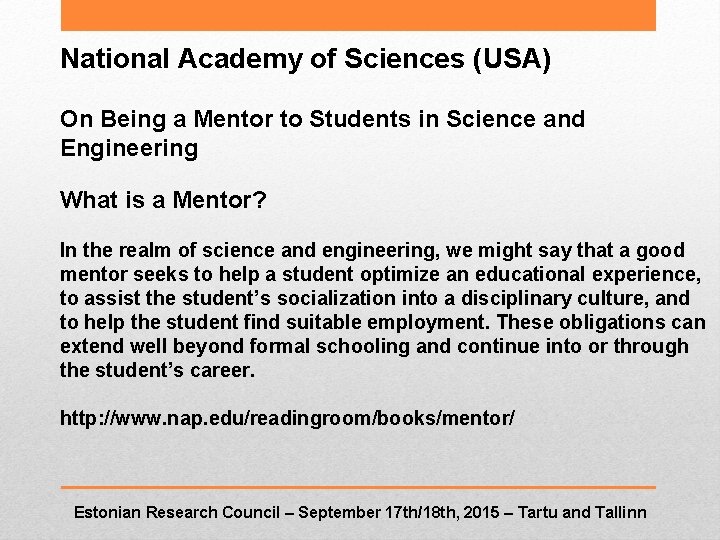
National Academy of Sciences (USA) On Being a Mentor to Students in Science and Engineering What is a Mentor? In the realm of science and engineering, we might say that a good mentor seeks to help a student optimize an educational experience, to assist the student’s socialization into a disciplinary culture, and to help the student find suitable employment. These obligations can extend well beyond formal schooling and continue into or through the student’s career. http: //www. nap. edu/readingroom/books/mentor/ Estonian Research Council – September 17 th/18 th, 2015 – Tartu and Tallinn
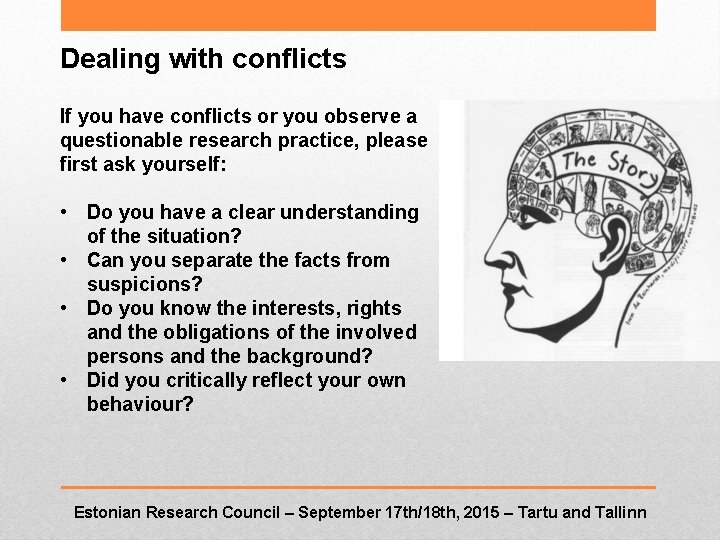
Dealing with conflicts If you have conflicts or you observe a questionable research practice, please first ask yourself: • Do you have a clear understanding of the situation? • Can you separate the facts from suspicions? • Do you know the interests, rights and the obligations of the involved persons and the background? • Did you critically reflect your own behaviour? Estonian Research Council – September 17 th/18 th, 2015 – Tartu and Tallinn
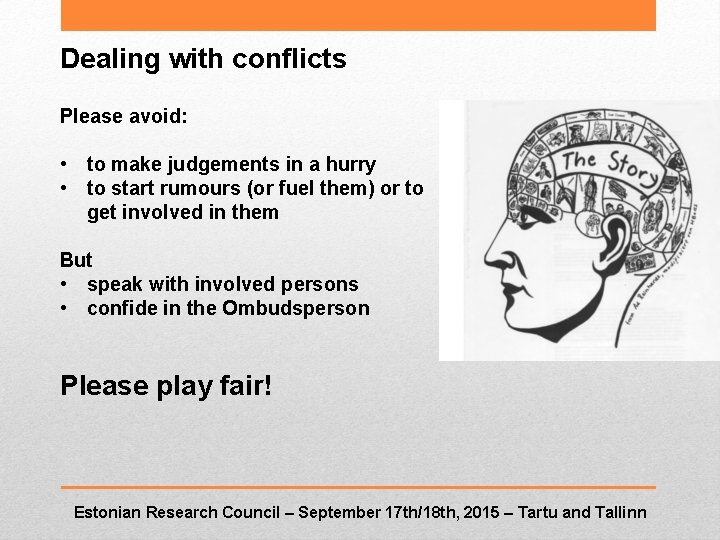
Dealing with conflicts Please avoid: • to make judgements in a hurry • to start rumours (or fuel them) or to get involved in them But • speak with involved persons • confide in the Ombudsperson Please play fair! Estonian Research Council – September 17 th/18 th, 2015 – Tartu and Tallinn
Whistleblowing Revised version of the Memorandum, July 2013, p. 88: Additional recommendation 17: Whistleblower “Researchers who suspect scientific misconduct and can provide specific information (whistleblowers) must not suffer disadvantage in their own scientific and career progress as result. The independent mediator (ombudsman) and the institutions who verify a suspicion must protect them in an appropriate manner. The information must be provided “in good faith”. „It is not the whistleblower who expresses a justified suspicion who damages research and the institution, but the researcher who is guilty of misconduct. . . „ Estonian Research Council – September 17 th/18 th, 2015 – Tartu and Tallinn
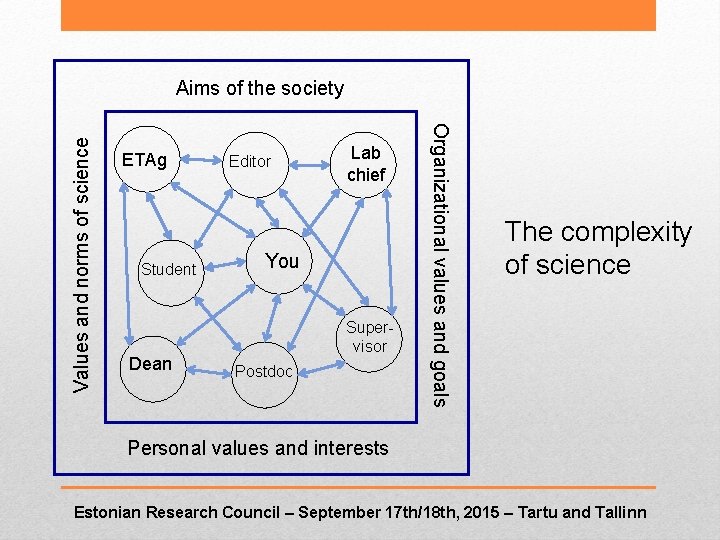
ETAg Student Dean Editor Lab chief You Supervisor Postdoc Organizational values and goals Values and norms of science Aims of the society The complexity of science Personal values and interests Estonian Research Council – September 17 th/18 th, 2015 – Tartu and Tallinn
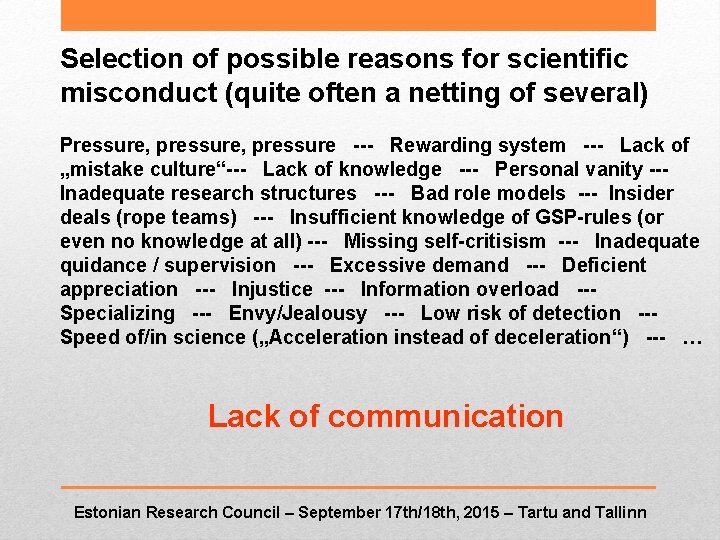
Selection of possible reasons for scientific misconduct (quite often a netting of several) Pressure, pressure --- Rewarding system --- Lack of „mistake culture“--- Lack of knowledge --- Personal vanity --Inadequate research structures --- Bad role models --- Insider deals (rope teams) --- Insufficient knowledge of GSP-rules (or even no knowledge at all) --- Missing self-critisism --- Inadequate quidance / supervision --- Excessive demand --- Deficient appreciation --- Injustice --- Information overload --Specializing --- Envy/Jealousy --- Low risk of detection --Speed of/in science („Acceleration instead of deceleration“) --- … Lack of communication Estonian Research Council – September 17 th/18 th, 2015 – Tartu and Tallinn
Proceedings and consequences of misconduct • • Allegation of misconduct, institutional procedures Inquiry Investigation Results • Consequences of scientific misconduct - retraction of scientific publications - academic consequences - employment law - civil / criminal law Estonian Research Council – September 17 th/18 th, 2015 – Tartu and Tallinn
Consequences of misconduct For individuals – animals – environment – society – science… Waste of resources, such as material, money, Lifetime…! Damaging of career, reputation… Overflow of control mechanisms („we need a new law…“) Damage / Loss / Withdrawal of Confidence in Science Estonian Research Council – September 17 th/18 th, 2015 – Tartu and Tallinn
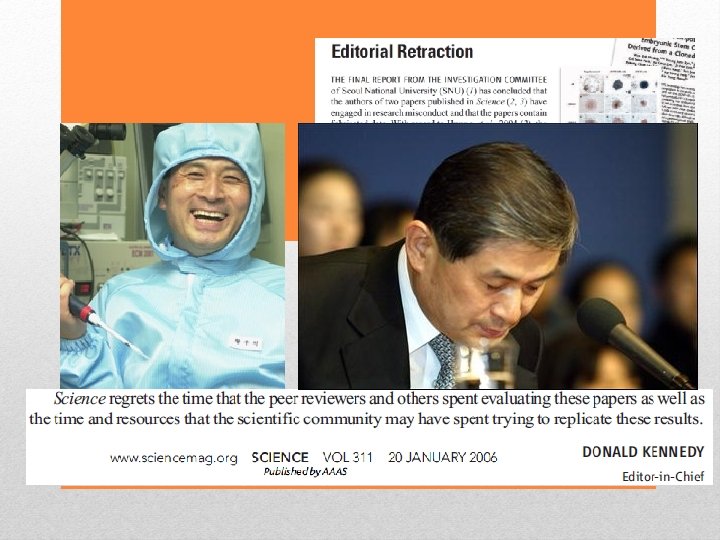
Hwang Woo-suk Quelle: Wikipedia
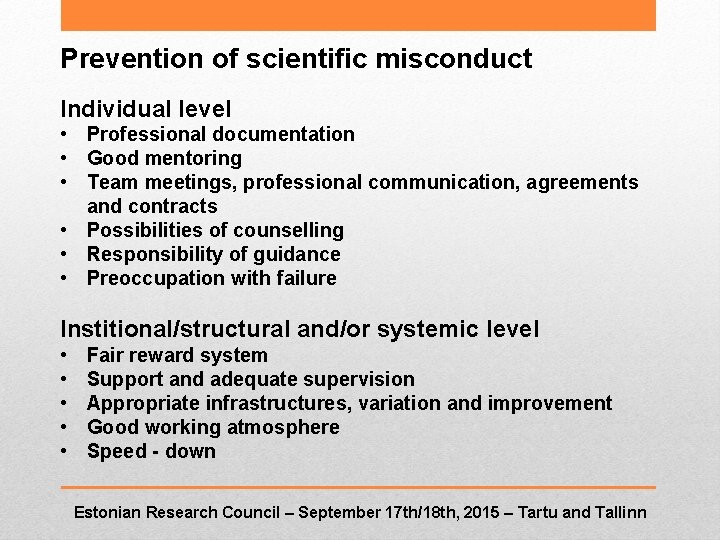
Prevention of scientific misconduct Individual level • Professional documentation • Good mentoring • Team meetings, professional communication, agreements and contracts • Possibilities of counselling • Responsibility of guidance • Preoccupation with failure Institional/structural and/or systemic level • • • Fair reward system Support and adequate supervision Appropriate infrastructures, variation and improvement Good working atmosphere Speed - down Estonian Research Council – September 17 th/18 th, 2015 – Tartu and Tallinn
Thank you for your attention Estonian Research Council – September 17 th/18 th, 2015 – Tartu and Tallinn