
Good Practice in writing a CHILD PERMANENCE REPORT

- Slides: 26
Good Practice in writing a CHILD PERMANENCE REPORT Purposeful Practice Workshop
Learning Outcomes and Aims • • What is a CPR & who is it for? The Purpose of a CPR & legal framework Who can write a CPR? Before you start writing a CPR – points to remember & planning • Be able to use the CPR to provide a full picture of the child’s story, needs and matching considerations KSS 1, 2, 3, 4, 5, 6, 7, 8, 10
The CPR- What is it? • A Child’s Permanence Report (CPR) is a requirement of the Adoption Regulations 2005. It is the document that is presented to the ADM to enable a decision to be made about whether it is in a child's best interests to be placed for adoption. • A CPR is an essential tool that enables the adoption agency to plan for the future life of the child. KSS 1, 2, 3, 4, 5, 6, 7, 8, 10
Activity • What are the functions of the Child Permanence Report? • On your tables or in pairs, take five minutes to think about who the CPR is for? KSS 1, 2, 3, 4, 5, 6, 7, 8, 10
Who Is the CPR For? • • • The Child Agency Decision Maker (ADM) Prospective Adopters Adoption Panel Used as referral form for National Adoption Register KSS 1, 2, 3, 4, 5, 6, 7, 8, 10
The CPR - Purpose? • to recommend/decide whether the child should be placed for adoption; • to recommend/decide that the child should be placed with prospective adopters; • as a source of important information for the adopted child about their life history and heritage; • as the source of essential information to the prospective adopters when first approached by the agency about a child to enable them to decide whether to proceed with the matching process; • as a source of important information about the child’s background and heritage to the adopters once any placement is made; • as the referral form for the Adoption Registers for England Wales. KSS 1, 2, 3, 4, 5, 6, 7, 8, 10
The CPR - Purpose? • A CPR combines facts about the child and the people who have played an important part in their life to date. It also contains evidence about the child’s development and their need for a permanent family. The report will combine the work of many different people contributing their experience, understanding and knowledge of the child and their circumstances. These people will include: • professionals from health, education and social care, including foster carers; • the wishes, views and feelings of the child, wherever these can be made available; • the child’s parents and other birth family members; • other significant people in the child’s life. KSS 1, 2, 3, 4, 5, 6, 7, 8, 10
Activity From reading the CPR, what would you want to know if you were the: • ADM • Prospective adopters • The child KSS 1, 2, 3, 4, 5, 6, 7, 8, 10
ADM Perspective In order to determine if the child should be placed for adoption the ADM will need be reassured that: • all assessment’s of potential family members willing to offer long term care have been concluded and are negative. • That any issues regarding paternity have been resolved. • that all assessments completed during care proceedings are concluded and adoption is the best plan for the child. • The IRO has ratified the plan of adoption at CLA review. • The CPR is sufficiently detailed and accurate to enable a decision to be made. KSS 1, 2, 3, 4, 5, 6, 7, 8, 10
Adopters Perspective • • • Accurate, up to date, detailed personal info on the child. Detailed birth family background info. Circumstances of child coming into care. Any siblings? Rational for any sibling separation? Child’s experience in foster care Legal position. Adoption Support issues (i. e. ASF) Child’s wishes about adoptive family Child’s personality, likes and dislikes Health – any hereditary conditions? Outstanding tests? Clear post adoption contact arrangements / rationales KSS 1, 2, 3, 4, 5, 6, 7, 8, 10
Adopted Child Perspective • • • Did my family love me? Why I was adopted Why family members could not care for me What happened to me before I came into care. Who were my foster carers Why was I not placed with my siblings Why could I only write to them once a year? Did my parents attend contact? As much information as possible about my birth family history KSS 1, 2, 3, 4, 5, 6, 7, 8, 10
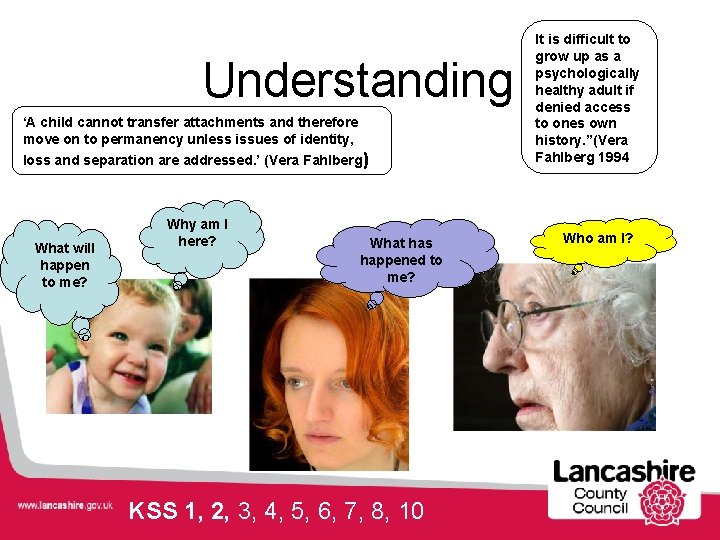
Understanding ‘A child cannot transfer attachments and therefore move on to permanency unless issues of identity, loss and separation are addressed. ’ (Vera Fahlberg) What will happen to me? Why am I here? What has happened to me? KSS 1, 2, 3, 4, 5, 6, 7, 8, 10 It is difficult to grow up as a psychologically healthy adult if denied access to ones own history. ”(Vera Fahlberg 1994 Who am I?
Who can write a CPR? • You must be three years post-qualifying experience in child care social work, including direct experience of adoption work • Or be supervised by your manager who needs to have the above. • This needs to be made clear both in the actual CPR and in the submission sheet. KSS 1, 2, 3, 4, 5, 6, 7, 8, 10
Planning writing a CPR • How long does it take to write a CPR? • Who would you approach/involve in getting information/contributions for a CPR? KSS 1, 2, 3, 4, 5, 6, 7, 8, 10
Activity – Amy Part 1 • Consider case? • Draw a time line of carers • What would be your analysis so far? • What is Amy’s Internal Working Model? Part 2 • What further information would you want? • In your groups produce an ecomap showing potential contributors and sources of information to draw upon in completing the CPR. KSS 1, 2, 3, 4, 5, 6, 7, 8, 10
Before you begin… • • • This is not a Court document, avoid copying and pasting from other documents and edit carefully, especially re third party information, use an appropriate ‘tone’ throughout. Explain any abbreviations, jargon, names of services, conditions etc. Write in plain English for a lay person to understand. Siblings must have their own CPR- bespoke to them Bear in mind this report will be read by the adult child, consider words and language and implication. Be sensitive to their feelings and include any positive information about their parents. Ensure the CPR gives the fullest information about the child Don’t generalise e. g. don’t say 'historic concerns' or 'poor home conditions' – explain what you mean. Clarify roles: use full name and title on first usage and then name thereafter. Be consistent in naming people and roles to avoid confusion Chronologies included should consist of key events- not running records or copies of case notes. Key details of the quality of care provided in each placement or family. This will assist with analysis of needs. When describing the child, be as accurate as possible, avoid value laden terms such as ‘adorable/charming’ – include the challenges KSS 1, 2, 3, 4, 5, 6, 7, 8, 10
Requirements • Up to date • Accurate • Balanced • Coherent • Complete KSS 1, 2, 3, 4, 5, 6, 7, 8, 10
Activity What is appropriate content? KSS 1, 2, 3, 4, 5, 6, 7, 8, 10
Legal context Adoption Agency Regulations 2005 - CPR AAR 17 “The CPR is prepared where the Agency considers, in light of all the information it has gathered, that adoption is the preferred option for the child's permanence. The Social Worker who knows the child best should compile the CPR provided they meet the requirements of the restrictions on the AAR 2005” Schedule 1, lists all information required for a CPR • Legal requirement that CPR’s are kept for 100 years. • Adoption and Childrens Act 2002 – Welfare Checklist KSS 1, 2, 3, 4, 5, 6, 7, 8, 10
THE FOLLOWING ARE REGULATORY REQUIREMENTS , this is why we need them recording on the CPR and why the ADM cannot grant a SHOPA decision without them • The IRO must have recorded on LCS that they agree with the plan of adoption • The adoption medical must have been done and you have to have the medical advisors summary. • The guardians views • The genogram must be included • In addition, don’t leave any sections blank. If it's not relevant put N/A • ADM cannot make a decision if any assessments are outstanding KSS 1, 2, 3, 4, 5, 6, 7, 8, 10
Before you start writing the CPR • LCS – refer to CPR LCS guidance for completing a CPR (refer to ‘journey of permanence to adoption flowchart’) KSS 1, 2, 3, 4, 5, 6, 7, 8, 10
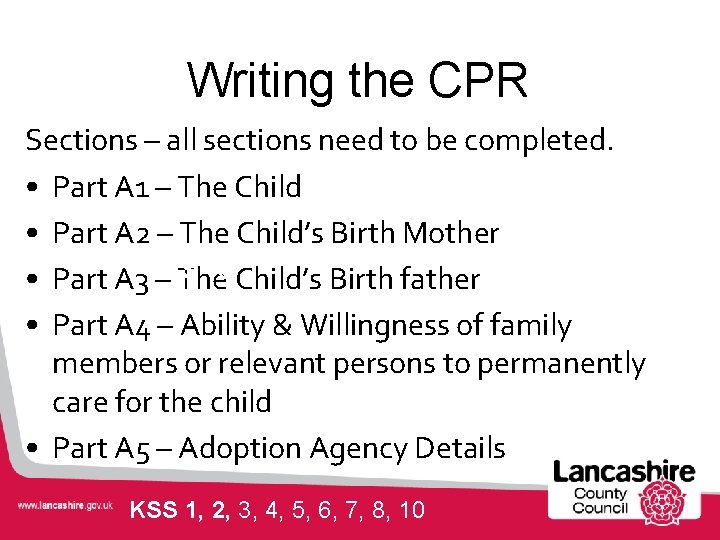
Writing the CPR Sections – all sections need to be completed. • Part A 1 – The Child • Part A 2 – The Child’s Birth Mother 10 Child’s Birth father • Part A 3 KSS – The • Part A 4 – Ability & Willingness of family members or relevant persons to permanently care for the child • Part A 5 – Adoption Agency Details KSS 1, 2, 3, 4, 5, 6, 7, 8, 10
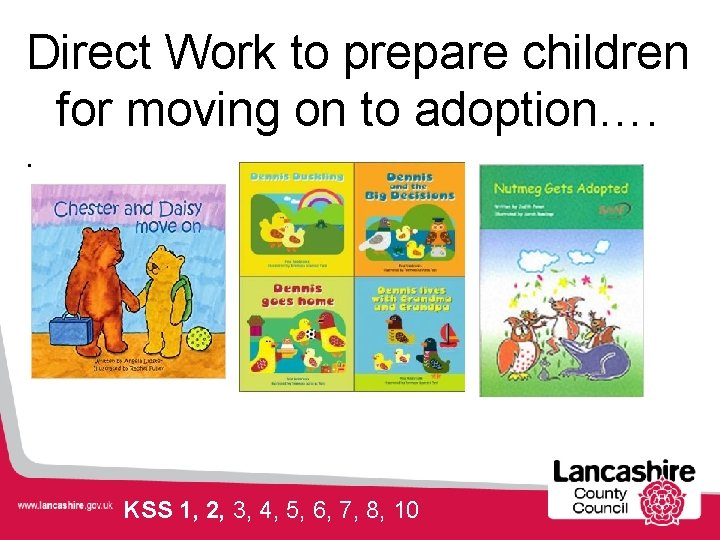
Direct Work to prepare children for moving on to adoption…. . KSS 1, 2, 3, 4, 5, 6, 7, 8, 10
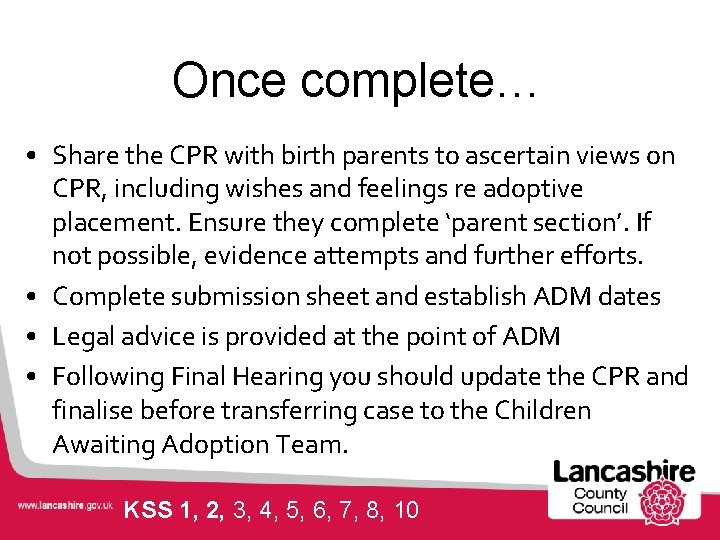
Once complete… • Share the CPR with birth parents to ascertain views on CPR, including wishes and feelings re adoptive placement. Ensure they complete ‘parent section’. If not possible, evidence attempts and further efforts. • Complete submission sheet and establish ADM dates • Legal advice is provided at the point of ADM • Following Final Hearing you should update the CPR and finalise before transferring case to the Children Awaiting Adoption Team. KSS 1, 2, 3, 4, 5, 6, 7, 8, 10
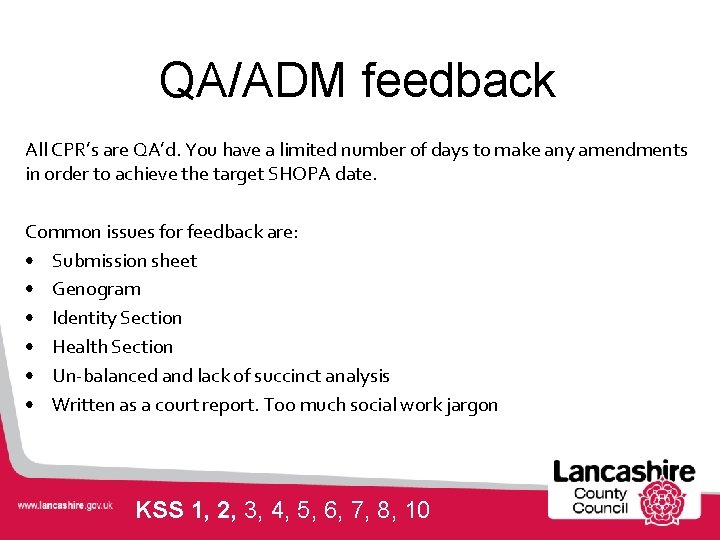
QA/ADM feedback All CPR’s are QA’d. You have a limited number of days to make any amendments in order to achieve the target SHOPA date. Common issues for feedback are: • Submission sheet • Genogram • Identity Section • Health Section • Un-balanced and lack of succinct analysis • Written as a court report. Too much social work jargon KSS 1, 2, 3, 4, 5, 6, 7, 8, 10
The Social Care Context • How would you apply the KSS to this area of practice? • Discuss in groups and prepare to feedback.