
Good Practice in Achieving Best Evidence Interviews with
Good Practice in Achieving Best Evidence Interviews with Children – Criminal Justice Perpsectivess DR LISA BUNTING, LECTURER IN SOCIAL WORK, QUB
Background NSPCC Discussion Move with stakeholders away from deficit approach Multiple ‘users’ of ABE interviews Appreciative Inquiry – focus on what works, in what circumstances, how can we maximise in future
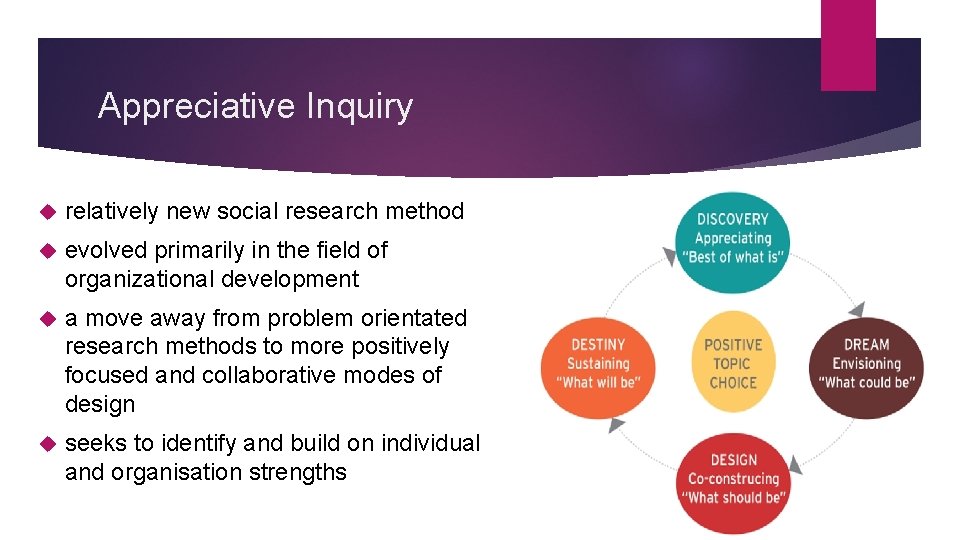
Appreciative Inquiry relatively new social research method evolved primarily in the field of organizational development a move away from problem orientated research methods to more positively focused and collaborative modes of design seeks to identify and build on individual and organisation strengths
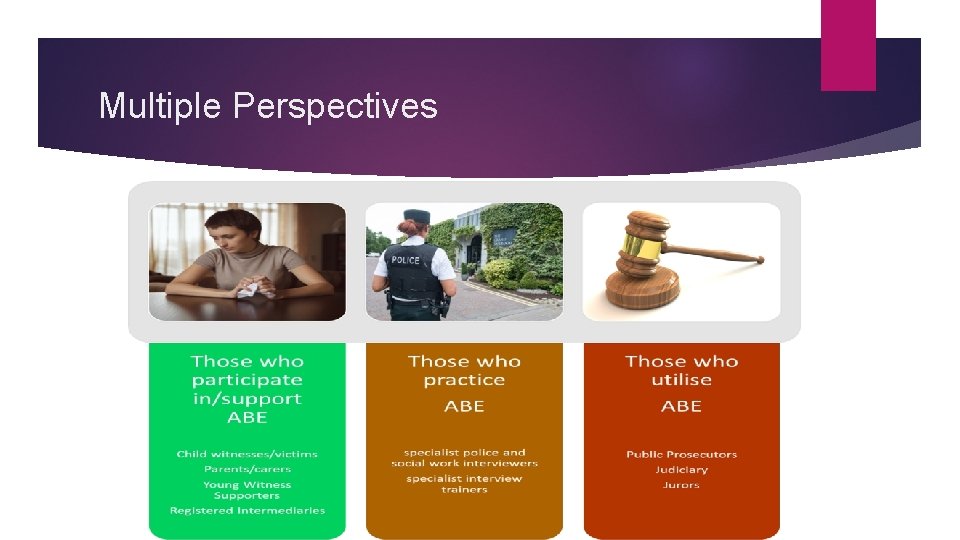
Multiple Perspectives
Aim Identify stakeholder narratives of good ABE practice with child witnesses Investigate the circumstances that lead to good ABE practice Identify how current, policy, guidance, training and organisational systems facilitate good practice Identify different stakeholders ‘vision’ of how current ABE can be developed and maximised Identify relevant research from the national and international literature than can support the development of ABE in NI;
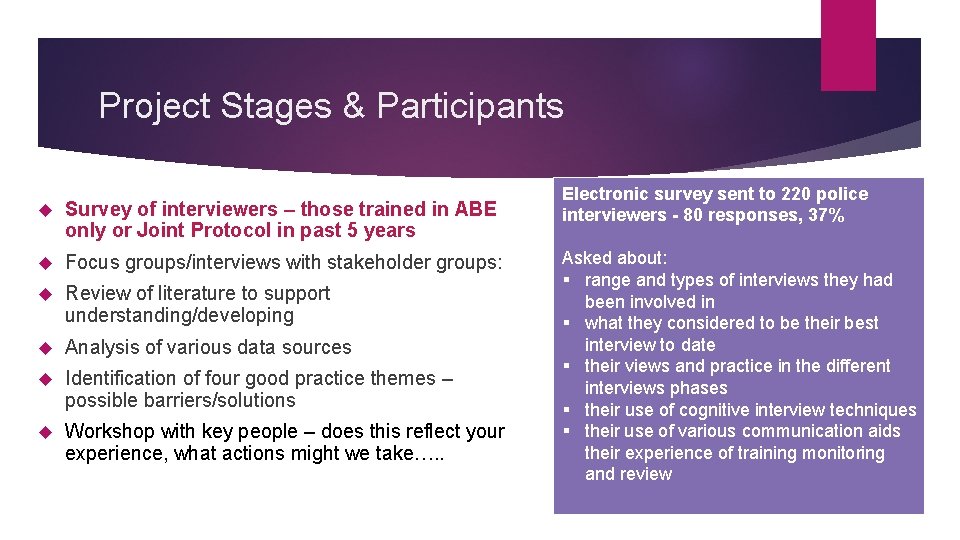
Project Stages & Participants Survey of interviewers – those trained in ABE only or Joint Protocol in past 5 years Focus groups/interviews with stakeholder groups: Review of literature to support understanding/developing Analysis of various data sources Identification of four good practice themes – possible barriers/solutions Workshop with key people – does this reflect your experience, what actions might we take…. . Electronic survey sent to 220 police interviewers - 80 responses, 37% Asked about: § range and types of interviews they had been involved in § what they considered to be their best interview to date § their views and practice in the different interviews phases § their use of cognitive interview techniques § their use of various communication aids their experience of training monitoring and review
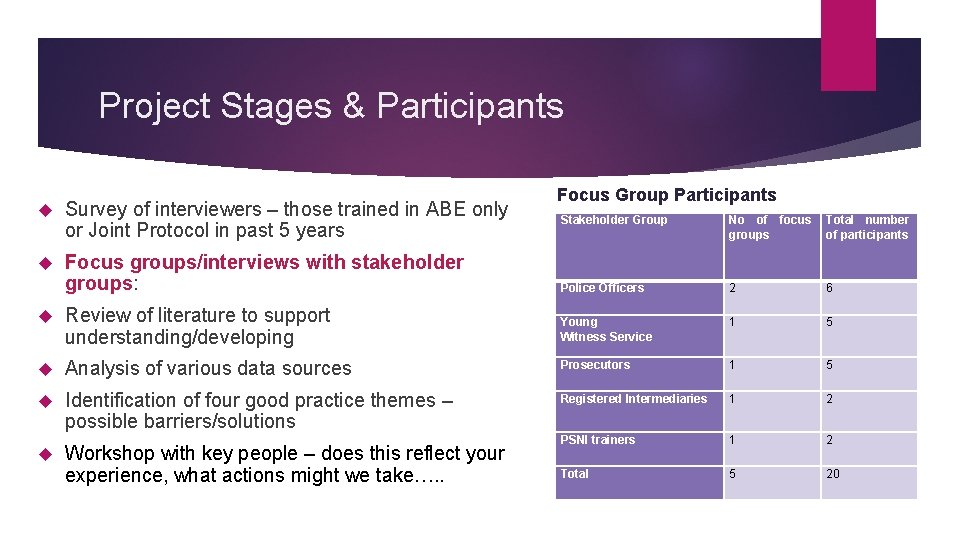
Project Stages & Participants Survey of interviewers – those trained in ABE only or Joint Protocol in past 5 years Focus Group Participants Stakeholder Group No of focus groups Total number of participants Focus groups/interviews with stakeholder groups: Police Officers 2 6 Review of literature to support understanding/developing Young Witness Service 1 5 Analysis of various data sources Prosecutors 1 5 Identification of four good practice themes – possible barriers/solutions Registered Intermediaries 1 2 Workshop with key people – does this reflect your experience, what actions might we take…. . PSNI trainers 1 2 Total 5 20
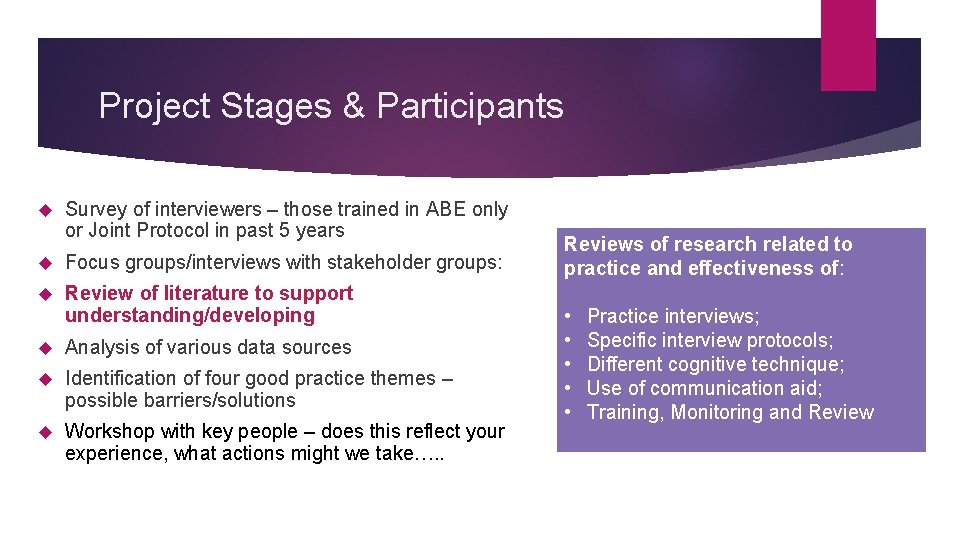
Project Stages & Participants Survey of interviewers – those trained in ABE only or Joint Protocol in past 5 years Focus groups/interviews with stakeholder groups: Review of literature to support understanding/developing Analysis of various data sources Identification of four good practice themes – possible barriers/solutions Workshop with key people – does this reflect your experience, what actions might we take…. . Reviews of research related to practice and effectiveness of: • • • Practice interviews; Specific interview protocols; Different cognitive technique; Use of communication aid; Training, Monitoring and Review
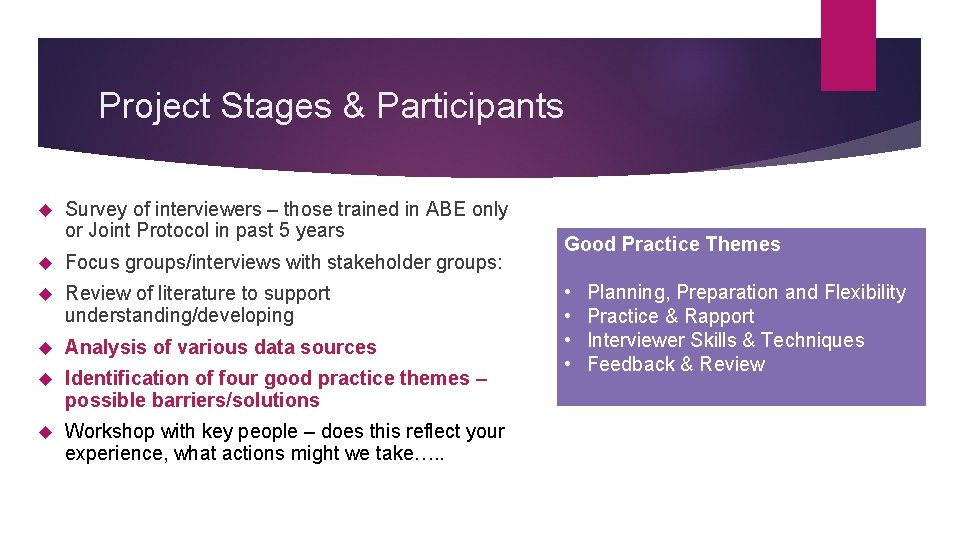
Project Stages & Participants Survey of interviewers – those trained in ABE only or Joint Protocol in past 5 years Focus groups/interviews with stakeholder groups: Review of literature to support understanding/developing Analysis of various data sources Identification of four good practice themes – possible barriers/solutions Workshop with key people – does this reflect your experience, what actions might we take…. . Good Practice Themes • • Planning, Preparation and Flexibility Practice & Rapport Interviewer Skills & Techniques Feedback & Review
Project Stages & Participants Survey of interviewers – those trained in ABE only or Joint Protocol in past 5 years Focus groups/interviews with stakeholder groups: Review of literature to support understanding/developing Analysis of various data sources Identification of four good practice themes – possible barriers/solutions Workshop with key people – does this reflect your experience, what actions might we take…. .
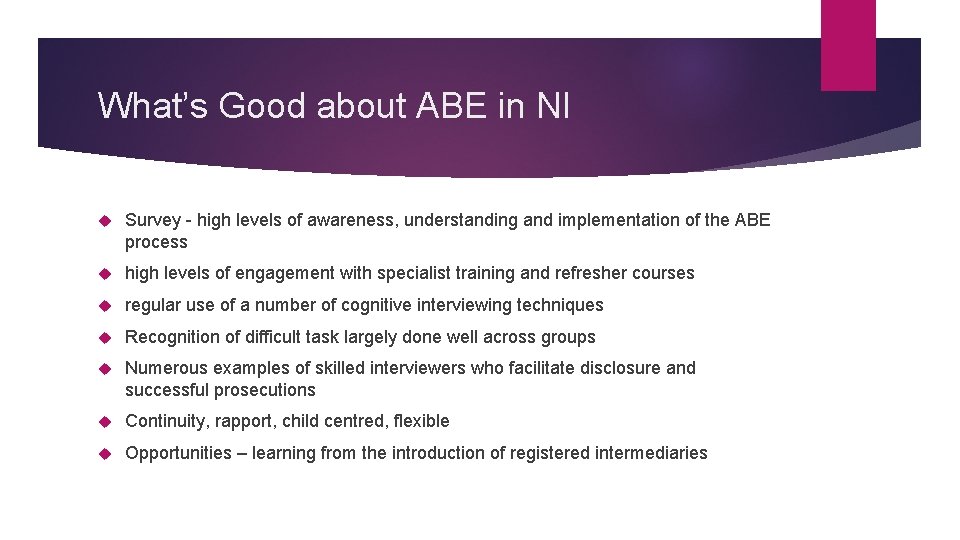
What’s Good about ABE in NI Survey - high levels of awareness, understanding and implementation of the ABE process high levels of engagement with specialist training and refresher courses regular use of a number of cognitive interviewing techniques Recognition of difficult task largely done well across groups Numerous examples of skilled interviewers who facilitate disclosure and successful prosecutions Continuity, rapport, child centred, flexible Opportunities – learning from the introduction of registered intermediaries
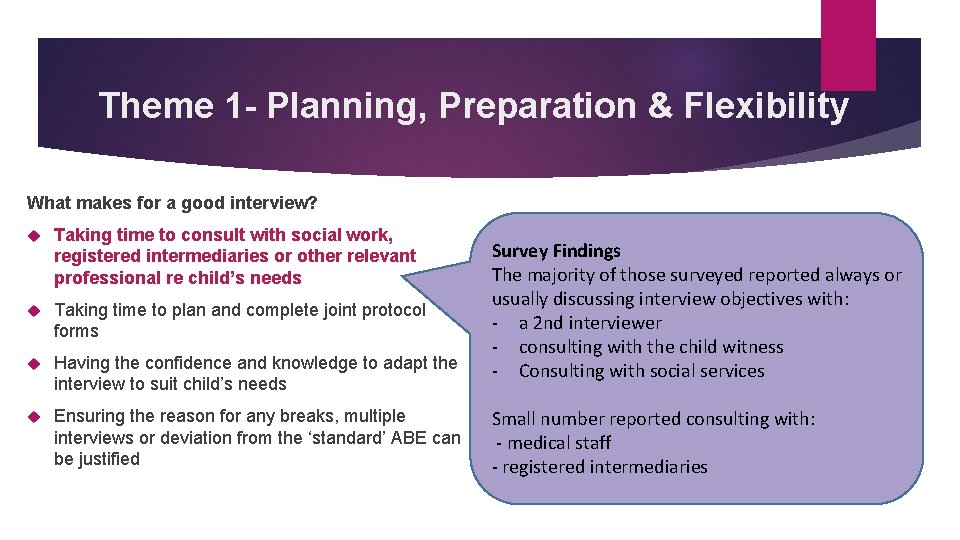
Theme 1 - Planning, Preparation & Flexibility What makes for a good interview? Taking time to consult with social work, registered intermediaries or other relevant professional re child’s needs Taking time to plan and complete joint protocol forms Having the confidence and knowledge to adapt the interview to suit child’s needs Ensuring the reason for any breaks, multiple interviews or deviation from the ‘standard’ ABE can be justified Survey Findings The majority of those surveyed reported always or usually discussing interview objectives with: - a 2 nd interviewer - consulting with the child witness - Consulting with social services Small number reported consulting with: - medical staff - registered intermediaries
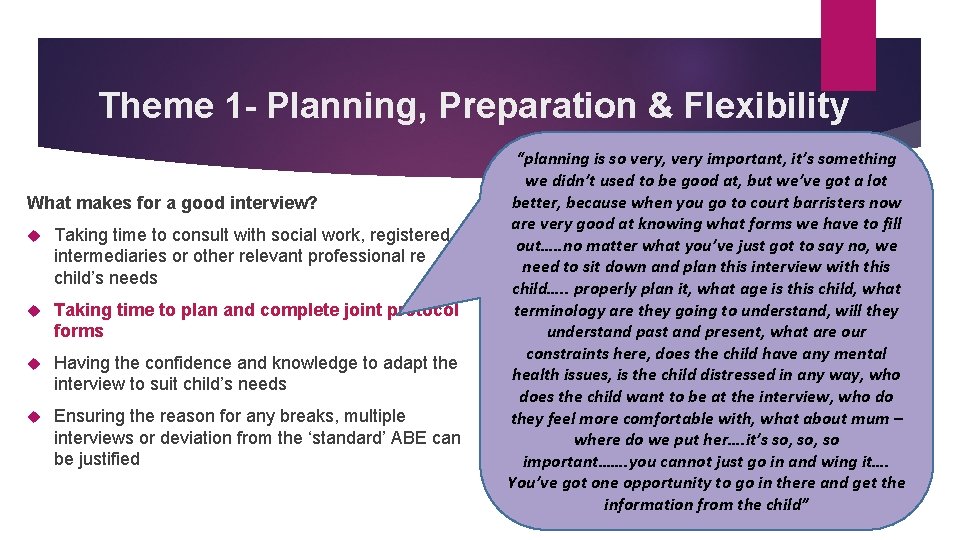
Theme 1 - Planning, Preparation & Flexibility What makes for a good interview? Taking time to consult with social work, registered intermediaries or other relevant professional re child’s needs Taking time to plan and complete joint protocol forms Having the confidence and knowledge to adapt the interview to suit child’s needs Ensuring the reason for any breaks, multiple interviews or deviation from the ‘standard’ ABE can be justified “planning is so very, very important, it’s something we didn’t used to be good at, but we’ve got a lot better, because when you go to court barristers now are very good at knowing what forms we have to fill out…. . no matter what you’ve just got to say no, we need to sit down and plan this interview with this child…. . properly plan it, what age is this child, what terminology are they going to understand, will they understand past and present, what are our constraints here, does the child have any mental health issues, is the child distressed in any way, who does the child want to be at the interview, who do they feel more comfortable with, what about mum – where do we put her…. it’s so, so important……. you cannot just go in and wing it…. You’ve got one opportunity to go in there and get the information from the child”
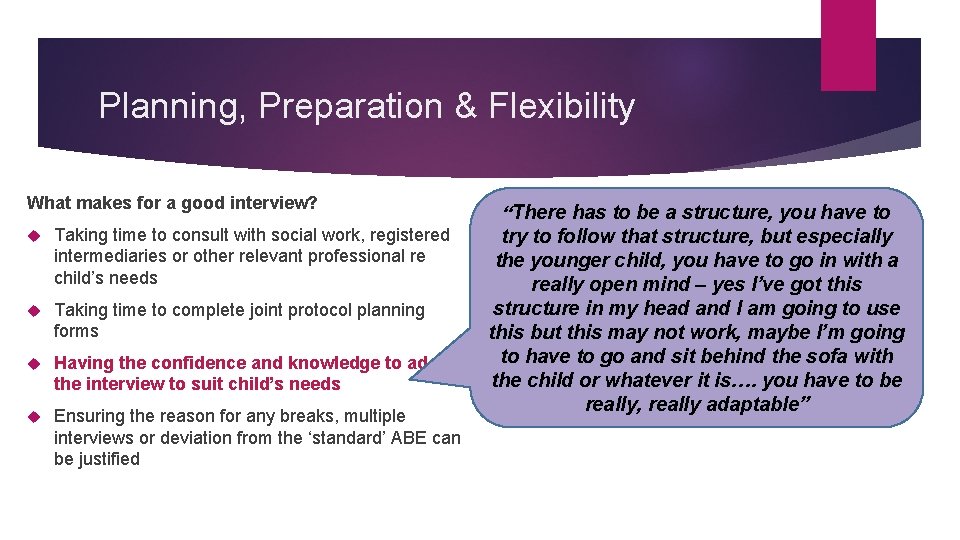
Planning, Preparation & Flexibility What makes for a good interview? Taking time to consult with social work, registered intermediaries or other relevant professional re child’s needs Taking time to complete joint protocol planning forms Having the confidence and knowledge to adapt the interview to suit child’s needs Ensuring the reason for any breaks, multiple interviews or deviation from the ‘standard’ ABE can be justified “There has to be a structure, you have to try to follow that structure, but especially the younger child, you have to go in with a really open mind – yes I’ve got this structure in my head and I am going to use this but this may not work, maybe I’m going to have to go and sit behind the sofa with the child or whatever it is…. you have to be really, really adaptable”
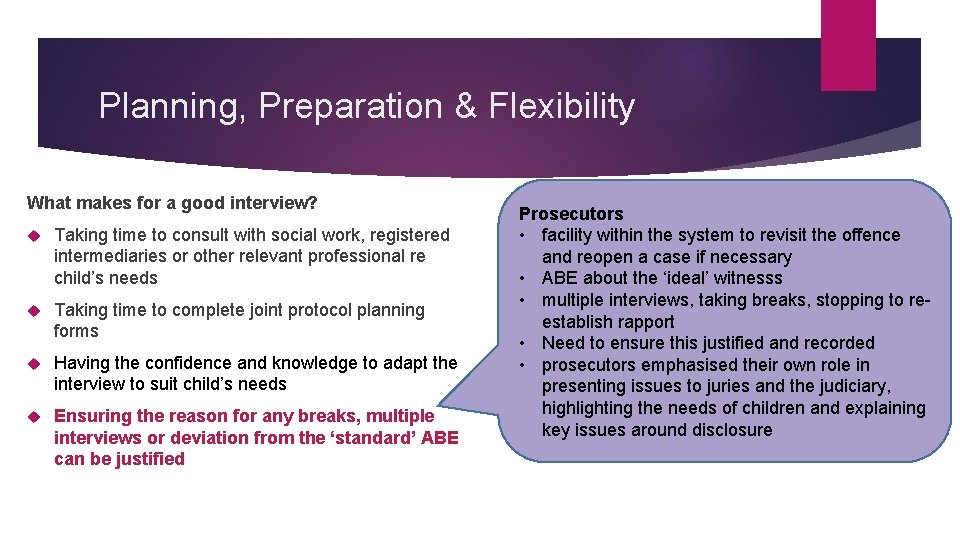
Planning, Preparation & Flexibility What makes for a good interview? Taking time to consult with social work, registered intermediaries or other relevant professional re child’s needs Taking time to complete joint protocol planning forms Having the confidence and knowledge to adapt the interview to suit child’s needs Ensuring the reason for any breaks, multiple interviews or deviation from the ‘standard’ ABE can be justified Prosecutors • facility within the system to revisit the offence and reopen a case if necessary • ABE about the ‘ideal’ witnesss • multiple interviews, taking breaks, stopping to reestablish rapport • Need to ensure this justified and recorded • prosecutors emphasised their own role in presenting issues to juries and the judiciary, highlighting the needs of children and explaining key issues around disclosure
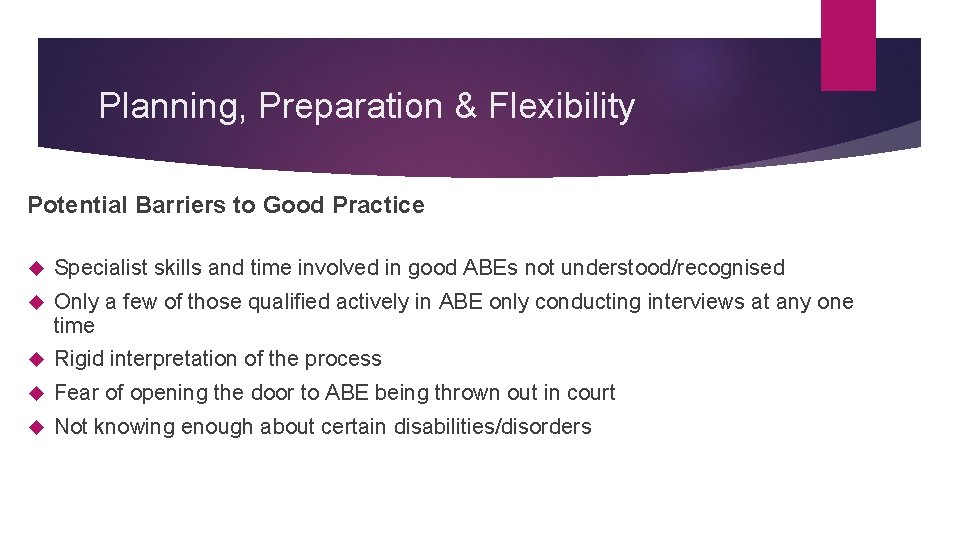
Planning, Preparation & Flexibility Potential Barriers to Good Practice Specialist skills and time involved in good ABEs not understood/recognised Only a few of those qualified actively in ABE only conducting interviews at any one time Rigid interpretation of the process Fear of opening the door to ABE being thrown out in court Not knowing enough about certain disabilities/disorders
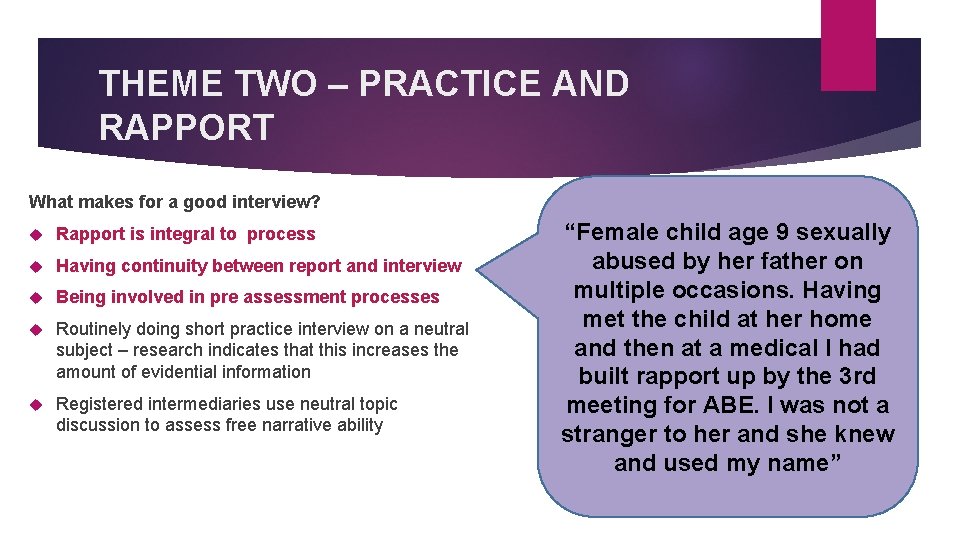
THEME TWO – PRACTICE AND RAPPORT What makes for a good interview? Rapport is integral to process Having continuity between report and interview Being involved in pre assessment processes Routinely doing short practice interview on a neutral subject – research indicates that this increases the amount of evidential information Registered intermediaries use neutral topic discussion to assess free narrative ability “Female child age 9 sexually abused by her father on multiple occasions. Having met the child at her home and then at a medical I had built rapport up by the 3 rd meeting for ABE. I was not a stranger to her and she knew and used my name”
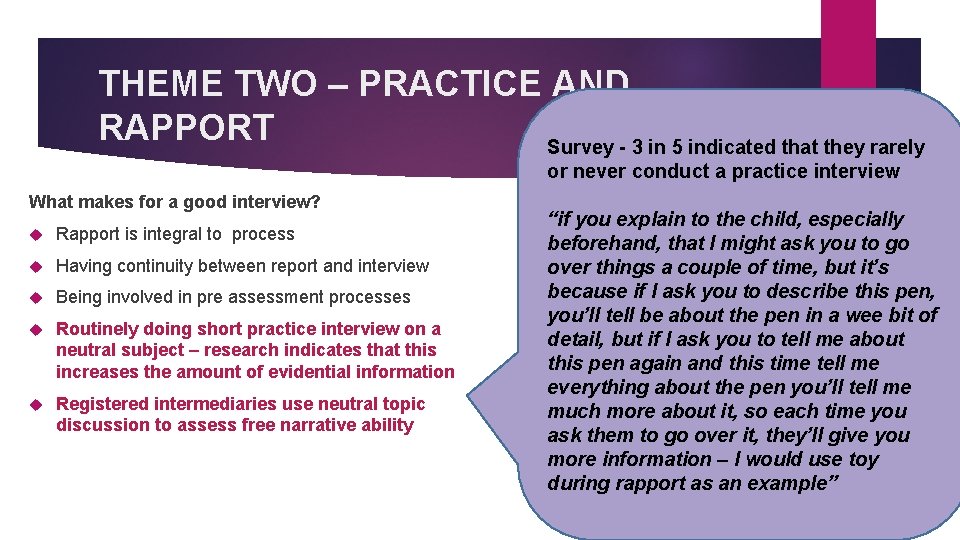
THEME TWO – PRACTICE AND RAPPORT Survey - 3 in 5 indicated that they rarely or never conduct a practice interview What makes for a good interview? Rapport is integral to process Having continuity between report and interview Being involved in pre assessment processes Routinely doing short practice interview on a neutral subject – research indicates that this increases the amount of evidential information Registered intermediaries use neutral topic discussion to assess free narrative ability “if you explain to the child, especially beforehand, that I might ask you to go over things a couple of time, but it’s because if I ask you to describe this pen, you’ll tell be about the pen in a wee bit of detail, but if I ask you to tell me about this pen again and this time tell me everything about the pen you’ll tell me much more about it, so each time you ask them to go over it, they’ll give you more information – I would use toy during rapport as an example”
THEME TWO – PRACTICE AND RAPPORT Potential Barriers to Good Practice Worrying that a practice interview may be perceived as coaching Not having time to do a ‘practice’ interview or understanding potential benefits System makes continuity difficult Not having time to build rapport
THEME 3 -INTERVIEWER SKILLS AND TECHNIQUES What makes for a good interview? Giving a child a number of opportunities to go through free narrative before moving to specific questions Using techniques like mental reinstatement of context as routine practice Using specific interview protocols to increase the level of free narrative Using child friendly techniques such as drawing to engage the child and provide visual triggers “you’ve big free narrative ‘tell me everything’, a couple of times over that and then, kids like you to break it down into sections –I tell them it’s like a jigsaw puzzle, I going to pull this bit out and tell me everything about that, out it back in and then pull another bit out and tell me everything about that bit and out it back and then at the end I’ll have a nice big picture of what happened, and kids like that”
THEME 3 -INTERVIEWER SKILLS AND TECHNIQUES What makes for a good interview? Giving a child a number of opportunities to go through free narrative before moving to specific questions Using techniques like mental reinstatement of context as routine practice Using specific interview protocols to increase the level of free narrative Using child friendly techniques such as drawing to engage the child and provide visual triggers Registered Intermediaries • limits of free narrative for very young children or those with significant learning or other disabilities • a simple instruction to ‘tell me everything about that’ would often only generate unfocused dialogue which would have no evidential relevance • Needed help to structure and sequence their story
THEME 3 -INTERVIEWER SKILLS AND TECHNIQUES What makes for a good interview? Giving a child a number of opportunities to go through free narrative before moving to specific questions Using techniques like mental reinstatement of context as routine practice Using specific interview protocols to increase the level of free narrative Using child friendly techniques such as drawing to engage the child and provide visual triggers What is mental reinstatement of context? It is one of a number of enhanced cognitive techniques. The context reinstatement instruction asks witnesses to reconstruct in their minds the context, both physical (environmental) and internal (i. e. how they felt at the time), of the witnessed event. Research Evidence numerous studies highlight MRC as a key component of improving the quality of information obtained in interviews
THEME 3 -INTERVIEWER SKILLS AND Survey Findings TECHNIQUES - mental reinstatement of context was What makes for a good interview? Giving a child a number of opportunities to go through free narrative before moving to specific questions Using techniques like mental reinstatement of context as routine practice Using specific interview protocols to increase the level of free narrative Using child friendly techniques such as drawing to engage the child and provide visual triggers one of the most frequently used cognitive techniques - only 2 in 5 reported always or usually using it “I will ask them if they can remember any smells, sounds or visuals and get them to describe the room or location. By taking them on a “tour” of the room / location this too has the effect of placing them back there and helps evoke memories. I try to use pauses but find that these usually work better with adults and teenagers as opposed to young children. ”
THEME 3 -INTERVIEWER SKILLS AND TECHNIQUES What makes for a good interview? Giving a child a number of opportunities to go through free narrative before moving to specific questions Using techniques like mental reinstatement of context as routine practice Using specific interview protocols to increase the level of free narrative Using child friendly techniques such as drawing to engage the child and provide visual triggers Research Evidence The NICHD Protocol was developed by group of researchers at the National Institute of Child Health and Human Development There is a wealth of evidence to suggest that using the NICHD: - improves the quantity and quality information - increases the likelihood of prosecution and conviction.
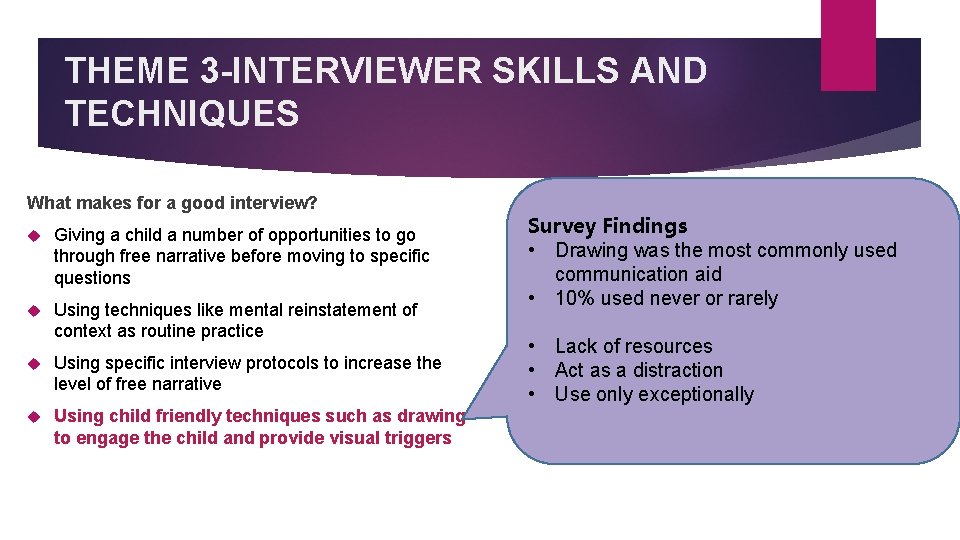
THEME 3 -INTERVIEWER SKILLS AND TECHNIQUES What makes for a good interview? Giving a child a number of opportunities to go through free narrative before moving to specific questions Using techniques like mental reinstatement of context as routine practice Using specific interview protocols to increase the level of free narrative Using child friendly techniques such as drawing to engage the child and provide visual triggers Survey Findings • Drawing was the most commonly used communication aid • 10% used never or rarely • Lack of resources • Act as a distraction • Use only exceptionally
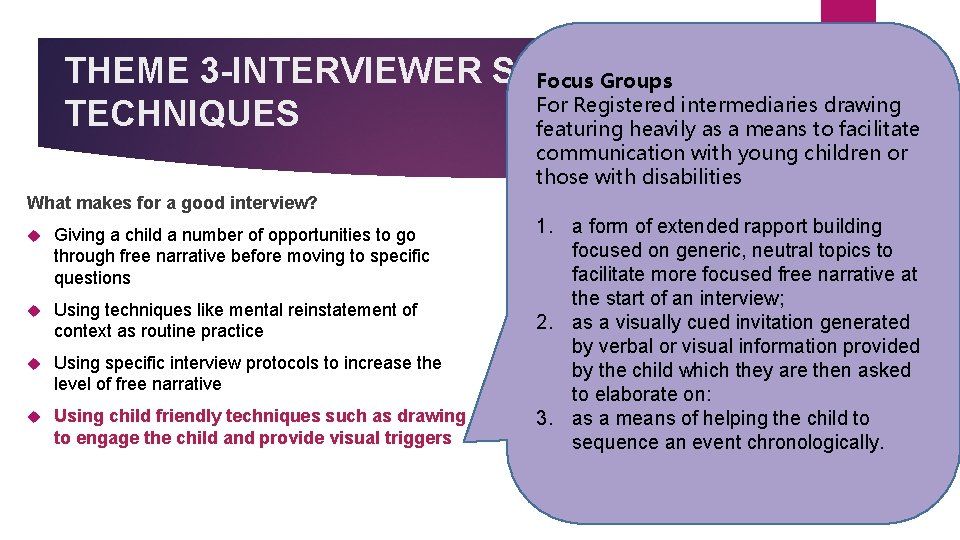
THEME 3 -INTERVIEWER SKILLS AND Focus Groups For Registered intermediaries drawing TECHNIQUES featuring heavily as a means to facilitate communication with young children or those with disabilities What makes for a good interview? Giving a child a number of opportunities to go through free narrative before moving to specific questions Using techniques like mental reinstatement of context as routine practice Using specific interview protocols to increase the level of free narrative Using child friendly techniques such as drawing to engage the child and provide visual triggers 1. a form of extended rapport building focused on generic, neutral topics to facilitate more focused free narrative at the start of an interview; 2. as a visually cued invitation generated by verbal or visual information provided by the child which they are then asked to elaborate on: 3. as a means of helping the child to sequence an event chronologically.
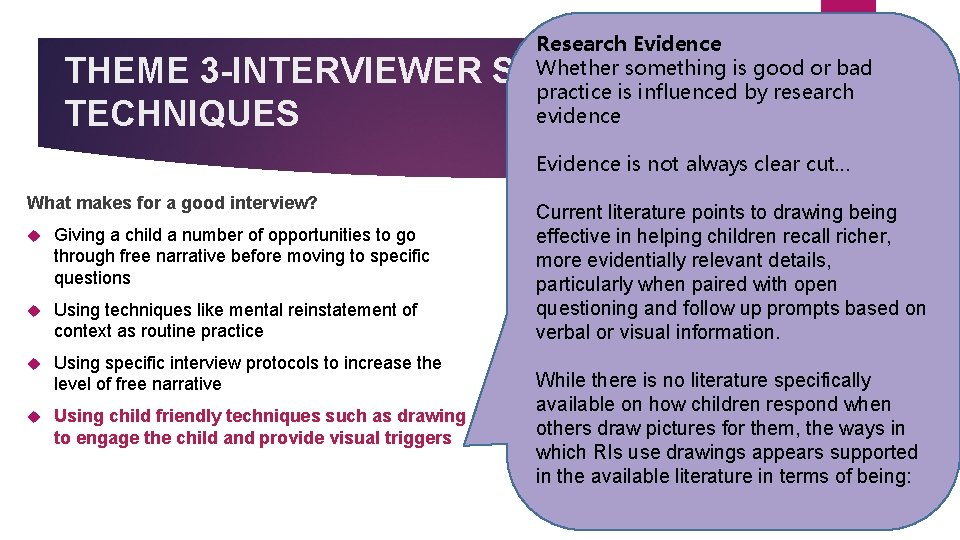
Research Evidence Whether something is good or bad practice is influenced by research evidence THEME 3 -INTERVIEWER SKILLS AND TECHNIQUES Evidence is not always clear cut… What makes for a good interview? Giving a child a number of opportunities to go through free narrative before moving to specific questions Using techniques like mental reinstatement of context as routine practice Using specific interview protocols to increase the level of free narrative Using child friendly techniques such as drawing to engage the child and provide visual triggers Current literature points to drawing being effective in helping children recall richer, more evidentially relevant details, particularly when paired with open questioning and follow up prompts based on verbal or visual information. While there is no literature specifically available on how children respond when others draw pictures for them, the ways in which RIs use drawings appears supported in the available literature in terms of being:
THEME 3 -INTERVIEWER SKILLS AND TECHNIQUES Potential Barriers to Good Practice Concern about evidential requirements may push interviewers from free narrative to specific questions Not feeling comfortable using techniques like MRC Not understanding why MRC can be effective and how memory can be triggered by its use No agreed use of a specific protocol such as the NICHD in NI Lack of knowledge about how and when to use drawing Concerns about what is ‘allowed’ in the formal interview
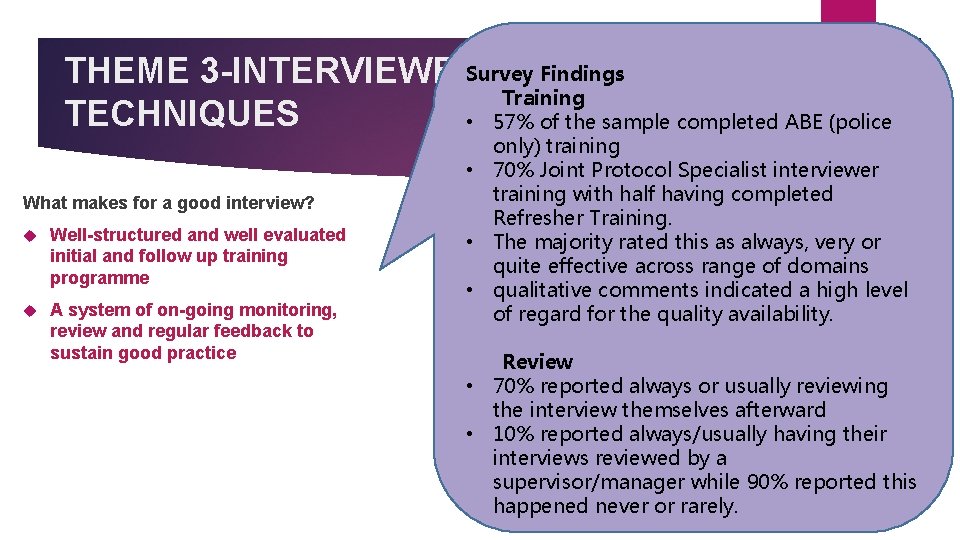
Findings AND THEME 3 -INTERVIEWERSurvey SKILLS Training TECHNIQUES • 57% of the sample completed ABE (police What makes for a good interview? Well-structured and well evaluated initial and follow up training programme A system of on-going monitoring, review and regular feedback to sustain good practice only) training • 70% Joint Protocol Specialist interviewer training with half having completed Refresher Training. • The majority rated this as always, very or quite effective across range of domains • qualitative comments indicated a high level of regard for the quality availability. Review • 70% reported always or usually reviewing the interview themselves afterward • 10% reported always/usually having their interviews reviewed by a supervisor/manager while 90% reported this happened never or rarely.
THEME 4 - FEEDBACK AND REVIEW What makes for a good interview? Well-structured and well evaluated initial and follow up training programme A system of on-going monitoring, review and regular feedback to sustain good practice Research Evidence Research consistently shows that training alone is not enough and continuous review and feedback is needed to develop and sustain good practice. When supervision is removed practice slips…
THEME 4 - FEEDBACK AND REVIEW Potential Barriers to Good Practice A lack of an on-going monitoring and review process Those supervising may not have skills to evaluate Not everyone who completes ABE only training puts their learning into practice Lack of a process to share good practice amongst interviewers Lack of a process to share good practice amongst stakeholders
What next – developing actions Consider themes, potential barriers and ways delivery might be enhanced: - Individually across themes - (20 mins) - As part of a multi-disciplinary group focused on a specific theme - (30 mins) - Consideration of other issues (or an alternate theme) - (15 mins) Does this reflect your views experiences? What would you add/change? What actions can be taken? Theme group feedback Use feedback and proformas to draw up an action plan
- Slides: 32