
Good Morning Vesiculo Bullous Lesions Group of disorder

Good Morning

Vesiculo Bullous Lesions Group of disorder in which the primary lesion is a vesicle or a bulla on the skin & mucous membrane.

• Vesicle – elevated blisters filled with clear fluids measuring less than 1 cm in diameter. • Bulla- more than 1 cm in diameter.

• Ulcer – break in the continuity of the epithelium due to micromolecular necrosis of the tissue. • Erosion-- – break in the continuity of the epithelium with intact basal membrane.
Classification According to the causes it is classified as • (a) result of viral infection • (b) allergic &hyper sensitive reaction • (c) auto immune disorder • (d)miscellaneous lesions like osmf
Herpetic group of infection There are seven herpes viruses that causes infection in humans. • herpes simplex type 1 and 2 • • • Vericella zoster –chicken pox and herpes zoster Cytomegalo virus Human herpes type 6 Human herpes type 8—kaposi sarcoma Epstein bar virus—infectious mononucleosis, hairy leukoplakia, Burkett's lymphoma.
Herpes simplex infection • Caused by herpes simplex virus—DNA virus. • Has a property of establishing life long persistent infection in the host & to undergo periodic reactivation • They occur in 2 forms –primary &secondary. • Physical contact with an infected person/direct muco-cutaneous contact with infected secretion.
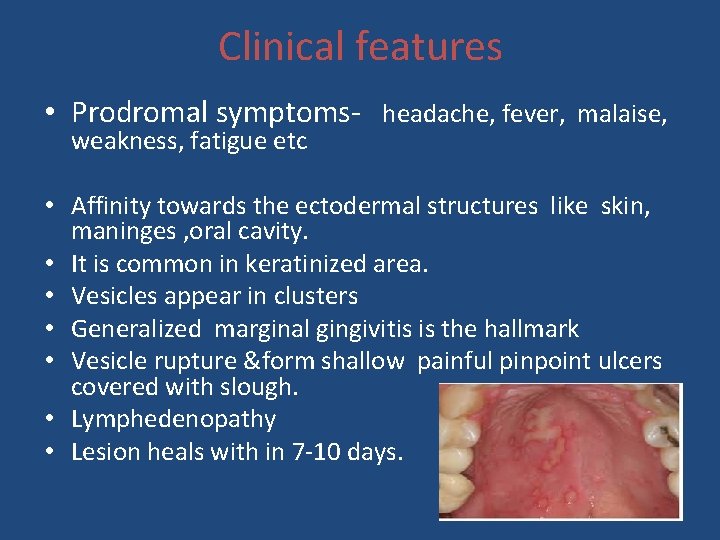
Clinical features • Prodromal symptoms- headache, fever, malaise, weakness, fatigue etc • Affinity towards the ectodermal structures like skin, maninges , oral cavity. • It is common in keratinized area. • Vesicles appear in clusters • Generalized marginal gingivitis is the hallmark • Vesicle rupture &form shallow painful pinpoint ulcers covered with slough. • Lymphedenopathy • Lesion heals with in 7 -10 days.
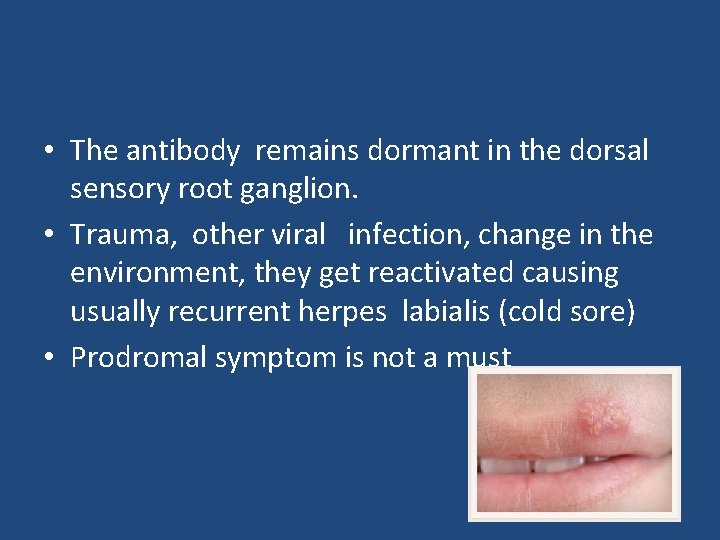
• The antibody remains dormant in the dorsal sensory root ganglion. • Trauma, other viral infection, change in the environment, they get reactivated causing usually recurrent herpes labialis (cold sore) • Prodromal symptom is not a must
Diagnosis • Cytology-fresh vesicle is scraped &look for balloning degeneration of the nucleus(cells swell because of collection of verions) and also Lipschutz bodies are seen. • Antibody titre
Treatment • Symptomatic treatment – anti-inflammatory &antipyretic agents like ibuprofen and paracetamol tablets • B complex tablets • Analgesic antiseptic and anesthetic mouthwash • Specific-acyclovir tabs • Corticosteroids are contra indicated
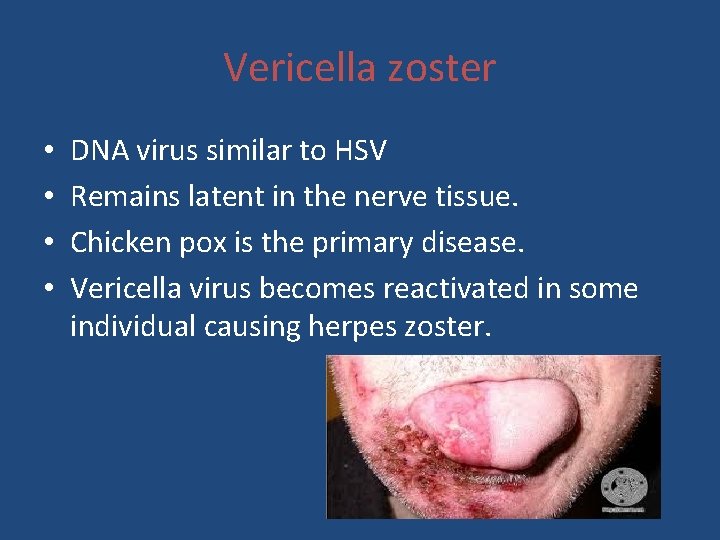
Vericella zoster • • DNA virus similar to HSV Remains latent in the nerve tissue. Chicken pox is the primary disease. Vericella virus becomes reactivated in some individual causing herpes zoster.
Clinical feature • Prodromal symptoms-severe pain- burning , tingling, itching, pricking type. • Unilateral vesicle appears in clusters along the course of the nerve • Vesicle becomes scales later and lesion heals in 2 -3 weeks. • Trigeminal nerve --1 st division -most commonly affected
Complication • Post herpetic neuralgia—caused by inflammation &fibrosis of the affected nerve &may cause severe pain at the site years after the skin lesions have healed.
Diagnosis • History • Clinical feature • Cytology – acantholysis of cells occur hence Tzank test is positive and free floating Tzank cells with nuclear margination of chromatin seen
Treatment • Symptomatic • Specific • Pt over 60 yrs corticosteroids should be given to prevent/ minimise the occurrence of post herpetic neuralgia. • Chicken pox vaccination
• Vericella zoster infection of geniculate ganglion results in –Ramsay hunt syndrome • Bells palsy • 8 th nerve deafness • Herpes zoster of the maxillary &mandibular branch of trigiminal nerve.
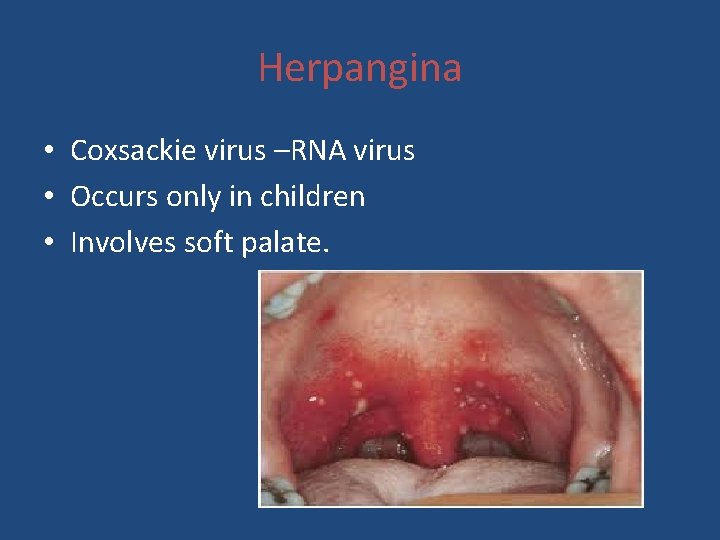
Herpangina • Coxsackie virus –RNA virus • Occurs only in children • Involves soft palate.
- Slides: 18