
Good Morning Lebanon Eli Ghazel Feb 2015 2

& Good Morning, Lebanon Eli Ghazel Feb 2015 2

www. eupad. net www. munjez. com www. 21 caf. org Eli Ghazel eli@eupad. net +971559221588 Eli Ghazel Feb 2015 3

In the next 20 years, 9 out 10 of the jobs we know today will become obsolete! Eli Ghazel Feb 2015 4

In the next 6 years, (by 2020), a 3 rd grader will enter high school a 6 th grader will go into university a 12 th grader will enter the job market Eli Ghazel Feb 2015 5

How is your educational institute preparing today’s children for the future? Eli Ghazel Feb 2015 6
There are three major questions that need to be asked and continuously seek answers for: Eli Ghazel Feb 2015 7
What do we want our children to learn? What are the best ways to help them learn? How do we know that they have learned? Eli Ghazel Feb 2015 8

Content of textbooks and websites can only give us data & information Information Data What is this? 95 Eli Ghazel Feb 2015 9
What is KNOWLEDGE? Knowledge cannot be stored anywhere except in the brain. Eli Ghazel Feb 2015 10
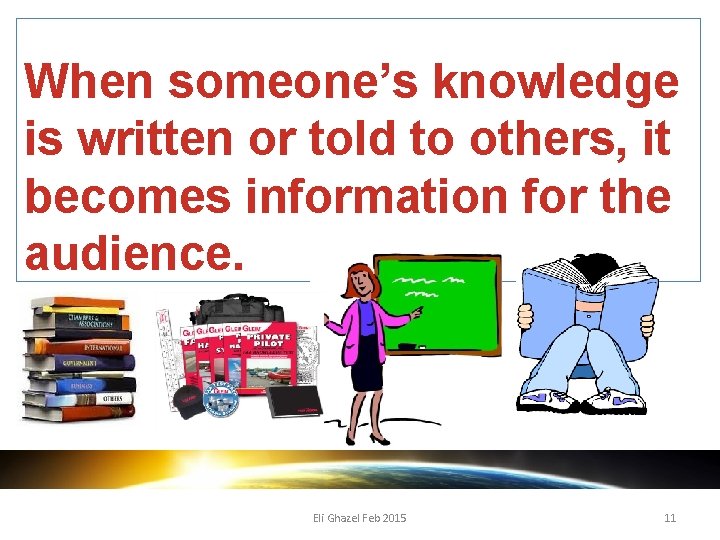
When someone’s knowledge is written or told to others, it becomes information for the audience. Eli Ghazel Feb 2015 11
• a series of planned or What is LEARNING? ‘accidental’ experiences that help persons • convert information and data from multiple sources into knowledge that • can be applied in new situations. Eli Ghazel Feb 2015 12
Who are WE? What do we do and what are the consequences of our actions in the classroom? Eli Ghazel Feb 2015 13
Who are WE? If we talk, show, explain, and provide examples, then we are only exposing our children to information. Eli Ghazel Feb 2015 14
Who are WE? Information is everywhere and readily accessible. It is no longer the prerogative of a few ‘teachers’. Eli Ghazel Feb 2015 15
What is our role? We are no longer ‘teachers’. We are LEARNING DESIGNERS. Eli Ghazel Feb 2015 16
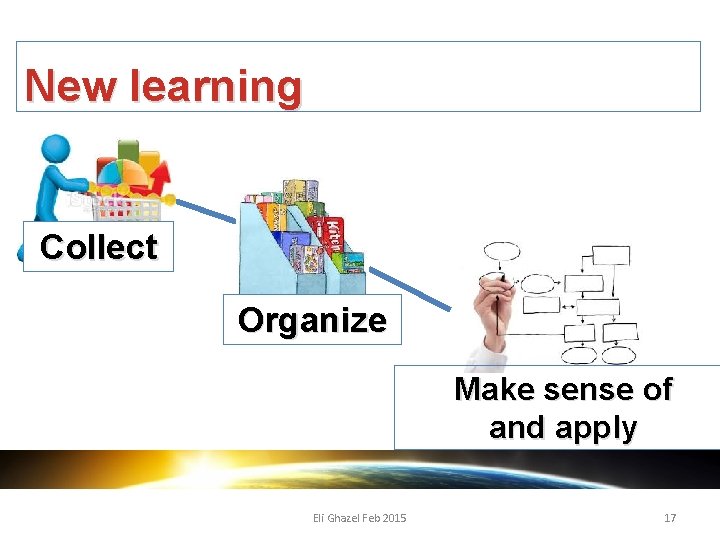
New learning Collect Organize Make sense of and apply Eli Ghazel Feb 2015 17
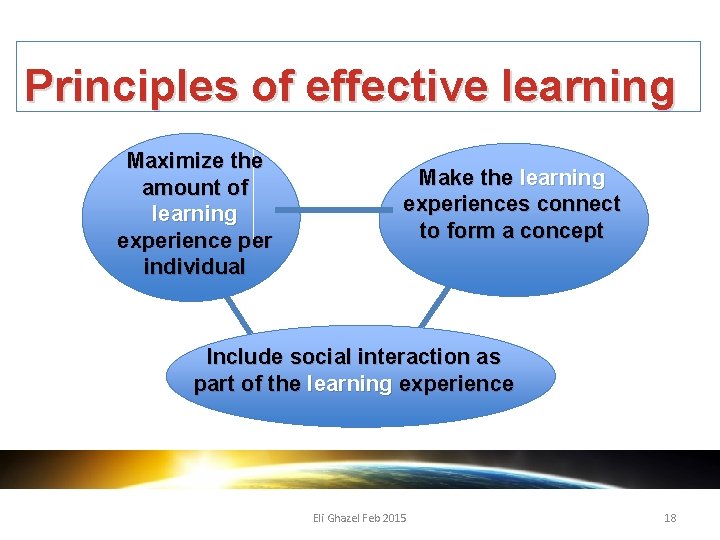
Principles of effective learning Maximize the amount of learning experience per individual Make the learning experiences connect to form a concept Include social interaction as part of the learning experience Eli Ghazel Feb 2015 18
Challenges and Problems in Learning Eli Ghazel Feb 2015 19
Challenges and Problems in Learning The student is bombarded with too much information from multiple subjects every day. Eli Ghazel Feb 2015 20
Challenges and Problems in Learning The student is not helped to develop mental models of organization in order to start making sense of information. (develop knowledge) Eli Ghazel Feb 2015 21
Challenges and Problems in Learning The students’ responses are usually • Test type exercises • Answers to questions • Essays Eli Ghazel Feb 2015 22
Challenges and Problems in Learning The need to develop an experience or a set of experiences in the classroom and at home that help our children learn. Eli Ghazel Feb 2015 23
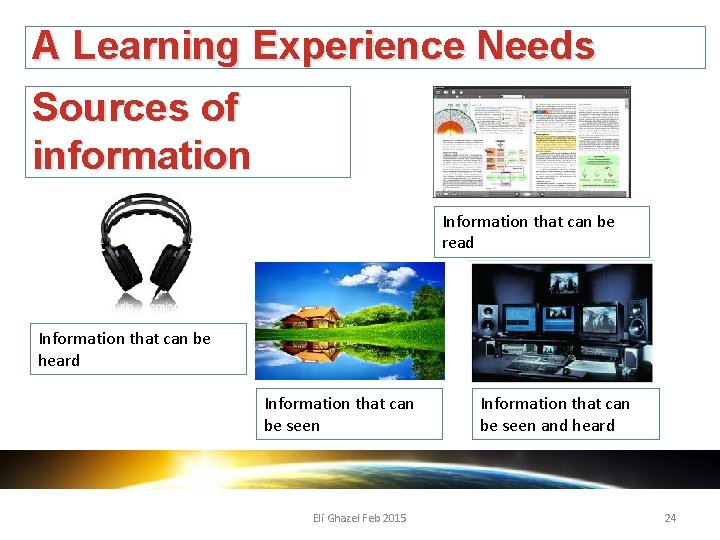
A Learning Experience Needs Sources of information Information that can be read Information that can be heard Information that can be seen Eli Ghazel Feb 2015 Information that can be seen and heard 24
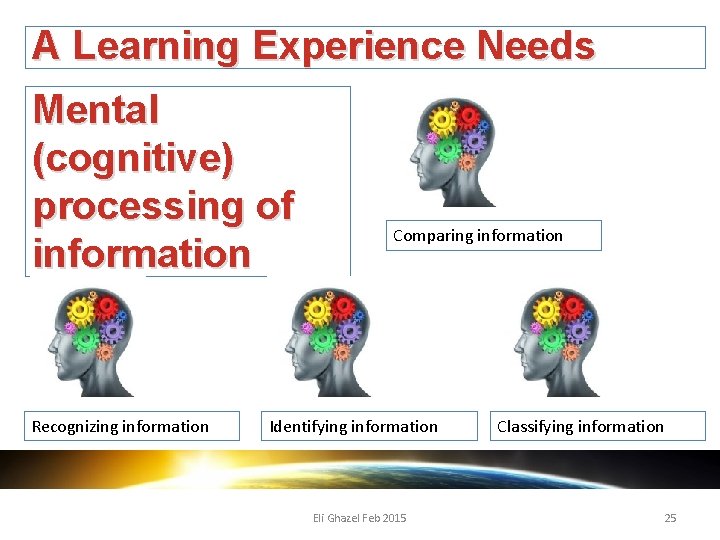
A Learning Experience Needs Mental (cognitive) processing of information Recognizing information Comparing information Identifying information Eli Ghazel Feb 2015 Classifying information 25
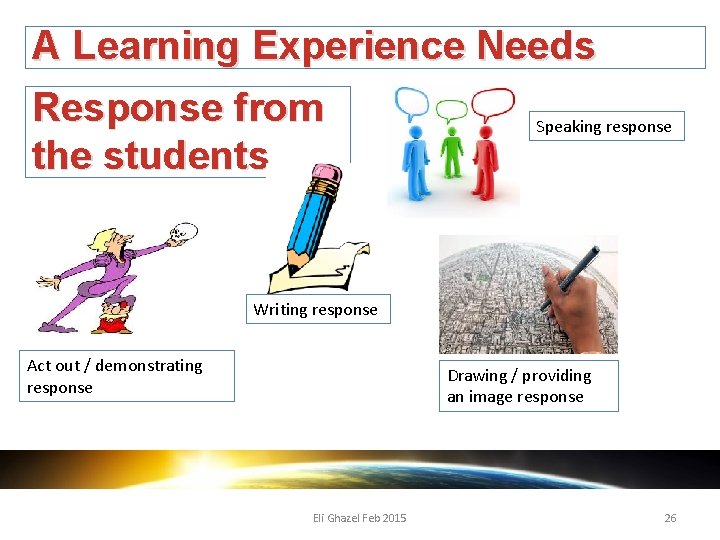
A Learning Experience Needs Response from the students Speaking response Writing response Act out / demonstrating response Drawing / providing an image response Eli Ghazel Feb 2015 26
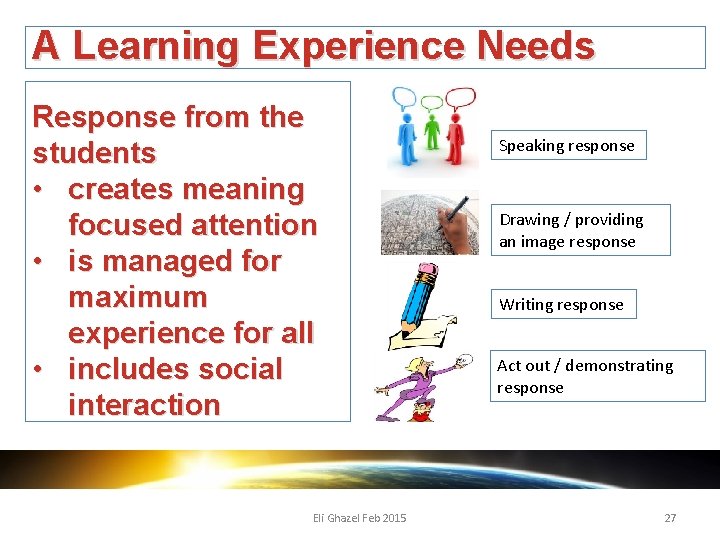
A Learning Experience Needs Response from the students • creates meaning focused attention • is managed for maximum experience for all • includes social interaction Eli Ghazel Feb 2015 Speaking response Drawing / providing an image response Writing response Act out / demonstrating response 27
What are the best ways to help our children learn? Eli Ghazel Feb 2015 28
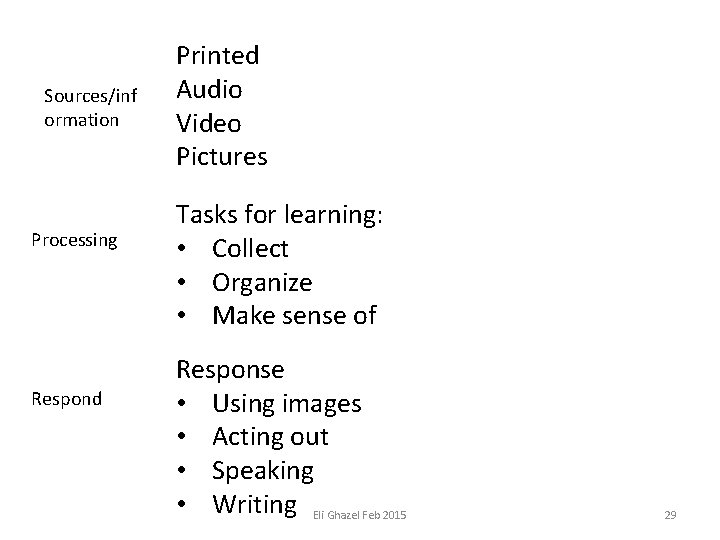
Sources/inf ormation Processing Respond Printed Audio Video Pictures Tasks for learning: • Collect • Organize • Make sense of Response • Using images • Acting out • Speaking • Writing Eli Ghazel Feb 2015 29
A writer is only as good as his mastery of reading skills and strategies Eli Ghazel Feb 2015 30
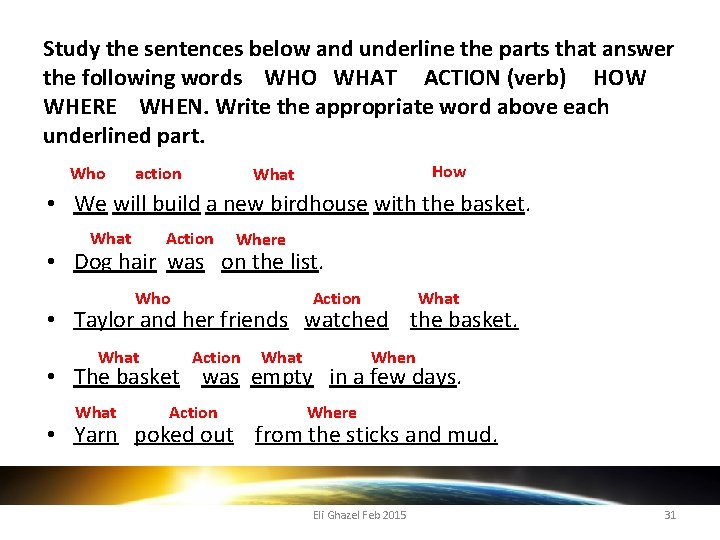
Study the sentences below and underline the parts that answer the following words WHO WHAT ACTION (verb) HOW WHERE WHEN. Write the appropriate word above each underlined part. Who action How What • We will build a new birdhouse with the basket. What Action Where • Dog hair was on the list. Who Action What • Taylor and her friends watched the basket. What Action What When • The basket was empty in a few days. What Action Where • Yarn poked out from the sticks and mud. Eli Ghazel Feb 2015 31
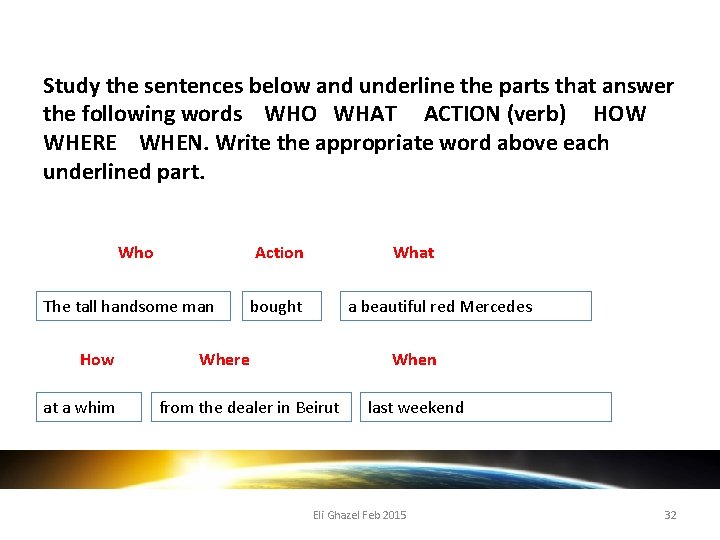
Study the sentences below and underline the parts that answer the following words WHO WHAT ACTION (verb) HOW WHERE WHEN. Write the appropriate word above each underlined part. Who Action What The tall handsome man bought a beautiful red Mercedes How Where When at a whim from the dealer in Beirut last weekend Eli Ghazel Feb 2015 32
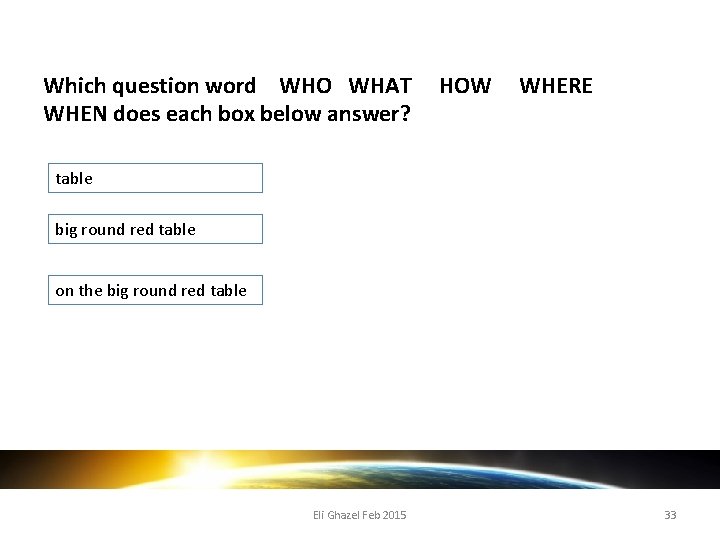
Which question word WHO WHAT HOW WHERE WHEN does each box below answer? table big round red table on the big round red table Eli Ghazel Feb 2015 33
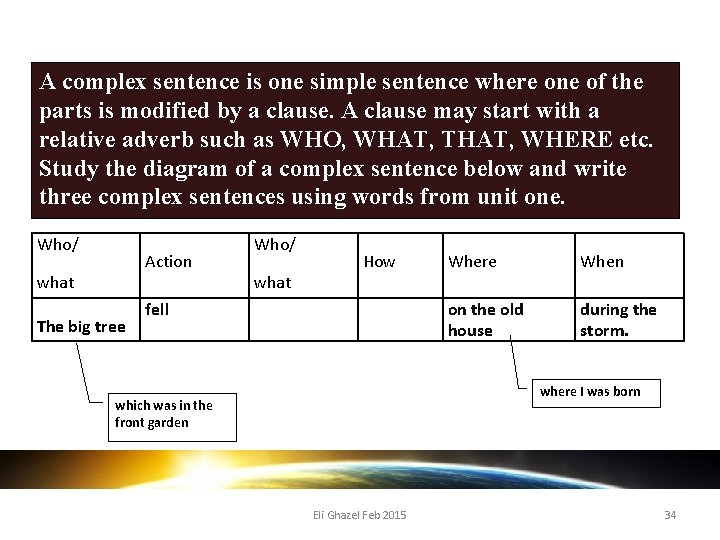
A complex sentence is one simple sentence where one of the parts is modified by a clause. A clause may start with a relative adverb such as WHO, WHAT, THAT, WHERE etc. Study the diagram of a complex sentence below and write three complex sentences using words from unit one. Who/ Action what The big tree Who/ what How fell Where When on the old house during the storm. where I was born which was in the front garden Eli Ghazel Feb 2015 34
At a lower level, we put words together to form the details and actions of a sentence. At a higher level, the details are no longer the parts of the sentence but the whole sentence becomes one idea. Eli Ghazel Feb 2015 35
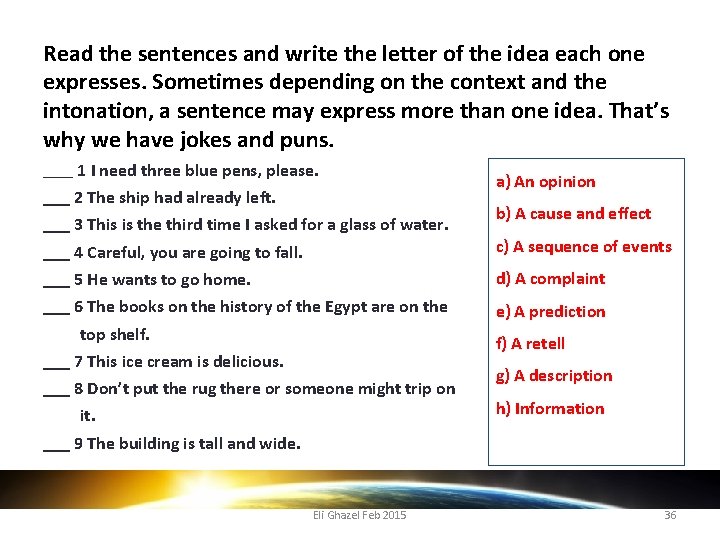
Read the sentences and write the letter of the idea each one expresses. Sometimes depending on the context and the intonation, a sentence may express more than one idea. That’s why we have jokes and puns. _____ 1 I need three blue pens, please. ___ 2 The ship had already left. ___ 3 This is the third time I asked for a glass of water. a) An opinion b) A cause and effect ___ 4 Careful, you are going to fall. c) A sequence of events ___ 5 He wants to go home. d) A complaint ___ 6 The books on the history of the Egypt are on the e) A prediction top shelf. f) A retell ___ 7 This ice cream is delicious. ___ 8 Don’t put the rug there or someone might trip on it. g) A description h) Information ___ 9 The building is tall and wide. Eli Ghazel Feb 2015 36
At an even higher level, the sentences come together to present a narrative, a description, an informative text and so forth. Eli Ghazel Feb 2015 37
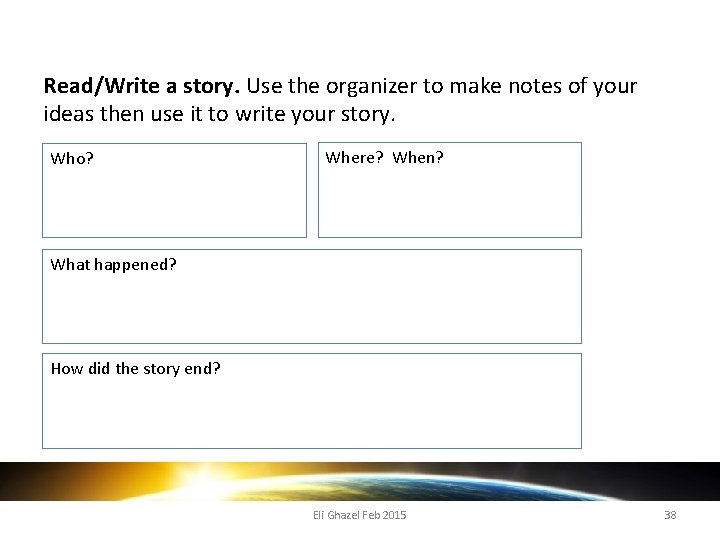
Read/Write a story. Use the organizer to make notes of your ideas then use it to write your story. Who? Where? When? What happened? How did the story end? Eli Ghazel Feb 2015 38
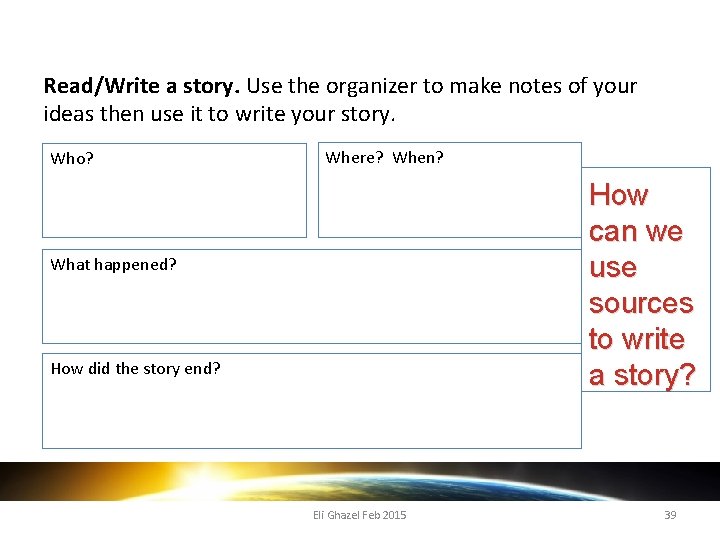
Read/Write a story. Use the organizer to make notes of your ideas then use it to write your story. Who? Where? When? How can we use sources to write a story? What happened? How did the story end? Eli Ghazel Feb 2015 39
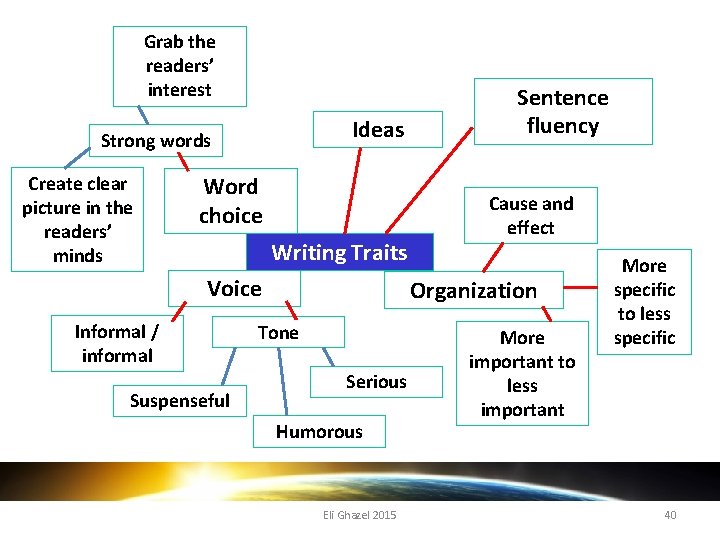
Grab the readers’ interest Ideas Strong words Create clear picture in the readers’ minds Sentence fluency Word choice Cause and effect Writing Traits Voice Informal / informal Suspenseful Organization Tone Serious Humorous Eli Ghazel 2015 More important to less important More specific to less specific 40
What do we want our children to learn? Eli Ghazel 2015 41
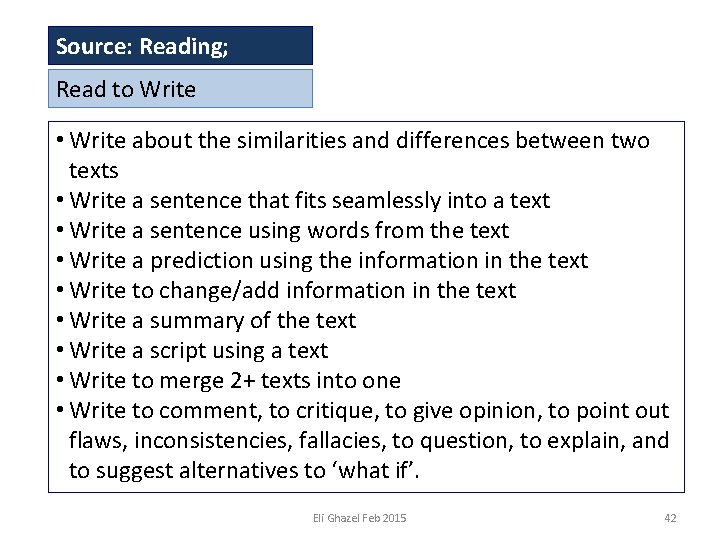
Source: Reading; Read to Write • Write about the similarities and differences between two texts • Write a sentence that fits seamlessly into a text • Write a sentence using words from the text • Write a prediction using the information in the text • Write to change/add information in the text • Write a summary of the text • Write a script using a text • Write to merge 2+ texts into one • Write to comment, to critique, to give opinion, to point out flaws, inconsistencies, fallacies, to question, to explain, and to suggest alternatives to ‘what if’. Eli Ghazel Feb 2015 42
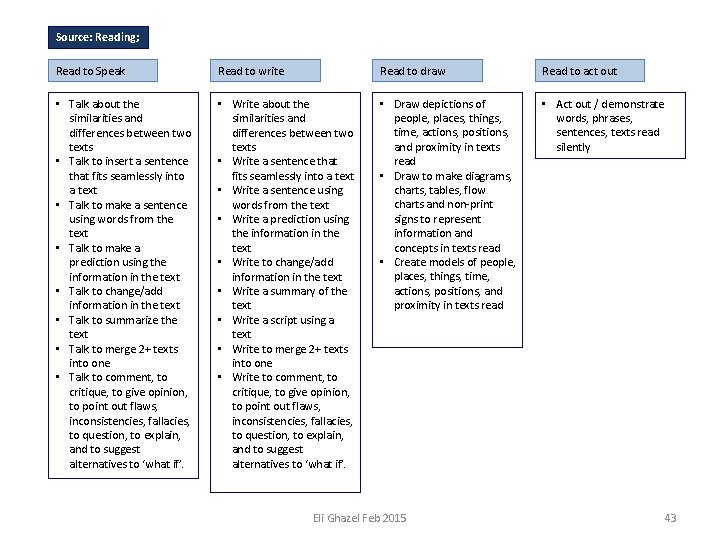
Source: Reading; Read to Speak Read to write Read to draw Read to act out • Talk about the similarities and differences between two texts • Talk to insert a sentence that fits seamlessly into a text • Talk to make a sentence using words from the text • Talk to make a prediction using the information in the text • Talk to change/add information in the text • Talk to summarize the text • Talk to merge 2+ texts into one • Talk to comment, to critique, to give opinion, to point out flaws, inconsistencies, fallacies, to question, to explain, and to suggest alternatives to ‘what if’. • Write about the similarities and differences between two texts • Write a sentence that fits seamlessly into a text • Write a sentence using words from the text • Write a prediction using the information in the text • Write to change/add information in the text • Write a summary of the text • Write a script using a text • Write to merge 2+ texts into one • Write to comment, to critique, to give opinion, to point out flaws, inconsistencies, fallacies, to question, to explain, and to suggest alternatives to ‘what if’. • Draw depictions of people, places, things, time, actions, positions, and proximity in texts read • Draw to make diagrams, charts, tables, flow charts and non-print signs to represent information and concepts in texts read • Create models of people, places, things, time, actions, positions, and proximity in texts read • Act out / demonstrate words, phrases, sentences, texts read silently Eli Ghazel Feb 2015 43
Let’s remember… Writing is just a response to a source of information Eli Ghazel 2015 44
Example Helping our students learn to compare and contrast in reading Eli Ghazel 2015 45
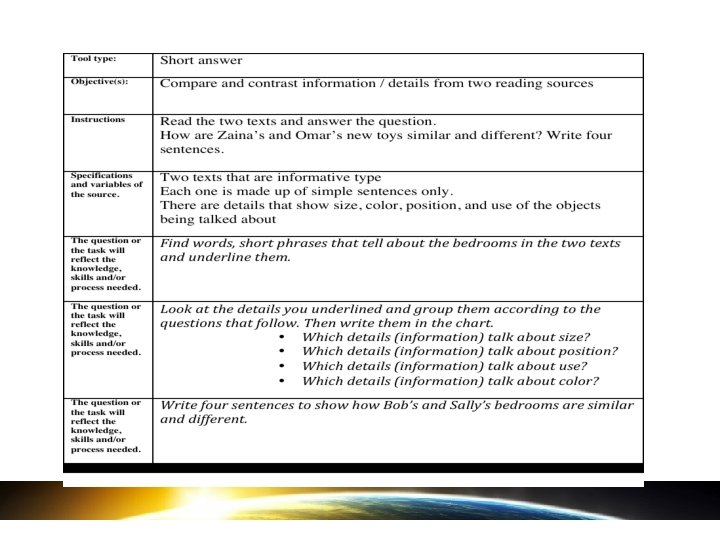
Performance task expected of the students: Read the two texts and answer the question. How are Bob’s and Sally’s bedrooms alike and different? Write four sentences. Eli Ghazel 2015 46
1 Teacher’s analysis: The students need to decide what information (details) should be compared. In her lesson plan, the teacher gives the students an activity such as the one below: Eli Ghazel 2015 47
a Teacher’s instructions to the students: Find words, short phrases that tell about the bedrooms in the two texts and underline them. Eli Ghazel 2015 48
2 Teacher’s analysis: The students need to group (classify) the information details in order to be able to compare and contrast. In her lesson plan, the teacher gives the students an activity such as the one below: Eli Ghazel 2015 49
b Teacher’s instructions to the students: Look at the details you underlined and group them according to the questions that follow. Then write them in the chart. Which details (information) talk about size? Which details (information) talk about position? Which details (information) talk about use? Which details (information) talk about color? Eli Ghazel 2015 50
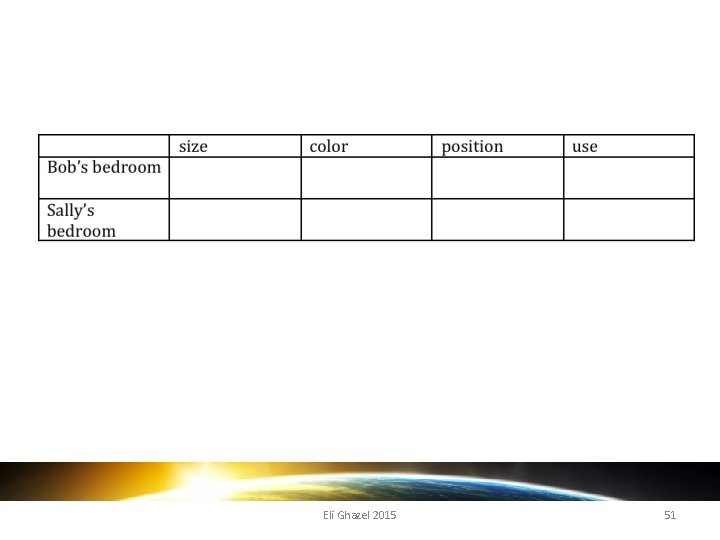
Eli Ghazel 2015 51
3 Teacher’s analysis: The students now have organized information in the chart and can produce sentences to compare and contrast Bob’s and Sally’s bedrooms. Eli Ghazel 2015 52
c Teacher’s instructions to the students: Write four sentences to show Bob’s and Sally’s bedrooms are similar and different. Eli Ghazel 2015 53
4 Teacher’s analysis: The teacher knows that the students need to be able to apply their knowledge to new situations Eli Ghazel 2015 54
d Teacher’s instructions to the students: In groups of three, tell each other the steps that you took in order to compare Sally’s and Bob’s bedrooms and what you should do when I give you two new texts to read and compare. When you finish, write your steps on the large sheet and put it up on the wall. Eli Ghazel 2015 55
How do we know that our children have learned? Eli Ghazel 2015 56
Eli Ghazel 2015 57
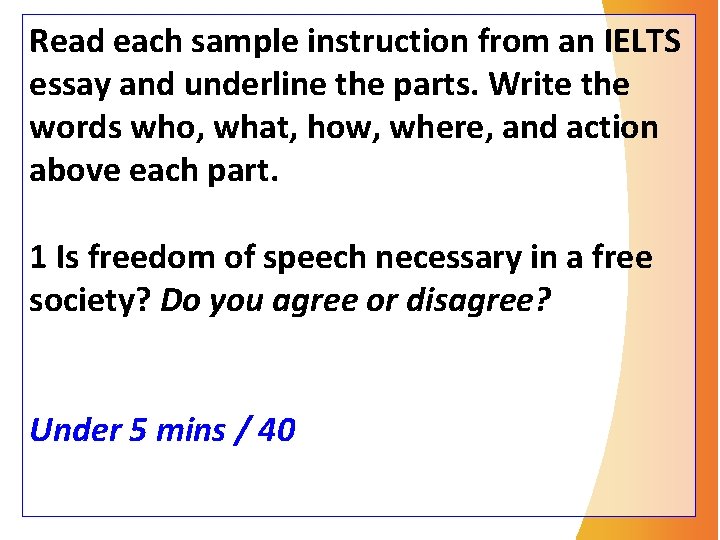
Read each sample instruction from an IELTS essay and underline the parts. Write the words who, what, how, where, and action above each part. 1 Is freedom of speech necessary in a free society? Do you agree or disagree? Under 5 mins / 40
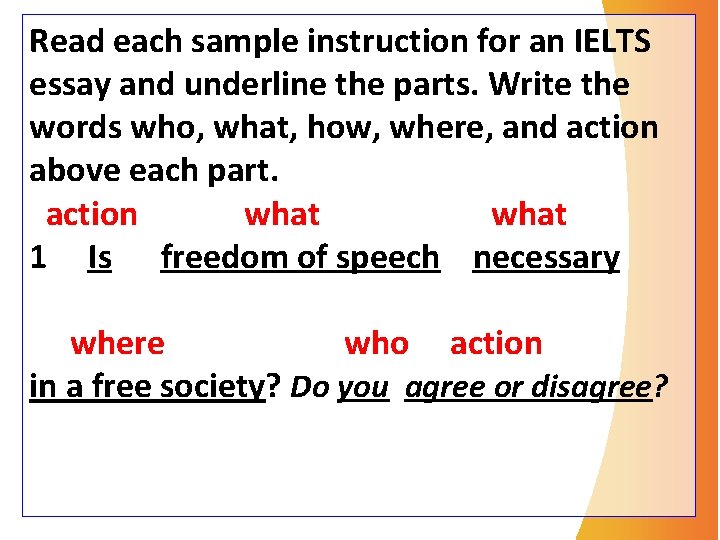
Read each sample instruction for an IELTS essay and underline the parts. Write the words who, what, how, where, and action above each part. action what 1 Is freedom of speech necessary where who action in a free society? Do you agree or disagree?
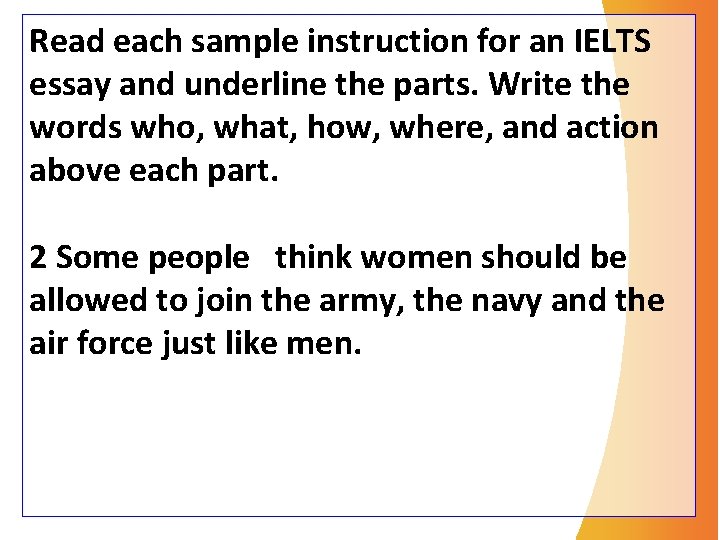
Read each sample instruction for an IELTS essay and underline the parts. Write the words who, what, how, where, and action above each part. 2 Some people think women should be allowed to join the army, the navy and the air force just like men.
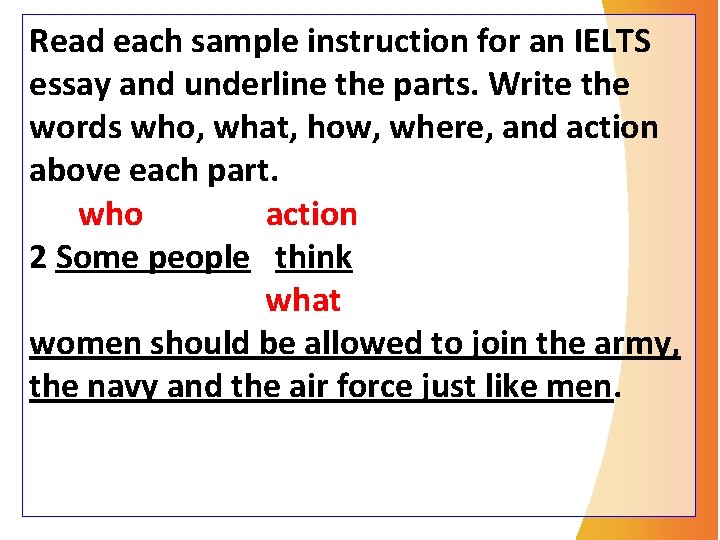
Read each sample instruction for an IELTS essay and underline the parts. Write the words who, what, how, where, and action above each part. who action 2 Some people think what women should be allowed to join the army, the navy and the air force just like men.
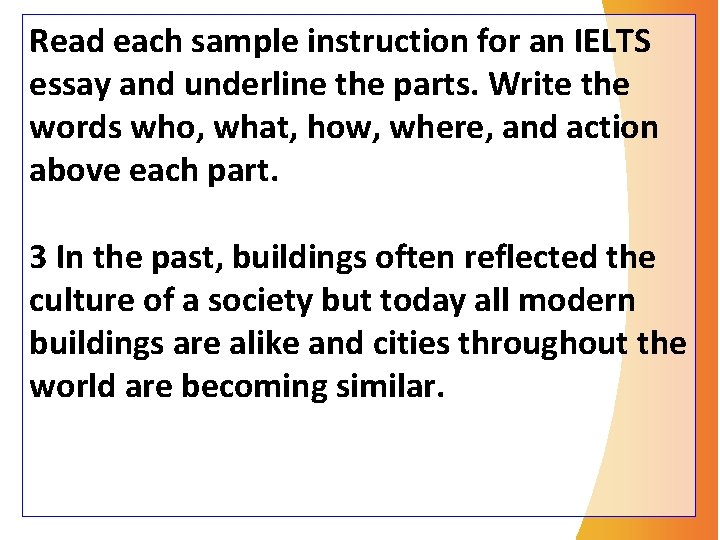
Read each sample instruction for an IELTS essay and underline the parts. Write the words who, what, how, where, and action above each part. 3 In the past, buildings often reflected the culture of a society but today all modern buildings are alike and cities throughout the world are becoming similar.
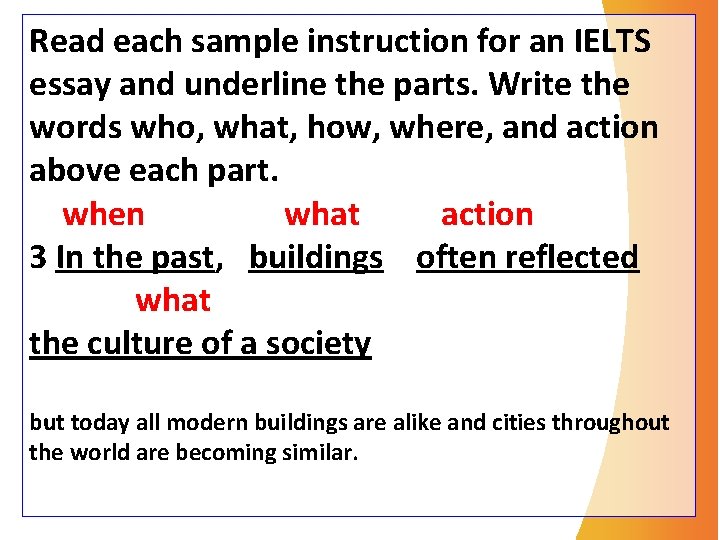
Read each sample instruction for an IELTS essay and underline the parts. Write the words who, what, how, where, and action above each part. when what action 3 In the past, buildings often reflected what the culture of a society but today all modern buildings are alike and cities throughout the world are becoming similar.
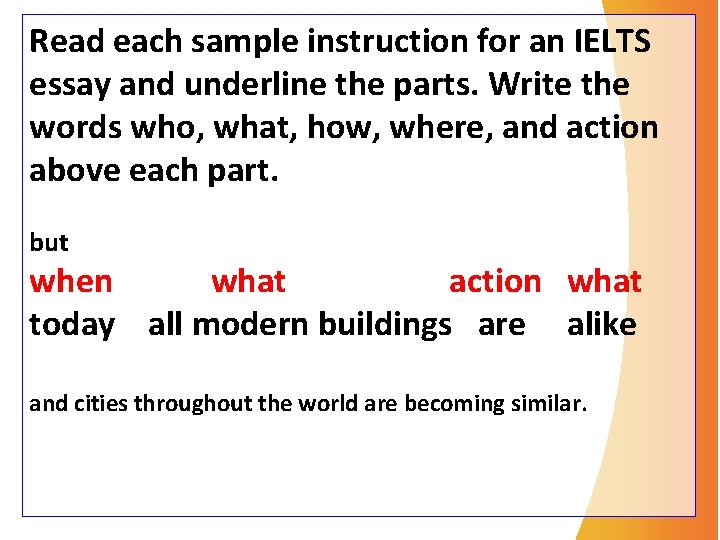
Read each sample instruction for an IELTS essay and underline the parts. Write the words who, what, how, where, and action above each part. but when what action what today all modern buildings are alike and cities throughout the world are becoming similar.
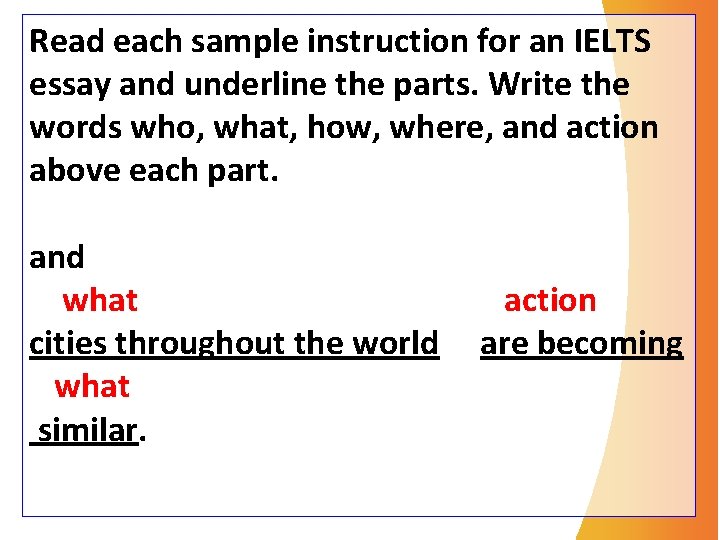
Read each sample instruction for an IELTS essay and underline the parts. Write the words who, what, how, where, and action above each part. and what action cities throughout the world are becoming what similar.
Read each sample instruction for an IELTS essay and underline the parts. Write the words who, what, how, where, and action above each part. What do you think is the reason for this, and is it a good thing or a bad thing?
Read each sample instruction for an IELTS essay and underline the parts. Write the words who, what, how, where, and action above each part. The world is experiencing a dramatic increase in population. This is causing problems not only for poor, underdeveloped countries, but also for industrialized and developing nations.
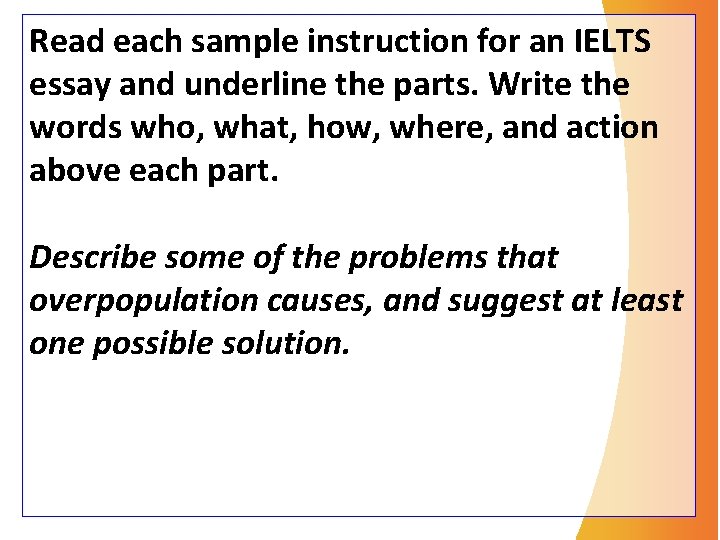
Read each sample instruction for an IELTS essay and underline the parts. Write the words who, what, how, where, and action above each part. Describe some of the problems that overpopulation causes, and suggest at least one possible solution.
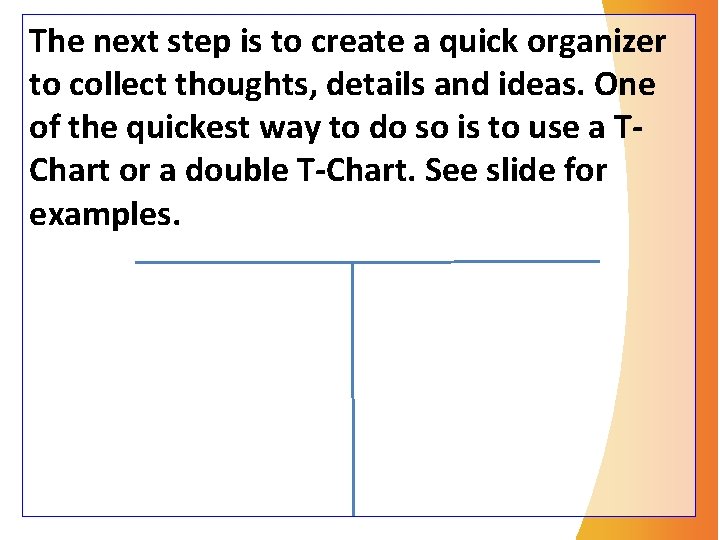
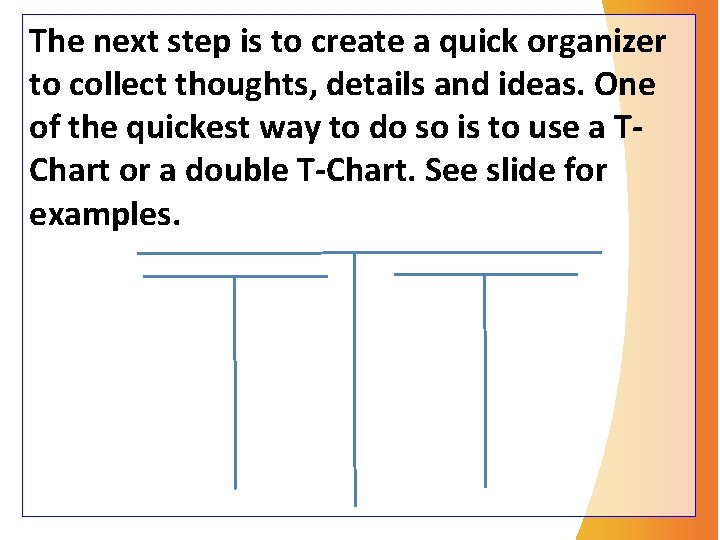
The next step is to create a quick organizer to collect thoughts, details and ideas. One of the quickest way to do so is to use a T-Chart or a double T-Chart. See slide for examples.
The next step is to create a quick organizer to collect thoughts, details and ideas. One of the quickest way to do so is to use a TChart or a double T-Chart. See slide for examples.
The next step is to create a quick organizer to collect thoughts, details and ideas. One of the quickest way to do so is to use a TChart or a double T-Chart. See slide for examples.
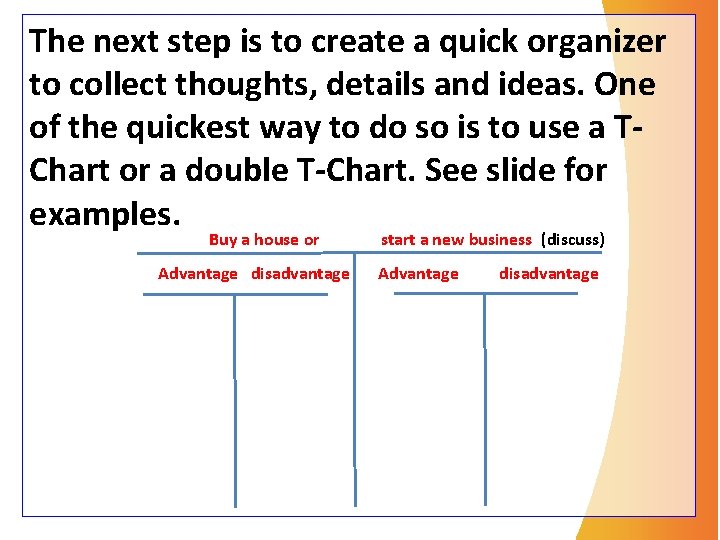
The next step is to create a quick organizer to collect thoughts, details and ideas. One of the quickest way to do so is to use a TChart or a double T-Chart. See slide for examples. Buy a house or start a new business (discuss) Advantage disadvantage Advantage disadvantage
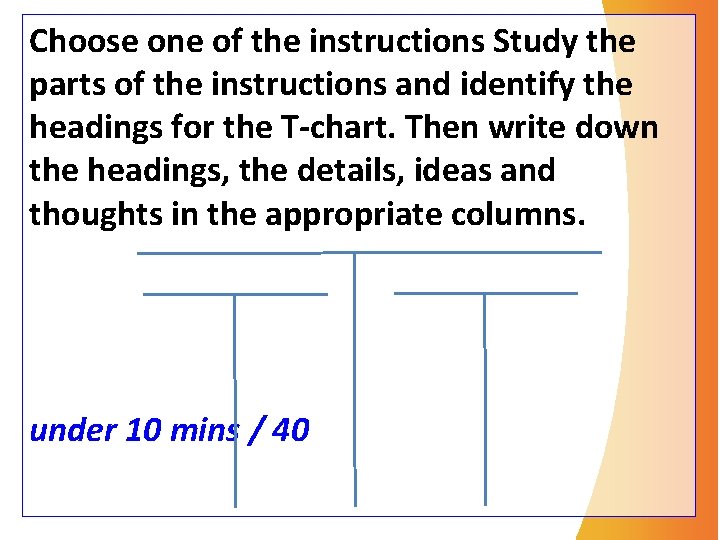
Choose one of the instructions Study the parts of the instructions and identify the headings for the T-chart. Then write down the headings, the details, ideas and thoughts in the appropriate columns. under 10 mins / 40
Study your details, thoughts and ideas. A Note which are examples, reasons, opinions, arguments B Cross out the ones you think are irrelevant C Number your ideas in the order importance to you Under 5 mins / 40
There are several types of essays – persuasive, descriptive, informative, comparison and contrast, cause and effect and each has its own unique organizer. The time available is not enough to go into the different types.
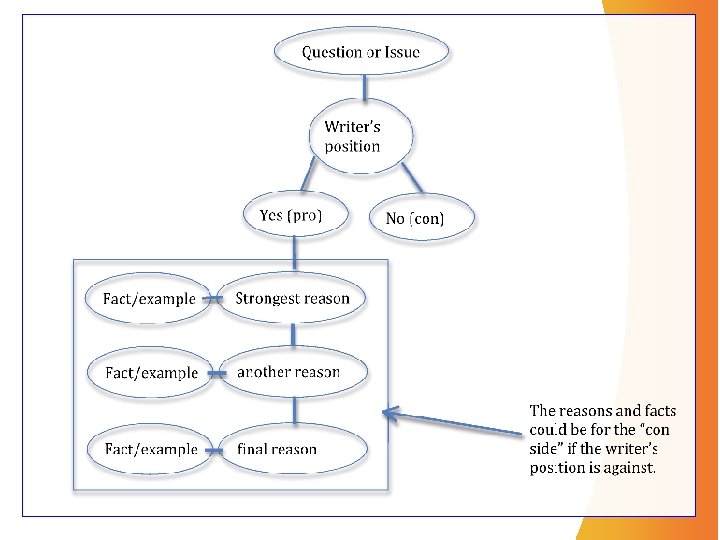
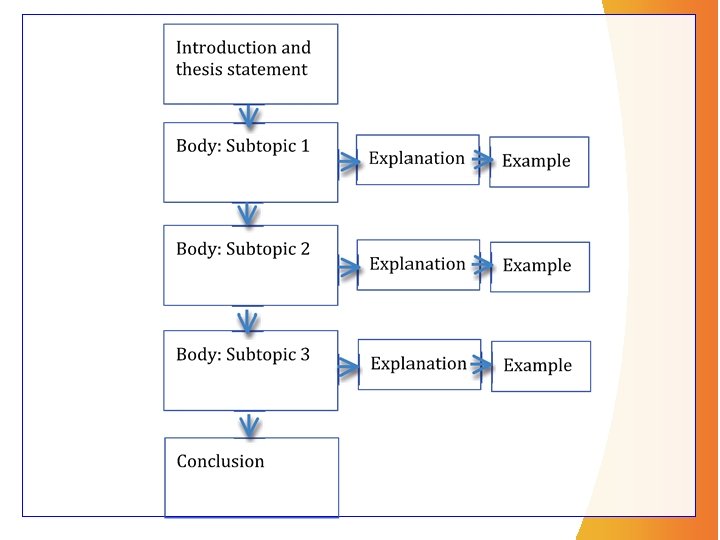
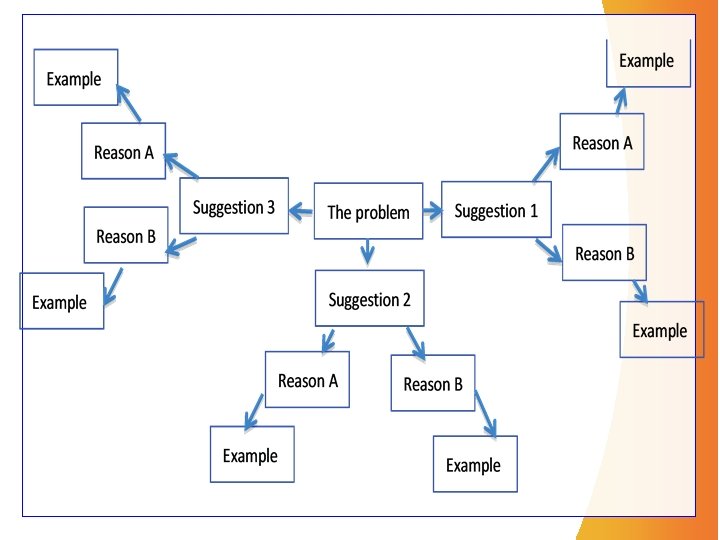
For more examples, go to www. munjez. com and download the On Location Teacher Support Guides for grades 10, 11 and 12 written by Eli Ghazel and published by Mc. Graw-Hill Education.
Examine three organizers that follow and decide which organizer would be most suitable for each of the four instructions in you saw in the previous slides. Write the number of the instruction next to the organizer. Then write the information from your T-chart in the organizer. Under 5 mins / 40
Use the information in your organizer to write your essay. Under 10 mins / 40
How do we know that our children have learned? Eli Ghazel 2015 82
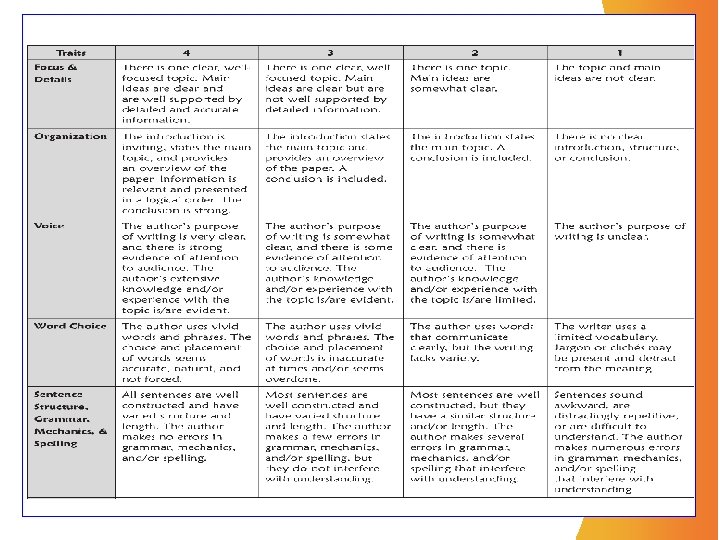
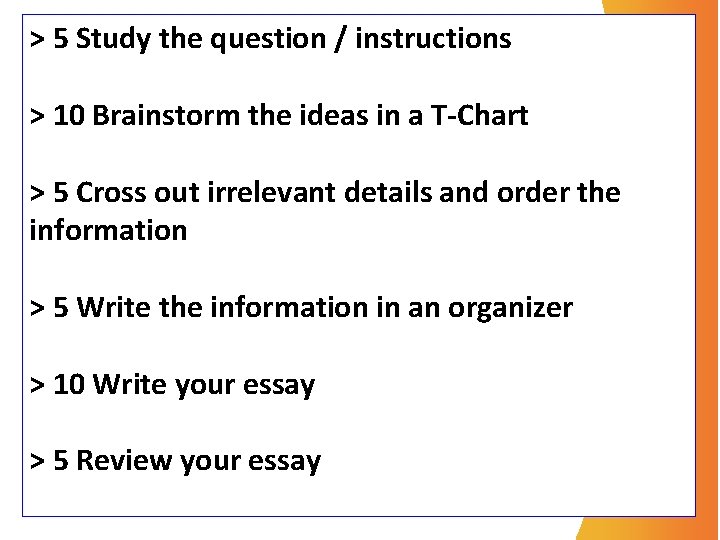
> 5 Study the question / instructions > 10 Brainstorm the ideas in a T-Chart > 5 Cross out irrelevant details and order the information > 5 Write the information in an organizer > 10 Write your essay > 5 Review your essay

www. eupad. net www. munjez. com www. 21 caf. org Eli Ghazel eli@eupad. net +971559221588 Eli Ghazel Feb 2015 85
- Slides: 84