
Good Morning Get ready for the day Reflect




- Slides: 20
Good Morning! Get ready for the day! Reflect on the following questions, write for the full five minutes exploring, answering, and justifying your overall position, answer in the student collaboration channel: 1. Do you enjoy poetry? Why or why not? 2. How are the ways you are exposed to poetry every day? 3. What are some real life instances in which poetry could by useful? 4. What do you know about poetry? 5. What tricks were you taught when reading poetry?
And Now For Some Celebrations
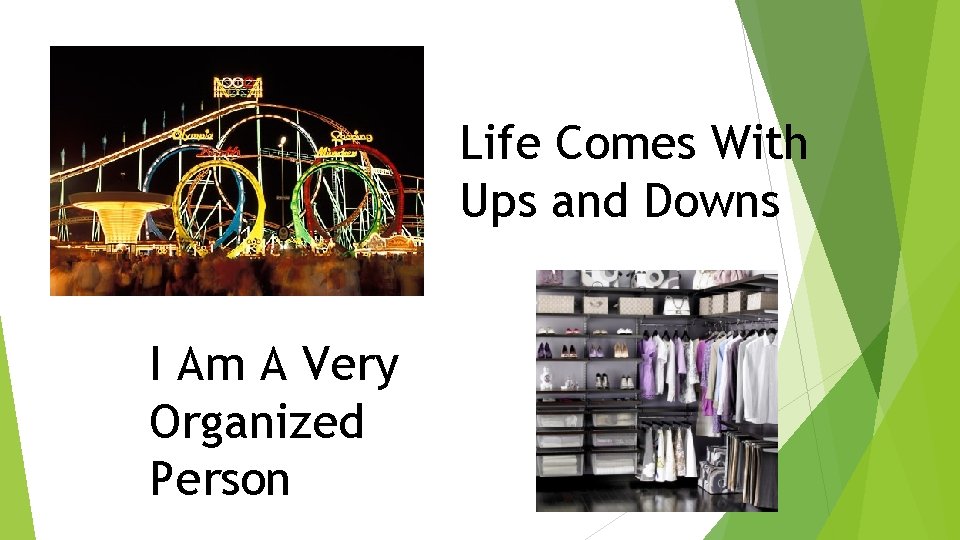
Life Comes With Ups and Downs I Am A Very Organized Person
I’m A Hard Worker and Outstanding Roller Coasters Change Directions, Not Course
Don’t Be Afraid To Be Different Your Goal Won’t Be Met Overnight
Chaos Can Be A Good Beginning (L O F H H B) Love, Outside, Fun, Happy, Heart, Sea. World
Standard, Objective, Essential Question W. 3. 7: Conduct short as well as more sustained research projects to answer a question (including a self-generated question) or solve a problem; narrow or broaden the inquiry when appropriate; synthesize multiple sources on the subject, demonstrating understanding of the subject under investigation. Objective: Complete a webquest assignment in order to understand the various topics and kinds of poems available. Essential Question: What are some common elements among poems, and how can they be used to create an emotional understanding of a topic.
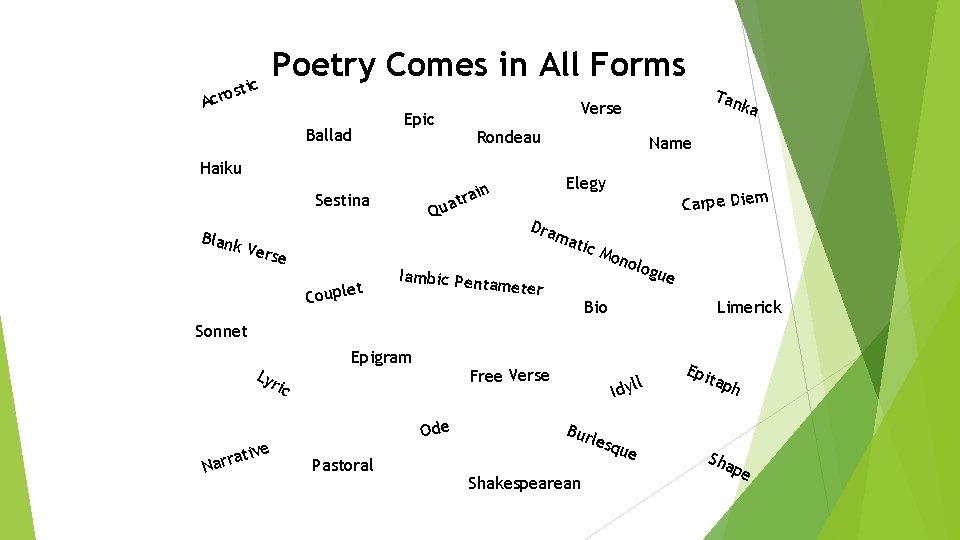
Poetry Comes in All Forms ic st o r c A Ballad Epic Blank Verse t Couple ka Rondeau Haiku ain r t Qua Sestina Tan Verse Name Elegy Dra mat ic M Carpe Diem ono Iambic Pent ameter logu e Bio Limerick Sonnet Lyr e ativ r r a N Epigram Free Verse ic Ode Pastoral l Idyl Bur lesq ue Shakespearean Epi tap h Sha pe
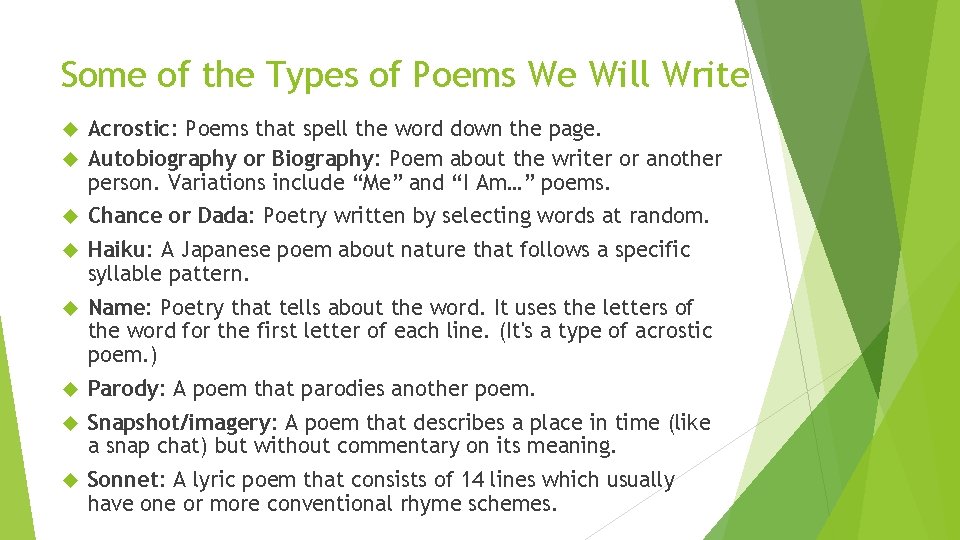
Some of the Types of Poems We Will Write Acrostic: Poems that spell the word down the page. Autobiography or Biography: Poem about the writer or another person. Variations include “Me” and “I Am…” poems. Chance or Dada: Poetry written by selecting words at random. Haiku: A Japanese poem about nature that follows a specific syllable pattern. Name: Poetry that tells about the word. It uses the letters of the word for the first letter of each line. (It's a type of acrostic poem. ) Parody: A poem that parodies another poem. Snapshot/imagery: A poem that describes a place in time (like a snap chat) but without commentary on its meaning. Sonnet: A lyric poem that consists of 14 lines which usually have one or more conventional rhyme schemes.
As we learn about a few poets, we'll start with some PARODY poems, mimicking their different forms and styles. Then we will explore other short forms of poems that you can write. After you have practiced several different forms, you will compile your own original book of poems. But don't worry. . . it's not as intimidating as it seems. I promise.
Before We Start Writing Though… We need to learn how to read poems. DON’T WORRY! This process is not as intense as it is in your English classes. It is about understanding how the poet creates an emotional connection to a topic, and what that connection “teaches” us about Life according to the poet. We need to learn for specific things, and then ask the question: Why did the poet do this? An poet always INTENTIONALLY chooses to word things in a specific way.
How to Analyze a Poem in 5 steps (the “close reading” way)
1. Don’t read more into it than the poet! Teachers have a tendency to push too hard for readers to find symbols and themes in poetry, insisting we look for “what the poet really meant. ” Sometimes the poet really does have a hidden meaning for the poem, but sometimes he just writes it because he likes it that way! We can look for symbolism and theme, but we should never try to see more in the poem than is actually there. Usually, theme is something the author believes, and wrote the poem for themselves to express that belief. Remember that poetry is meant to express emotion, to connect with the reader in a way that helps us feel what the poet feels. Don’t fight so hard to take poetry seriously that you miss the emotional connection.
2. Read the poem once. Read through the whole poem without stopping, even if there are words or phrases that you don’t understand. What emotion does the poem give you? Highlight the words in RED. (The reader’s response to the poem, the emotional connection, is called MOOD. ) How does the poem make you feel?
3. Read the poem a second time. Look at the words the author uses to describe or an idea. You may want to look words up in this case. How does the poet feel about the subject matter? (The way the author feels about a subject, his attitude that is expressed by his word choice, is called TONE. ) Highlight the words in BLUE.
4. Read the poem a third time. What kind of interesting word choices do you see? Are there any examples of Figurative Language, (metaphor, simile, hyperbole, personification, idiom, euphemism, oxymoron, or paradox, ) or Sensory Language, (rhyme, near rhyme, assonance, consonance, alliteration, repetition, or onomatopoeia, ) that you can find? How do those poetic devices help to show the poet’s TONE, and give you MOOD? Highlight these in GREEN.
5. Read the poem one more time. The poet’s word choice is meant to show his TONE, which is meant to give you a MOOD, which helps you understand the poem’s THEME, (the big message that the author wants you to understand remember. ) What THEME did you see in the poem? What message are you going to take with you for your life after having studied this poem? Write a single sentence on what you think the author is trying to tell us about the subject and underline it.
Now that you’ve read the poem closely, you understand what the poet was trying to say, and you have made an emotional connection!
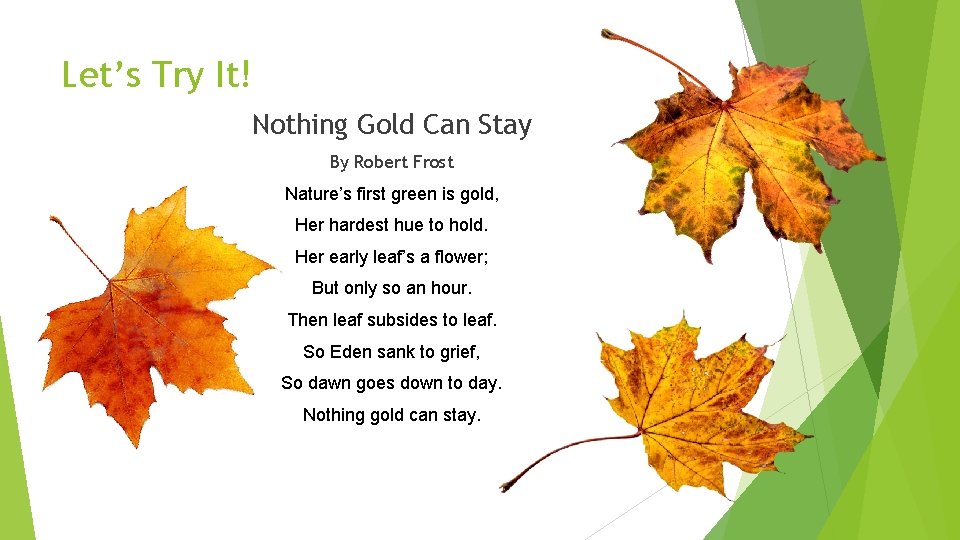
Let’s Try It! Nothing Gold Can Stay By Robert Frost Nature’s first green is gold, Her hardest hue to hold. Her early leaf’s a flower; But only so an hour. Then leaf subsides to leaf. So Eden sank to grief, So dawn goes down to day. Nothing gold can stay.
Your Assignment Find I two poems online can recommend the following website(s) to search: https: //www. poetryfoundation. org/ Poems Back About Teenage Life to School Poems Complete a step by step analysis of the poem In other words, copy the poem to the assignment document, highlight what needs to be highlighted, and write out a theme statement (THIS IS A COMPLETE SENTENCE) File is available on Focus and the Class Website miclef. weebly. com