
Good Morning Class You ready to learn about
Good Morning Class!!! You ready to learn about your awesome planet? I thought so, so stop staring at my awesome mustache and start taking some notes!
Earth in Space Objective: 1)Describe Earth’s position in the solar system 2)Explain how rotation and revolution affect Earth.
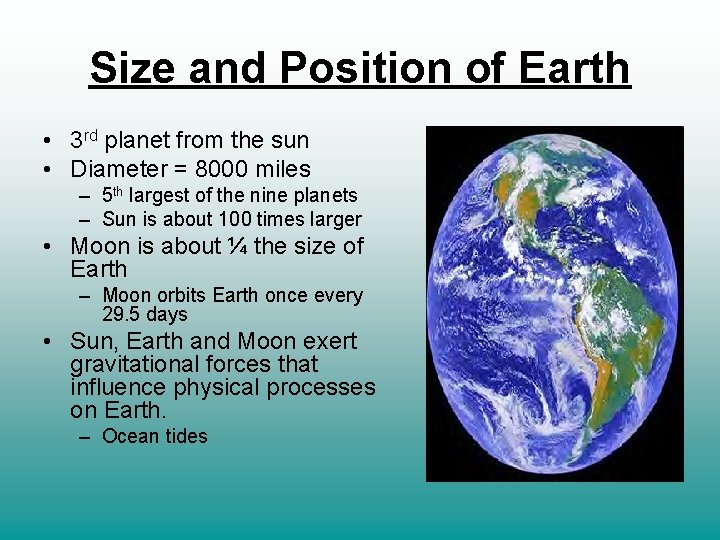
Size and Position of Earth • 3 rd planet from the sun • Diameter = 8000 miles – 5 th largest of the nine planets – Sun is about 100 times larger • Moon is about ¼ the size of Earth – Moon orbits Earth once every 29. 5 days • Sun, Earth and Moon exert gravitational forces that influence physical processes on Earth. – Ocean tides
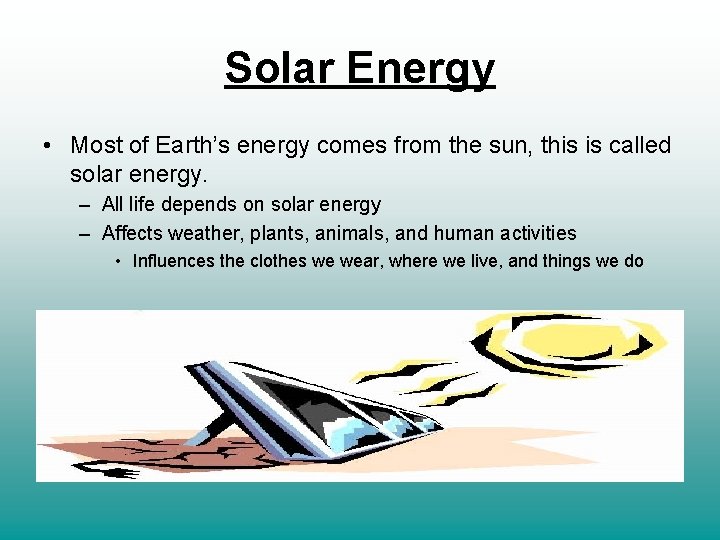
Solar Energy • Most of Earth’s energy comes from the sun, this is called solar energy. – All life depends on solar energy – Affects weather, plants, animals, and human activities • Influences the clothes we wear, where we live, and things we do
Factors affecting solar energy • There are three factors that control how much solar energy is received at different locations. –Rotation –Revolution –Tilt
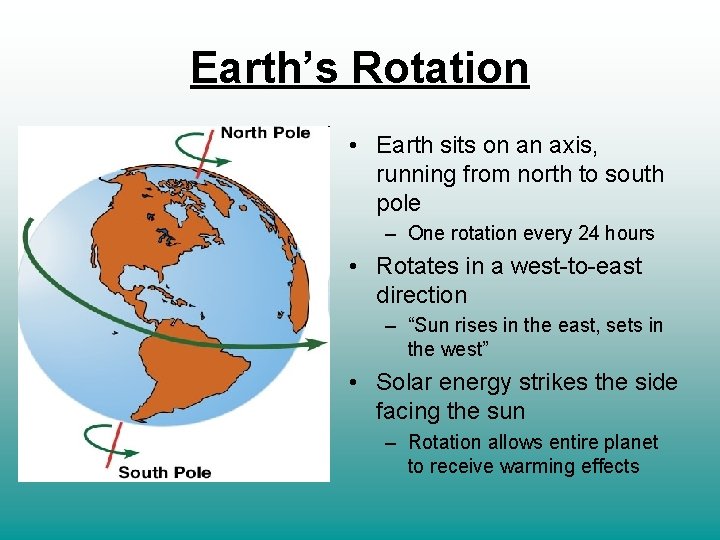
Earth’s Rotation • Earth sits on an axis, running from north to south pole – One rotation every 24 hours • Rotates in a west-to-east direction – “Sun rises in the east, sets in the west” • Solar energy strikes the side facing the sun – Rotation allows entire planet to receive warming effects
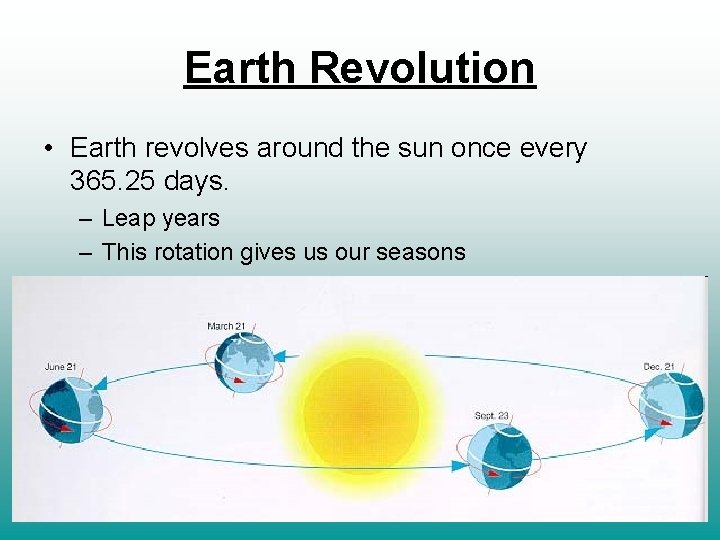
Earth Revolution • Earth revolves around the sun once every 365. 25 days. – Leap years – This rotation gives us our seasons
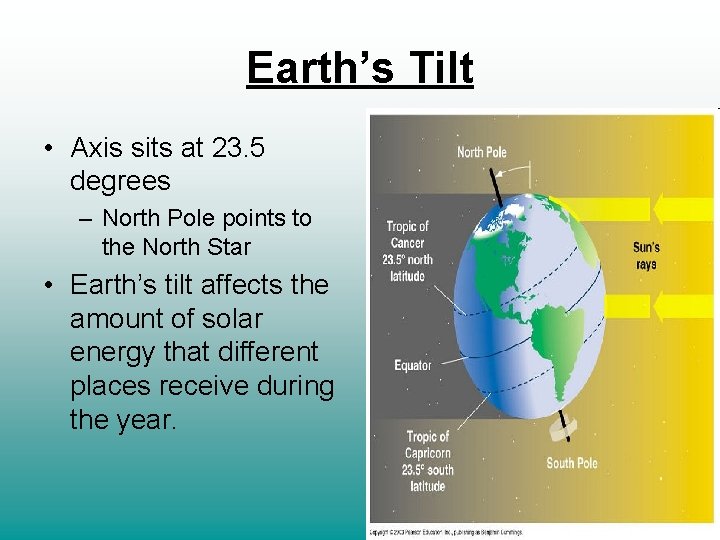
Earth’s Tilt • Axis sits at 23. 5 degrees – North Pole points to the North Star • Earth’s tilt affects the amount of solar energy that different places receive during the year.
Comprehension Check • How do the three relationships affect the amount of solar energy received at different locations on Earth? – Rotation allows the warming of sunlight and cooling effects of darkness. – Tilt and revolution cause hemispheres to receive varying amounts of solar energy during the year.

Earth-Sun Relation Objective: 1) How the angle of the Sun’s rays affects the amounts of solar energy received on Earth 2) Difference between equinox and solstice

Energy and Latitude
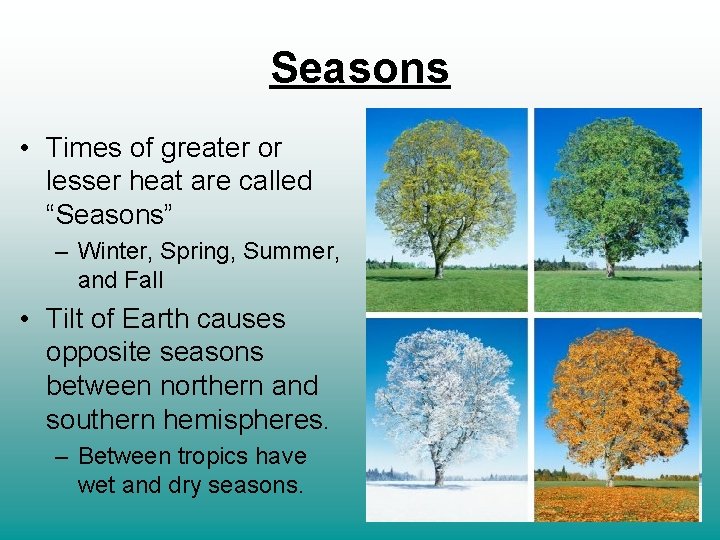
Seasons • Times of greater or lesser heat are called “Seasons” – Winter, Spring, Summer, and Fall • Tilt of Earth causes opposite seasons between northern and southern hemispheres. – Between tropics have wet and dry seasons.
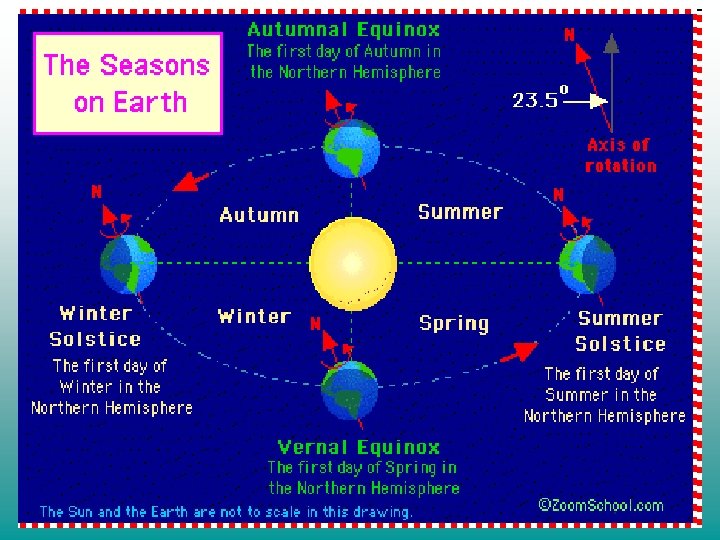
Equinox vs. Solstice • Solstice refers to the two times each year when the sun's strongest rays are furthest from the equator (north of it during our summer solstice and south during the winter). – For the northern hemisphere, summer solstice occurs around June 21 st; we have the maximum number of daylight hours at that time. Winter solstice is around December 21 st when we have the fewest daylight hours. • Equinox refers to the two times each year when the sun's strongest rays are directly hitting the equator. – Everywhere on earth has 12 hours of daylight on the spring and fall equinoxes. – In the northern hemisphere, spring equinox occurs around March 21 st and autumnal equinox around September 21 st.
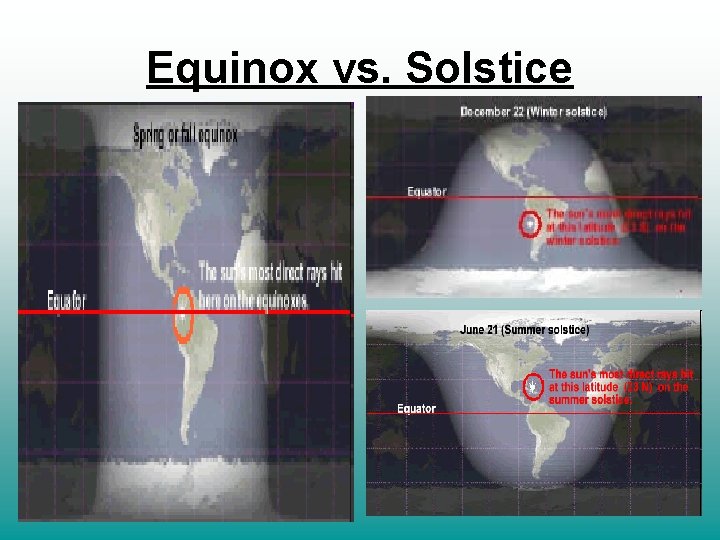
Equinox vs. Solstice
Comprehension Check • When is the first day of spring in the Northern Hemisphere? Southern Hemisphere? – March 21 – September 22
Earth System Objective: 1) Identify Earth’s 4 spheres 2) Uniqueness of Earth’s environment in solar system
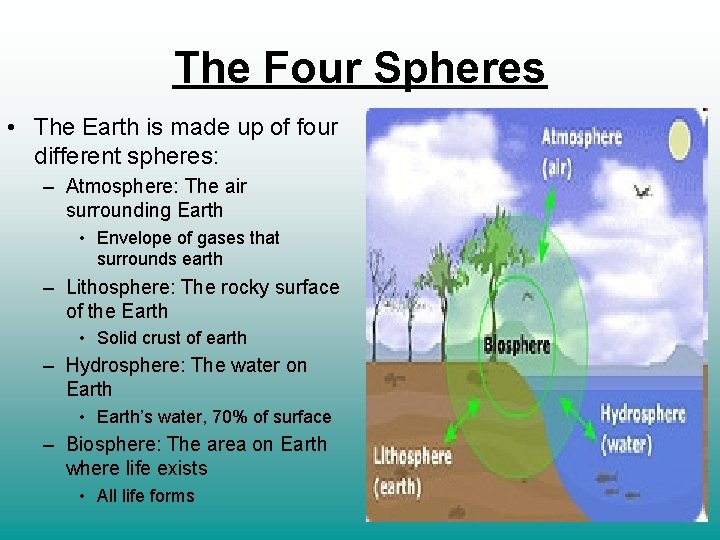
The Four Spheres • The Earth is made up of four different spheres: – Atmosphere: The air surrounding Earth • Envelope of gases that surrounds earth – Lithosphere: The rocky surface of the Earth • Solid crust of earth – Hydrosphere: The water on Earth • Earth’s water, 70% of surface – Biosphere: The area on Earth where life exists • All life forms
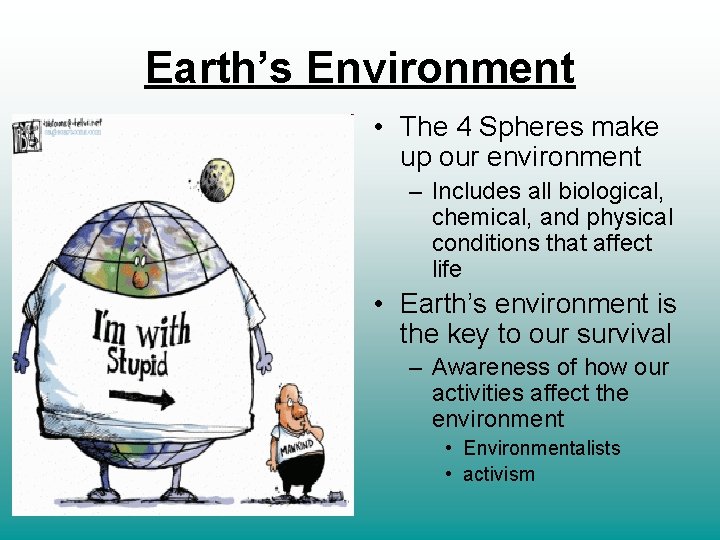
Earth’s Environment • The 4 Spheres make up our environment – Includes all biological, chemical, and physical conditions that affect life • Earth’s environment is the key to our survival – Awareness of how our activities affect the environment • Environmentalists • activism
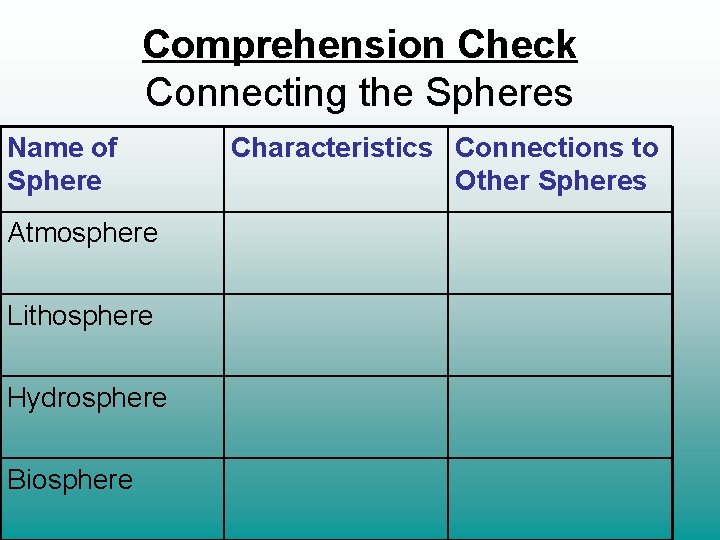
Comprehension Check Connecting the Spheres Name of Sphere Atmosphere Lithosphere Hydrosphere Biosphere Characteristics Connections to Other Spheres
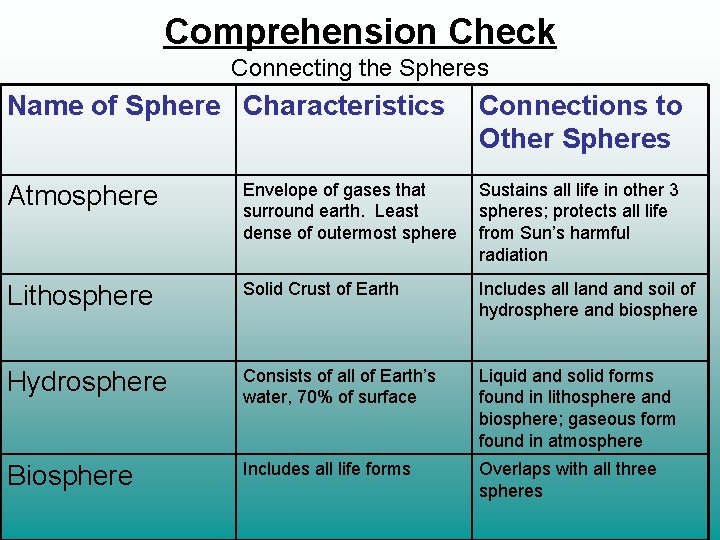
Comprehension Check Connecting the Spheres Name of Sphere Characteristics Connections to Other Spheres Atmosphere Envelope of gases that surround earth. Least dense of outermost sphere Sustains all life in other 3 spheres; protects all life from Sun’s harmful radiation Lithosphere Solid Crust of Earth Includes all land soil of hydrosphere and biosphere Hydrosphere Consists of all of Earth’s water, 70% of surface Liquid and solid forms found in lithosphere and biosphere; gaseous form found in atmosphere Biosphere Includes all life forms Overlaps with all three spheres
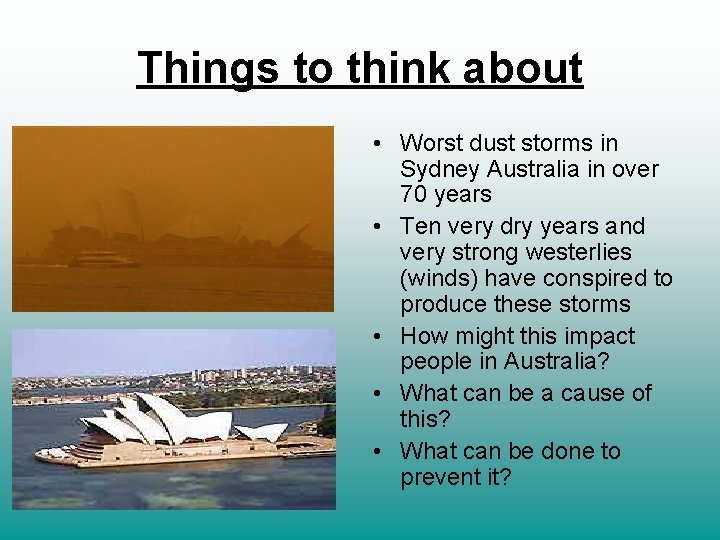
Things to think about • Worst dust storms in Sydney Australia in over 70 years • Ten very dry years and very strong westerlies (winds) have conspired to produce these storms • How might this impact people in Australia? • What can be a cause of this? • What can be done to prevent it?
- Slides: 23