
Good Morning As you enter 1 Sign in

- Slides: 28
Good Morning › As you enter. . . 1. Sign in on the blue sheet. 2. Pick up an agenda and a maze worksheet. 3. Find a seat (we will move later). 4. Work with a partner on your mazes. 5. As you are working on the mazes, think about the strategies you are using. . .
Leon County Schools Secondary Math Instructional Leaders Training October 2, 2015 Vicki Register and Denise Williams, Facilitators registerv@leonschools. net williamsd 5@leonschools. net Chelsea Jones, Amy Adams and Rachelle Felix, Guest Facilitators
Welcome §Introductions … §Paperwork … §Sign In §Pay for Subs / Code §Products §Follow-Up
Way of Work Today… § Break as needed all day … Restrooms out the back § Cell Phones happen outside… § No email needs to be checked until lunch… § Be respectful in speaking & listening § No “Hogs” & “Logs” today…everyone participates! § No “Side Conversations” § DO Ask Questions … You are here to learn!
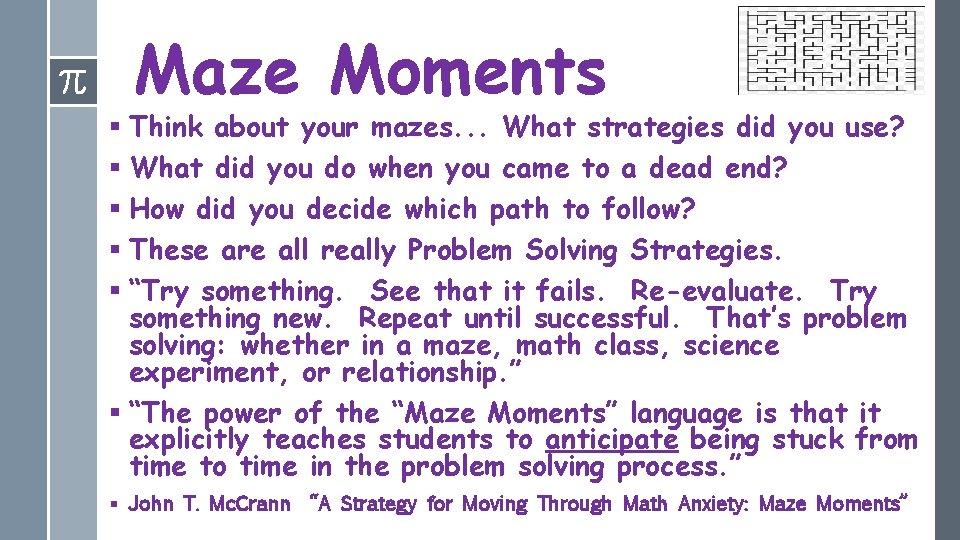
Maze Moments § Think about your mazes. . . What strategies did you use? § What did you do when you came to a dead end? § How did you decide which path to follow? § These are all really Problem Solving Strategies. § “Try something. See that it fails. Re-evaluate. Try something new. Repeat until successful. That’s problem solving: whether in a maze, math class, science experiment, or relationship. ” § “The power of the “Maze Moments” language is that it explicitly teaches students to anticipate being stuck from time to time in the problem solving process. ” § John T. Mc. Crann “A Strategy for Moving Through Math Anxiety: Maze Moments”
Algebra Nation Introducing: Chelsea Jones, Amy Adams, and Rachelle Felix What’s NEW?
“Test Yourself” in Algebra Nation §Where is it? §What is it? §Ideas on using it in the classroom? §Ideas on using it outside of the classroom?
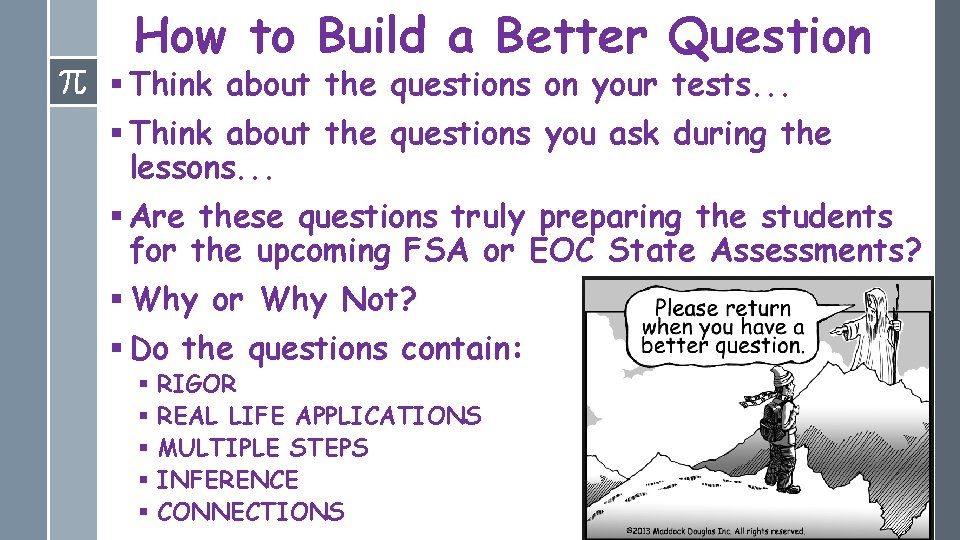
How to Build a Better Question § Think about the questions on your tests. . . § Think about the questions you ask during the lessons. . . § Are these questions truly preparing the students for the upcoming FSA or EOC State Assessments? § Why or Why Not? § Do the questions contain: § § § RIGOR REAL LIFE APPLICATIONS MULTIPLE STEPS INFERENCE CONNECTIONS
Math Talk provides students an opportunity for deeper understanding through communication. Individually or in groups, students articulate and defend their ideas and analyze the reasoning of others. Mathsolutions. com
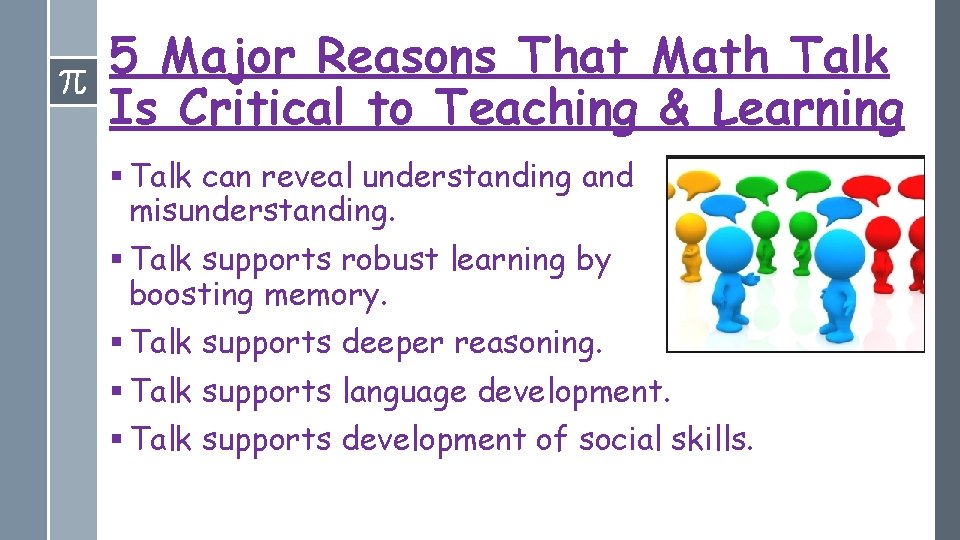
5 Major Reasons That Math Talk Is Critical to Teaching & Learning § Talk can reveal understanding and misunderstanding. § Talk supports robust learning by boosting memory. § Talk supports deeper reasoning. § Talk supports language development. § Talk supports development of social skills.
Math Talk - continued § Using communication in the classroom to represent, explain, justify, agree, and disagree shapes the way students learn mathematics. § Classroom dialogue engages students, encourages them to learn more, and allows for the exploration of ideas, strategies, procedures, facts, and more. §HOW can Math Talk be incorporated into your classrooms? ? ?
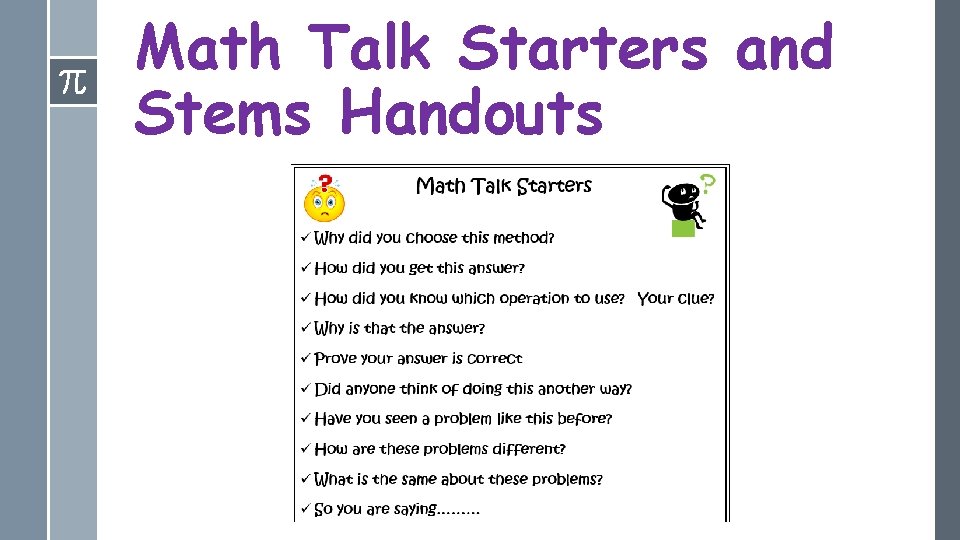
Math Talk Starters and Stems Handouts
FSA / EOC -- STANDARDS §MAFS Standards – § If a teacher is teaching the MAFS Standards, then they are ONLY preparing their students to score a Level 3 on the FSA! § Teachers MUST teach beyond the MAFS Standards in to order to prepare students to score a Level 4 or Level 5. § What changes need to happen to get our students to score a Level 4 or 5? ? ?
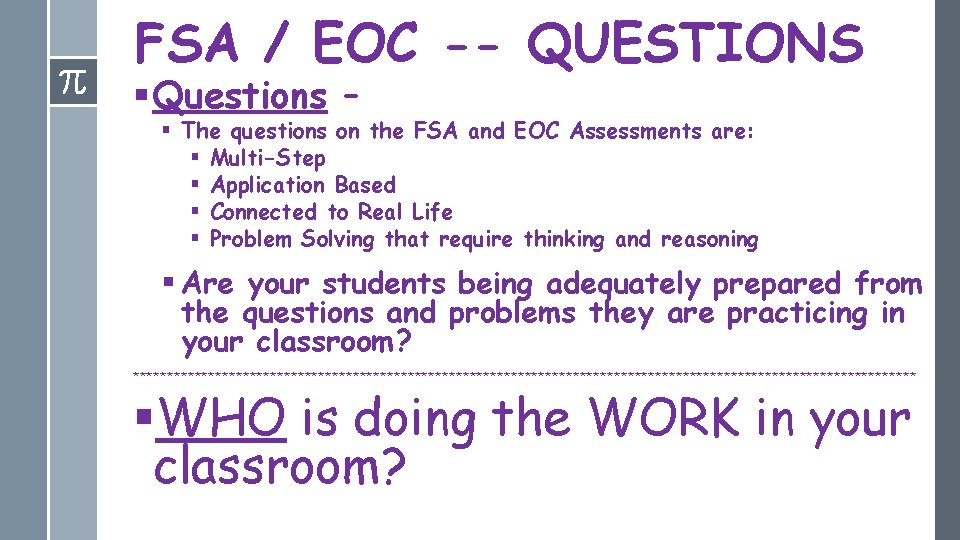
FSA / EOC -- QUESTIONS § Questions – § The questions on the FSA and EOC Assessments are: § Multi-Step § Application Based § Connected to Real Life § Problem Solving that require thinking and reasoning § Are your students being adequately prepared from the questions and problems they are practicing in your classroom? ********************************************************* §WHO is doing the WORK in your classroom?
Break – 10 minutes §When you return, MOVE to the table that represents a grade or subject that you teach this year.
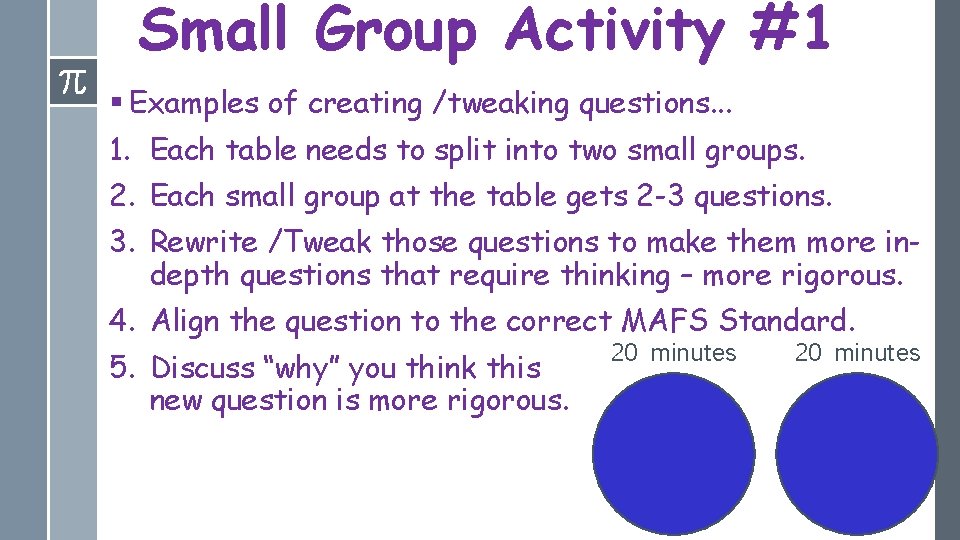
Small Group Activity #1 § Examples of creating /tweaking questions. . . 1. Each table needs to split into two small groups. 2. Each small group at the table gets 2 -3 questions. 3. Rewrite /Tweak those questions to make them more indepth questions that require thinking – more rigorous. 4. Align the question to the correct MAFS Standard. 5. Discuss “why” you think this new question is more rigorous. 20 minutes
Small Group Activity #1 - Continued § Write the “old” question on chart paper with the “new” question underneath. § Put all of them on the same chart paper. § Write the Grade Level at the top of the chart paper and the MAFS Standard beside each question. § Tape it to the Wall 15 minutes
Question Walk § As a small group, walk around all of the questions from all of the grade levels. § Talk with your partners about changes that were made or strategies that were used in rewriting the questions. 15 minutes § Take notes for discussion. . .
Sharing and Discussing § At your table, make a list of the various ways used in recreating the questions. § Discuss – § What did you “like” and “not like so much”? § Which ones do you think you could use in your classroom? § Questions to other groups? ? ? § Comments to other groups? ? ? 20 minutes
Lunch § We will begin at 1: 00. § Make sure you sign in again when you return.
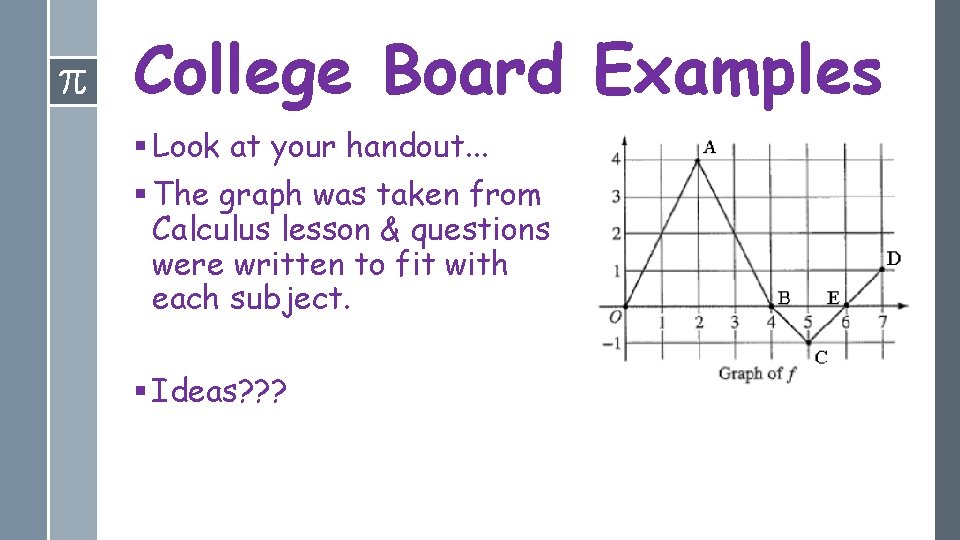
College Board Examples § Look at your handout. . . § The graph was taken from Calculus lesson & questions were written to fit with each subject. § Ideas? ? ? a
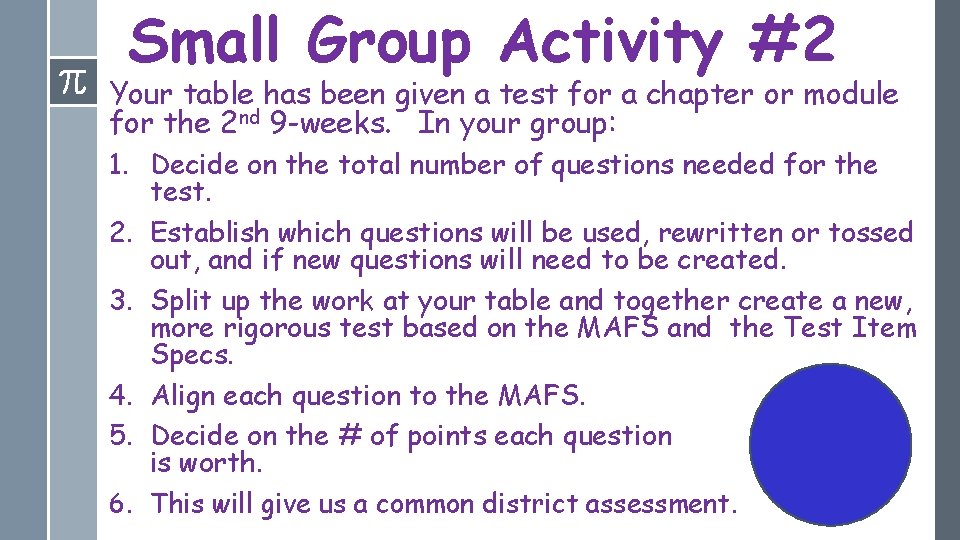
Small Group Activity #2 Your table has been given a test for a chapter or module for the 2 nd 9 -weeks. In your group: 1. Decide on the total number of questions needed for the test. 2. Establish which questions will be used, rewritten or tossed out, and if new questions will need to be created. 3. Split up the work at your table and together create a new, more rigorous test based on the MAFS and the Test Item Specs. 4. Align each question to the MAFS. 5. Decide on the # of points each question is worth. 6. This will give us a common district assessment.
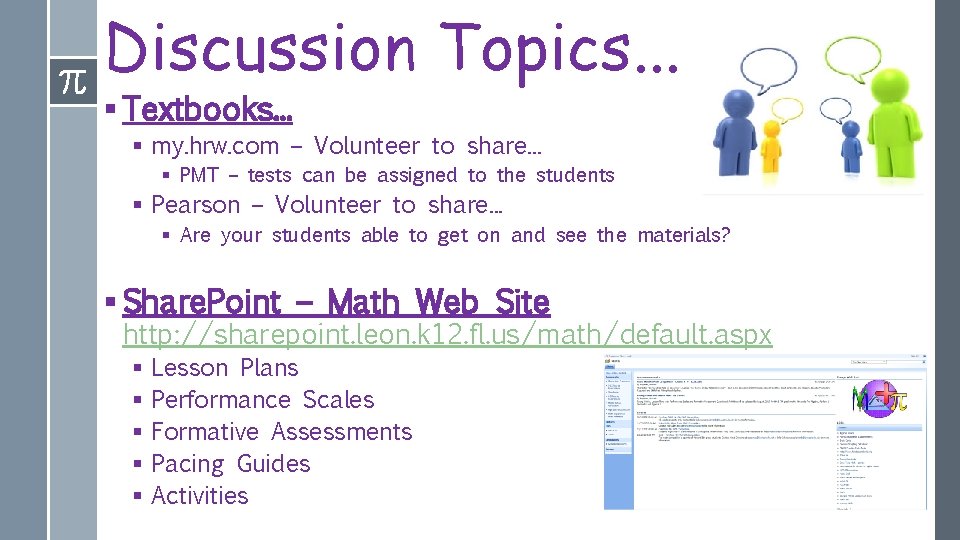
Discussion Topics. . . § Textbooks. . . § my. hrw. com – Volunteer to share. . . § PMT – tests can be assigned to the students § Pearson – Volunteer to share. . . § Are your students able to get on and see the materials? § Share. Point – Math Web Site http: //sharepoint. leon. k 12. fl. us/math/default. aspx § § § Lesson Plans Performance Scales Formative Assessments Pacing Guides Activities
Discussion Topics. . . §Homework § What is its purpose? § How do you count it as a grade? § How do you check it? § What is working in your room with homework that you like? § What is NOT working in your room with homework that you wish could change? § What changes “could” be made in your classroom with homework?
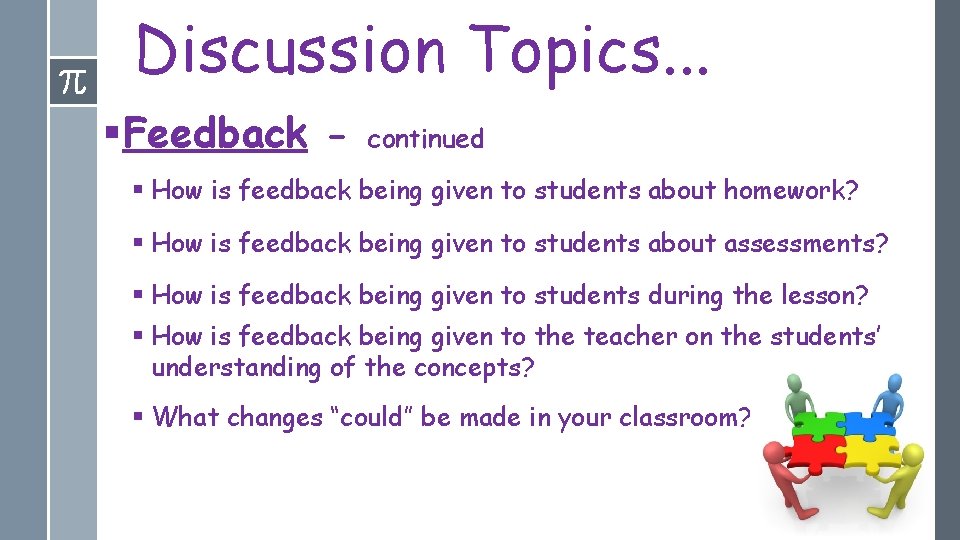
Discussion Topics. . . §Feedback § What does this word mean to you? “What is Feedback? ØFeedback is any response from a teacher in regard to a student’s performance or behavior. ØIt can be verbal, written or gestural. ØThe purpose of feedback in the learning process is to improve a student’s performance – definitely NOT put a damper on it. ØThe ultimate goal of feedback is to provide students with an “I can do this” attitude. ” Cited from: https: //plus. google. com/u/0/101796324413630088793#ixzz 3 n 4 HQnw. Qx
Discussion Topics. . . §Feedback - continued § How is feedback being given to students about homework? § How is feedback being given to students about assessments? § How is feedback being given to students during the lesson? § How is feedback being given to the teacher on the students’ understanding of the concepts? § What changes “could” be made in your classroom?
Discussion Topics. . . › Reteaching/Retesting and/or Test Corrections › Discuss at your table the breakdown of your grades at your table for tests, quizzes, homework, classwork, etc. › Looking at Data – What percentage of your class is making a 70% or above? How are you reteaching / retesting? › What are you doing about students that do NOT make a 70% or above? How are you reteaching / retesting? › Have you used “small groups” to reteach with you while the others work with a partner on an assignment? › Retesting. . . What is its purpose? › Test Corrections. . . What is its purpose?
Wrap Up § Survey from Algebra Nation § Survey/Needs Assessment § Questions or Comments Thank you so much for taking your time to be here today. Please share what you learned today with the other teachers at your school. Next Secondary Math Instructional Leaders Training is Thursday, February 4, 2016. Ideas or Suggestions for Topics? ? ?