
GOOD MORNING 1 DR PRITI D DESAI ASSOCIATE



- Slides: 87
GOOD MORNING 1
DR PRITI D DESAI ASSOCIATE PROFESSOR CONSERVATIVE ND ENDODONTIC DENTISTRY GURUNANAK INSTITUTE OFDENTAL SCIENCE AND RESEARCH, PANIHATI KOLKATA-127 2
DENTISTRY �Dentistry is branch of medical science which deals with diagnosis , treatment plane, prognosis and prevention of disease of the teeth 3
Conservative Dentistry �Conservative dentistry is branch of 4 dentistry which deals with the diagnosis, treatment plan , prognosis, and prevention of disease of hard structure of teeth(enamel dentin , cementum), restoring them to their own form , function and esthetics there by maintaining the stomatognathic system.
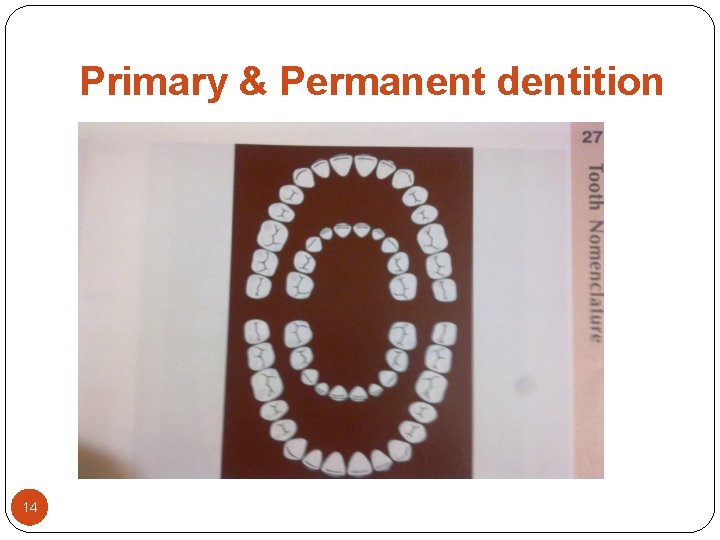
Tooth �Tooth is mineralized organs in the mouth that are used to pronounce letters and mostly to chew on food. �Two sets of teeth comes in human life 1. Primary dentition - total 20 teeth are present 2. Permanent t dentition - total 32 teeth are present 5
Function of teeth are- 1. Mastication, 2. Esthetic (appearance) 3. Phonetics(speech) 6
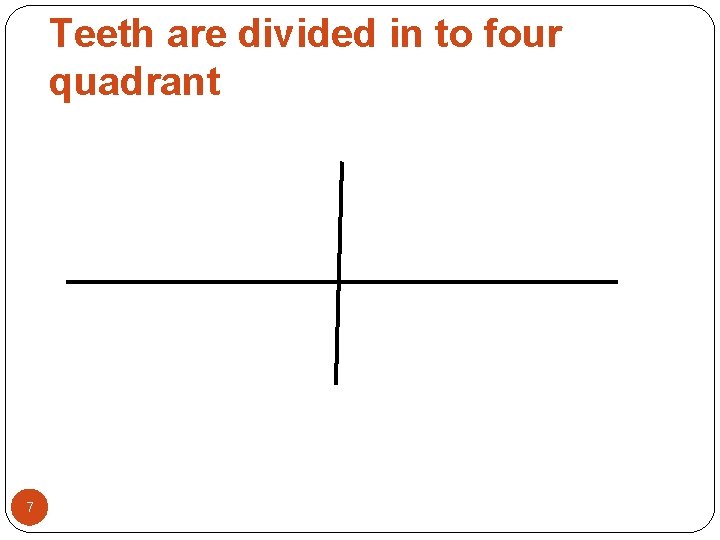
Teeth are divided in to four quadrant 7
Primary dentitionmilk teeth or deciduous teeth � Central incisor � These five set of teeth comes in each � Lateral incisor quadrant � Canine 8 � First molar 1. upper right, � Second molar 2. upper left 3. Lower right, 4. lower left
approximate appearance in mouth � Upper Jaw �Central incisors – 7½ months �Lateral incisors – 9 months 9 � Lower Jaw �Central incisors – 6 months �Lateral incisors – 7 months �Cuspid – 18 months �Cuspid – 16 months �Primary or first molars –
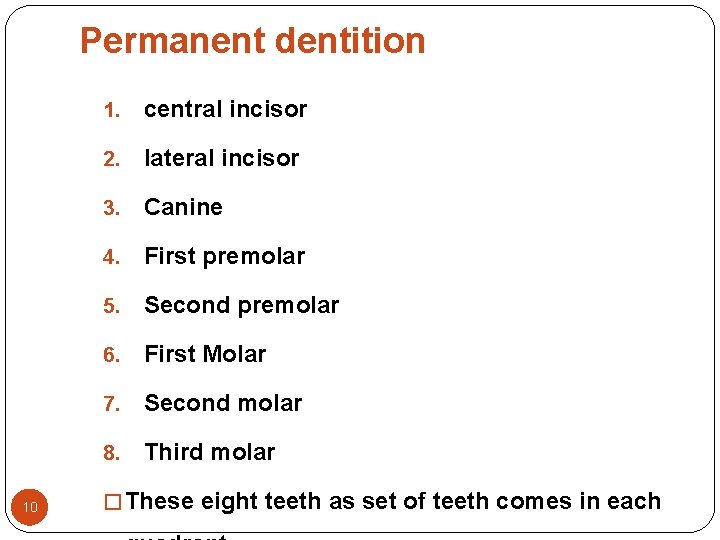
Permanent dentition 10 1. central incisor 2. lateral incisor 3. Canine 4. First premolar 5. Second premolar 6. First Molar 7. Second molar 8. Third molar � These eight teeth as set of teeth comes in each
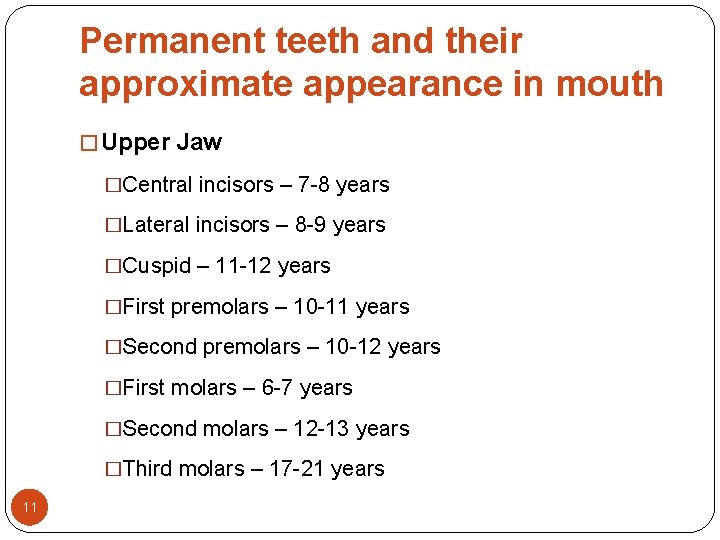
Permanent teeth and their approximate appearance in mouth � Upper Jaw �Central incisors – 7 -8 years �Lateral incisors – 8 -9 years �Cuspid – 11 -12 years �First premolars – 10 -11 years �Second premolars – 10 -12 years �First molars – 6 -7 years �Second molars – 12 -13 years �Third molars – 17 -21 years 11
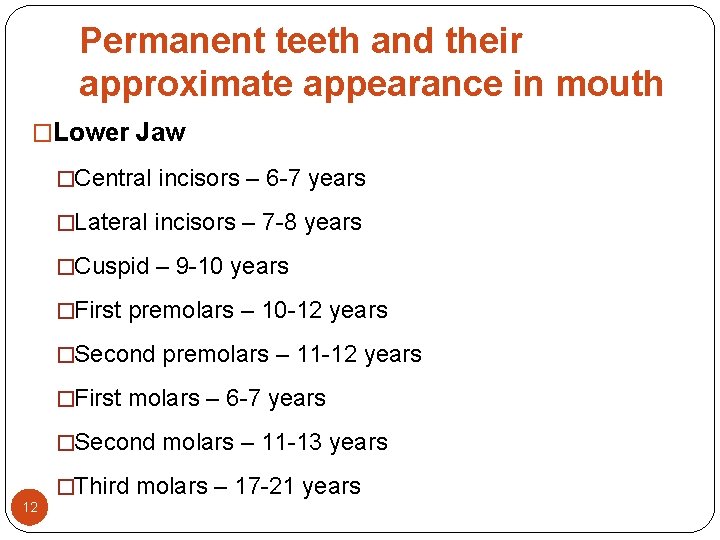
Permanent teeth and their approximate appearance in mouth �Lower Jaw �Central incisors – 6 -7 years �Lateral incisors – 7 -8 years �Cuspid – 9 -10 years �First premolars – 10 -12 years �Second premolars – 11 -12 years �First molars – 6 -7 years �Second molars – 11 -13 years �Third molars – 17 -21 years 12
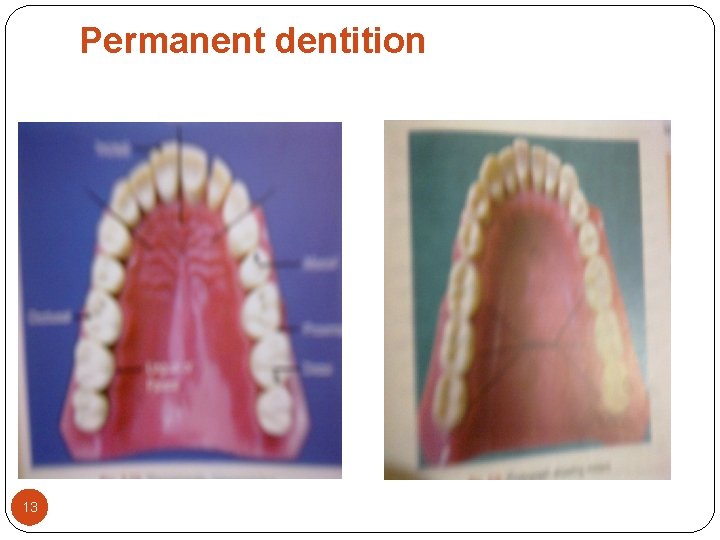
Permanent dentition 13
Primary & Permanent dentition 14
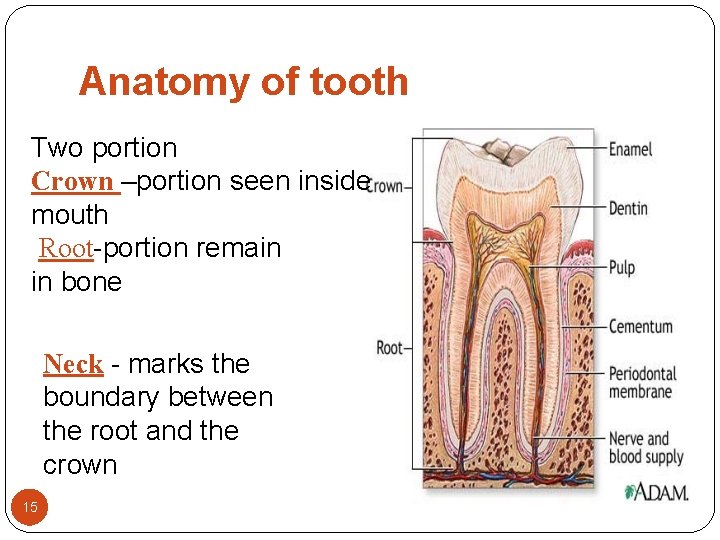
Anatomy of tooth Two portion Crown –portion seen inside mouth Root-portion remain in bone Neck - marks the boundary between the root and the crown 15
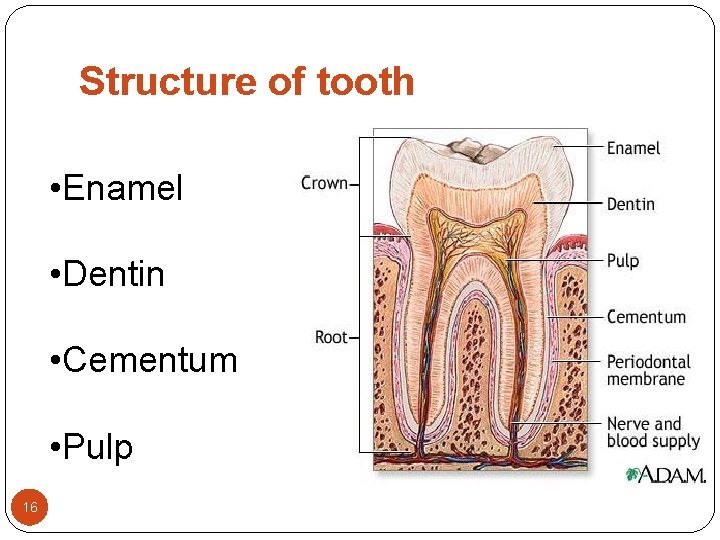
Structure of tooth • Enamel • Dentin • Cementum • Pulp 16
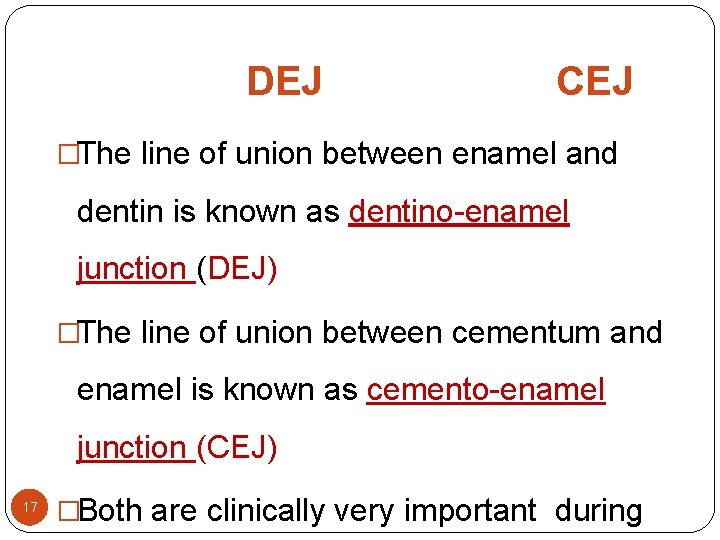
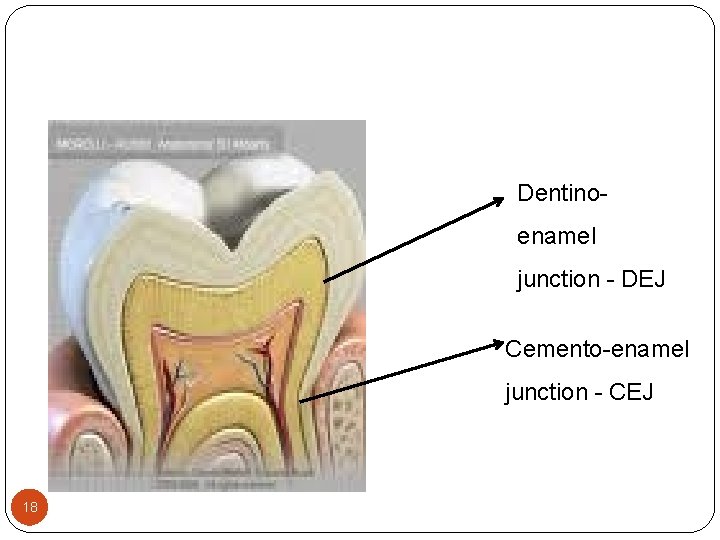
DEJ CEJ �The line of union between enamel and dentin is known as dentino-enamel junction (DEJ) �The line of union between cementum and enamel is known as cemento-enamel junction (CEJ) 17 �Both are clinically very important during
Dentinoenamel junction - DEJ Cemento-enamel junction - CEJ 18
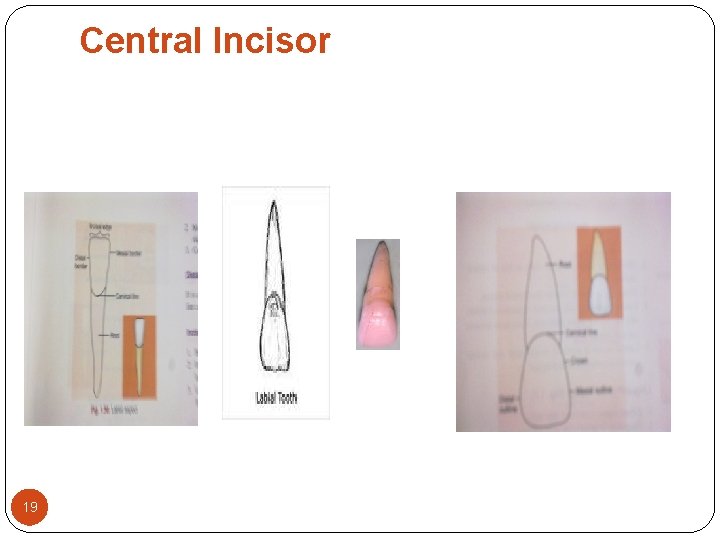
Central Incisor 19
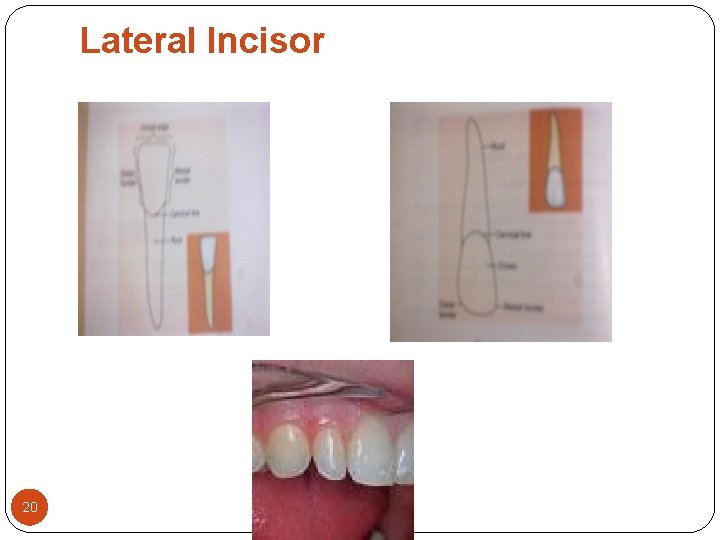
Lateral Incisor 20
Canine 21
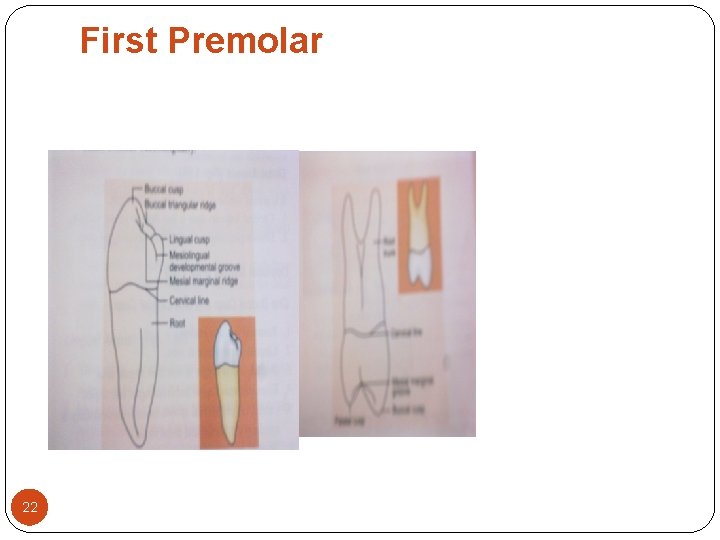
First Premolar 22
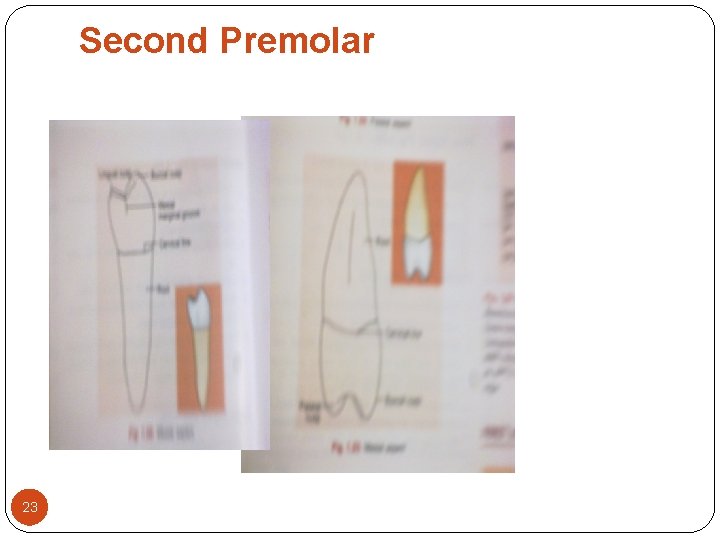
Second Premolar 23
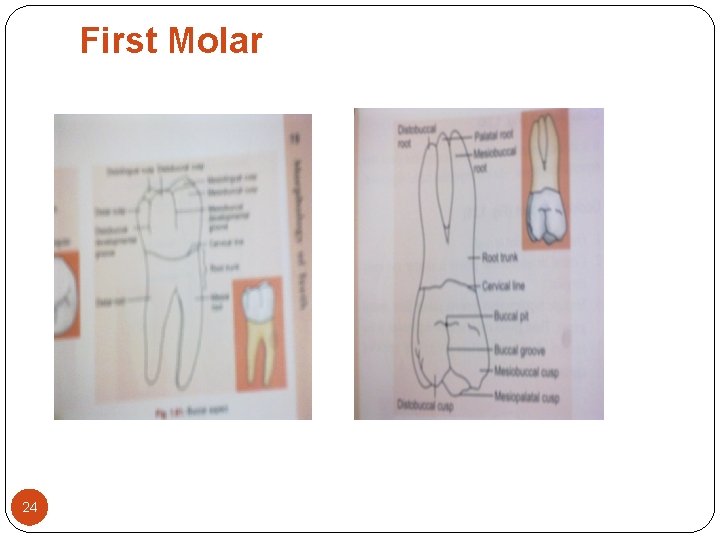
First Molar 24
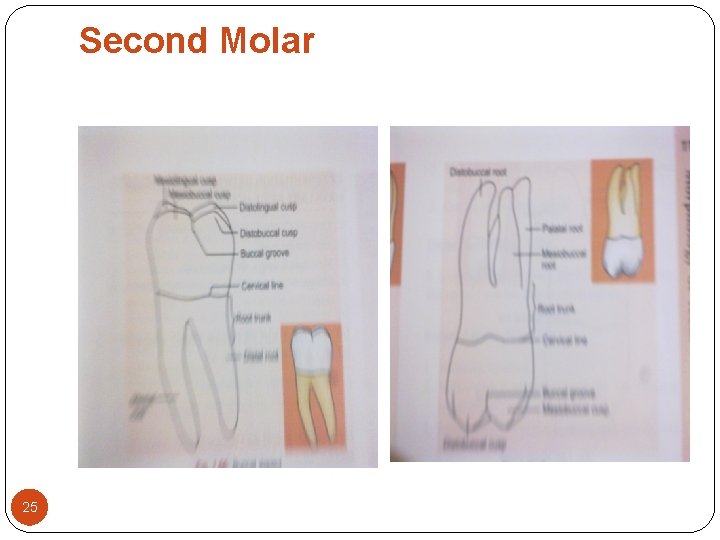
Second Molar 25
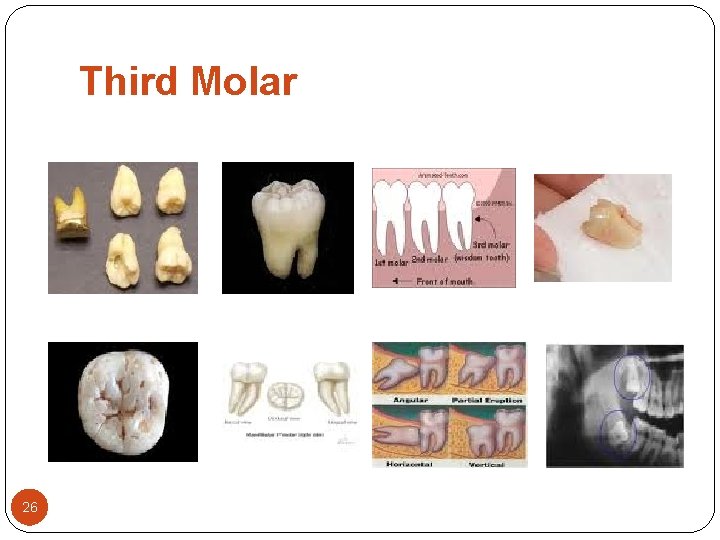
Third Molar 26
Tooth notation system � There are different tooth numbering system for naming a specific tooth. � Three most common system used are – 27 1. FDI(world federation notation) 2. Universal numbering system 3. Zsigmondy palmer notation � FDI system used world wide and universal is used
Tooth notation system �Two categories � 1 -those having similar notation for the teeth in each segment � 2 -Those having a different notation for 28 the teeth in each segment
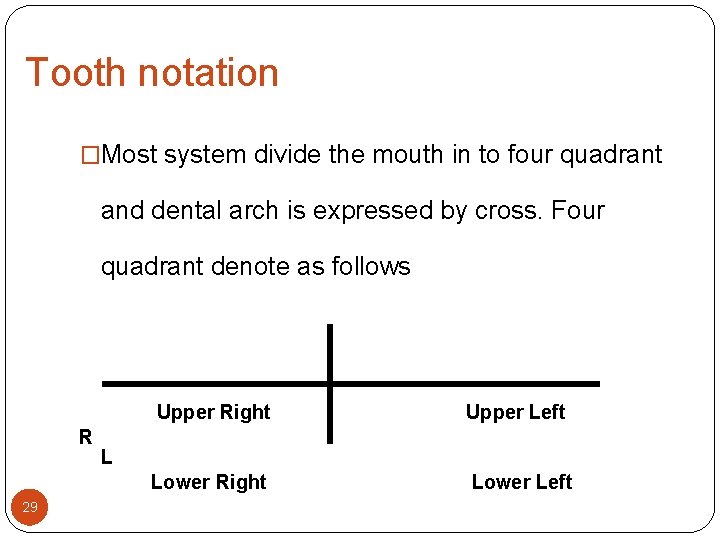
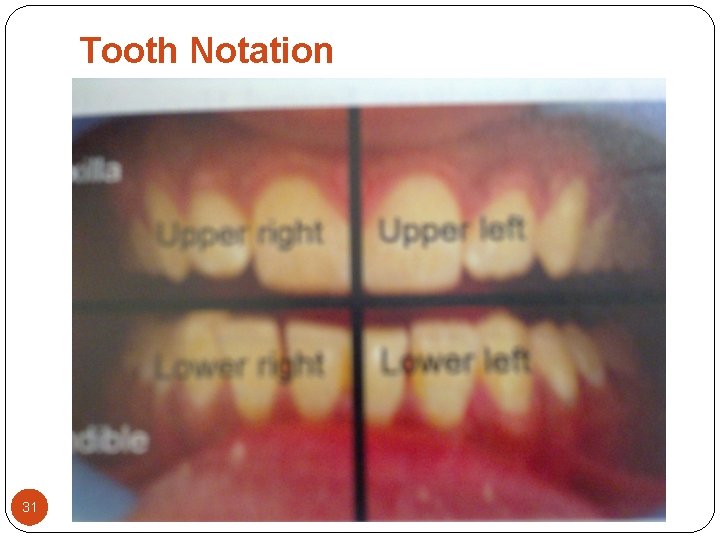
Tooth notation �Most system divide the mouth in to four quadrant and dental arch is expressed by cross. Four quadrant denote as follows R 29 Upper Right Upper Left Lower Right Lower Left L
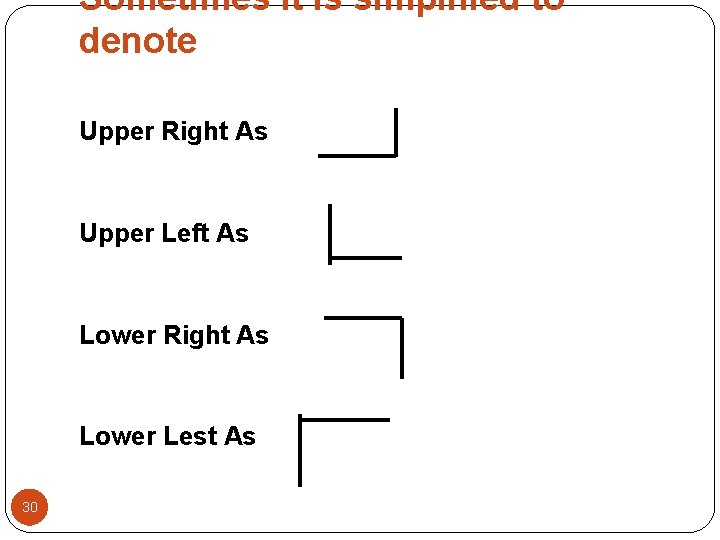
Sometimes it is simplified to denote Upper Right As Upper Left As Lower Right As Lower Lest As 30
Tooth Notation 31
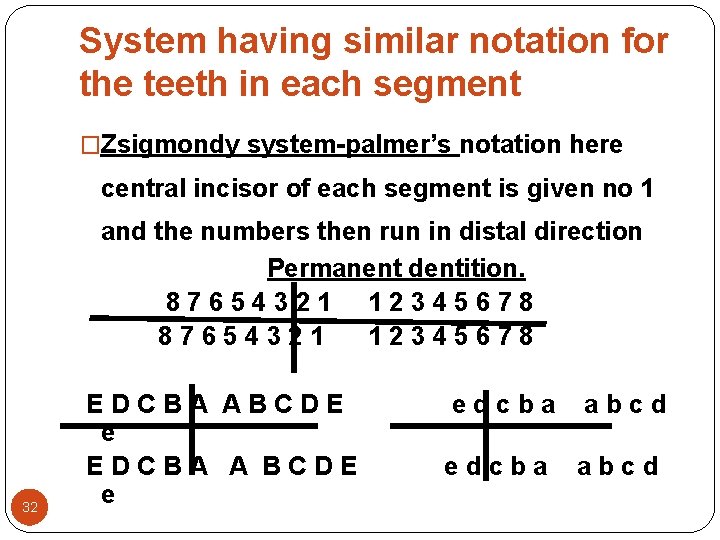
System having similar notation for the teeth in each segment �Zsigmondy system-palmer’s notation here central incisor of each segment is given no 1 and the numbers then run in distal direction Permanent dentition. 87654321 12345678 32 EDCBA ABCDE e EDCBA A BCDE e edcba abcd
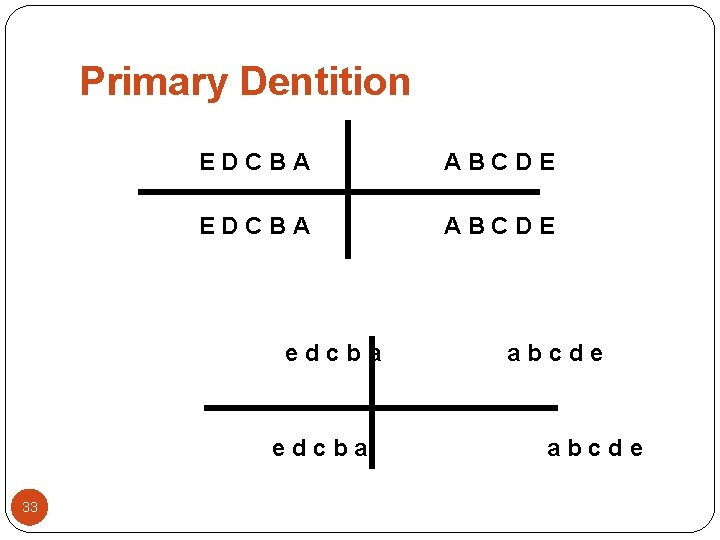
Primary Dentition EDCBA ABCDE edcba 33 abcde
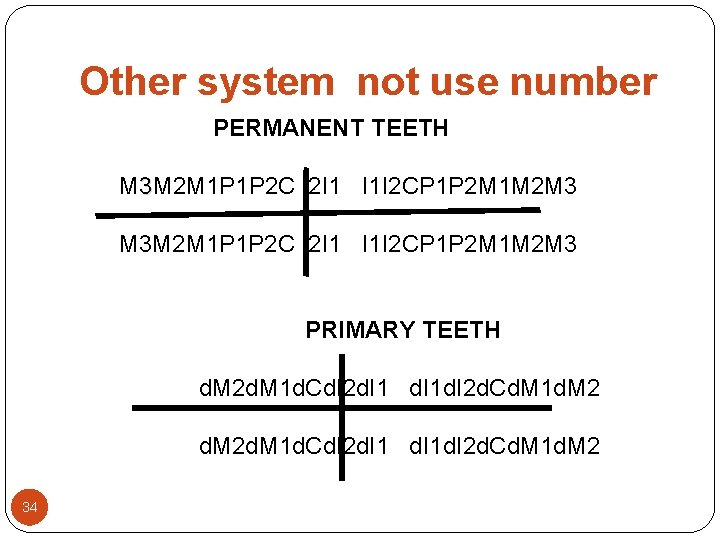
Other system not use number PERMANENT TEETH M 3 M 2 M 1 P 1 P 2 C I 2 I 1 I 1 I 2 CP 1 P 2 M 1 M 2 M 3 PRIMARY TEETH d. M 2 d. M 1 d. Cd. I 2 d. I 1 d. I 2 d. Cd. M 1 d. M 2 34
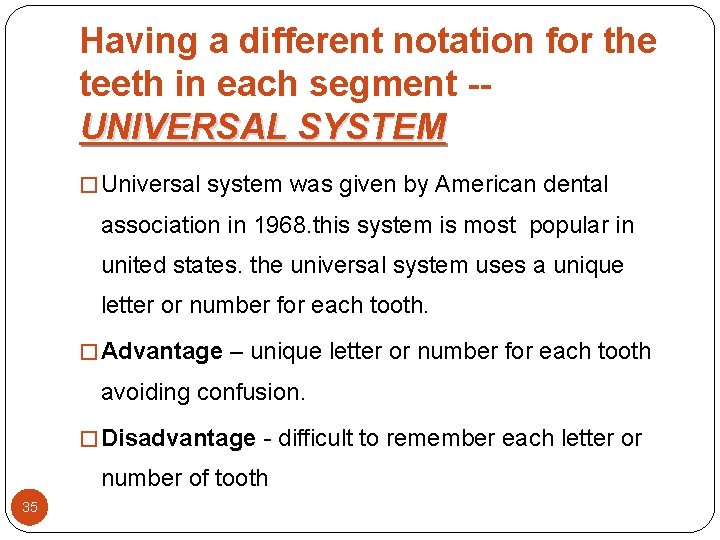
Having a different notation for the teeth in each segment -UNIVERSAL SYSTEM � Universal system was given by American dental association in 1968. this system is most popular in united states. the universal system uses a unique letter or number for each tooth. � Advantage – unique letter or number for each tooth avoiding confusion. � Disadvantage - difficult to remember each letter or number of tooth 35
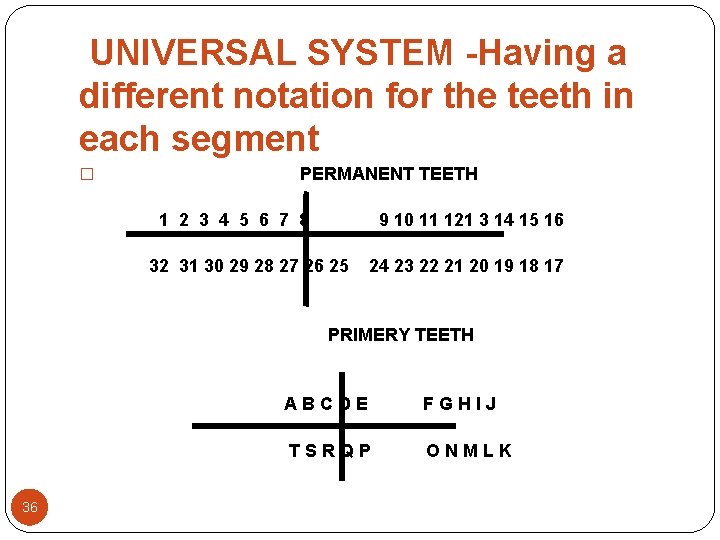
UNIVERSAL SYSTEM -Having a different notation for the teeth in each segment � PERMANENT TEETH 1 2 3 4 5 6 7 8 9 10 11 121 3 14 15 16 32 31 30 29 28 27 26 25 24 23 22 21 20 19 18 17 PRIMERY TEETH 36 ABCDE FGHIJ TSRQP ONMLK
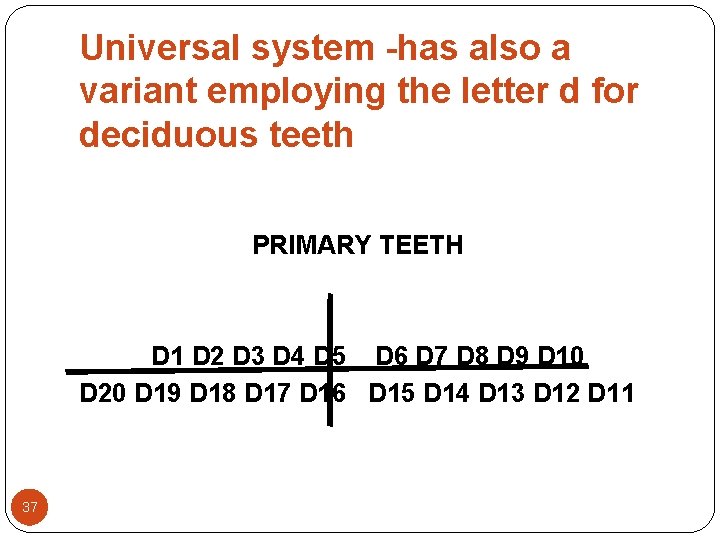
Universal system -has also a variant employing the letter d for deciduous teeth PRIMARY TEETH D 1 D 2 D 3 D 4 D 5 D 6 D 7 D 8 D 9 D 10 D 20 D 19 D 18 D 17 D 16 D 15 D 14 D 13 D 12 D 11 37
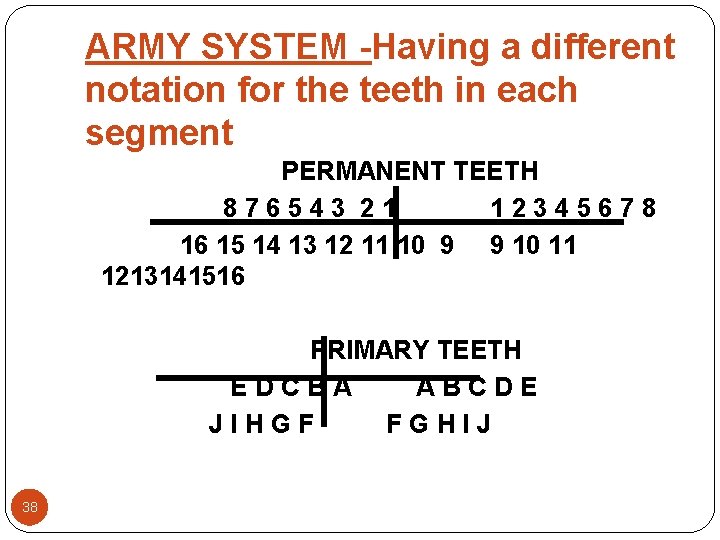
ARMY SYSTEM -Having a different notation for the teeth in each segment PERMANENT TEETH 876543 21 12345678 16 15 14 13 12 11 10 9 9 10 11 1213141516 PRIMARY TEETH EDCBA ABCDE JIHGF FGHIJ 38
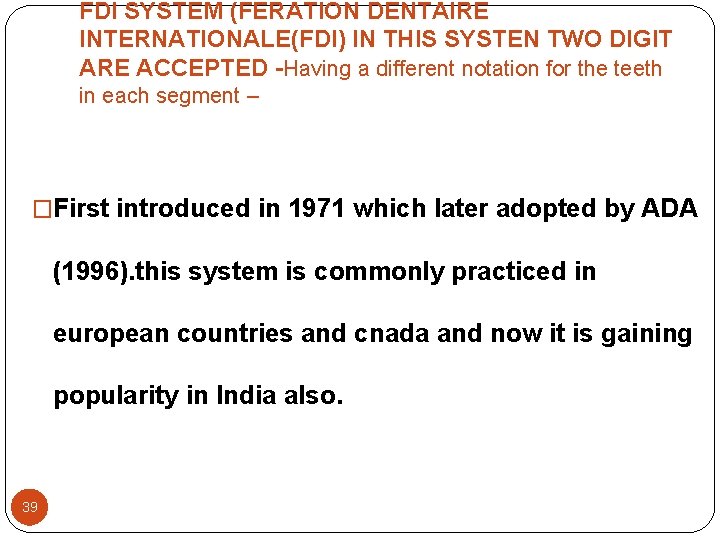
FDI SYSTEM (FERATION DENTAIRE INTERNATIONALE(FDI) IN THIS SYSTEN TWO DIGIT ARE ACCEPTED -Having a different notation for the teeth in each segment – �First introduced in 1971 which later adopted by ADA (1996). this system is commonly practiced in european countries and cnada and now it is gaining popularity in India also. 39
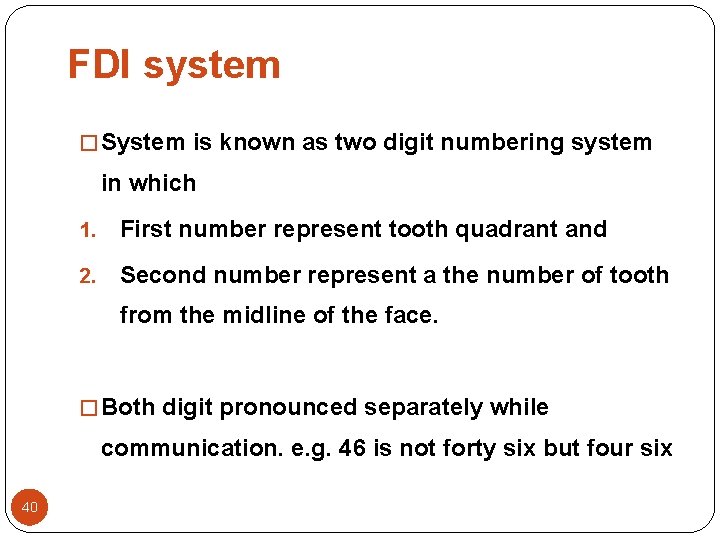
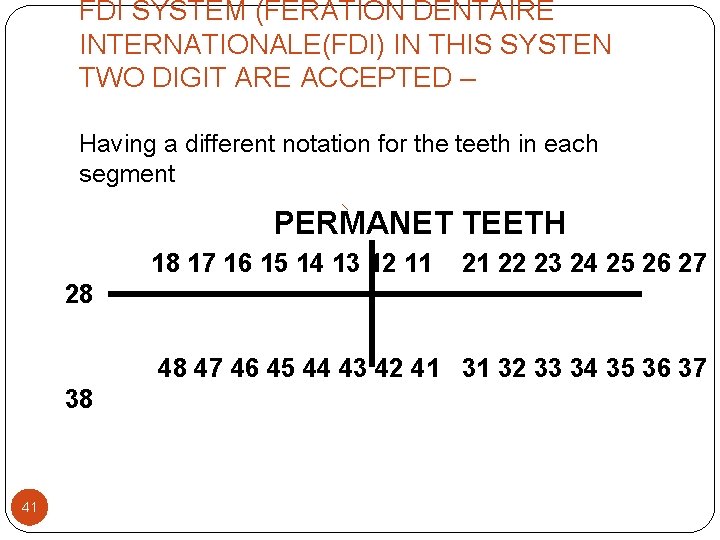
FDI system � System is known as two digit numbering system in which 1. First number represent tooth quadrant and 2. Second number represent a the number of tooth from the midline of the face. � Both digit pronounced separately while communication. e. g. 46 is not forty six but four six 40
FDI SYSTEM (FERATION DENTAIRE INTERNATIONALE(FDI) IN THIS SYSTEN TWO DIGIT ARE ACCEPTED – Having a different notation for the teeth in each segment PERMANET TEETH 18 17 16 15 14 13 12 11 21 22 23 24 25 26 27 28 48 47 46 45 44 43 42 41 31 32 33 34 35 36 37 38 41
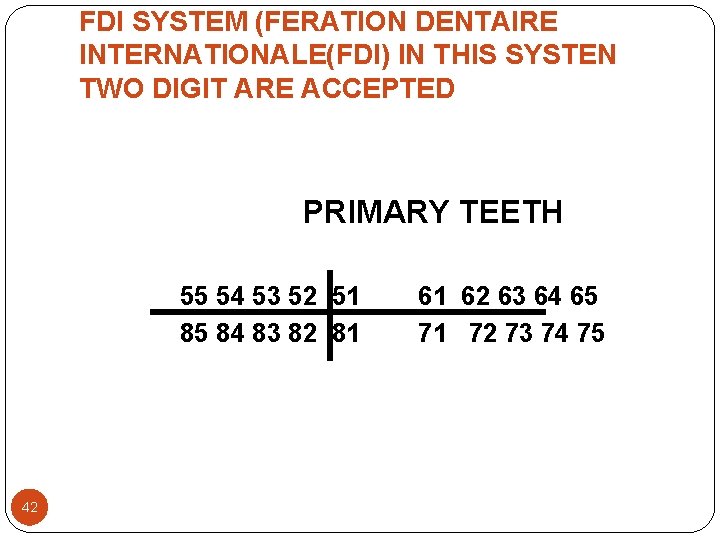
FDI SYSTEM (FERATION DENTAIRE INTERNATIONALE(FDI) IN THIS SYSTEN TWO DIGIT ARE ACCEPTED PRIMARY TEETH 55 54 53 52 51 85 84 83 82 81 42 61 62 63 64 65 71 72 73 74 75
�Out of existing system for noting the dentition there is no system which is full proof �The safest method is to write full description of the teeth e. g. 1. upper left first permanent molar, 43 2. lower right first primary molar
Tooth �All the parts of the body get repaired by physiologic process when it get damaged but when tooth structure is get damaged it is not repaired by itself especially hard structure of tooth. �so tooth is not repairable tissue of the body so it require replacement of tooth structure when ever there is loss of tooth structure. �Loss of tooth structure occurs due to various 44
Disease Of The Teeth � Caries � Discoloration of teeth � Attrition � Hypoplasia of tooth � Abrasion � Erosion � Abfraction � Fracture of tooth 45 � Hypo calcification of tooth � Abnormal form of tooth– peg shape lateral, taurodontism
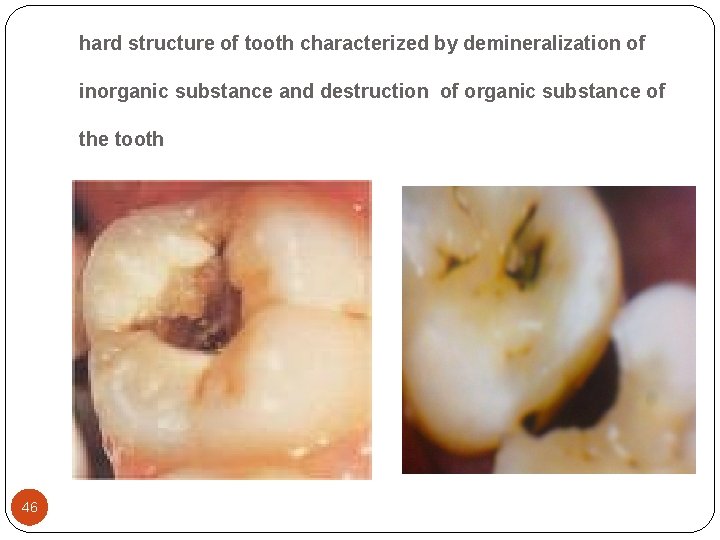
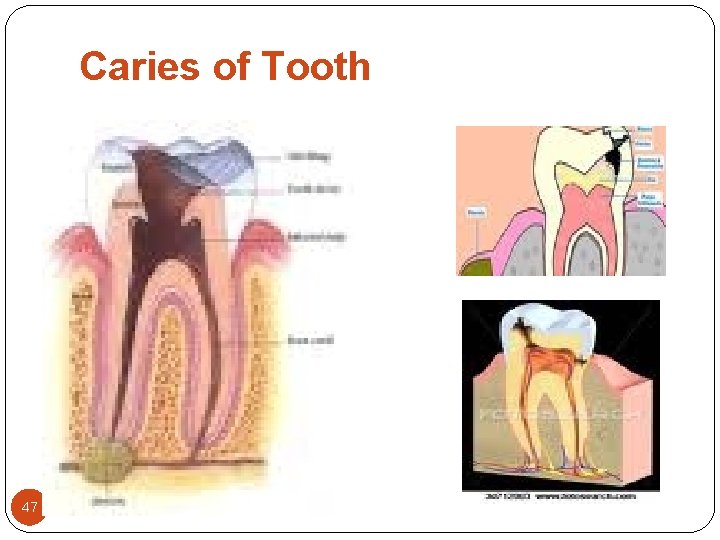
hard structure of tooth characterized by demineralization of inorganic substance and destruction of organic substance of the tooth 46
Caries of Tooth 47
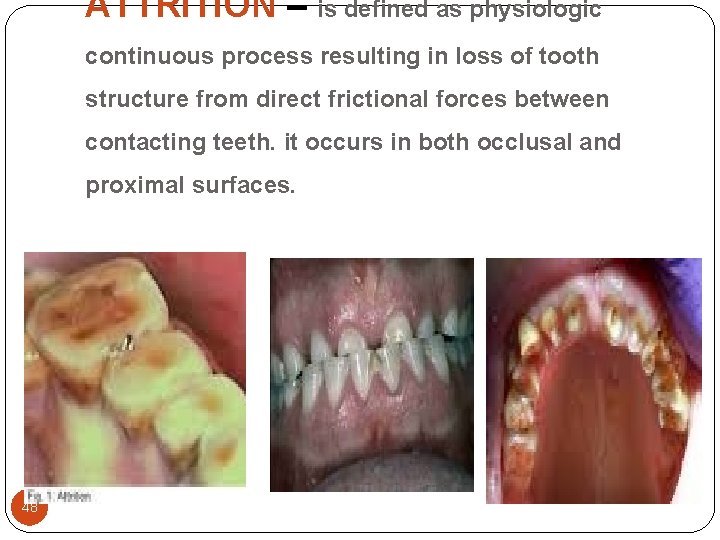
ATTRITION – is defined as physiologic continuous process resulting in loss of tooth structure from direct frictional forces between contacting teeth. it occurs in both occlusal and proximal surfaces. 48
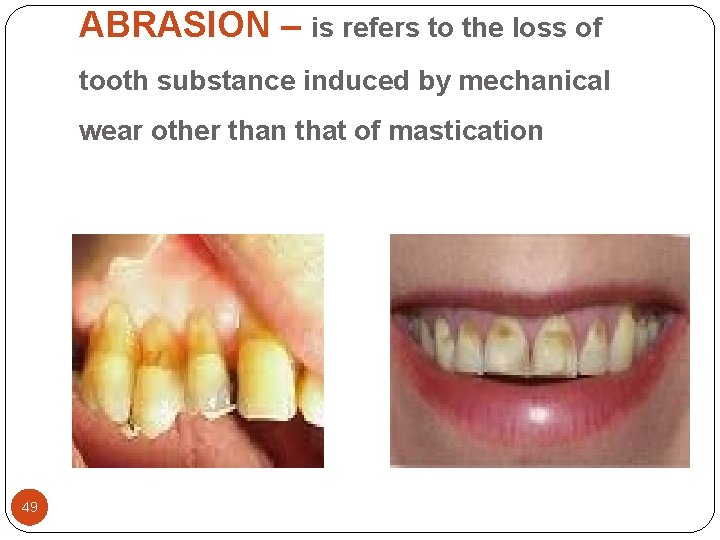
ABRASION – is refers to the loss of tooth substance induced by mechanical wear other than that of mastication 49
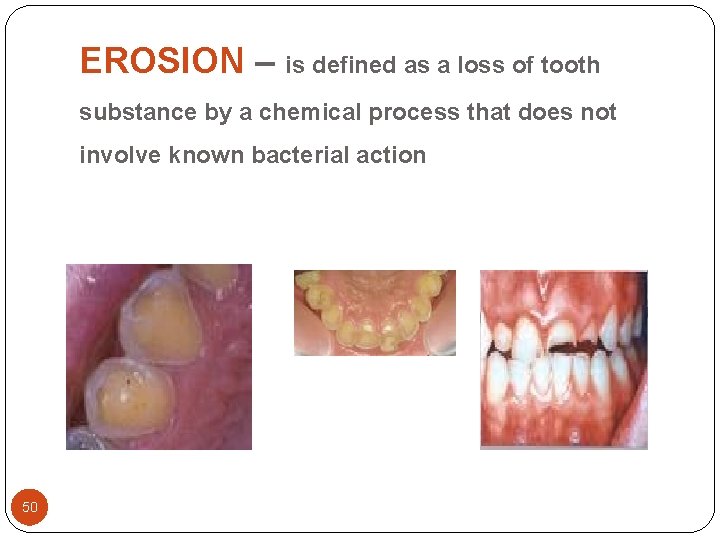
EROSION – is defined as a loss of tooth substance by a chemical process that does not involve known bacterial action 50
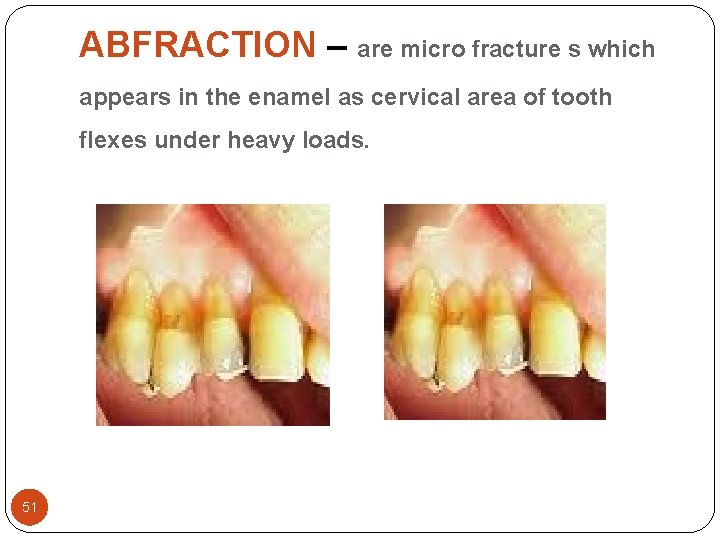
ABFRACTION – are micro fracture s which appears in the enamel as cervical area of tooth flexes under heavy loads. 51
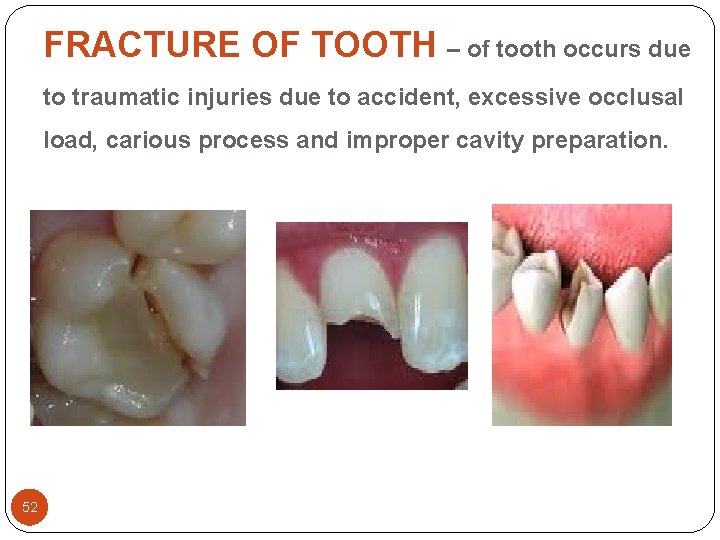
FRACTURE OF TOOTH – of tooth occurs due to traumatic injuries due to accident, excessive occlusal load, carious process and improper cavity preparation. 52
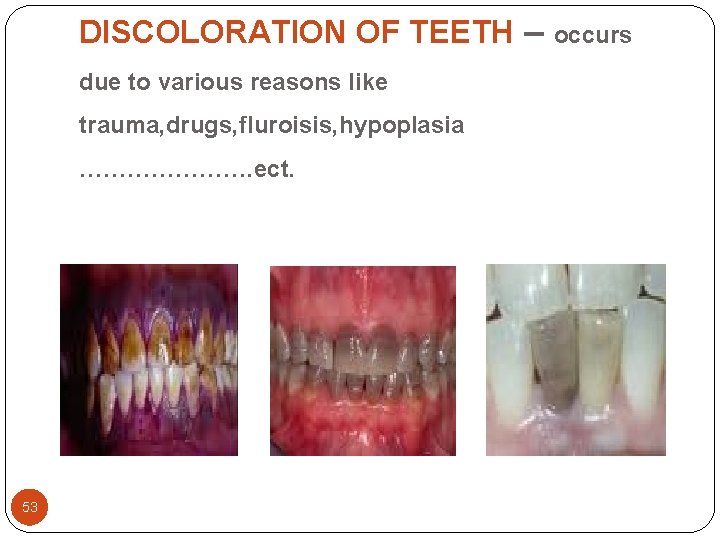
DISCOLORATION OF TEETH – due to various reasons like trauma, drugs, fluroisis, hypoplasia …………………. ect. 53 occurs
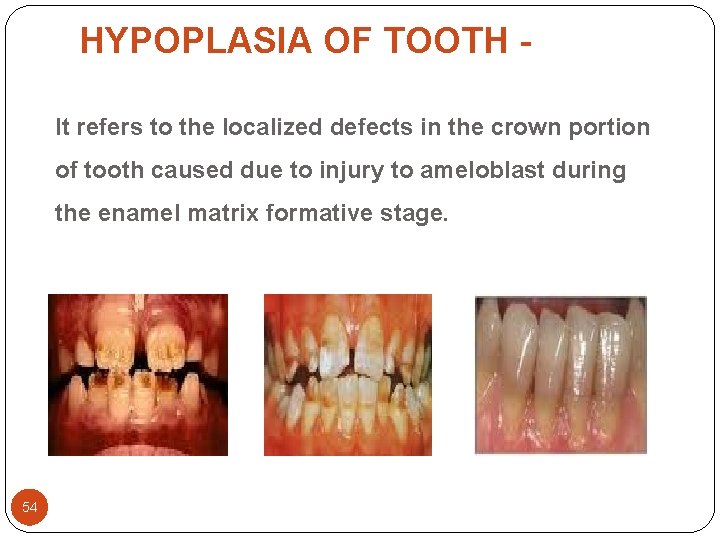
HYPOPLASIA OF TOOTH It refers to the localized defects in the crown portion of tooth caused due to injury to ameloblast during the enamel matrix formative stage. 54
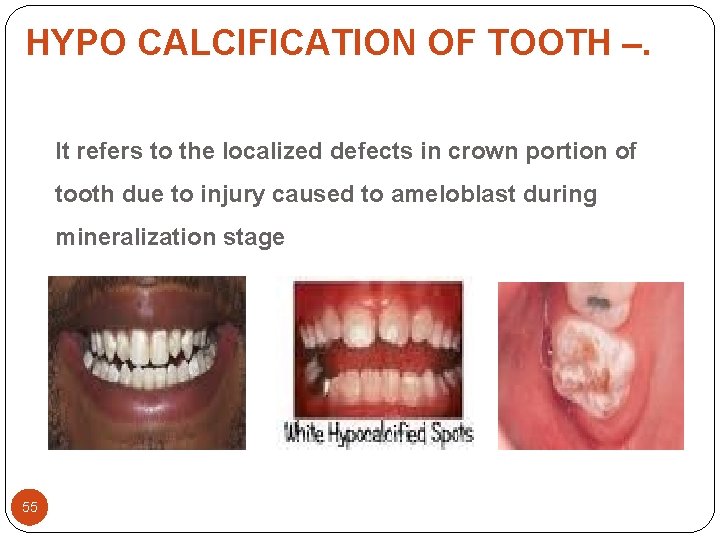
HYPO CALCIFICATION OF TOOTH –. It refers to the localized defects in crown portion of tooth due to injury caused to ameloblast during mineralization stage 55
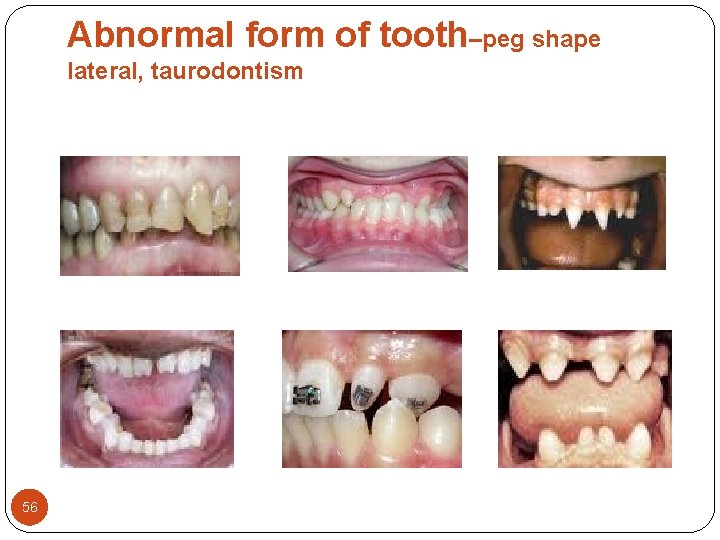
Abnormal form of tooth–peg shape lateral, taurodontism 56
Nomenclature �For understanding the concept s of conservative dentistry it is essential for clinician be thoroughly familiar with the technical terms used during treatment, these terms helps in recording the patient’s sign and symptoms which can be useful during subsequent visits of the patient. 57
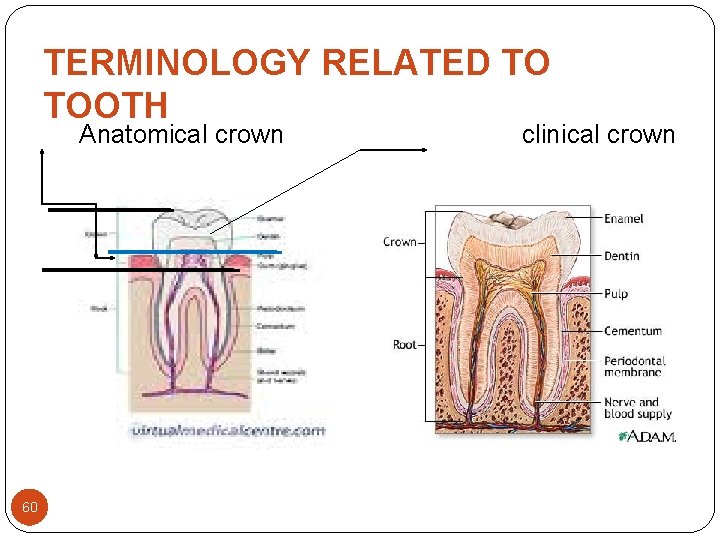
Tooth Crown �Are of two types �Anatomical tooth crown- means portion of tooth that is covered with enamel. �Clinical tooth crown- is portion of tooth that is exposed in the oral cavity. 58
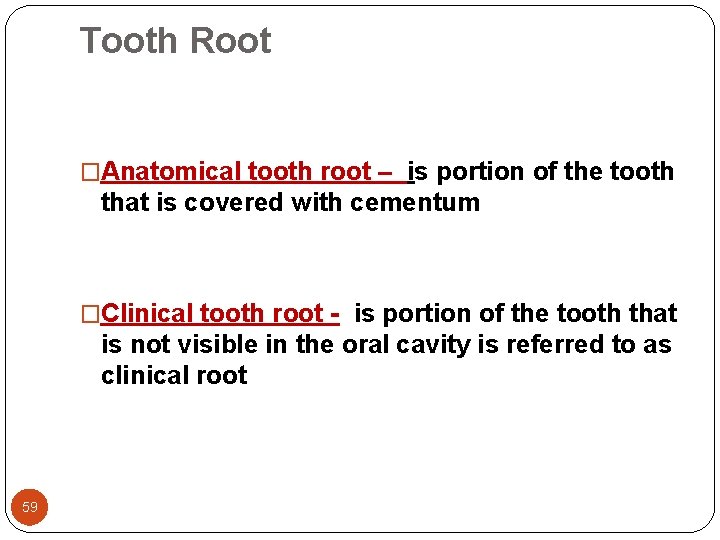
Tooth Root �Anatomical tooth root – is portion of the tooth that is covered with cementum �Clinical tooth root - is portion of the tooth that is not visible in the oral cavity is referred to as clinical root 59
TERMINOLOGY RELATED TO TOOTH Anatomical crown 60 clinical crown
Terminology Related To Tooth � Different surface of the tooth are named according to their adjoining anatomic structures e. g. � facial surface- facing toward lips-labial surface-F / La � Facing towards cheek –buccal surface - B � Lingual surface –facing toward tongue - L / Li 61� Palatal surface – facing toward palate -P
Terminology Related To Tooth �Mesial surface-facing toward mid line - M �Distal surface –facing away from midline – D �Incisal surface-functioning edge of the incisor and canine – I �Occlusal surface-functioning surface of molar and premolar -O �Cervical portion –portion of tooth related to the cervical 62 line or neck of teeth
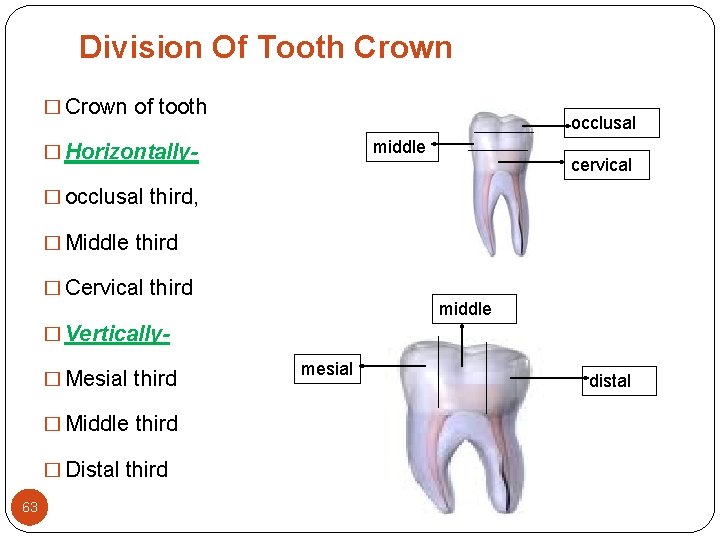
Division Of Tooth Crown � Crown of tooth occlusal middle � Horizontally- cervical � occlusal third, � Middle third � Cervical third middle � Vertically� Mesial third � Middle third � Distal third 63 mesial distal
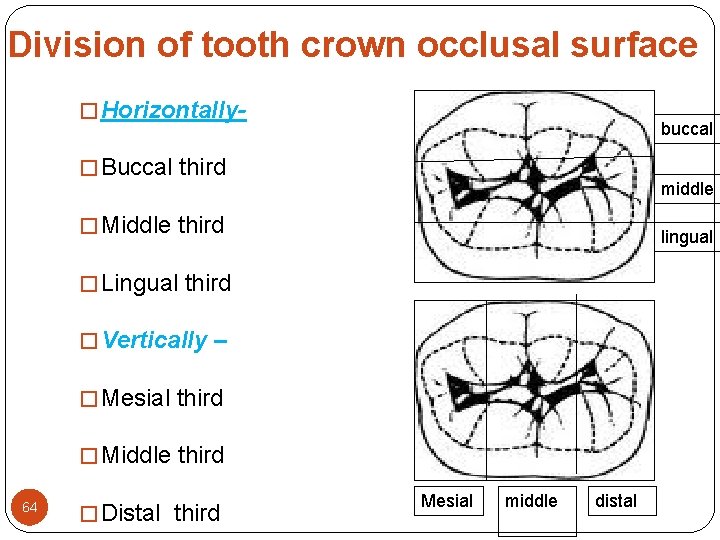
Division of tooth crown occlusal surface � Horizontally- buccal � Buccal third middle � Middle third lingual � Lingual third � Vertically – � Mesial third � Middle third 64 � Distal third Mesial middle distal
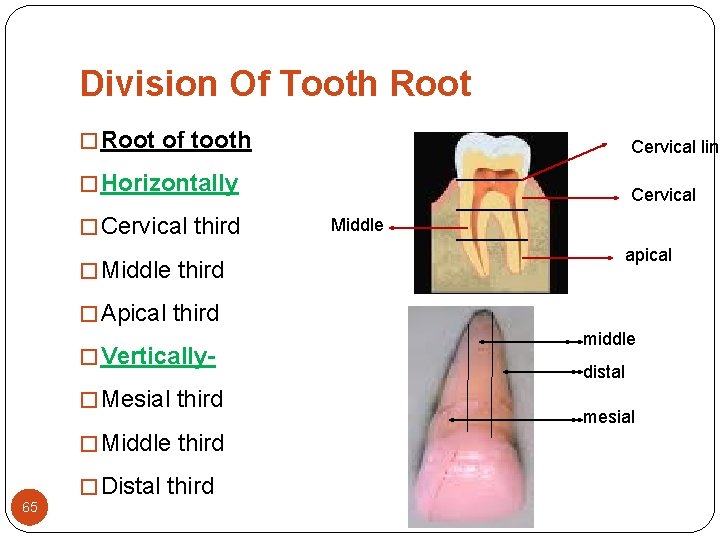
Division Of Tooth Root � Root of tooth Cervical line � Horizontally Cervical � Cervical third Middle apical � Middle third � Apical third � Vertically� Mesial third � Middle third � Distal third 65 middle distal mesial
Cavity & Preparation Cavity �Cavity – a cavity refers to as a defect in enamel or both enamel and dentin subsequent to the destruction caused by disease. (Breach in the surface integrity of the tooth) �Cavity Preparation – as removal of disease structure and the cutting or preparation of remaining tooth structure to best receive a restorative material. 66
Tooth Preparation �Now many indication for teeth are not due to caries and there for it refers to as tooth preparation. �Tooth Preparation – is the mechanical alteration of defective , diseased or injured tooth structure to best receive a restorative material that will reestablish a healthy state for the tooth including esthetic corrections where indicated 67 along with normal form and function.
Restoration�After cavity preparation we replaced the tooth structure with artificial material is known as restoration �Restoration- is artificial replacement of lost tooth structure in proper form and function with various restorative material. 68
Functions Of Restoration 1. Repair of loss tooth structure 2. Establish function of teeth 3. Establish loss contact between teeth 4. Removal of all defects and provide necessary protection to pulp 5. Conservation of tooth 6. Improving appearance of individual 69
Different types of restorative materials � Silver Amalgam � Cast Gold � Direct Filling Gold (Gold Foil) � Glass-ionomer � Composite Resin � Ceramic 70
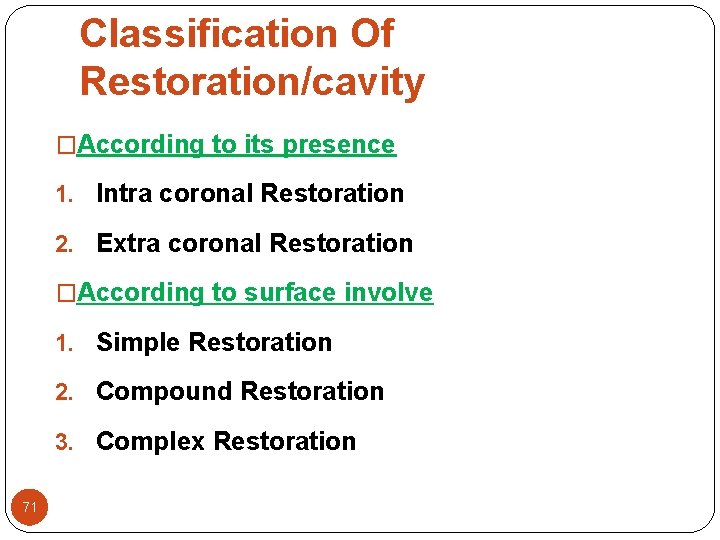
Classification Of Restoration/cavity �According to its presence 1. Intra coronal Restoration 2. Extra coronal Restoration �According to surface involve 1. Simple Restoration 2. Compound Restoration 3. Complex Restoration 71
Classification Of Restoration �Temporary restoration – is used for short period of time like for 2 - 3 days or one week or 15 days or one month �Permanent restoration – is used for long period of time like 5 to 6 years or 10 to 15 years. 72
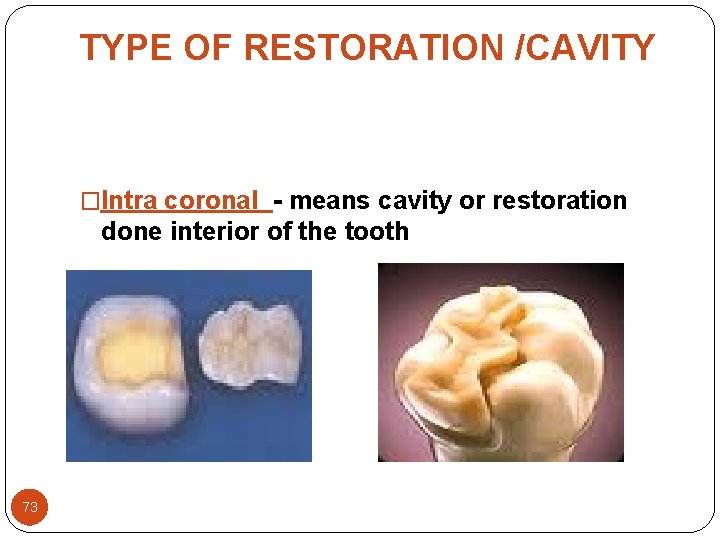
TYPE OF RESTORATION /CAVITY �Intra coronal - means cavity or restoration done interior of the tooth 73
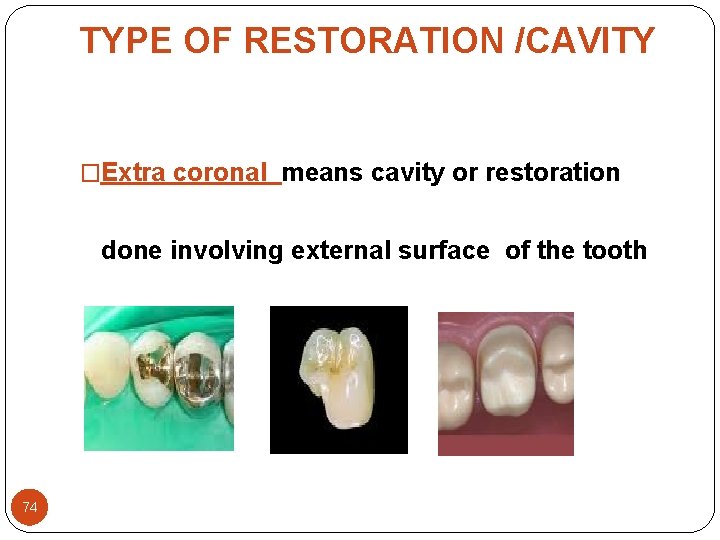
TYPE OF RESTORATION /CAVITY �Extra coronal means cavity or restoration done involving external surface of the tooth 74
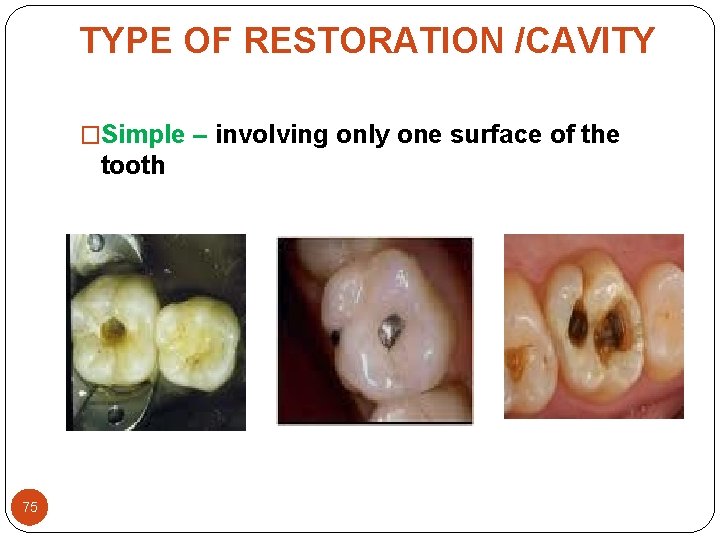
TYPE OF RESTORATION /CAVITY �Simple – involving only one surface of the tooth 75
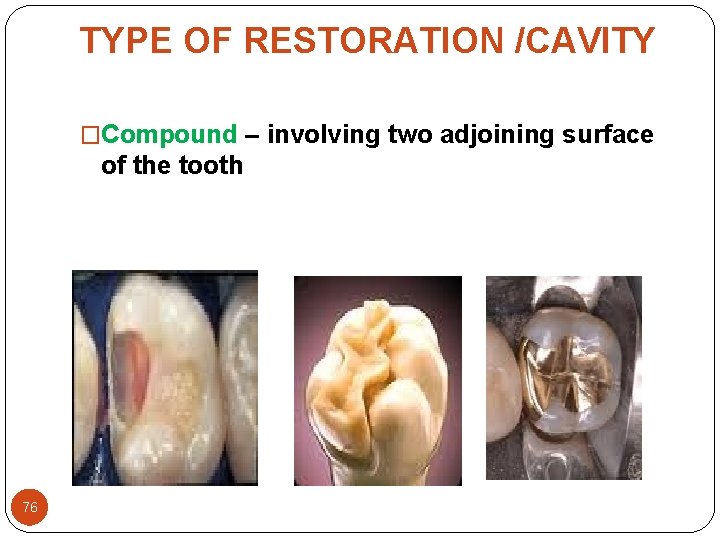
TYPE OF RESTORATION /CAVITY �Compound – involving two adjoining surface of the tooth 76
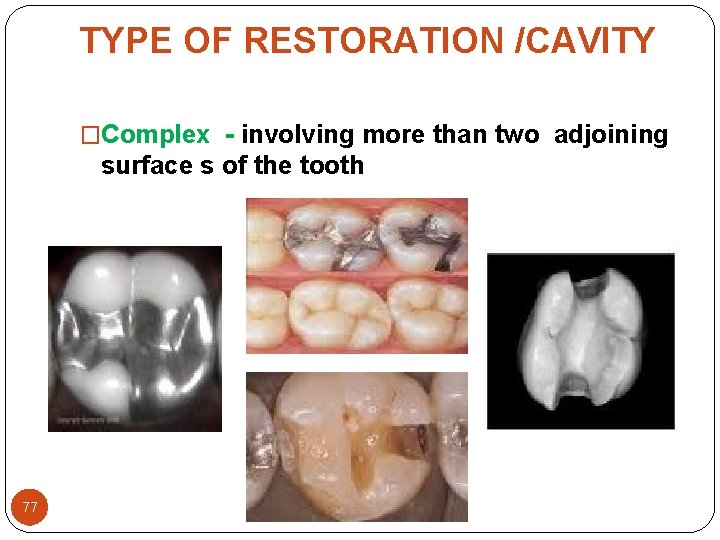
TYPE OF RESTORATION /CAVITY �Complex - involving more than two adjoining surface s of the tooth 77
Tooth Preparation �Preparation involving occlusal surface is -O �Preparation involving the mesial and occlusal surface is – MO �Preparation involving the distal and occlusal surface is - DO �Preparation involving the mesial occlusal and distal surfaces is - MOD 78
TOOTH PREPARATION TERMINOLOGY �Occlusal -O �Mesio-occlusal- MO �Disto-occlusal -DO �Mesio-occlusal-distal -MOD 79
Objective Of Tooth Preparation � Removal of all defects and provide necessary protection of the pulp � Extend the as minimum as possible and conserve remaining tooth structure � Form the preparation is such way that under force of mastication tooth or restoration will not fracture or 80 displaced
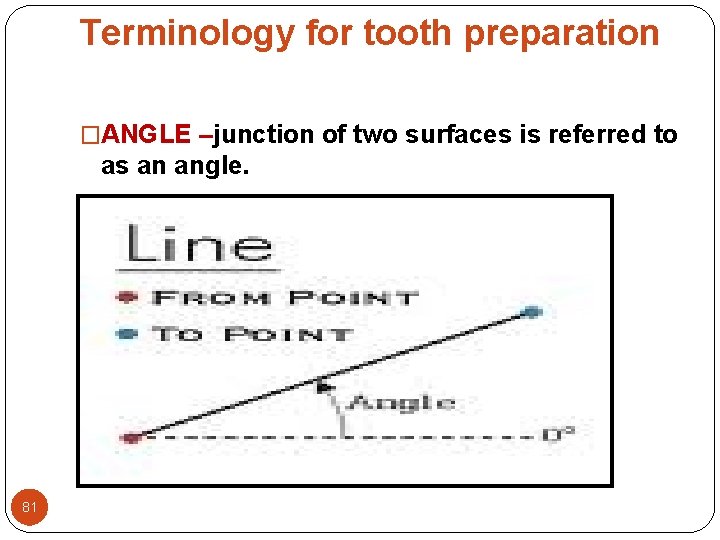
Terminology for tooth preparation �ANGLE –junction of two surfaces is referred to as an angle. 81
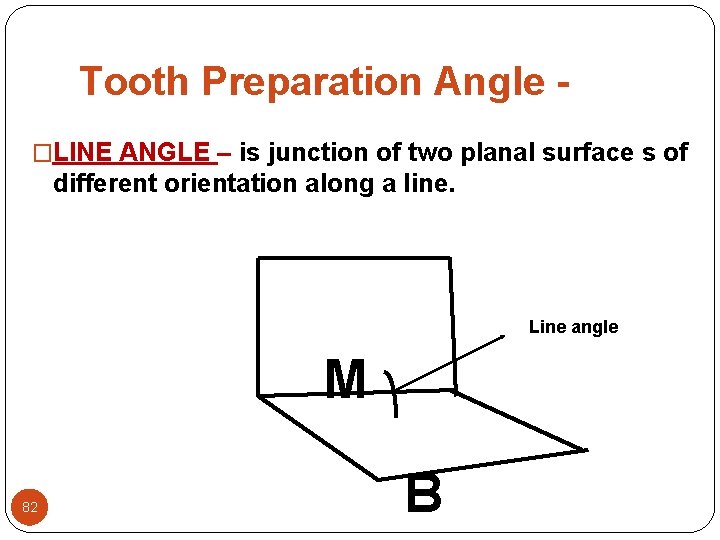
Tooth Preparation Angle �LINE ANGLE – is junction of two planal surface s of different orientation along a line. Line angle M 82 B
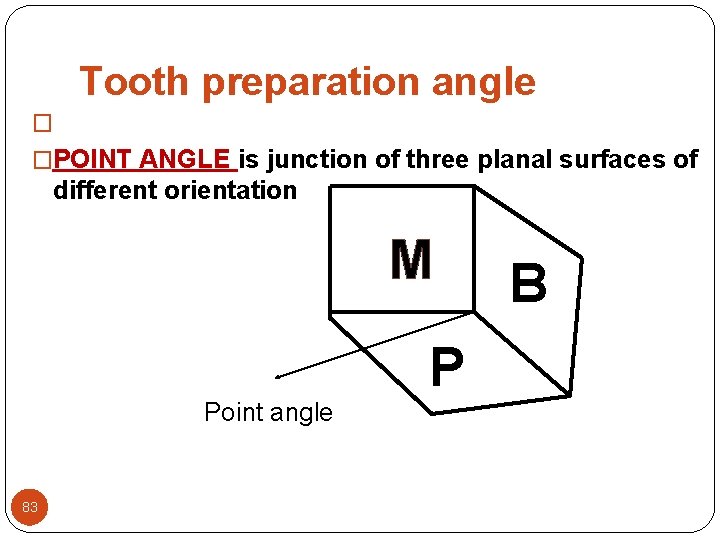
Tooth preparation angle � �POINT ANGLE is junction of three planal surfaces of different orientation M P Point angle 83 B
Terminology for tooth preparation �For describing line angle and point angle –surface which form the angle , they are named accordingly e. g. �line angle formed by 1. Lingual and incisal surfaces is termed as linguoincisal line angle, 84 2. Mesial and buccal surface –mesiobuccal line angle
Terminology for tooth preparation �Internal Line Angle is angle whose apex is points in to the tooth �External Line Angle whose apex points away from the tooth 85
Terminology for tooth preparation �Cavo-surface Angle –is angle of tooth structure formed by the junction of a prepared tooth surface and the external surface of the tooth. �Cavo-srface Margin is actual junction of prepared tooth surface and external surface of tooth 86
THANK YOU 87