
GOOD LUCK SYMBOLS THE OWL Having some owls
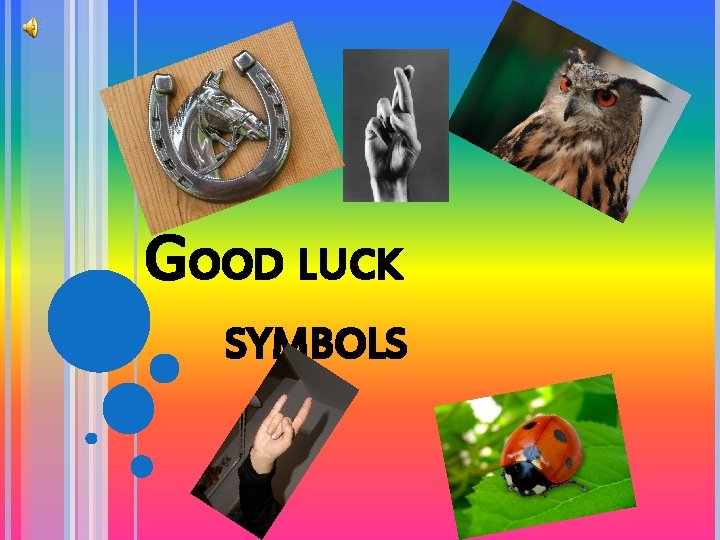
GOOD LUCK SYMBOLS
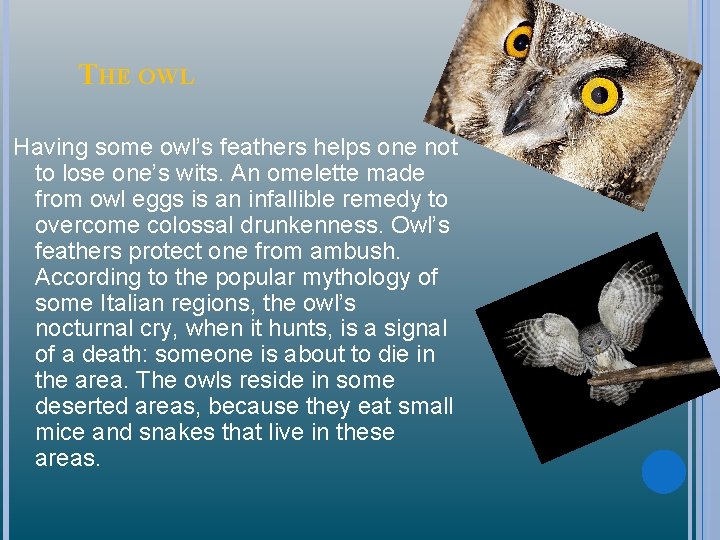
THE OWL Having some owl’s feathers helps one not to lose one’s wits. An omelette made from owl eggs is an infallible remedy to overcome colossal drunkenness. Owl’s feathers protect one from ambush. According to the popular mythology of some Italian regions, the owl’s nocturnal cry, when it hunts, is a signal of a death: someone is about to die in the area. The owls reside in some deserted areas, because they eat small mice and snakes that live in these areas.
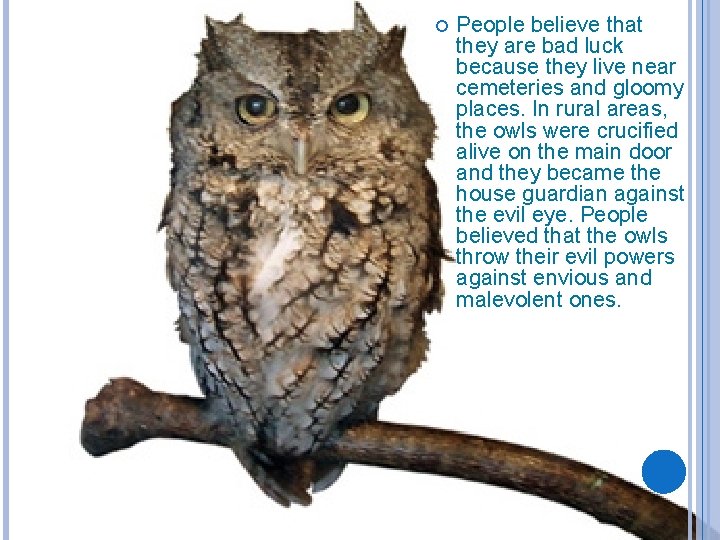
People believe that they are bad luck because they live near cemeteries and gloomy places. In rural areas, the owls were crucified alive on the main door and they became the house guardian against the evil eye. People believed that the owls throw their evil powers against envious and malevolent ones.
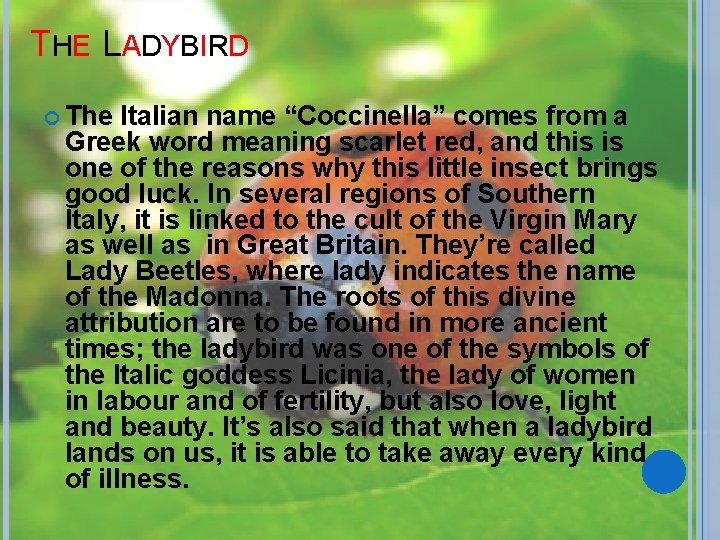
THE LADYBIRD The Italian name “Coccinella” comes from a Greek word meaning scarlet red, and this is one of the reasons why this little insect brings good luck. In several regions of Southern Italy, it is linked to the cult of the Virgin Mary as well as in Great Britain. They’re called Lady Beetles, where lady indicates the name of the Madonna. The roots of this divine attribution are to be found in more ancient times; the ladybird was one of the symbols of the Italic goddess Licinia, the lady of women in labour and of fertility, but also love, light and beauty. It’s also said that when a ladybird lands on us, it is able to take away every kind of illness.
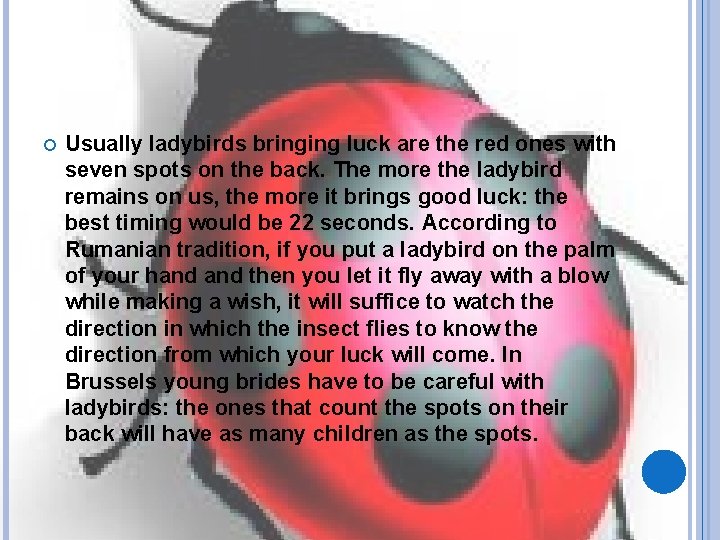
Usually ladybirds bringing luck are the red ones with seven spots on the back. The more the ladybird remains on us, the more it brings good luck: the best timing would be 22 seconds. According to Rumanian tradition, if you put a ladybird on the palm of your hand then you let it fly away with a blow while making a wish, it will suffice to watch the direction in which the insect flies to know the direction from which your luck will come. In Brussels young brides have to be careful with ladybirds: the ones that count the spots on their back will have as many children as the spots.

THE “CORNA”GESTURE AND CROSSING FINGERS The Italian gesture “fare le corna” raising the index and little fingers and closing the fist is used against the “Evil Eye”, for example if the teacher is going to give an oral test and you hope she is not going to choose you “fai le corna” (make horns). If the teacher chooses you, you “incroci le dita” (cross index and medium fingers) and you will have a good oral test, infact “crossing fingers” brings good luck.
TOUCHING IRON Since ancient times, in many parts of the world, iron has been considered one of the elements with great magic value, which is why they used to touch it as a scaramantic act. At the origins of this belief, there were various characteristics, real or imagined: it was one of the first metals worked by man and was extracted from the bowels of the earth. Its hardness makes it a perfect shield against danger. For example, in ancient times in Valsassina studded doors of iron were placed on doors to ward off the evil incarnated bear.
Other iron objects were considered amulets. One of these was the “horse shoe” which combines the properties of the metal with its crescent shape. This symbol is linked to various gods of western and oriental culture. In the ancient African religion, iron has a double value: it’s a link between elements with magic power but it could be an evil instrument.
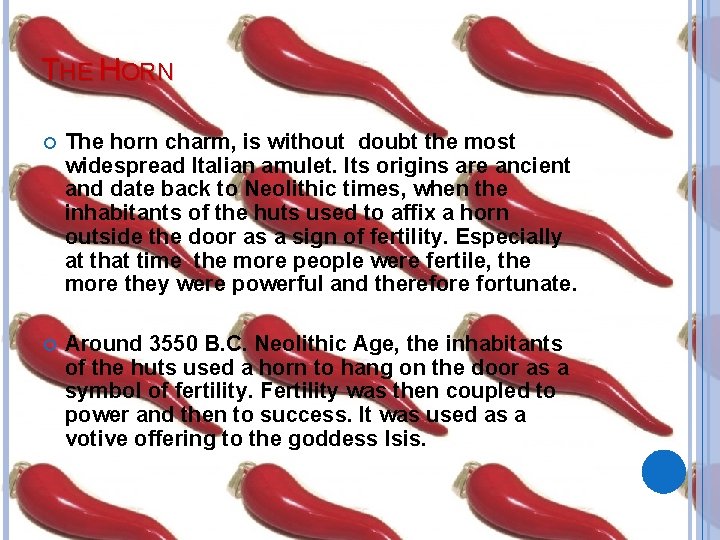
THE HORN The horn charm, is without doubt the most widespread Italian amulet. Its origins are ancient and date back to Neolithic times, when the inhabitants of the huts used to affix a horn outside the door as a sign of fertility. Especially at that time the more people were fertile, the more they were powerful and therefore fortunate. Around 3550 B. C. Neolithic Age, the inhabitants of the huts used a horn to hang on the door as a symbol of fertility. Fertility was then coupled to power and then to success. It was used as a votive offering to the goddess Isis.
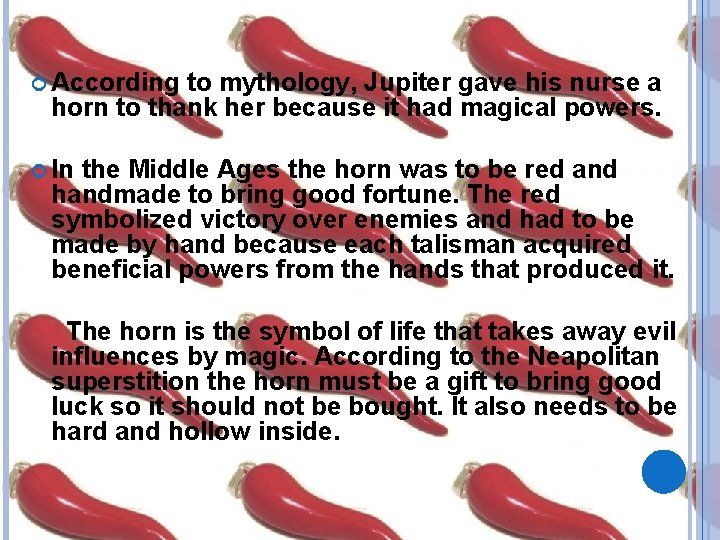
According to mythology, Jupiter gave his nurse a horn to thank her because it had magical powers. In the Middle Ages the horn was to be red and handmade to bring good fortune. The red symbolized victory over enemies and had to be made by hand because each talisman acquired beneficial powers from the hands that produced it. The horn is the symbol of life that takes away evil influences by magic. According to the Neapolitan superstition the horn must be a gift to bring good luck so it should not be bought. It also needs to be hard and hollow inside.
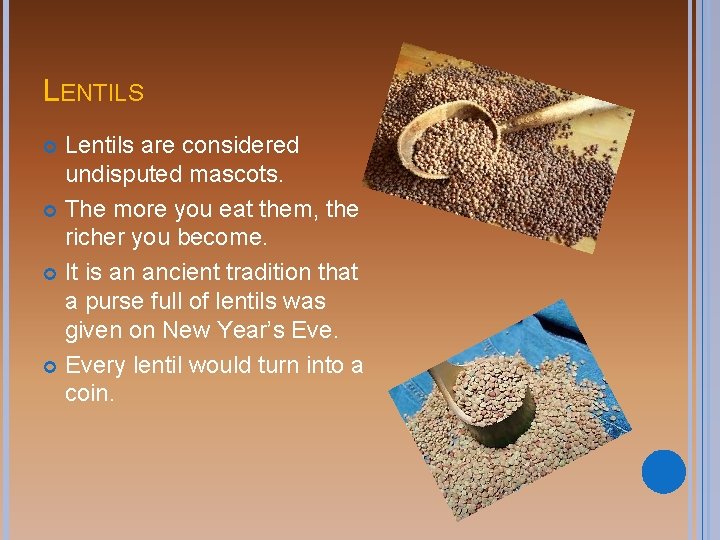
LENTILS Lentils are considered undisputed mascots. The more you eat them, the richer you become. It is an ancient tradition that a purse full of lentils was given on New Year’s Every lentil would turn into a coin.
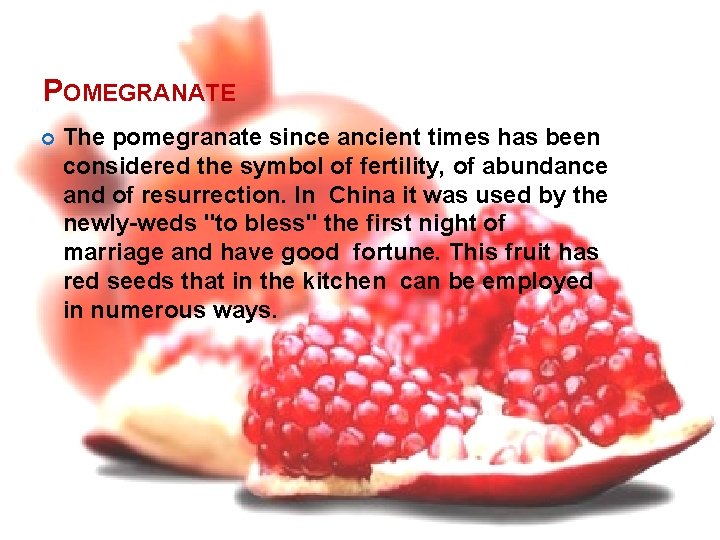
POMEGRANATE The pomegranate since ancient times has been considered the symbol of fertility, of abundance and of resurrection. In China it was used by the newly-weds "to bless" the first night of marriage and have good fortune. This fruit has red seeds that in the kitchen can be employed in numerous ways.
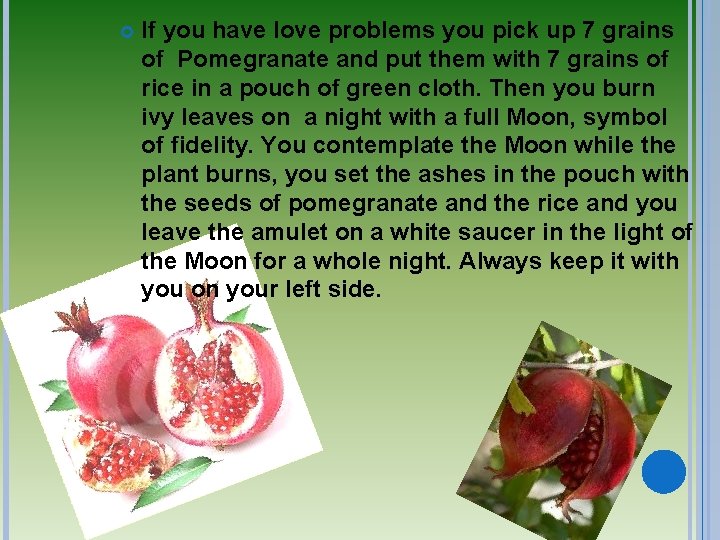
If you have love problems you pick up 7 grains of Pomegranate and put them with 7 grains of rice in a pouch of green cloth. Then you burn ivy leaves on a night with a full Moon, symbol of fidelity. You contemplate the Moon while the plant burns, you set the ashes in the pouch with the seeds of pomegranate and the rice and you leave the amulet on a white saucer in the light of the Moon for a whole night. Always keep it with you on your left side.

THE END Liceo Statale “C. Cafiero” – Barletta, March 2012 By: - Pantaleo Cassatella - Annalisa Rizzi - Maria Zagaria - Mya Arbues - Claudia Nanula - Daniela Vitale - Rosalba Lionetti
- Slides: 14