
Good governance in the pharmaceutical sector Gilles Forte
- Slides: 13
Good governance in the pharmaceutical sector Gilles Forte Deirdre Dimancesco Cécile Macé Department of Essential Medicines and Health Products Side event at the 66 th WHA 1 Good Governance in the pharmaceutical sector, WHA side event
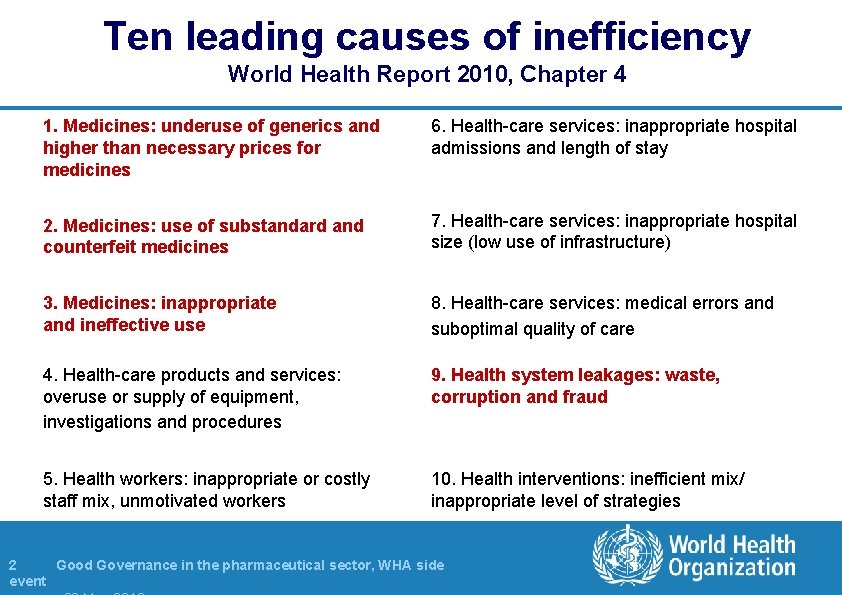
Ten leading causes of inefficiency World Health Report 2010, Chapter 4 1. Medicines: underuse of generics and higher than necessary prices for medicines 6. Health-care services: inappropriate hospital admissions and length of stay 2. Medicines: use of substandard and counterfeit medicines 7. Health-care services: inappropriate hospital size (low use of infrastructure) 3. Medicines: inappropriate and ineffective use 8. Health-care services: medical errors and suboptimal quality of care 4. Health-care products and services: overuse or supply of equipment, investigations and procedures 9. Health system leakages: waste, corruption and fraud 5. Health workers: inappropriate or costly staff mix, unmotivated workers 10. Health interventions: inefficient mix/ inappropriate level of strategies 2 Good Governance in the pharmaceutical sector, WHA side event
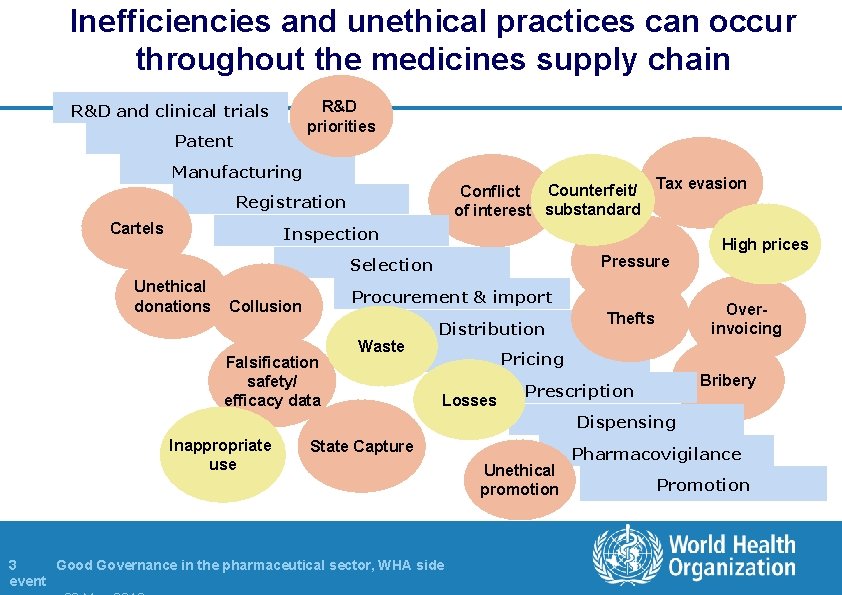
Inefficiencies and unethical practices can occur throughout the medicines supply chain R&D priorities R & D a n d c l i n i c a l t ri a l s P a t en t M a n u f a c t u ri n g Counterfeit/ Tax evasion Conflict of interest substandard R eg i s t ra t i o n Cartels I n s p ec t i o n Pressure S el ec t i o n Unethical donations P ro c u rem en t & i m p o rt Collusion Falsification safety/ efficacy data Waste Di s t ri b u t i o n High prices Overinvoicing Thefts P ri c i n g Losses Bribery P res c ri p t i o n Di s p en s i n g Inappropriate use State Capture 3 Good Governance in the pharmaceutical sector, WHA side event Unethical promotion P h a rm a c o v i g i l a n c e P ro m o t i o n
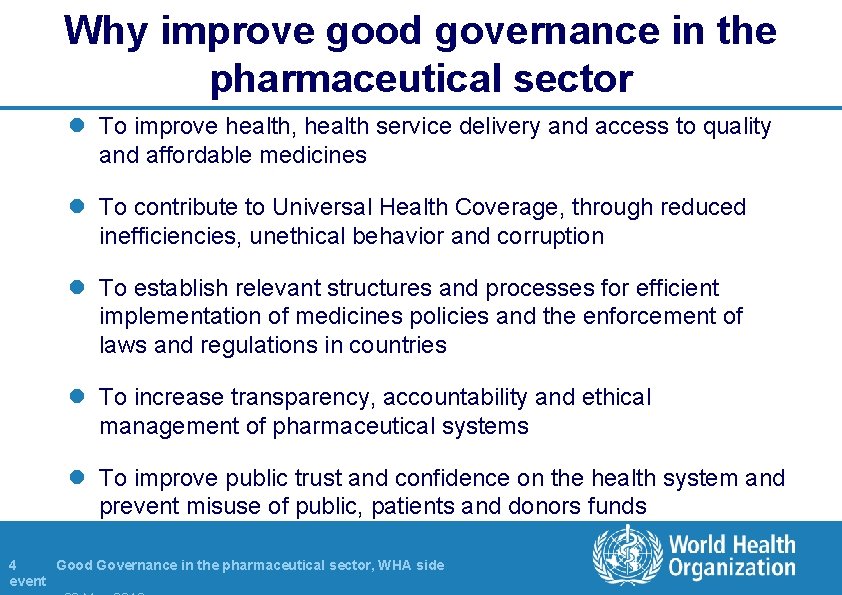
Why improve good governance in the pharmaceutical sector l To improve health, health service delivery and access to quality and affordable medicines l To contribute to Universal Health Coverage, through reduced inefficiencies, unethical behavior and corruption l To establish relevant structures and processes for efficient implementation of medicines policies and the enforcement of laws and regulations in countries l To increase transparency, accountability and ethical management of pharmaceutical systems l To improve public trust and confidence on the health system and prevent misuse of public, patients and donors funds 4 Good Governance in the pharmaceutical sector, WHA side event
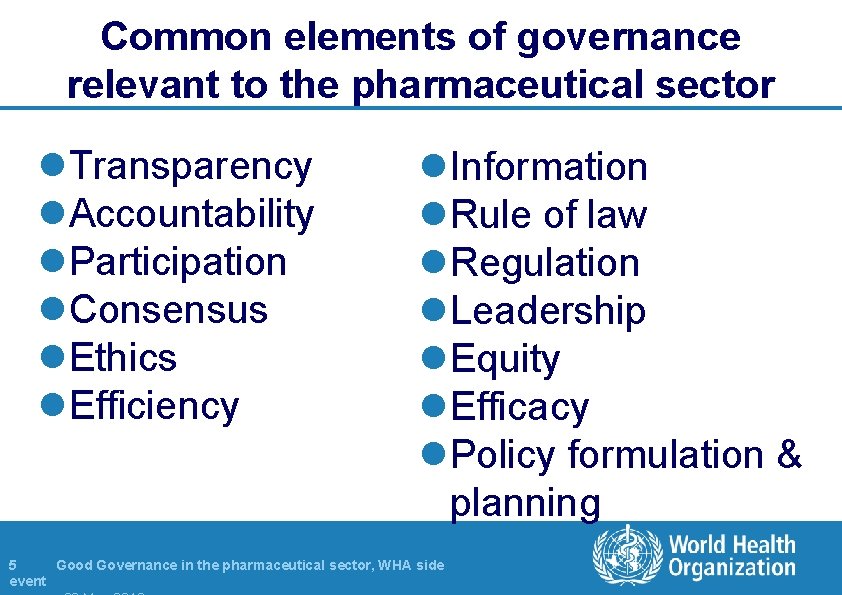
Common elements of governance relevant to the pharmaceutical sector l. Transparency l. Accountability l. Participation l. Consensus l. Ethics l. Efficiency l. Information l. Rule of law l. Regulation l. Leadership l. Equity l. Efficacy l. Policy formulation & planning 5 Good Governance in the pharmaceutical sector, WHA side event
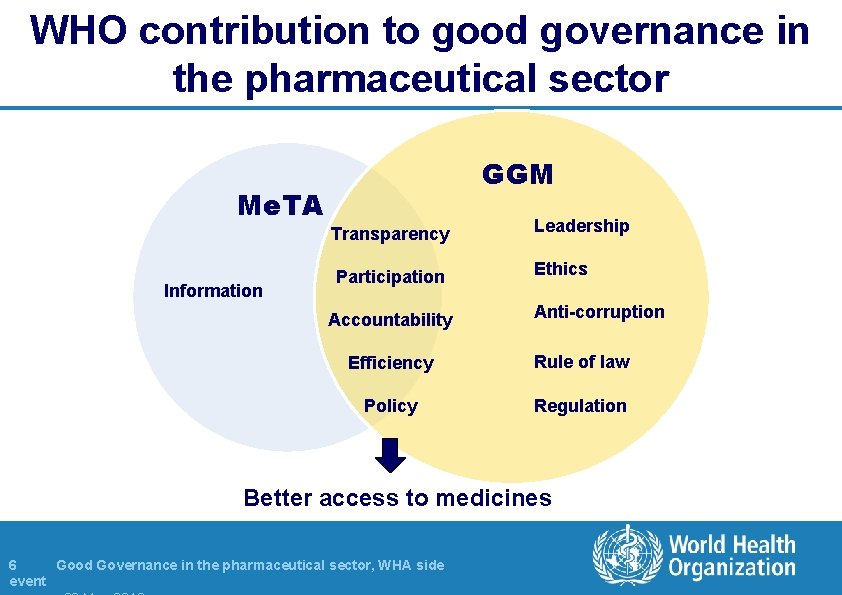
WHO contribution to good governance in the pharmaceutical sector Me. TA Information GGM Transparency Leadership Participation Ethics Accountability Anti-corruption Efficiency Rule of law Policy Regulation Better access to medicines 6 Good Governance in the pharmaceutical sector, WHA side event
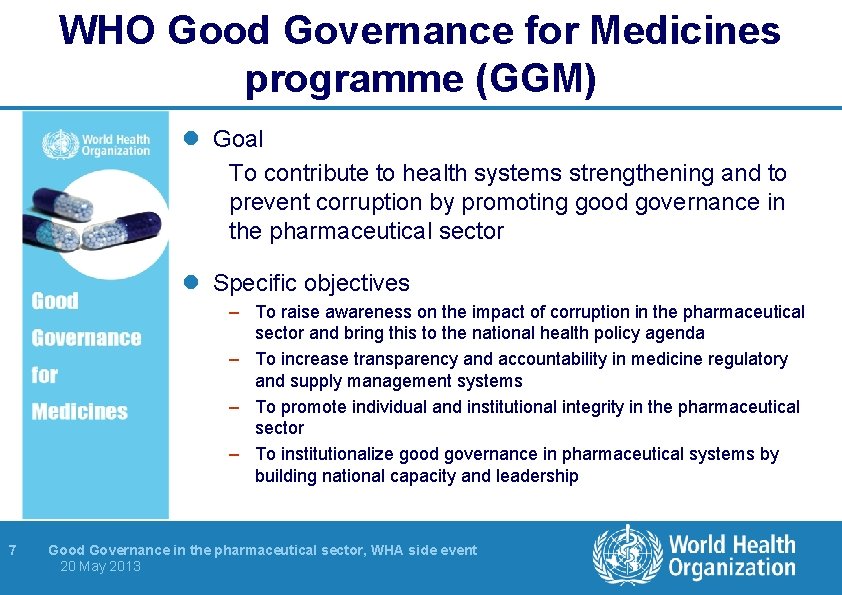
WHO Good Governance for Medicines programme (GGM) l Goal To contribute to health systems strengthening and to prevent corruption by promoting good governance in the pharmaceutical sector l Specific objectives – To raise awareness on the impact of corruption in the pharmaceutical sector and bring this to the national health policy agenda – To increase transparency and accountability in medicine regulatory and supply management systems – To promote individual and institutional integrity in the pharmaceutical sector – To institutionalize good governance in pharmaceutical systems by building national capacity and leadership 7 Good Governance in the pharmaceutical sector, WHA side event 20 May 2013
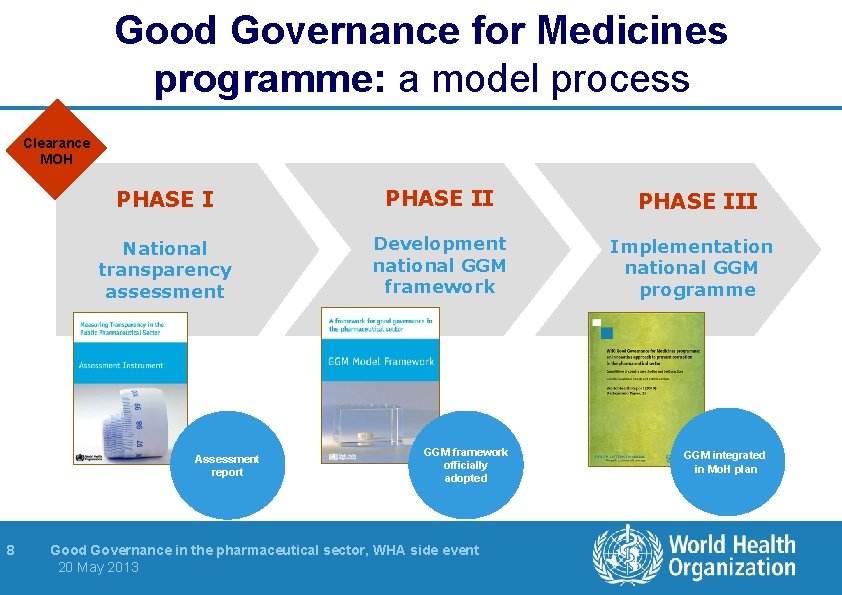
Good Governance for Medicines programme: a model process Clearance MOH PHASE II National transparency assessment Development national GGM framework Assessment report 8 GGM framework officially adopted Good Governance in the pharmaceutical sector, WHA side event 20 May 2013 PHASE III Implementation national GGM programme GGM integrated in Mo. H plan
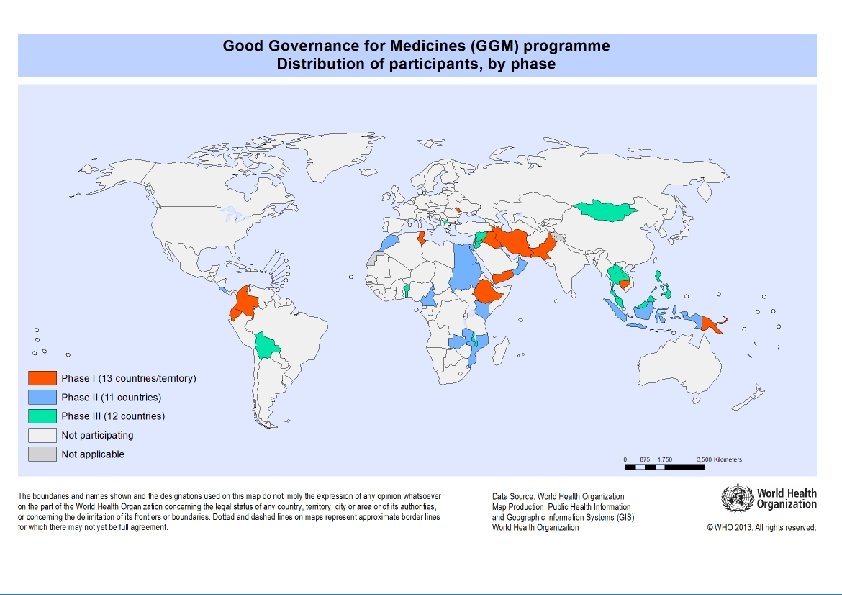
9 Good Governance in the pharmaceutical sector, WHA side event 20 May 2013
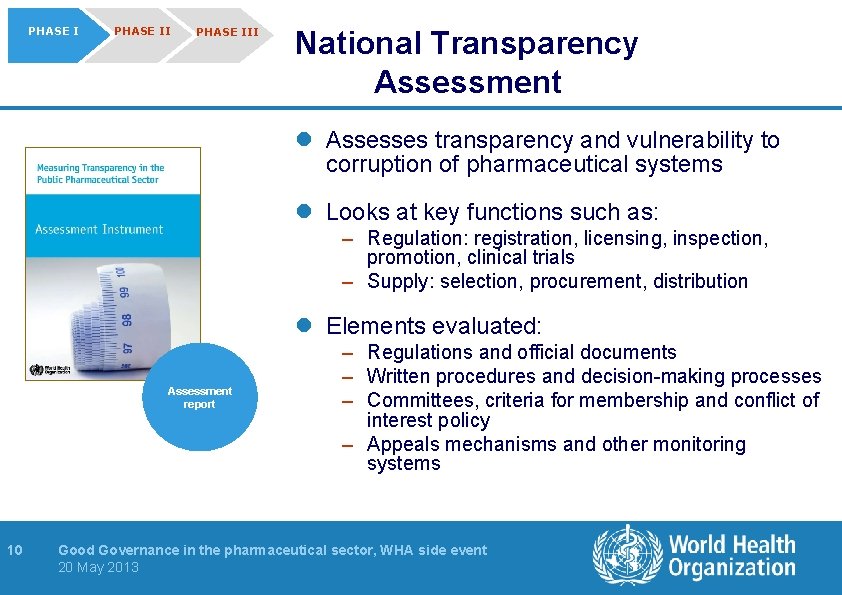
PHASE III National Transparency Assessment l Assesses transparency and vulnerability to corruption of pharmaceutical systems l Looks at key functions such as: – Regulation: registration, licensing, inspection, promotion, clinical trials – Supply: selection, procurement, distribution l Elements evaluated: Assessment report 10 – Regulations and official documents – Written procedures and decision-making processes – Committees, criteria for membership and conflict of interest policy – Appeals mechanisms and other monitoring systems Good Governance in the pharmaceutical sector, WHA side event 20 May 2013
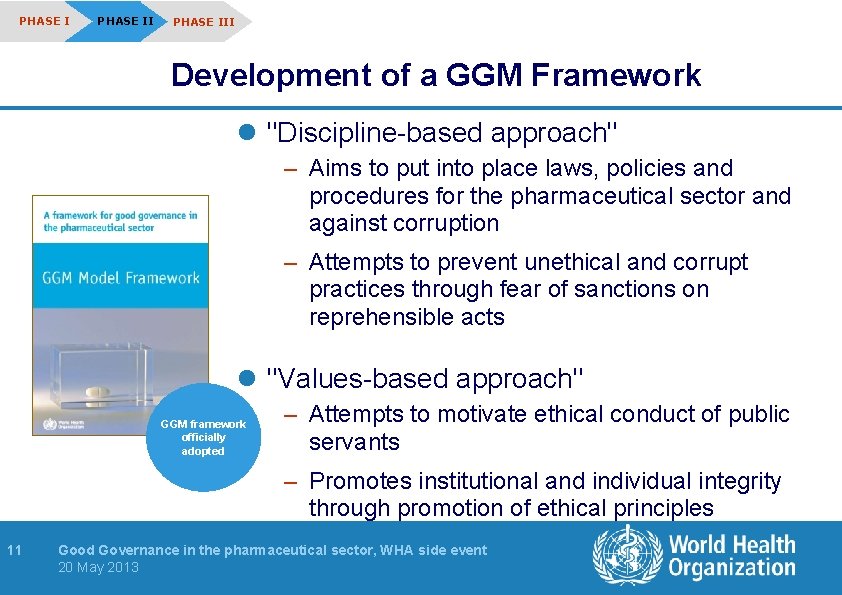
PHASE III Development of a GGM Framework l "Discipline-based approach" – Aims to put into place laws, policies and procedures for the pharmaceutical sector and against corruption – Attempts to prevent unethical and corrupt practices through fear of sanctions on reprehensible acts l "Values-based approach" GGM framework officially adopted – Attempts to motivate ethical conduct of public servants – Promotes institutional and individual integrity through promotion of ethical principles 11 Good Governance in the pharmaceutical sector, WHA side event 20 May 2013
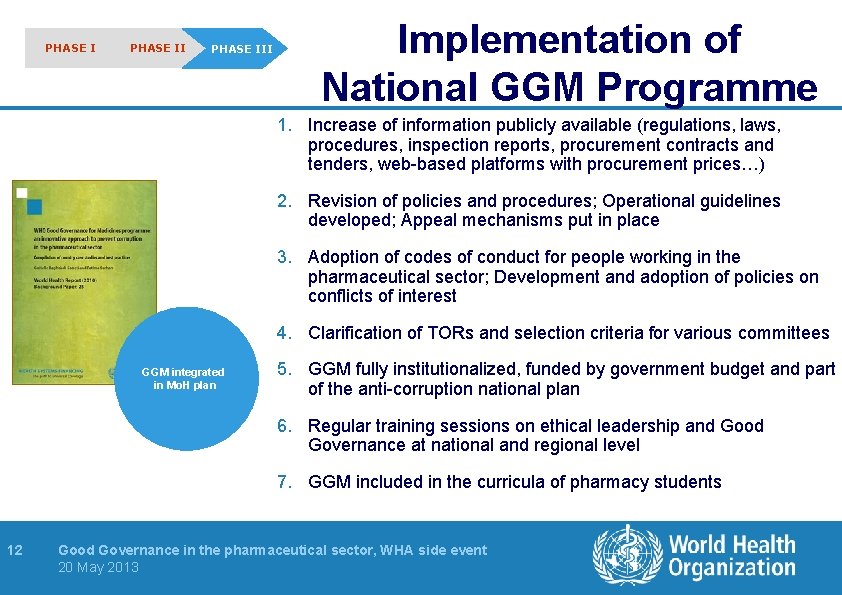
PHASE III Implementation of National GGM Programme 1. Increase of information publicly available (regulations, laws, procedures, inspection reports, procurement contracts and tenders, web-based platforms with procurement prices…) 2. Revision of policies and procedures; Operational guidelines developed; Appeal mechanisms put in place 3. Adoption of codes of conduct for people working in the pharmaceutical sector; Development and adoption of policies on conflicts of interest 4. Clarification of TORs and selection criteria for various committees GGM integrated in Mo. H plan 5. GGM fully institutionalized, funded by government budget and part of the anti-corruption national plan 6. Regular training sessions on ethical leadership and Good Governance at national and regional level 7. GGM included in the curricula of pharmacy students 12 Good Governance in the pharmaceutical sector, WHA side event 20 May 2013
Next steps/Final words l Develop methodologies for assessing good governance interventions and their impact on reducing inefficiencies and on improving access to quality and affordable medicines. l Strengthen WHO support to countries for good governance in pharmaceutical and health systems as a contribution to the achievement of universal health coverage. l Facilitate sharing of experiences among countries and explore synergies with other partners and sectors. 13 Good Governance in the pharmaceutical sector, WHA side event 20 May 2013