
GOOD AFTERNOON TO ALL BIO GEOGRAPHY TOPIC ORIGIN
GOOD AFTERNOON TO ALL BIO - GEOGRAPHY TOPIC: ORIGIN OF FLORA AND FAUNA DAY ORDER: III Date: 05. 08. 2020 Time: 2: 30 to 3: 30 S. Nithya, Lecturer in geography, Gcwk(A)
Flora and fauna refer to the plants and animals of an environment. To remember them, fauna sounds similar to fawn, indicating it refers to animals, whereas flora sounds like flowers, indicating it refers to plants.
You may have heard the terms flora and fauna before, but what do they actually mean? Flora and fauna refer to plants and animals in the broadest sense of the words, encompassing pretty much all life on Earth. As you might imagine, these are very broad categories and in general scientists break down the different types of flora and fauna into different classifications, ranging from a specific type of life down to an individual species.
Before we take a look at how scientists divide flora and fauna into different groups, let’s take a look at the terms flora and fauna themselves.
What was the first plant on earth?
The Terms Flora: Flora and fauna are umbrella terms that refer to many different types of life. What is counted as flora and fauna is dependant upon the specific region, climate, or time period. A region might be a specific habitat or biome like grasslands or savannas. For this reason, what classifies as a particular group of flora or fauna can be up for debate depending upon how groups of scientists classify a time period or region.
The Terms Fauna: The term flora refers to the plant life that exists in a particular place at a particular time. This typically includes all indigenous plant life, and the use of flora in this fashion was coined by the French-Swiss botanist and geologist Jules Thurmann. Similarly, fauna refers to animal life that exists in a particular place at a particular time, and the use of fauna in this fashion was codified by Swedish zoologist Carl Linnaeus.
What is Fauna? Fauna refers to the collection of animals that are located in a geographical area of the planet or can be found during a certain period of the year or have lived in a certain area of the planet at some point in the past. Fauna derive from the Greek name ‘Fauna’, which represents one of the Roman goddesses of the earth and fertility.
Fauna is considered the wife, the sister, or the daughter of Faunus, which is the horned god of the forest, plains and fields, and they (Fauna and Faunus) are both related to the forest spirits called Fauns. The number of animal species (vertebrates and invertebrates) on planet Earth is much higher than the number of flora species due to the fact that only the insects are represented by almost 1 million different species.
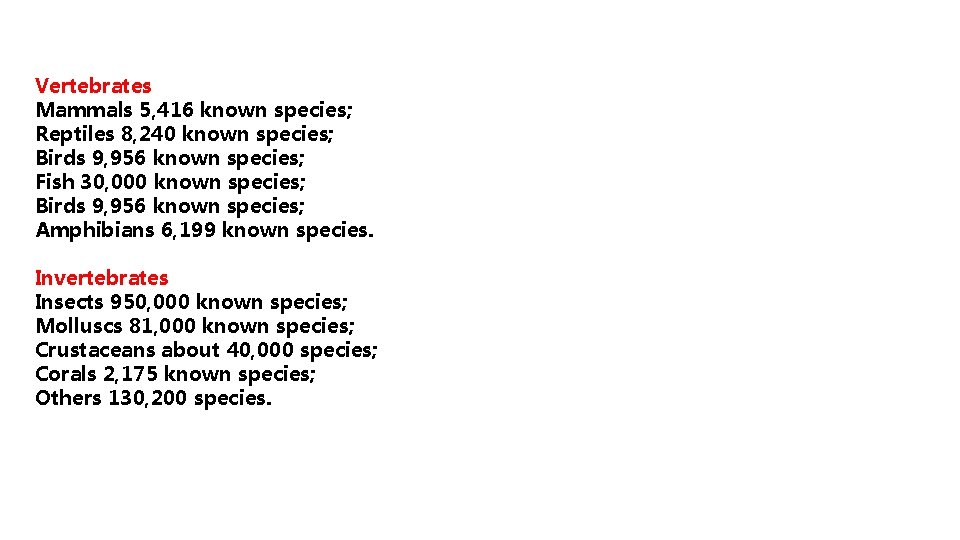
Vertebrates Mammals 5, 416 known species; Reptiles 8, 240 known species; Birds 9, 956 known species; Fish 30, 000 known species; Birds 9, 956 known species; Amphibians 6, 199 known species. Invertebrates Insects 950, 000 known species; Molluscs 81, 000 known species; Crustaceans about 40, 000 species; Corals 2, 175 known species; Others 130, 200 species.
v The Importance of Flora and Fauna in the Planet’s Ecosystem v Flora and fauna keep the ecological balance on planet Earth and without them the human civilization would not have existed. v Flora is responsible for consuming carbon dioxide and generating oxygen, while fauna is consuming the oxygen and releases carbon dioxide that is used by flora in the photosynthesis process.
v Humans consume the oxygen produced in the photosynthesis process and release carbon dioxide exactly like fauna does, but flora and fauna represent a natural resource of food and medicine for the human civilization here on planet Earth v This is why is so important to keep flora and fauna in very good conditions because our life on the planet depends pretty much on them.
v Flora and fauna have a functional role on the planet, but also an aesthetic role because with its natural beauty, the environment is helping us to get rid of stress and charge our bodies with healthy energy provided by the forest. v Flora and fauna also represent a great asset for the world tourism sector because many people on the entire planet are visiting distant places just to see and feel the natural beauties of those interesting places.
v Flora and fauna are mostly affected by the reckless human activity on the planet that pollutes the air, the soil and water, by people leaving behind garbage in nature that could contaminate the soil and the water in the area and by people that are destroying habitats, plants and animals, even the endangered animal species.



- Slides: 17