
GOLDSCHMIDTS RULES 1 The ions of one element

- Slides: 31
GOLDSCHMIDT’S RULES 1. The ions of one element can extensively replace those of another in ionic crystals if their radii differ by less than approximately 15%. 2. Ions whose charges differ by one unit substitute readily for one another provided electrical neutrality of the crystal is maintained. If the charges differ by more than one unit, substitution is generally slight. 3. When two different ions can occupy a particular position in a crystal lattice, the ion with the higher ionic potential forms a stronger bond with the anions surrounding the site.
RINGWOOD’S MODIFICATION OF GOLDSCHMIDT’S RULES 4. Substitutions may be limited, even when the size and charge criteria are satisfied, when the competing ions have different electronegativities and form bonds of different ionic character. This rule was proposed in 1955 to explain discrepancies with respect to the first three Goldschmidt rules. For example, Na+ and Cu+ have the same radius and charge, but do not substitute for one another.
Coupled Substitution • When the ion of a major element in a mineral is replaced with something having a different charge, the charge imbalance created must be neutralized by addition of a counter ion • Example addition of Al 3+ in a silicate structure (replacing Si 4+) requires addition of a Na+ or K+ (Key to understanding feldspar chemistry…). When 2 Al 3+ are added for Si 4+, this then can be balanced by adding a Ca 2+ ion
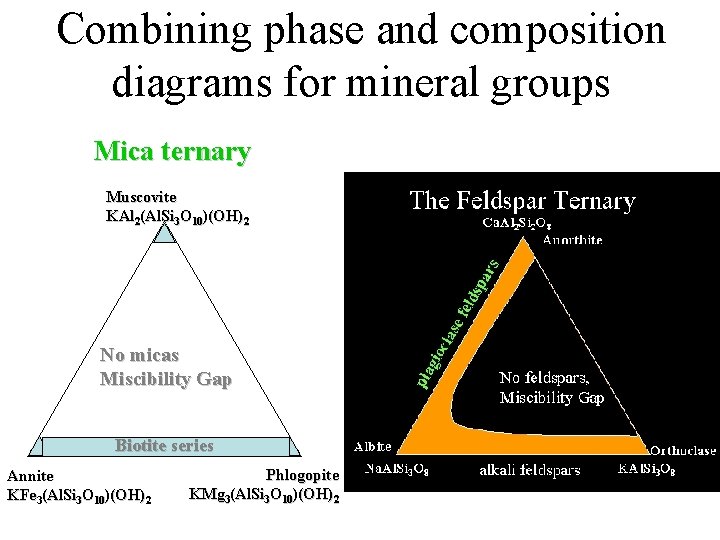
Combining phase and composition diagrams for mineral groups Mica ternary Muscovite KAl 2(Al. Si 3 O 10)(OH)2 No micas Miscibility Gap Biotite series Annite KFe 3(Al. Si 3 O 10)(OH)2 Phlogopite KMg 3(Al. Si 3 O 10)(OH)2
SOLID SOLUTION • Occurs when, in a crystalline solid, one element substitutes for another. • For example, a garnet may have the composition: (Mg 1. 7 Fe 0. 9 Mn 0. 2 Ca 0. 2)Al 2 Si 3 O 12. • The garnet is a solid solution of the following end member components: Pyrope - Mg 3 Al 2 Si 3 O 12; Spessartine Mn 3 Al 2 Si 3 O 12; Almandine - Fe 3 Al 2 Si 3 O 12; and Grossular Ca 3 Al 2 Si 3 O 12.
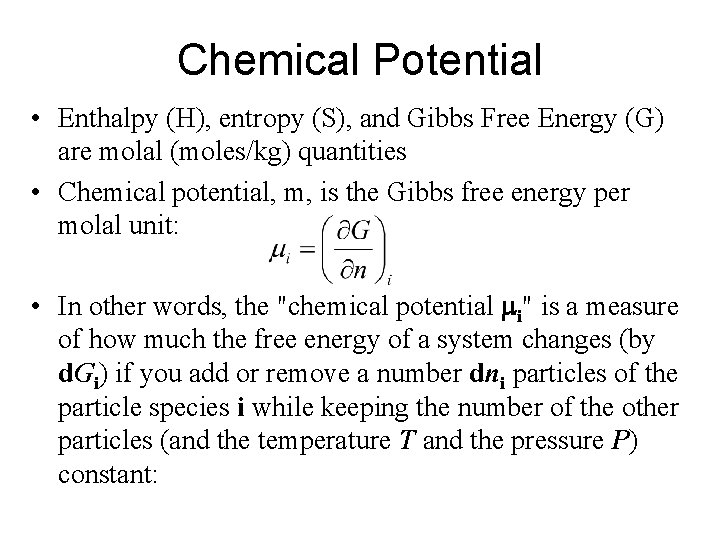
Chemical Potential • Enthalpy (H), entropy (S), and Gibbs Free Energy (G) are molal (moles/kg) quantities • Chemical potential, m, is the Gibbs free energy per molal unit: • In other words, the "chemical potential mi" is a measure of how much the free energy of a system changes (by d. Gi) if you add or remove a number dni particles of the particle species i while keeping the number of the other particles (and the temperature T and the pressure P) constant:
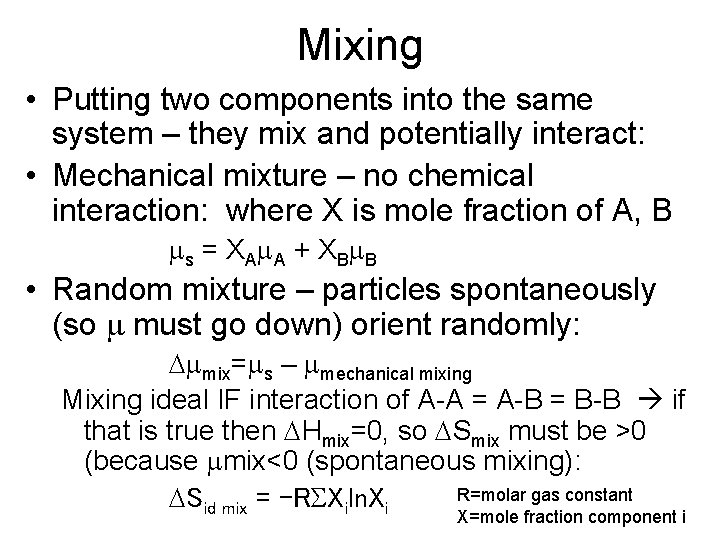
Mixing • Putting two components into the same system – they mix and potentially interact: • Mechanical mixture – no chemical interaction: where X is mole fraction of A, B ms = X A m. A + X B m. B • Random mixture – particles spontaneously (so m must go down) orient randomly: Dmmix=ms – mmechanical mixing Mixing ideal IF interaction of A-A = A-B = B-B if that is true then DHmix=0, so DSmix must be >0 (because mmix<0 (spontaneous mixing): R=molar gas constant DSid mix = -RSXiln. Xi X=mole fraction component i
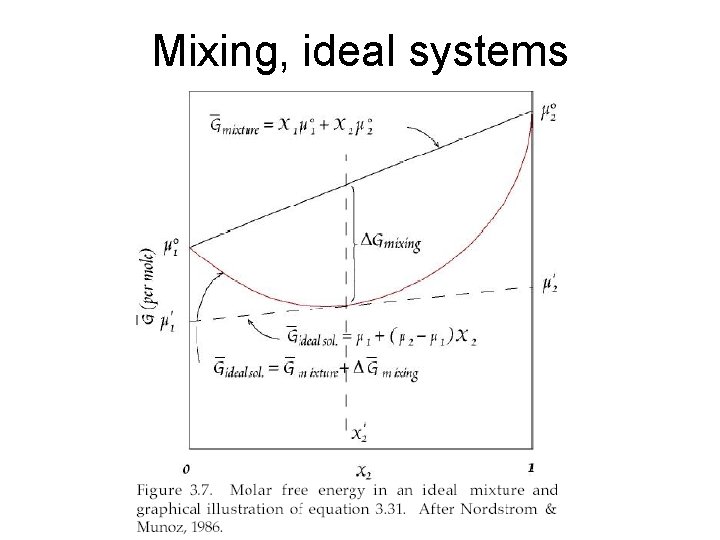
Mixing, ideal systems
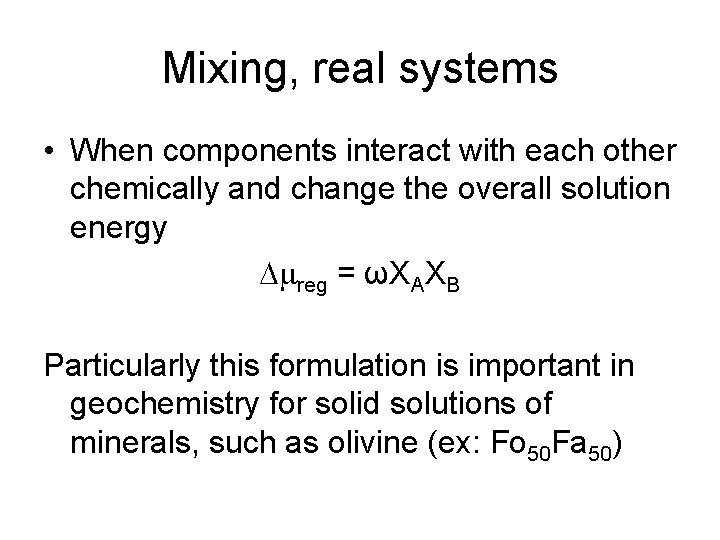
Mixing, real systems • When components interact with each other chemically and change the overall solution energy Dmreg = ωXAXB Particularly this formulation is important in geochemistry for solid solutions of minerals, such as olivine (ex: Fo 50 Fa 50)
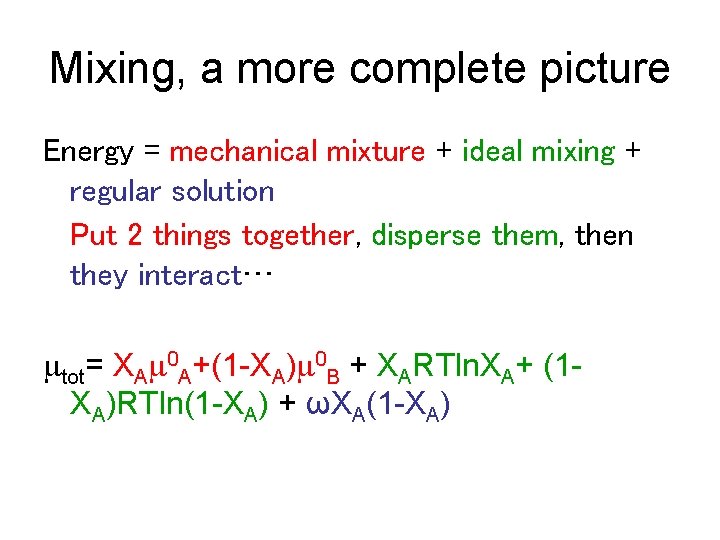
Mixing, a more complete picture Energy = mechanical mixture + ideal mixing + regular solution Put 2 things together, disperse them, then they interact… mtot= XAm 0 A+(1 -XA)m 0 B + XARTln. XA+ (1 XA)RTln(1 -XA) + ωXA(1 -XA)
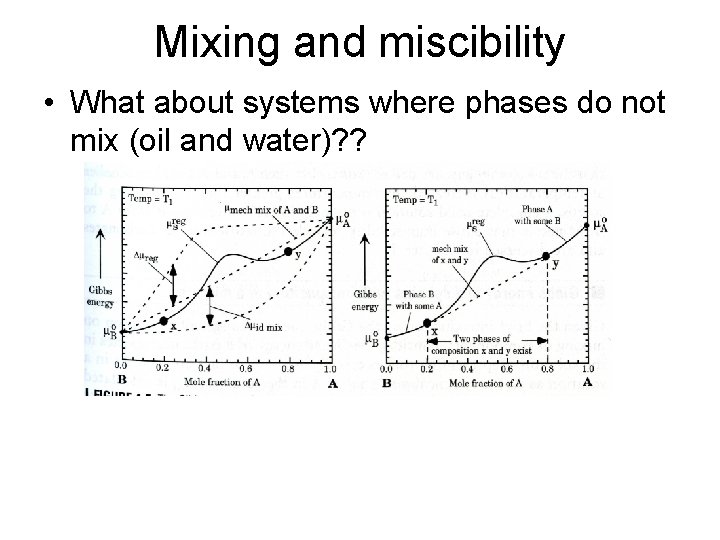
Mixing and miscibility • What about systems where phases do not mix (oil and water)? ?
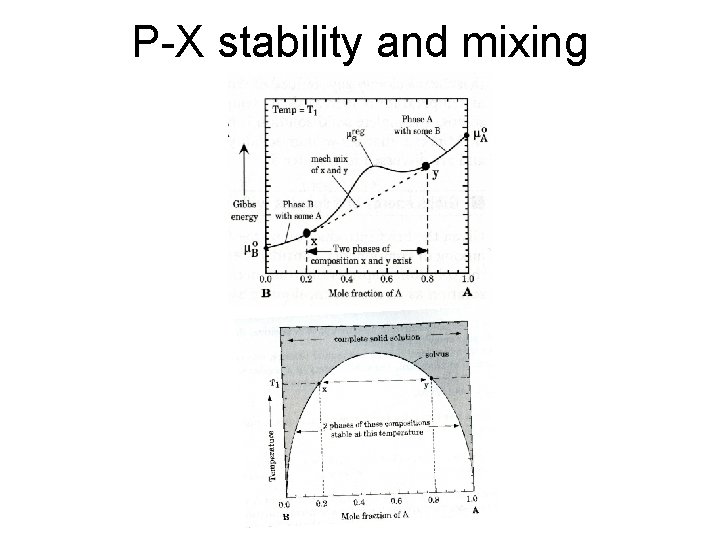
P-X stability and mixing
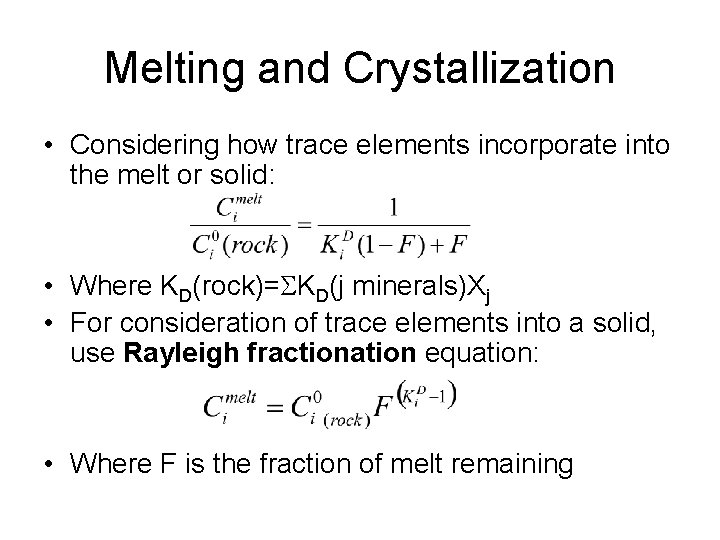
Melting and Crystallization • Considering how trace elements incorporate into the melt or solid: • Where KD(rock)=SKD(j minerals)Xj • For consideration of trace elements into a solid, use Rayleigh fractionation equation: • Where F is the fraction of melt remaining
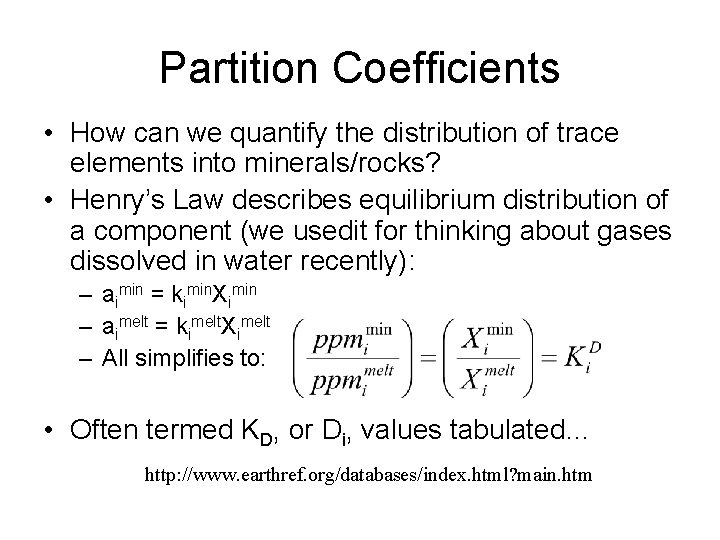
Partition Coefficients • How can we quantify the distribution of trace elements into minerals/rocks? • Henry’s Law describes equilibrium distribution of a component (we usedit for thinking about gases dissolved in water recently): – aimin = kimin. Ximin – aimelt = kimelt. Ximelt – All simplifies to: • Often termed KD, or Di, values tabulated… http: //www. earthref. org/databases/index. html? main. htm
Limitations of KD • What factors affect how well any element gets into a particular rock? ? ?
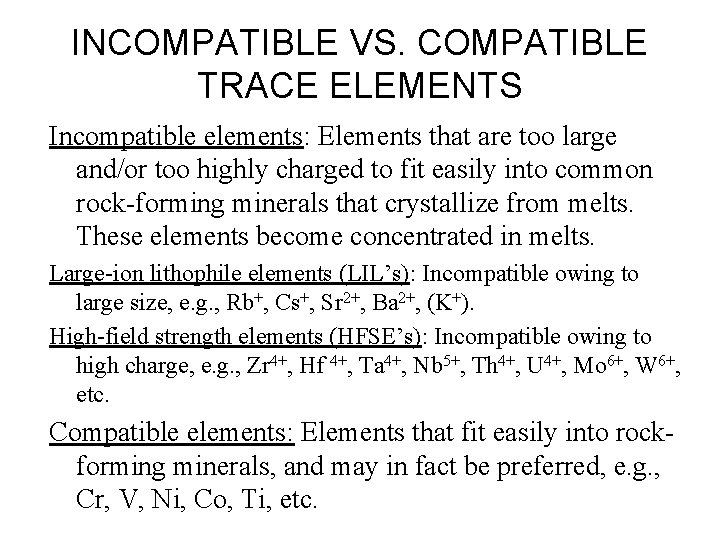
INCOMPATIBLE VS. COMPATIBLE TRACE ELEMENTS Incompatible elements: Elements that are too large and/or too highly charged to fit easily into common rock-forming minerals that crystallize from melts. These elements become concentrated in melts. Large-ion lithophile elements (LIL’s): Incompatible owing to large size, e. g. , Rb+, Cs+, Sr 2+, Ba 2+, (K+). High-field strength elements (HFSE’s): Incompatible owing to high charge, e. g. , Zr 4+, Hf 4+, Ta 4+, Nb 5+, Th 4+, U 4+, Mo 6+, W 6+, etc. Compatible elements: Elements that fit easily into rockforming minerals, and may in fact be preferred, e. g. , Cr, V, Ni, Co, Ti, etc.
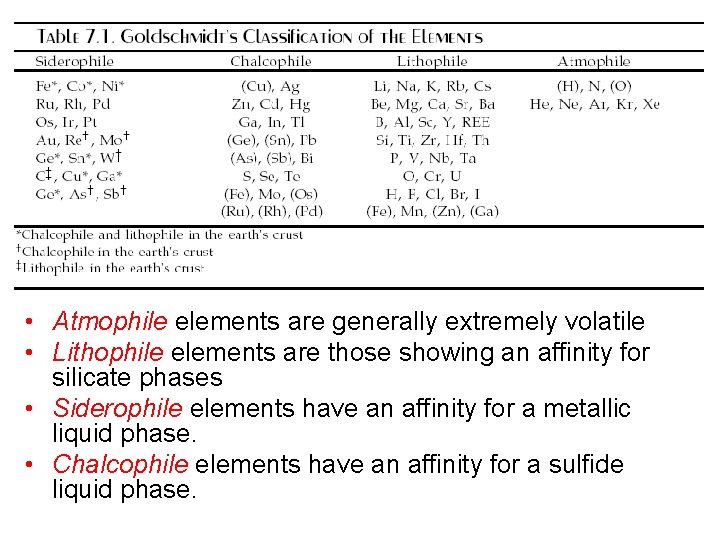
• Atmophile elements are generally extremely volatile • Lithophile elements are those showing an affinity for silicate phases • Siderophile elements have an affinity for a metallic liquid phase. • Chalcophile elements have an affinity for a sulfide liquid phase.
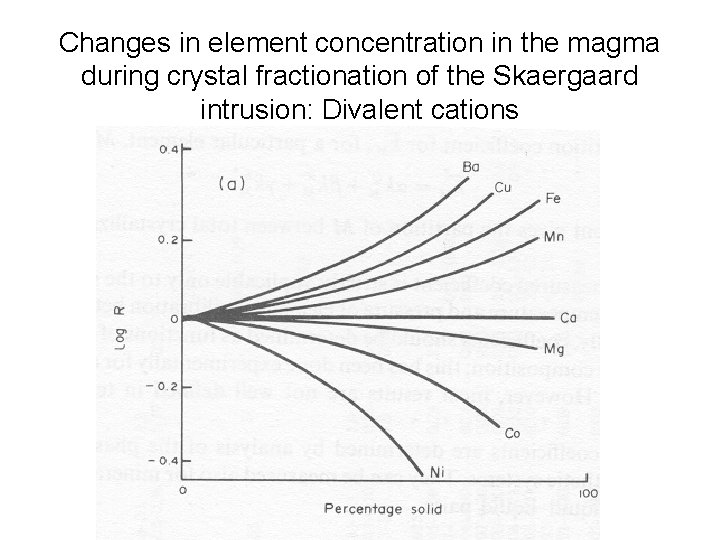
Changes in element concentration in the magma during crystal fractionation of the Skaergaard intrusion: Divalent cations
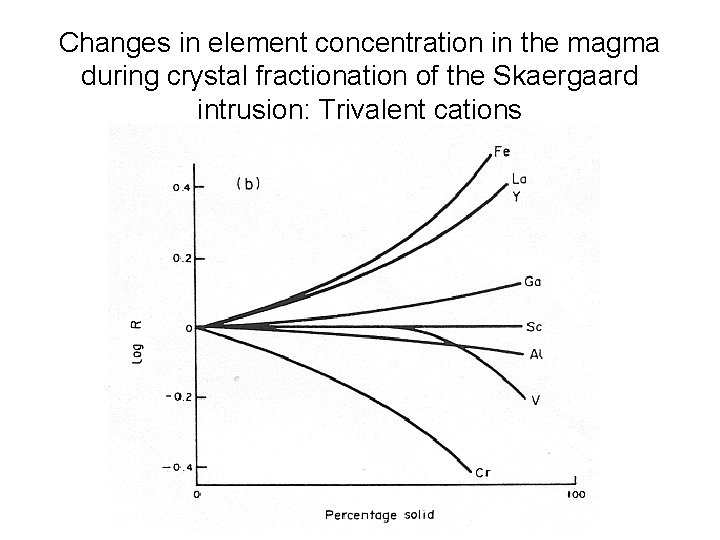
Changes in element concentration in the magma during crystal fractionation of the Skaergaard intrusion: Trivalent cations
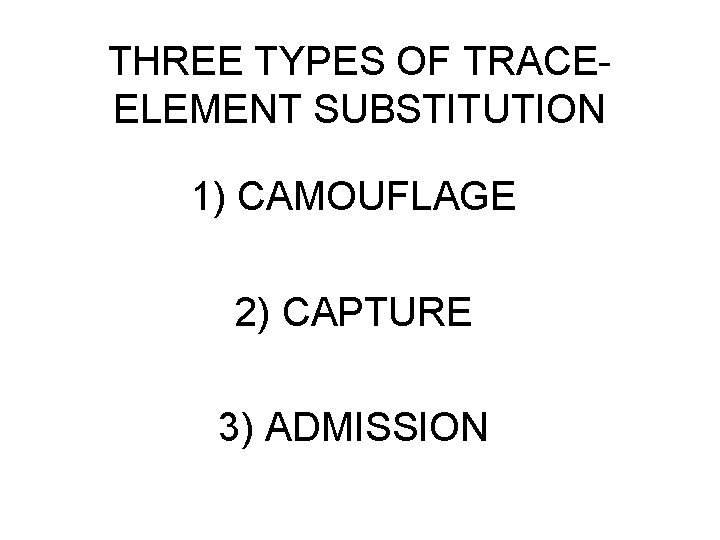
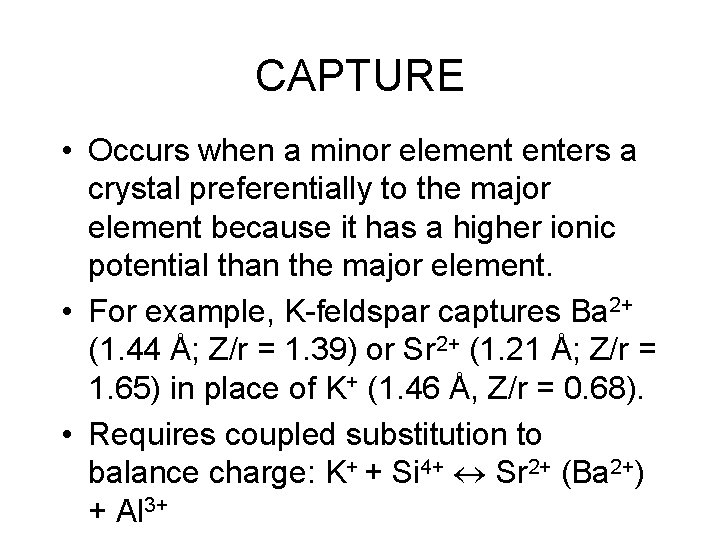
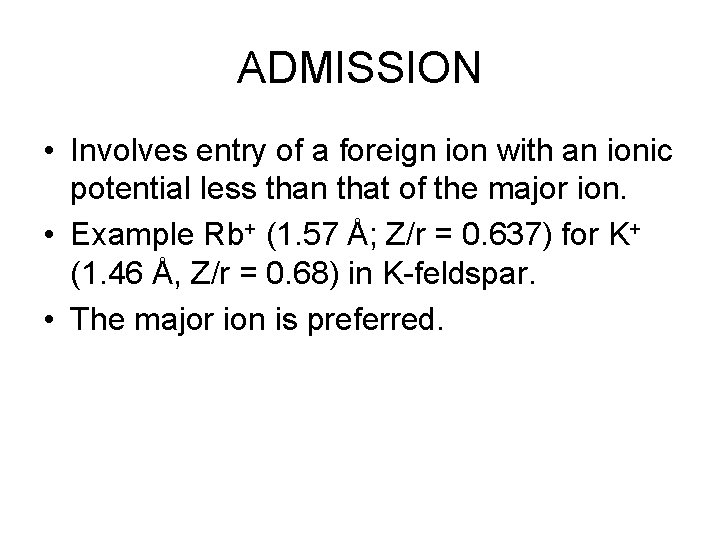
THREE TYPES OF TRACEELEMENT SUBSTITUTION 1) CAMOUFLAGE 2) CAPTURE 3) ADMISSION
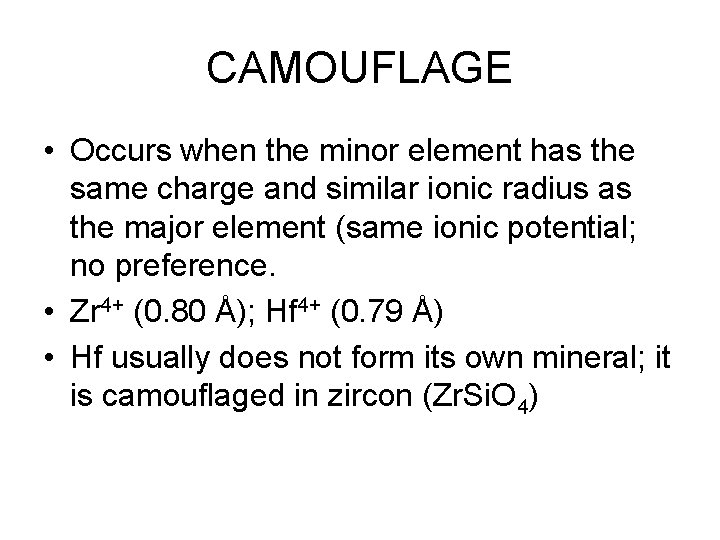
CAMOUFLAGE • Occurs when the minor element has the same charge and similar ionic radius as the major element (same ionic potential; no preference. • Zr 4+ (0. 80 Å); Hf 4+ (0. 79 Å) • Hf usually does not form its own mineral; it is camouflaged in zircon (Zr. Si. O 4)
CAPTURE • Occurs when a minor element enters a crystal preferentially to the major element because it has a higher ionic potential than the major element. • For example, K-feldspar captures Ba 2+ (1. 44 Å; Z/r = 1. 39) or Sr 2+ (1. 21 Å; Z/r = 1. 65) in place of K+ (1. 46 Å, Z/r = 0. 68). • Requires coupled substitution to balance charge: K+ + Si 4+ Sr 2+ (Ba 2+) + Al 3+
ADMISSION • Involves entry of a foreign ion with an ionic potential less than that of the major ion. • Example Rb+ (1. 57 Å; Z/r = 0. 637) for K+ (1. 46 Å, Z/r = 0. 68) in K-feldspar. • The major ion is preferred.
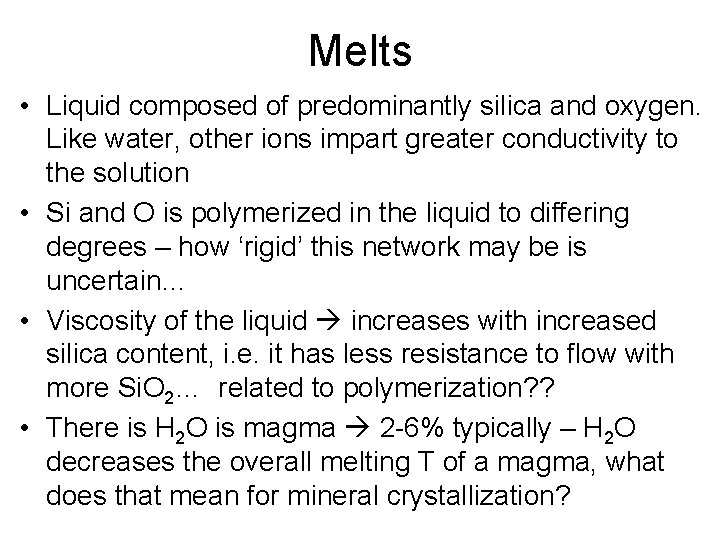
Melts • Liquid composed of predominantly silica and oxygen. Like water, other ions impart greater conductivity to the solution • Si and O is polymerized in the liquid to differing degrees – how ‘rigid’ this network may be is uncertain… • Viscosity of the liquid increases with increased silica content, i. e. it has less resistance to flow with more Si. O 2… related to polymerization? ? • There is H 2 O is magma 2 -6% typically – H 2 O decreases the overall melting T of a magma, what does that mean for mineral crystallization?
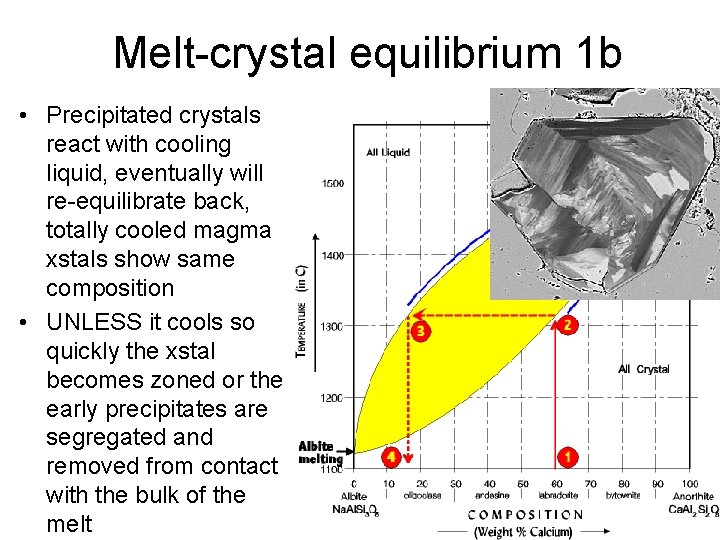
Melt-crystal equilibrium 1 b • Precipitated crystals react with cooling liquid, eventually will re-equilibrate back, totally cooled magma xstals show same composition • UNLESS it cools so quickly the xstal becomes zoned or the early precipitates are segregated and removed from contact with the bulk of the melt
Why aren’t all feldspars zoned? • Kinetics, segregation • IF there is sufficient time, the crystals will re-equilibrate with the magma they are in – and reflect the total Na-Ca content of the magma • IF not, then different minerals of different composition will be present in zoned plagioclase or segregated from each other physically
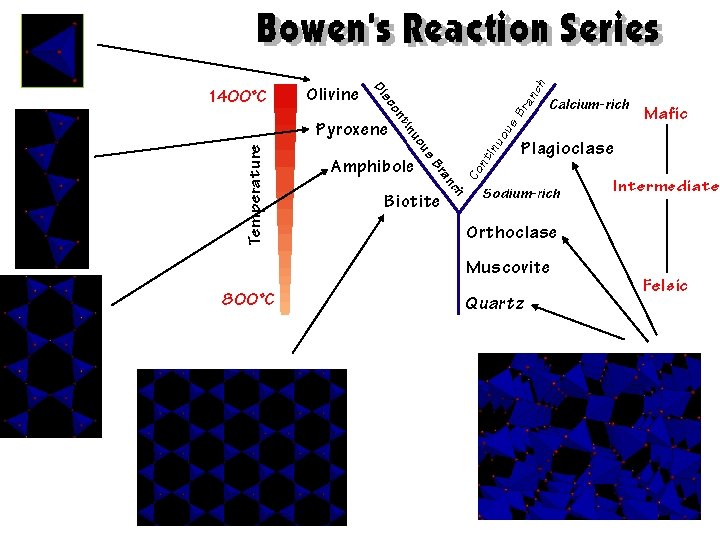
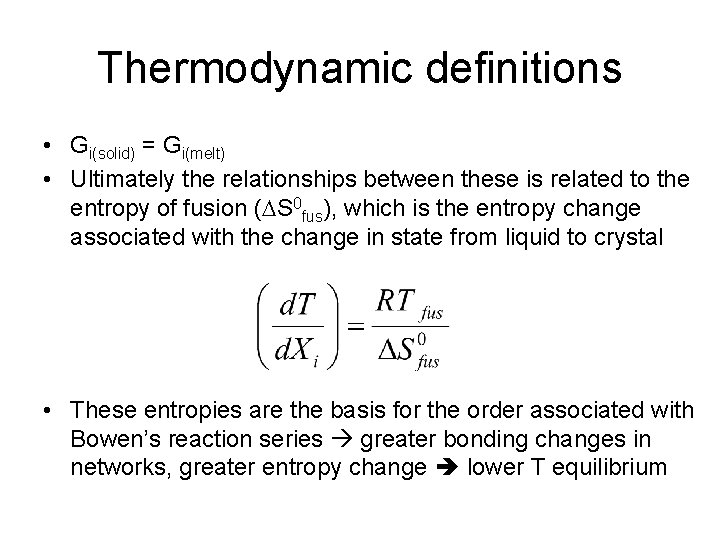
Thermodynamic definitions • Gi(solid) = Gi(melt) • Ultimately the relationships between these is related to the entropy of fusion (DS 0 fus), which is the entropy change associated with the change in state from liquid to crystal • These entropies are the basis for the order associated with Bowen’s reaction series greater bonding changes in networks, greater entropy change lower T equilibrium
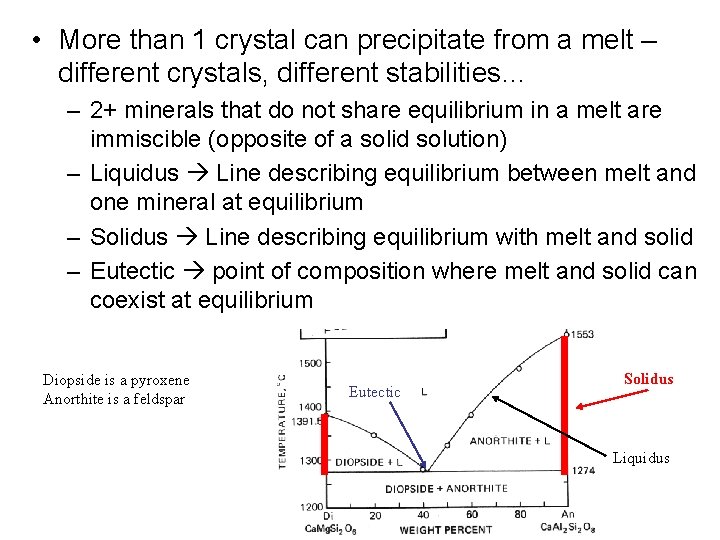
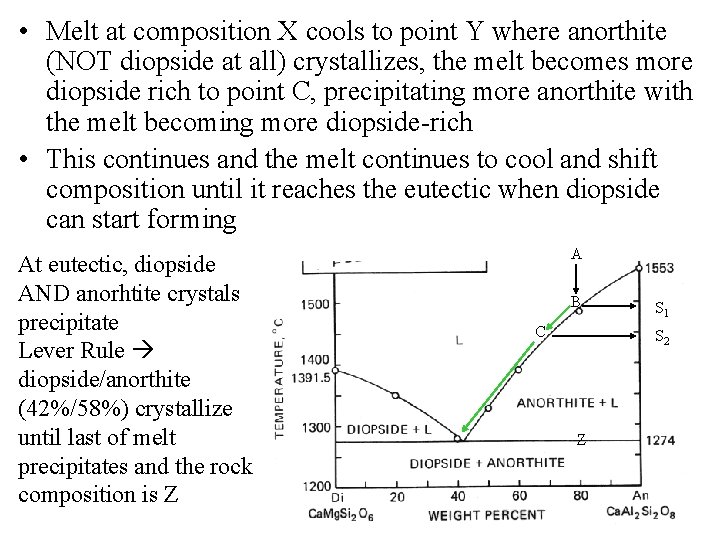
• More than 1 crystal can precipitate from a melt – different crystals, different stabilities… – 2+ minerals that do not share equilibrium in a melt are immiscible (opposite of a solid solution) – Liquidus Line describing equilibrium between melt and one mineral at equilibrium – Solidus Line describing equilibrium with melt and solid – Eutectic point of composition where melt and solid can coexist at equilibrium Diopside is a pyroxene Anorthite is a feldspar Eutectic Solidus Liquidus
• Melt at composition X cools to point Y where anorthite (NOT diopside at all) crystallizes, the melt becomes more diopside rich to point C, precipitating more anorthite with the melt becoming more diopside-rich • This continues and the melt continues to cool and shift composition until it reaches the eutectic when diopside can start forming At eutectic, diopside AND anorhtite crystals precipitate Lever Rule diopside/anorthite (42%/58%) crystallize until last of melt precipitates and the rock composition is Z A B C S 1 S 2 Z
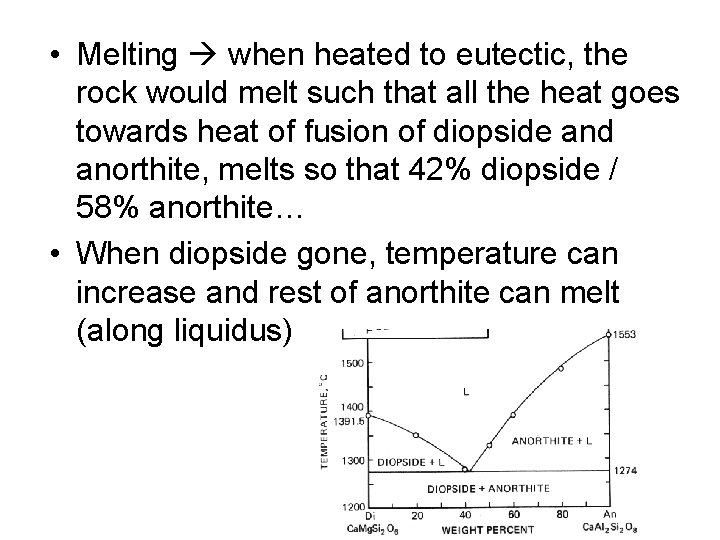
• Melting when heated to eutectic, the rock would melt such that all the heat goes towards heat of fusion of diopside and anorthite, melts so that 42% diopside / 58% anorthite… • When diopside gone, temperature can increase and rest of anorthite can melt (along liquidus)