
Goiter THE MULAS MANSA SCHOOL OF NURSING FOR
- Slides: 18
Goiter THE MULAS MANSA SCHOOL OF NURSING “FOR EVERY CLOUD THERE IS A SILVER LINE”
Definition • Goiter is defined as any visible enlargement of the thyroid gland with or without increased secretion of thyroid hormones.
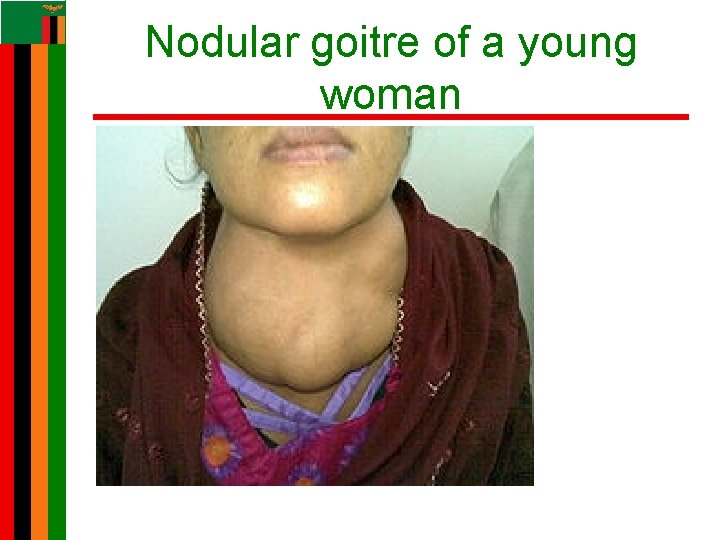
Nodular goitre of a young woman
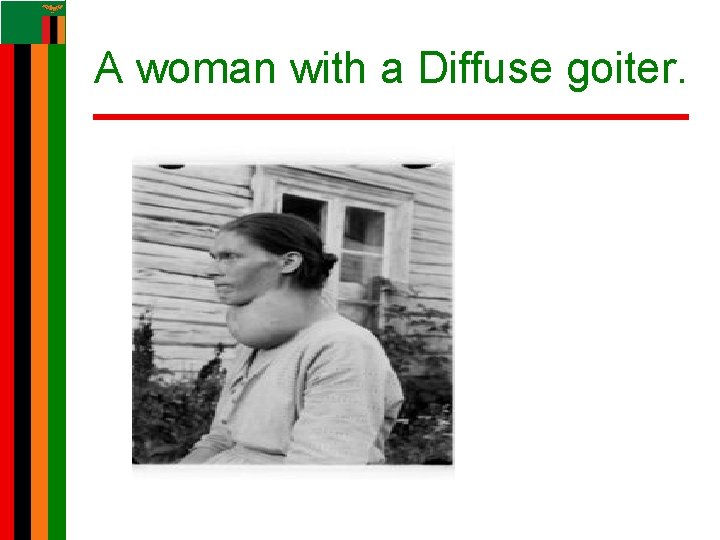
A woman with a Diffuse goiter.
Classification • A "diffuse goiter" is a goiter that has spread through all of the thyroid gland (and can be a "simple goitre", or a "multinodular goitre"). • "Toxic goitre" refers to goitre with hyperthyroidism. This is commonly due to Graves' disease, but can be caused by inflammation or a multinodular goitre. • "Nontoxic goitre" (associated with normal or low thyroid levels) refers to all other types (such as that caused by lithium or certain other autoimmune diseases).
Classification • Diffuse goiter: It has sub types ie; v Simple goitre; whose cause is physiological for example pregnancy and puberty v The other type is graves’ disease and Hashimoto’s disease and are said to be caused by autoimmunity v Thyroiditis is the other cause especially the ‘de Quervain’s thyroiditis v Iodine defficiency v Goitrogens are the other cause e. g. cassava, drugs like sulphonylureas
Causes • Worldwide, the most common cause for goitre is iodine deficiency. In countries that use iodized salt, Hashimoto's thyroiditis becomes the most common cause. • Other causes are: • Hashimoto's thyroiditis • Grave's disease
Causes cont • Inborn errors of thyroid hormone synthesis, causing congenital hypothyroidism • Thyroiditis (acute, chronic) • Ingestion of goitrogens, such as cassava. • Side-effects of pharmacological therapy eg sulphonylureas • Thyroid cancer
Pathophysiology • Iodine is necessary for the synthesis of the thyroid hormones thyroxine (T 4) and triiodothyronine (T 3). • In endemic goitre, iodine deficiency leaves the thyroid gland unable to produce its hormones because the hormones are made out of iodine. • When levels of thyroid hormones fall, thyrotropin-releasing hormone (TRH) is produced by the hypothalamus.
Pathophysiology cont • TRH then prompts the pituitary gland to make thyrotropin or thyroid stimulating hormone (TSH), which stimulates the thyroid gland’s production of T 4 and T 3. • It also causes the thyroid gland to grow in size by increasing cell division
Symptoms • In many of cases there are no symptoms other than the appearance of large swelling in the neck. The size of a goiter can range from very small to very large. • Breathing problems may occur - if the goiter is large enough and presses on the windpipe. • Swallowing problems may also occur - if the goiter is large enough to press on the esophagus.
Signs and symptoms cont • Depression and problems with memory and concentration may also occur. • Sweaty moist palms. • Rapid Heart beat. • Increased Appetite. • Feeling tired and sleeping excessively. • Dry and Thickened Skin.
Signs and symptoms cont • • Poor Memory and Concentration. Deteriorating or slowing growth rate. Brittle Hair. The suffering person may have a croaky or hoarse voice. • Slow Reflexes.
Signs and symptoms cont • Delayed precocious sexual development • High Cholesterol Levels • Girls suffering from goitre may suffer from increased menstrual flow.
Diagnosis • Clinical feature such an enlarged thyroid gland • An ultrasound scan of the thyroid. This may be done if you have a single nodule. It can tell if a nodule is a cyst or a solid lump. • Needle biopsy may be taken and sent to the lab. • A radioactive iodine scan or similar test. This may be done to see if any nodules are making too much thyroxine or T 3.
Treatment • Treatment may not be necessary if the goitre is small. • Goitre may be related to hyper- and hypothyroidism (especially Graves' disease) and may be reversed by treatment of hyper- and hypothyroidism. • Grave's disease can be corrected with antithyroid drugs such as; Ø Propylthiouracil and Ø Methimazole Ø Surgical removal of the thyroid gland (Thyroidectomy) Ø Iodine-131 (131 Iodine - a radioactive isotope of iodine that is absorbed by the thyroid gland destroys it).
Treatment cont • Hypothyroidism may raise the risk of goitre because it usually increases the production of TRH and TSH. • Levothyroxine 25 -100 mcg, used to treat hypothyroidism, can also be used in euthyroid patients for the treatment of goiter. • Levothyroxine suppressive therapy decreases the production of TRH and TSH and may reduce goiter.
THE END THANK YOU! THE MULAS MANSA SCHOOL OF NURSING 18