
Going Places with ABC Berkeley Logic Synthesis and
Going Places with ABC Berkeley Logic Synthesis and Verification Group
Overview • • Introduction Logic networks And-Inverter Graphs (AIGs) Other aspect
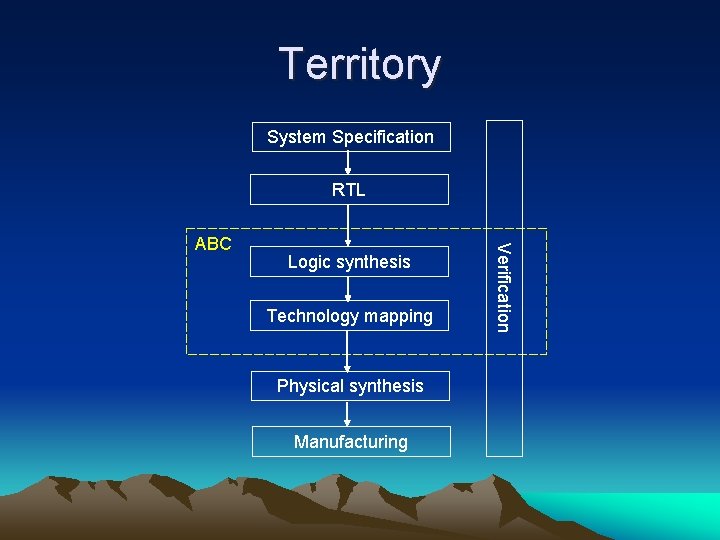
Territory System Specification RTL Logic synthesis Technology mapping Physical synthesis Manufacturing Verification ABC
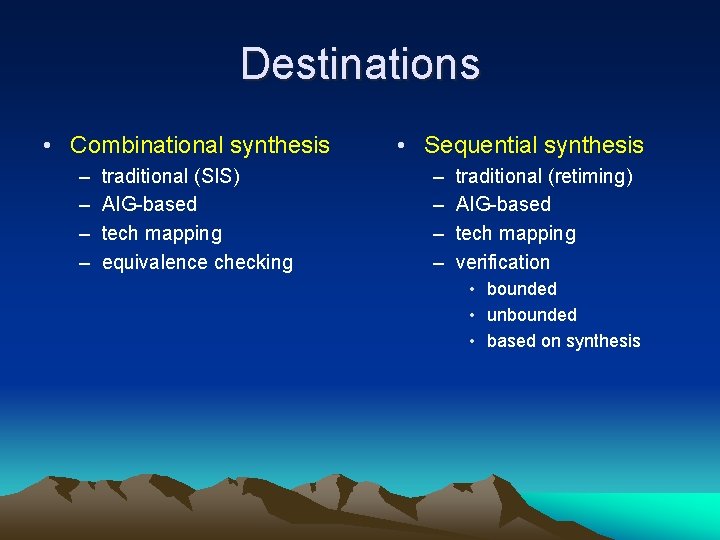
Destinations • Combinational synthesis – – traditional (SIS) AIG-based tech mapping equivalence checking • Sequential synthesis – – traditional (retiming) AIG-based tech mapping verification • bounded • unbounded • based on synthesis
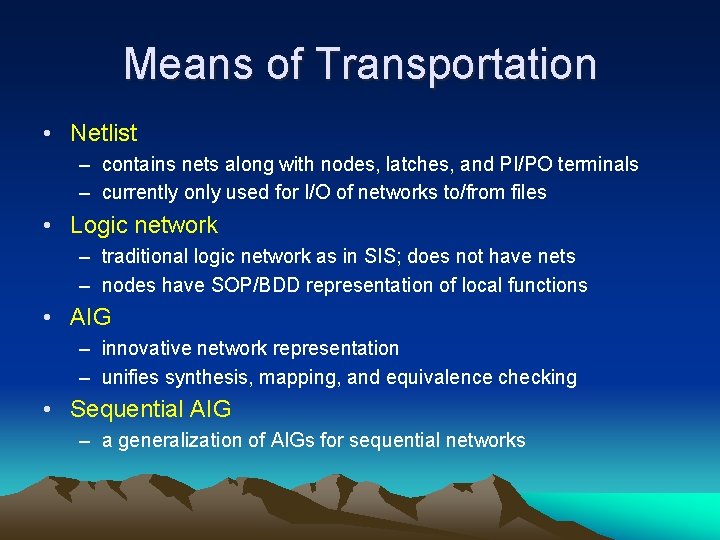
Means of Transportation • Netlist – contains nets along with nodes, latches, and PI/PO terminals – currently only used for I/O of networks to/from files • Logic network – traditional logic network as in SIS; does not have nets – nodes have SOP/BDD representation of local functions • AIG – innovative network representation – unifies synthesis, mapping, and equivalence checking • Sequential AIG – a generalization of AIGs for sequential networks
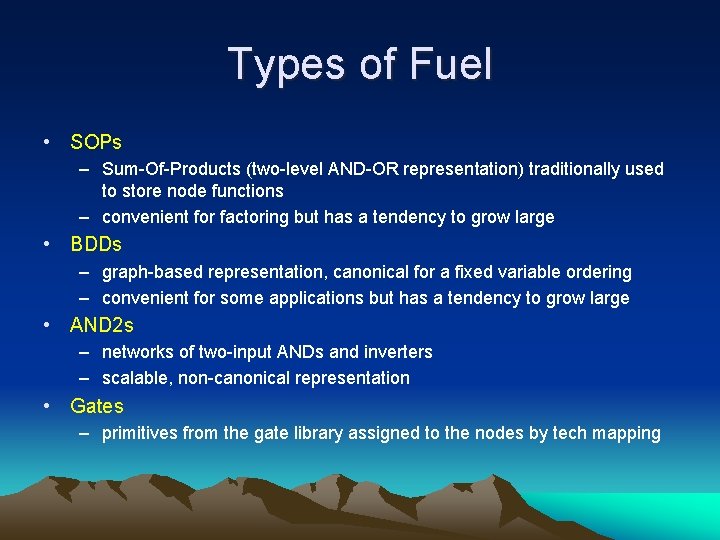
Types of Fuel • SOPs – Sum-Of-Products (two-level AND-OR representation) traditionally used to store node functions – convenient for factoring but has a tendency to grow large • BDDs – graph-based representation, canonical for a fixed variable ordering – convenient for some applications but has a tendency to grow large • AND 2 s – networks of two-input ANDs and inverters – scalable, non-canonical representation • Gates – primitives from the gate library assigned to the nodes by tech mapping
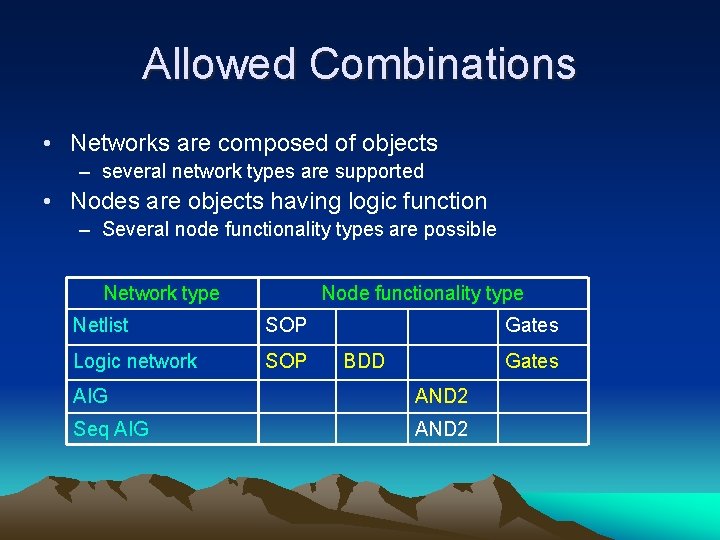
Allowed Combinations • Networks are composed of objects – several network types are supported • Nodes are objects having logic function – Several node functionality types are possible Network type Node functionality type Netlist SOP Logic network SOP Gates BDD Gates AIG AND 2 Seq AIG AND 2
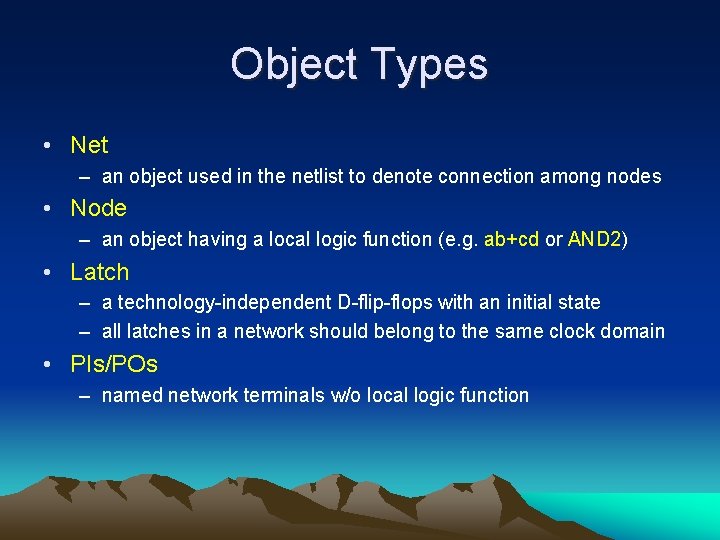
Object Types • Net – an object used in the netlist to denote connection among nodes • Node – an object having a local logic function (e. g. ab+cd or AND 2) • Latch – a technology-independent D-flip-flops with an initial state – all latches in a network should belong to the same clock domain • PIs/POs – named network terminals w/o local logic function
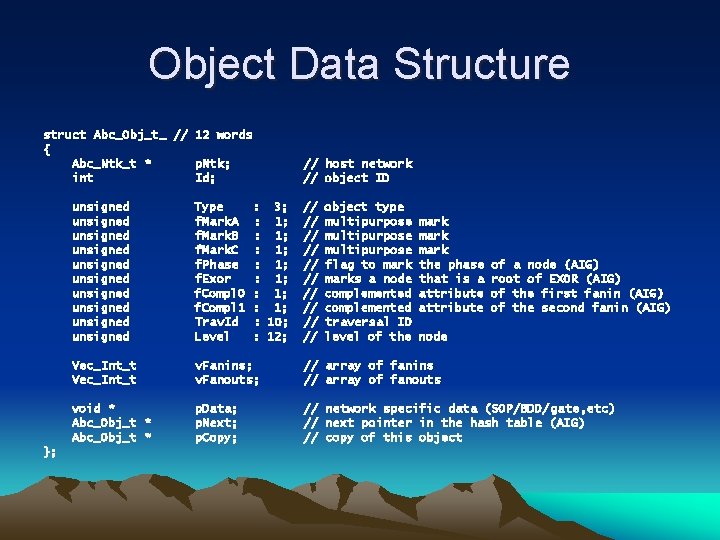
Object Data Structure struct Abc_Obj_t_ // 12 words { Abc_Ntk_t * p. Ntk; int Id; }; : 3; : 1; : 1; : 10; : 12; // host network // object ID unsigned unsigned unsigned Type f. Mark. A f. Mark. B f. Mark. C f. Phase f. Exor f. Compl 0 f. Compl 1 Trav. Id Level // // // object type multipurpose flag to marks a node complemented traversal ID level of the Vec_Int_t v. Fanins; v. Fanouts; // array of fanins // array of fanouts void * Abc_Obj_t * p. Data; p. Next; p. Copy; // network specific data (SOP/BDD/gate, etc) // next pointer in the hash table (AIG) // copy of this object mark the phase that is a attribute of a node (AIG) root of EXOR (AIG) of the first fanin (AIG) of the second fanin (AIG) node

Overview • • Introduction Logic networks And-Inverter Graphs (AIGs) Other aspect

Logic Network • Similar to SIS network – contains nodes, latches, PI/PO terminals – adding, duplicating, removing nodes are similar – nodes can have a logic function or a gate assigned • Differences – after construction, finalizing steps are required – internal node names are currently not stored – node functionality can be a BDD

Constructing Logic Network • Typically a new network is created from an old network – Abc_Ntk. Start. From // copies PIs, POs, latches, etc • Objects can be added in any order – Abc_Ntk. Dup. Obj // duplicates an object – Abc_Ntk. Create. Node // creates a new node • Object should be connected – Abc_Obj. Add. Fanin // adds fanin to an object • In the end, one or more finalizing functions may be called – – – Abc_Ntk. Finalize // connects POs to nodes (unless done manually) Abc_Ntk. Dup. Cio. Names. Table // should be called always Abc_Man. Time. Dup // duplicates timing info if present Abc_Ntk. Logic. Make. Simple. Cos // often needed (e. g. converting from AIG) Abc_Ntk. Minimum. Base // removes duplicated or vacuous fanins if present Abc_Ntk. Reassign. Ids // restores topological ordering of nodes (AIGs only)
Overview • • Introduction Logic networks And-Inverter Graphs (AIGs) Other aspect
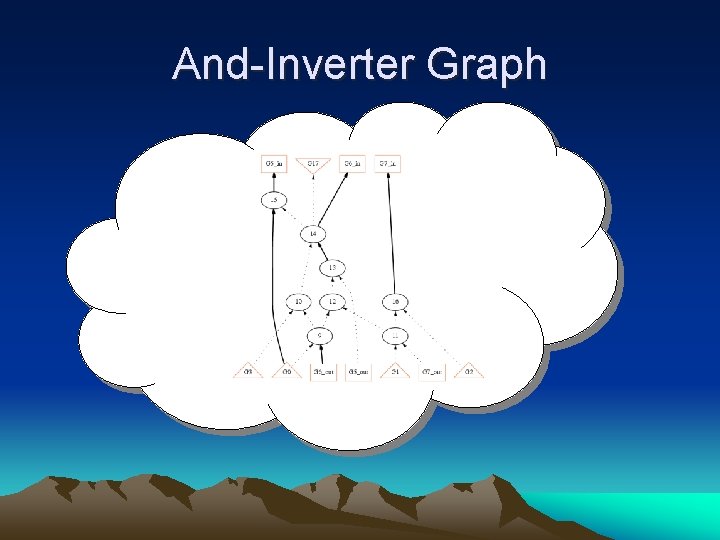
And-Inverter Graph
Requirements for AIGs in ABC • AIG is always stored in the structurally hashed form: – two AND 2 s with the same fanins are merged – the constants are propagated – there is no single-input nodes (inverters/buffers) • Additionally, the following requirements are satisfied: – – – there are no dangling nodes (nodes without fanouts are deleted) the level of each AND 2 reflects the levels of its fanins the EXOR-status of each AND 2 is up-to-date the nodes are stored in the topological order the constant 1 node has always number 0 in the object list
Manipulation of AIGs • AIGs are uniform, compact, and versatile • Computation based on AIG is fast and scalable • Deriving AIGs from logic networks is easy (strash) – simple AIG conversion rules are used for gates – algebraic factoring is used to convert large logic nodes • AIGs are the primary network representation in ABC – required by tech-mappers and most of synthesis commands (balance, collapse, renode, rewrite, refactor, retime) • Extensively used in sequential synthesis • Manipulation is different compared to logic networks – e. g. cannot duplicate or collapse nodes in an AIG
Operations Performed on AIG • Building new AND nodes – Abc_Aig. And • Computing elementary Boolean functions – Abc_Aig. Or, Abc_Aig. Xor, etc • Replacing one node with another – Abc_Aig. Replace • Propagating constants (computing cofactors) – Abc_Aig. Replace • Structural hashing and other requirements are automatically enforced by the AIG manager
Overview • • Introduction Logic networks And-Inverter Graphs (AIGs) Other aspect – – – – Mapping information Timing information BDD representation SAT solvers FRAIG package Snapshots Sequential AIGs Visualizations
Using Mapping Information • Pointer to the library – attached to p. Ntk->p. Man. Func of the network • Pointers to gates – attached to p. Node->p. Data of all internal nodes • What to do with the mapped network? – – – – print mapping statistics (print_stats) print gates used in the mapping (print_gates –l) print delay profile (print_level) sweep equivalent nodes without unmapping (fraig_sweep) write into a BLIF file (write_blif) replace gates by SOPs at all nodes (unmap) continue synthesis (network is unmapped automatically)
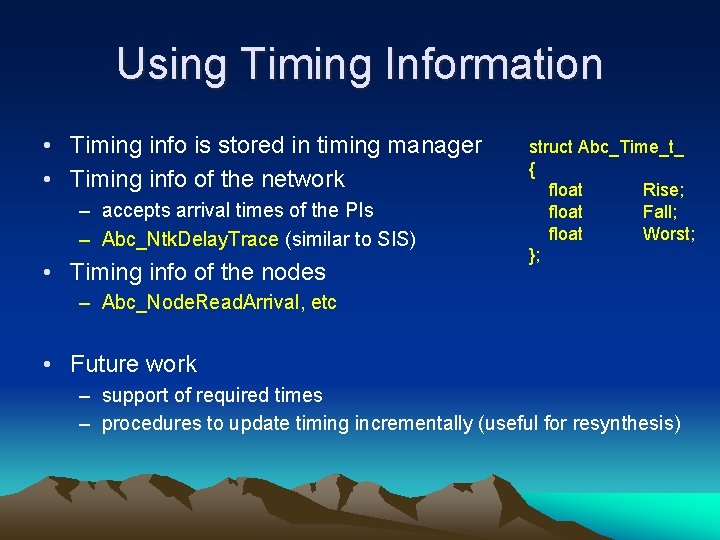
Using Timing Information • Timing info is stored in timing manager • Timing info of the network – accepts arrival times of the PIs – Abc_Ntk. Delay. Trace (similar to SIS) • Timing info of the nodes struct Abc_Time_t_ { float Rise; float Fall; float Worst; }; – Abc_Node. Read. Arrival, etc • Future work – support of required times – procedures to update timing incrementally (useful for resynthesis)
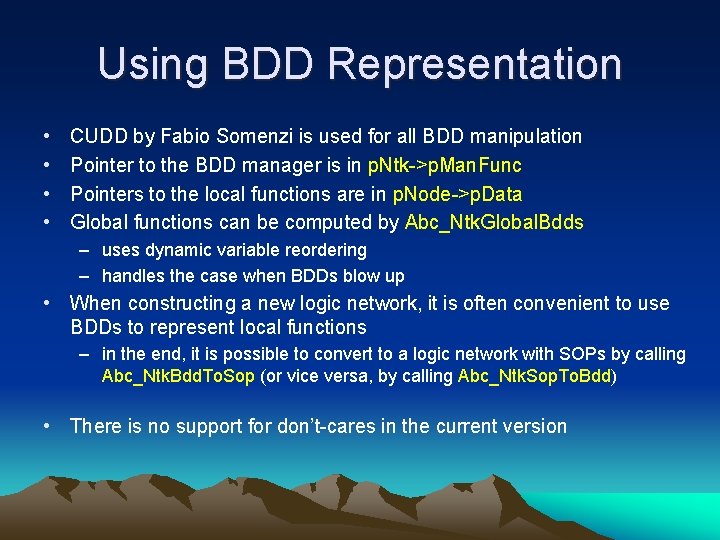
Using BDD Representation • • CUDD by Fabio Somenzi is used for all BDD manipulation Pointer to the BDD manager is in p. Ntk->p. Man. Func Pointers to the local functions are in p. Node->p. Data Global functions can be computed by Abc_Ntk. Global. Bdds – uses dynamic variable reordering – handles the case when BDDs blow up • When constructing a new logic network, it is often convenient to use BDDs to represent local functions – in the end, it is possible to convert to a logic network with SOPs by calling Abc_Ntk. Bdd. To. Sop (or vice versa, by calling Abc_Ntk. Sop. To. Bdd) • There is no support for don’t-cares in the current version
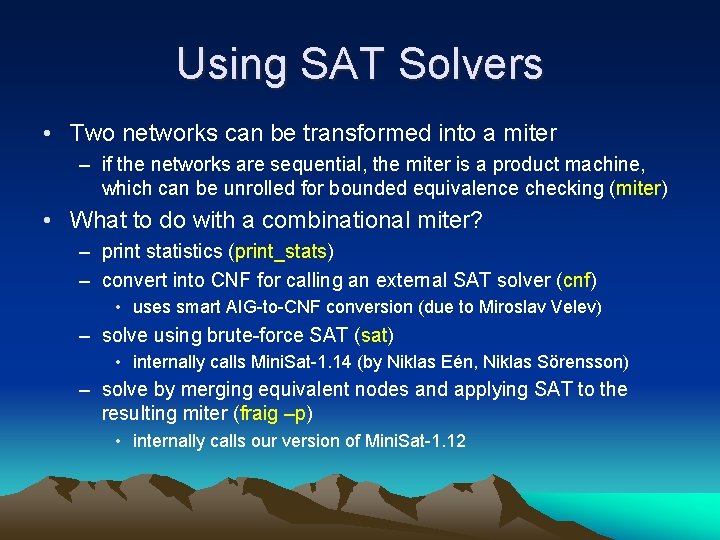
Using SAT Solvers • Two networks can be transformed into a miter – if the networks are sequential, the miter is a product machine, which can be unrolled for bounded equivalence checking (miter) • What to do with a combinational miter? – print statistics (print_stats) – convert into CNF for calling an external SAT solver (cnf) • uses smart AIG-to-CNF conversion (due to Miroslav Velev) – solve using brute-force SAT (sat) • internally calls Mini. Sat-1. 14 (by Niklas Eén, Niklas Sörensson) – solve by merging equivalent nodes and applying SAT to the resulting miter (fraig –p) • internally calls our version of Mini. Sat-1. 12
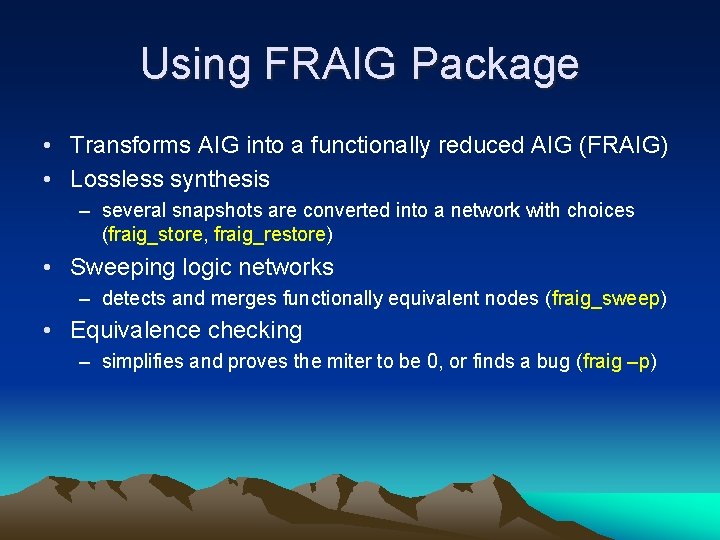
Using FRAIG Package • Transforms AIG into a functionally reduced AIG (FRAIG) • Lossless synthesis – several snapshots are converted into a network with choices (fraig_store, fraig_restore) • Sweeping logic networks – detects and merges functionally equivalent nodes (fraig_sweep) • Equivalence checking – simplifies and proves the miter to be 0, or finds a bug (fraig –p)
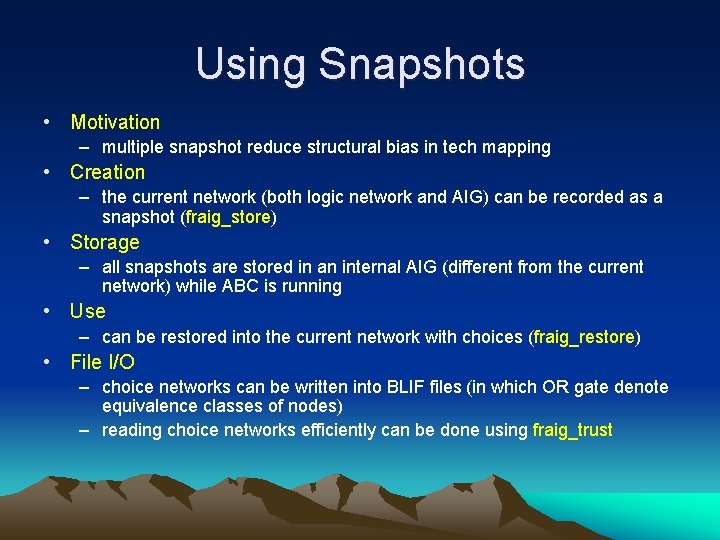
Using Snapshots • Motivation – multiple snapshot reduce structural bias in tech mapping • Creation – the current network (both logic network and AIG) can be recorded as a snapshot (fraig_store) • Storage – all snapshots are stored in an internal AIG (different from the current network) while ABC is running • Use – can be restored into the current network with choices (fraig_restore) • File I/O – choice networks can be written into BLIF files (in which OR gate denote equivalence classes of nodes) – reading choice networks efficiently can be done using fraig_trust
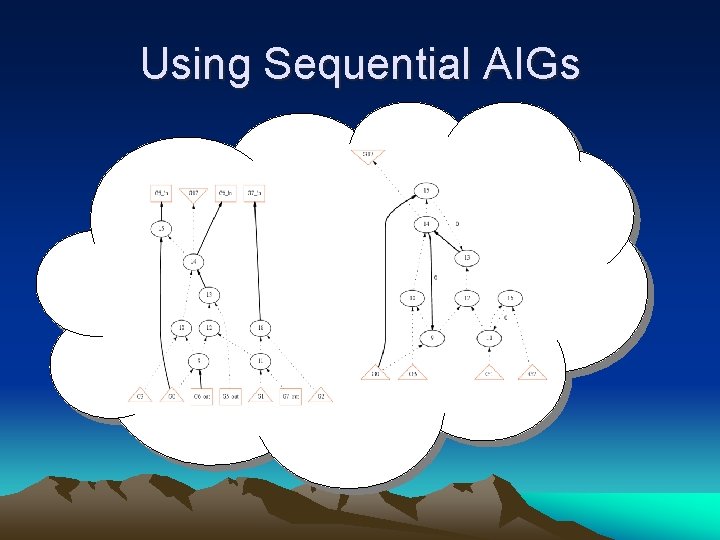
Using Sequential AIGs
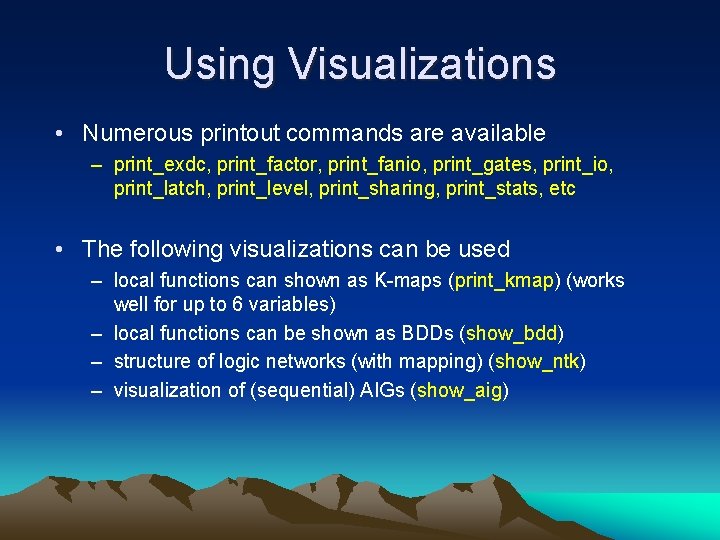
Using Visualizations • Numerous printout commands are available – print_exdc, print_factor, print_fanio, print_gates, print_io, print_latch, print_level, print_sharing, print_stats, etc • The following visualizations can be used – local functions can shown as K-maps (print_kmap) (works well for up to 6 variables) – local functions can be shown as BDDs (show_bdd) – structure of logic networks (with mapping) (show_ntk) – visualization of (sequential) AIGs (show_aig)
ABC Compared with Other Tools • Industrial – well documented, fewer bugs – too specialized, no source code, often costly • SIS – traditionally very popular – some data structures / algorithms are outdated, no sequential synthesis • VIS – features Verilog input, implementation of BDD-based verification – not meant for binary logic synthesis • MVSIS – allows for multi-valued logic synthesis and finite automata manipulation – complicated for experimental programming, not for binary synthesis
Conclusion • Reviewed basic concepts of ABC • Outlined basic programming principles Updated programmer’s manual is online: http: //www. eecs. berkeley. edu/~alanmi/abc/programming. pdf
- Slides: 28