
Going Deeper into Questioning and Feedback in English

Going Deeper into Questioning and Feedback in English Language Arts and History Social Science Margaret Heritage Becky Sullivan, ELA Charlie Gilmore, HSS Webinar Series
Learning Goals • • Understand what makes effective questions designed to elicit evidence in formative assessment Understand what constitutes effective feedback in support of learning in the disciplines
Success Criteria • • • Explain the characteristics of effective questions to elicit evidence in specific disciplines Explain the characteristics of effective feedback in specific disciplines Identify strong and weak examples of each
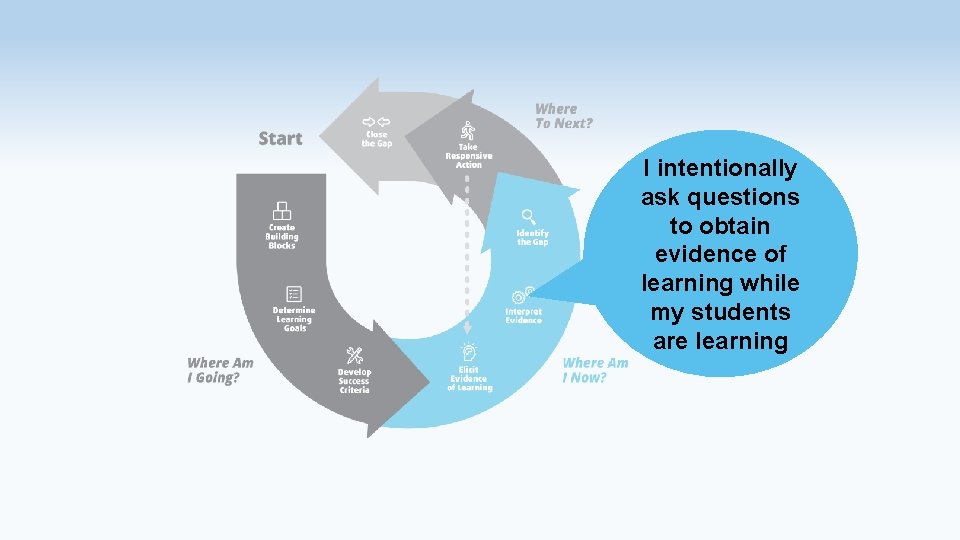
I intentionally ask questions to obtain evidence of learning while my students are learning
Disciplinary Learning
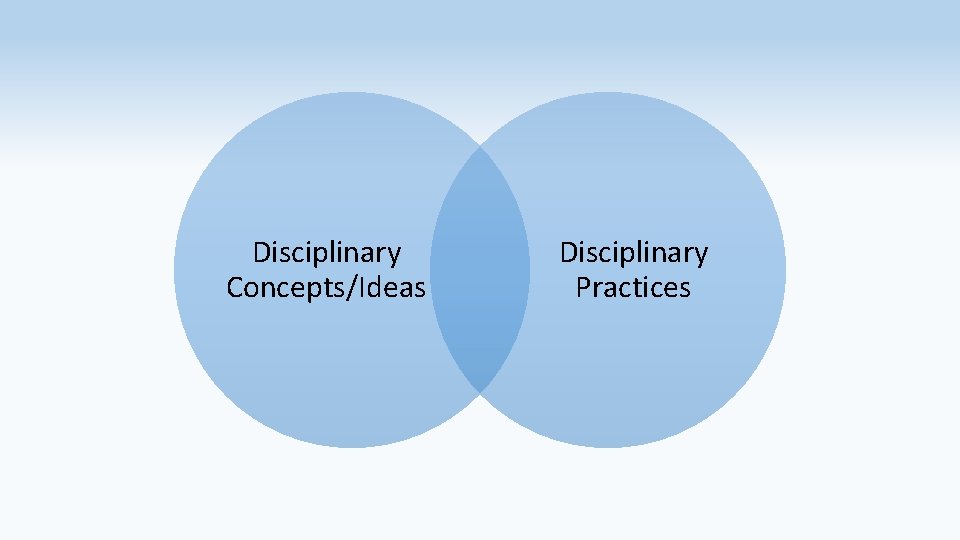
Disciplinary Concepts/Ideas Disciplinary Practices
Disciplinary Learning • Teaching learning strategies (e. g. , critical thinking) out of context is unlikely to develop a generic skill applicable to many subjects • Mathematics proof - critical thinking: ensuring that each step follows from the previous one • Historical account – critical thinking: considering the author of the account, the potential biases and limitations that the author may be bringing to the account Wiliam, 2014
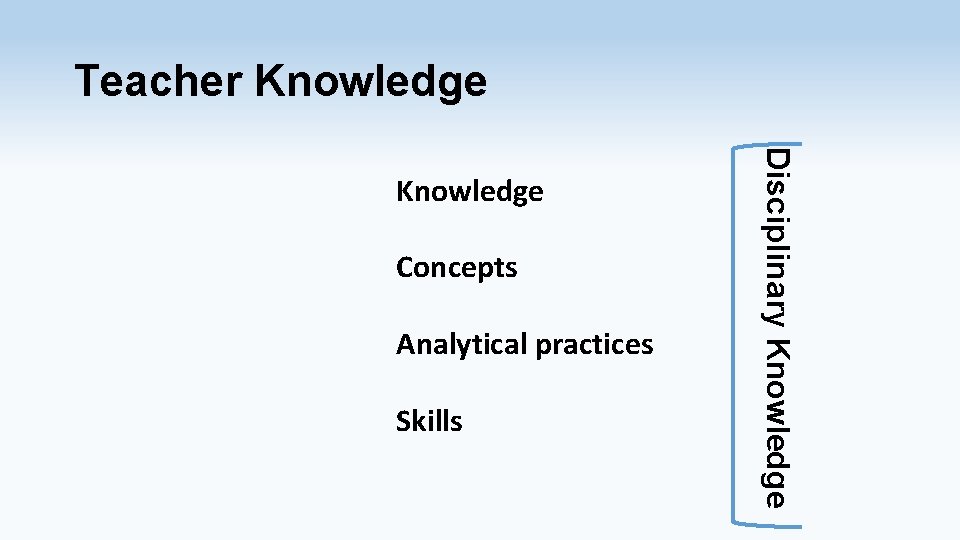
Teacher Knowledge Concepts Analytical practices Skills Disciplinary Knowledge
Questioning: A Key Tool in Formative Assessment
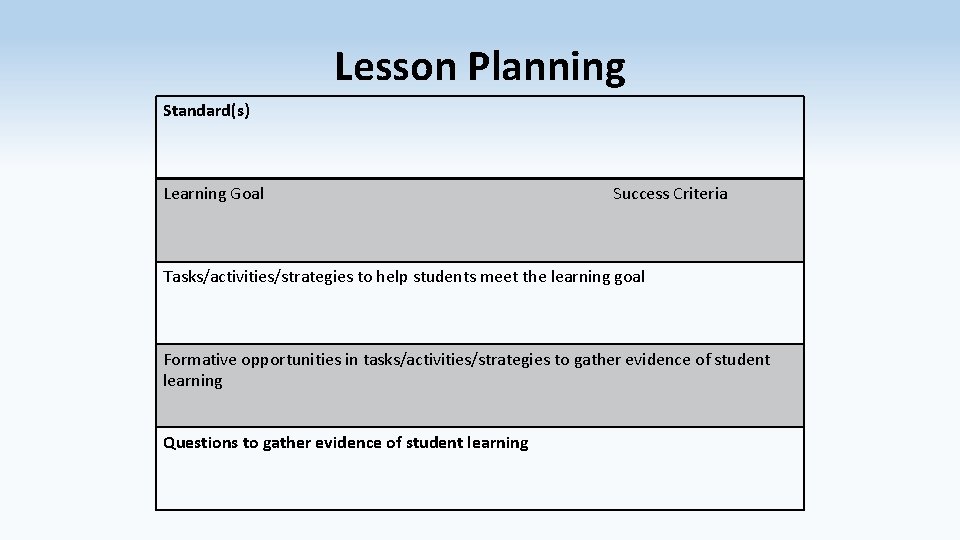
Lesson Planning Standard(s) Learning Goal Success Criteria Tasks/activities/strategies to help students meet the learning goal Formative opportunities in tasks/activities/strategies to gather evidence of student learning Questions to gather evidence of student learning
• Plan good questions to elicit evidence • A few carefully prepared questions are preferable to a large number of questions • Preserve good questions
Asking Well-Thought Out Questions • Assess what students bring to the lesson • Provide insights into the current status of student learning during the lesson • Identify gaps and/or misconceptions in student learning during the lesson • Assess what students take from the lesson
Designing Questions • Questions that target learning goals and success criteria
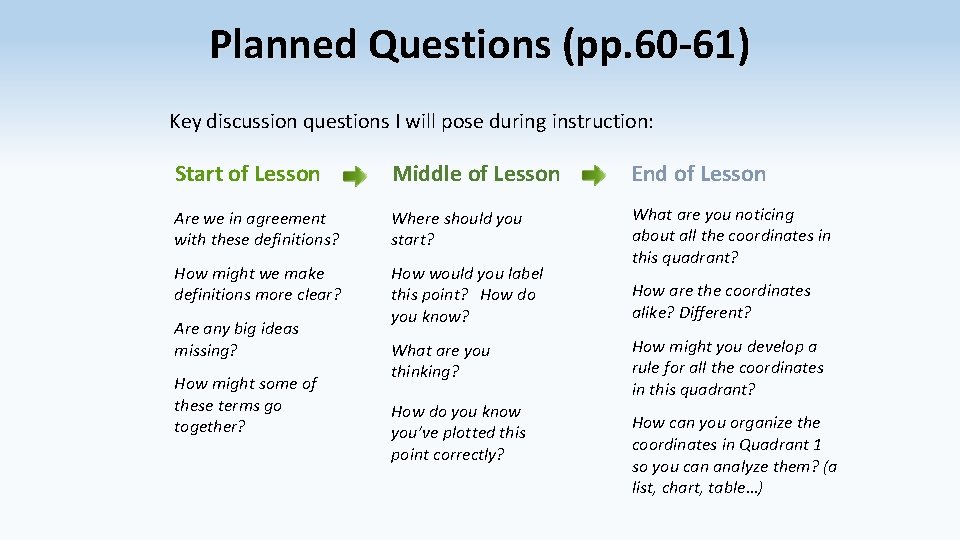
Planned Questions (pp. 60 -61) Key discussion questions I will pose during instruction: Start of Lesson Middle of Lesson End of Lesson Are we in agreement with these definitions? Where should you start? How might we make definitions more clear? How would you label this point? How do you know? What are you noticing about all the coordinates in this quadrant? Are any big ideas missing? How might some of these terms go together? What are you thinking? How do you know you’ve plotted this point correctly? How are the coordinates alike? Different? How might you develop a rule for all the coordinates in this quadrant? How can you organize the coordinates in Quadrant 1 so you can analyze them? (a list, chart, table…)

Types of Questions • Closed: checking students’ memory and recall of facts (typically one right answer) • Open: have more than one answer (typically promote higher order thinking skills) • Low risk: no right or wrong (what comes into their head when introduce a topic – what comes to mind when you think of? )

Broad Versus Focused Broad Open-ended : How are these two ideas connected? Analysis: How would you interpret…? Prediction: What will happen if. . . ? Focused Recalling facts: What is the name of the main character? Defining terms: What is x? Categorizing: What characteristics do x, y, and z share? Brent & Felder, 2014
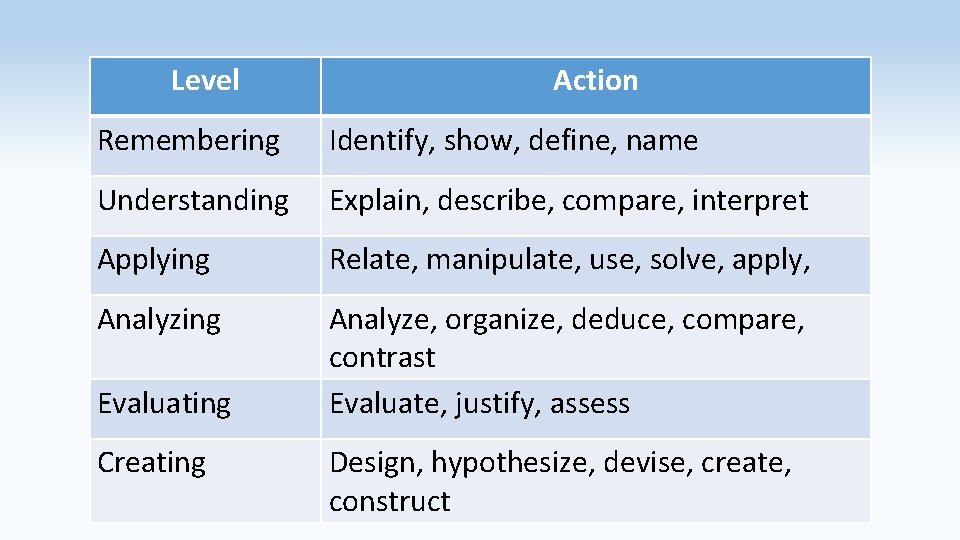
Level Action Remembering Identify, show, define, name Understanding Explain, describe, compare, interpret Applying Relate, manipulate, use, solve, apply, Analyzing Analyze, organize, deduce, compare, contrast Evaluate, justify, assess Evaluating Creating Design, hypothesize, devise, create, construct
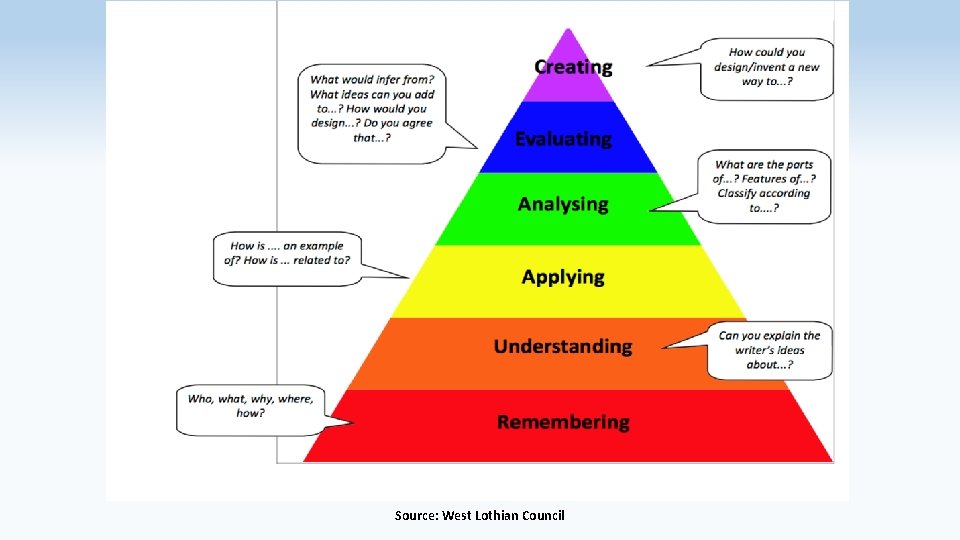
Source: West Lothian Council
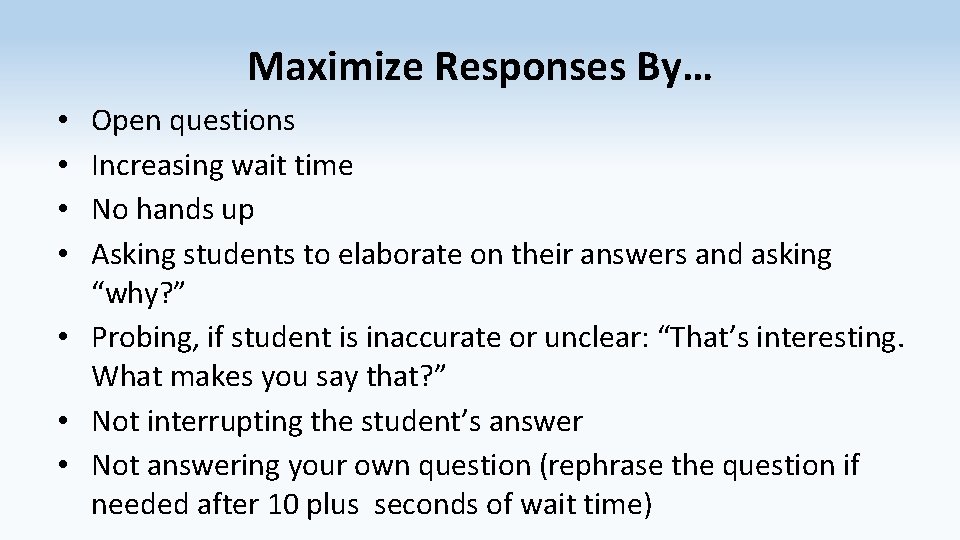
Maximize Responses By… Open questions Increasing wait time No hands up Asking students to elaborate on their answers and asking “why? ” • Probing, if student is inaccurate or unclear: “That’s interesting. What makes you say that? ” • Not interrupting the student’s answer • Not answering your own question (rephrase the question if needed after 10 plus seconds of wait time) • •
Questioning in the Disciplines
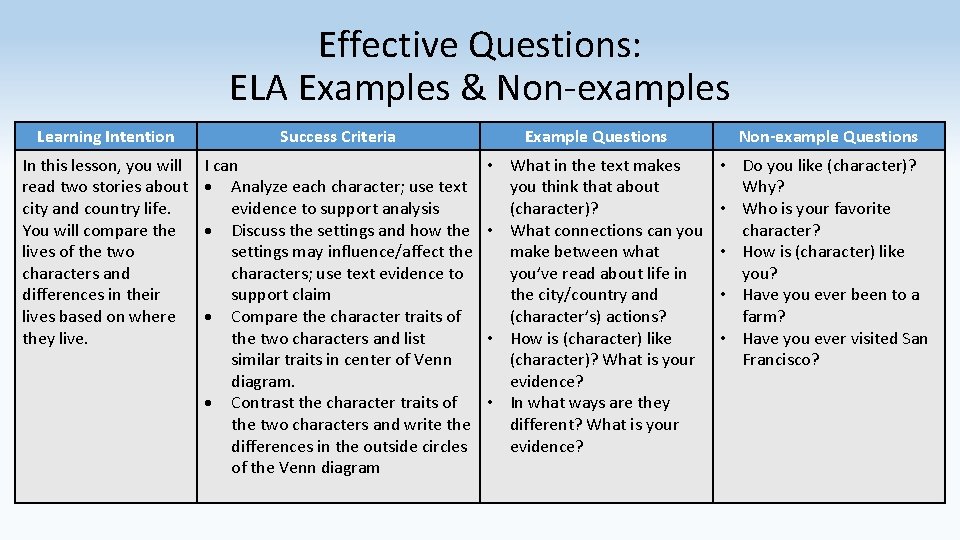
Effective Questions: ELA Examples & Non-examples Learning Intention Success Criteria Example Questions Non-example Questions In this lesson, you will read two stories about city and country life. You will compare the lives of the two characters and differences in their lives based on where they live. I can Analyze each character; use text evidence to support analysis Discuss the settings and how the settings may influence/affect the characters; use text evidence to support claim Compare the character traits of the two characters and list similar traits in center of Venn diagram. Contrast the character traits of the two characters and write the differences in the outside circles of the Venn diagram • What in the text makes you think that about (character)? • What connections can you make between what you’ve read about life in the city/country and (character’s) actions? • How is (character) like (character)? What is your evidence? • In what ways are they different? What is your evidence? • Do you like (character)? Why? • Who is your favorite character? • How is (character) like you? • Have you ever been to a farm? • Have you ever visited San Francisco?
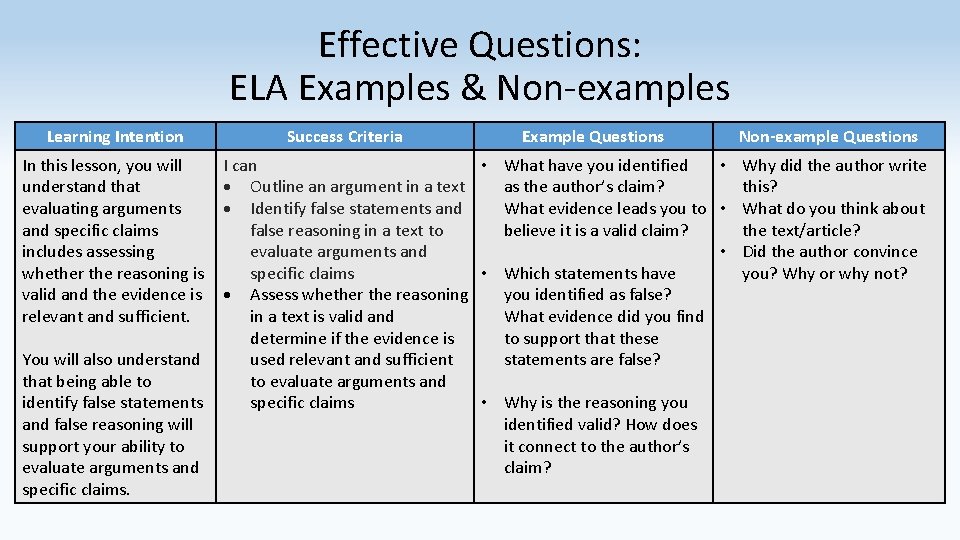
Effective Questions: ELA Examples & Non-examples Learning Intention In this lesson, you will understand that evaluating arguments and specific claims includes assessing whether the reasoning is valid and the evidence is relevant and sufficient. You will also understand that being able to identify false statements and false reasoning will support your ability to evaluate arguments and specific claims. Success Criteria Example Questions Non-example Questions I can • What have you identified • Why did the author write Outline an argument in a text as the author’s claim? this? Identify false statements and What evidence leads you to • What do you think about false reasoning in a text to believe it is a valid claim? the text/article? evaluate arguments and • Did the author convince specific claims • Which statements have you? Why or why not? Assess whether the reasoning you identified as false? in a text is valid and What evidence did you find determine if the evidence is to support that these used relevant and sufficient statements are false? to evaluate arguments and specific claims • Why is the reasoning you identified valid? How does it connect to the author’s claim?
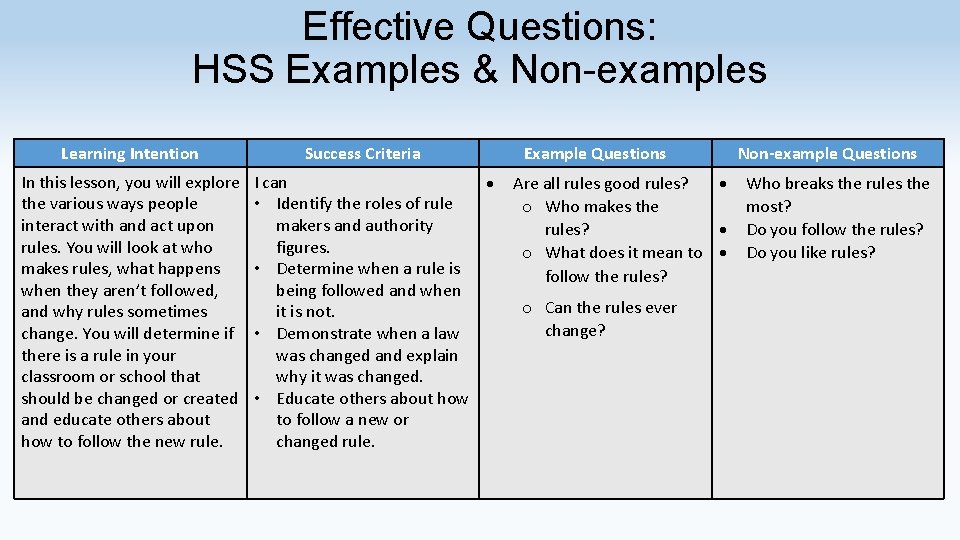
Effective Questions: HSS Examples & Non-examples Learning Intention In this lesson, you will explore the various ways people interact with and act upon rules. You will look at who makes rules, what happens when they aren’t followed, and why rules sometimes change. You will determine if there is a rule in your classroom or school that should be changed or created and educate others about how to follow the new rule. Success Criteria I can • Identify the roles of rule makers and authority figures. • Determine when a rule is being followed and when it is not. • Demonstrate when a law was changed and explain why it was changed. • Educate others about how to follow a new or changed rule. Example Questions Are all rules good rules? o Who makes the rules? o What does it mean to follow the rules? o Can the rules ever change? Non-example Questions Who breaks the rules the most? Do you follow the rules? Do you like rules?
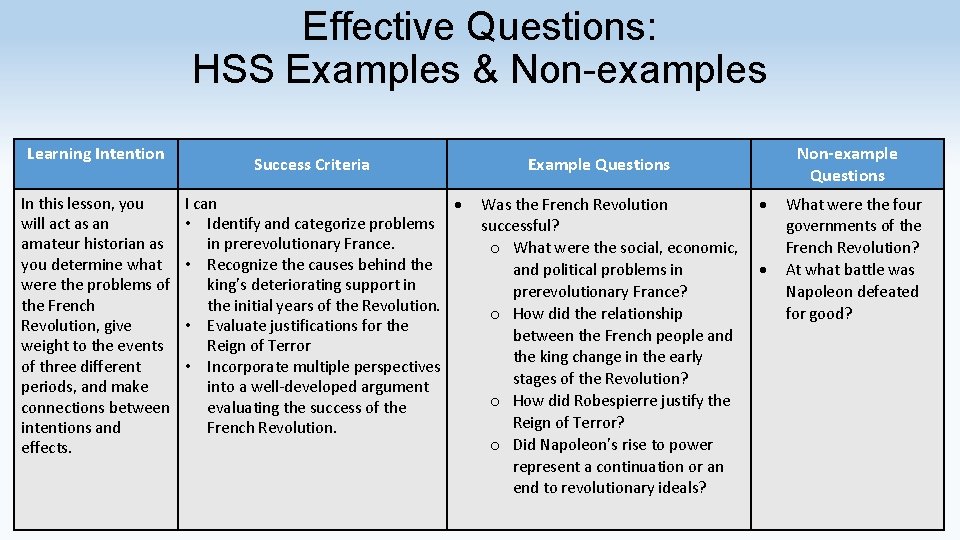
Effective Questions: HSS Examples & Non-examples Learning Intention In this lesson, you will act as an amateur historian as you determine what were the problems of the French Revolution, give weight to the events of three different periods, and make connections between intentions and effects. Success Criteria I can • Identify and categorize problems in prerevolutionary France. • Recognize the causes behind the king’s deteriorating support in the initial years of the Revolution. • Evaluate justifications for the Reign of Terror • Incorporate multiple perspectives into a well-developed argument evaluating the success of the French Revolution. Example Questions Was the French Revolution successful? o What were the social, economic, and political problems in prerevolutionary France? o How did the relationship between the French people and the king change in the early stages of the Revolution? o How did Robespierre justify the Reign of Terror? o Did Napoleon’s rise to power represent a continuation or an end to revolutionary ideals? Non-example Questions What were the four governments of the French Revolution? At what battle was Napoleon defeated for good?

Think About… Ways in which you use questions to elicit evidence of learning The proportion of questions designed to elicit evidence and the proportion of “managerial” questions How you could improve your questioning to elicit evidence of learning


Feedback
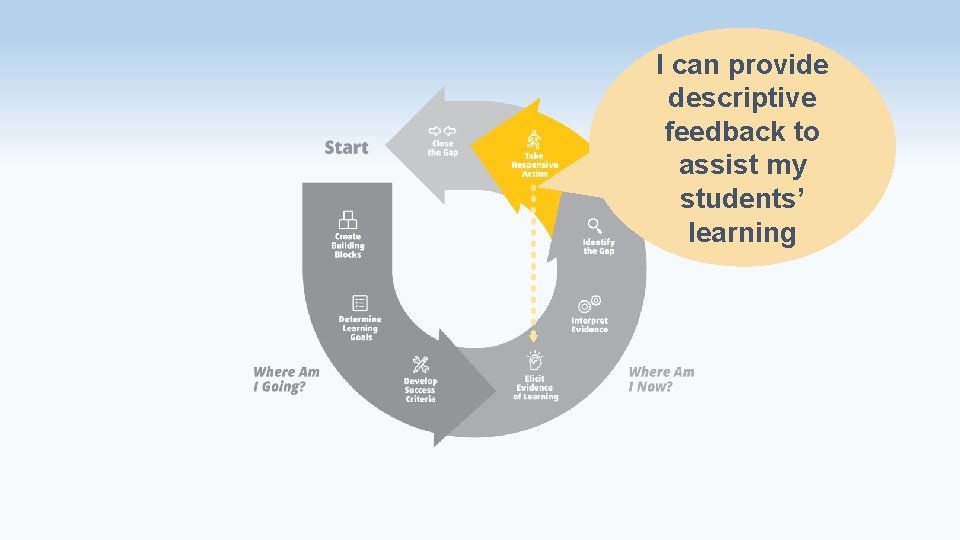
I can provide descriptive feedback to assist my students’ learning
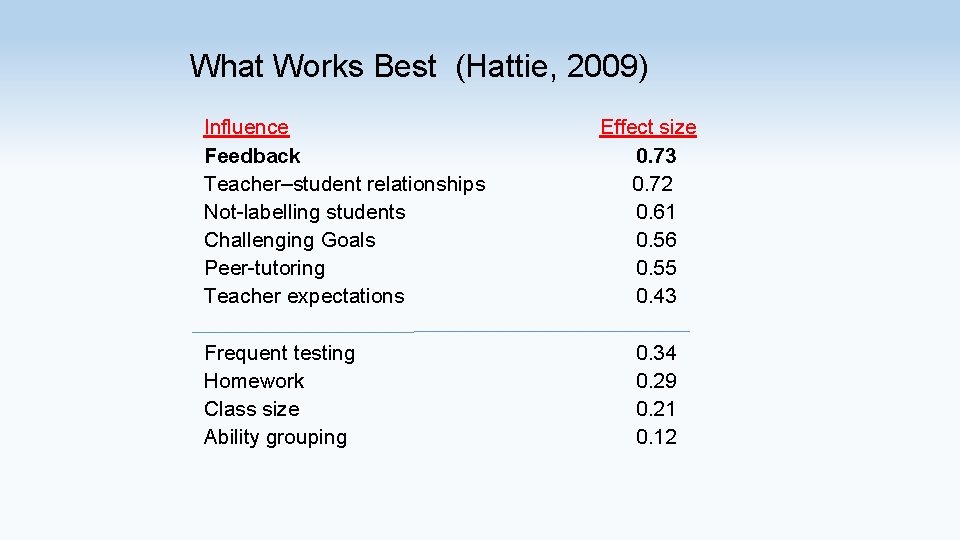
What Works Best (Hattie, 2009) Influence Feedback Teacher–student relationships Not-labelling students Challenging Goals Peer-tutoring Teacher expectations Frequent testing Homework Class size Ability grouping Effect size 0. 73 0. 72 0. 61 0. 56 0. 55 0. 43 0. 34 0. 29 0. 21 0. 12

Teachers who combine strong subject knowledge with effective feedback can offer students rich, focused information about their learning and how to improve it. Ministry of Education, New Zealand

ü Effective feedback requires students to have an understanding of the desired goal ü Evidence about their present position in relation to the goal ü Guidance on the way to close the gap between the two
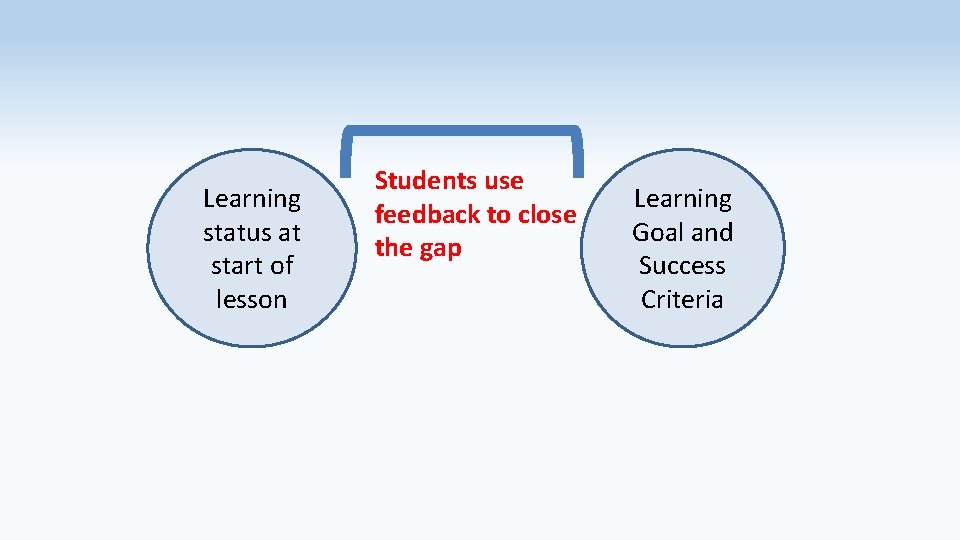
Learning status at start of lesson Students use feedback to close the gap Learning Goal and Success Criteria
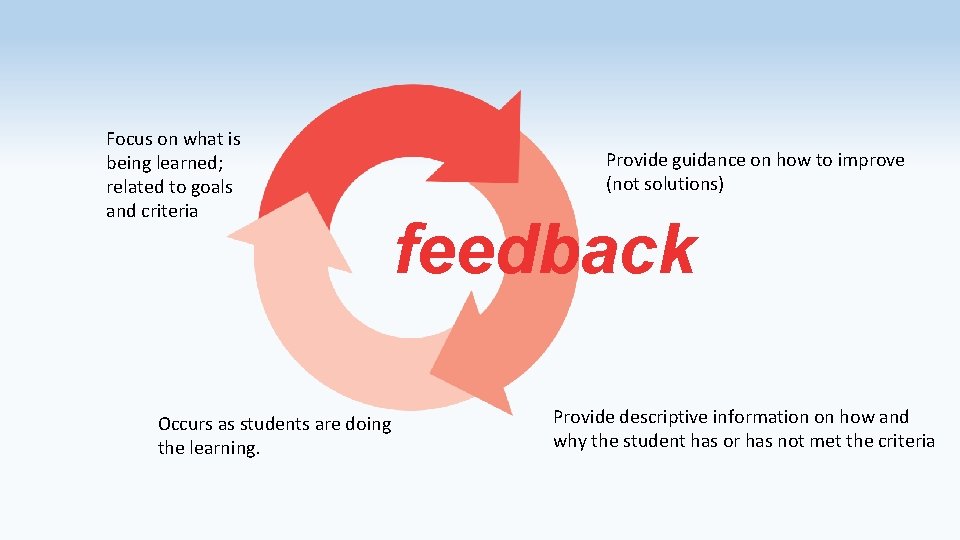
Focus on what is being learned; related to goals and criteria Provide guidance on how to improve (not solutions) feedback Occurs as students are doing the learning. Provide descriptive information on how and why the student has or has not met the criteria
Descriptive Feedback • That’s a good introduction because you have covered the main points we discussed at the beginning. Now … which points do you think you should expand on? • You’ve created an clear chronological series of events for the Loyalists. Can you now use these events to compare what was happening with the Patriots at the same time.
Evaluative Feedback That’s a good essay. You’ve done well. That’s not good enough. You need to do that over.
Feedback is Most Effective When… • initiated by the student, in conjunction with self and/or peer assessment • teachers carefully gauge when feedback is needed to promote learning • teachers use the kind of feedback prompt that best meets the need of the students, at the level of support they need • teachers allow time for, and students can independently act on, feedback to improve their learning • feedback takes place as a conversation • teachers check the adequacy of the feedback with the students Source: Ministry of Education, New Zealand
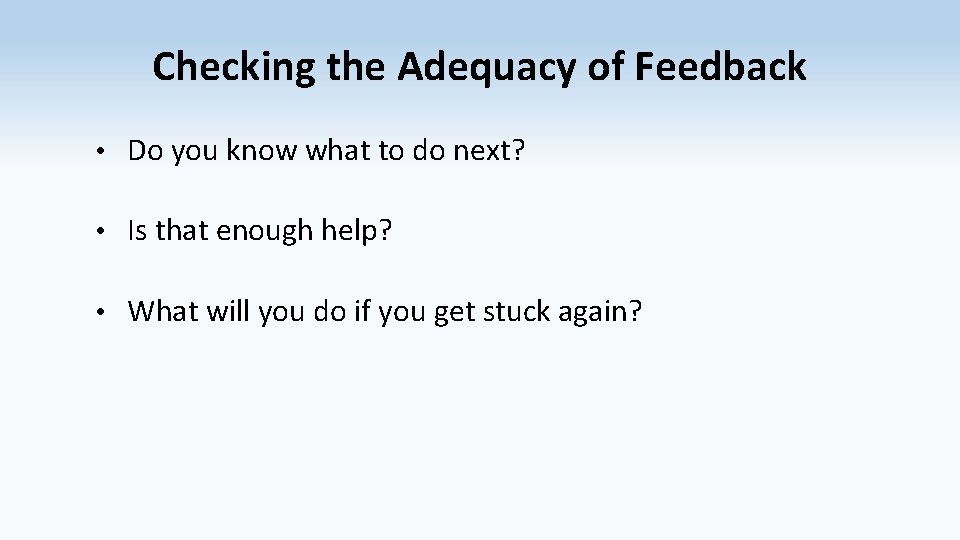
Checking the Adequacy of Feedback • Do you know what to do next? • Is that enough help? • What will you do if you get stuck again?

Feedback in the Disciplines
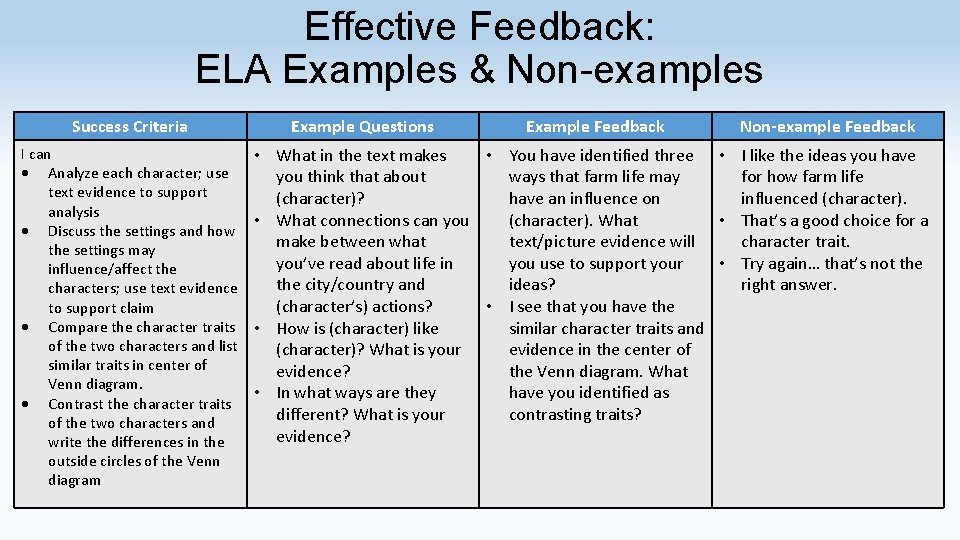
Effective Feedback: ELA Examples & Non-examples Success Criteria I can Analyze each character; use text evidence to support analysis Discuss the settings and how the settings may influence/affect the characters; use text evidence to support claim Compare the character traits of the two characters and list similar traits in center of Venn diagram. Contrast the character traits of the two characters and write the differences in the outside circles of the Venn diagram Example Questions Example Feedback Non-example Feedback • What in the text makes • You have identified three • I like the ideas you have you think that about ways that farm life may for how farm life (character)? have an influence on influenced (character). • What connections can you (character). What • That’s a good choice for a make between what text/picture evidence will character trait. you’ve read about life in you use to support your • Try again… that’s not the city/country and ideas? right answer. (character’s) actions? • I see that you have the • How is (character) like similar character traits and (character)? What is your evidence in the center of evidence? the Venn diagram. What • In what ways are they have you identified as different? What is your contrasting traits? evidence?
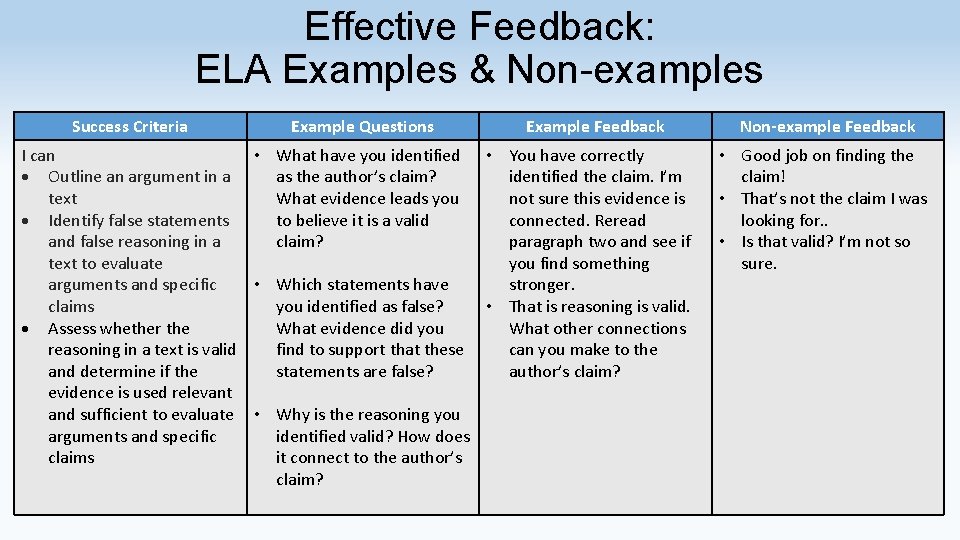
Effective Feedback: ELA Examples & Non-examples Success Criteria Example Questions Example Feedback I can • What have you identified • You have correctly Outline an argument in a as the author’s claim? identified the claim. I’m text What evidence leads you not sure this evidence is Identify false statements to believe it is a valid connected. Reread and false reasoning in a claim? paragraph two and see if text to evaluate you find something arguments and specific • Which statements have stronger. claims you identified as false? • That is reasoning is valid. Assess whether the What evidence did you What other connections reasoning in a text is valid find to support that these can you make to the and determine if the statements are false? author’s claim? evidence is used relevant and sufficient to evaluate • Why is the reasoning you arguments and specific identified valid? How does claims it connect to the author’s claim? Non-example Feedback • Good job on finding the claim! • That’s not the claim I was looking for. . • Is that valid? I’m not so sure.
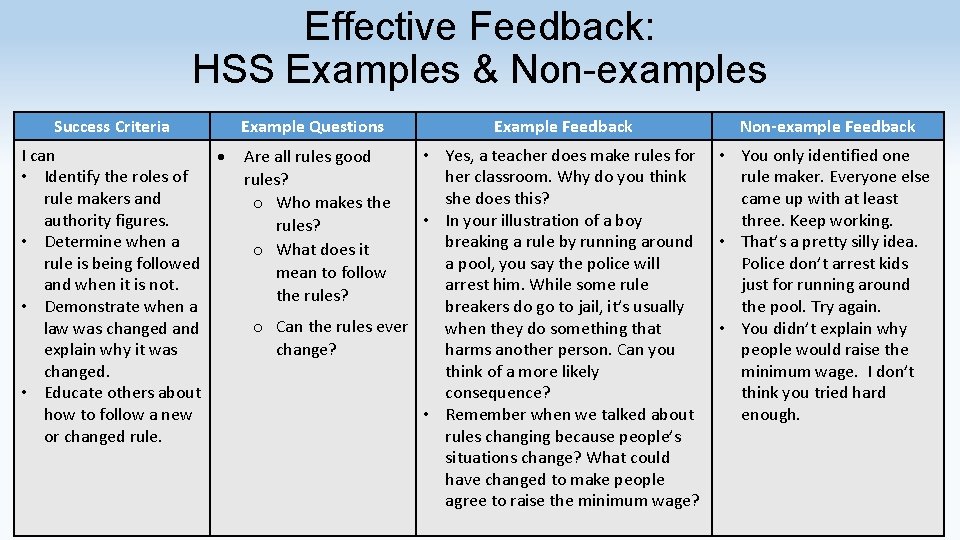
Effective Feedback: HSS Examples & Non-examples Success Criteria I can • Identify the roles of rule makers and authority figures. • Determine when a rule is being followed and when it is not. • Demonstrate when a law was changed and explain why it was changed. • Educate others about how to follow a new or changed rule. Example Questions Example Feedback • Yes, a teacher does make rules for her classroom. Why do you think she does this? • In your illustration of a boy breaking a rule by running around a pool, you say the police will arrest him. While some rule breakers do go to jail, it’s usually o Can the rules ever when they do something that change? harms another person. Can you think of a more likely consequence? • Remember when we talked about rules changing because people’s situations change? What could have changed to make people agree to raise the minimum wage? Are all rules good rules? o Who makes the rules? o What does it mean to follow the rules? Non-example Feedback • You only identified one rule maker. Everyone else came up with at least three. Keep working. • That’s a pretty silly idea. Police don’t arrest kids just for running around the pool. Try again. • You didn’t explain why people would raise the minimum wage. I don’t think you tried hard enough.
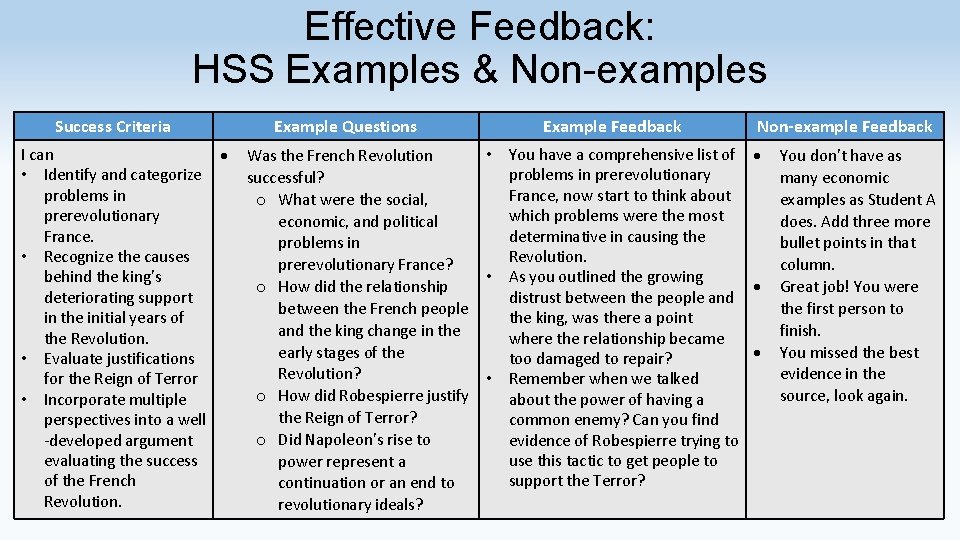
Effective Feedback: HSS Examples & Non-examples Success Criteria I can • Identify and categorize problems in prerevolutionary France. • Recognize the causes behind the king’s deteriorating support in the initial years of the Revolution. • Evaluate justifications for the Reign of Terror • Incorporate multiple perspectives into a well -developed argument evaluating the success of the French Revolution. Example Questions Example Feedback Non-example Feedback • You have a comprehensive list of Was the French Revolution problems in prerevolutionary successful? France, now start to think about o What were the social, which problems were the most economic, and political determinative in causing the problems in Revolution. prerevolutionary France? • As you outlined the growing o How did the relationship distrust between the people and between the French people the king, was there a point and the king change in the where the relationship became early stages of the too damaged to repair? Revolution? • Remember when we talked o How did Robespierre justify about the power of having a the Reign of Terror? common enemy? Can you find o Did Napoleon’s rise to evidence of Robespierre trying to use this tactic to get people to power represent a support the Terror? continuation or an end to revolutionary ideals? You don’t have as many economic examples as Student A does. Add three more bullet points in that column. Great job! You were the first person to finish. You missed the best evidence in the source, look again.
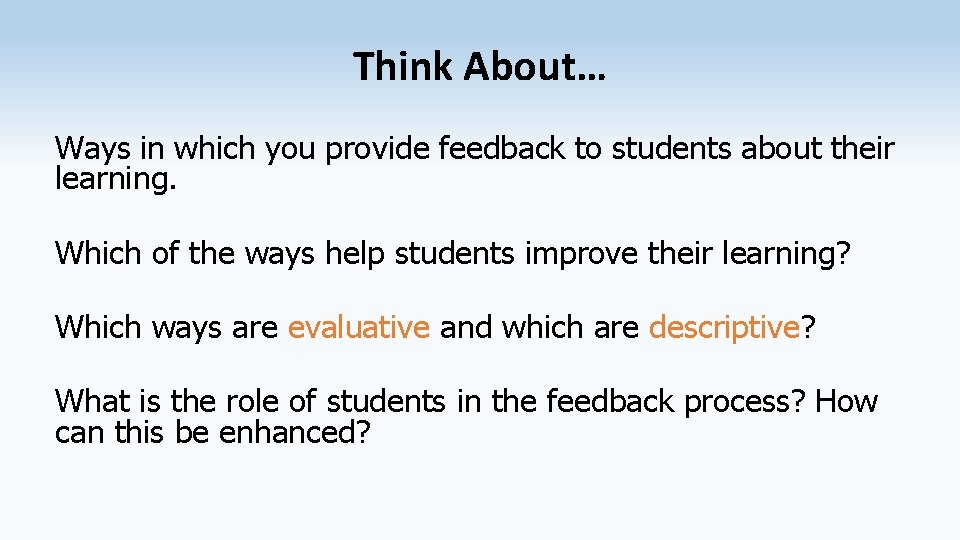
Think About… Ways in which you provide feedback to students about their learning. Which of the ways help students improve their learning? Which ways are evaluative and which are descriptive? What is the role of students in the feedback process? How can this be enhanced?

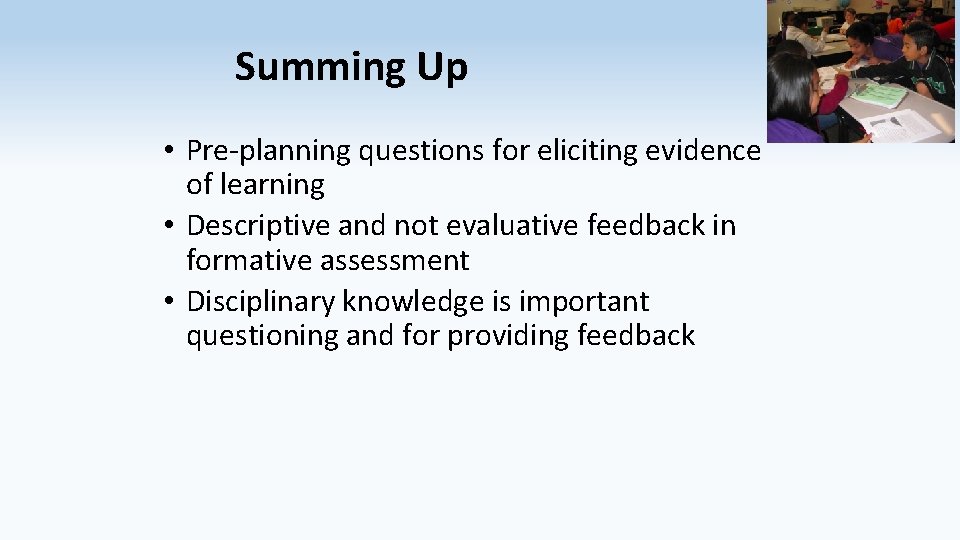
Summing Up • Pre-planning questions for eliciting evidence of learning • Descriptive and not evaluative feedback in formative assessment • Disciplinary knowledge is important questioning and for providing feedback
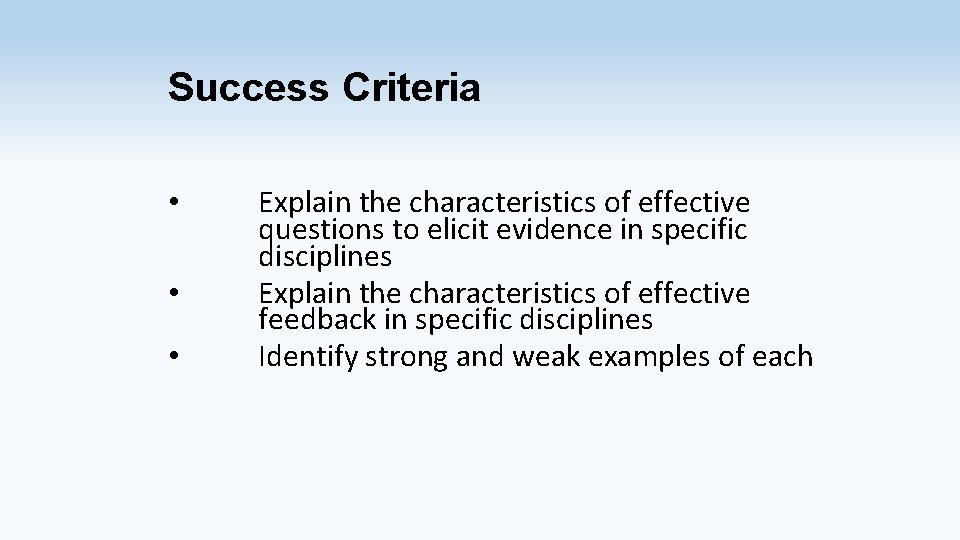
Success Criteria • • • Explain the characteristics of effective questions to elicit evidence in specific disciplines Explain the characteristics of effective feedback in specific disciplines Identify strong and weak examples of each

Thank You! 47
- Slides: 47