
Going Beyond the Borders of Language with Humor
Going Beyond the Borders of Language with Humor Teaching Tip Jolene Jaquays The University of Michigan – Flint Sara Okello TESOL Conference 2016 Baltimore, MD

Background Humor is crucial in learning and understanding a second language. This teaching tip describes humorous activities that can enliven the classroom and motivate students to learn. Three of these activities come from the New Ways of Teaching with Humor series (John Rucynski, editor, July 2016). These activities include: 1. Humorous pictures 2. Commercials 3. Memes 4. Sentence Scrambling 5. Family Tree Construction 6. Jokes

1. Humorous Pictures • Writing / Speaking impromptu prompts • Caption this! • Cause and effect • What’s wrong / unusual with this picture?

1. Writing / Speaking Prompts

1. ghoughphtheightteeau

Caption This!

1. Cause and Effect

1. What’s wrong with this picture?
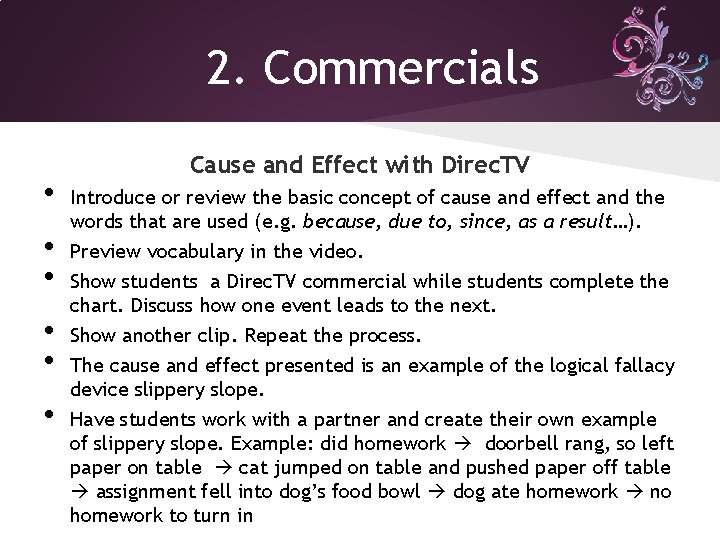
2. Commercials • • • Cause and Effect with Direc. TV Introduce or review the basic concept of cause and effect and the words that are used (e. g. because, due to, since, as a result…). Preview vocabulary in the video. Show students a Direc. TV commercial while students complete the chart. Discuss how one event leads to the next. Show another clip. Repeat the process. The cause and effect presented is an example of the logical fallacy device slippery slope. Have students work with a partner and create their own example of slippery slope. Example: did homework doorbell rang, so left paper on table cat jumped on table and pushed paper off table assignment fell into dog’s food bowl dog ate homework no homework to turn in
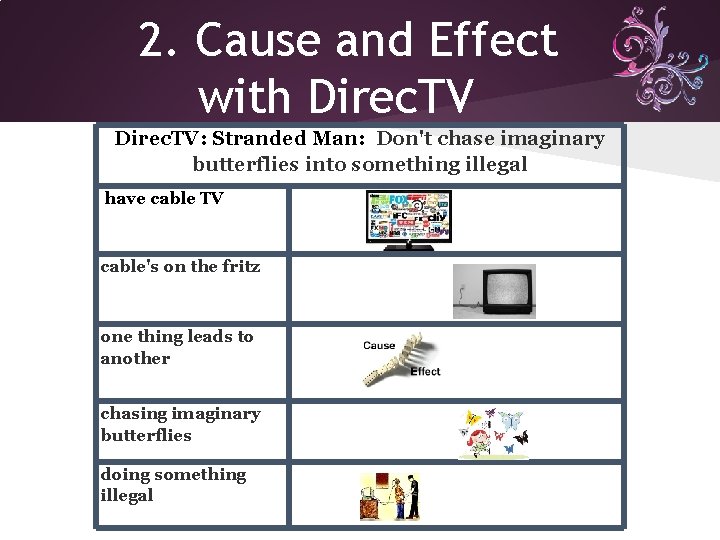
2. Cause and Effect with Direc. TV: Stranded Man: Don't chase imaginary butterflies into something illegal have cable TV cable's on the fritz one thing leads to another chasing imaginary butterflies doing something illegal
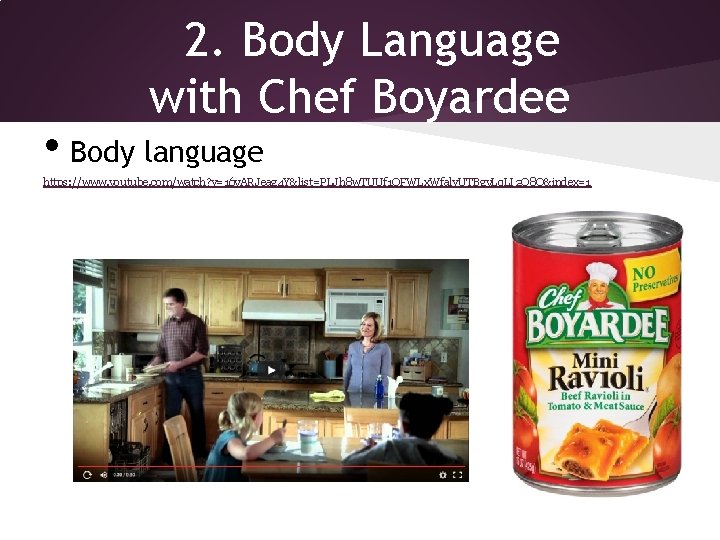
2. Body Language with Chef Boyardee • Body language https: //www. youtube. com/watch? v=16 y. ARJeag 4 Y&list=PLJh 8 w. TUUf 1 OFWLx. Wfalv. UTBgy. Lq. LI 2 O 8 Q&index=1
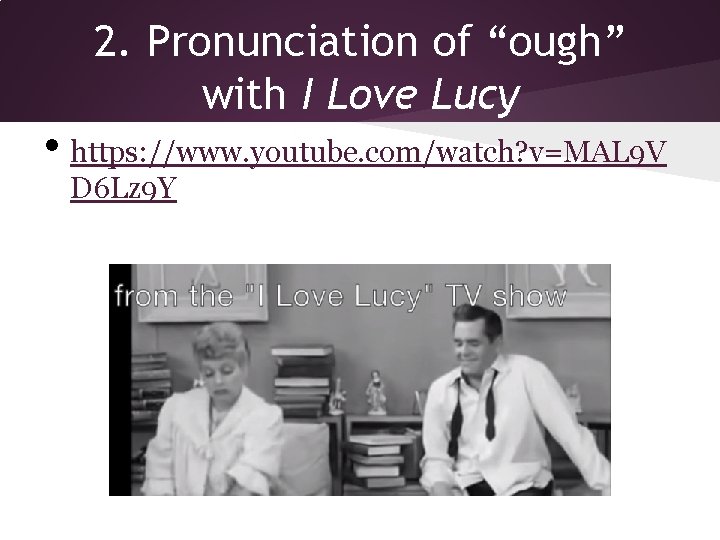
2. Pronunciation of “ough” with I Love Lucy • https: //www. youtube. com/watch? v=MAL 9 V D 6 Lz 9 Y
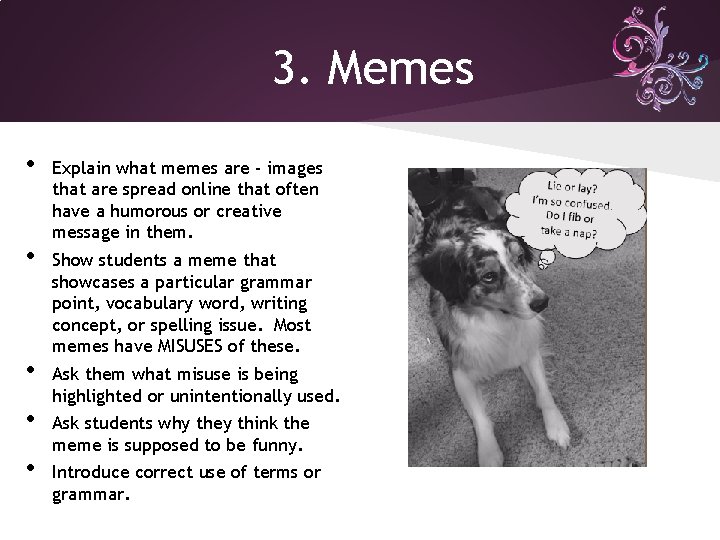
3. Memes • • • Explain what memes are - images that are spread online that often have a humorous or creative message in them. Show students a meme that showcases a particular grammar point, vocabulary word, writing concept, or spelling issue. Most memes have MISUSES of these. Ask them what misuse is being highlighted or unintentionally used. Ask students why they think the meme is supposed to be funny. Introduce correct use of terms or grammar.
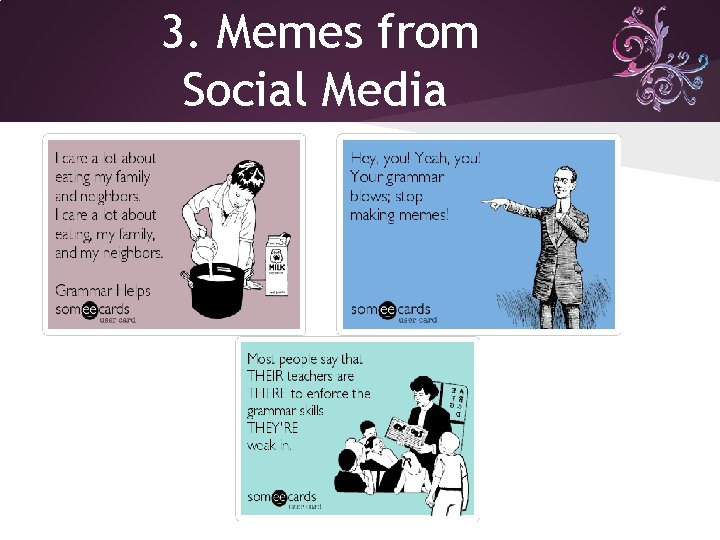
3. Memes from Social Media
4. Sentence Scrambling • • Review the three main types of sentences: simple, compound, and complex & the two main types of clauses: independent and dependent. Compound Sentences: give students one strip of red paper and one strip of green paper. Red paper– Student writes independent clause. Green paper– write other independent clause (with the coordinating conjunction at the beginning) The students read their sentences aloud to the class. Collect the strips of paper and scramble them. Each student chooses one red strip of paper and one green strip and reads the resulting sentence. • Complex sentences: give students one red strip of paper and one yellow strip of paper. Red paper – write the independent clause Yellow paper – write the dependent clause. The students read their sentences out loud to the class. Then collect the two parts of the sentence, scramble the independent clause and dependent clause, and each student chooses one red and one yellow strip of paper and reads the resulting funny sentences aloud.

4. Scrambled Sentences Examples of Sentence Types and Humorous Sentences (Adapted from authentic sentences from students): Compound: I like chocolate, but I study in university. I will eat pizza, and I will pass the TOEFL. I have free time, or I have a lot of money. Complex: I’m going to the store because I want to complete my education. Because I’m out of milk, I’m living in the U. S. I won’t complete my education if I eat pizza. • • •
5. Family Tree Construction • • • “Create” a family on the board Begin with one central character named “Mary. ” I write “Mary” under the picture after I stick it to the whiteboard with a magnet. Today we will meet Mary’s family. Next introduce Mary’s siblings and parents & review the relationships between them. As you progress, ask simple questions. Who is Mary’s husband? How many children do Mary and Mark have? Continue until there are grandparents, grandchildren, aunts, uncles, cousins, spouses, etc. The humor comes from the chosen pictures - pictures of unusual looking and/or famous people. The students think it’s funny to see, for example, Michael Jackson marry Miley Cyrus or for Popeye to be given the name of a male teacher in the department.
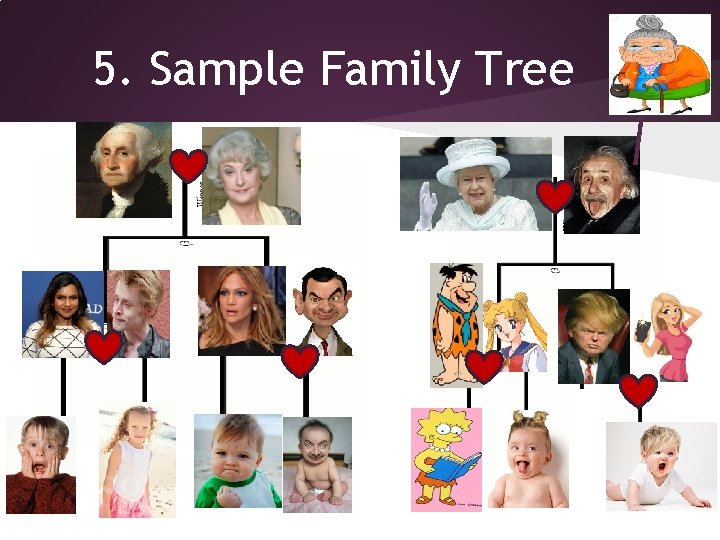
5. Sample Family Tree
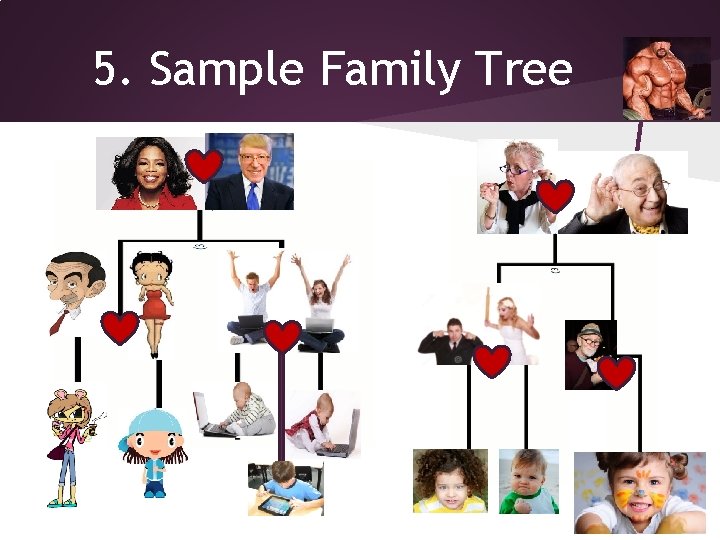
5. Sample Family Tree
6. Jokes • Great to use as a time filler or to introduce a new topic or lesson • What is Beethoven’s A: Knock knock B: Who’s there? A: Interrupting owl. B: Interrupting owl _ A: Whooo? Whoooo? • favorite fruit? Ba – Na - Na https: //www. youtube. com/watch? v=c. OAZ 7 Yo. A 63 c&lis t=RDo. KPh. GHAdqk 0&index=32 • I’ll be back • I’ll be Beethoven. (sounding like Arnold Schwarzenegger)
References • • http: //www. someecards. com/search? q=grammar Jaquays, J. , & Okello, S. (July 2016). Cause and effect with Direc. TV. In J. Rucynski (Ed. ), New ways of teaching with humor. Alexandria, VA: TESOL Press. Jaquays, J. , & Okello, S. (July 2016). Lie like a dog. In J. Rucynski (Ed. ), New ways of teaching with humor. Alexandria, VA: TESOL Press. Okello, S. , & Jaquays, J. (July 2016). All mixed up. . . In J. Rucynski (Ed. ), New ways of teaching with humor. Alexandria, VA: TESOL Press.
Questions
- Slides: 22