
Going Back to Basics How do you learn
Going Back to Basics How do you learn to learn better? Sandeep Puthanveetil Satheesan
It Starts With… One Thing… I Don’t Know Why !! • Why do some people… • find it so hard to study? • procrastinate till the last moment? • forget what was learned in the past?
It Doesn’t Even Matter… How Hard You Try !! • Brain is not like a computer wherein you can easily store and retrieve information – just by a few mouse clicks. • It takes proper effort to build proper neural connections. • Understanding how brain works helps a lot to learn new concepts efficiently and with long term benefits. • Without such an understanding, we cannot put good effort in the right direction while learning.
Keep That In Mind… I Designed This Rhyme !! • Focus, Focus , and Focus s i Only One Form of Focus. • Two modes of thinking / learning: • Focused Mode: • Comes into picture when you are thinking about a known concept or thought. • Works well when you are following a known procedure one step at a time. • E. g. Adding two numbers, literary criticism. • Best enhanced with concentration. • Diffused Mode: • Comes into picture when you are thinking about new a concept or thought. • Works well when you have to look at things from a broad perspective. • E. g. Err… it can be any new thought. • Best employed when you wander in thoughts / are just about to sleep.
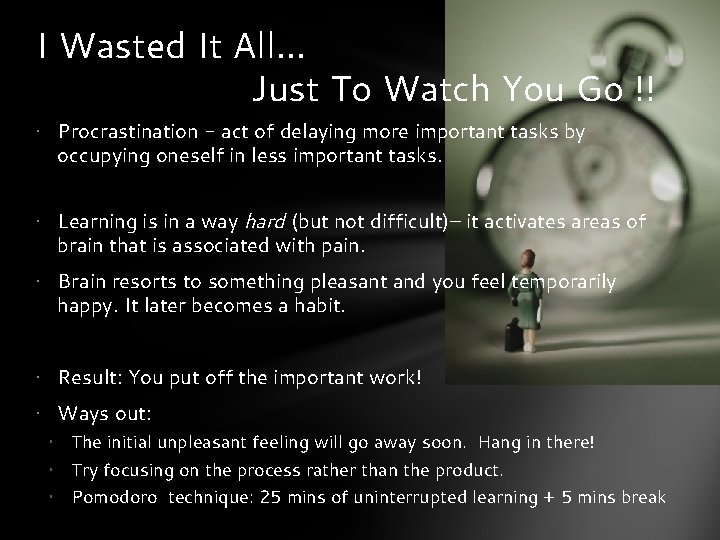
I Wasted It All… Just To Watch You Go !! • Procrastination - act of delaying more important tasks by occupying oneself in less important tasks. • Learning is in a way hard (but not difficult)– it activates areas of brain that is associated with pain. • Brain resorts to something pleasant and you feel temporarily happy. It later becomes a habit. • Result: You put off the important work! • Ways out: • The initial unpleasant feeling will go away soon. Hang in there! • Try focusing on the process rather than the product. • Pomodoro technique: 25 mins of uninterrupted learning + 5 mins break
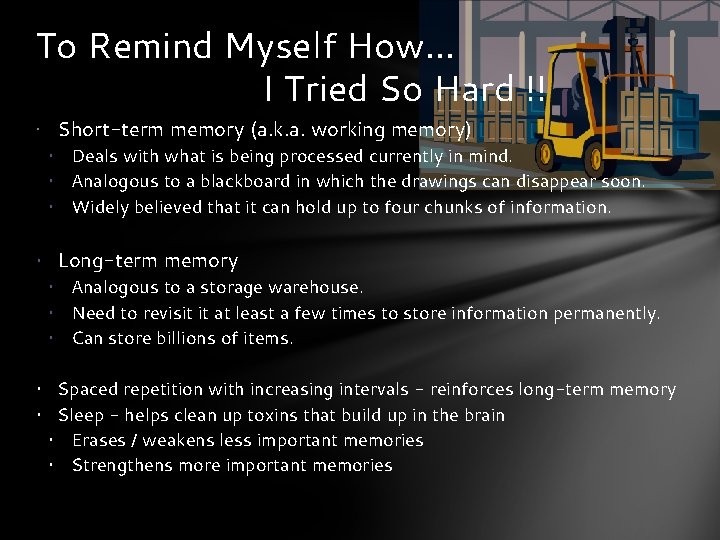
To Remind Myself How… I Tried So Hard !! • Short-term memory (a. k. a. working memory) • Deals with what is being processed currently in mind. • Analogous to a blackboard in which the drawings can disappear soon. • Widely believed that it can hold up to four chunks of information. • Long-term memory • Analogous to a storage warehouse. • Need to revisit it at least a few times to store information permanently. • Can store billions of items. • Spaced repetition with increasing intervals - reinforces long-term memory • Sleep - helps clean up toxins that build up in the brain • Erases / weakens less important memories • Strengthens more important memories
References • “In the End” by Linkin Park. Lyrics from http: //www. azlyrics. com/lyrics/linkinpark/intheend. html • Clip-arts from Microsoft Office. com • Lectures by Dr. Barbara Oakley on Learning How to Learn, Coursera

But In The End… It Doesn’t Even Matter !!
- Slides: 8