
GOESR ABI and Himawari8 AHI Training using SIFT

GOES-R ABI and Himawari-8 AHI Training using SIFT Raymond K. Garcia, David Hoese, Jordan J. Gerth, Scott S. Lindstrom, Kathleen I. Strabala UW-Madison Cooperative Institute for Meteorological Satellite Studies Timothy J. Schmit NOAA/NESDIS/ASPB Bill Ward NOAA/National Weather Service
SIFT • Satellite Information and Familiarization Tool • Created to facilitate training of Himawari-8 data in the Pacific Region of the NWS Satellite Meteorology Madison Wisconsin 2016 2

Where has SIFT been used? • • NWS Day-1 Ready Training for Guam WFO (Himawari) NWS Training at Honolulu WFO Satellite Liaison Training in Kansas City Graduate Student Training in Madison Satellite Meteorology Madison Wisconsin 2016 3
System Requirements • Compatible with Windows/Linux/Mac – Faster I/O the better – Does a lot on the Graphics Card – 500 Mb (8. 5 Gb) workspace needed for 2 km (0. 5 km) imagery • Sample datasets (pre-projected mercator Geo. TIFF files) require up to 1 TB of storage. – Coming soon: Data in Native Formats! Satellite Meteorology Madison Wisconsin 2016 4
Why is SIFT good for training? • Quick access to multiple bands for visual inspection/comparison • Density Diagrams/Scatterplots to compare two channels • Easy and seamless zoom and roam capabilities • Datasets are pre-selected and loaded • When you compare bands, you learn something about both bands being compared Satellite Meteorology Madison Wisconsin 2016 5
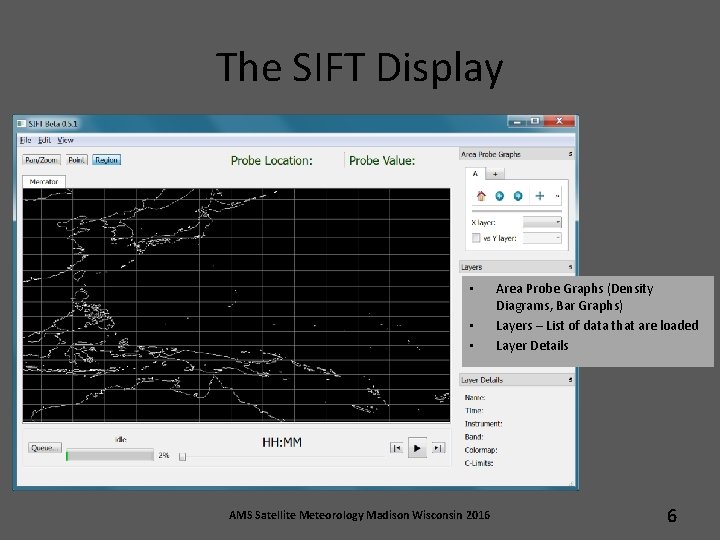
The SIFT Display • • • AMS Satellite Meteorology Madison Wisconsin 2016 Area Probe Graphs (Density Diagrams, Bar Graphs) Layers – List of data that are loaded Layer Details 6
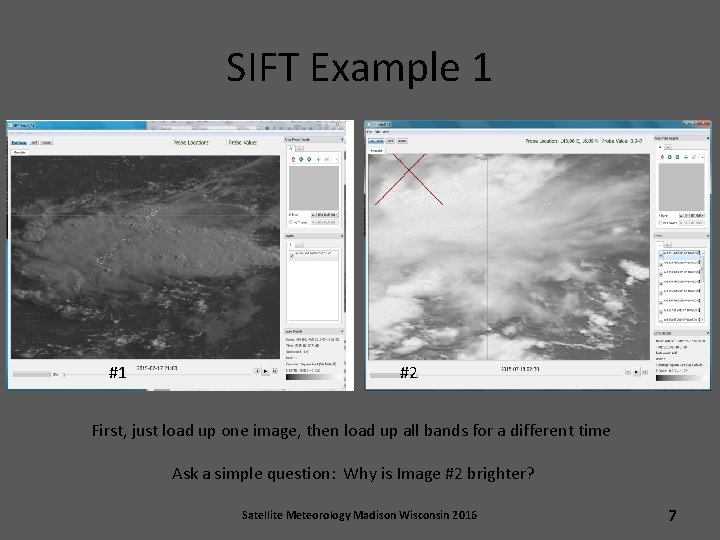
SIFT Example 1 #1 #2 First, just load up one image, then load up all bands for a different time Ask a simple question: Why is Image #2 brighter? Satellite Meteorology Madison Wisconsin 2016 7
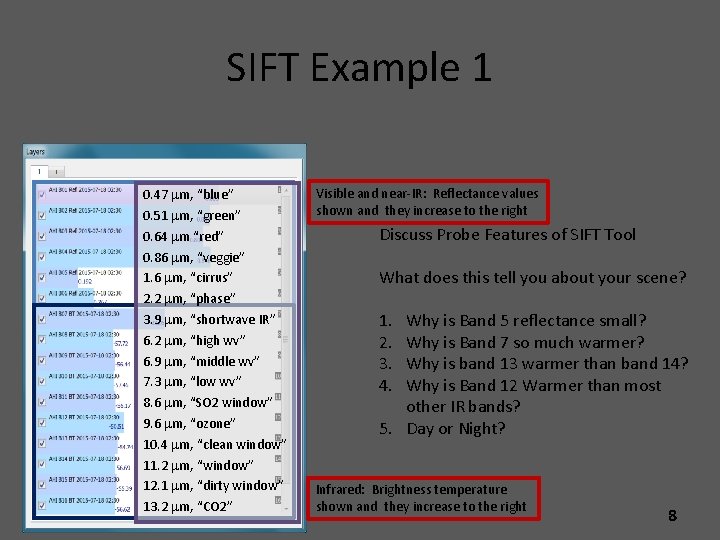
SIFT Example 1 0. 47 mm, “blue” 0. 51 mm, “green” 0. 64 mm “red” 0. 86 mm, “veggie” 1. 6 mm, “cirrus” 2. 2 mm, “phase” 3. 9 mm, “shortwave IR” 6. 2 mm, “high wv” 6. 9 mm, “middle wv” 7. 3 mm, “low wv” 8. 6 mm, “SO 2 window” 9. 6 mm, “ozone” 10. 4 mm, “clean window” 11. 2 mm, “window” 12. 1 mm, “dirty window” 13. 2 mm, “CO 2” Visible and near-IR: Reflectance values shown and they increase to the right Discuss Probe Features of SIFT Tool What does this tell you about your scene? 1. 2. 3. 4. Why is Band 5 reflectance small? Why is Band 7 so much warmer? Why is band 13 warmer than band 14? Why is Band 12 Warmer than most other IR bands? 5. Day or Night? Infrared: Brightness temperature shown and they increase to the right 8
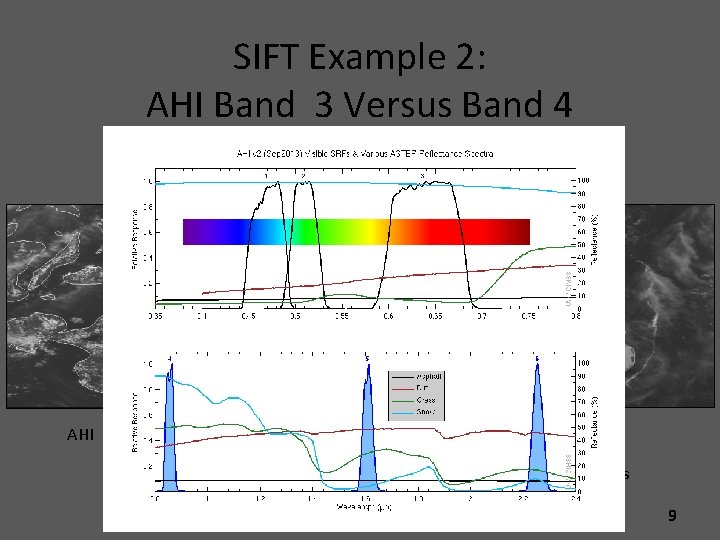
SIFT Example 2: AHI Band 3 Versus Band 4 AHI Band 3 (0. 64 μm) AHI Band 4 (0. 86 μm) Easy to toggle between these two to really accentuate the differences Satellite Meteorology Madison Wisconsin 2016 9
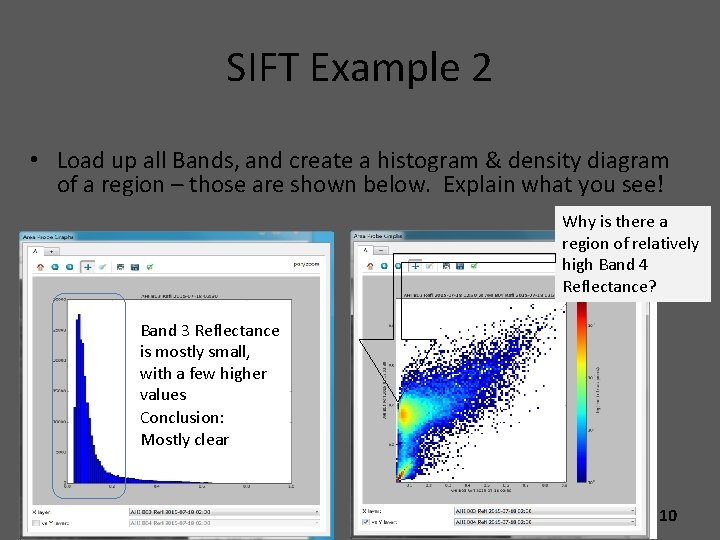
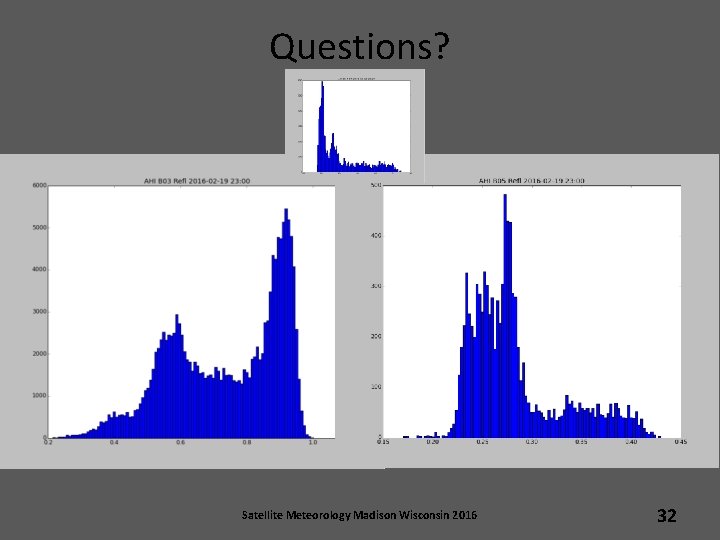
SIFT Example 2 • Load up all Bands, and create a histogram & density diagram of a region – those are shown below. Explain what you see! Why is there a region of relatively high Band 4 Reflectance? Band 3 Reflectance is mostly small, with a few higher values Conclusion: Mostly clear 10
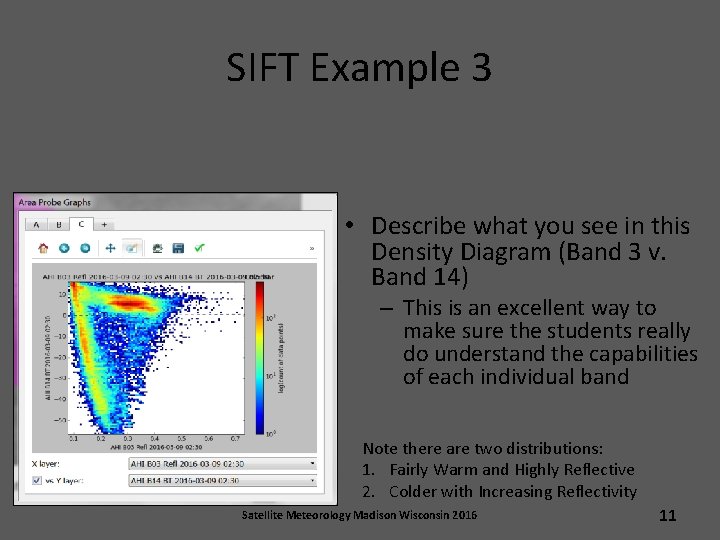
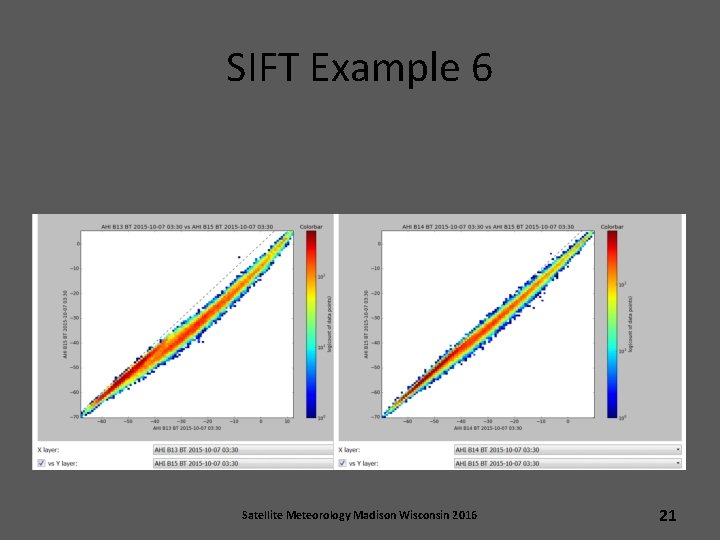
SIFT Example 3 • Describe what you see in this Density Diagram (Band 3 v. Band 14) – This is an excellent way to make sure the students really do understand the capabilities of each individual band Note there are two distributions: 1. Fairly Warm and Highly Reflective 2. Colder with Increasing Reflectivity Satellite Meteorology Madison Wisconsin 2016 11
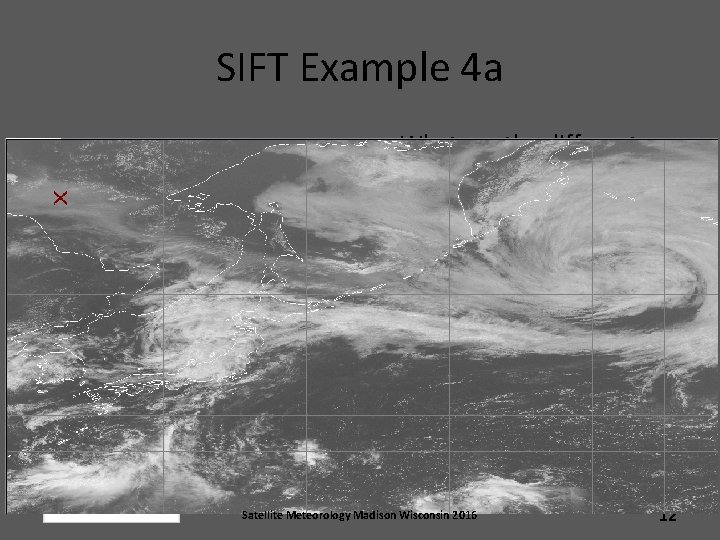
SIFT Example 4 a • What are the different bands telling you here? • Is it day or night? • Is it cloudy? Thick clouds? Thin clouds? • What do the Water Vapor Bands Tells you? • Which two (that’s a hint) bands are most important in describing what’s going on? Satellite Meteorology Madison Wisconsin 2016 12
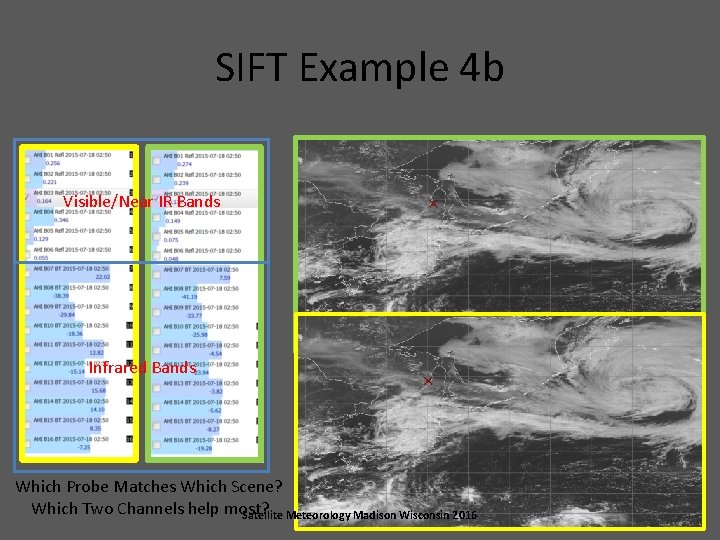
SIFT Example 4 b Visible/Near IR Bands Infrared Bands Which Probe Matches Which Scene? Which Two Channels help most? Satellite Meteorology Madison Wisconsin 2016 13
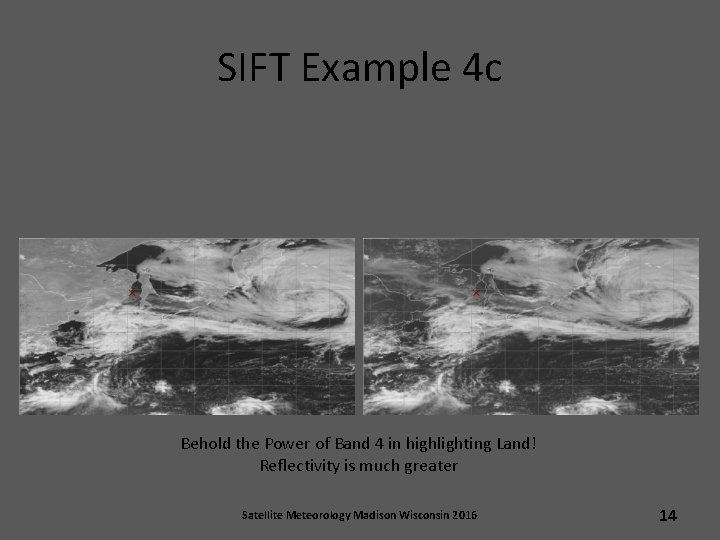
SIFT Example 4 c Behold the Power of Band 4 in highlighting Land! Reflectivity is much greater Satellite Meteorology Madison Wisconsin 2016 14
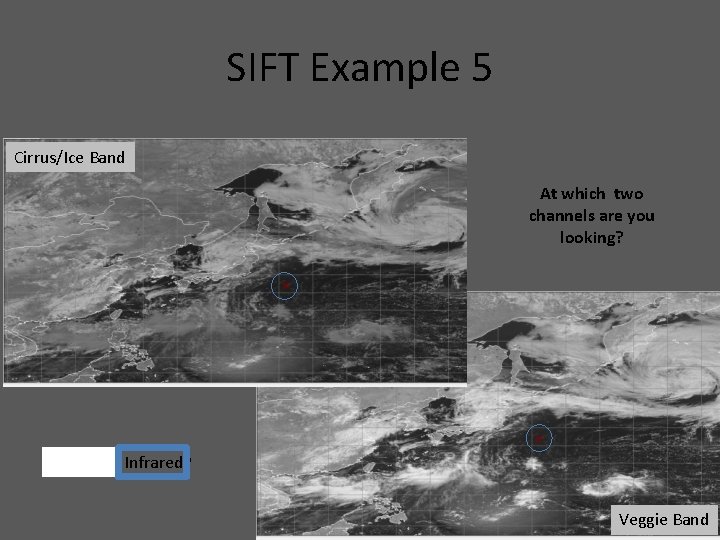
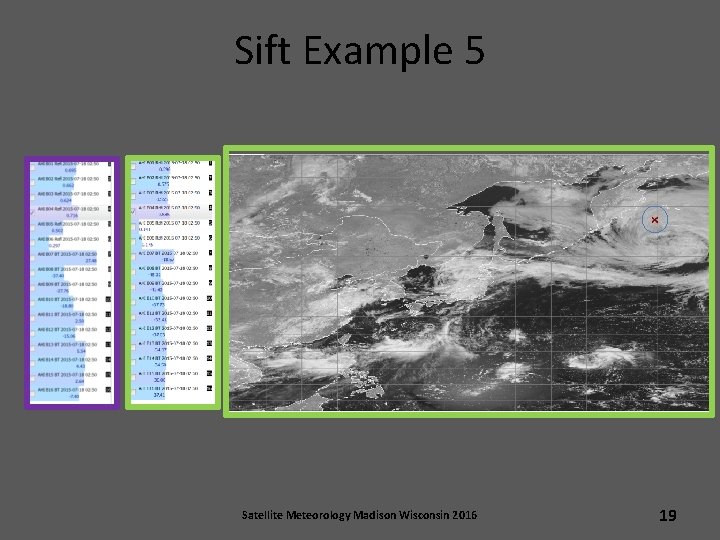
SIFT Example 5 Cirrus/Ice Band At which two channels are you looking? Visible or Infrared? 15 Band Veggie
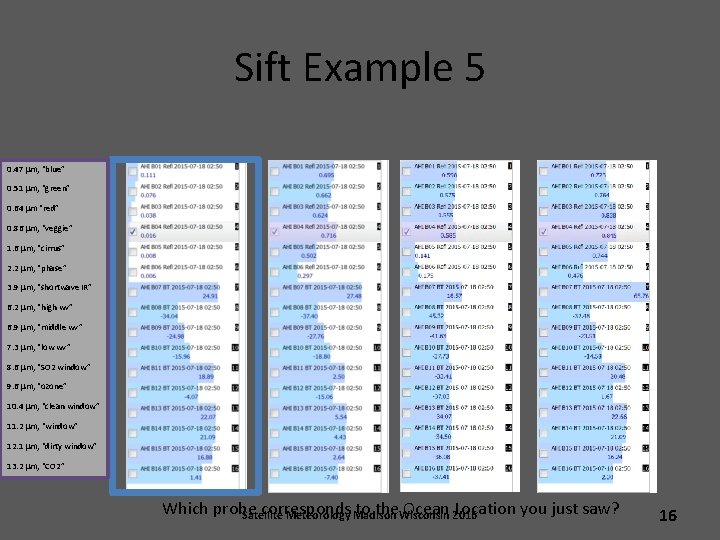
Sift Example 5 0. 47 mm, “blue” 0. 51 mm, “green” 0. 64 mm “red” 0. 86 mm, “veggie” 1. 6 mm, “cirrus” 2. 2 mm, “phase” 3. 9 mm, “shortwave IR” 6. 2 mm, “high wv” 6. 9 mm, “middle wv” 7. 3 mm, “low wv” 8. 6 mm, “SO 2 window” 9. 6 mm, “ozone” 10. 4 mm, “clean window” 11. 2 mm, “window” 12. 1 mm, “dirty window” 13. 2 mm, “CO 2” Which probe corresponds to the. Wisconsin Ocean 2016 Location you just saw? Satellite Meteorology Madison 16
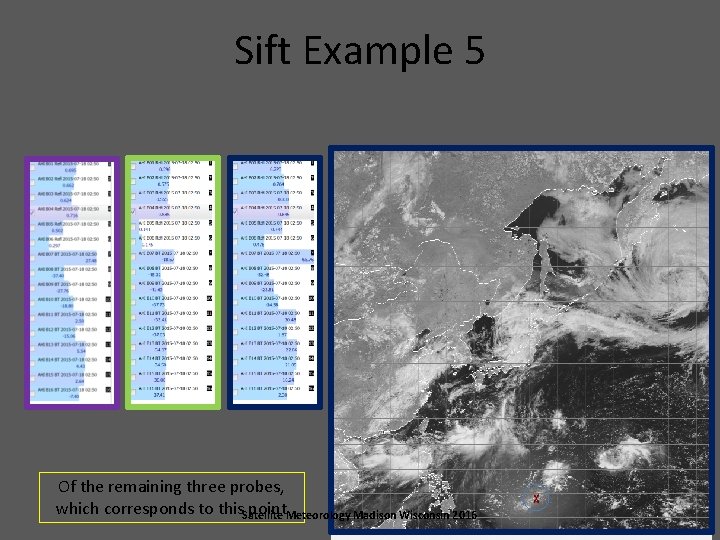
Sift Example 5 Of the remaining three probes, which corresponds to this. Satellite point. Meteorology Madison Wisconsin 2016 17
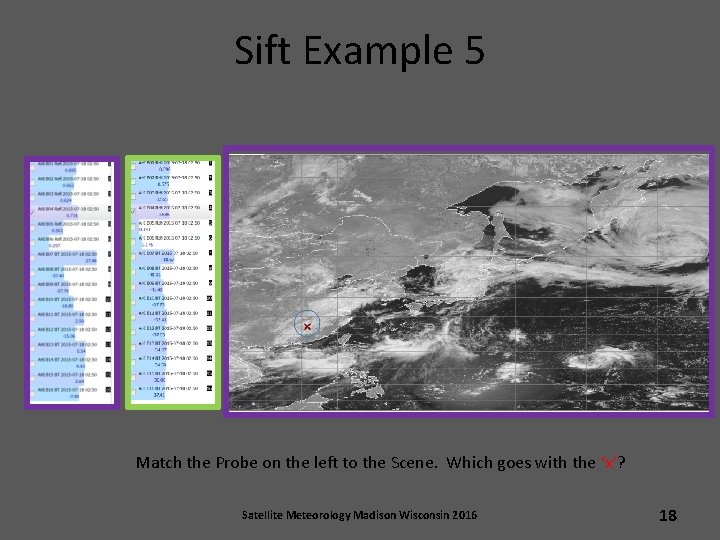
Sift Example 5 Match the Probe on the left to the Scene. Which goes with the ‘x’? Satellite Meteorology Madison Wisconsin 2016 18
Sift Example 5 Satellite Meteorology Madison Wisconsin 2016 19
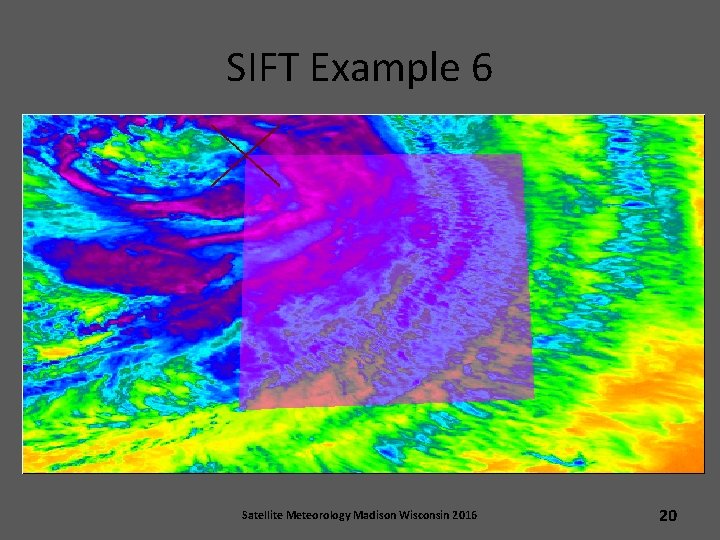
SIFT Example 6 15 14 13 Satellite Meteorology Madison Wisconsin 2016 20
SIFT Example 6 Satellite Meteorology Madison Wisconsin 2016 21
Questions asked in Lab • What AHI visible reflectance band is best for detecting/identifying low clouds? • What AHI visible reflectance band is best for detecting/identifying high clouds? • What AHI thermal infrared band is best for detecting/identifying low clouds? • What AHI thermal infrared band is best for detecting/identifying high clouds? • What AHI visible reflectance band is best for detecting/identifying land surface features? • What AHI thermal infrared band is best for detecting/identifying land surface features? • What AHI band or bands are best for detecting/identifying mid atmosphere features? Satellite Meteorology Madison Wisconsin 2016 22
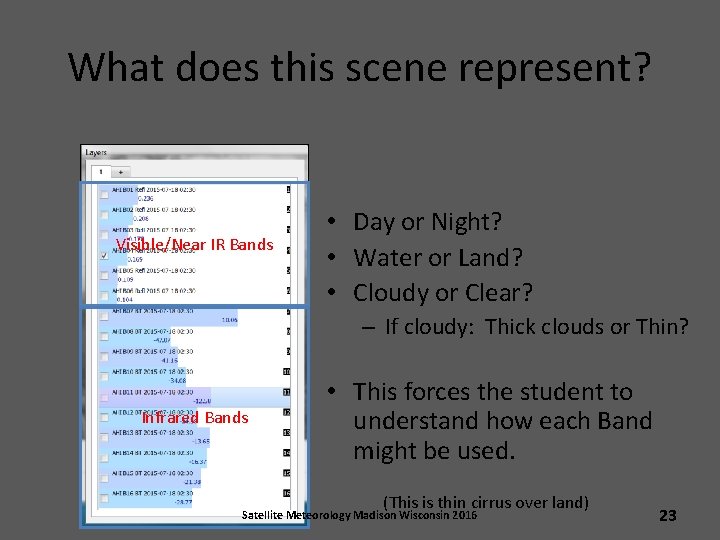
What does this scene represent? Visible/Near IR Bands • Day or Night? • Water or Land? • Cloudy or Clear? – If cloudy: Thick clouds or Thin? Infrared Bands • This forces the student to understand how each Band might be used. (This is thin cirrus over land) Satellite Meteorology Madison Wisconsin 2016 23
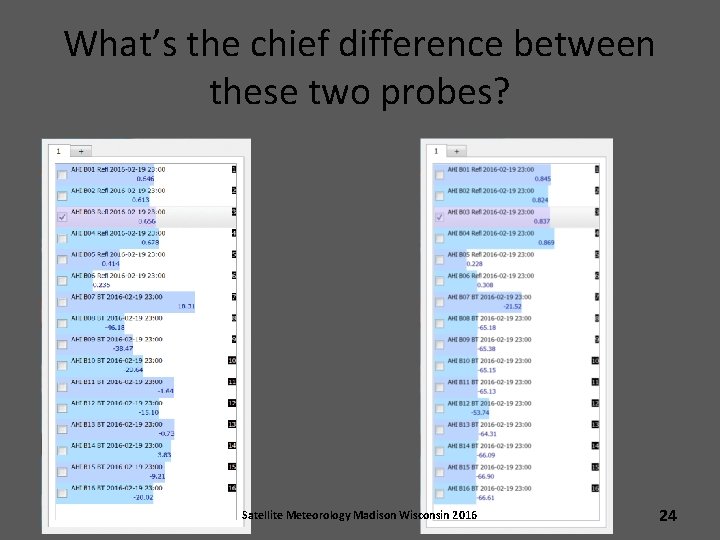
What’s the chief difference between these two probes? Satellite Meteorology Madison Wisconsin 2016 24
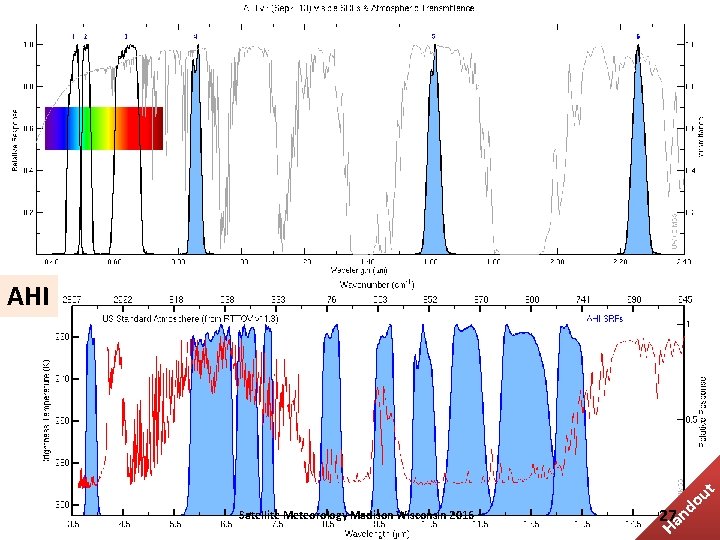
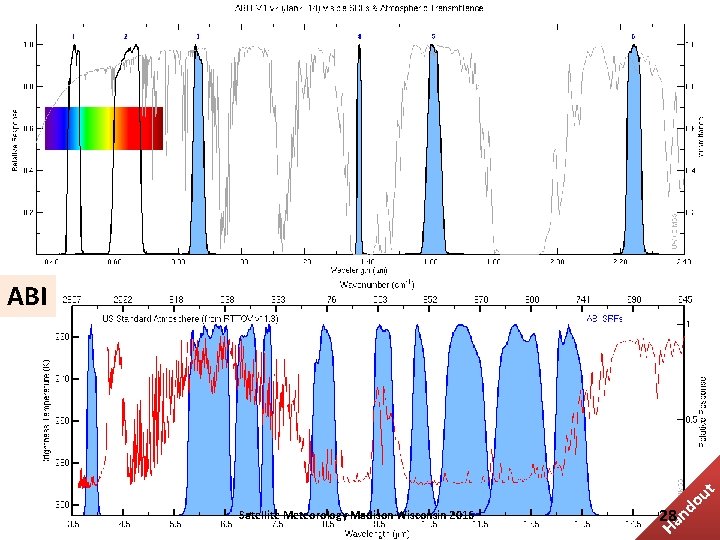
SIFT Training always referred back to Spectral Response Functions • Why are the channels placed where they are? • What can you expect the bands to view given the Spectral Response Functions? • Handouts provided to facilitate learning Satellite Meteorology Madison Wisconsin 2016 25
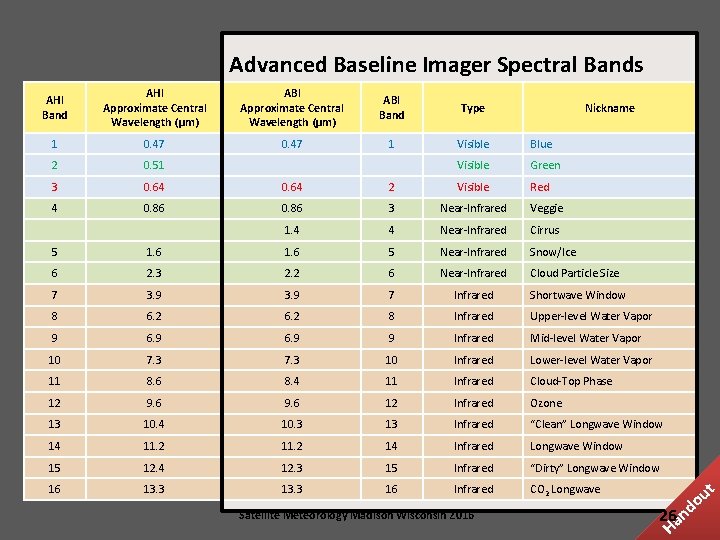
Advanced Baseline Imager Spectral Bands AHI Band AHI Approximate Central Wavelength (μm) ABI Band Type 1 0. 47 1 Visible Blue 2 0. 51 Visible Green 3 0. 64 2 Visible Red 4 0. 86 3 Near-Infrared Veggie 1. 4 4 Near-Infrared Cirrus Nickname 5 1. 6 5 Near-Infrared Snow/Ice 6 2. 3 2. 2 6 Near-Infrared Cloud Particle Size 7 3. 9 7 Infrared Shortwave Window 8 6. 2 8 Infrared Upper-level Water Vapor 9 6. 9 9 Infrared Mid-level Water Vapor 10 7. 3 10 Infrared Lower-level Water Vapor 11 8. 6 8. 4 11 Infrared Cloud-Top Phase 12 9. 6 12 Infrared Ozone 13 10. 4 10. 3 13 Infrared “Clean” Longwave Window 14 11. 2 14 Infrared Longwave Window 15 12. 4 12. 3 15 Infrared “Dirty” Longwave Window 16 13. 3 16 Infrared CO 2 Longwave Satellite Meteorology Madison Wisconsin 2016 t 26 an H u do
AHI t Satellite Meteorology Madison Wisconsin 2016 27 an H u do
ABI t Satellite Meteorology Madison Wisconsin 2016 28 an H u do
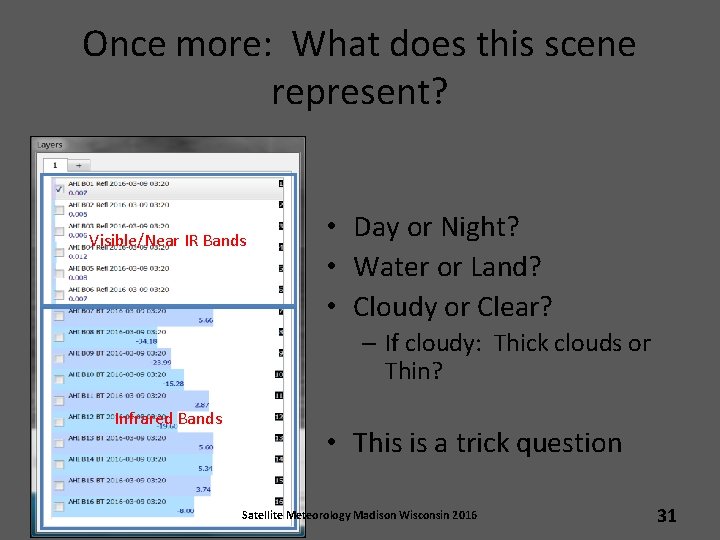
Once more: What does this scene represent? Visible/Near IR Bands • Day or Night? • Water or Land? • Cloudy or Clear? – If cloudy: Thick clouds or Thin? Infrared Bands • This is a trick question Satellite Meteorology Madison Wisconsin 2016 31
Questions? Satellite Meteorology Madison Wisconsin 2016 32
- Slides: 30