
GOES16 ABI Lunar Data Preparation to GIRO Fangfang
GOES-16 ABI Lunar Data Preparation to GIRO Fangfang Yu 1, Xiangqian Wu 2, and Xi Shao 1 1: ERT, Inc@NOAA/NESDIS/STAR 2: NOAA/NESDIS/Center for Satellite Application and Research (STAR) GSICS/CEOS 2 nd Lunar Calibration Workshop, Xi'an, China, Nov. 13 -17, 2017 GOES-16 is not declared operational yet. The ABI data are currently experimental and still undergoing testing. 11/14/2017 1
GOES-16 • First NOAA Geostationary Operational Environmental satellite in the GOES-R Series – Launched on November 19, 2016 – Key payload: Advanced Baseline Imager (ABI) – Locations: • Parked at 89. 5 W for PLT/PLPT tests. • Moved from 89. 5 W to 89. 3 W between August 8, 2017 and Sept. 3, 2017. • Plan to move from 89. 3 W to 75. 2 W for operation in December 2017. 11/14/2017 2 nd Lunar Calibration Workshop, Xi'An, China 2
Normal Lunar Scans ABI Mode 3 timeline • MESO scan in mode 3 is used to collect the Moon data. • Each MESO scan consists of two swaths • The Moon is scanned with one of the two swaths • ABI Moon data is in Level 1 Alpha format – calibrated but not navigated data ASD: Angular sample distance • G 16 ABI uses FPM Side 2 Band Central EW ASD name Wavelength (µrad) detectors (µm) swath 11/14/2017 Best Detector Selection (BDS) NS ASD (µrad) #Det per Column #Det per Swath B 01 0. 47 22 22. 9 3 676 B 02 0. 64 11 10. 5 3 1460 B 03 0. 87 22 22. 9 3 676 B 04 1. 38 44 42. 0 6 372 B 05 1. 61 22 22. 9 6 676 B 06 2. 25 44 42. 0 6 372 2 nd Lunar Calibration Workshop, Xi'An, China 3
Normal Lunar Scans: Chasing and Trending • Chasing: – ABI consecutively scans the Moon as it transits across the space within the Field of Regard (FOR). – Used for the scan mirror response vs. scanangle (RVS) study, as well as trending of instrument degradation analysis. – Mainly conducted during the PLT/PLPT periods. • Trending: Phase angle range: -90 o – ABI scans the Moon during the meso frame time which is ~2 minutes. – Used for the monitoring and trending of the solar calibration result. – Will be conducted 2 -4 times per month throughout the satellite mission life. 11/14/2017 2 nd Lunar Calibration Workshop, Xi'An, China 4
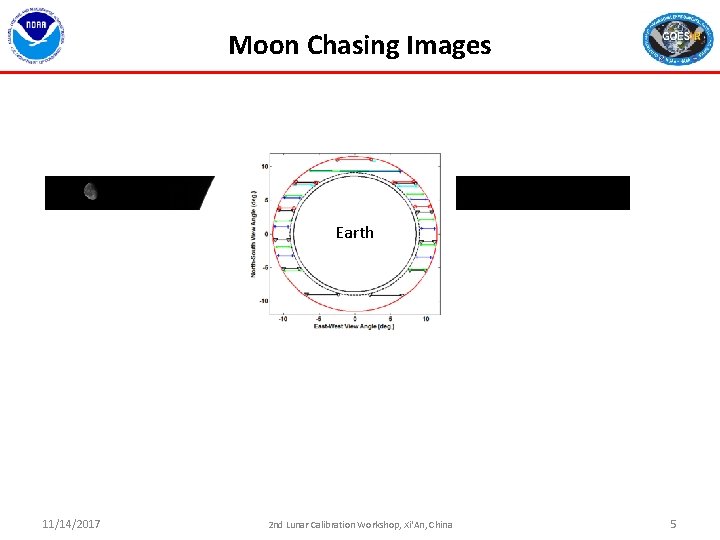
Moon Chasing Images Earth 11/14/2017 2 nd Lunar Calibration Workshop, Xi'An, China 5
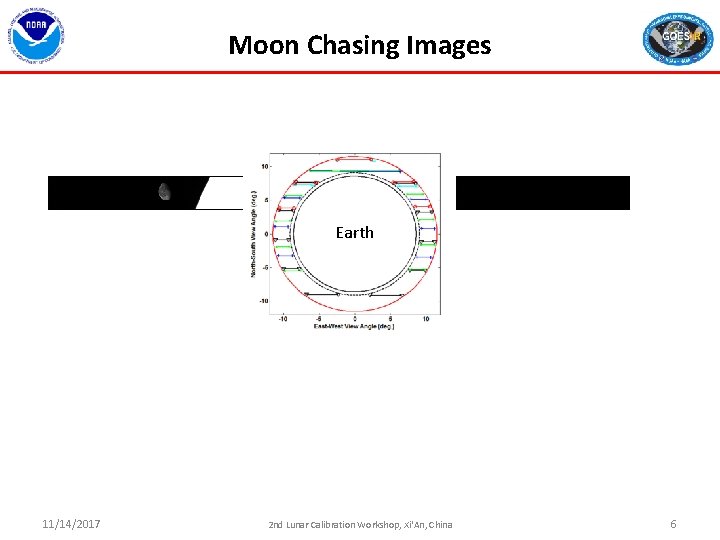
Moon Chasing Images Earth 11/14/2017 2 nd Lunar Calibration Workshop, Xi'An, China 6
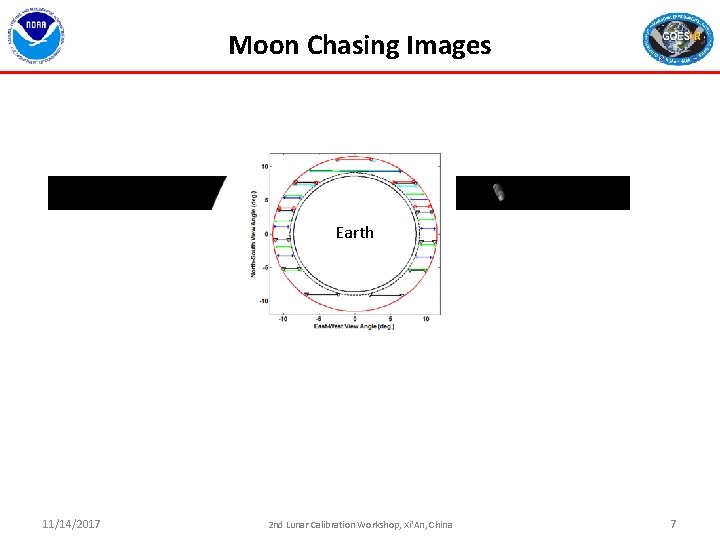
Moon Chasing Images Earth 11/14/2017 2 nd Lunar Calibration Workshop, Xi'An, China 7
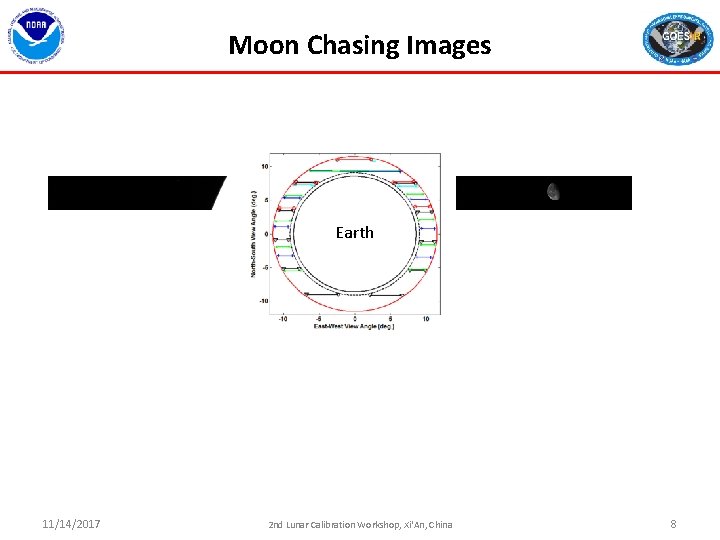
Moon Chasing Images Earth 11/14/2017 2 nd Lunar Calibration Workshop, Xi'An, China 8
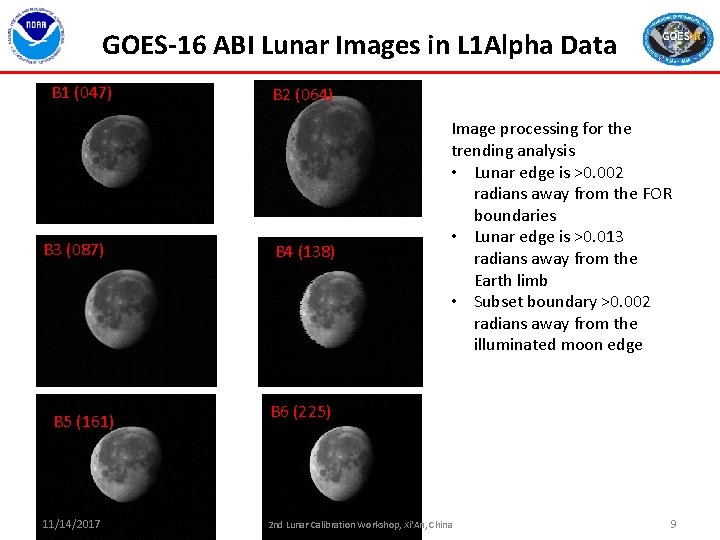
GOES-16 ABI Lunar Images in L 1 Alpha Data B 1 (047) B 3 (087) B 5 (161) 11/14/2017 B 2 (064) B 4 (138) Image processing for the trending analysis • Lunar edge is >0. 002 radians away from the FOR boundaries • Lunar edge is >0. 013 radians away from the Earth limb • Subset boundary >0. 002 radians away from the illuminated moon edge B 6 (225) 2 nd Lunar Calibration Workshop, Xi'An, China 9
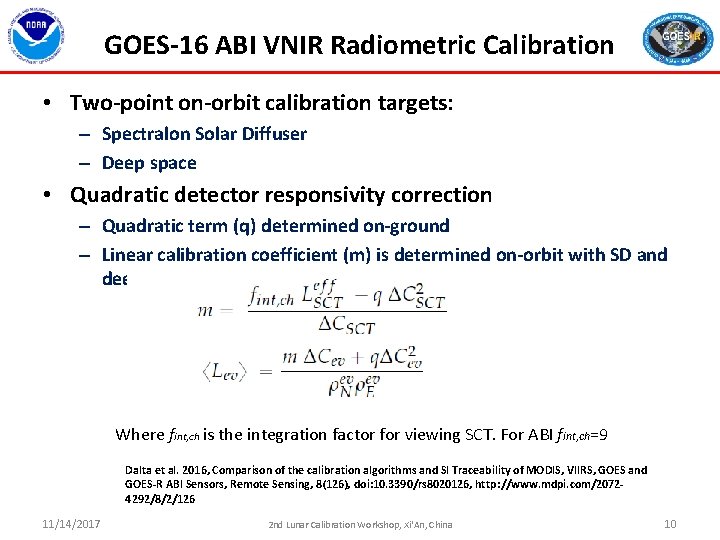
GOES-16 ABI VNIR Radiometric Calibration • Two-point on-orbit calibration targets: – Spectralon Solar Diffuser – Deep space • Quadratic detector responsivity correction – Quadratic term (q) determined on-ground – Linear calibration coefficient (m) is determined on-orbit with SD and deep space observations Where fint, ch is the integration factor for viewing SCT. For ABI fint, ch=9 Dalta et al. 2016, Comparison of the calibration algorithms and SI Traceability of MODIS, VIIRS, GOES and GOES-R ABI Sensors, Remote Sensing, 8(126), doi: 10. 3390/rs 8020126, http: //www. mdpi. com/20724292/8/2/126 11/14/2017 2 nd Lunar Calibration Workshop, Xi'An, China 10
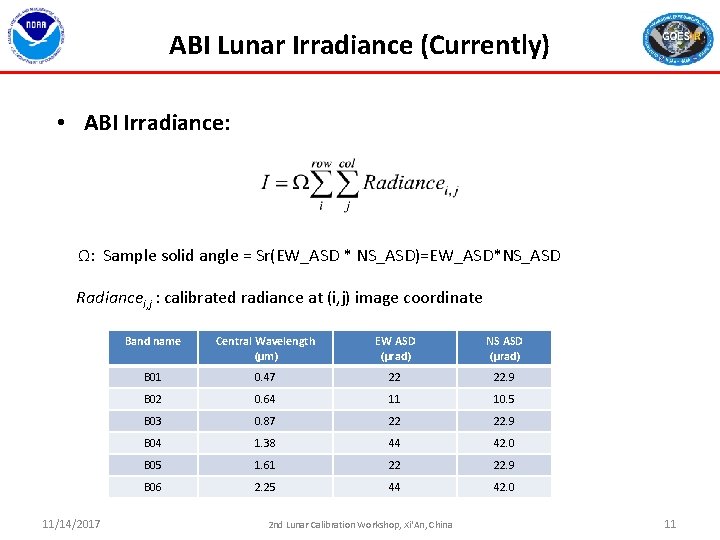
ABI Lunar Irradiance (Currently) • ABI Irradiance: Ω: Sample solid angle = Sr(EW_ASD * NS_ASD)=EW_ASD*NS_ASD Radiancei, j : calibrated radiance at (i, j) image coordinate 11/14/2017 Band name Central Wavelength (µm) EW ASD (µrad) NS ASD (µrad) B 01 0. 47 22 22. 9 B 02 0. 64 11 10. 5 B 03 0. 87 22 22. 9 B 04 1. 38 44 42. 0 B 05 1. 61 22 22. 9 B 06 2. 25 44 42. 0 2 nd Lunar Calibration Workshop, Xi'An, China 11
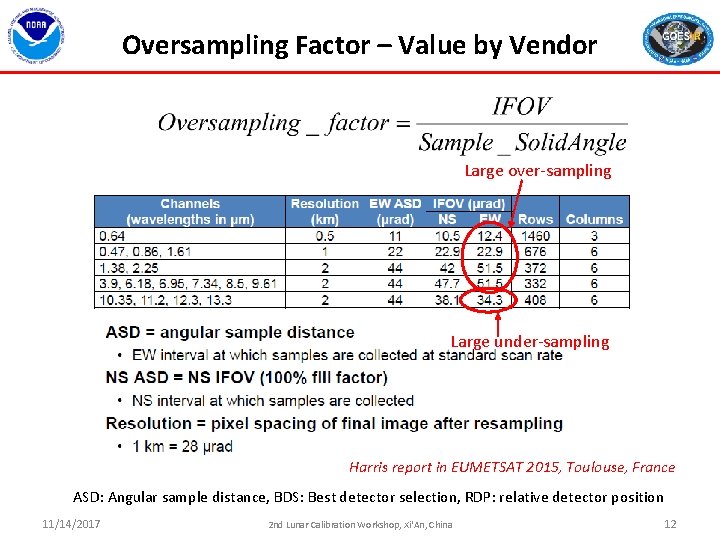
Oversampling Factor – Value by Vendor Large over-sampling Large under-sampling Harris report in EUMETSAT 2015, Toulouse, France ASD: Angular sample distance, BDS: Best detector selection, RDP: relative detector position 11/14/2017 2 nd Lunar Calibration Workshop, Xi'An, China 12
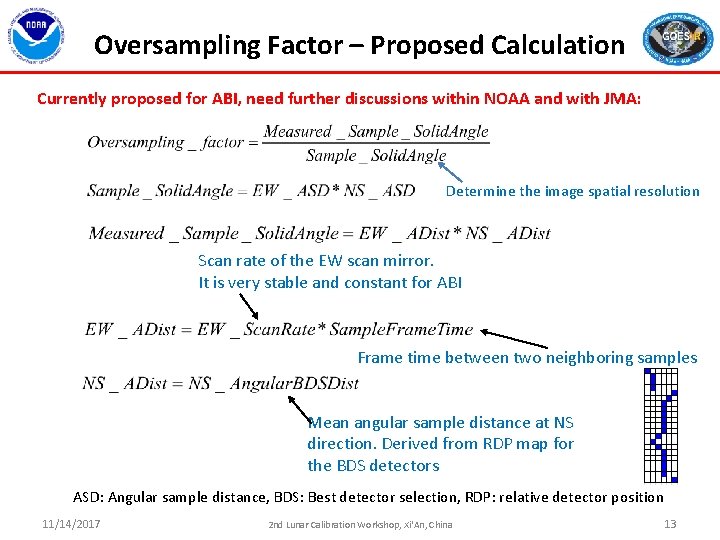
Oversampling Factor – Proposed Calculation Currently proposed for ABI, need further discussions within NOAA and with JMA: Determine the image spatial resolution Scan rate of the EW scan mirror. It is very stable and constant for ABI Frame time between two neighboring samples Mean angular sample distance at NS direction. Derived from RDP map for the BDS detectors ASD: Angular sample distance, BDS: Best detector selection, RDP: relative detector position 11/14/2017 2 nd Lunar Calibration Workshop, Xi'An, China 13
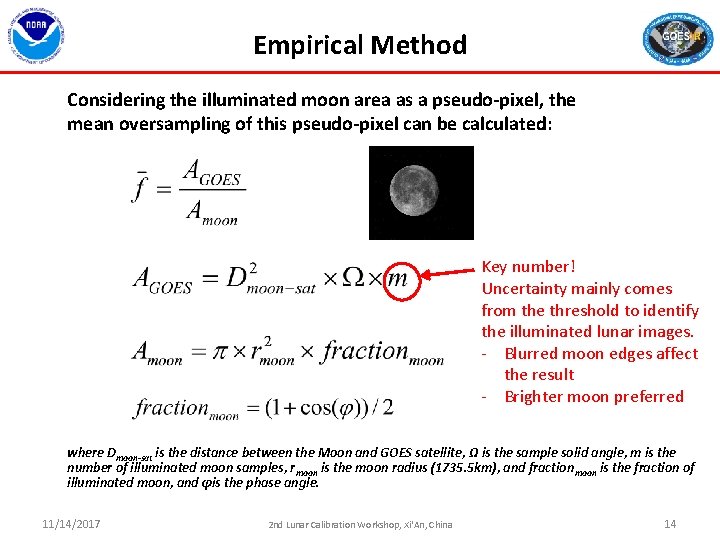
Empirical Method Considering the illuminated moon area as a pseudo-pixel, the mean oversampling of this pseudo-pixel can be calculated: Key number! Uncertainty mainly comes from the threshold to identify the illuminated lunar images. - Blurred moon edges affect the result - Brighter moon preferred where Dmoon-sat is the distance between the Moon and GOES satellite, Ω is the sample solid angle, m is the number of illuminated moon samples, rmoon is the moon radius (1735. 5 km), and fractionmoon is the fraction of illuminated moon, and φis the phase angle. 11/14/2017 2 nd Lunar Calibration Workshop, Xi'An, China 14
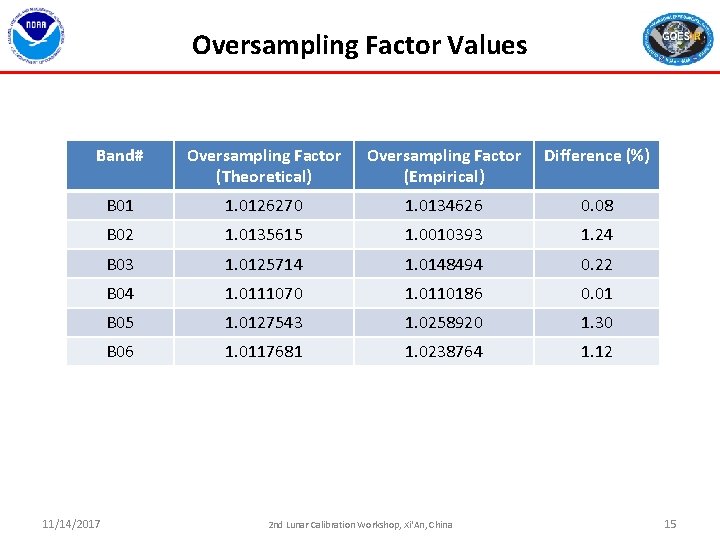
Oversampling Factor Values Band# Oversampling Factor (Theoretical) Oversampling Factor (Empirical) Difference (%) B 01 1. 0126270 1. 0134626 0. 08 B 02 1. 0135615 1. 0010393 1. 24 B 03 1. 0125714 1. 0148494 0. 22 B 04 1. 0111070 1. 0110186 0. 01 B 05 1. 0127543 1. 0258920 1. 30 B 06 1. 0117681 1. 0238764 1. 12 11/14/2017 2 nd Lunar Calibration Workshop, Xi'An, China 15
Summary • Oversampling factor may not be important for trending the instrument degradation when it is a constant. • Important for irradiance-based absolute calibration, sensorto-sensor and band-to-band inter-calibrations – Also important for accurate MTF analysis (Xi Shao’s report) – For ABI-like instruments, it can be calculated with scan rate, sample frame time and RDP values – Validated with Moon observations with near full moon images • Oversampling factor values for ABI bands are relatively small 11/14/2017 2 nd Lunar Calibration Workshop, Xi'An, China 16
- Slides: 16