
Gods Immutability Does God change A Response to
God’s Immutability Does God change? A Response to Open Theism By Shawn Nelson, 2019
1. 2. 3. 4. 5. 6. Defining immutability Objections from open theism Biblical support Philosophical support Historical support Answering open theism’s arguments 7. Practical take-aways
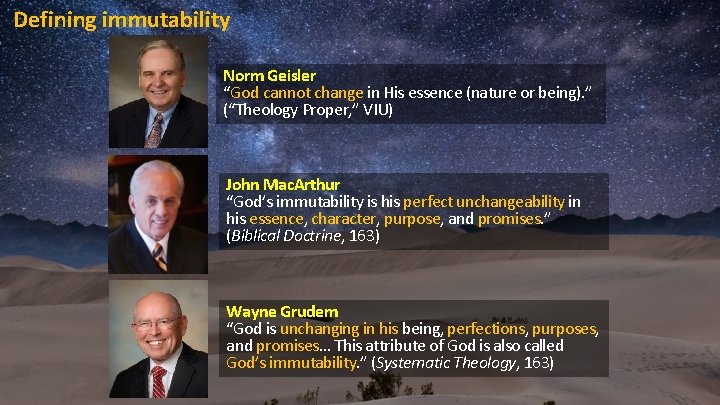
Defining immutability Norm Geisler “God cannot change in His essence (nature or being). ” (“Theology Proper, ” VIU) John Mac. Arthur “God’s immutability is his perfect unchangeability in his essence, character, purpose, and promises. ” (Biblical Doctrine, 163) Wayne Grudem “God is unchanging in his being, perfections, purposes, and promises… This attribute of God is also called God’s immutability. ” (Systematic Theology, 163)
What immutability implies If God is unchangeable then God… • Does not learn (since learning is a change) • Knows all things (is omniscient) • Can’t forget (since forgetting is a loss) • Is never surprised • Does not take risks • Does not suffer (He cannot be caused pain) • Is perfect (nobody can add to his perfection) • Is eternal (does not move in time) • Is everywhere at once (does not move in space) • Is all powerful (cannot grow in strength) We see that immutability connects to all of God’s other metaphysical attributes. • Self-existence • Eternality • Omnipotence • Omniscience • Necessary • Simplicity • Omnipresence • Perfection • Infinity
1. 2. 3. 4. 5. 6. Defining immutability Objections from open theism Biblical support Philosophical support Historical support Answering open theism’s arguments 7. Practical take-aways
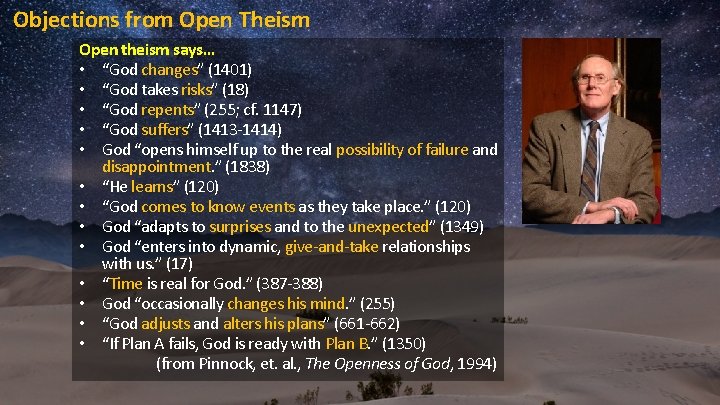
Objections from Open Theism Open theism says… • “God changes” (1401) • “God takes risks” (18) • “God repents” (255; cf. 1147) • “God suffers” (1413 -1414) • God “opens himself up to the real possibility of failure and disappointment. ” (1838) • “He learns” (120) • “God comes to know events as they take place. ” (120) • God “adapts to surprises and to the unexpected” (1349) • God “enters into dynamic, give-and-take relationships with us. ” (17) • “Time is real for God. ” (387 -388) • God “occasionally changes his mind. ” (255) • “God adjusts and alters his plans” (661 -662) • “If Plan A fails, God is ready with Plan B. ” (1350) (from Pinnock, et. al. , The Openness of God, 1994)
1. 2. 3. 4. 5. 6. Defining immutability Objections from open theism Biblical support Philosophical support Historical support Answering open theism’s arguments 7. Practical take-aways
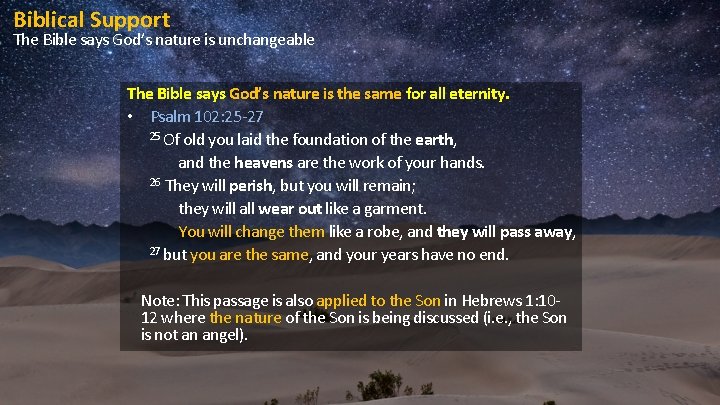
Biblical Support The Bible says God’s nature is unchangeable The Bible says God’s nature is the same for all eternity. • Psalm 102: 25 -27 25 Of old you laid the foundation of the earth, and the heavens are the work of your hands. 26 They will perish, but you will remain; they will all wear out like a garment. You will change them like a robe, and they will pass away, 27 but you are the same, and your years have no end. Note: This passage is also applied to the Son in Hebrews 1: 1012 where the nature of the Son is being discussed (i. e. , the Son is not an angel).
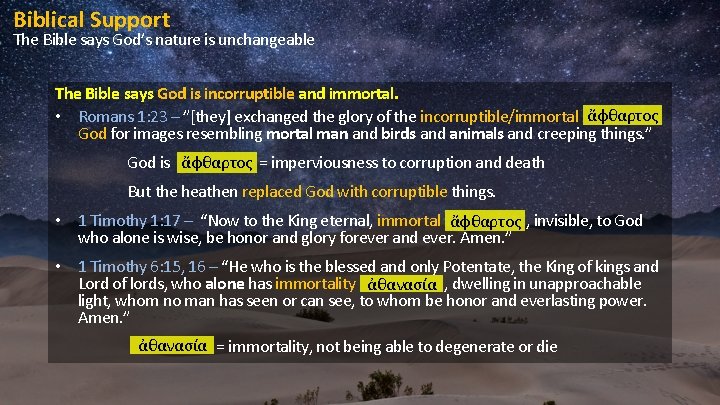
Biblical Support The Bible says God’s nature is unchangeable The Bible says God is incorruptible and immortal. • Romans 1: 23 – ”[they] exchanged the glory of the incorruptible/immortal ἄφθαρτος God for images resembling mortal man and birds and animals and creeping things. ” God is ἄφθαρτος = imperviousness to corruption and death But the heathen replaced God with corruptible things. • 1 Timothy 1: 17 – “Now to the King eternal, immortal ἄφθαρτος , invisible, to God who alone is wise, be honor and glory forever and ever. Amen. ” • 1 Timothy 6: 15, 16 – “He who is the blessed and only Potentate, the King of kings and Lord of lords, who alone has immortality ἀθανασία , dwelling in unapproachable light, whom no man has seen or can see, to whom be honor and everlasting power. Amen. ” ἀθανασία = immortality, not being able to degenerate or die
Biblical Support The Bible says God’s nature is unchangeable The Bible says to have confidence in God because of his unchanging nature. • Malachi 3: 6 – “For I the Lord do not change; therefore you, O children of Jacob, are not consumed. • James 1: 17 – Every good gift and every perfect gift is from above, coming down from the Father of lights, with whom there is no variation or shadow due to change. • Hebrews 13: 8 – Jesus Christ is the same yesterday and today and forever.
Biblical Support The Bible says God’s will and purpose are unchangeable The Bible says God perfectly executes his will. • Numbers 23: 19 – “God is not a man, that He should lie, Nor a son of man, that He should repent. Has He said, and will He not do? Or has He spoken, and will He not make it good? ” • 1 Samuel 15: 29 – “And also the Strength of Israel will not lie nor relent. For He is not a man, that He should relent. ” The Bible says God does not take back his calling. • Romans 11: 29 – “For the gifts and the calling of God are irrevocable. ” He says God does not fail to keep his promises. • Romans 11: 1 – “I say then, has God cast away His people? Certainly not! For I also am an Israelite, of the seed of Abraham, of the tribe of Benjamin. ”
Biblical Support The Bible says God’s will and purpose are unchangeable The Bible says God’s predestined make it to the end. • Romans 8: 29, 30 – “For whom He foreknew, He also predestined to be conformed to the image of His Son, that He might be the firstborn among many brethren. Moreover whom He predestined, these He also called; whom He called, these He also justified; and whom He justified, these He also glorified. ” The Bible says God finishes what he starts. • Psalm 138: 8 – “The LORD will fulfill his purpose for me; your steadfast love, O LORD, endures forever. Do not forsake the work of your hands. ” • Philippians 1: 6 – “And I am sure of this, that he who began a good work in you will bring it to completion at the day of Jesus Christ. ” The Bible says God’s decisions do not change. • Hebrews 6: 17 – “Thus God, determining to show more abundantly to the heirs of promise the immutability of His counsel βουλή , confirmed it by an oath…” βουλή = that which one decides, resolution, decision, plan, purpose, intention
1. 2. 3. 4. 5. 6. Defining immutability Objections from open theism Biblical support Philosophical support Historical support Answering open theism’s arguments 7. Practical take-aways
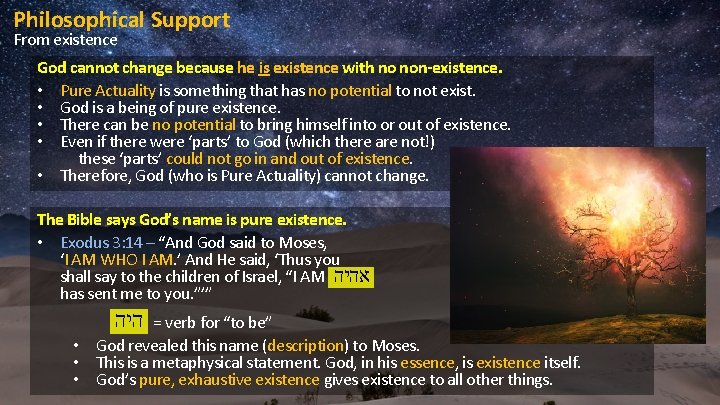
Philosophical Support From existence God cannot change because he is existence with no non-existence. • Pure Actuality is something that has no potential to not exist. • God is a being of pure existence. • There can be no potential to bring himself into or out of existence. • Even if there were ‘parts’ to God (which there are not!) these ‘parts’ could not go in and out of existence. • Therefore, God (who is Pure Actuality) cannot change. The Bible says God’s name is pure existence. • Exodus 3: 14 – “And God said to Moses, ‘I AM WHO I AM. ’ And He said, ‘Thus you shall say to the children of Israel, “I AM אהיה has sent me to you. ”’” היה = verb for “to be” • God revealed this name (description) to Moses. • This is a metaphysical statement. God, in his essence, is existence itself. • God’s pure, exhaustive existence gives existence to all other things.
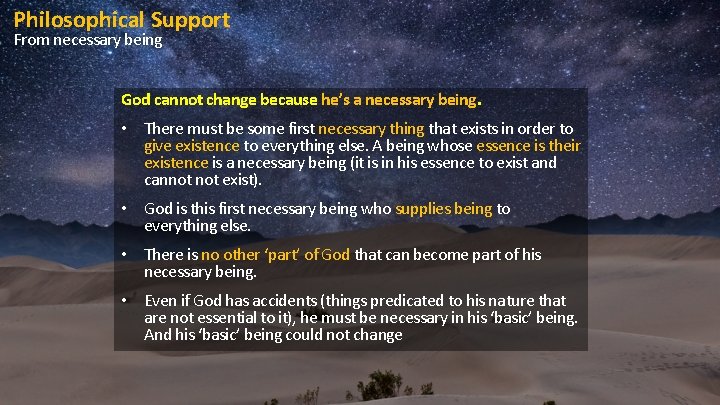
Philosophical Support From necessary being God cannot change because he’s a necessary being. • There must be some first necessary thing that exists in order to give existence to everything else. A being whose essence is their existence is a necessary being (it is in his essence to exist and cannot exist). • God is this first necessary being who supplies being to everything else. • There is no other ‘part’ of God that can become part of his necessary being. • Even if God has accidents (things predicated to his nature that are not essential to it), he must be necessary in his ‘basic’ being. And his ‘basic’ being could not change
Philosophical Support From causation God cannot change because there is no other first agent. • If God had potential to change… …and he did change… …then there must be some other thing that brought about the change. • In the words of Novatian (c. 200 - c. 258), if God were to change… "He [would] cease to be God, being reduced into the power of another, in whose greatness He, being smaller, shall have been included” (Concerning The Trinity, 4)
Philosophical Support From simplicity God cannot change because he does not have parts. • God is not composed of parts. • John 4: 24 – “God is Spirit [non-matter], and those who worship Him must worship in spirit and truth. ” • Therefore there is nothing in him that can differ. • There are no parts to arrange in different order. The Bible says God is ‘one’ in his essence. • Deuteronomy 6: 4 – “Hear, O Israel: The LORD our God, the LORD is one!” Like Exodus 3: 14, this is a metaphysical statement. There is not only one God, but God, in his essence is one (there are no parts). There is only one essence and it is existence itself.
Philosophical Support From perfection God cannot change because he’s perfect. • God is already perfect. • You can’t add something to God to make him more perfect (or take something away). • He cannot become better off than he already is. • Therefore, he cannot change.
Philosophical Support From infinity God cannot change because he’s infinite. • You can have an infinite series theoretically (in the mind only, i. e. , mathematically). But you cannot have an infinite series in reality. • Why? Because regardless of how high the number, you would always be able to add one more. • Therefore, God cannot be both infinite and composed of parts. • The only way for him to be infinite is to not have parts.
Philosophical Support From eternality God cannot change because he’s eternal. • Time is the measurement of the movement of parts. • God is outside time since time is part of creation (Gen. 1: 1; even science shows time has a beginning). • Therefore, God does not have moving parts. • Neither can there be any measure of movement in God since he is eternal.
1. 2. 3. 4. 5. 6. Defining immutability Objections from open theism Biblical support Philosophical support Historical support Answering open theism’s arguments 7. Practical take-aways
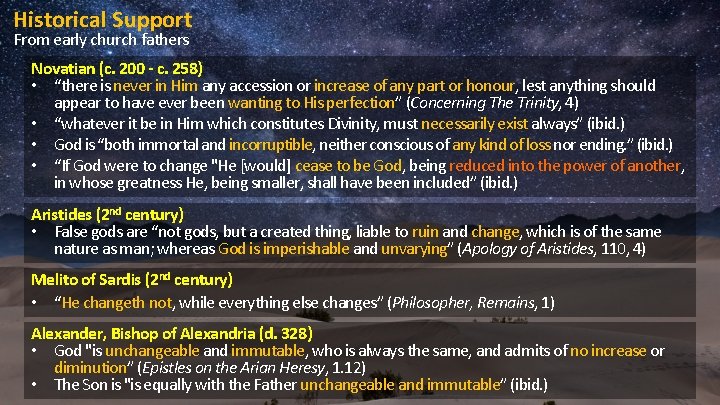
Historical Support From early church fathers Novatian (c. 200 - c. 258) • “there is never in Him any accession or increase of any part or honour, lest anything should appear to have ever been wanting to His perfection” (Concerning The Trinity, 4) • “whatever it be in Him which constitutes Divinity, must necessarily exist always” (ibid. ) • God is “both immortal and incorruptible, neither conscious of any kind of loss nor ending. ” (ibid. ) • “If God were to change "He [would] cease to be God, being reduced into the power of another, in whose greatness He, being smaller, shall have been included” (ibid. ) Aristides (2 nd century) • False gods are “not gods, but a created thing, liable to ruin and change, which is of the same nature as man; whereas God is imperishable and unvarying” (Apology of Aristides, 110, 4) Melito of Sardis (2 nd century) • “He changeth not, while everything else changes” (Philosopher, Remains, 1) Alexander, Bishop of Alexandria (d. 328) • God "is unchangeable and immutable, who is always the same, and admits of no increase or diminution” (Epistles on the Arian Heresy, 1. 12) • The Son is "is equally with the Father unchangeable and immutable” (ibid. )
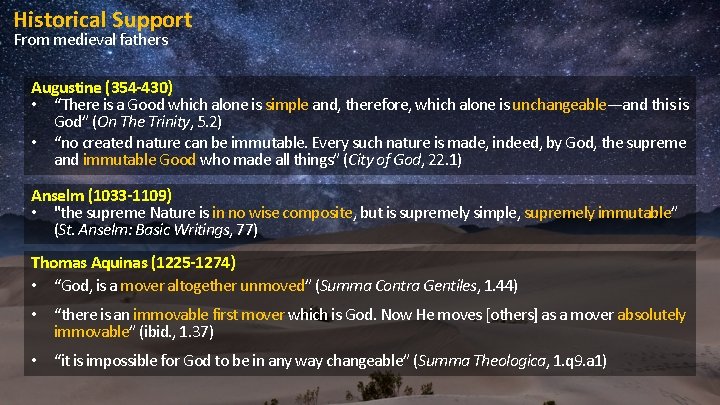
Historical Support From medieval fathers Augustine (354 -430) • “There is a Good which alone is simple and, therefore, which alone is unchangeable—and this is God” (On The Trinity, 5. 2) • “no created nature can be immutable. Every such nature is made, indeed, by God, the supreme and immutable Good who made all things” (City of God, 22. 1) Anselm (1033 -1109) • "the supreme Nature is in no wise composite, but is supremely simple, supremely immutable” (St. Anselm: Basic Writings, 77) Thomas Aquinas (1225 -1274) • “God, is a mover altogether unmoved” (Summa Contra Gentiles, 1. 44) • “there is an immovable first mover which is God. Now He moves [others] as a mover absolutely immovable” (ibid. , 1. 37) • “it is impossible for God to be in any way changeable” (Summa Theologica, 1. q 9. a 1)
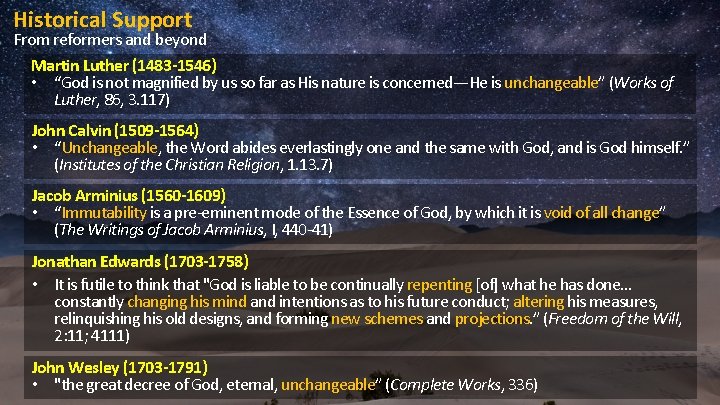
Historical Support From reformers and beyond Martin Luther (1483 -1546) • “God is not magnified by us so far as His nature is concerned—He is unchangeable” (Works of Luther, 86, 3. 117) John Calvin (1509 -1564) • “Unchangeable, the Word abides everlastingly one and the same with God, and is God himself. ” (Institutes of the Christian Religion, 1. 13. 7) Jacob Arminius (1560 -1609) • “Immutability is a pre-eminent mode of the Essence of God, by which it is void of all change” (The Writings of Jacob Arminius, I, 440 -41) Jonathan Edwards (1703 -1758) • It is futile to think that "God is liable to be continually repenting [of] what he has done… constantly changing his mind and intentions as to his future conduct; altering his measures, relinquishing his old designs, and forming new schemes and projections. ” (Freedom of the Will, 2: 11; 4111) John Wesley (1703 -1791) • "the great decree of God, eternal, unchangeable” (Complete Works, 336)
1. 2. 3. 4. 5. 6. Defining immutability Objections from open theism Biblical support Philosophical support Historical support Answering open theism’s arguments 7. Practical take-aways
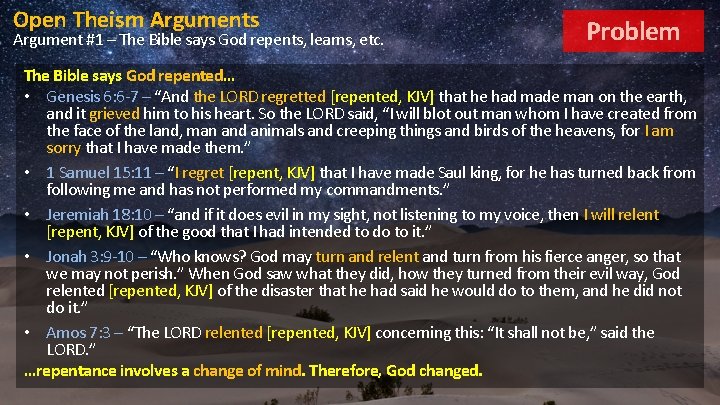
Open Theism Arguments Argument #1 – The Bible says God repents, learns, etc. Problem The Bible says God repented… • Genesis 6: 6 -7 – “And the LORD regretted [repented, KJV] that he had made man on the earth, and it grieved him to his heart. So the LORD said, “I will blot out man whom I have created from the face of the land, man and animals and creeping things and birds of the heavens, for I am sorry that I have made them. ” • 1 Samuel 15: 11 – “I regret [repent, KJV] that I have made Saul king, for he has turned back from following me and has not performed my commandments. ” • Jeremiah 18: 10 – “and if it does evil in my sight, not listening to my voice, then I will relent [repent, KJV] of the good that I had intended to do to it. ” • Jonah 3: 9 -10 – “Who knows? God may turn and relent and turn from his fierce anger, so that we may not perish. ” When God saw what they did, how they turned from their evil way, God relented [repented, KJV] of the disaster that he had said he would do to them, and he did not do it. ” • Amos 7: 3 – “The LORD relented [repented, KJV] concerning this: “It shall not be, ” said the LORD. ” …repentance involves a change of mind. Therefore, God changed.
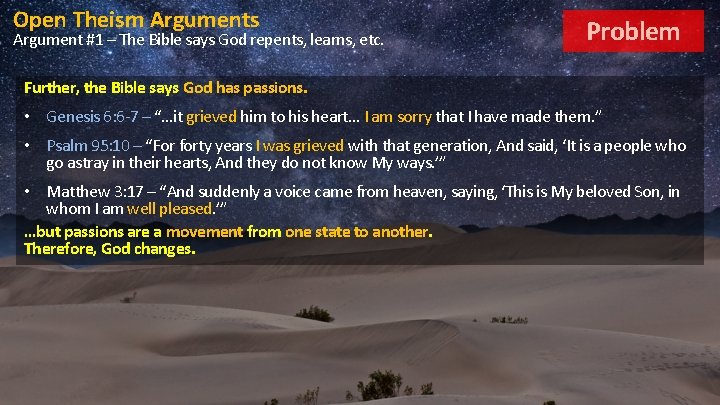
Open Theism Arguments Argument #1 – The Bible says God repents, learns, etc. Problem Further, the Bible says God has passions. • Genesis 6: 6 -7 – “…it grieved him to his heart… I am sorry that I have made them. ” • Psalm 95: 10 – “For forty years I was grieved with that generation, And said, ‘It is a people who go astray in their hearts, And they do not know My ways. ’” • Matthew 3: 17 – “And suddenly a voice came from heaven, saying, ‘This is My beloved Son, in whom I am well pleased. ’” …but passions are a movement from one state to another. Therefore, God changes.
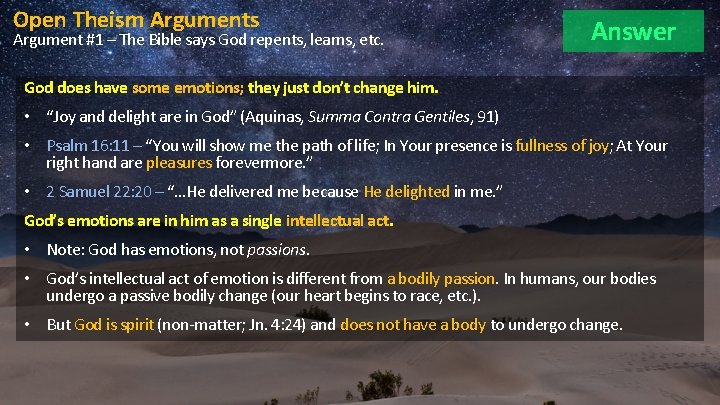
Open Theism Arguments Argument #1 – The Bible says God repents, learns, etc. Answer God does have some emotions; they just don’t change him. • “Joy and delight are in God” (Aquinas, Summa Contra Gentiles, 91) • Psalm 16: 11 – “You will show me the path of life; In Your presence is fullness of joy; At Your right hand are pleasures forevermore. ” • 2 Samuel 22: 20 – “…He delivered me because He delighted in me. ” God’s emotions are in him as a single intellectual act. • Note: God has emotions, not passions. • God’s intellectual act of emotion is different from a bodily passion. In humans, our bodies undergo a passive bodily change (our heart begins to race, etc. ). • But God is spirit (non-matter; Jn. 4: 24) and does not have a body to undergo change.
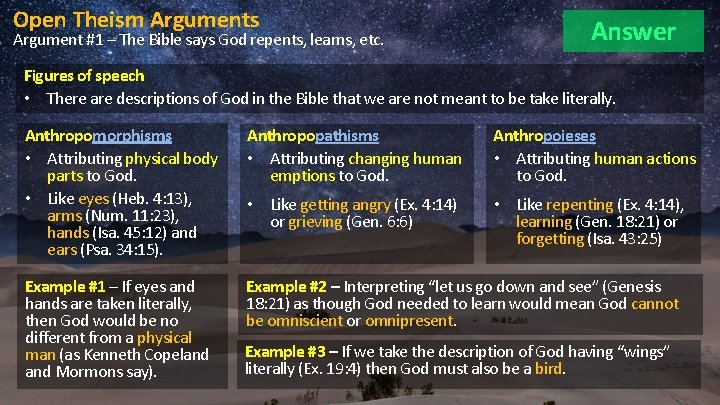
Open Theism Arguments Argument #1 – The Bible says God repents, learns, etc. Answer Figures of speech • There are descriptions of God in the Bible that we are not meant to be take literally. Anthropomorphisms • Attributing physical body parts to God. • Like eyes (Heb. 4: 13), arms (Num. 11: 23), hands (Isa. 45: 12) and ears (Psa. 34: 15). Anthropopathisms • Attributing changing human emptions to God. Anthropoieses • Attributing human actions to God. • Like getting angry (Ex. 4: 14) or grieving (Gen. 6: 6) • Like repenting (Ex. 4: 14), learning (Gen. 18: 21) or forgetting (Isa. 43: 25) Example #1 – If eyes and hands are taken literally, then God would be no different from a physical man (as Kenneth Copeland Mormons say). Example #2 – Interpreting “let us go down and see” (Genesis 18: 21) as though God needed to learn would mean God cannot be omniscient or omnipresent. Example #3 – If we take the description of God having “wings” literally (Ex. 19: 4) then God must also be a bird.
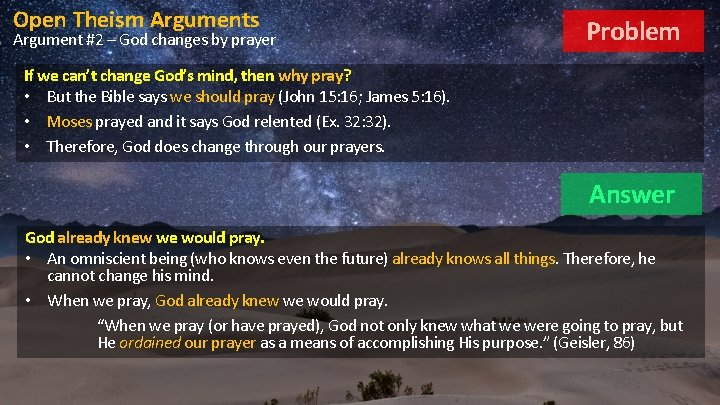
Open Theism Arguments Argument #2 – God changes by prayer Problem If we can’t change God’s mind, then why pray? • But the Bible says we should pray (John 15: 16; James 5: 16). • Moses prayed and it says God relented (Ex. 32: 32). • Therefore, God does change through our prayers. Answer God already knew we would pray. • An omniscient being (who knows even the future) already knows all things. Therefore, he cannot change his mind. • When we pray, God already knew we would pray. “When we pray (or have prayed), God not only knew what we were going to pray, but He ordained our prayer as a means of accomplishing His purpose. ” (Geisler, 86)
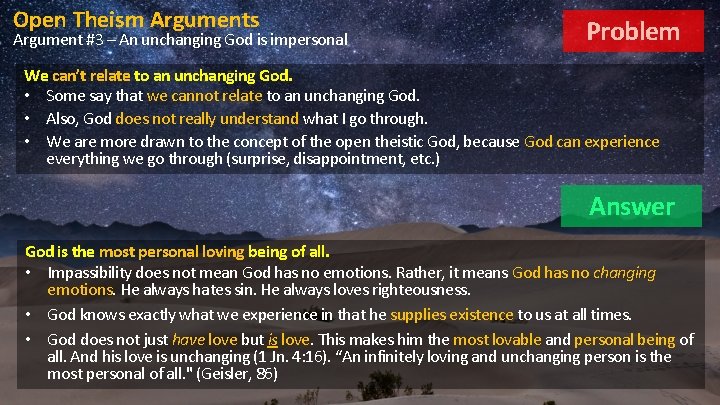
Open Theism Arguments Argument #3 – An unchanging God is impersonal Problem We can’t relate to an unchanging God. • Some say that we cannot relate to an unchanging God. • Also, God does not really understand what I go through. • We are more drawn to the concept of the open theistic God, because God can experience everything we go through (surprise, disappointment, etc. ) Answer God is the most personal loving being of all. • Impassibility does not mean God has no emotions. Rather, it means God has no changing emotions. He always hates sin. He always loves righteousness. • God knows exactly what we experience in that he supplies existence to us at all times. • God does not just have love but is love. This makes him the most lovable and personal being of all. And his love is unchanging (1 Jn. 4: 16). “An infinitely loving and unchanging person is the most personal of all. " (Geisler, 86)
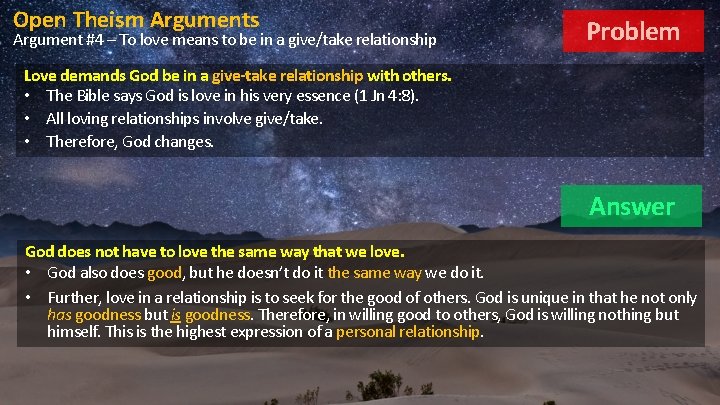
Open Theism Arguments Argument #4 – To love means to be in a give/take relationship Problem Love demands God be in a give-take relationship with others. • The Bible says God is love in his very essence (1 Jn 4: 8). • All loving relationships involve give/take. • Therefore, God changes. Answer God does not have to love the same way that we love. • God also does good, but he doesn’t do it the same way we do it. • Further, love in a relationship is to seek for the good of others. God is unique in that he not only has goodness but is goodness. Therefore, in willing good to others, God is willing nothing but himself. This is the highest expression of a personal relationship.
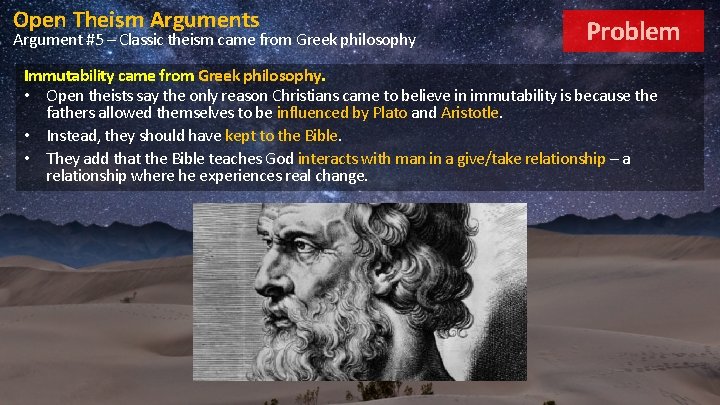
Open Theism Arguments Argument #5 – Classic theism came from Greek philosophy Problem Immutability came from Greek philosophy. • Open theists say the only reason Christians came to believe in immutability is because the fathers allowed themselves to be influenced by Plato and Aristotle. • Instead, they should have kept to the Bible. • They add that the Bible teaches God interacts with man in a give/take relationship – a relationship where he experiences real change.
Open Theism Arguments Argument #5 – Classic theism came from Greek philosophy Answer Truth is truth regardless where it comes from. • Aristotle discovered the laws of logic. Should we avoid logic because it was discovered by Greek philosophy? • Scientists make many discoveries today that correspond to reality (are truthful). • To dismiss something simply because of its origin is called a genetic fallacy. Rational thinking makes for good Bible study. • Reality (rational thinking, reason) can help us understand what the Bible is actually affirming. • Example: Revelation 7: 1 mentions the “four corners of the earth. ” Taken at face value, this could lead some to argue that the earth is a square. However, science has shown the earth is a sphere. Thus, science and reason help us know this is a figure of speech.
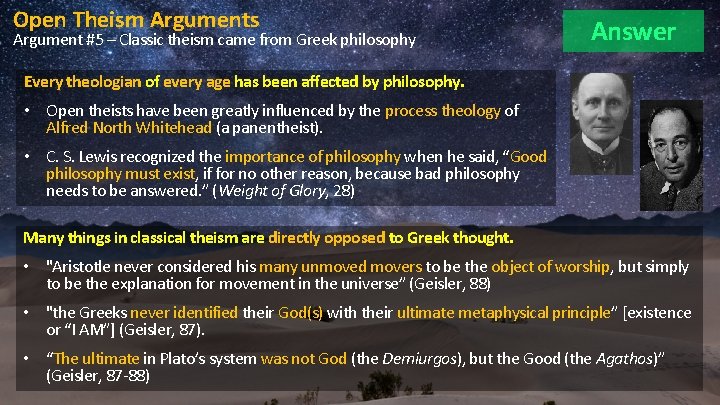
Open Theism Arguments Argument #5 – Classic theism came from Greek philosophy Answer Every theologian of every age has been affected by philosophy. • Open theists have been greatly influenced by the process theology of Alfred North Whitehead (a panentheist). • C. S. Lewis recognized the importance of philosophy when he said, “Good philosophy must exist, if for no other reason, because bad philosophy needs to be answered. ” (Weight of Glory, 28) Many things in classical theism are directly opposed to Greek thought. • "Aristotle never considered his many unmoved movers to be the object of worship, but simply to be the explanation for movement in the universe” (Geisler, 88) • "the Greeks never identified their God(s) with their ultimate metaphysical principle” [existence or “I AM”] (Geisler, 87). • “The ultimate in Plato’s system was not God (the Demiurgos), but the Good (the Agathos)” (Geisler, 87 -88)
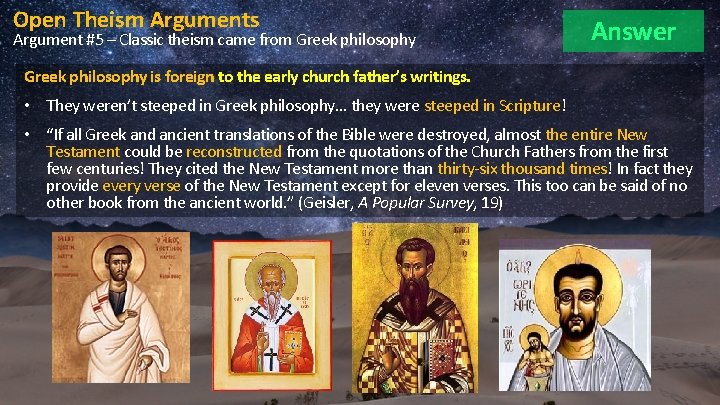
Open Theism Arguments Argument #5 – Classic theism came from Greek philosophy Answer Greek philosophy is foreign to the early church father’s writings. • They weren’t steeped in Greek philosophy… they were steeped in Scripture! • “If all Greek and ancient translations of the Bible were destroyed, almost the entire New Testament could be reconstructed from the quotations of the Church Fathers from the first few centuries! They cited the New Testament more than thirty-six thousand times! In fact they provide every verse of the New Testament except for eleven verses. This too can be said of no other book from the ancient world. ” (Geisler, A Popular Survey, 19)
Open Theism Arguments Argument #6 – God couldn’t have free will unless he could change Problem Only a being who’s able to change has free will. • God would not be truly free to do what he wants if he were unchanging. • God must be able to change his course to be truly free. • Therefore, he can change. Answer God did not have to act the way he did. • Classical theism says God could have done otherwise (hence, free will). • But once God wills something, it must necessarily come to pass. • God made unchangeable decisions from eternity (in one single act). But it was not necessary for him to will the way he did.
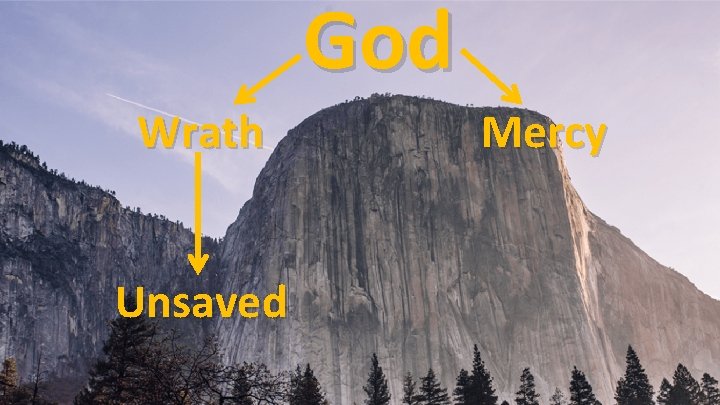
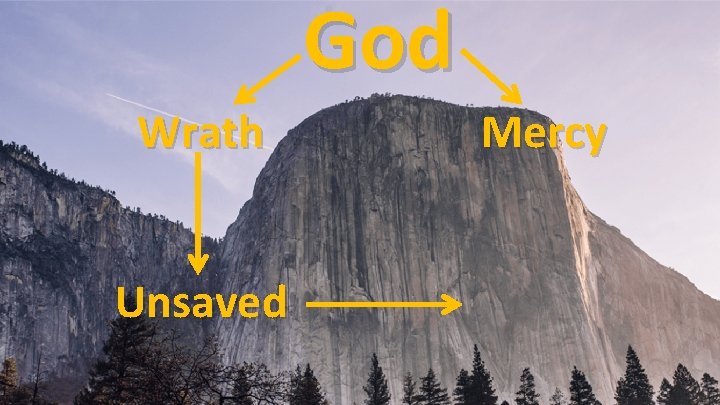
Open Theism Arguments Argument #7 – Creation requires changes in God Problem Creation shows that God changes. • At one point there was no universe, then God created the universe. • Does not that mean there’s a change with God? “…does not the act of creation itself imply a change in God? ” (Pinnock, Openness of God, 935) Answer God moves all things in creation while remaining immovable. • First, the universe is not God (like pantheism and panentheism say). God, who is transcendent from the universe, is immovable. But he does move everything else. • It’s true that God was not related to the world before creation, and after, he was. But the change of relation is from the perspective of creation, not God. There was no change in God any more than a person walking by a pillar changes the pillar. • Change in relation happens at salvation as well. When a person is saved, they change…
God Wrath Unsaved Mercy
God Wrath Unsaved Mercy
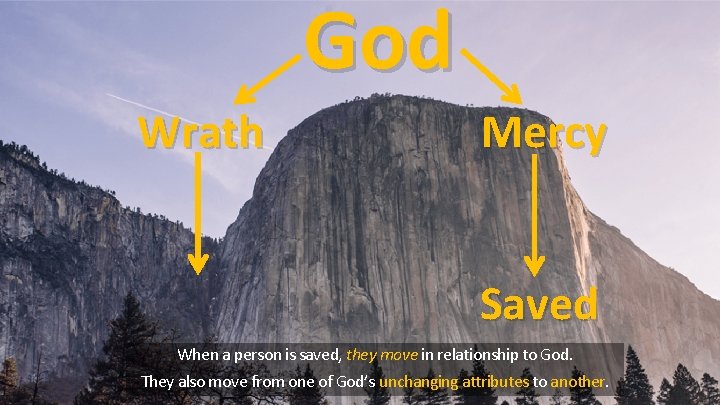
God Wrath Mercy Saved When a person is saved, they move in relationship to God. They also move from one of God’s unchanging attributes to another.
1. 2. 3. 4. 5. 6. Defining immutability Objections from open theism Biblical support Philosophical support Historical support Answering open theism’s arguments 7. Practical take-aways
Practical Take-aways Because God does not change… We can trust the Bible. • Matt. 5: 18 – Jesus said, “For truly, I say to you, until heaven and earth pass away, not an iota, not a dot, will pass from the Law until all is accomplished. ” • Since God cannot learn and knows all things, prophecy cannot fail (the Bible is infallible)! • God’s Word doesn’t contain ‘best guesses. ’ We can trust God’s promises. • Psalm 89: 28 -35 – “My mercy I will keep for him forever… My covenant shall stand firm. . . I will not utterly take from him, Nor allow My faithfulness to fail. My covenant I will not break, Nor alter the word that has gone out of My lips… I will not lie…”
Practical Take-aways Because God does not change… We can ask God for specific guidance. • Since God is immutable, he knows the future and doesn’t have to “wait and learn. ” • Therefore, we can come to him for advice on who to marry, which job to accept, which degree to study in school, and so forth. We can be sure of our own salvation. • Since God does not pass through time, he already knows all and calls those who are his. • Philippians 1: 6 – you can “[be] confident of this very thing, that He who has begun a good work in you will complete it until the day of Jesus Christ” • Romans 8: 30 – “And those whom he predestined he also called, and those whom he called he also justified, and those whom he justified he also glorified. ” We have a solid foundation for service. • 1 Corinthians 15: 58 – “Therefore, my beloved brothers, be steadfast, immovable, always abounding in the work of the Lord, knowing that in the Lord your labor is not in vain. ”
Bibliography Aquinas, Thomas. Summa Contra Gentiles. Translated by Fathers of the English Dominican Province. London: Burns Oates & Washbourne, 1924. Aquinas, Thomas. Summa Theologica. Translated by Fathers of the English Dominican Province. London: Burns Oates & Washbourne, n. d. Geisler, Norman. A Popular Survey of the New Testament. Grand Rapids, MI: Baker Books, 2014. Geisler, Norman. Systematic Theology, Volume Two: God, Creation. Minneapolis, MN: Bethany House Publishers, 2003. Geisler, Norman. “TH 540: Theology Proper. ” Lecture, Veritas International University, Murrieta, CA, 2014, God. Immut 7. ser. pptx Grudem, Wayne A. Systematic Theology: An Introduction to Biblical Doctrine. Leicester, England; Grand Rapids, MI: Inter-Varsity Press; Zondervan Pub. House, 2004. Mac. Arthur, John, and Richard Mayhue, eds. , Biblical Doctrine: A Systematic Summary of Bible Truth. Wheaton, IL: Crossway, 2017. Pinnock, Clark H. , Richard Rice, John Sanders, William Hasker, David Basinger. The Openness of God: A Biblical Challenge to the Traditional Understanding of God. Dovers Grove, IL: Inter. Varsity Press, 1994. Kindle Edition.
- Slides: 45