
Goddard Space Flight Center GOESR FLIGHT PROJECT OFFICE

- Slides: 11
Goddard Space Flight Center GOES-R FLIGHT PROJECT OFFICE GOES Users Conference (GUC) Current Status on Advanced Baseline Imager November, 2009 NASA and NOAA Internal Use Only 12/1/2020 1
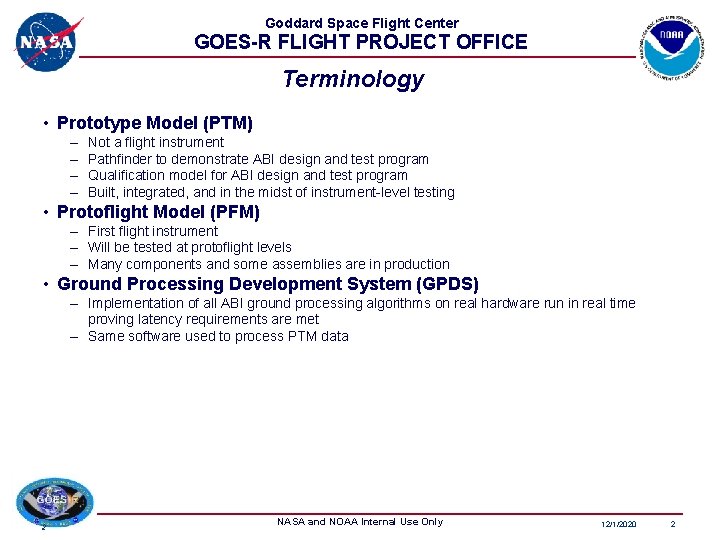
Goddard Space Flight Center GOES-R FLIGHT PROJECT OFFICE Terminology • Prototype Model (PTM) – – Not a flight instrument Pathfinder to demonstrate ABI design and test program Qualification model for ABI design and test program Built, integrated, and in the midst of instrument-level testing • Protoflight Model (PFM) – First flight instrument – Will be tested at protoflight levels – Many components and some assemblies are in production • Ground Processing Development System (GPDS) – Implementation of all ABI ground processing algorithms on real hardware run in real time proving latency requirements are met – Same software used to process PTM data 2 NASA and NOAA Internal Use Only 12/1/2020 2
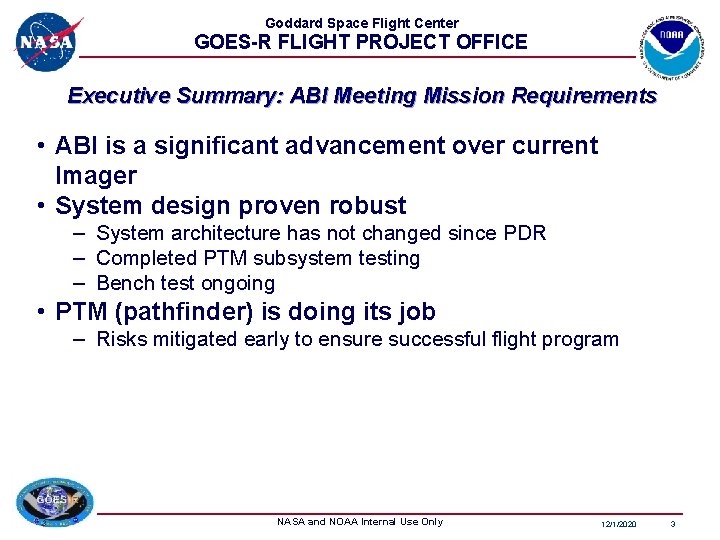
Goddard Space Flight Center GOES-R FLIGHT PROJECT OFFICE Executive Summary: ABI Meeting Mission Requirements • ABI is a significant advancement over current Imager • System design proven robust – System architecture has not changed since PDR – Completed PTM subsystem testing – Bench test ongoing • PTM (pathfinder) is doing its job – Risks mitigated early to ensure successful flight program 3 NASA and NOAA Internal Use Only 12/1/2020 3
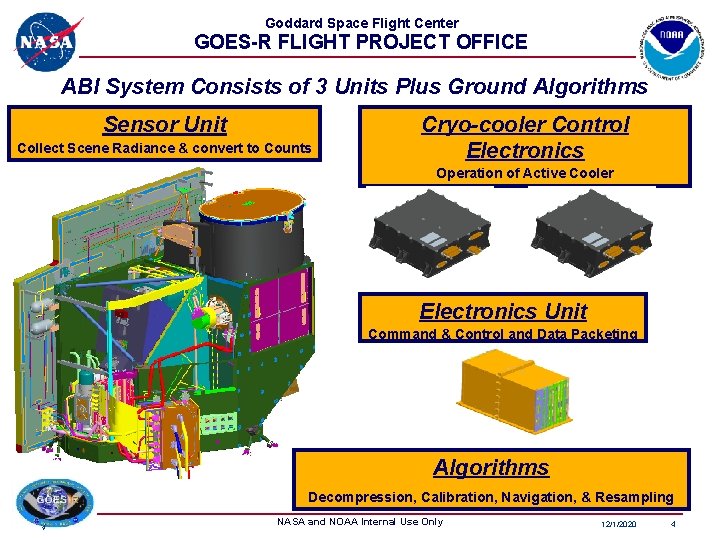
Goddard Space Flight Center GOES-R FLIGHT PROJECT OFFICE ABI System Consists of 3 Units Plus Ground Algorithms Sensor Unit Collect Scene Radiance & convert to Counts Cryo-cooler Control Electronics Operation of Active Cooler Electronics Unit Command & Control and Data Packeting Algorithms Decompression, Calibration, Navigation, & Resampling 4 NASA and NOAA Internal Use Only 12/1/2020 4
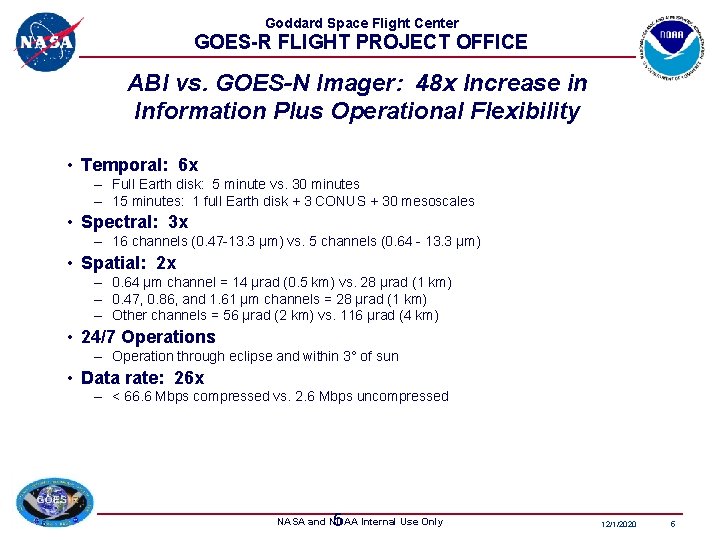
Goddard Space Flight Center GOES-R FLIGHT PROJECT OFFICE ABI vs. GOES-N Imager: 48 x Increase in Information Plus Operational Flexibility • Temporal: 6 x – Full Earth disk: 5 minute vs. 30 minutes – 15 minutes: 1 full Earth disk + 3 CONUS + 30 mesoscales • Spectral: 3 x – 16 channels (0. 47 -13. 3 µm) vs. 5 channels (0. 64 - 13. 3 µm) • Spatial: 2 x – 0. 64 µm channel = 14 µrad (0. 5 km) vs. 28 µrad (1 km) – 0. 47, 0. 86, and 1. 61 µm channels = 28 µrad (1 km) – Other channels = 56 µrad (2 km) vs. 116 µrad (4 km) • 24/7 Operations – Operation through eclipse and within 3° of sun • Data rate: 26 x – < 66. 6 Mbps compressed vs. 2. 6 Mbps uncompressed 5 5 NASA and NOAA Internal Use Only 12/1/2020 5
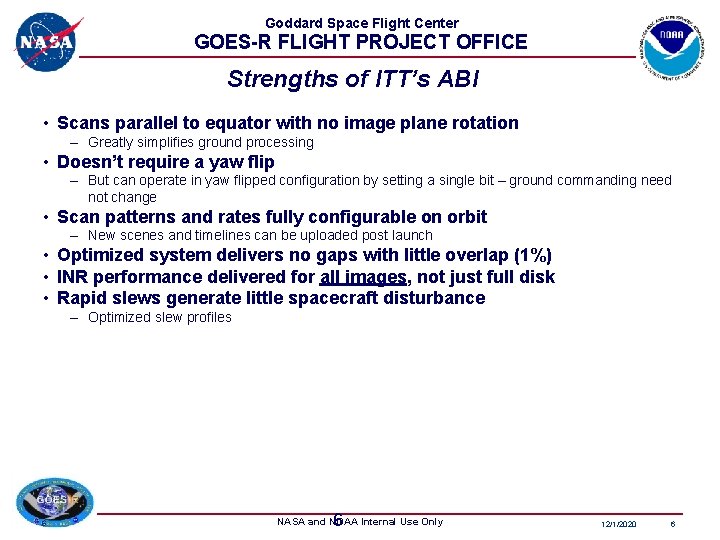
Goddard Space Flight Center GOES-R FLIGHT PROJECT OFFICE Strengths of ITT’s ABI • Scans parallel to equator with no image plane rotation – Greatly simplifies ground processing • Doesn’t require a yaw flip – But can operate in yaw flipped configuration by setting a single bit – ground commanding need not change • Scan patterns and rates fully configurable on orbit – New scenes and timelines can be uploaded post launch • Optimized system delivers no gaps with little overlap (1%) • INR performance delivered for all images, not just full disk • Rapid slews generate little spacecraft disturbance – Optimized slew profiles 6 6 NASA and NOAA Internal Use Only 12/1/2020 6
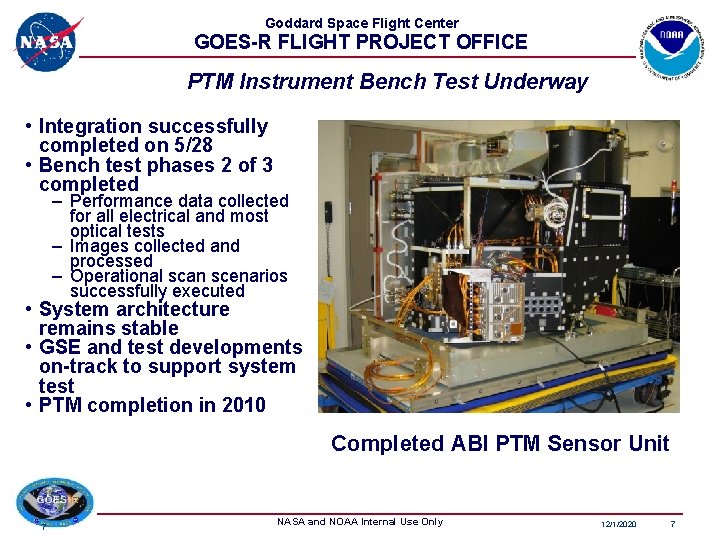
Goddard Space Flight Center GOES-R FLIGHT PROJECT OFFICE PTM Instrument Bench Test Underway • Integration successfully completed on 5/28 • Bench test phases 2 of 3 completed – Performance data collected for all electrical and most optical tests – Images collected and processed – Operational scan scenarios successfully executed • System architecture remains stable • GSE and test developments on-track to support system test • PTM completion in 2010 Completed ABI PTM Sensor Unit 7 NASA and NOAA Internal Use Only 12/1/2020 7
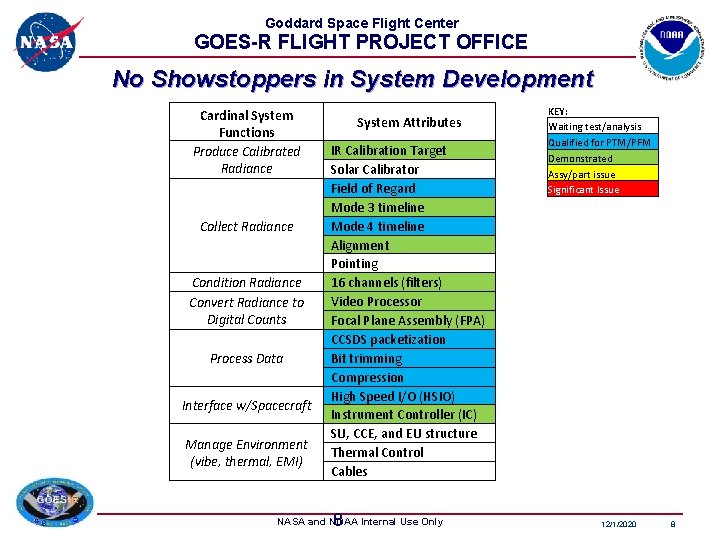
Goddard Space Flight Center GOES-R FLIGHT PROJECT OFFICE No Showstoppers in System Development Cardinal System Functions Produce Calibrated Radiance Collect Radiance Condition Radiance Convert Radiance to Digital Counts Process Data Interface w/Spacecraft Manage Environment (vibe, thermal, EMI) 8 System Attributes IR Calibration Target Solar Calibrator Field of Regard Mode 3 timeline Mode 4 timeline Alignment Pointing 16 channels (filters) Video Processor Focal Plane Assembly (FPA) CCSDS packetization Bit trimming Compression High Speed I/O (HSIO) Instrument Controller (IC) SU, CCE, and EU structure Thermal Control Cables 8 NASA and NOAA Internal Use Only KEY: Waiting test/analysis Qualified for PTM/PFM Demonstrated Assy/part issue Significant Issue 12/1/2020 8
Goddard Space Flight Center GOES-R FLIGHT PROJECT OFFICE PTM Demonstrating ABI Design • System design remains stable – No architectural changes since PDR • PTM executing scan mode 3 & 4 timelines – Scanner works – Producing images • Sensor Unit modal testing correlated SU FEM first modes – 1 st mode at 57. 6 Hz; 2 nd mode at 63. 6 Hz • Coherent noise data: no significant frequency content • Polarization: performance meeting expectations PTM Is Effectively and Efficiently Paving the Path to Flight 9 NASA and NOAA Internal Use Only 12/1/2020 9
Goddard Space Flight Center GOES-R FLIGHT PROJECT OFFICE Ground Processing Algorithms Performance Demonstrated Using Simulated Data Channel 9. 61 um – 2. 0 km (LWIR) • Input generated by AIPS – Earth, space look, and blackbody all simulated – Unique gain & offset for every detector element – All sources of noise added – Bit-trimmed & compressed • GPDS processing: – Decompression – Calibration • Using space look & blackbody scenes – Navigation – Resampling Same algorithms used to process PTM data 10 10 NASA and NOAA Internal Use Only 12/1/2020 10
Goddard Space Flight Center GOES-R FLIGHT PROJECT OFFICE Summary - PTM Collecting Real Images • • • Scan Modes 3 and 4 work Custom timelines work Mechanisms for collecting data work well Mechanisms for adjusting instrument performance are working Data collections presenting real data to analysis teams and software PTM Demonstrating ABI Will Deliver Significantly Improved Imager Data for Weather Forecasting & Other Products 11 11 NASA and NOAA Internal Use Only 12/1/2020 11