
Goat and Sheep Restraint and clinical procedures Chapter






- Slides: 69
Goat and Sheep Restraint and clinical procedures Chapter 2, 14 and 15
• There are two things to aim at in life; first to get what you want, and after that to enjoy it. Only the wisest of mankind has achieved the second. Logan Pearsall Smith
Objectives Restraint of sheep and goats Reproduction Nutrition Intravenous catheter, and monitor the catheter for complications. Explain the rationale and indications for each of the clinical procedures described. • prepare the patient as needed for the procedure. • • •
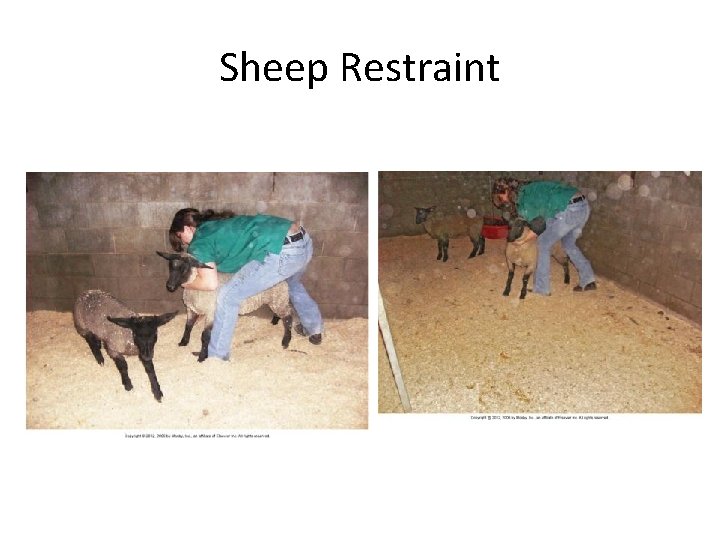
Sheep restraint • Sheep are timid animals. – do not seem to enjoy being stroked or petted • The usual response is to flee when frightened and they may cause serious injury to themselves in their effort to escape • Sheep have extremely strong flocking instincts
Key Points: Sheep • Individual sheep need to be separated from the flock • Another common tendency to avoid is catching them by grabbing the wool – Bruise/rip skin • Grabbing by the horns (when present) must be done with care to avoid breaking them • Note can get fractures by throwing them down
Sheep Restraint
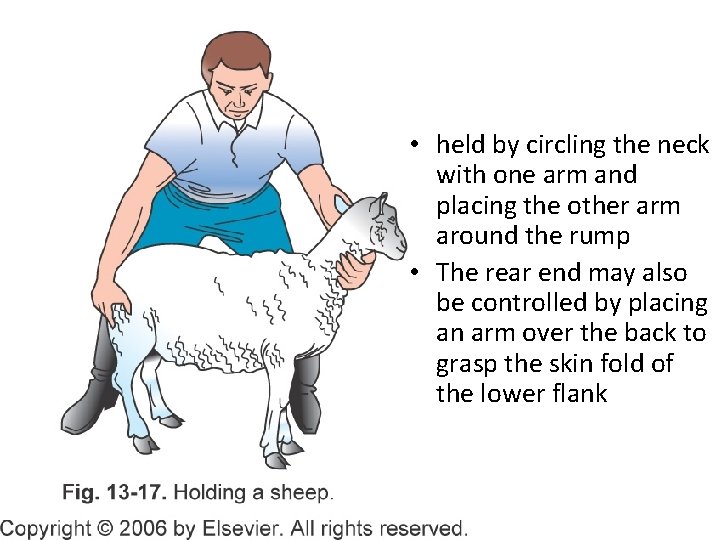
• held by circling the neck with one arm and placing the other arm around the rump • The rear end may also be controlled by placing an arm over the back to grasp the skin fold of the lower flank
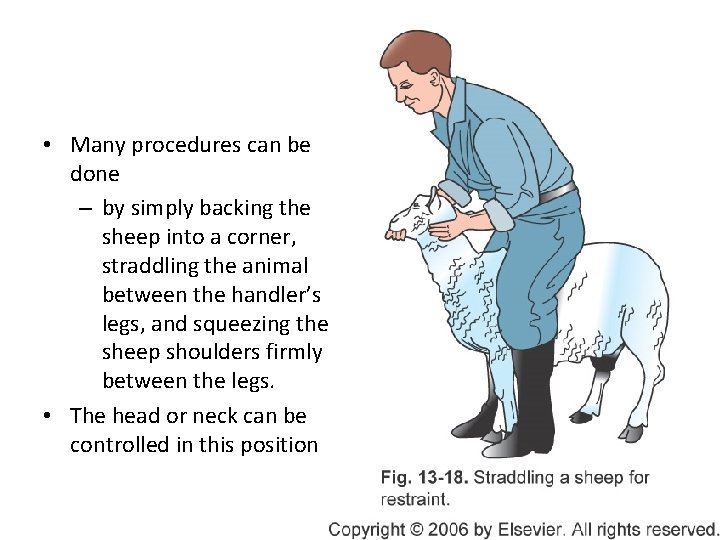
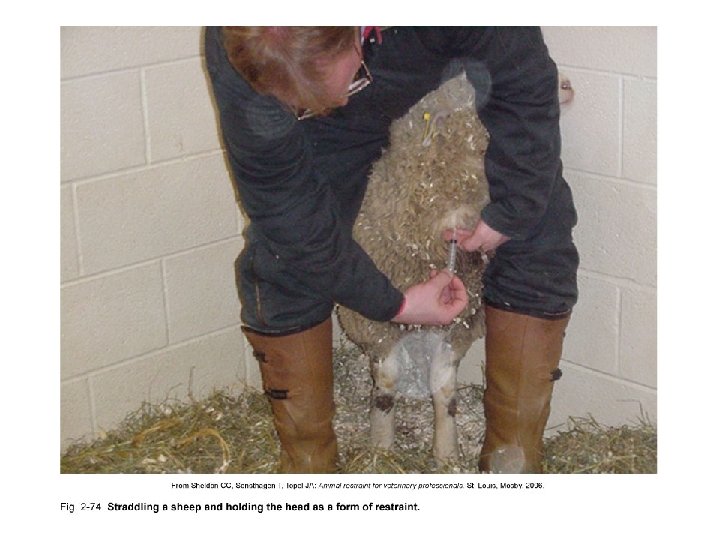
• Many procedures can be done – by simply backing the sheep into a corner, straddling the animal between the handler’s legs, and squeezing the sheep shoulders firmly between the legs. • The head or neck can be controlled in this position
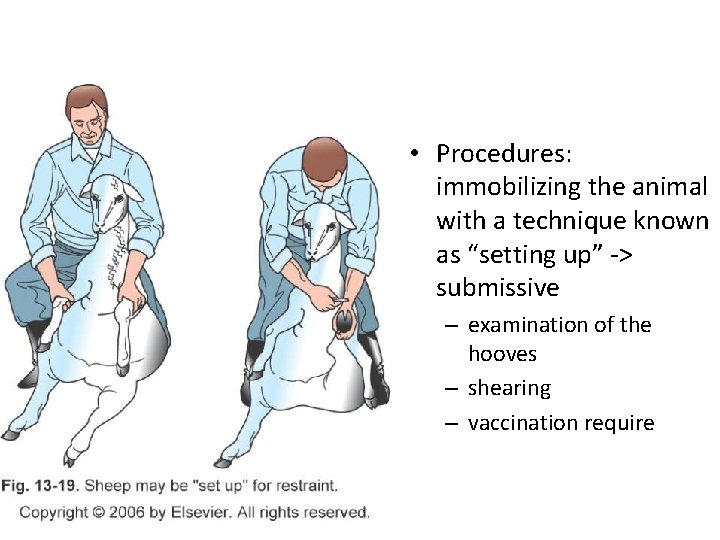
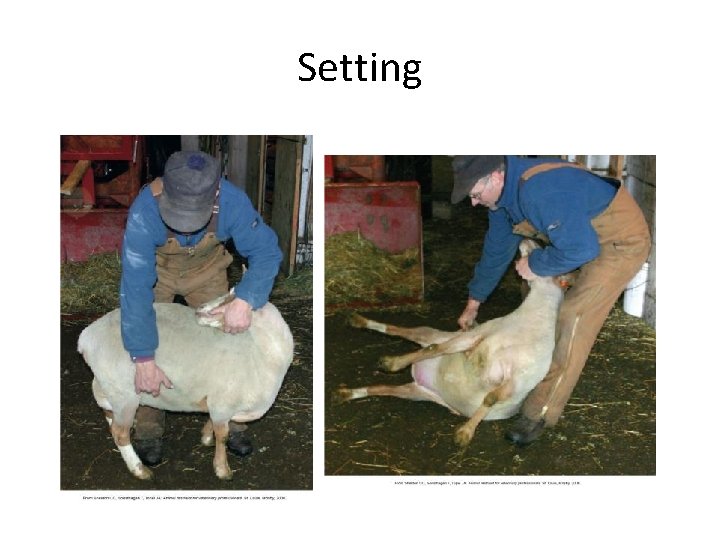
• Procedures: immobilizing the animal with a technique known as “setting up” -> submissive – examination of the hooves – shearing – vaccination require
Setting
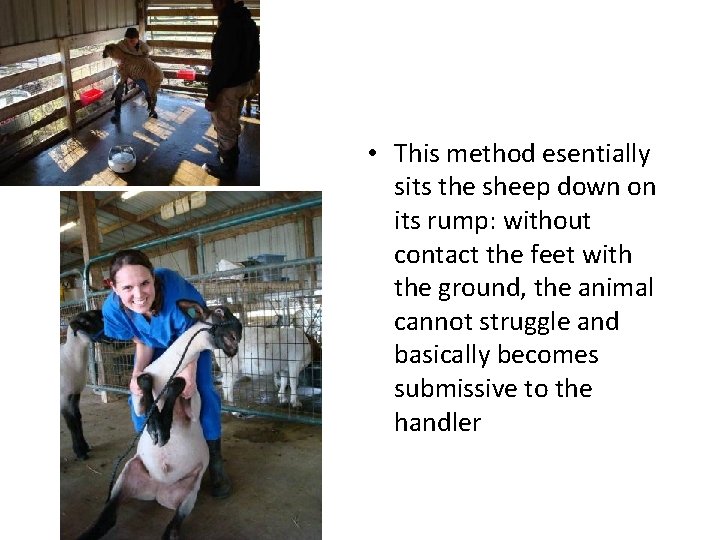
• This method esentially sits the sheep down on its rump: without contact the feet with the ground, the animal cannot struggle and basically becomes submissive to the handler
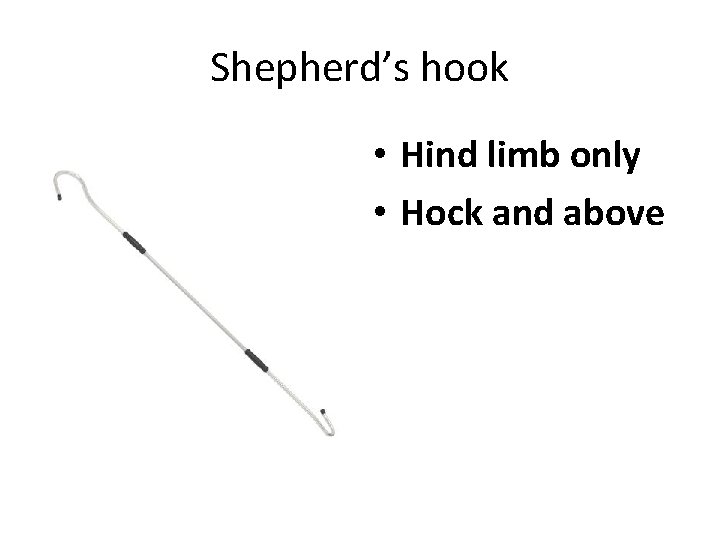
Shepherd’s hook • Hind limb only • Hock and above
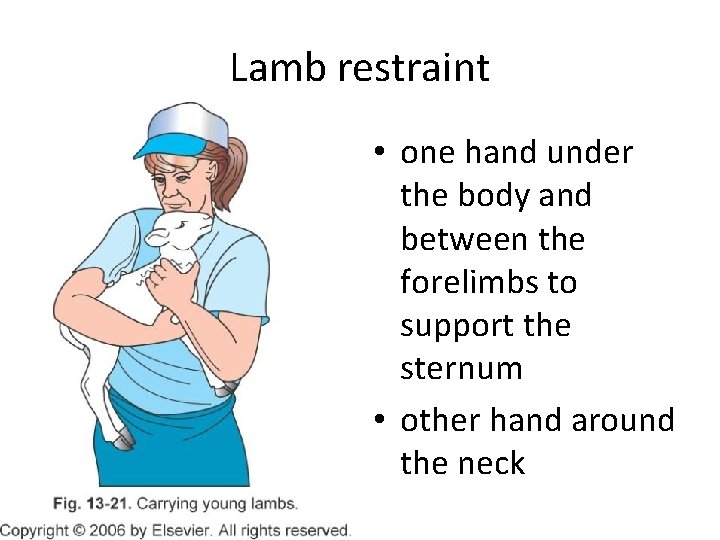
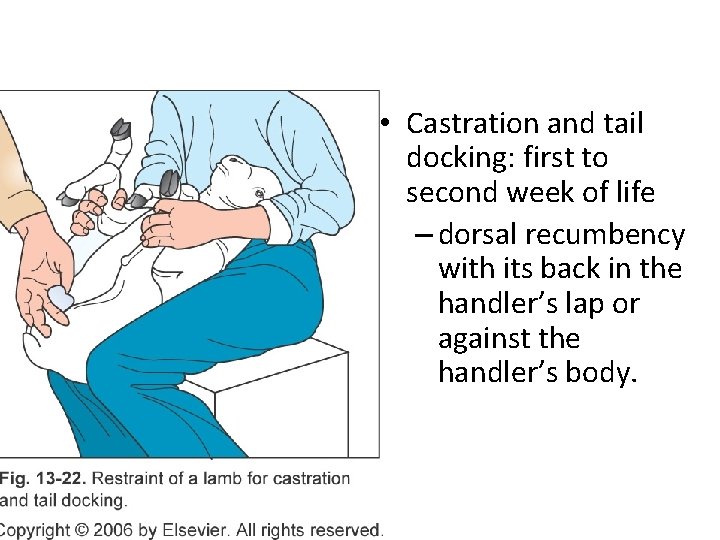
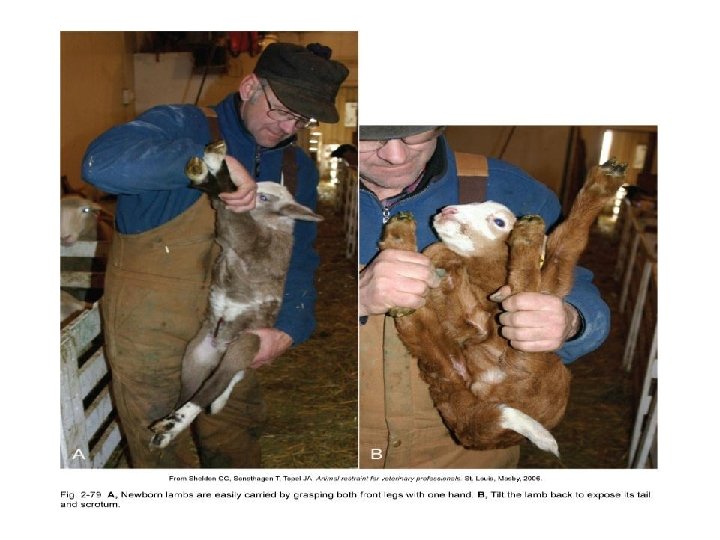
Lamb restraint • one hand under the body and between the forelimbs to support the sternum • other hand around the neck
• Castration and tail docking: first to second week of life – dorsal recumbency with its back in the handler’s lap or against the handler’s body.
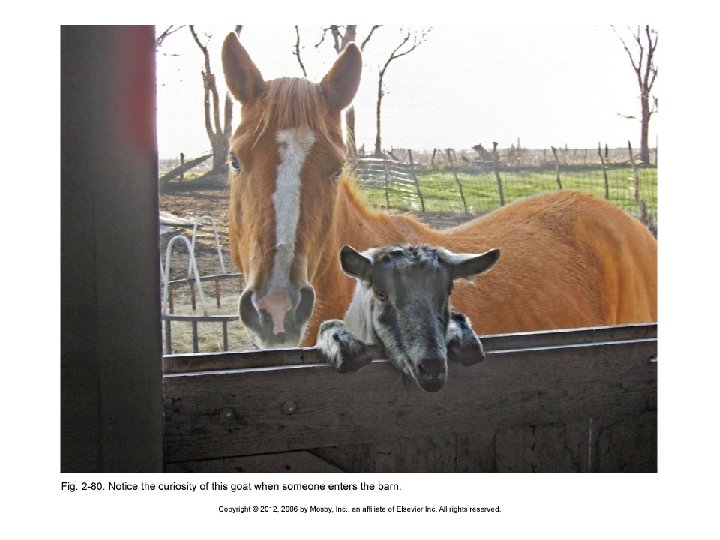
Goat restraining • Goats are gregarious and seem to enjoy the company of other species of animals • Goats form social hierarchy within a group and dominant males and females can be identify • Goats may show aggression – – – head-butting by raising the hair on the spine stamping the front feet sneezing/snorting noise Esp. bucks during breeding season
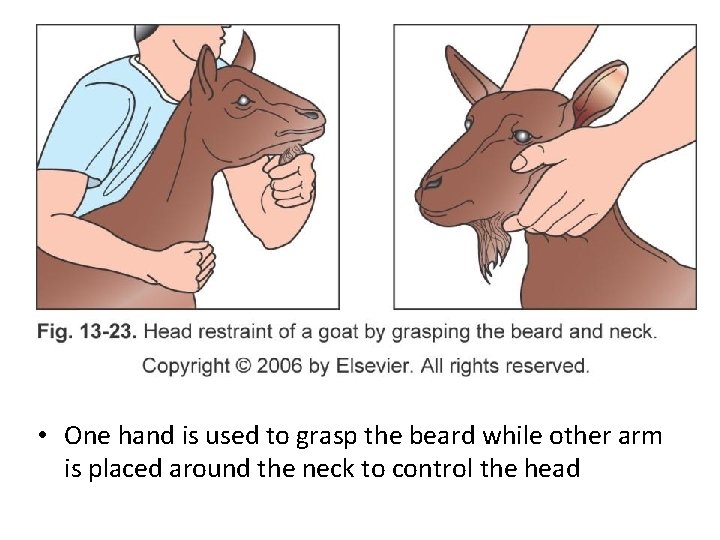
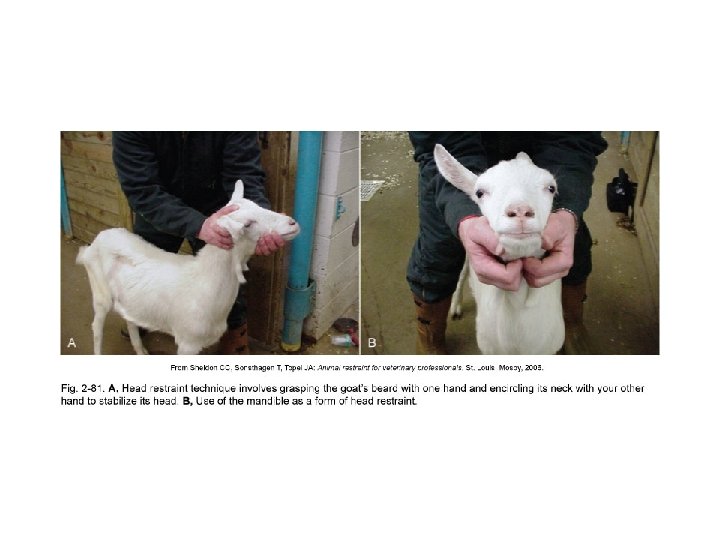
Goat Restraint (cont’d) • By the beard • Horns can be held near the base • Do not restrain by ears • Lateral recumbency • Collars
• One hand is used to grasp the beard while other arm is placed around the neck to control the head
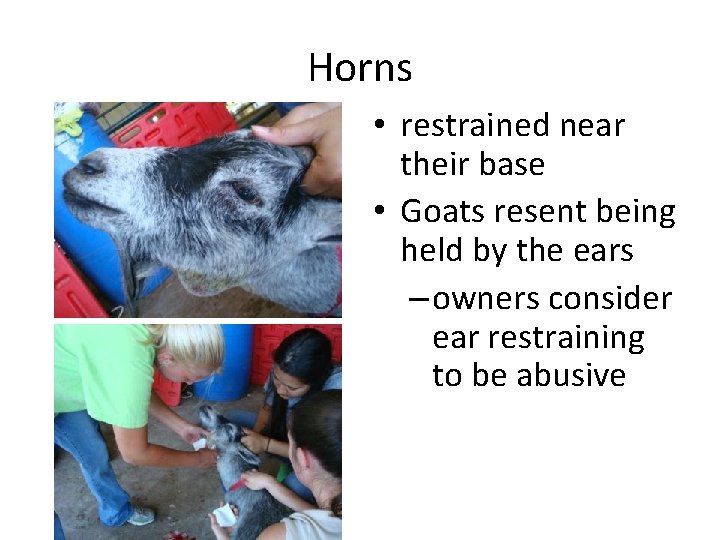
Horns • restrained near their base • Goats resent being held by the ears – owners consider ear restraining to be abusive
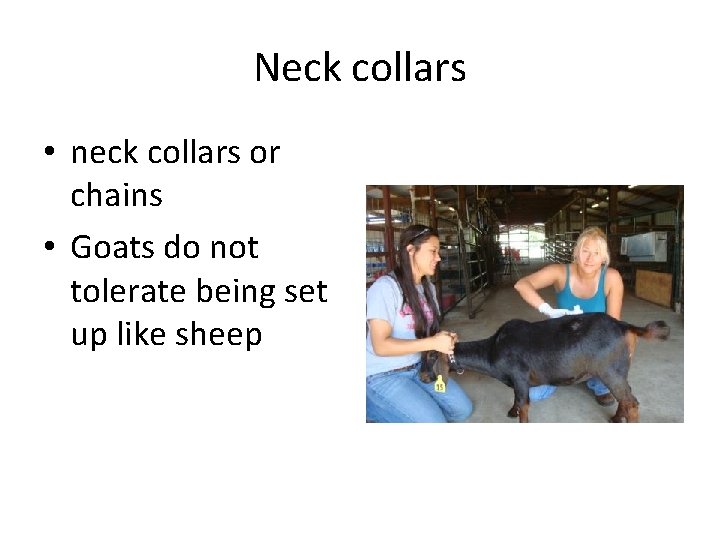
Neck collars • neck collars or chains • Goats do not tolerate being set up like sheep
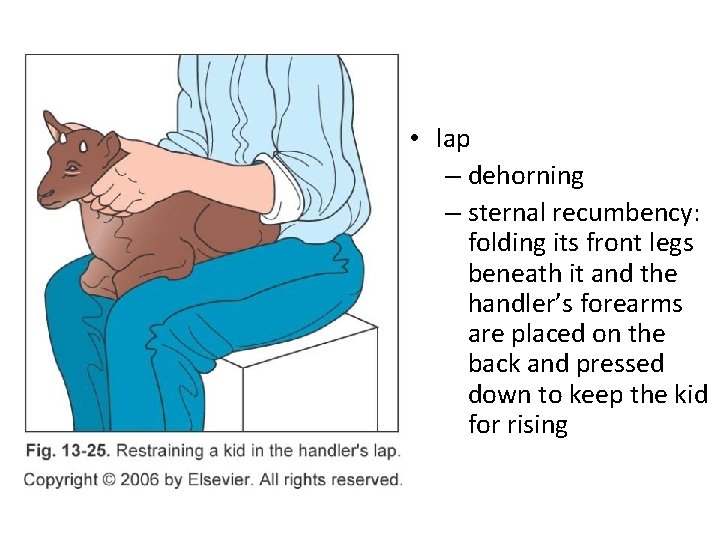
• lap – dehorning – sternal recumbency: folding its front legs beneath it and the handler’s forearms are placed on the back and pressed down to keep the kid for rising
Sheep and Goat Reproduction
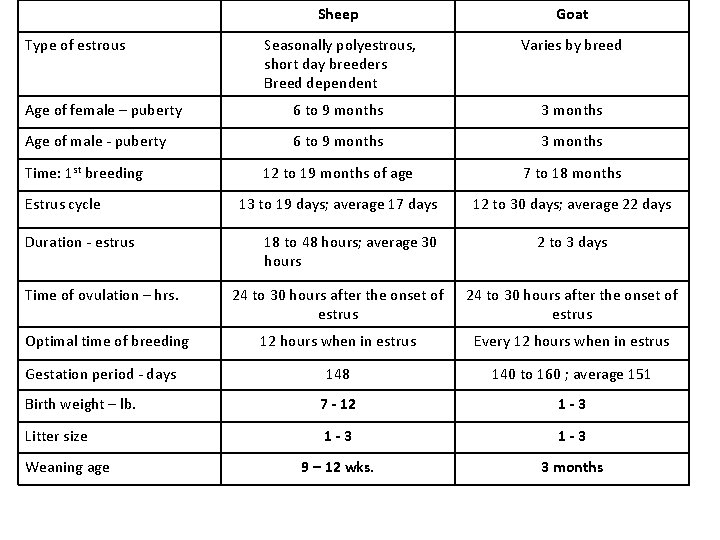
Sheep Goat Seasonally polyestrous, short day breeders Breed dependent Varies by breed Age of female – puberty 6 to 9 months 3 months Age of male - puberty 6 to 9 months 3 months 12 to 19 months of age 7 to 18 months 13 to 19 days; average 17 days 12 to 30 days; average 22 days Type of estrous Time: 1 st breeding Estrus cycle Duration - estrus Time of ovulation – hrs. 18 to 48 hours; average 30 hours 2 to 3 days 24 to 30 hours after the onset of estrus 12 hours when in estrus Every 12 hours when in estrus 148 140 to 160 ; average 151 Birth weight – lb. 7 - 12 1 -3 Litter size 1 -3 9 – 12 wks. 3 months Optimal time of breeding Gestation period - days Weaning age
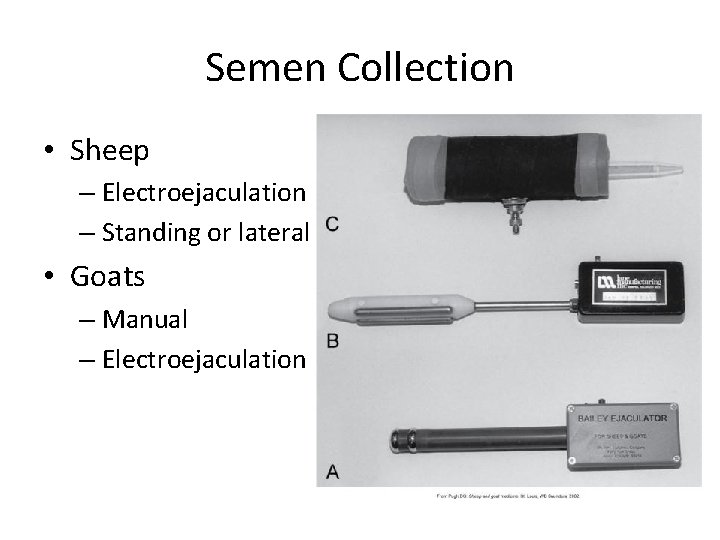
Semen Collection • Sheep – Electroejaculation – Standing or lateral • Goats – Manual – Electroejaculation
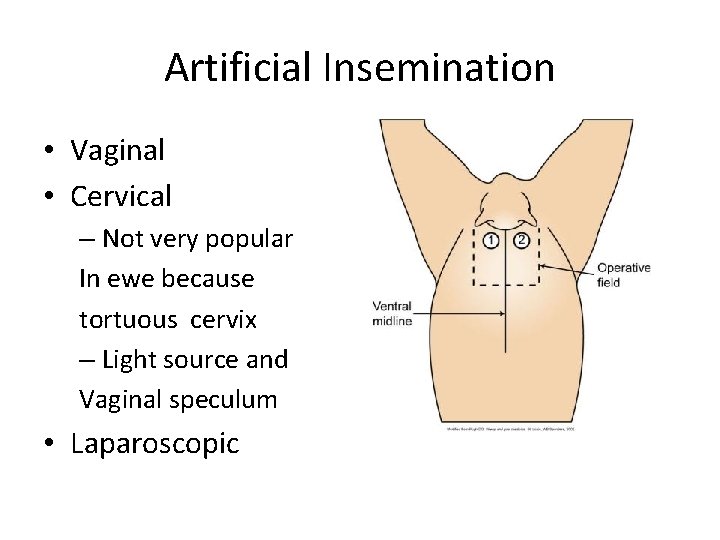
Artificial Insemination • Vaginal • Cervical – Not very popular In ewe because tortuous cervix – Light source and Vaginal speculum • Laparoscopic
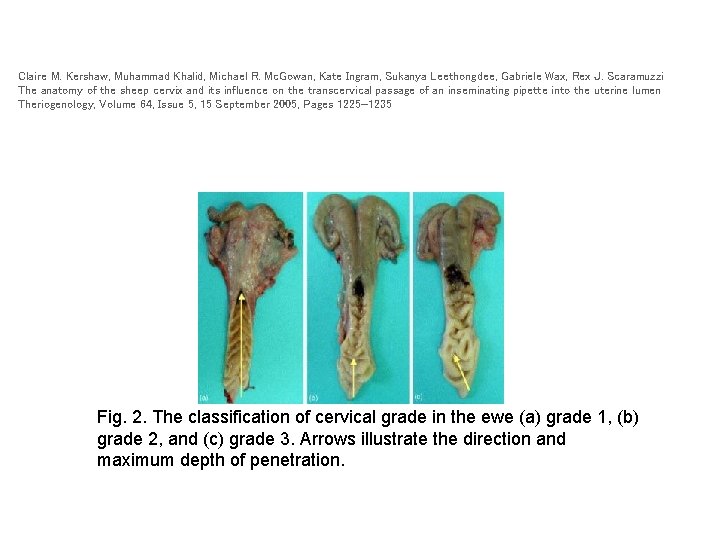
Claire M. Kershaw, Muhammad Khalid, Michael R. Mc. Gowan, Kate Ingram, Sukanya Leethongdee, Gabriele Wax, Rex J. Scaramuzzi The anatomy of the sheep cervix and its influence on the transcervical passage of an inseminating pipette into the uterine lumen Theriogenology, Volume 64, Issue 5, 15 September 2005, Pages 1225– 1235 Fig. 2. The classification of cervical grade in the ewe (a) grade 1, (b) grade 2, and (c) grade 3. Arrows illustrate the direction and maximum depth of penetration.
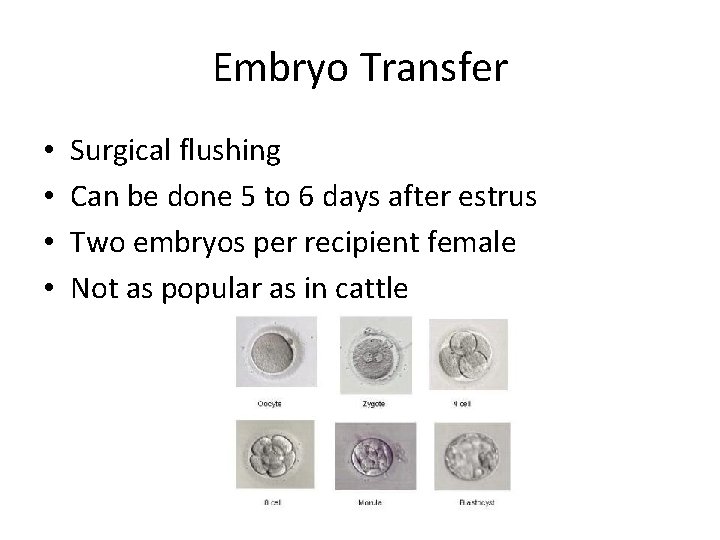
Embryo Transfer • • Surgical flushing Can be done 5 to 6 days after estrus Two embryos per recipient female Not as popular as in cattle
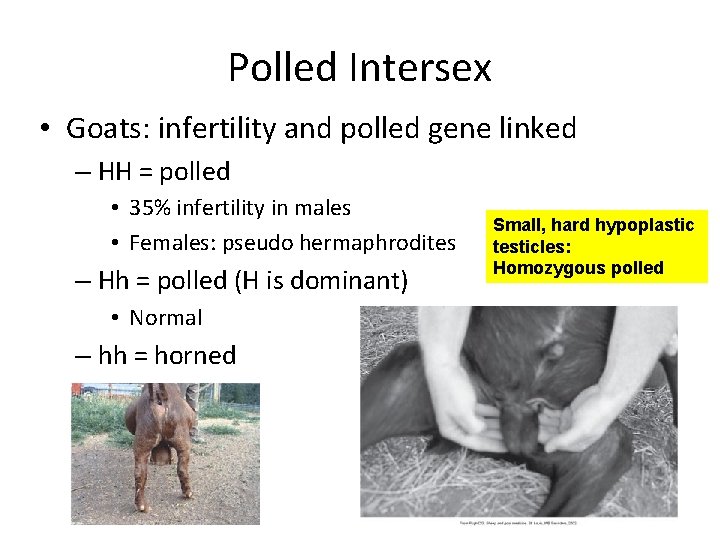
Polled Intersex • Goats: infertility and polled gene linked – HH = polled • 35% infertility in males • Females: pseudo hermaphrodites – Hh = polled (H is dominant) • Normal – hh = horned • Normal Small, hard hypoplastic testicles: Homozygous polled
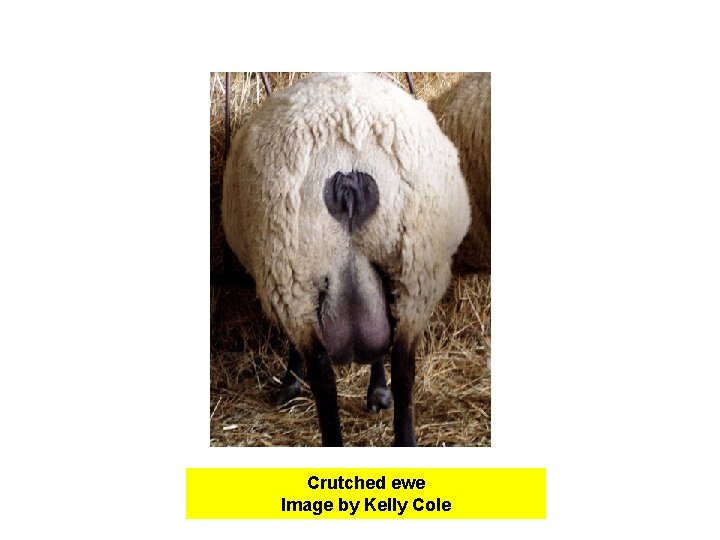
Preparation - Parturition • Preparation – 3 -4 weeks before lambing – Crutching: shearing wool: udder and mammary glands – Facing: shearing wool around eyes – Goats: hide their kids hence construct small boxes • Vaccination and deworming: Clostridium diseases (vaccines) – Vaccine: Type CD - T toxoid: vaccinate ewes 1 month before lambing and 6, 10 wks lambs • Enterotoxemia (Type D) (Overeating Disease/ pulpy kidney disease) - Clostridium perfringins type D • Hemorrhagic enteritis, bloody scours - Clostridium perfringins type C • Tetanus - Clostridium tetani : vaccinate ewes 1 month before lambing/ tx with antitoxin during castration and tail docking
Crutched ewe Image by Kelly Cole
Clinical Signs of Impending Parturition – Ewes are moved to “jugs”: lambing pens – Swelling of the vulva – Mucoid vulvar discharge – Relaxation of the pelvic ligaments – Enlargement of the udder
Parturition • Stage 1 – – – Ewes: 1 to 4 hours Does: up to 12 hours Restless Separation from herd in sheep Nesting in goats • Stage 2 – 1 to 2 hours – Minutes to hours between neonates – Assistance needed if contractions without fetus in 30 minutes to 1 hour • Stage 3 – 2 to 6 hours – Assistance after 12 hours
Dystocia • • • Common in sheep Uncommon in goats Mutation via traction Fetotomy C-section
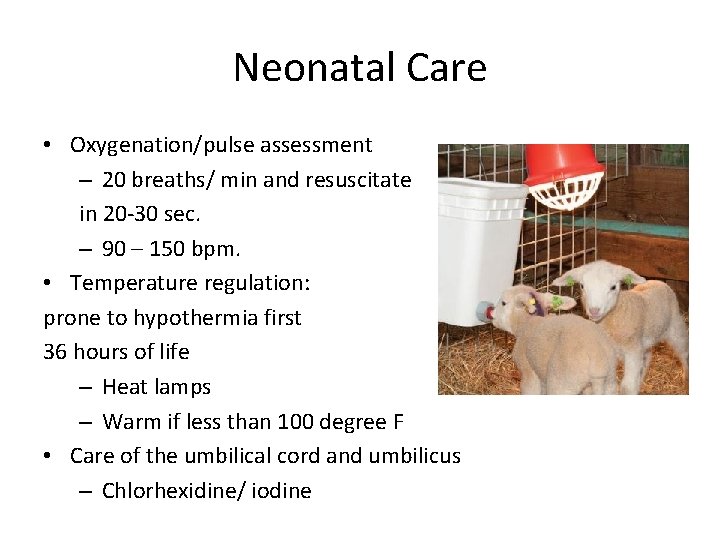
Neonatal Care • Oxygenation/pulse assessment – 20 breaths/ min and resuscitate in 20 -30 sec. – 90 – 150 bpm. • Temperature regulation: prone to hypothermia first 36 hours of life – Heat lamps – Warm if less than 100 degree F • Care of the umbilical cord and umbilicus – Chlorhexidine/ iodine
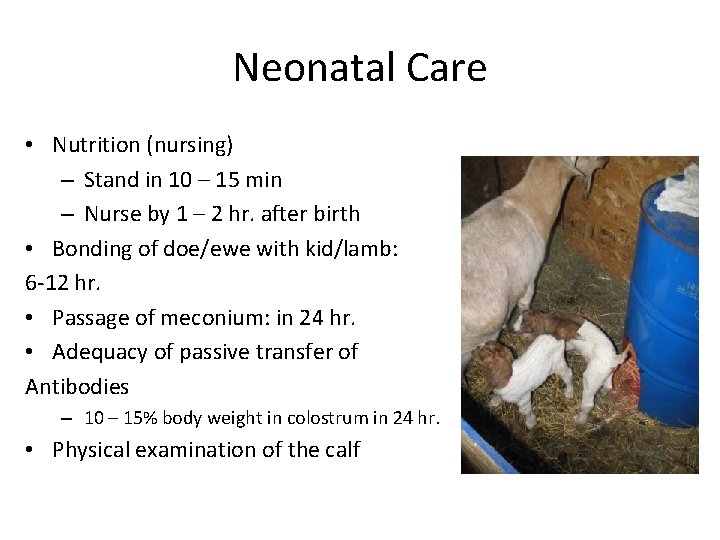
Neonatal Care • Nutrition (nursing) – Stand in 10 – 15 min – Nurse by 1 – 2 hr. after birth • Bonding of doe/ewe with kid/lamb: 6 -12 hr. • Passage of meconium: in 24 hr. • Adequacy of passive transfer of Antibodies – 10 – 15% body weight in colostrum in 24 hr. • Physical examination of the calf
Neonatal Care • Sick Neonate: weakness, depression – Starvation • Less calories, hypothermia, prenatal or postnatal infections • Feeding bottle or tube feeding: 8 french red urethral tube or 14 F – 18 F infant feeding tube with 60 ml catheter tip, ororumen tubes – Diarrhea • Escheria coli, Clostridium perfringes type C – Hypothermia: < 100⁰ F – Hypoglycemia: electrolytes and glucose, SQ fluids
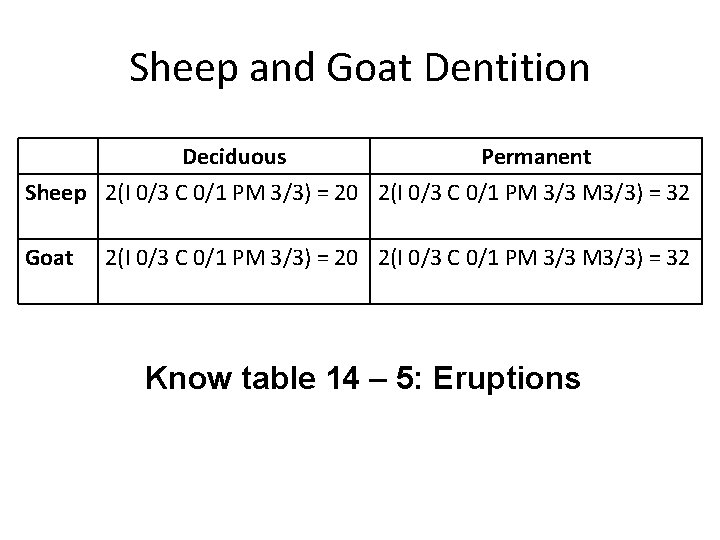
Sheep and Goat Dentition Deciduous Permanent Sheep 2(I 0/3 C 0/1 PM 3/3) = 20 2(I 0/3 C 0/1 PM 3/3) = 32 Goat 2(I 0/3 C 0/1 PM 3/3) = 20 2(I 0/3 C 0/1 PM 3/3) = 32 Know table 14 – 5: Eruptions
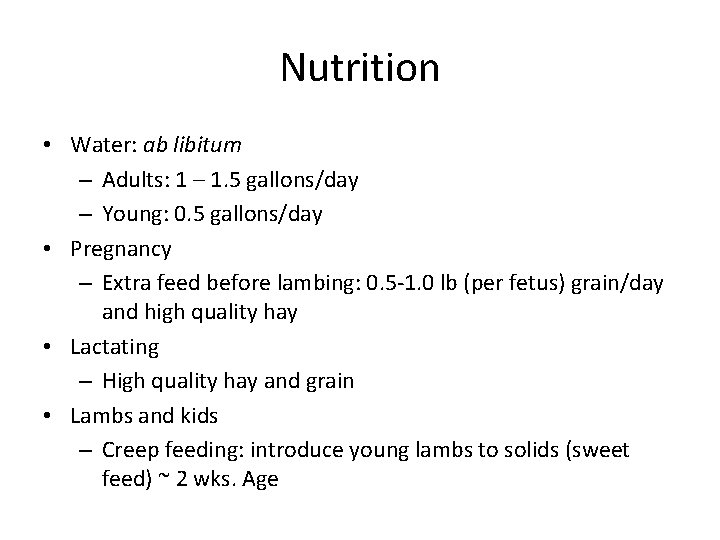
Nutrition • Water: ab libitum – Adults: 1 – 1. 5 gallons/day – Young: 0. 5 gallons/day • Pregnancy – Extra feed before lambing: 0. 5 -1. 0 lb (per fetus) grain/day and high quality hay • Lactating – High quality hay and grain • Lambs and kids – Creep feeding: introduce young lambs to solids (sweet feed) ~ 2 wks. Age
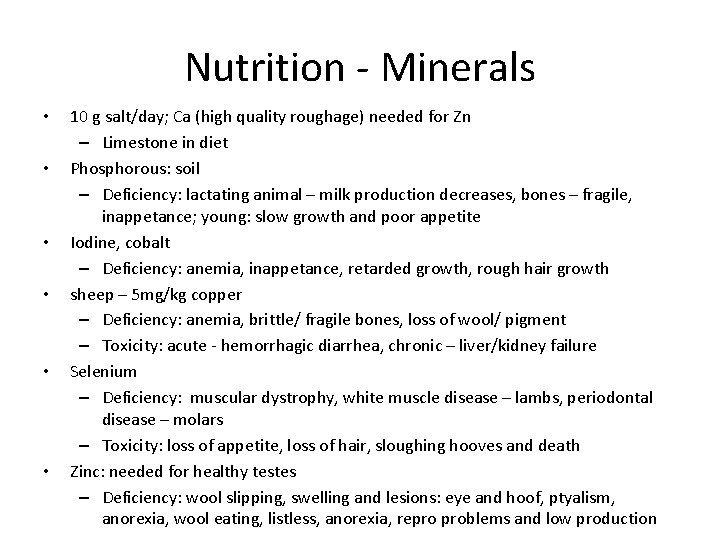
Nutrition - Minerals • • • 10 g salt/day; Ca (high quality roughage) needed for Zn – Limestone in diet Phosphorous: soil – Deficiency: lactating animal – milk production decreases, bones – fragile, inappetance; young: slow growth and poor appetite Iodine, cobalt – Deficiency: anemia, inappetance, retarded growth, rough hair growth sheep – 5 mg/kg copper – Deficiency: anemia, brittle/ fragile bones, loss of wool/ pigment – Toxicity: acute - hemorrhagic diarrhea, chronic – liver/kidney failure Selenium – Deficiency: muscular dystrophy, white muscle disease – lambs, periodontal disease – molars – Toxicity: loss of appetite, loss of hair, sloughing hooves and death Zinc: needed for healthy testes – Deficiency: wool slipping, swelling and lesions: eye and hoof, ptyalism, anorexia, wool eating, listless, anorexia, repro problems and low production
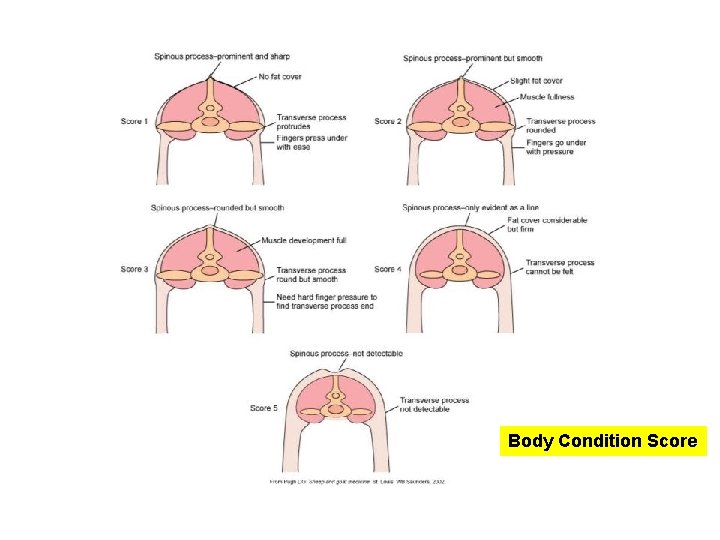
Body Condition Score
Key Terms – Chapter 15 • • • Balling gun Cystocentesis Gluteal muscles Hoof knives Intramammary infusion Lateral cervical muscles Sigmoid flexture Trimming shears Urethral diverticulum • KNOW table 15 -1 and 15 -2: CBC • Know 15 -3 and 15 -4: chemscreen
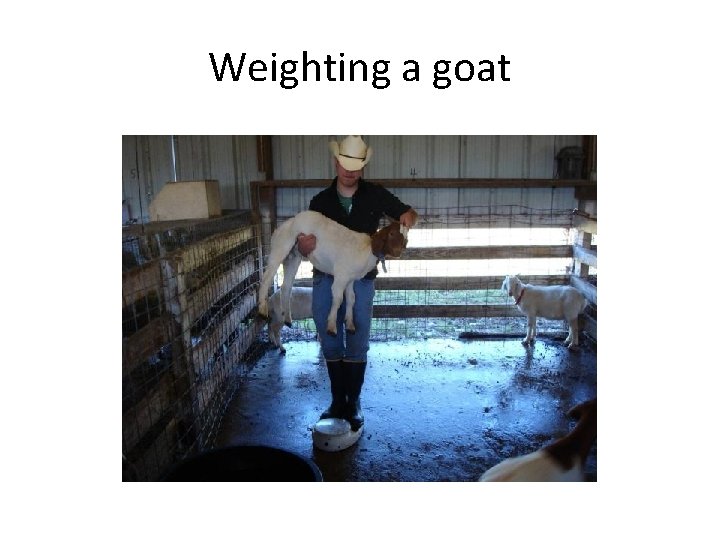
Weighting a goat
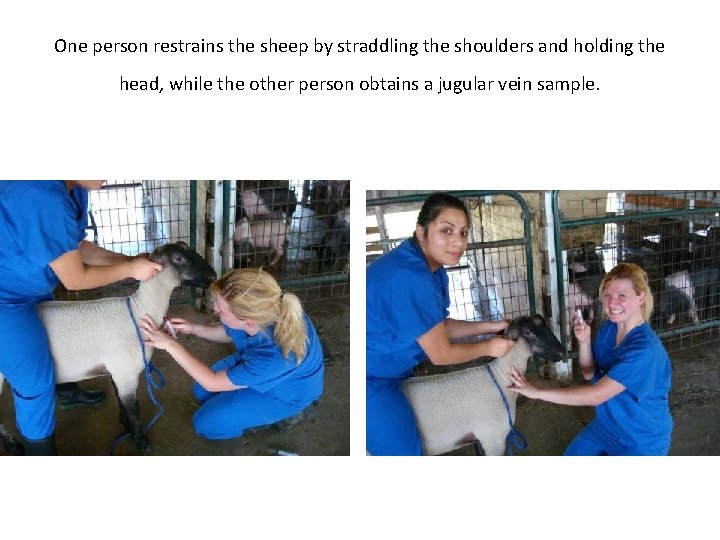
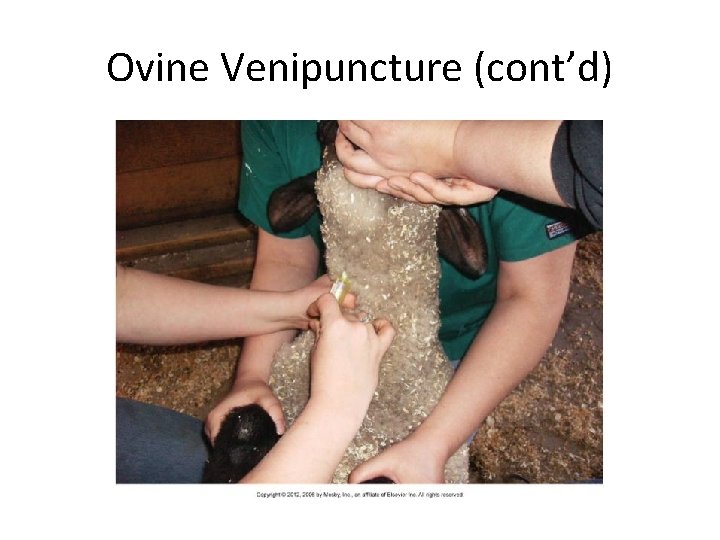
Ovine Venipuncture • Jugular vein (most common) – Performed while the sheep is set or standing • Cephalic – Performed while the sheep is set • Femoral – Performed in lateral recumbency
Ovine Venipuncture (cont’d) • Procedure – Wool is parted – Alcohol applied – Firm occlusion of the vein – Needle sizes • 18 -, 19 -, 20 -, or 22 -gauge × 1 to 1 1/2 -inch
One person restrains the sheep by straddling the shoulders and holding the head, while the other person obtains a jugular vein sample.
Ovine Venipuncture (cont’d)
Caprine Venipuncture • • Jugular Cephalic Femoral Procedure – Alcohol – Occlude – A 18 -, 19 -, 20 -, or 22 -gauge × 1 - to 1 1/2 -in needle – A 20 -gauge needle is preferred – Apply pressure
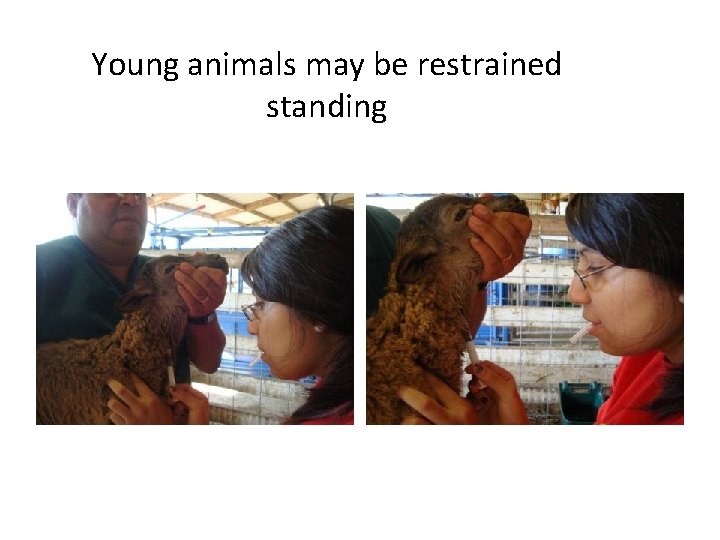
Young animals may be restrained standing
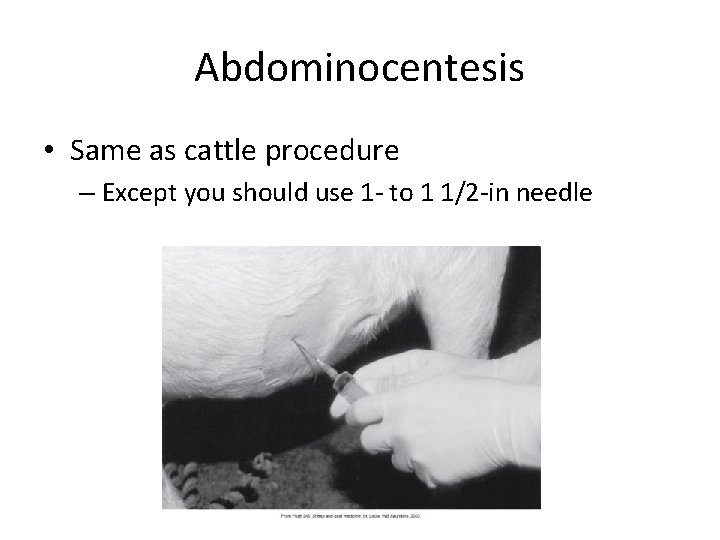
Abdominocentesis • Same as cattle procedure – Except you should use 1 - to 1 1/2 -in needle
Rumen Fluid Collection • Same as cattle – Except you should use a 16 - or 18 -gauge needle
Urine Collection • Sheep – Holding the nostrils and mouth shut for up to 45 seconds • Goats – After lateral recumbency – Placed in a new stall or pen area • Male goats – During breeding season • Cystocentesis – Possible but rarely used
Urine Collection (cont’d) • Bladder catheterization – Female • Vaginal speculum • Light source • Adults use a no. 10 - to 12 -French catheter – Male • Difficult due to the sigmoid flexure: urethra and penis
Oral Medication • Balling gun • Orogastric intubation
Sheep and Goat Injections • Intramuscular – Alcohol – Adult needle size: 18 - to 20 -gauge × 1 inch – Lamb needle size: 20 - to 22 -gauge × 1 inch – Never give more than 5 ml per site
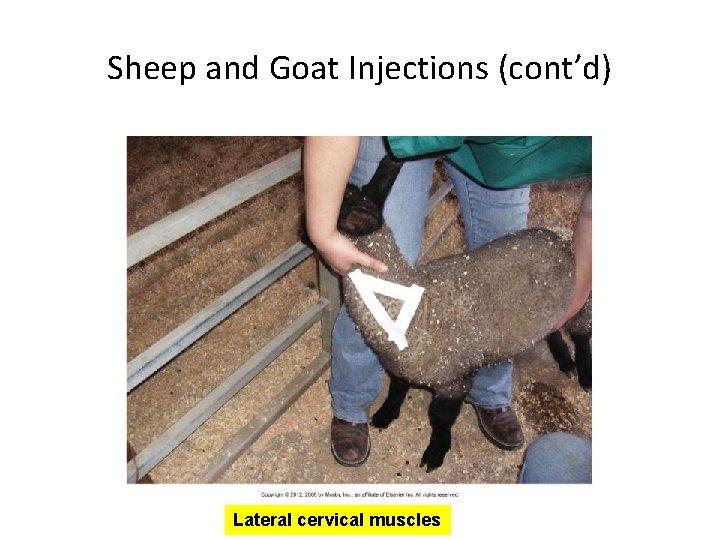
Sheep and Goat Injections (cont’d) • Gluteals – Due to thin muscles, it should be avoided. • Lateral cervical muscles – Most common – 1 inch needle – Avoided in show goats due to possible abscess • Abscess can look like caseous lymphadenitis • Longissimus muscle – Devalue the hide due to scarring and other blemishes – Used in show goats
Sheep and Goat Injections (cont’d) Lateral cervical muscles
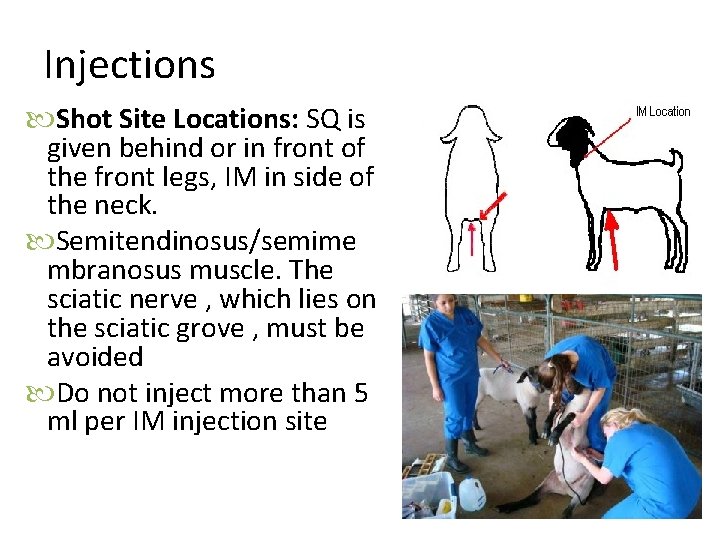
Injections Shot Site Locations: SQ is given behind or in front of the front legs, IM in side of the neck. Semitendinosus/semime mbranosus muscle. The sciatic nerve , which lies on the sciatic grove , must be avoided Do not inject more than 5 ml per IM injection site
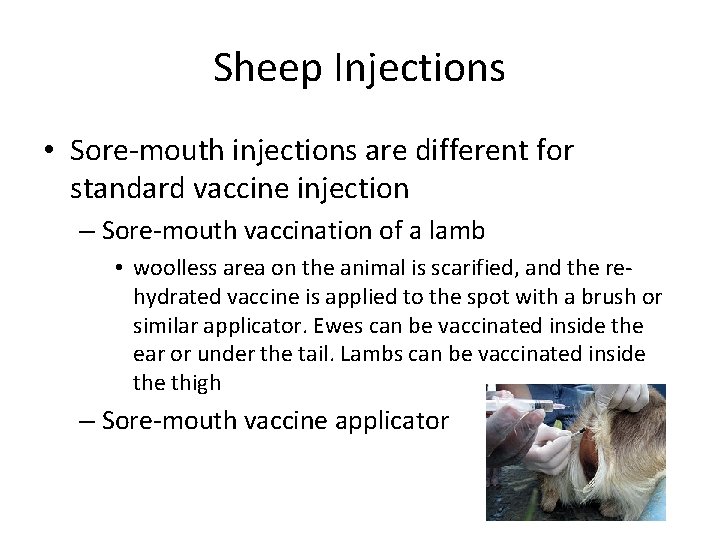
Sheep Injections • Sore-mouth injections are different for standard vaccine injection – Sore-mouth vaccination of a lamb • woolless area on the animal is scarified, and the rehydrated vaccine is applied to the spot with a brush or similar applicator. Ewes can be vaccinated inside the ear or under the tail. Lambs can be vaccinated inside thigh – Sore-mouth vaccine applicator
Sheep and Goat Injections • Subcutaneous – A 18 - to 22 -gauge needle – Up to 50 ml – Sheep may be set up for easy access to the axilla and flank fold
IV Catheter • A 14 - to 18 -gauge needle • Small individuals may use catheters that are 2 to 3 inches in length
Intramammary Infusion • A small 1/8 -inch infusion tip • Sterile tomcat catheters may also be used for goats with small teat orifices
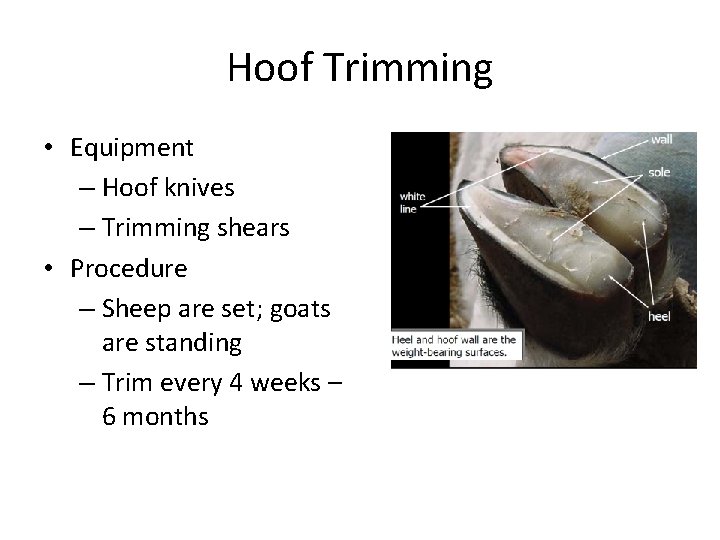
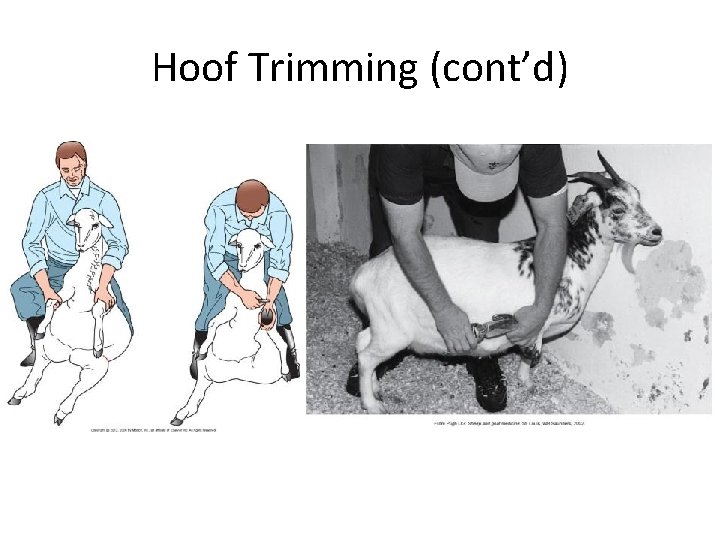
Hoof Trimming • Equipment – Hoof knives – Trimming shears • Procedure – Sheep are set; goats are standing – Trim every 4 weeks – 6 months
Hoof Trimming (cont’d)
References • http: //www. ramsem. com/embryolocal. html • http: //www. aces. edu/pubs/docs/U/UNP 0110/UNP-0110. html • http: //www. sheep 101. info/201/shearing. html • K Holtgrew-Bohling , Large Animal Clinical Procedures for Veterinary Technicians, 2 nd Edition, Mosby, 2012, ISBN: 97803223077323