
Goals of Psychology Describe Explain Predict Change Step
-Goals of Psychology • • Describe Explain Predict Change
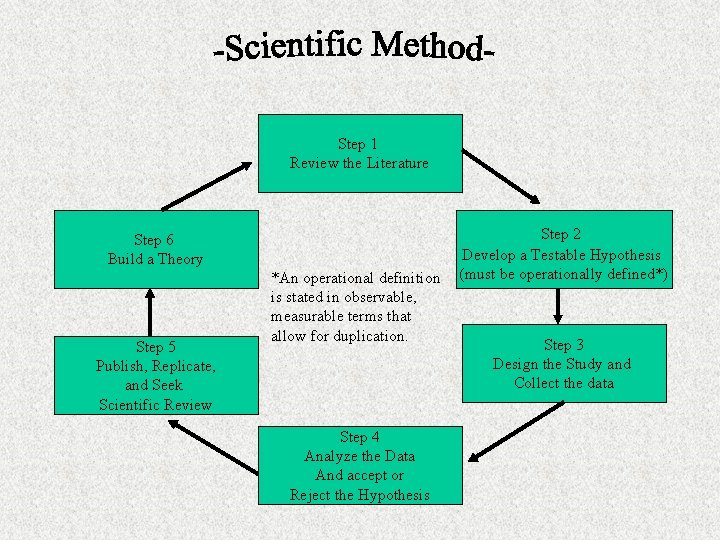
Step 1 Review the Literature Step 6 Build a Theory Step 5 Publish, Replicate, and Seek Scientific Review *An operational definition is stated in observable, measurable terms that allow for duplication. Step 4 Analyze the Data And accept or Reject the Hypothesis Step 2 Develop a Testable Hypothesis (must be operationally defined*) Step 3 Design the Study and Collect the data
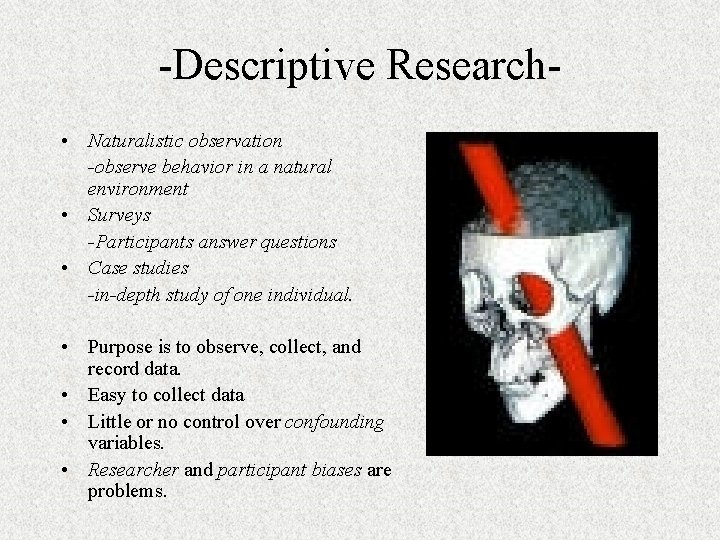
-Descriptive Research • Naturalistic observation -observe behavior in a natural environment • Surveys -Participants answer questions • Case studies -in-depth study of one individual. • Purpose is to observe, collect, and record data. • Easy to collect data • Little or no control over confounding variables. • Researcher and participant biases are problems.
-Surveys • Saying vs. doing – What would you do if someone confessed to a murder in a chat room? • 60% said they would notify the police • When this actually occurred in a group of 200, 3 people responded • Wording Effects – “government censorship” – (27%) – “more restrictions on what is shown on TV” – (66%) – Are you interested in plants and trees? (77%) – Are you interested in Botany? (39%) – Barack Obama – Barack Hussein Obama
-Biases • Hindsight bias – Something is always obvious after it has happened. We trust information without confirming it for ourselves. • Overconfidence phenomenon – you overestimate the accuracy of current knowledge (thinking within the box). • The false consensus bias – we think people hold similar opinions more than they do.
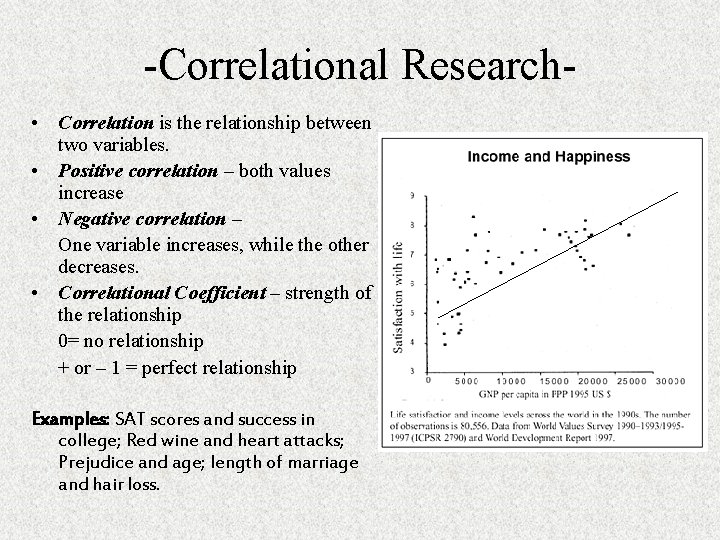
-Correlational Research • Correlation is the relationship between two variables. • Positive correlation – both values increase • Negative correlation – One variable increases, while the other decreases. • Correlational Coefficient – strength of the relationship 0= no relationship + or – 1 = perfect relationship Examples: SAT scores and success in college; Red wine and heart attacks; Prejudice and age; length of marriage and hair loss.
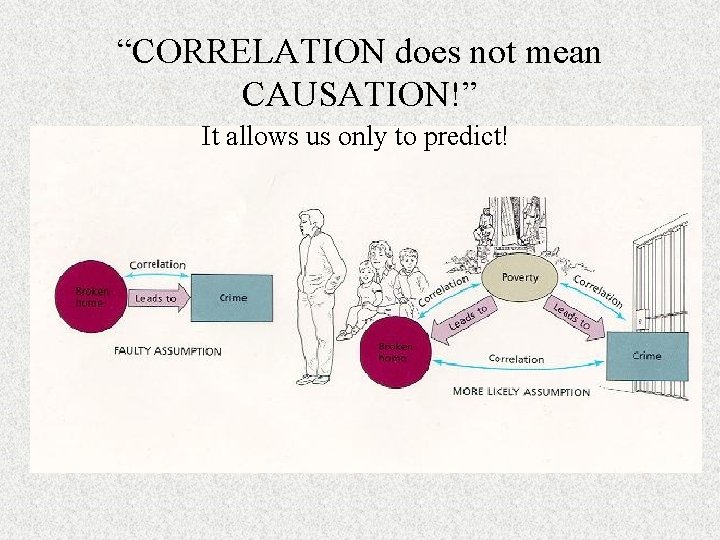
“CORRELATION does not mean CAUSATION!” It allows us only to predict!
-Different Types of Studies • Longitudinal Studies –Periodic tests on the same participants over a number of years. • Cross-Sectional Studies –Participants are often divided into subgroups. What are the disadvantages of each type of study? §Too long - Delays Diagnosis §Hard to predict causation §High attrition rates §Many intervening variables
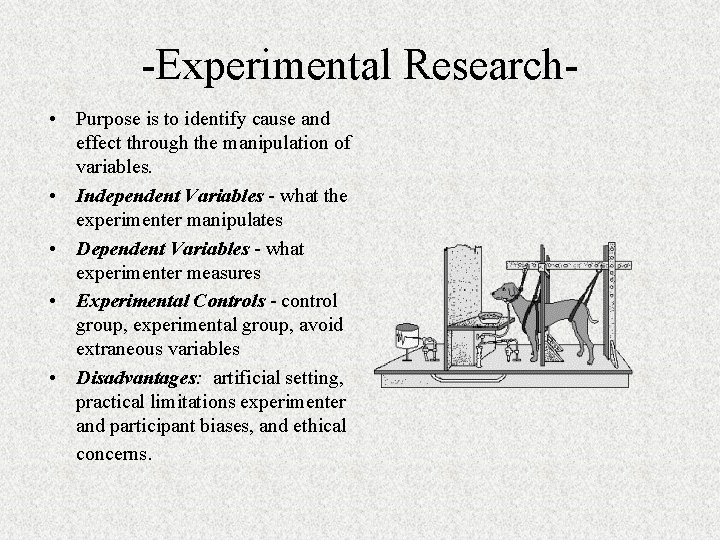
-Experimental Research • Purpose is to identify cause and effect through the manipulation of variables. • Independent Variables - what the experimenter manipulates • Dependent Variables - what experimenter measures • Experimental Controls - control group, experimental group, avoid extraneous variables • Disadvantages: artificial setting, practical limitations experimenter and participant biases, and ethical concerns.
-Bias in Research • Bias is any condition that distorts data • Experimenter bias – predisposed beliefs of the experimenter can confound the research findings. --Creates a self-fulfilling prophesy • Subject bias – subjects change behavior Ex. Hawthorne effect – a subject’s behavior changes because of awareness of being studied. • Placebo effect – subject’s expectations lead them to believe some change has occurred.
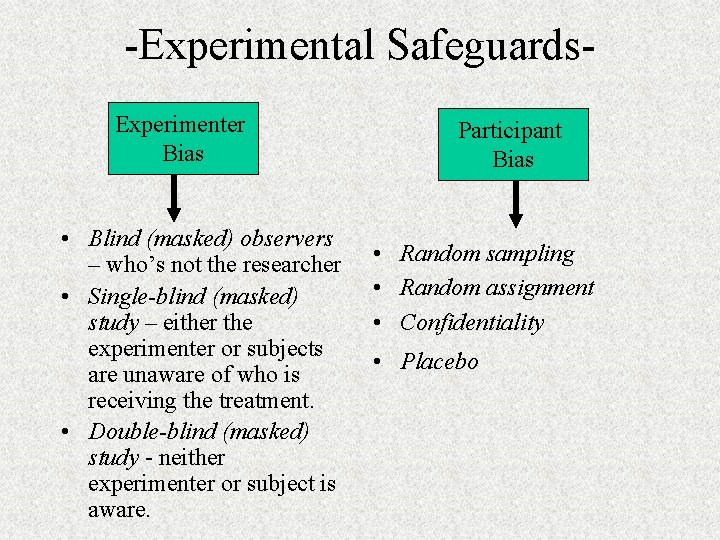
-Experimental Safeguards. Experimenter Bias • Blind (masked) observers – who’s not the researcher • Single-blind (masked) study – either the experimenter or subjects are unaware of who is receiving the treatment. • Double-blind (masked) study - neither experimenter or subject is aware. Participant Bias • Random sampling • Random assignment • Confidentiality • Placebo
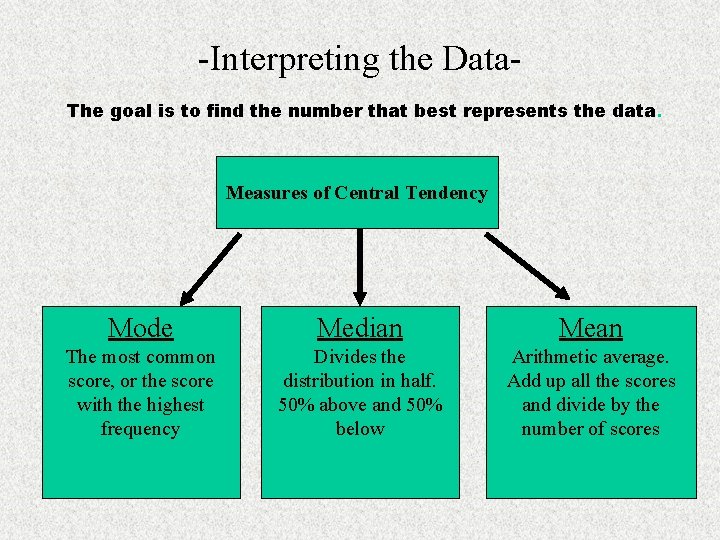
-Interpreting the Data. The goal is to find the number that best represents the data. Measures of Central Tendency Mode Median Mean The most common score, or the score with the highest frequency Divides the distribution in half. 50% above and 50% below Arithmetic average. Add up all the scores and divide by the number of scores
-Ethics in Research • • • Approval of American Psychological Association (APA) Informed Consent Confidentiality Minimize risk and discomfort Fairness and Deception – Informed consent • Debriefing • Animal Research? • The Milgram experiment was the impetus for these ethical guidelines
- Slides: 13