
GOALS OF CARE CONVERSATIONS TRAINING For Nurses Social
- Slides: 28
GOALS OF CARE CONVERSATIONS TRAINING For Nurses, Social Workers, Psychologists & Chaplains Part 3: Implementation
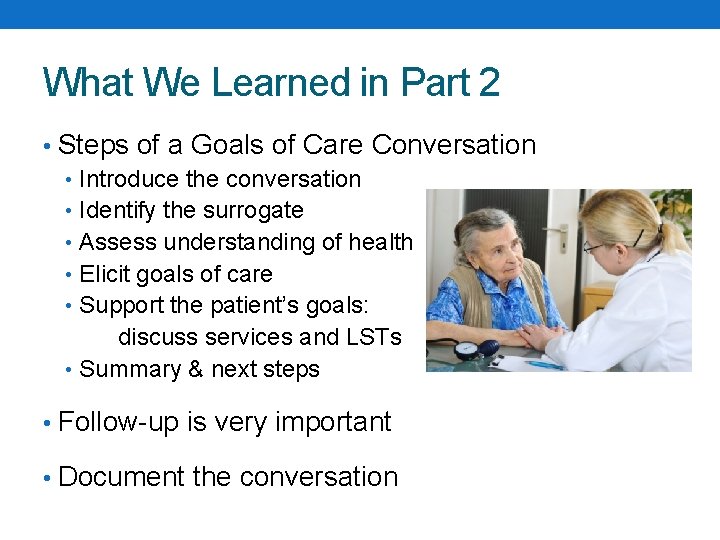
What We Learned in Part 2 • Steps of a Goals of Care Conversation • Introduce the conversation • Identify the surrogate • Assess understanding of health • Elicit goals of care • Support the patient’s goals: discuss services and LSTs • Summary & next steps • Follow-up is very important • Document the conversation
Part 3: What We Will Learn • Team strategies for implementing goals of care conversations
Part 3: How We Will Learn • Presentation • Team Planning Exercises • Discussion
Goals of Care Conversations Tasks • Proactively identify high-risk patients • Prepare patient for the Go. CC • Make the appointment • Lead the Go. CC • Arrange follow-up • Monitor & improve processes
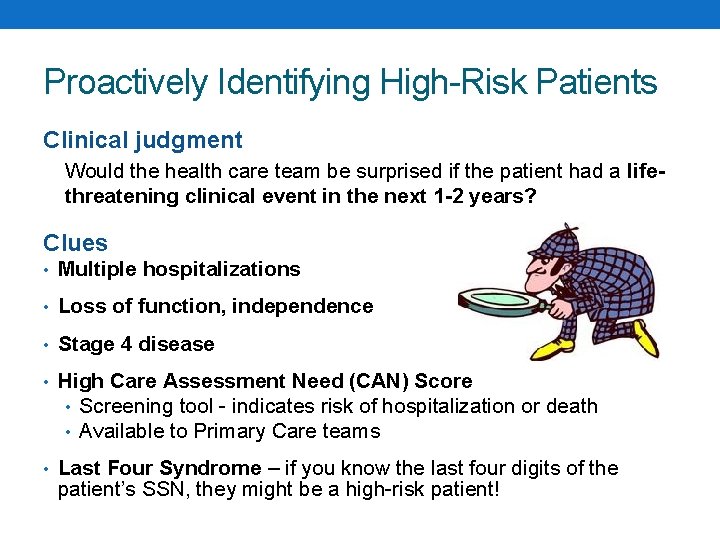
Proactively Identifying High-Risk Patients Clinical judgment Would the health care team be surprised if the patient had a lifethreatening clinical event in the next 1 -2 years? Clues • Multiple hospitalizations • Loss of function, independence • Stage 4 disease • High Care Assessment Need (CAN) Score • Screening tool - indicates risk of hospitalization or death • Available to Primary Care teams • Last Four Syndrome – if you know the last four digits of the patient’s SSN, they might be a high-risk patient!
Proactively Identifying High-Risk Patients in Primary Care Patient Care Assessment System (PCAS) • Panel management program for PACT teams • Helps PACT team: • Identify patients who require focused attention • Manage patient care services, tasks • Coordinate care
Proactively Identifying High-Risk Patients in Primary Care Using PCAS Goals of Care Conversations for Life-Sustaining Treatment Filter • Lists patients on the PACT panel with CAN scores > 95 • Identifies whether the patient already has an LST Progress Note • Can manually add other patients to the list • Can assign tasks to team members This filter activated when the LST Progress Note is in use at the facility
Primary Care Teams: Accessing PCAS https: //secure. vssc. med. va. gov/PCAS/ Will automatically import the appropriate panel assigned through the Primary Care Management Module (PCMM). The Primary Care administrator can help if the person’s panel of patients does not appear.
TEAM PLANNING Proactively Identifying High-Risk Patients • How will high-risk patients will be identified and tracked? • Who will be responsible for this? • How will the team communicate with each other about high-risk patients and GOCCs?
TEAM PLANNING Preparing the Patient • Who will prepare patients (or surrogates)? • Face-to-face or by telephone? • What will be said? • Will patient education materials will be provided before the appointment? • Which ones? • Who will order them or make copies? • Who will send them to the patient?
TEAM PLANNING Making the Appointment • Do you need to set up a new clinic? • Who will make the appointment? • How will the scheduler be notified?
TEAM PLANNING Leading the Goals of Care Conversation • Which members of the team will conduct goals of care conversations? • Will patient education materials be used during the conversation? • Which ones? • Who will order them or make copies?
Arranging Follow-Up • Must have a follow-up discussion with a practitioner (physician, nurse practitioner, PA, resident): • For more information about diagnosis, prognosis • To answer questions about treatment risk and benefits, based on the patient’s condition • To establish a life-sustaining treatment plan (including LST orders and state-authorized portable orders) • May need: • Another appointment to continue the conversation • More information from other team members about services • Referrals for services • Help with advance directives, state-authorized portable orders
TEAM PLANNING Arranging Follow-up • How will you communicate pertinent information to the practitioner? • How will follow-up with the practitioner be arranged? • Will the practitioner meet with the patient in person or by telephone? • Who will be responsible for helping the patient with advance directives and state-authorized portable orders?
Monitoring and Improving Practices What are signs of quality with respect to eliciting, documenting, and honoring patients’ values, goals and preferences? • Goals of care conversations are initiated proactively with high -risk patients in your clinic • Follow-up is planned and occurs • Patients are satisfied with the process • Documentation is complete and consistent Progress notes, LST orders, advance directives, -authorized portable orders • Patients’ goals and decisions are honored state
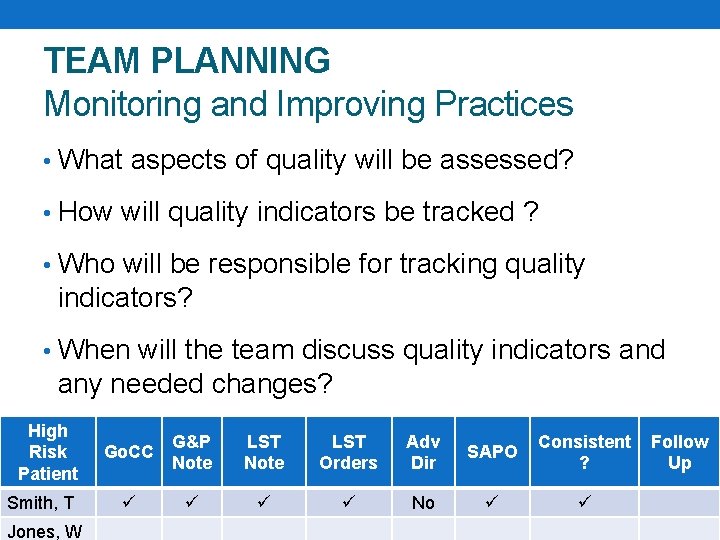
TEAM PLANNING Monitoring and Improving Practices • What aspects of quality will be assessed? • How will quality indicators be tracked ? • Who will be responsible for tracking quality indicators? • When will the team discuss quality indicators and any needed changes? High Risk Patient Smith, T Jones, W Go. CC G&P Note LST Orders Adv Dir SAPO Consistent ? No Follow Up
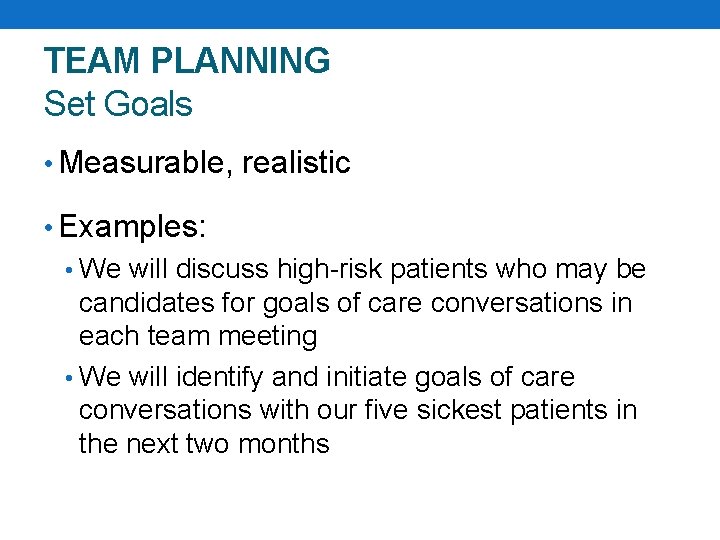
TEAM PLANNING Set Goals • Measurable, realistic • Examples: • We will discuss high-risk patients who may be candidates for goals of care conversations in each team meeting • We will identify and initiate goals of care conversations with our five sickest patients in the next two months
Implementation Planning Exercise • Break-up into groups with your team • If your team members are not present, find a partner to discuss implementation plan • Complete Implementation Worksheet See Handout
Implementation Planning Exercise Debriefing • How will your team identify and monitor high-risk patients? • How will you ensure the patient has a follow-up appointment with the practitioner when needed? • What quality indicators will you monitor, and how will you track this information? • What are your goals?
To Do After Training • Discuss with other team members • Refine implementation plans • Work toward your goals!
What surprised you? What do you want to take forward? Anywhere you might get stuck?
Peer Observation • Training participants are encouraged to mentor each other on the first several Go. CC: • Provide ongoing feedback and support • Assist if a conversation “goes off track” • Peer Mentoring worksheet provided
Summary Successfully incorporate goals of care conversations into routine practice requires team processes and goals for: • Proactively identifing high-risk patients • Preparing patients for the Go. CC • Making Go. CC appointments • Leading Go. CCs • Arranging follow-up • Monitoring & improving processes
Reminder • Complete evaluation in TMS • Helps improve the program • Required to obtain CEs
Goals of Care Conversations training materials were developed and made available for public use through U. S. Department of Veterans Affairs. Materials are available for download from VA National Center for Ethics in Health Care at www. ethics. va. gov/goalsofcaretraining. asp.
OPTIONAL SLIDE Customize and incorporate this slide at the end of Part 3 to communicate plans to support your learners.
Training Follow Up • An optional session will be available to: • check in on your goals • discuss process issues • answer questions • The session will be: • 60 minutes • 1 month from now: [insert date and time] • You will receive Outlook Calendar invitation