
Goals of Care Conversations Part 1 Reframing Were
- Slides: 29
Goals of Care Conversations – Part 1 Reframing: We’re in a Different Place Training for Physicians, Advance Practice Nurses, and Physician Assistants
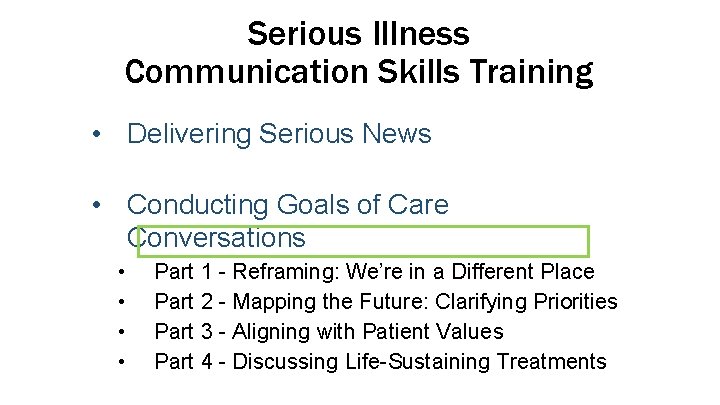
Serious Illness Communication Skills Training • Delivering Serious News • Conducting Goals of Care Conversations • • Part 1 - Reframing: We’re in a Different Place Part 2 - Mapping the Future: Clarifying Priorities Part 3 - Aligning with Patient Values Part 4 - Discussing Life-Sustaining Treatments
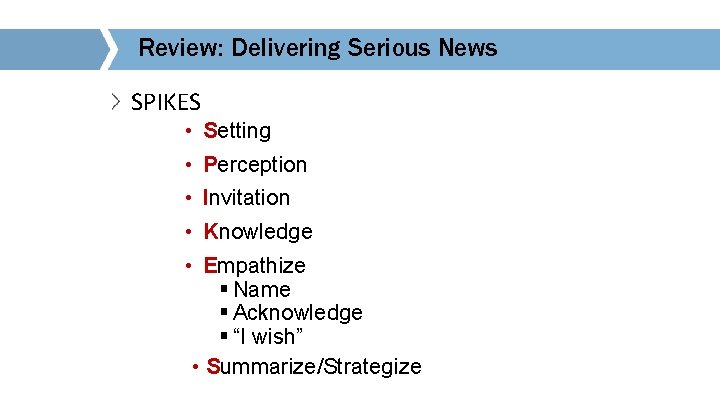
Review: Delivering Serious News SPIKES • Setting • Perception • Invitation • Knowledge • Empathize § Name § Acknowledge § “I wish” • Summarize/Strategize
Since Last Time, Have You Delivered Serious News? ü What went well? ü Any challenges?
Goals of Care: What Makes these Conversations Tough? ü Uncertainty ü Emotions ü And … the lack of a framework within which to enter the conversation
What We Will Learn REMAP: A Talking Map for Goals of Care Conversations
How We Will Learn ü Define skills (lecture) ü Observe skills in action (videos) ü Practice (drills)
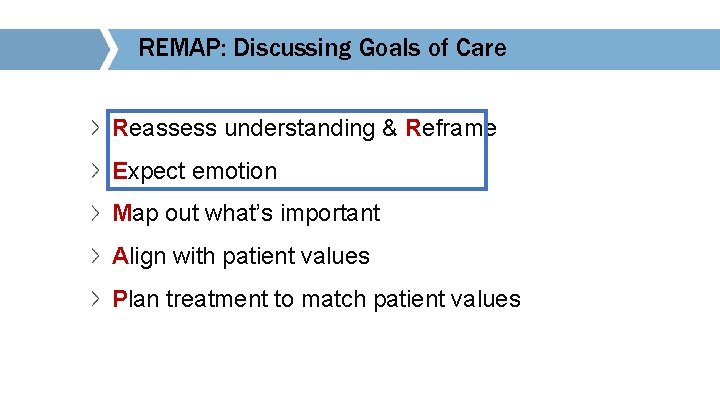
REMAP: Discussing Goals of Care Reassess understanding & Reframe Expect emotion Map out what’s important Align with patient values Plan treatment to match patient values
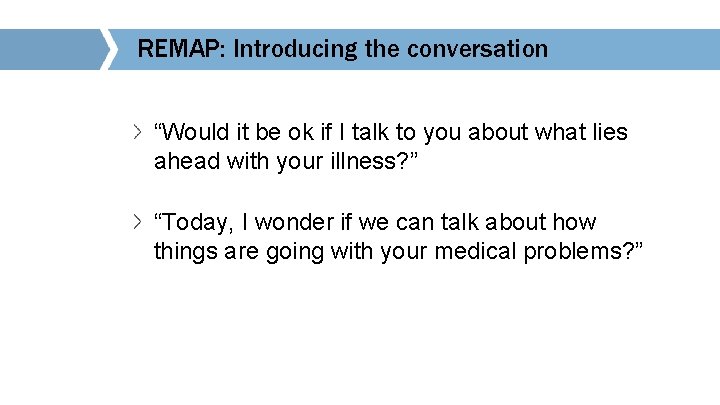
REMAP: Introducing the conversation “Would it be ok if I talk to you about what lies ahead with your illness? ” “Today, I wonder if we can talk about how things are going with your medical problems? ”
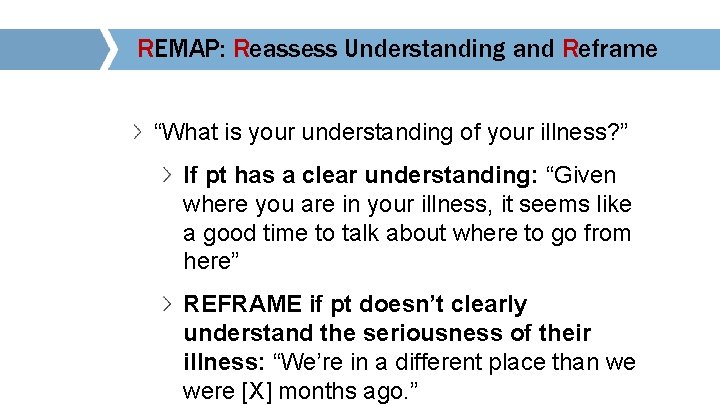
REMAP: Reassess Understanding and Reframe “What is your understanding of your illness? ” If pt has a clear understanding: “Given where you are in your illness, it seems like a good time to talk about where to go from here” REFRAME if pt doesn’t clearly understand the seriousness of their illness: “We’re in a different place than we were [X] months ago. ”
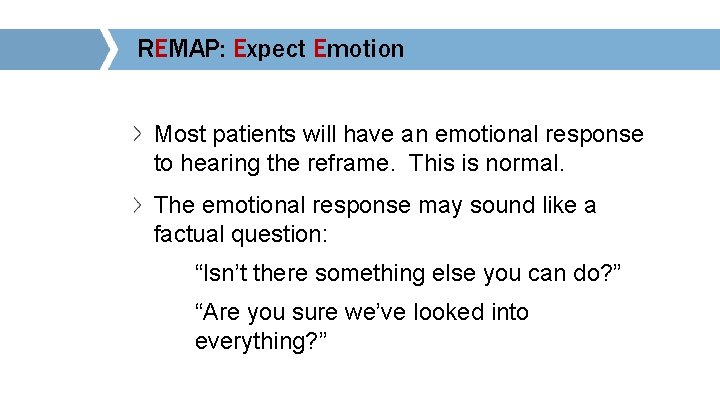
REMAP: Expect Emotion Most patients will have an emotional response to hearing the reframe. This is normal. The emotional response may sound like a factual question: “Isn’t there something else you can do? ” “Are you sure we’ve looked into everything? ”
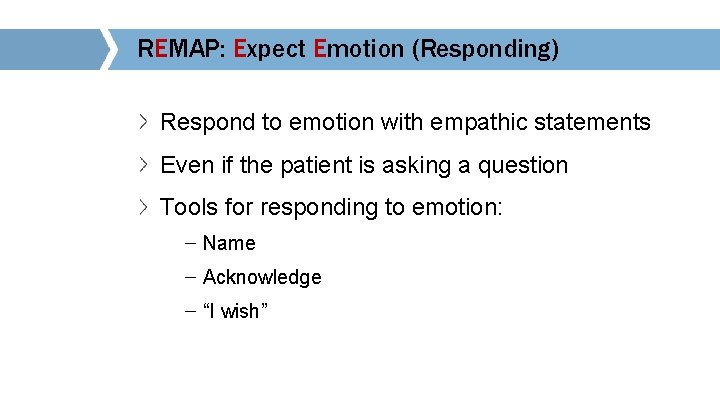
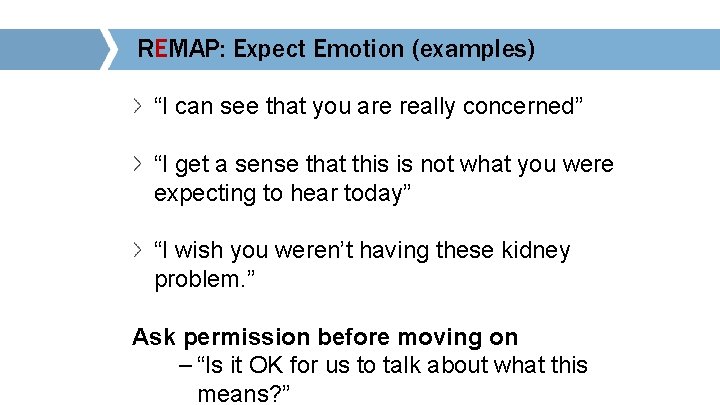
REMAP: Expect Emotion (Responding) Respond to emotion with empathic statements Even if the patient is asking a question Tools for responding to emotion: – Name – Acknowledge – “I wish”
REMAP: Expect Emotion (examples) “I can see that you are really concerned” “I get a sense that this is not what you were expecting to hear today” “I wish you weren’t having these kidney problem. ” Ask permission before moving on – “Is it OK for us to talk about what this means? ”
REMAP: Reframe and Expect Emotion
What specifically did the clinician do that you liked?
Time to Practice!!
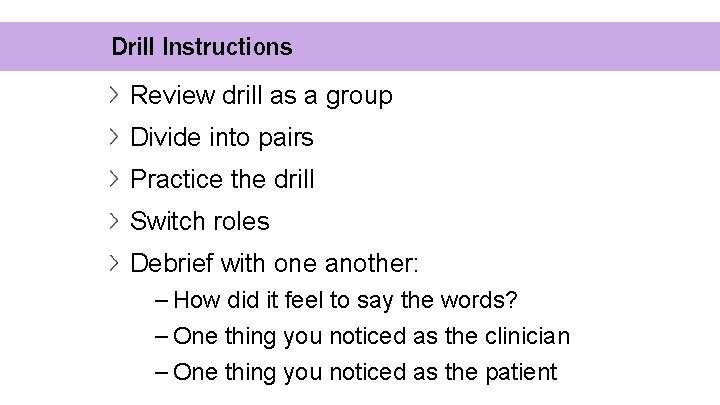
Drill Instructions Review drill as a group Divide into pairs Practice the drill Switch roles Debrief with one another: – How did it feel to say the words? – One thing you noticed as the clinician – One thing you noticed as the patient
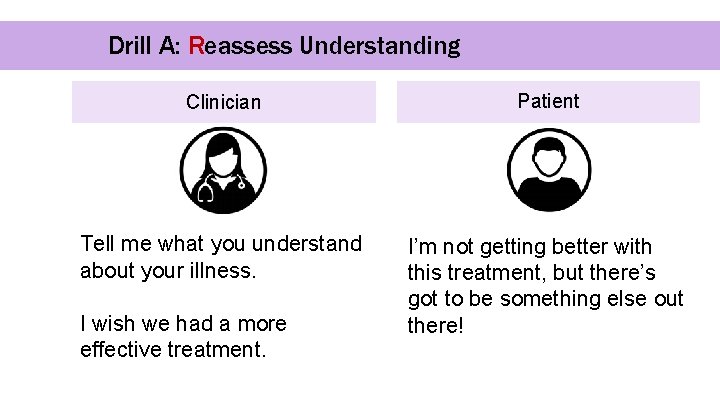
Drill A: Reassess Understanding Clinician Patient Tell me what you understand about your illness. I’m not getting better with this treatment, but there’s got to be something else out there! I wish we had a more effective treatment.
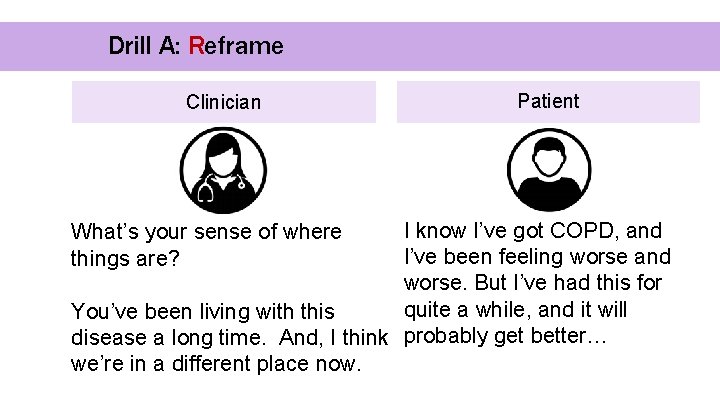
Drill A: Reframe Clinician Patient I know I’ve got COPD, and I’ve been feeling worse and worse. But I’ve had this for quite a while, and it will You’ve been living with this disease a long time. And, I think probably get better… we’re in a different place now. What’s your sense of where things are?
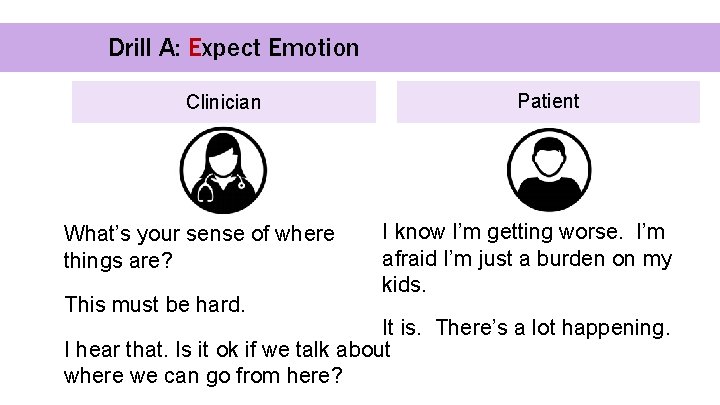
Drill A: Expect Emotion Clinician What’s your sense of where things are? This must be hard. Patient I know I’m getting worse. I’m afraid I’m just a burden on my kids. It is. There’s a lot happening. I hear that. Is it ok if we talk about where we can go from here?
Drill A: Swap Roles Clinician Patient
Drill A: Debrief How did it feel to say the words? One thing you noticed as the clinician One thing you noticed as the patient
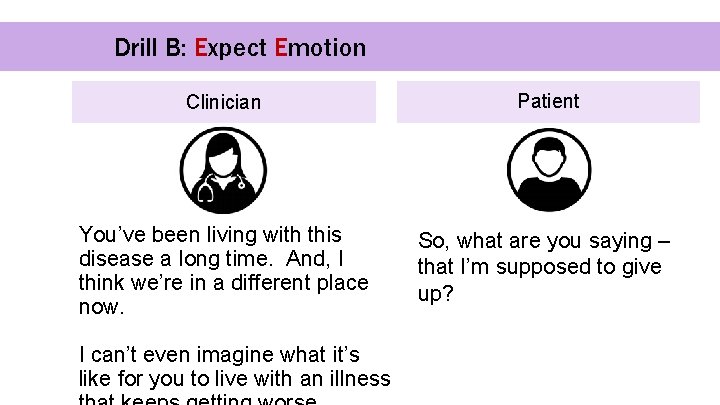
Drill B: Expect Emotion Clinician Patient You’ve been living with this disease a long time. And, I think we’re in a different place now. So, what are you saying – that I’m supposed to give up? I can’t even imagine what it’s like for you to live with an illness
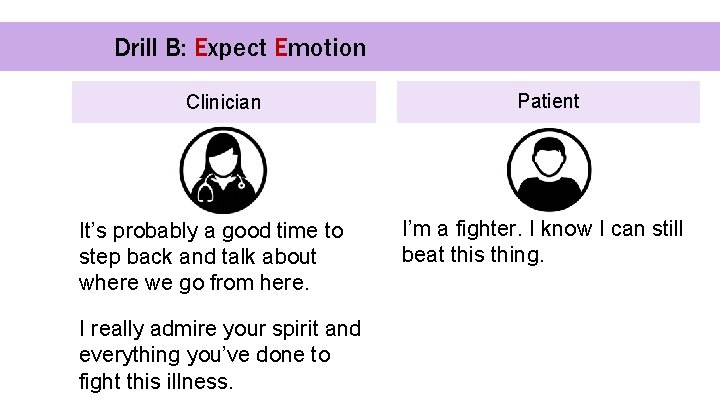
Drill B: Expect Emotion Clinician It’s probably a good time to step back and talk about where we go from here. I really admire your spirit and everything you’ve done to fight this illness. Patient I’m a fighter. I know I can still beat this thing.
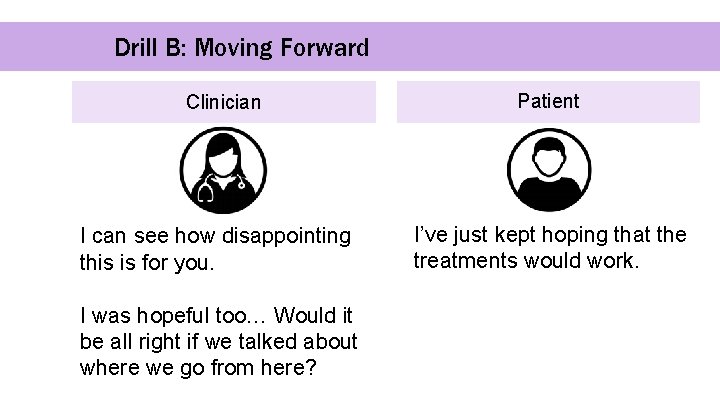
Drill B: Moving Forward Clinician I can see how disappointing this is for you. I was hopeful too… Would it be all right if we talked about where we go from here? Patient I’ve just kept hoping that the treatments would work.
Drill B: Swap Roles Clinician Patient
Drill B: Debrief How did it feel to say the words? One thing you noticed as the clinician One thing you noticed as the patient
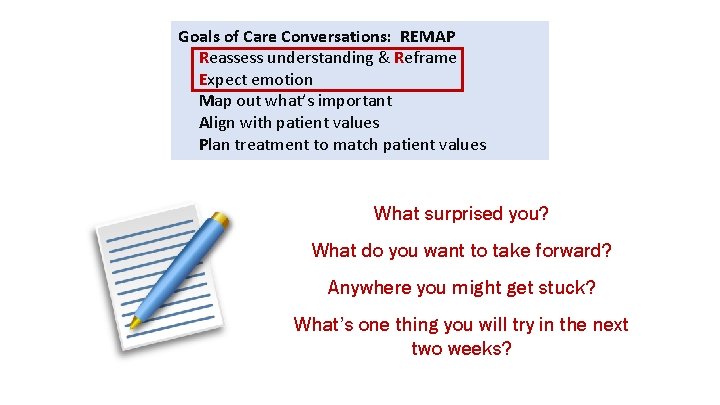
Goals of Care Conversations: REMAP Reassess understanding & Reframe Expect emotion Map out what’s important Align with patient values Plan treatment to match patient values What surprised you? What do you want to take forward? Anywhere you might get stuck? What’s one thing you will try in the next two weeks?
Goals of Care Conversations training materials were developed and made available for public use through U. S. Department of Veterans Affairs contracts with Vital. Talk [Orders VA 777 -14 -P-0400 and VA 777 -16 -C-0015]. Materials are available for download from VA National Center for Ethics in Health Care at www. ethics. va. gov/goalsofcaretraining. asp.