
Goals objectives performance metrics Management Strategy Advisory Board
Goals, objectives, performance metrics Management Strategy Advisory Board MSAB 011 May 7 -10, 2018 IPHC-2018 -MSAB 011 -07 D. Griffay
Goals of this agenda item • Consider the current MSE goals and objectives and – Identify the intent of the objectives – Verify that the objectives are current • Comment on the objectives for distributing the TCEY identified in Circular IPHC-2017 -CR-022 • Understand what “preserving biocomplexity” means • Recommend additions or deletions to the MSE goals and objectives • Discuss performance metrics to report for the evaluation of future simulations • Suggest ways to report the performance metrics and results from the simulations IPHC-2018 -MSAB 011 -07_Objectives Slide 2
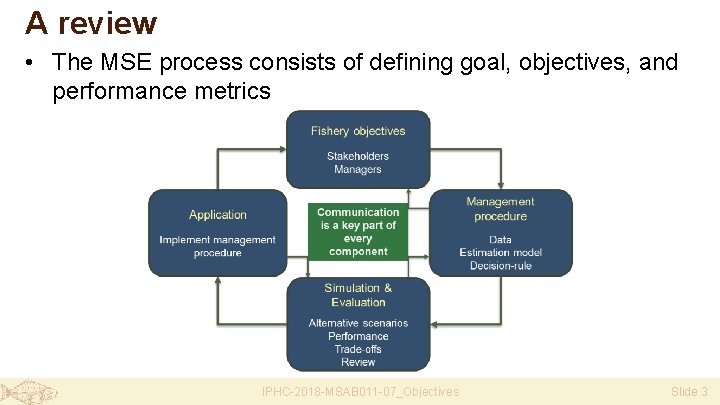
A review • The MSE process consists of defining goal, objectives, and performance metrics IPHC-2018 -MSAB 011 -07_Objectives Slide 3
Fishery Terms • Commercial: directed commercial fishery, no discards • Discard Mortality: mortality in the commercial fishery that is not landed (formerly wastage) • Bycatch: mortality from fisheries not targeting Pacific halibut • Recreational: mortality from recreational/sport fisheries • Subsistence: mortality for subsistence/personal use purposes IPHC-2018 -MSAB 011 -07_Objectives Slide 4
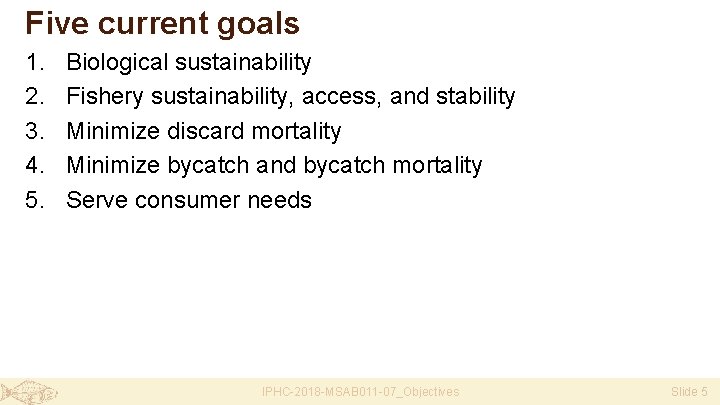
Five current goals 1. 2. 3. 4. 5. Biological sustainability Fishery sustainability, access, and stability Minimize discard mortality Minimize bycatch and bycatch mortality Serve consumer needs IPHC-2018 -MSAB 011 -07_Objectives Slide 5
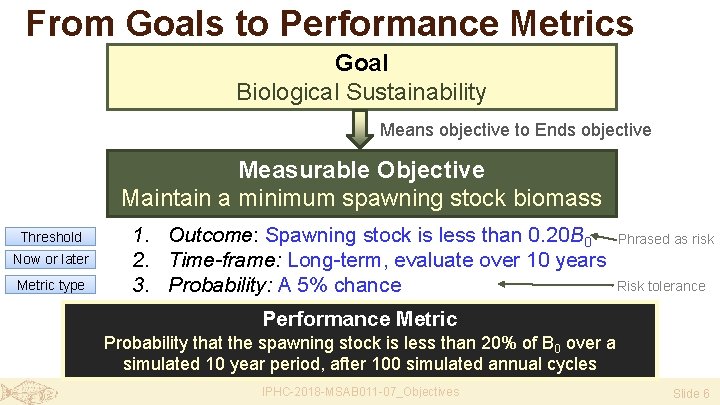
From Goals to Performance Metrics Goal Biological Sustainability Means objective to Ends objective Measurable Objective Maintain a minimum spawning stock biomass Threshold Now or later Metric type 1. Outcome: Spawning stock is less than 0. 20 B 0 2. Time-frame: Long-term, evaluate over 10 years 3. Probability: A 5% chance Phrased as risk Risk tolerance Performance Metric Probability that the spawning stock is less than 20% of B 0 over a simulated 10 year period, after 100 simulated annual cycles IPHC-2018 -MSAB 011 -07_Objectives Slide 6
Means Objectives to Ends Objectives • Ensure that conservation needs of the stock are met for long -term sustainability – Why is this important? • Ensure that the coastwide stock is healthy and continues to be productive – Why is this important? • Maintaining the stock above some minimum ensures continued productivity and a fishery IPHC-2018 -MSAB 011 -07_Objectives Slide 7
Performance metrics • Define a small set of relevant performance metrics to evaluate alternatives – Based on risk (chance of something ‘bad’ happening) – Understood by stakeholders – Reflects all objectives • Time-frame AM 094 -R, para 44. The Commission RECOMMENDED that long- and midterm performance metrics for conservation objectives be considered in the MSE process for conservation objectives, and that short-term metrics be included for fishery-related objectives in the MSE process, via the MSAB. IPHC-2018 -MSAB 011 -07_Objectives Slide 8
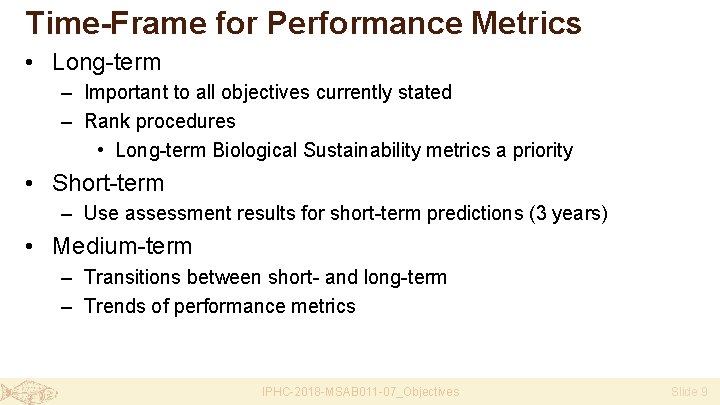
Time-Frame for Performance Metrics • Long-term – Important to all objectives currently stated – Rank procedures • Long-term Biological Sustainability metrics a priority • Short-term – Use assessment results for short-term predictions (3 years) • Medium-term – Transitions between short- and long-term – Trends of performance metrics IPHC-2018 -MSAB 011 -07_Objectives Slide 9
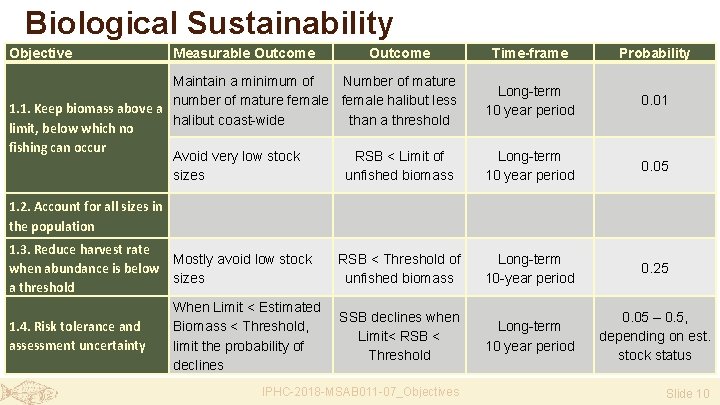
Biological Sustainability Objective Measurable Outcome Time-frame Probability Long-term 10 year period 0. 01 Long-term 10 year period 0. 05 RSB < Threshold of unfished biomass Long-term 10 -year period 0. 25 SSB declines when Limit< RSB < Threshold Long-term 10 year period 0. 05 – 0. 5, depending on est. stock status Maintain a minimum of Number of mature number of mature female halibut less 1. 1. Keep biomass above a halibut coast-wide than a threshold limit, below which no fishing can occur Avoid very low stock RSB < Limit of sizes unfished biomass 1. 2. Account for all sizes in the population 1. 3. Reduce harvest rate Mostly avoid low stock when abundance is below sizes a threshold When Limit < Estimated 1. 4. Risk tolerance and Biomass < Threshold, assessment uncertainty limit the probability of declines IPHC-2018 -MSAB 011 -07_Objectives Slide 10
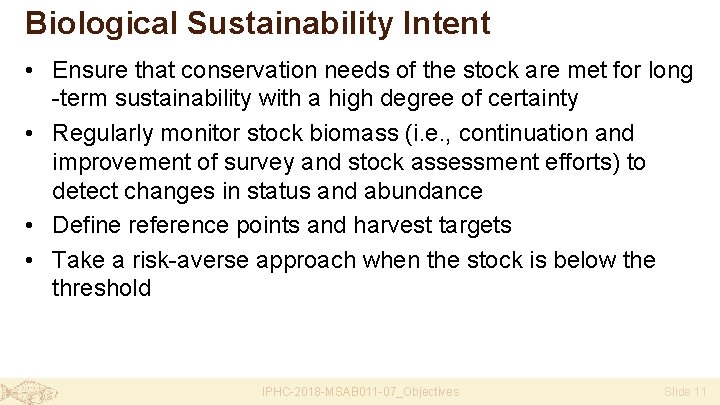
Biological Sustainability Intent • Ensure that conservation needs of the stock are met for long -term sustainability with a high degree of certainty • Regularly monitor stock biomass (i. e. , continuation and improvement of survey and stock assessment efforts) to detect changes in status and abundance • Define reference points and harvest targets • Take a risk-averse approach when the stock is below the threshold IPHC-2018 -MSAB 011 -07_Objectives Slide 11
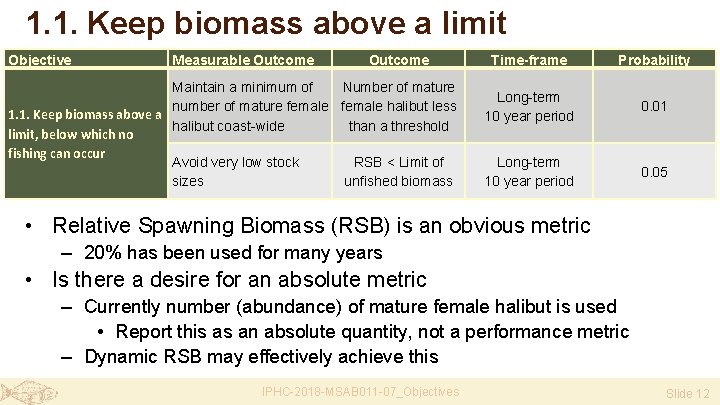
1. 1. Keep biomass above a limit Objective Measurable Outcome Maintain a minimum of Number of mature number of mature female halibut less 1. 1. Keep biomass above a halibut coast-wide than a threshold limit, below which no fishing can occur Avoid very low stock RSB < Limit of sizes unfished biomass Time-frame Probability Long-term 10 year period 0. 01 Long-term 10 year period 0. 05 • Relative Spawning Biomass (RSB) is an obvious metric – 20% has been used for many years • Is there a desire for an absolute metric – Currently number (abundance) of mature female halibut is used • Report this as an absolute quantity, not a performance metric – Dynamic RSB may effectively achieve this IPHC-2018 -MSAB 011 -07_Objectives Slide 12
1. 2. Account for all sizes in the population Objective Measurable Outcome Time-frame Probability 1. 2. Account for all sizes in the population • A SPR-based management procedure meets this objective – An example of an objective guiding the development of the procedure • Some measurable outcomes could be developed IPHC-2018 -MSAB 011 -07_Objectives Slide 13
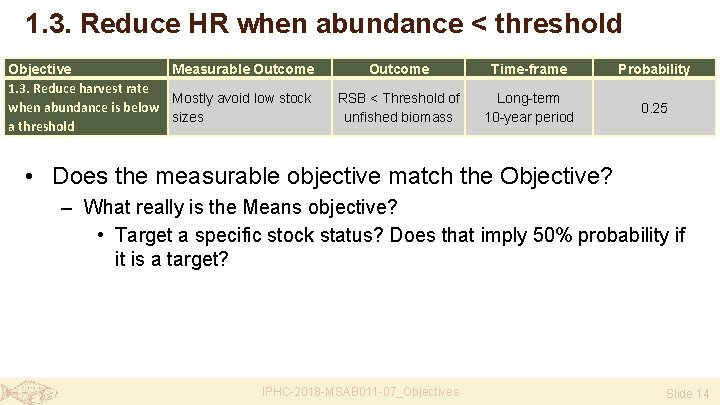
1. 3. Reduce HR when abundance < threshold Objective Measurable Outcome 1. 3. Reduce harvest rate Mostly avoid low stock when abundance is below sizes a threshold Outcome Time-frame Probability RSB < Threshold of unfished biomass Long-term 10 -year period 0. 25 • Does the measurable objective match the Objective? – What really is the Means objective? • Target a specific stock status? Does that imply 50% probability if it is a target? IPHC-2018 -MSAB 011 -07_Objectives Slide 14
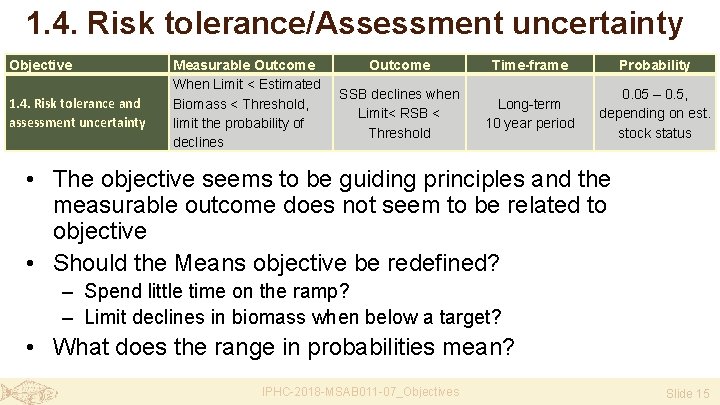
1. 4. Risk tolerance/Assessment uncertainty Objective 1. 4. Risk tolerance and assessment uncertainty Measurable Outcome When Limit < Estimated Biomass < Threshold, limit the probability of declines Outcome Time-frame Probability SSB declines when Limit< RSB < Threshold Long-term 10 year period 0. 05 – 0. 5, depending on est. stock status • The objective seems to be guiding principles and the measurable outcome does not seem to be related to objective • Should the Means objective be redefined? – Spend little time on the ramp? – Limit declines in biomass when below a target? • What does the range in probabilities mean? IPHC-2018 -MSAB 011 -07_Objectives Slide 15
Preserve biocomplexity? ? ? • Should this be an objective or a goal? Biocomplexity “complexity as exhibited by living organisms in their structure, composition, function, and interactions; complexity of a kind considered distinctive of biological systems. ” (Oxford dictionary) • Even with coastwide migration, there are some obstacles that appear to delineate spawning components IPHC-2018 -MSAB 011 -07_Objectives Slide 16
Preserving biocomplexity • Buffer against change and plays a critical role in stability and sustainability • It may be desired to maintain sub-population structure that is not completely understood – Remove fish in proportion to biomass in biological regions – Using fine scale areas is not necessary and increases area-specific variability IPHC-2018 -MSAB 011 -07_Objectives Slide 17
Biological Regions • Areas-as-fleets model – Identifying portions of data that correspond to differing biological and population processes – Differences include sex ratios, age-composition, size-at-age, historical trends, … • Regions were identified with boundaries matching Regulatory Areas – Data are often only available by Regulatory Area – Necessary to distribute TCEY to Regulatory Area – Identifying an accurate line delineating sub-populations is unlikely • Region only needs to be a reasonable approximation to preserve biocomplexity Special Session 01 Slide 18
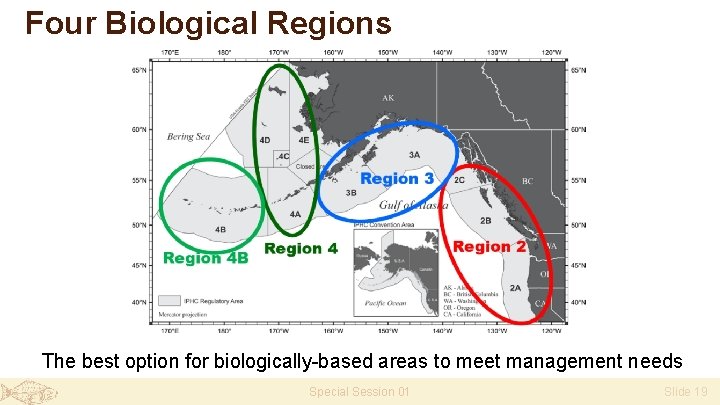
Four Biological Regions The best option for biologically-based areas to meet management needs Special Session 01 Slide 19
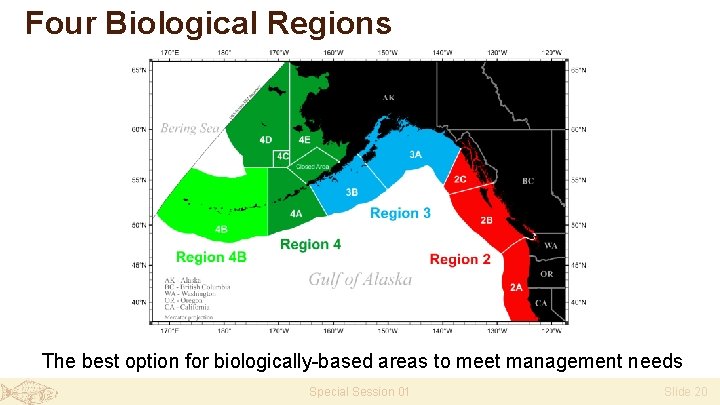
Four Biological Regions The best option for biologically-based areas to meet management needs Special Session 01 Slide 20
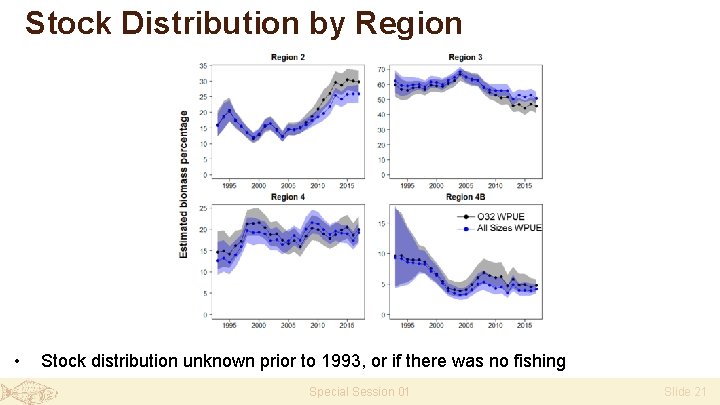
Stock Distribution by Region • Stock distribution unknown prior to 1993, or if there was no fishing Special Session 01 Slide 21
1. 5? Preserve biocomplexity • Related to biological sustainability • Could help define some Region-specific objectives • Possible measurable objectives – Proportion of spawning biomass in a biological region is above a threshold – The annual change in the proportion of biomass in a region is less than a threshold • Guiding principles for a management procedure – Current stock distribution across regions informs the procedure IPHC-2018 -MSAB 011 -07_Objectives Slide 22
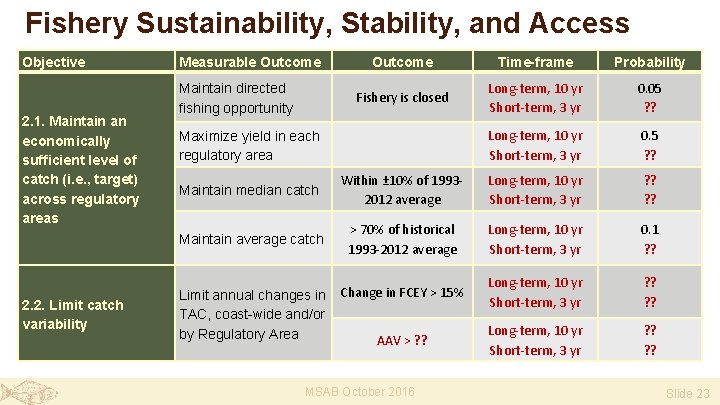
Fishery Sustainability, Stability, and Access Objective 2. 1. Maintain an economically sufficient level of catch (i. e. , target) across regulatory areas 2. 2. Limit catch variability Measurable Outcome Maintain directed fishing opportunity Outcome Time-frame Probability Fishery is closed Long-term, 10 yr Short-term, 3 yr 0. 05 ? ? Long-term, 10 yr Short-term, 3 yr 0. 5 ? ? Maximize yield in each regulatory area Maintain median catch Within ± 10% of 19932012 average Long-term, 10 yr Short-term, 3 yr ? ? Maintain average catch > 70% of historical 1993 -2012 average Long-term, 10 yr Short-term, 3 yr 0. 1 ? ? Change in FCEY > 15% Long-term, 10 yr Short-term, 3 yr ? ? AAV > ? ? Long-term, 10 yr Short-term, 3 yr ? ? Limit annual changes in TAC, coast-wide and/or by Regulatory Area MSAB October 2016 Slide 23
Fishery Sustainability & Stability Intent • Ensure that the directed fishery has viable fishing opportunities every year • Provide directed fisheries that are economically beneficial to individual participants, local businesses, and broader communities • Support efforts to allow continued access to the halibut resource within acceptable conservation limits IPHC-2018 -MSAB 011 -07_Objectives Slide 24
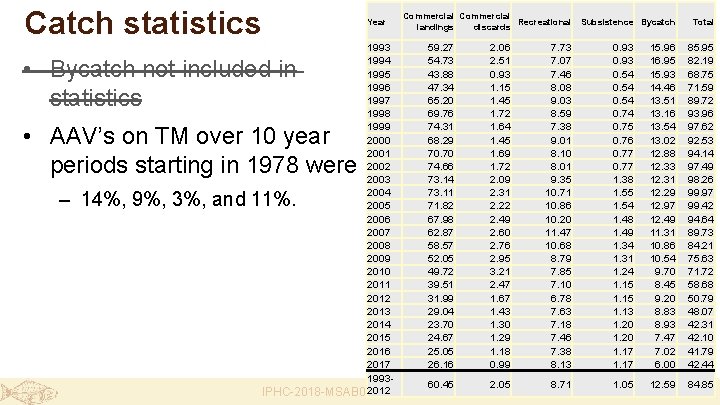
Catch statistics Year Commercial Recreational landings discards 1993 59. 27 1994 54. 73 1995 43. 88 1996 47. 34 1997 65. 20 1998 69. 76 1999 74. 31 2000 68. 29 2001 70. 70 2002 74. 66 2003 73. 14 2004 73. 11 2005 71. 82 2006 67. 98 2007 62. 87 2008 58. 57 2009 52. 05 2010 49. 72 2011 39. 51 2012 31. 99 2013 29. 04 2014 23. 70 2015 24. 67 2016 25. 05 2017 26. 16 199360. 45 2012 IPHC-2018 -MSAB 011 -07_Objectives • Bycatch not included in statistics • AAV’s on TM over 10 year periods starting in 1978 were – 14%, 9%, 3%, and 11%. Subsistence Bycatch Total 2. 06 2. 51 0. 93 1. 15 1. 45 1. 72 1. 64 1. 45 1. 69 1. 72 2. 09 2. 31 2. 22 2. 49 2. 60 2. 76 2. 95 3. 21 2. 47 1. 67 1. 43 1. 30 1. 29 1. 18 0. 99 7. 73 7. 07 7. 46 8. 08 9. 03 8. 59 7. 38 9. 01 8. 10 8. 01 9. 35 10. 71 10. 86 10. 20 11. 47 10. 68 8. 79 7. 85 7. 10 6. 78 7. 63 7. 18 7. 46 7. 38 8. 13 0. 93 0. 54 0. 75 0. 76 0. 77 1. 38 1. 55 1. 54 1. 48 1. 49 1. 34 1. 31 1. 24 1. 15 1. 13 1. 20 1. 17 15. 96 16. 95 15. 93 14. 46 13. 51 13. 16 13. 54 13. 02 12. 88 12. 33 12. 31 12. 29 12. 97 12. 49 11. 31 10. 86 10. 54 9. 70 8. 45 9. 20 8. 83 8. 93 7. 47 7. 02 6. 00 85. 95 82. 19 68. 75 71. 59 89. 72 93. 96 97. 62 92. 53 94. 14 97. 49 98. 26 99. 97 99. 42 94. 64 89. 73 84. 21 75. 63 71. 72 58. 68 50. 79 48. 07 42. 31 42. 10 41. 79 42. 44 2. 05 8. 71 1. 05 12. 59 84. 85 Slide 25
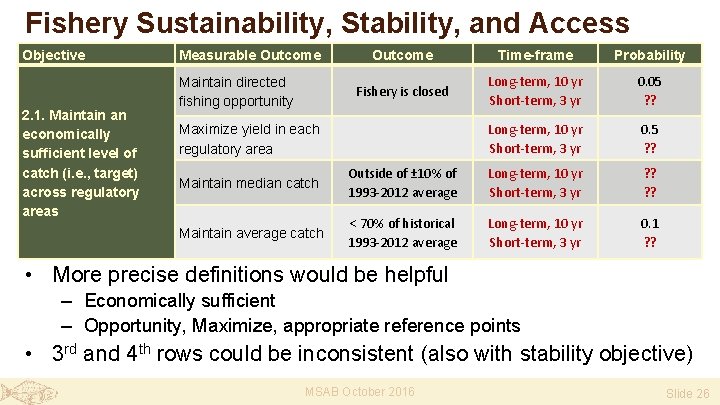
Fishery Sustainability, Stability, and Access Objective 2. 1. Maintain an economically sufficient level of catch (i. e. , target) across regulatory areas Measurable Outcome Maintain directed fishing opportunity Outcome Time-frame Probability Fishery is closed Long-term, 10 yr Short-term, 3 yr 0. 05 ? ? Long-term, 10 yr Short-term, 3 yr 0. 5 ? ? Maximize yield in each regulatory area Maintain median catch Outside of ± 10% of 1993 -2012 average Long-term, 10 yr Short-term, 3 yr ? ? Maintain average catch < 70% of historical 1993 -2012 average Long-term, 10 yr Short-term, 3 yr 0. 1 ? ? • More precise definitions would be helpful – Economically sufficient – Opportunity, Maximize, appropriate reference points • 3 rd and 4 th rows could be inconsistent (also with stability objective) MSAB October 2016 Slide 26
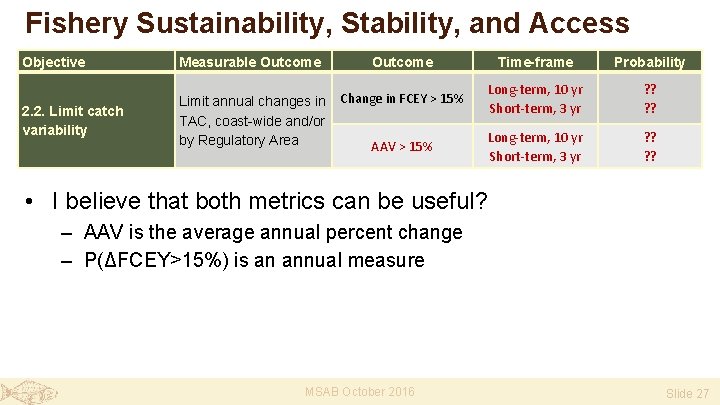
Fishery Sustainability, Stability, and Access Objective Measurable Outcome Time-frame Probability 2. 2. Limit catch variability Limit annual changes in TAC, coast-wide and/or by Regulatory Area Change in FCEY > 15% Long-term, 10 yr Short-term, 3 yr ? ? AAV > 15% Long-term, 10 yr Short-term, 3 yr ? ? • I believe that both metrics can be useful? – AAV is the average annual percent change – P(ΔFCEY>15%) is an annual measure MSAB October 2016 Slide 27
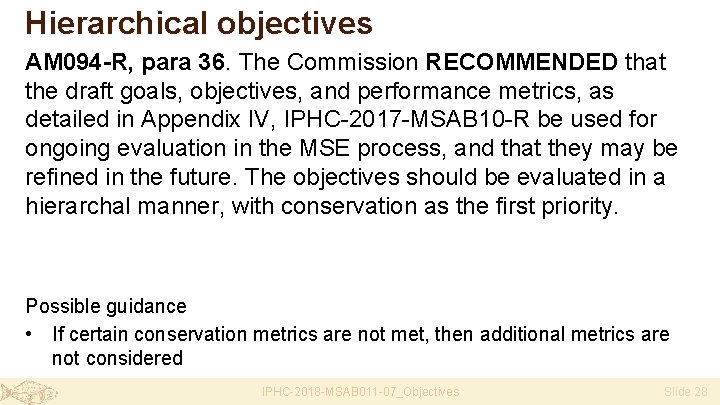
Hierarchical objectives AM 094 -R, para 36. The Commission RECOMMENDED that the draft goals, objectives, and performance metrics, as detailed in Appendix IV, IPHC-2017 -MSAB 10 -R be used for ongoing evaluation in the MSE process, and that they may be refined in the future. The objectives should be evaluated in a hierarchal manner, with conservation as the first priority. Possible guidance • If certain conservation metrics are not met, then additional metrics are not considered IPHC-2018 -MSAB 011 -07_Objectives Slide 28
TCEY distribution objectives AM 094 -R, para 37. The Commission REQUESTED that the objectives related to distributing the TCEY, as detailed in Circular IPHC-2017 -CR 022, be presented at MSAB 11 for further stakeholder feedback. IPHC-2018 -MSAB 011 -07_Objectives Slide 29
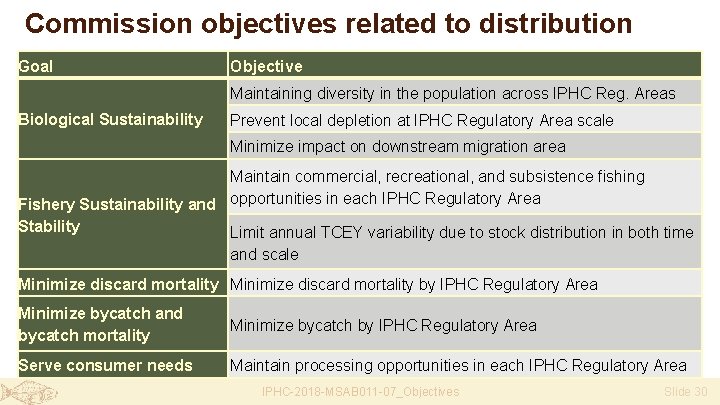
Commission objectives related to distribution Goal Objective Maintaining diversity in the population across IPHC Reg. Areas Biological Sustainability Prevent local depletion at IPHC Regulatory Area scale Minimize impact on downstream migration area Maintain commercial, recreational, and subsistence fishing Fishery Sustainability and opportunities in each IPHC Regulatory Area Stability Limit annual TCEY variability due to stock distribution in both time and scale Minimize discard mortality by IPHC Regulatory Area Minimize bycatch and bycatch mortality Minimize bycatch by IPHC Regulatory Area Serve consumer needs Maintain processing opportunities in each IPHC Regulatory Area IPHC-2018 -MSAB 011 -07_Objectives Slide 30
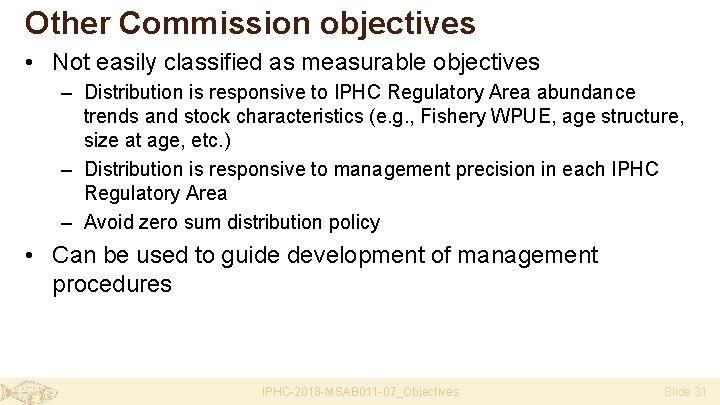
Other Commission objectives • Not easily classified as measurable objectives – Distribution is responsive to IPHC Regulatory Area abundance trends and stock characteristics (e. g. , Fishery WPUE, age structure, size at age, etc. ) – Distribution is responsive to management precision in each IPHC Regulatory Area – Avoid zero sum distribution policy • Can be used to guide development of management procedures IPHC-2018 -MSAB 011 -07_Objectives Slide 31
Area-specific objectives • MSAB will need to develop these • Can begin with means objectives or “intent” • Can be specific to IPHC Regulatory Areas or Regions IPHC-2018 -MSAB 011 -07_Objectives Slide 32
Recommendations 1. 2. 3. NOTE paper IPHC-2018 -MSAB 011 -08 CONSIDER the current MSAB goals and objectives, and the objectives for distributing the TCEY identified by the Commission. RECOMMEND additions or deletions to the MSAB goals and objectives. More specifically, the following topics should be addressed. a) b) c) 4. 5. How to incorporate the objectives for distributing the TCEY identified by the Commission. Defining objectives for goals that currently do not have objectives (4 & 5). Determining if the goal of preserving biocomplexity should be its own goal, or if it should be an objective under the goal of biological sustainability. And, defining associated measurable objectives. RECOMMEND a practical set of performance metrics to report for the evaluation of future simulations. SUGGEST ways to report the performance metrics and results from the simulations considered in paper IPHC-2017 -MSAB 10 -09. IPHC-2018 -MSAB 011 -07_Objectives Slide 33

Additional Actions • Consider if the existing objectives require modification • Define measurable objectives for preserving biocomplexity • How to incorporate the objectives for distributing the TCEY identified by the Commission • Determine what are guiding principles and what are measurable objectives • Recommend performance metrics to report and how to report them • Define which objectives must be met in a hierarchy IPHC-2018 -MSAB 011 -07_Objectives Slide 34
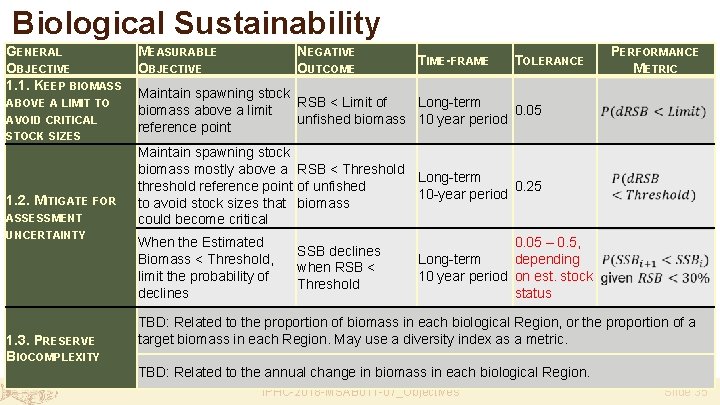
Biological Sustainability GENERAL OBJECTIVE 1. 1. KEEP BIOMASS ABOVE A LIMIT TO AVOID CRITICAL STOCK SIZES 1. 2. MITIGATE FOR ASSESSMENT UNCERTAINTY 1. 3. PRESERVE BIOCOMPLEXITY MEASURABLE OBJECTIVE NEGATIVE OUTCOME TIME-FRAME TOLERANCE PERFORMANCE METRIC Maintain spawning stock RSB < Limit of Long-term biomass above a limit 0. 05 unfished biomass 10 year period reference point Maintain spawning stock biomass mostly above a RSB < Threshold Long-term threshold reference point of unfished 0. 25 10 -year period to avoid stock sizes that biomass could become critical When the Estimated Biomass < Threshold, limit the probability of declines SSB declines when RSB < Threshold 0. 05 – 0. 5, Long-term depending 10 year period on est. stock status TBD: Related to the proportion of biomass in each biological Region, or the proportion of a target biomass in each Region. May use a diversity index as a metric. TBD: Related to the annual change in biomass in each biological Region. IPHC-2018 -MSAB 011 -07_Objectives Slide 35
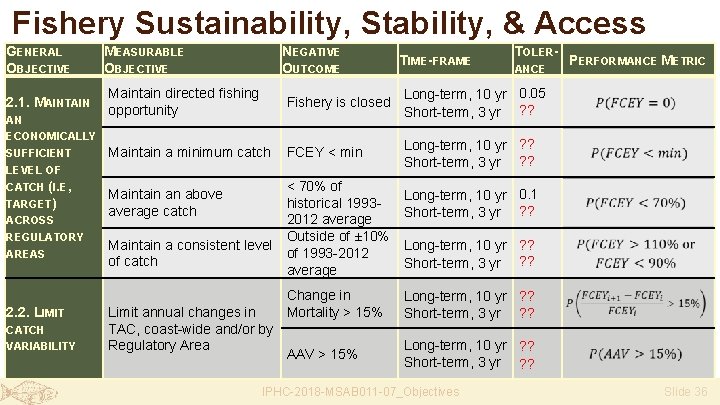
Fishery Sustainability, Stability, & Access GENERAL OBJECTIVE MEASURABLE OBJECTIVE Maintain directed fishing 2. 1. MAINTAIN opportunity AN ECONOMICALLY Maintain a minimum catch SUFFICIENT LEVEL OF CATCH (I. E , Maintain an above TARGET) average catch ACROSS REGULATORY Maintain a consistent level AREAS of catch 2. 2. LIMIT CATCH VARIABILITY Limit annual changes in TAC, coast-wide and/or by Regulatory Area NEGATIVE OUTCOME TIME-FRAME Fishery is closed Long-term, 10 yr 0. 05 Short-term, 3 yr ? ? FCEY < min Long-term, 10 yr ? ? Short-term, 3 yr ? ? < 70% of historical 19932012 average Outside of ± 10% of 1993 -2012 average TOLERANCE PERFORMANCE METRIC Long-term, 10 yr 0. 1 Short-term, 3 yr ? ? Long-term, 10 yr ? ? Short-term, 3 yr ? ? Change in Mortality > 15% Long-term, 10 yr ? ? Short-term, 3 yr ? ? AAV > 15% Long-term, 10 yr ? ? Short-term, 3 yr ? ? IPHC-2018 -MSAB 011 -07_Objectives Slide 36
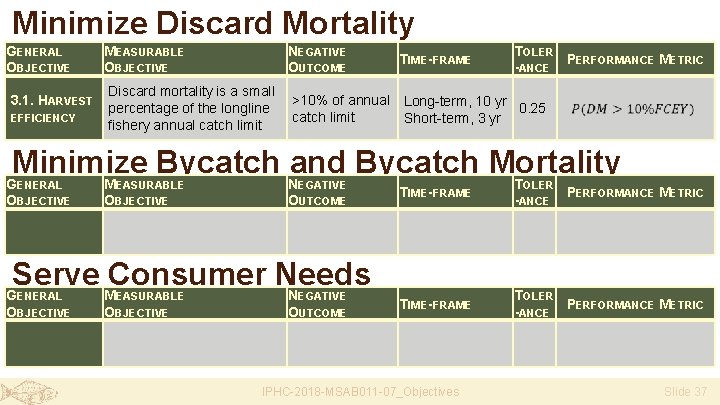
Minimize Discard Mortality GENERAL OBJECTIVE 3. 1. HARVEST EFFICIENCY MEASURABLE OBJECTIVE NEGATIVE OUTCOME Discard mortality is a small percentage of the longline fishery annual catch limit >10% of annual Long-term, 10 yr 0. 25 catch limit Short-term, 3 yr TIME-FRAME TOLER PERFORMANCE METRIC -ANCE Minimize Bycatch and Bycatch Mortality G M N T ENERAL OBJECTIVE EASURABLE OBJECTIVE EGATIVE OUTCOME Serve Consumer Needs G M N ENERAL OBJECTIVE EASURABLE OBJECTIVE EGATIVE OUTCOME TIME-FRAME IPHC-2018 -MSAB 011 -07_Objectives OLER -ANCE PERFORMANCE METRIC TOLER PERFORMANCE METRIC -ANCE Slide 37
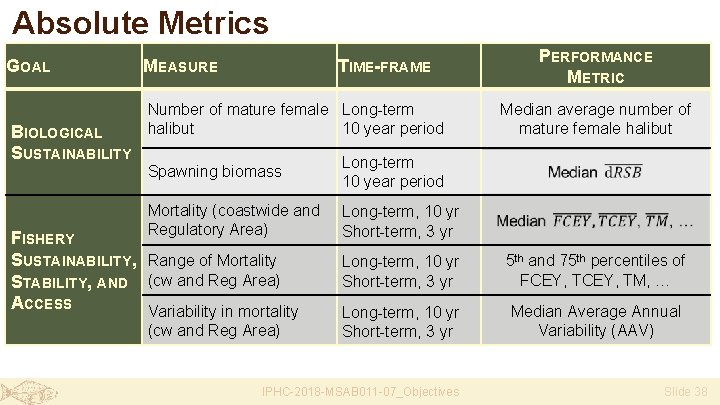
Absolute Metrics GOAL BIOLOGICAL SUSTAINABILITY MEASURE TIME-FRAME Number of mature female Long-term halibut 10 year period Spawning biomass Long-term 10 year period Mortality (coastwide and Regulatory Area) Long-term, 10 yr Short-term, 3 yr FISHERY SUSTAINABILITY, Range of Mortality STABILITY, AND (cw and Reg Area) ACCESS Variability in mortality (cw and Reg Area) PERFORMANCE METRIC Median average number of mature female halibut Long-term, 10 yr Short-term, 3 yr 5 th and 75 th percentiles of FCEY, TM, … Long-term, 10 yr Short-term, 3 yr Median Average Annual Variability (AAV) IPHC-2018 -MSAB 011 -07_Objectives Slide 38

Slide 39
- Slides: 39