
Goals Objectives and Performance Measures for Restoration Projects
Goals, Objectives and Performance Measures for Restoration Projects Or What am I doing and how do I know when I’m done?
Overview. . . Defining goals Setting goals Performance measures Specific measures forestoration in the Pacific Northwest Monitoring
What are goals? Dictionary definition of a goal: An observable and measurable end result having one or more objectives to be achieved within a fixed timeframe Therefore, a good goal must be: • Clear • Specific • Quantifiable/Verifiable
How to set a goal • Decide on scale – large scale or small scale Example – The Green Seattle Partnership’s goal is to restore 2, 500 acres of forested habitat in Seattle within 20 years Example – My community organization would like to build two trails in our park within the next three years Example – I will do community outreach to three school groups in the next month and teach 100 second graders about the importance of planting trees
How to set a goal Often goals will depend on: • Amount of funding available • Amount of person power available • Amount of time available
How to set a goal • Get consensus from your stakeholders • Coworkers • Funders • Community • Anyone else involved Must have buy-in from all the key players to be successful. Do your goals reflect what the organization, community or funders want to achieve?
Examples of goals • Remove ivy from Chism Beach Park • Provide a sustainable source of firewood for the local community • Improve habitat for salmon in Taylor Creek
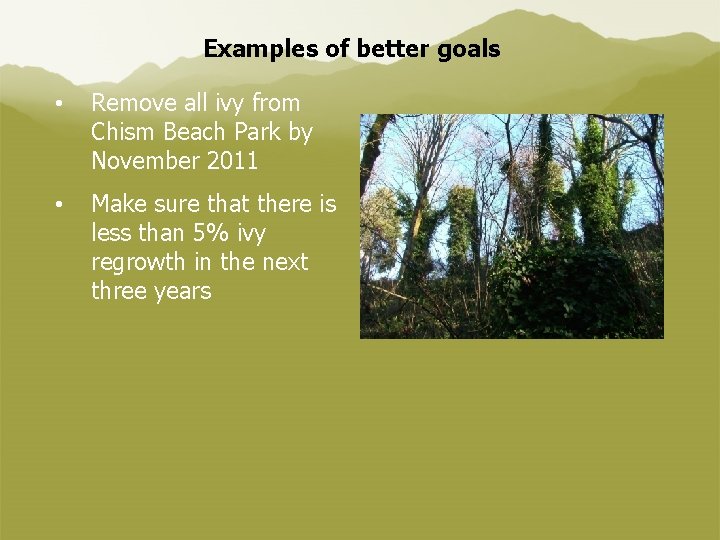
Examples of better goals • Remove all ivy from Chism Beach Park by November 2011 • Make sure that there is less than 5% ivy regrowth in the next three years
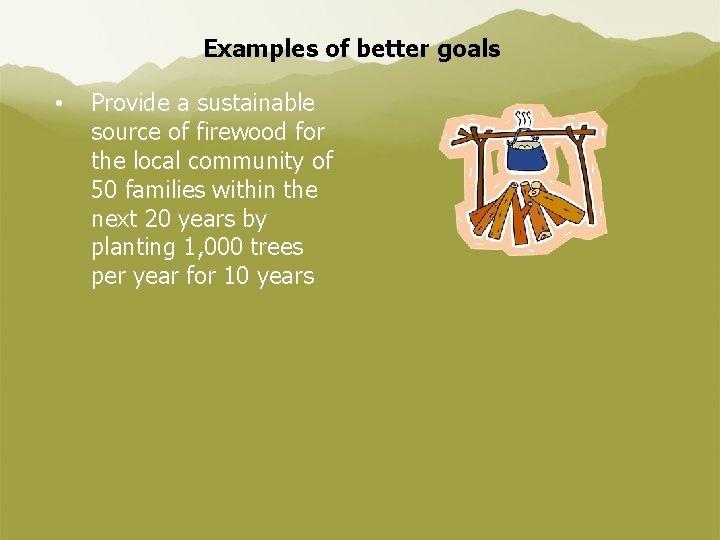
Examples of better goals • Provide a sustainable source of firewood for the local community of 50 families within the next 20 years by planting 1, 000 trees per year for 10 years
Examples of better goals Improve habitat for salmon in Taylor Creek by: • Doing an inventory of culverts or other obstructions to salmon passage in the next year • Removing all invasive vegetation within 20 feet of both sides of the creek in the next three years and planting with native shrub and tree species • Follow all performance measures for the project
Performance Measures A performance measure is a set of specific, quantifiable objectives that a project must meet in order to be successful. These measures usually include mortality survival, monitoring and vegetation requirements for restoration projects. Examples: • At least 80% of all planted shrubs and trees must survive past the first three years • The project site must be monitored each year at the end of the growing season • Native shrub species will exceed 80% cover by year five
Performance Measures Chism Beach Goal: • Remove all ivy from Chism Beach Park by November 2011 • Make sure that there is less than 5% ivy regrowth in the next three years
Performance Measures Sustainable Firewood Goal: • Provide a sustainable source of firewood for the local community of 50 families within the next 20 years by planting 1, 000 trees per year for 10 years
Performance Measures Taylor Creek Goal: • Doing an inventory of culverts or other obstructions to salmon passage in the next year • Removing all invasive vegetation within 20 feet of both sides of the creek in the next three years and planting with native shrub and tree species • Follow all performance measures for the project
Some Common Goals for Urban Forests in Seattle Reduce invasive species in the forest: • Percent cover of invasive species will be less than 5% on the site after three years Increase diversity of native species: • 10 different species of shrubs will be planted on the site Increase conifer density: • Conifer density on the site will be between 100 – 200 stems/acre for regenerating trees Maintain the site: • Plant survival on the site will be at least 80%
Specific Goals for Three Forest Types Conifer/Deciduous Forest • Appropriate for: Deciduous Forests • Mixed Conifer/Deciduous Forests • Conifer Forests • Madrone/Conifer Forest • Appropriate for any type of Madrone forest • Riparian Forest • Appropriate for riparian forests • Forested Wetlands
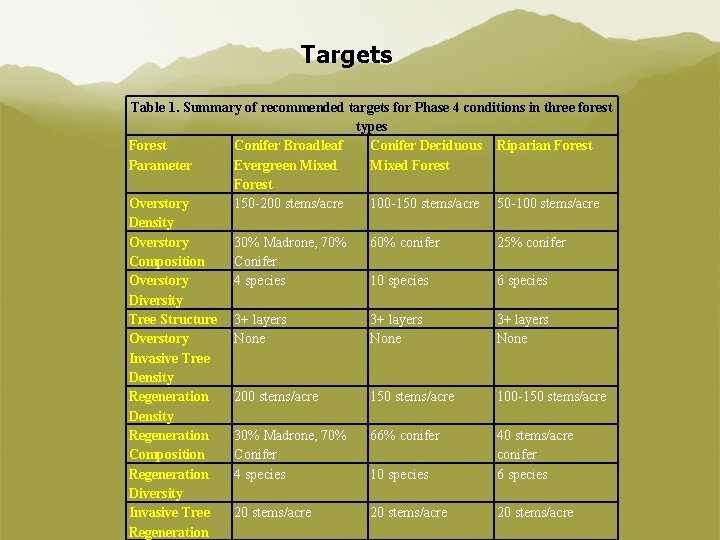
Targets Table 1. Summary of recommended targets for Phase 4 conditions in three forest types Forest Conifer Broadleaf Conifer Deciduous Riparian Forest Parameter Evergreen Mixed Forest Overstory 150 -200 stems/acre 100 -150 stems/acre 50 -100 stems/acre Density Overstory 30% Madrone, 70% 60% conifer 25% conifer Composition Conifer Overstory 4 species 10 species 6 species Diversity Tree Structure 3+ layers Overstory None Invasive Tree Density Regeneration 200 stems/acre 150 stems/acre 100 -150 stems/acre Density Regeneration 30% Madrone, 70% 66% conifer 40 stems/acre Composition Conifer conifer Regeneration 4 species 10 species 6 species Diversity Invasive Tree 20 stems/acre Regeneration
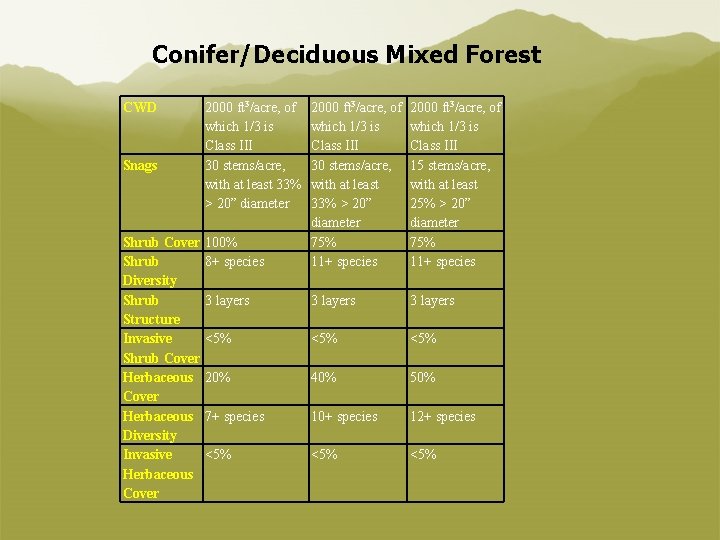
Conifer/Deciduous Mixed Forest CWD Snags Shrub Cover Shrub Diversity Shrub Structure Invasive Shrub Cover Herbaceous Diversity Invasive Herbaceous Cover 2000 ft 3/acre, of which 1/3 is Class III 30 stems/acre, with at least 33% > 20” diameter 100% 8+ species 2000 ft 3/acre, of which 1/3 is Class III 30 stems/acre, with at least 33% > 20” diameter 75% 11+ species 2000 ft 3/acre, of which 1/3 is Class III 15 stems/acre, with at least 25% > 20” diameter 75% 11+ species 3 layers <5% <5% 20% 40% 50% 7+ species 10+ species 12+ species <5% <5%
Monitoring and Adaptive Management Identify successes and limitations of management strategies and allow for changes to these strategies
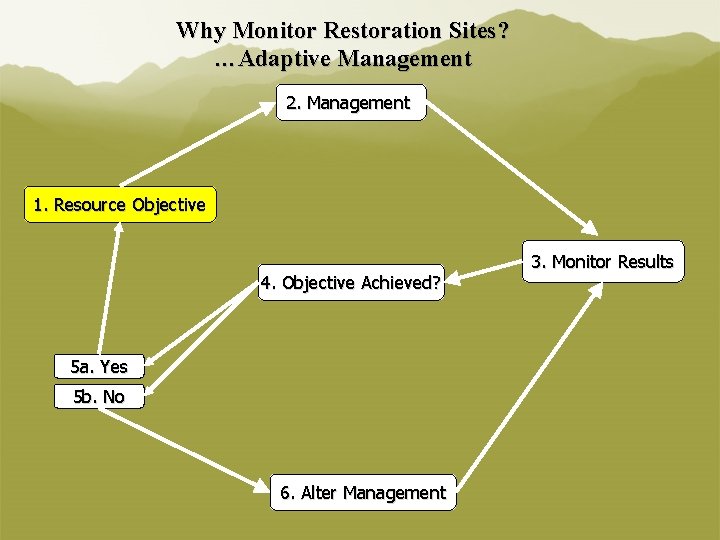
Why Monitor Restoration Sites? …Adaptive Management 2. Management 1. Resource Objective 4. Objective Achieved? 5 a. Yes 5 b. No 6. Alter Management 3. Monitor Results
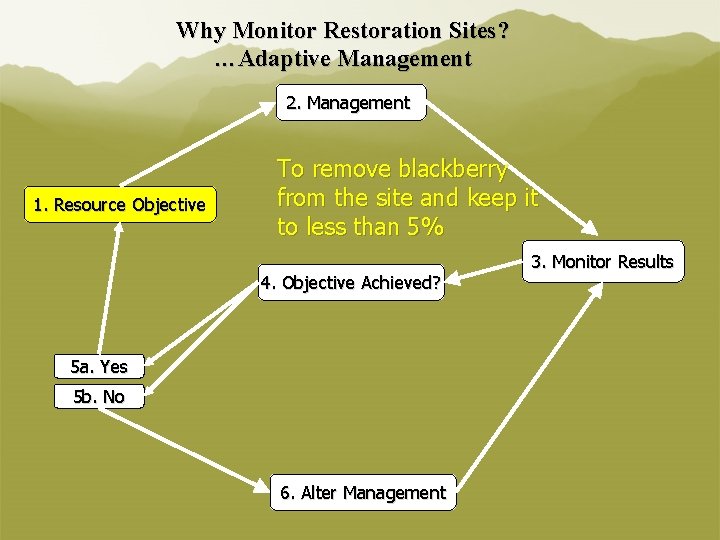
Why Monitor Restoration Sites? …Adaptive Management 2. Management 1. Resource Objective To remove blackberry from the site and keep it to less than 5% 4. Objective Achieved? 5 a. Yes 5 b. No 6. Alter Management 3. Monitor Results
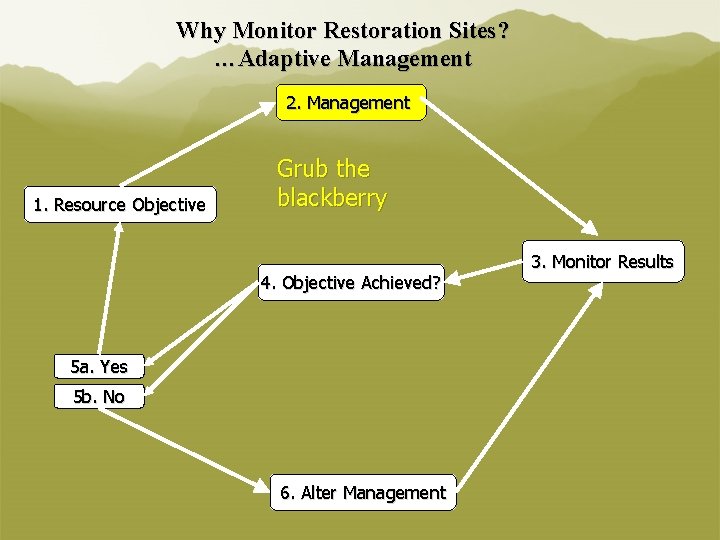
Why Monitor Restoration Sites? …Adaptive Management 2. Management 1. Resource Objective Grub the blackberry 4. Objective Achieved? 5 a. Yes 5 b. No 6. Alter Management 3. Monitor Results
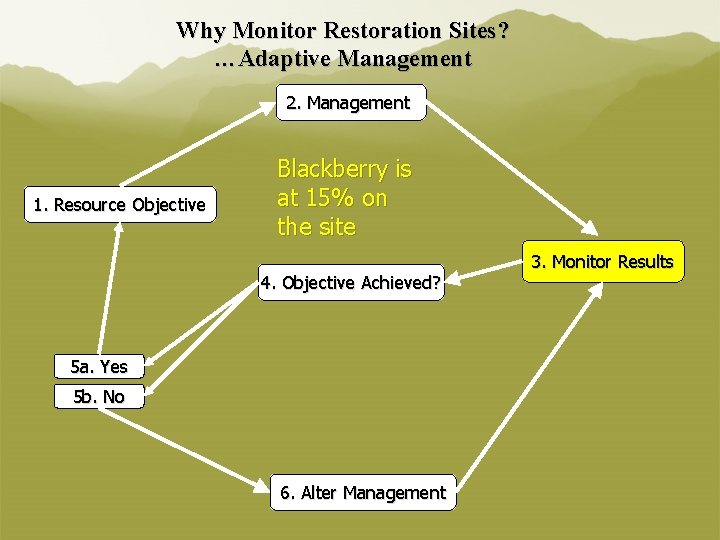
Why Monitor Restoration Sites? …Adaptive Management 2. Management 1. Resource Objective Blackberry is at 15% on the site 4. Objective Achieved? 5 a. Yes 5 b. No 6. Alter Management 3. Monitor Results
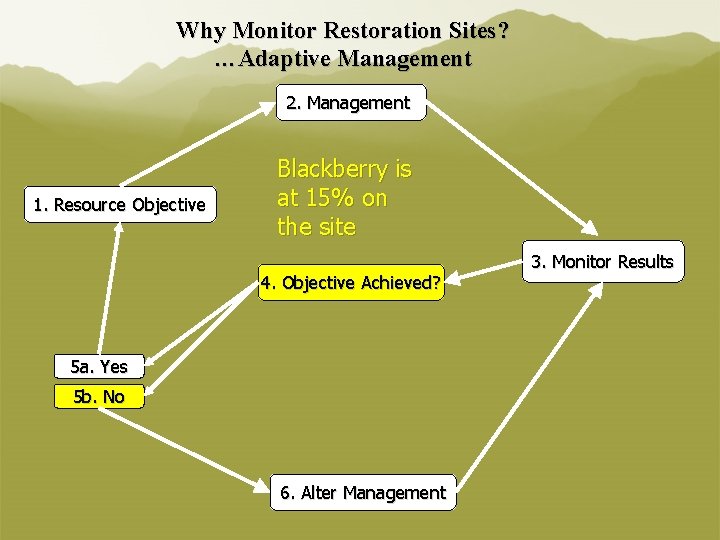
Why Monitor Restoration Sites? …Adaptive Management 2. Management 1. Resource Objective Blackberry is at 15% on the site 4. Objective Achieved? 5 a. Yes 5 b. No 6. Alter Management 3. Monitor Results
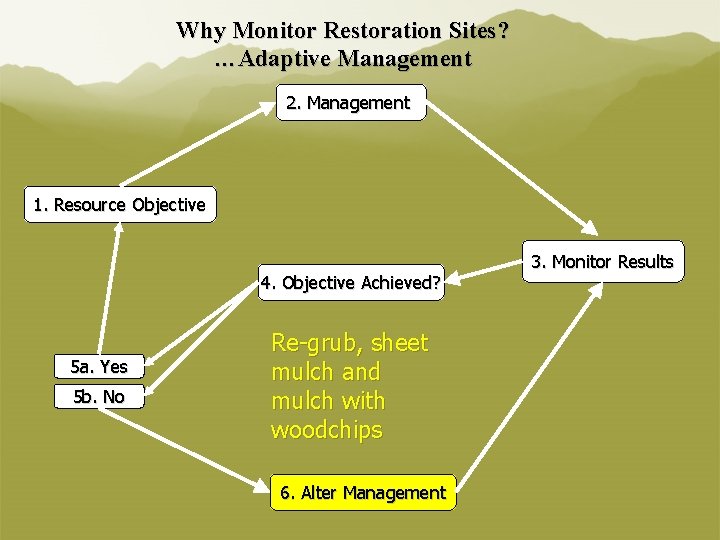
Why Monitor Restoration Sites? …Adaptive Management 2. Management 1. Resource Objective 4. Objective Achieved? 5 a. Yes 5 b. No Re-grub, sheet mulch and mulch with woodchips 6. Alter Management 3. Monitor Results
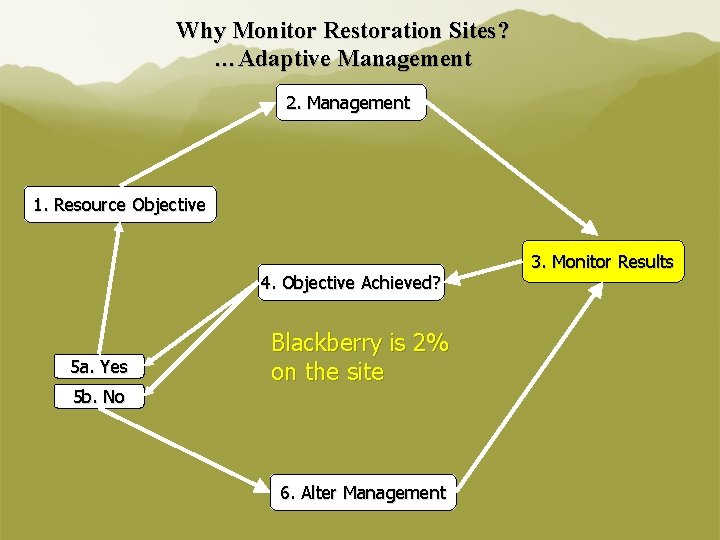
Why Monitor Restoration Sites? …Adaptive Management 2. Management 1. Resource Objective 4. Objective Achieved? 5 a. Yes 5 b. No Blackberry is 2% on the site 6. Alter Management 3. Monitor Results
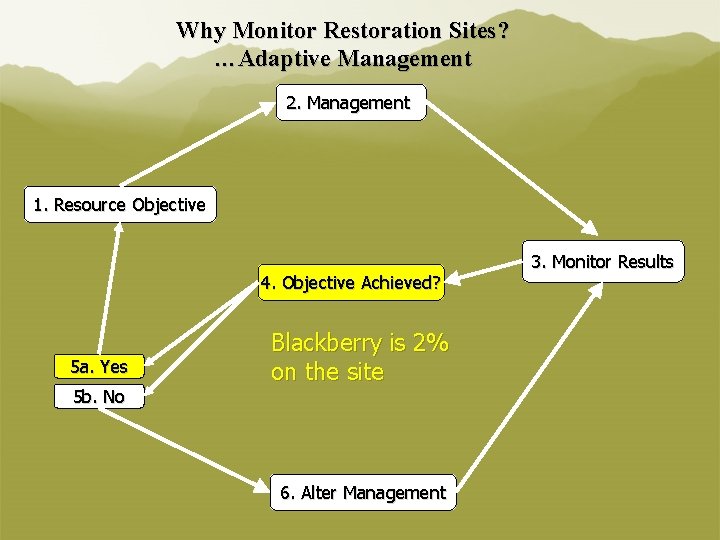
Why Monitor Restoration Sites? …Adaptive Management 2. Management 1. Resource Objective 4. Objective Achieved? 5 a. Yes 5 b. No Blackberry is 2% on the site 6. Alter Management 3. Monitor Results
Monitoring What type of monitoring is appropriate for a site? • Depends on your performance measures, size of site, available time and budget
Monitoring If you have a small site and need to look at plant survival, you can count all the trees and shrubs you planted to get a full count. • Must know exactly what you planted • Not a good idea to count ground covers because they spread rapidly – use percent cover to assess herbaceous layer and invasive species
Monitoring If you have a large site and need to look at plant survival, you can put in a permanent plot (1/10 th acre is standard) or use a belt transect to monitor survival of trees and shrubs • If possible, put in plot or transect prior to restoration to get baseline data (helps you plan!) • Collect information in plot immediately after you plant so you know what you planted • Optimal to monitor each year for 3 -5 years at end of growing season
Summary and Application Where to go from here? • • Use the specific forest targets to assign a target forest type to each of your zones Compare your collected baseline data to the targets Identify how to achieve the targets based on your management activities and planting plans on the site Some targets such as snags and CWD will take many years to achieve
- Slides: 31