
Goals Identify and read subjunctive yiqtol geminate roots
Goals Identify and read • subjunctive yiqtol • geminate roots in the Niphal
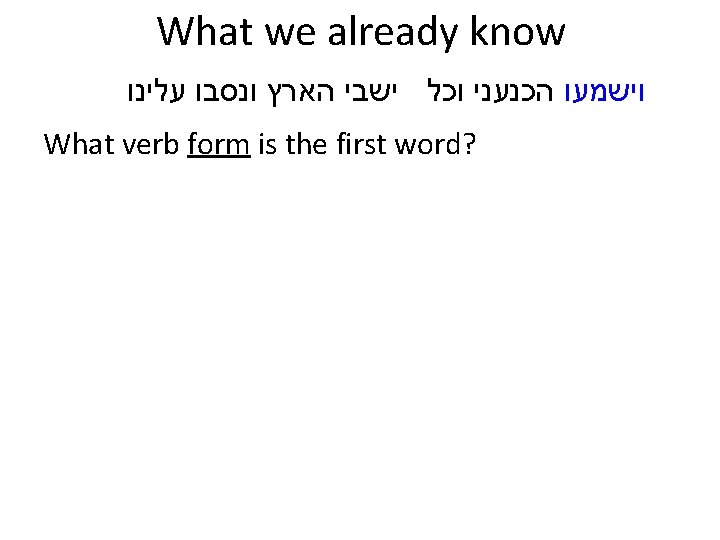
What we already know וישמעו הכנעני וכל ישבי הארץ ונסבו עלינו What verb form is the first word?
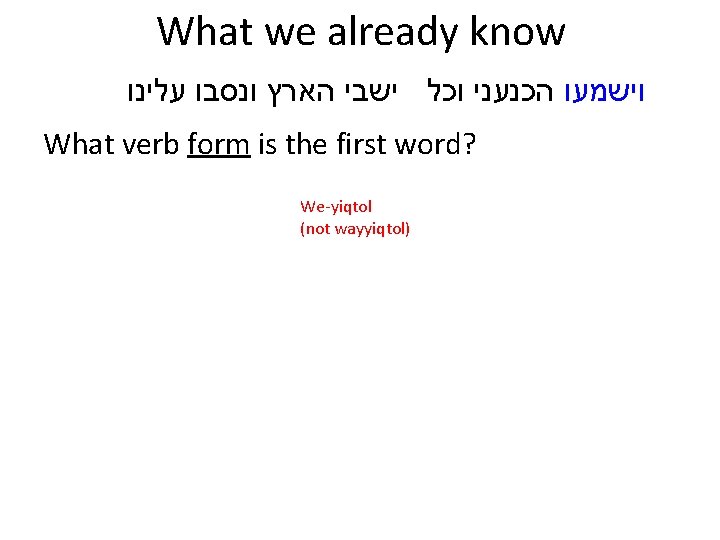
What we already know וישמעו הכנעני וכל ישבי הארץ ונסבו עלינו What verb form is the first word? We-yiqtol (not wayyiqtol)
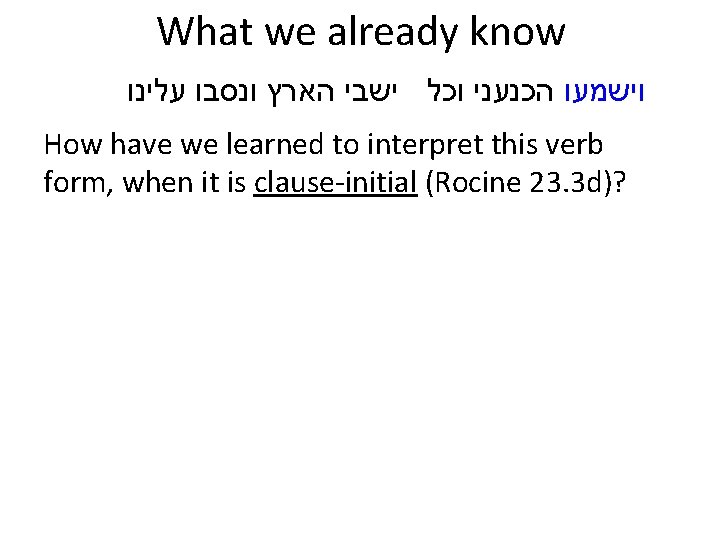
What we already know וישמעו הכנעני וכל ישבי הארץ ונסבו עלינו How have we learned to interpret this verb form, when it is clause-initial (Rocine 23. 3 d)?
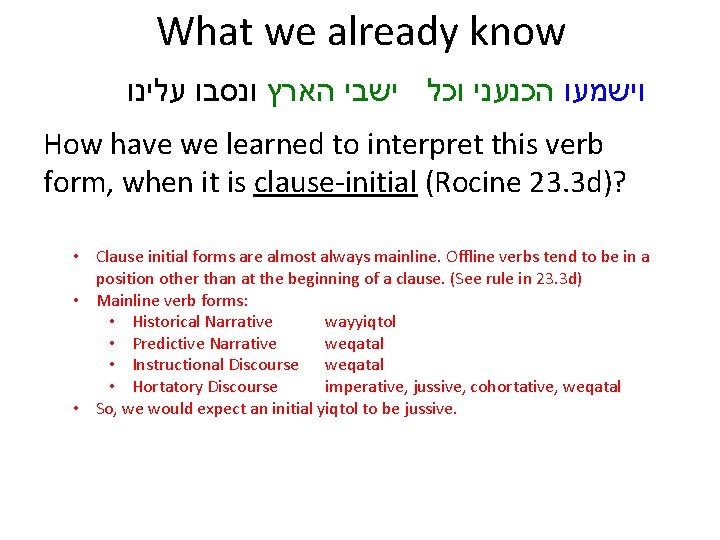
What we already know וישמעו הכנעני וכל ישבי הארץ ונסבו עלינו How have we learned to interpret this verb form, when it is clause-initial (Rocine 23. 3 d)? • Clause initial forms are almost always mainline. Offline verbs tend to be in a position other than at the beginning of a clause. (See rule in 23. 3 d) • Mainline verb forms: • Historical Narrative wayyiqtol • Predictive Narrative weqatal • Instructional Discourse weqatal • Hortatory Discourse imperative, jussive, cohortative, weqatal • So, we would expect an initial yiqtol to be jussive.
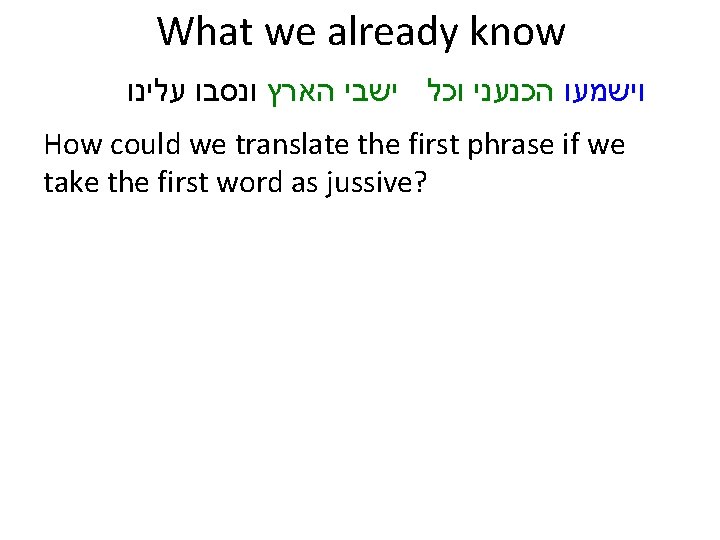
What we already know וישמעו הכנעני וכל ישבי הארץ ונסבו עלינו How could we translate the first phrase if we take the first word as jussive?
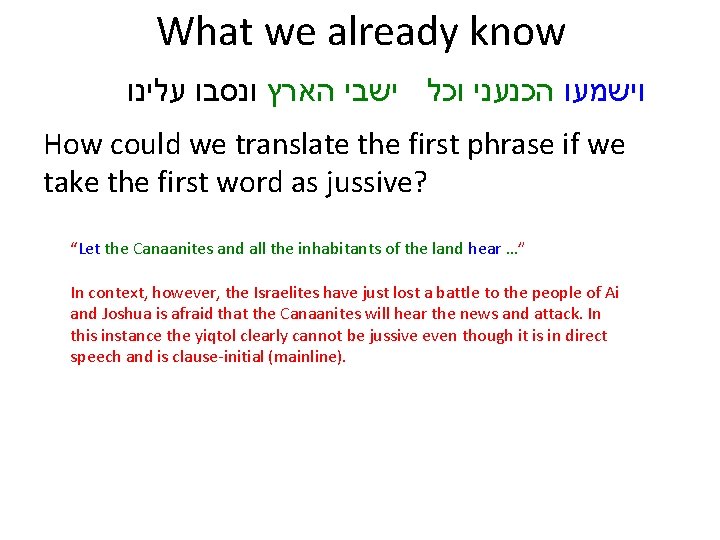
What we already know וישמעו הכנעני וכל ישבי הארץ ונסבו עלינו How could we translate the first phrase if we take the first word as jussive? “Let the Canaanites and all the inhabitants of the land hear …” In context, however, the Israelites have just lost a battle to the people of Ai and Joshua is afraid that the Canaanites will hear the news and attack. In this instance the yiqtol clearly cannot be jussive even though it is in direct speech and is clause-initial (mainline).
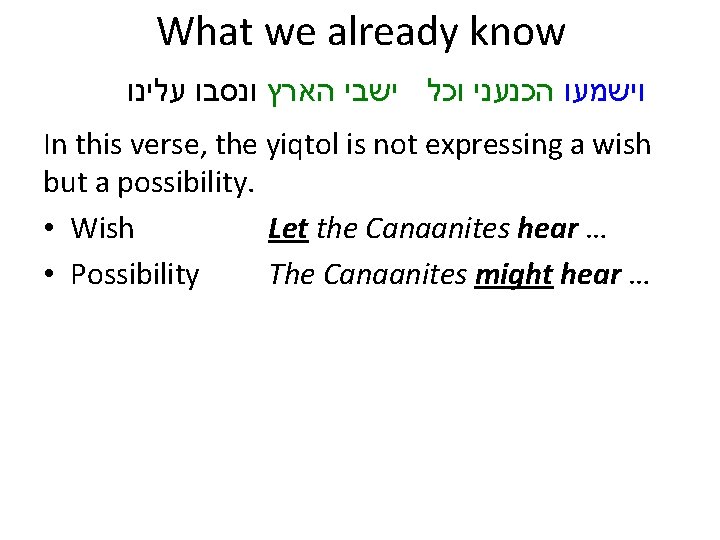
What we already know וישמעו הכנעני וכל ישבי הארץ ונסבו עלינו In this verse, the yiqtol is not expressing a wish but a possibility. • Wish Let the Canaanites hear … • Possibility The Canaanites might hear …
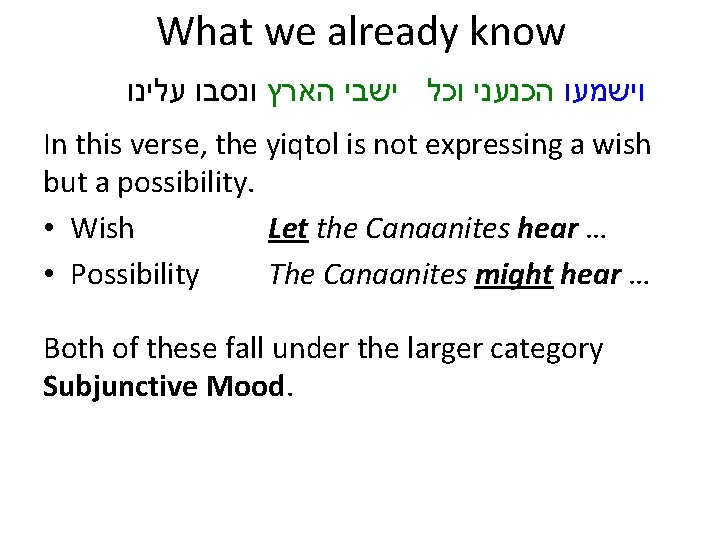
What we already know וישמעו הכנעני וכל ישבי הארץ ונסבו עלינו In this verse, the yiqtol is not expressing a wish but a possibility. • Wish Let the Canaanites hear … • Possibility The Canaanites might hear … Both of these fall under the larger category Subjunctive Mood.
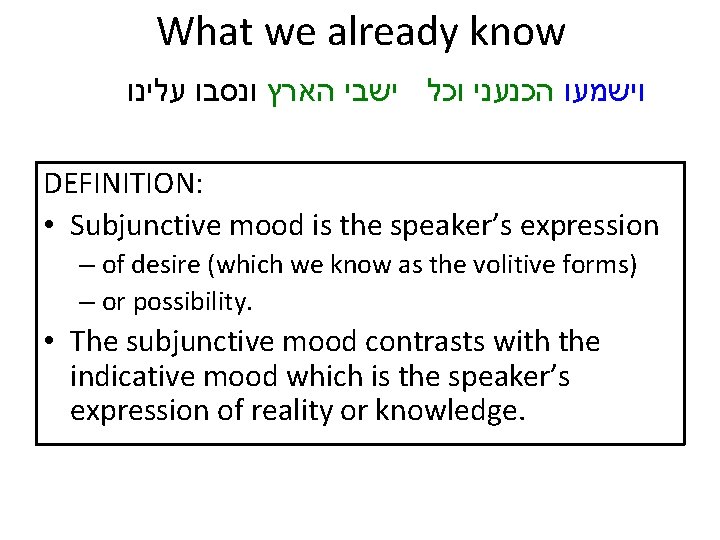
What we already know וישמעו הכנעני וכל ישבי הארץ ונסבו עלינו DEFINITION: • Subjunctive mood is the speaker’s expression – of desire (which we know as the volitive forms) – or possibility. • The subjunctive mood contrasts with the indicative mood which is the speaker’s expression of reality or knowledge.
Tense – Aspect – Modality • What is mood (e. g. subjunctive mood or indicative mood)? • How does mood differ from tense? • How do these both differ from aspect?
Tense – Aspect – Modality In modern linguistics many languages (incl. BH) are often described in terms of Tense-Aspect. Modality (TAM) and it’s really helpful to have some understanding of this.
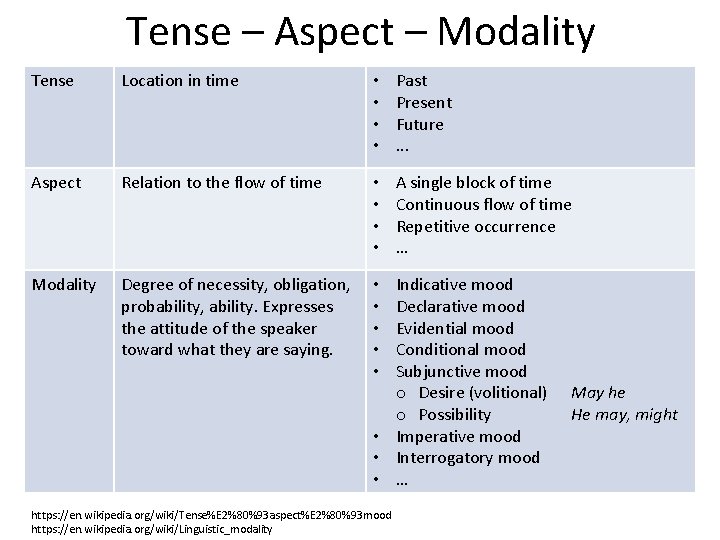
Tense – Aspect – Modality Tense Location in time • • Past Present Future. . . Aspect Relation to the flow of time • • A single block of time Continuous flow of time Repetitive occurrence … Modality Degree of necessity, obligation, probability, ability. Expresses the attitude of the speaker toward what they are saying. • • • Indicative mood Declarative mood Evidential mood Conditional mood Subjunctive mood o Desire (volitional) o Possibility • Imperative mood • Interrogatory mood • … https: //en. wikipedia. org/wiki/Tense%E 2%80%93 aspect%E 2%80%93 mood https: //en. wikipedia. org/wiki/Linguistic_modality May he He may, might
![Tense – Aspect – Modality The term [Tense-Aspect-Modality] is convenient because it is often](http://slidetodoc.com/presentation_image_h/134354213036ca5745f62655c5fdfbe7/image-15.jpg "Tense – Aspect – Modality The term [Tense-Aspect-Modality] is convenient because it is often")
Tense – Aspect – Modality The term [Tense-Aspect-Modality] is convenient because it is often difficult to untangle these features of a language. Often any two of tense, aspect, and mood (or all three) may be conveyed by a single grammatical construction, but this system may not be complete in that not all possible combinations may have an available construction. In other cases there may not be clearly delineated categories of tense and mood, or aspect and mood. For instance, many Indo-European languages do not clearly distinguish tense from aspect. In some languages, such as Spanish and Modern Greek, the imperfective aspect is fused with the past tense in a form traditionally called the imperfect. Other languages with distinct past imperfectives include Latin and Persian. https: //en. wikipedia. org/wiki/Tense%E 2%80%93 aspect%E 2%80%93 mood
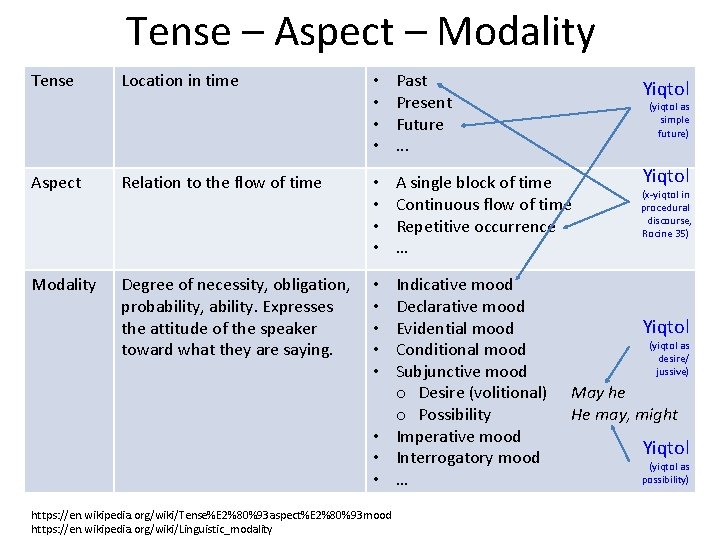
Tense – Aspect – Modality Tense Location in time • • Past Present Future. . . Yiqtol A single block of time Continuous flow of time Repetitive occurrence … Yiqtol Aspect Relation to the flow of time • • Modality Degree of necessity, obligation, probability, ability. Expresses the attitude of the speaker toward what they are saying. • • • Indicative mood Declarative mood Evidential mood Conditional mood Subjunctive mood o Desire (volitional) o Possibility • Imperative mood • Interrogatory mood • … https: //en. wikipedia. org/wiki/Tense%E 2%80%93 aspect%E 2%80%93 mood https: //en. wikipedia. org/wiki/Linguistic_modality (yiqtol as simple future) (x-yiqtol in procedural discourse, Rocine 35) Yiqtol (yiqtol as desire/ jussive) May he He may, might Yiqtol (yiqtol as possibility)
TAM in Biblical Hebrew For a succinct summary of TAM in BH see http: //berithroad. blogspot. ca/2011/02/tense-aspectmood-hebrew-verbs. html More a fuller discussion see http: //www. artsrn. ualberta. ca/cocoon/JHS/a 080. html http: //berithroad. blogspot. ca/2011/02/tense-aspect-mood-hebrew-verbs. html
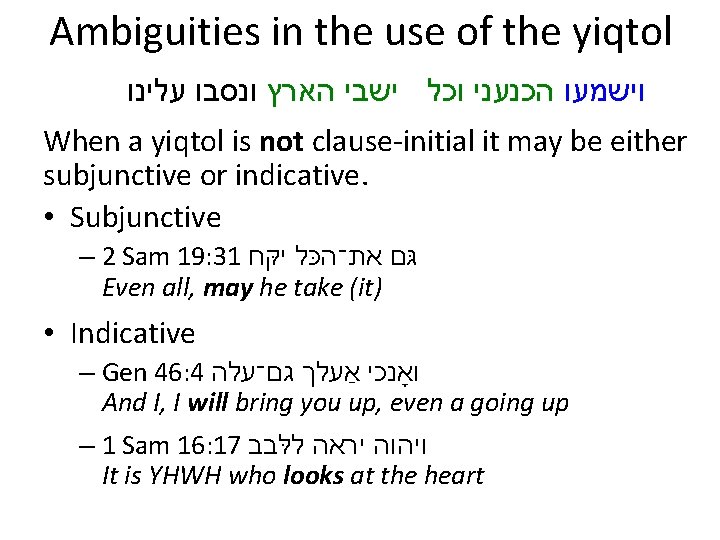
Ambiguities in the use of the yiqtol וישמעו הכנעני וכל ישבי הארץ ונסבו עלינו When a yiqtol is not clause-initial it may be either subjunctive or indicative. • Subjunctive – 2 Sam 19: 31 גּם את־הכּל יקּח Even all, may he take (it) • Indicative – Gen 46: 4 ואָנכי אַעלך גם־עלה And I, I will bring you up, even a going up – 1 Sam 16: 17 ויהוה יראה ללּבב It is YHWH who looks at the heart
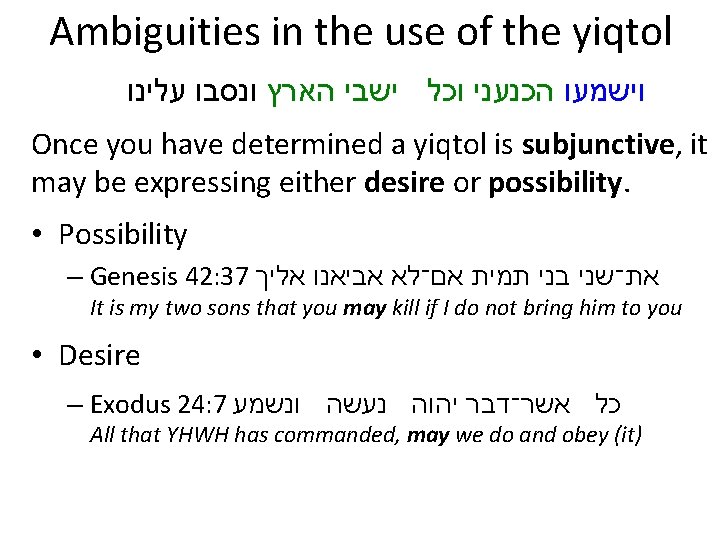
Ambiguities in the use of the yiqtol וישמעו הכנעני וכל ישבי הארץ ונסבו עלינו Once you have determined a yiqtol is subjunctive, it may be expressing either desire or possibility. • Possibility – Genesis 42: 37 את־שני בני תמית אם־לא אביאנו אליך It is my two sons that you may kill if I do not bring him to you • Desire – Exodus 24: 7 כל אשר־דבר יהוה נעשה ונשמע All that YHWH has commanded, may we do and obey (it)
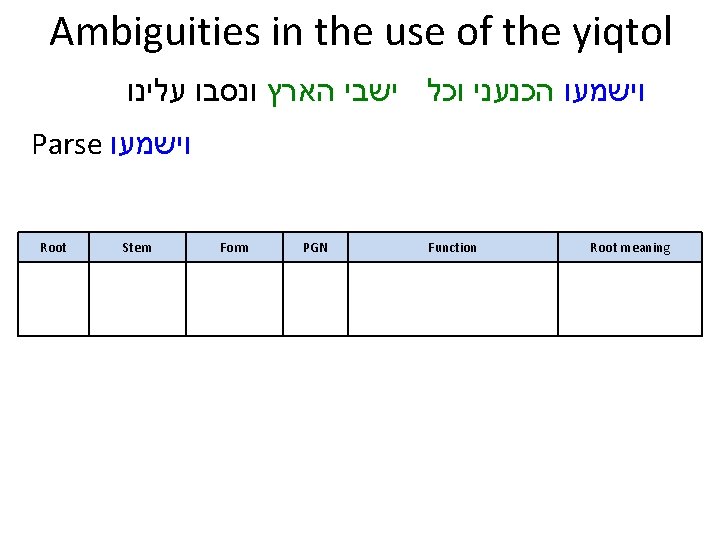
Ambiguities in the use of the yiqtol וישמעו הכנעני וכל ישבי הארץ ונסבו עלינו Parse וישמעו Root Stem Form PGN Function Root meaning
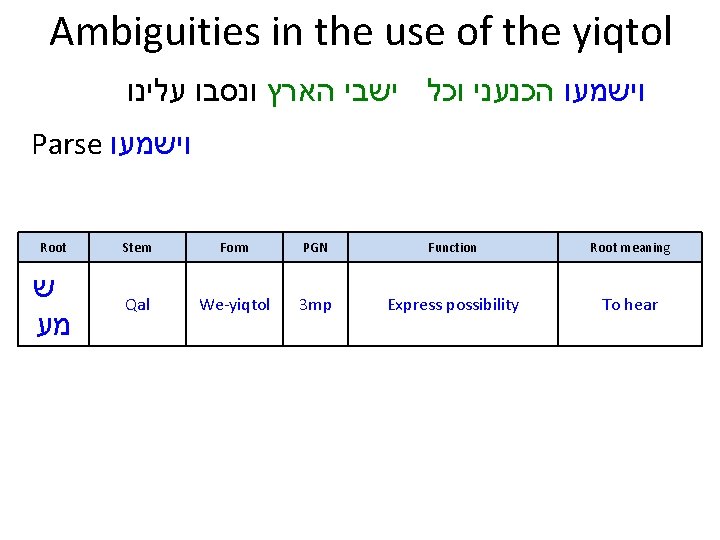
Ambiguities in the use of the yiqtol וישמעו הכנעני וכל ישבי הארץ ונסבו עלינו Parse וישמעו Root Stem Form PGN Function Root meaning ש מע Qal We-yiqtol 3 mp Express possibility To hear
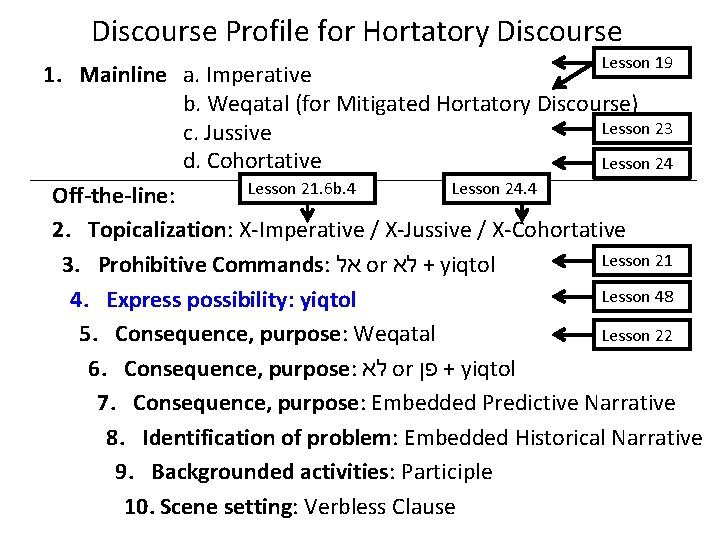
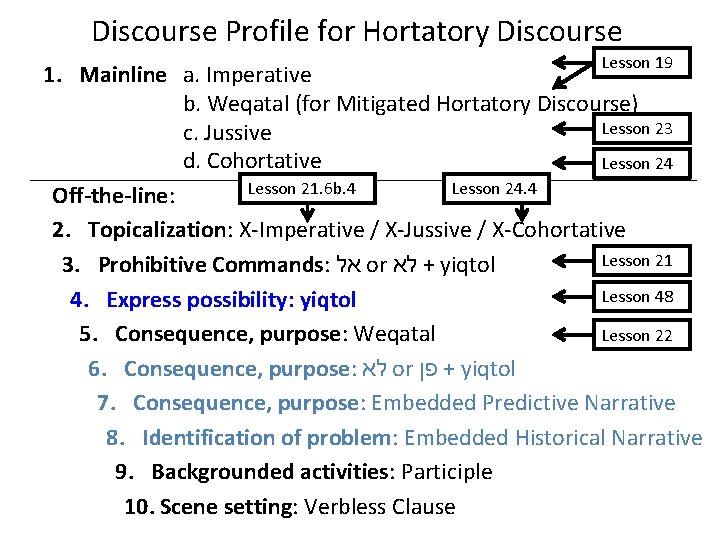
Discourse Profile for Hortatory Discourse Lesson 19 1. Mainline a. Imperative b. Weqatal (for Mitigated Hortatory Discourse) Lesson 23 c. Jussive d. Cohortative Lesson 24 Lesson 21. 6 b. 4 Lesson 24. 4 Off-the-line: 2. Topicalization: X-Imperative / X-Jussive / X-Cohortative Lesson 21 3. Prohibitive Commands: אל or לא + yiqtol Lesson 48 4. Express possibility: yiqtol Lesson 22 5. Consequence, purpose: Weqatal 6. Consequence, purpose: לא or פן + yiqtol 7. Consequence, purpose: Embedded Predictive Narrative 8. Identification of problem: Embedded Historical Narrative 9. Backgrounded activities: Participle 10. Scene setting: Verbless Clause
Discourse Profile for Hortatory Discourse Lesson 19 1. Mainline a. Imperative b. Weqatal (for Mitigated Hortatory Discourse) Lesson 23 c. Jussive d. Cohortative Lesson 24 Lesson 21. 6 b. 4 Lesson 24. 4 Off-the-line: 2. Topicalization: X-Imperative / X-Jussive / X-Cohortative Lesson 21 3. Prohibitive Commands: אל or לא + yiqtol Lesson 48 4. Express possibility: yiqtol Lesson 22 5. Consequence, purpose: Weqatal 6. Consequence, purpose: לא or פן + yiqtol 7. Consequence, purpose: Embedded Predictive Narrative 8. Identification of problem: Embedded Historical Narrative 9. Backgrounded activities: Participle 10. Scene setting: Verbless Clause
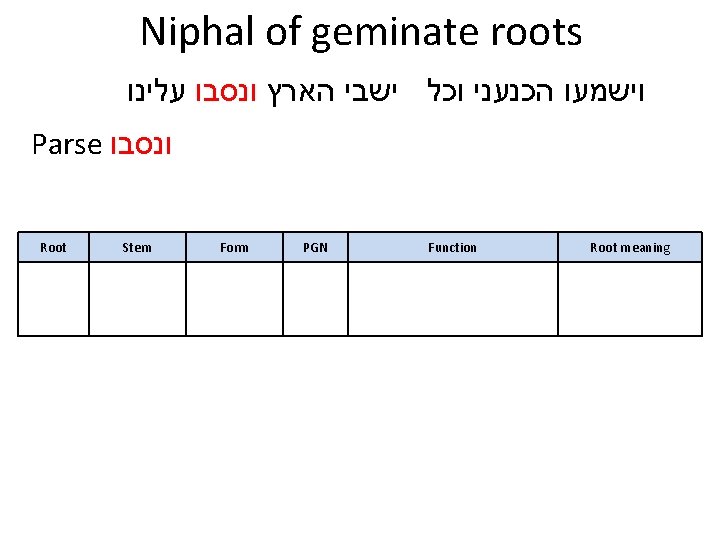
Niphal of geminate roots וישמעו הכנעני וכל ישבי הארץ ונסבו עלינו Parse ונסבו Root Stem Form PGN Function Root meaning
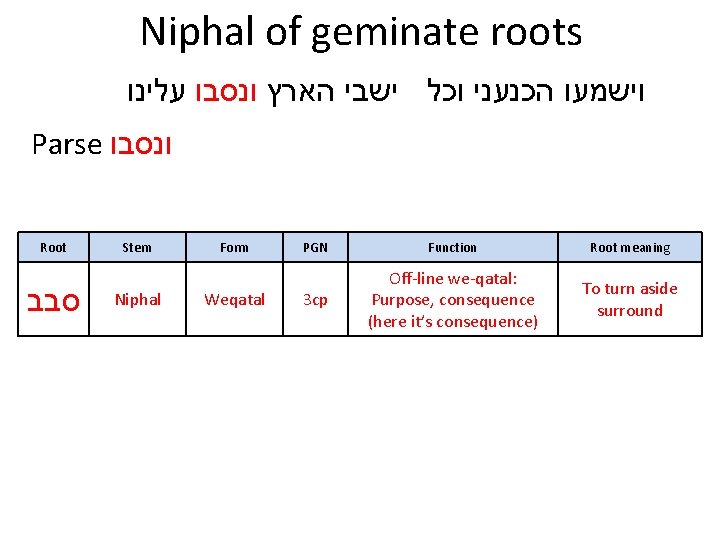
Niphal of geminate roots וישמעו הכנעני וכל ישבי הארץ ונסבו עלינו Parse ונסבו Root סבב Stem Niphal Form Weqatal PGN Function Root meaning 3 cp Off-line we-qatal: Purpose, consequence (here it’s consequence) To turn aside surround
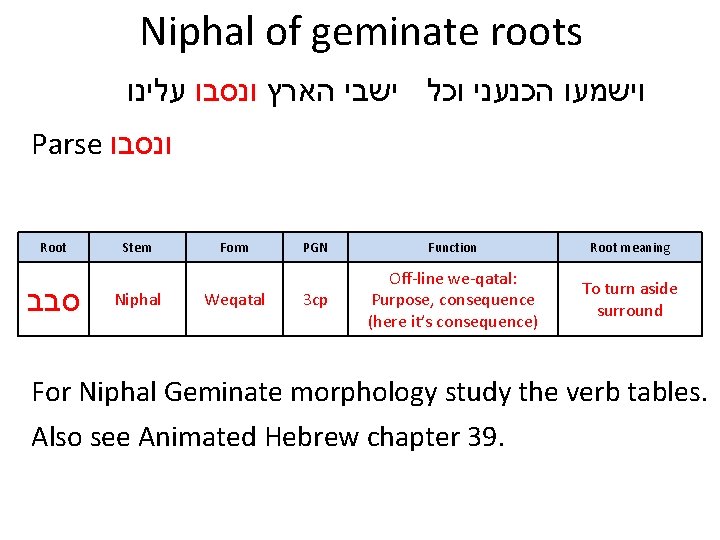
Niphal of geminate roots וישמעו הכנעני וכל ישבי הארץ ונסבו עלינו Parse ונסבו Root סבב Stem Niphal Form Weqatal PGN Function Root meaning 3 cp Off-line we-qatal: Purpose, consequence (here it’s consequence) To turn aside surround For Niphal Geminate morphology study the verb tables. Also see Animated Hebrew chapter 39.
Polel, and Pilpel Polel and Pilpel are two special stems/binyanim that can occur with Geminates. • Equivalent to Piel in meaning • Important but … – Not many attested – Easy to recognize
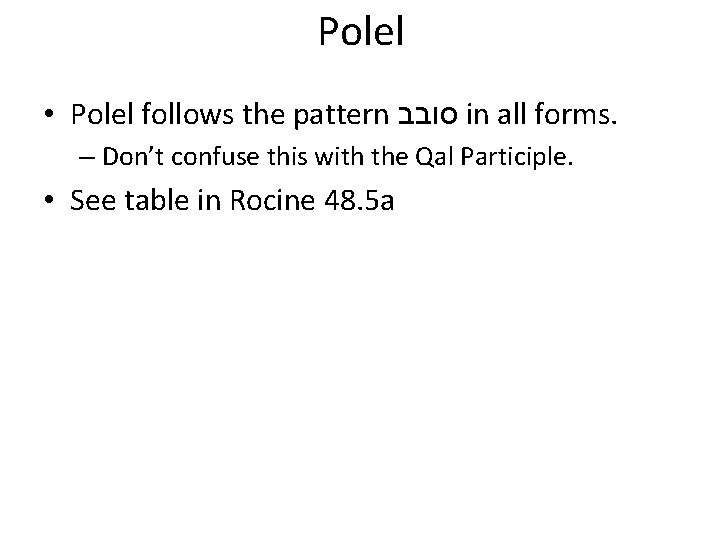
Polel • Polel follows the pattern סובב in all forms. – Don’t confuse this with the Qal Participle. • See table in Rocine 48. 5 a
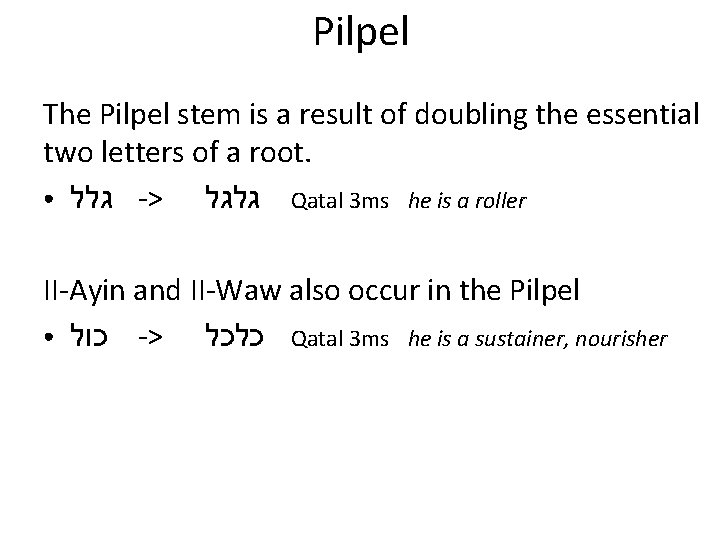
Pilpel The Pilpel stem is a result of doubling the essential two letters of a root. ● גלל -> גלגל Qatal 3 ms he is a roller II-Ayin and II-Waw also occur in the Pilpel ● כול -> כלכל Qatal 3 ms he is a sustainer, nourisher
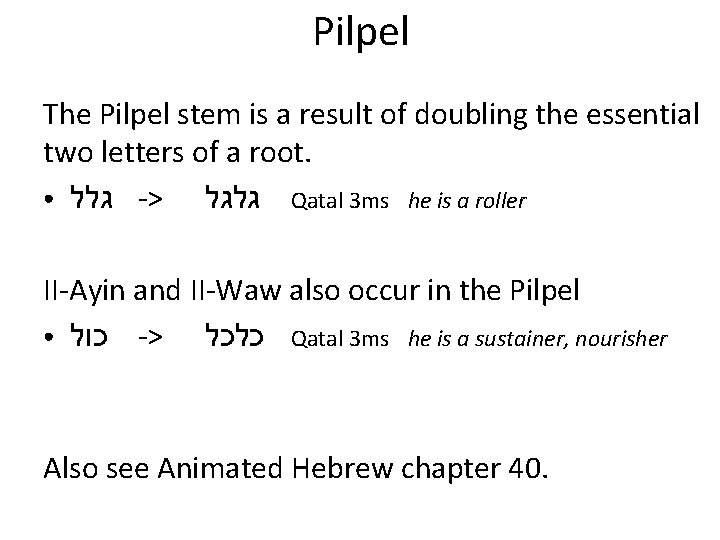
Pilpel The Pilpel stem is a result of doubling the essential two letters of a root. ● גלל -> גלגל Qatal 3 ms he is a roller II-Ayin and II-Waw also occur in the Pilpel ● כול -> כלכל Qatal 3 ms he is a sustainer, nourisher Also see Animated Hebrew chapter 40.
- Slides: 30