
GoalDirected Feature Learning Cornelius Weber and Jochen Triesch
Goal-Directed Feature Learning Cornelius Weber and Jochen Triesch Frankfurt Institute for Advanced Studies (FIAS) IJCNN, Atlanta, 17 th June 2009
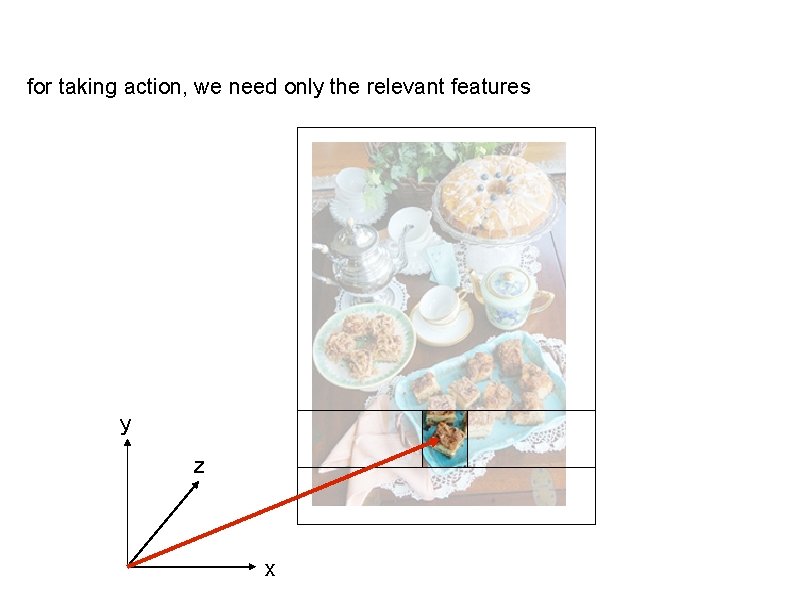
for taking action, we need only the relevant features y z x
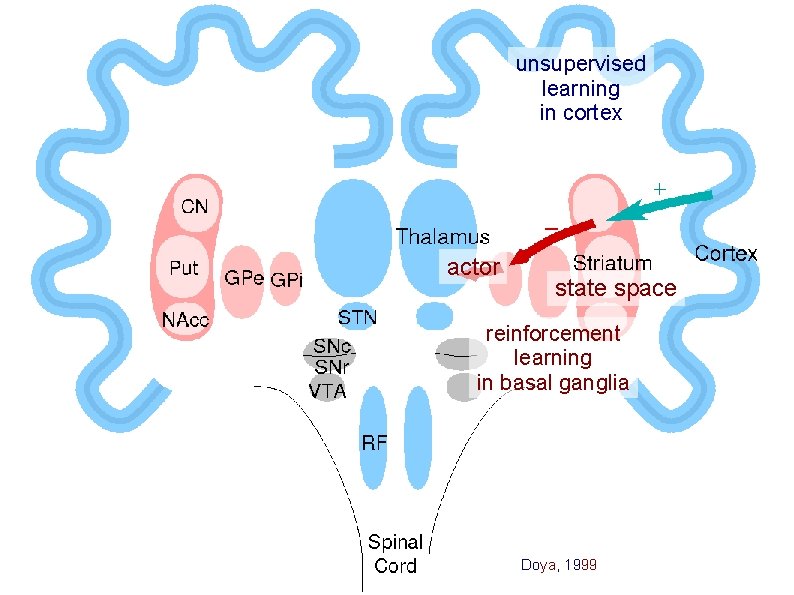
unsupervised learning in cortex actor state space reinforcement learning in basal ganglia Doya, 1999
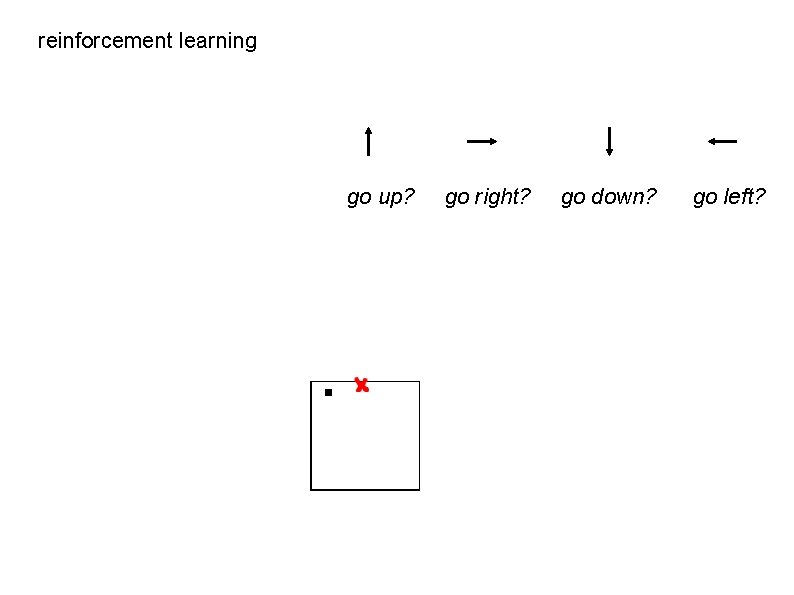
reinforcement learning go up? go right? go down? go left?
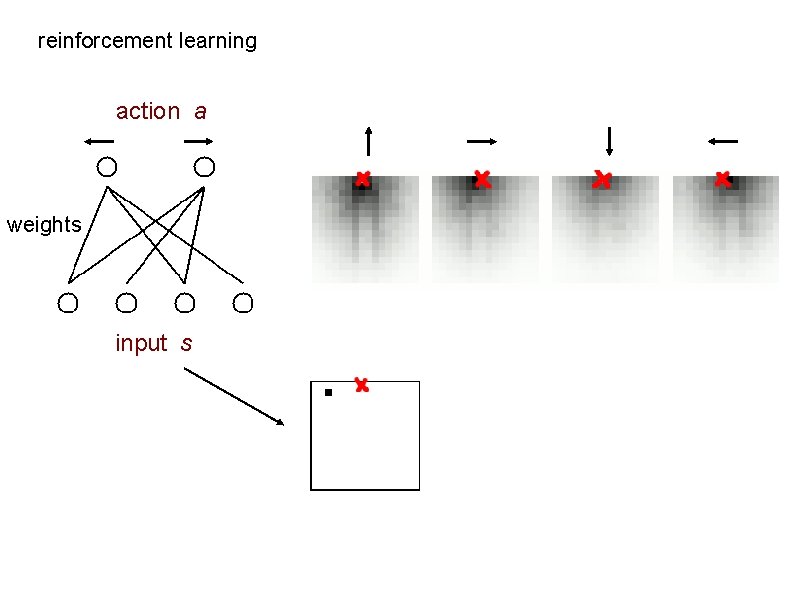
reinforcement learning action a weights input s
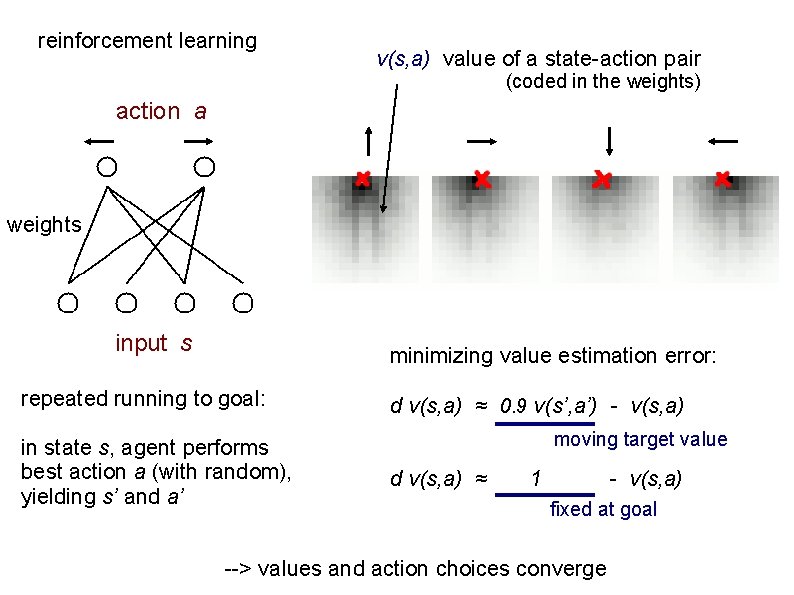
reinforcement learning v(s, a) value of a state-action pair (coded in the weights) action a weights input s minimizing value estimation error: repeated running to goal: in state s, agent performs best action a (with random), yielding s’ and a’ d v(s, a) ≈ 0. 9 v(s’, a’) - v(s, a) moving target value d v(s, a) ≈ 1 - v(s, a) fixed at goal --> values and action choices converge
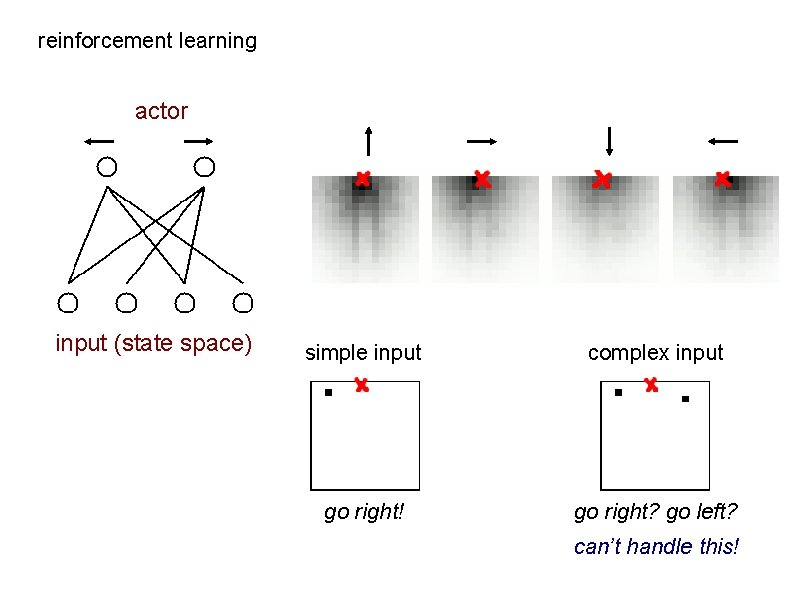
reinforcement learning actor input (state space) simple input complex input go right! go right? go left? can’t handle this!
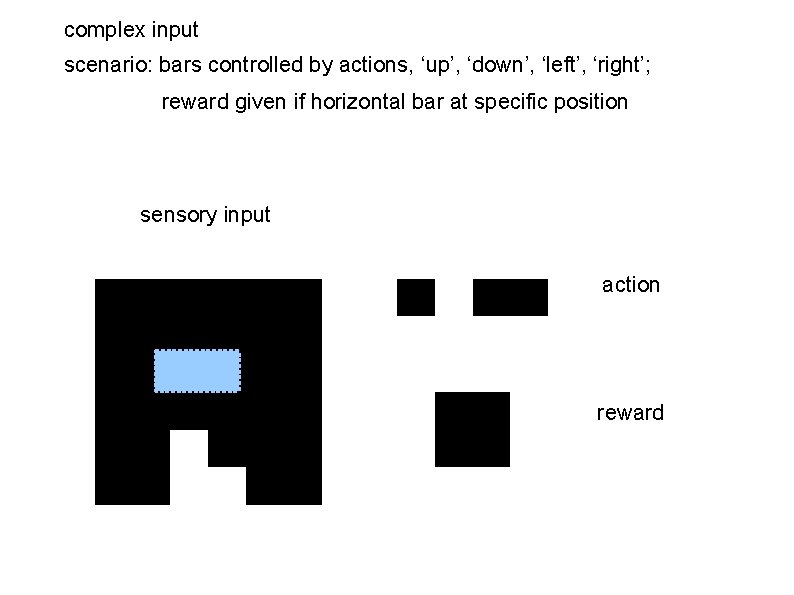
complex input scenario: bars controlled by actions, ‘up’, ‘down’, ‘left’, ‘right’; reward given if horizontal bar at specific position sensory input action reward
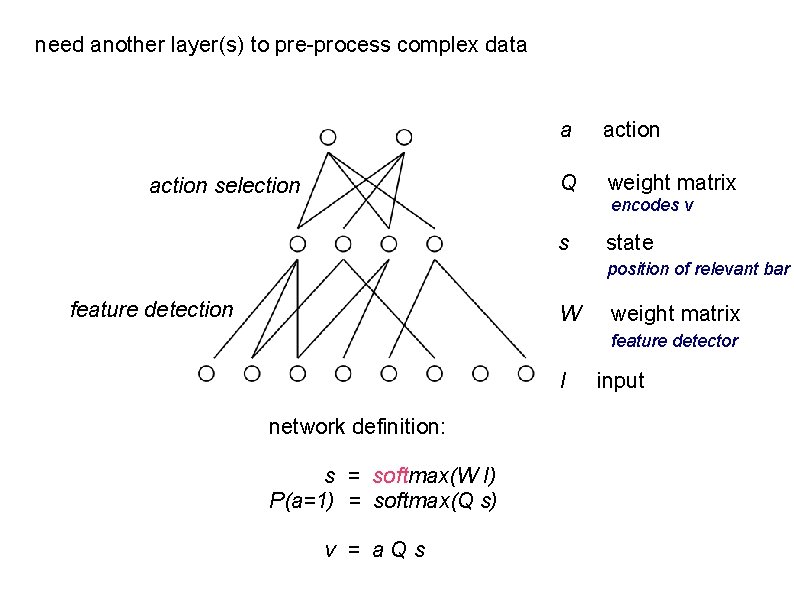
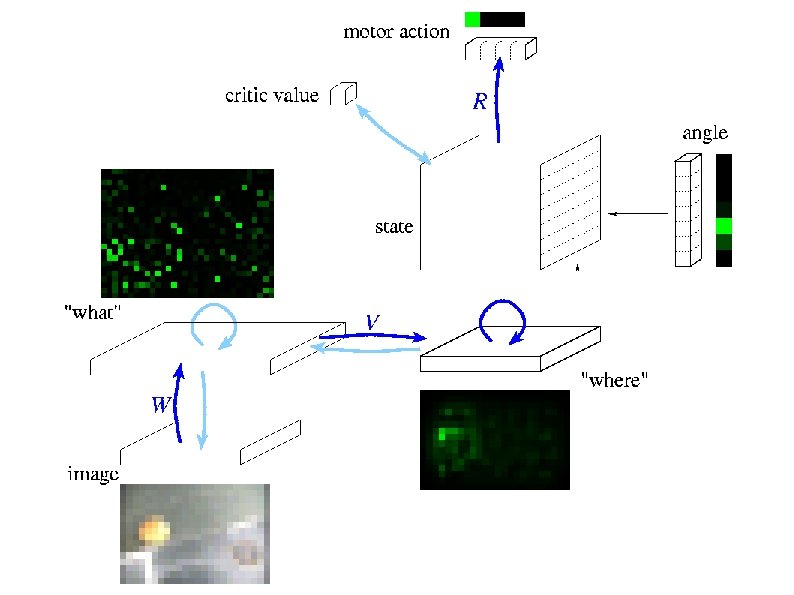
need another layer(s) to pre-process complex data action selection a action Q weight matrix encodes v s state position of relevant bar feature detection W weight matrix feature detector I network definition: s = softmax(W I) P(a=1) = softmax(Q s) v = a. Qs input
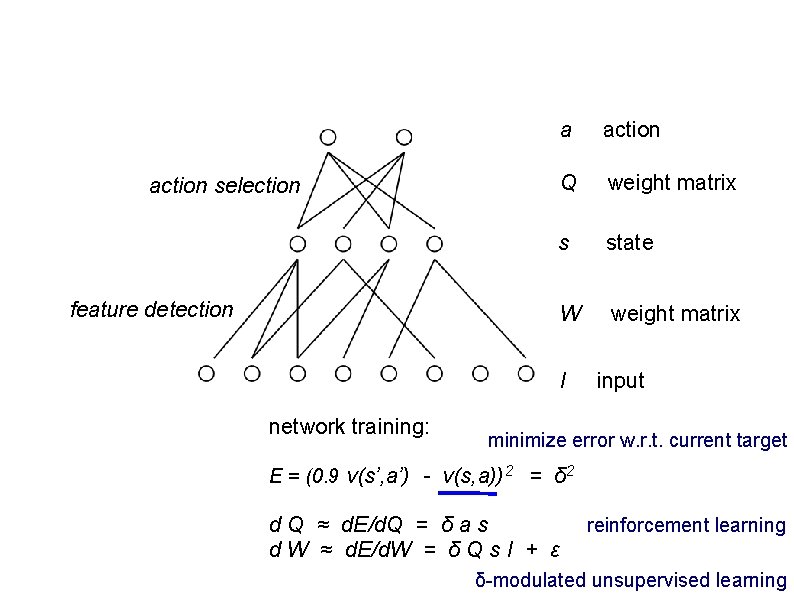
a action Q weight matrix s state W weight matrix action selection feature detection I network training: input minimize error w. r. t. current target E = (0. 9 v(s’, a’) - v(s, a))2 = δ 2 d Q ≈ d. E/d. Q = δ a s d W ≈ d. E/d. W = δ Q s I + ε reinforcement learning δ-modulated unsupervised learning
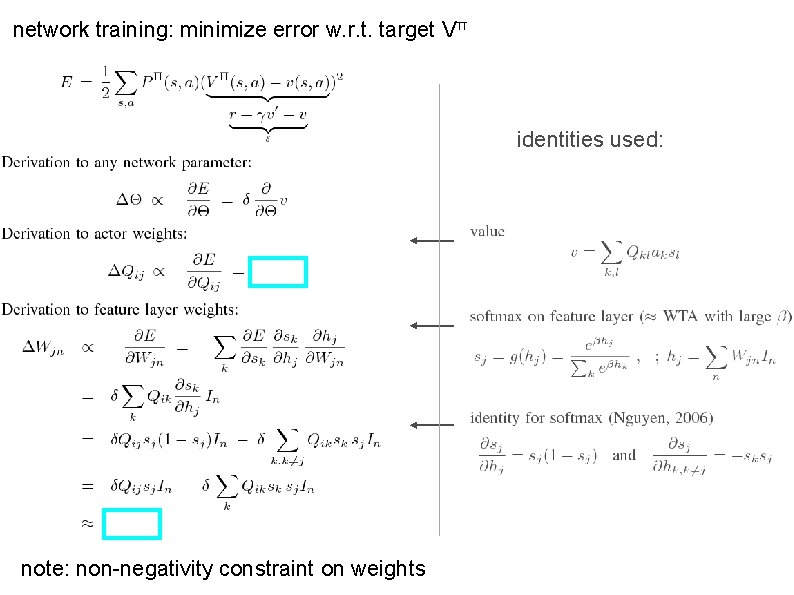
network training: minimize error w. r. t. target Vπ identities used: note: non-negativity constraint on weights
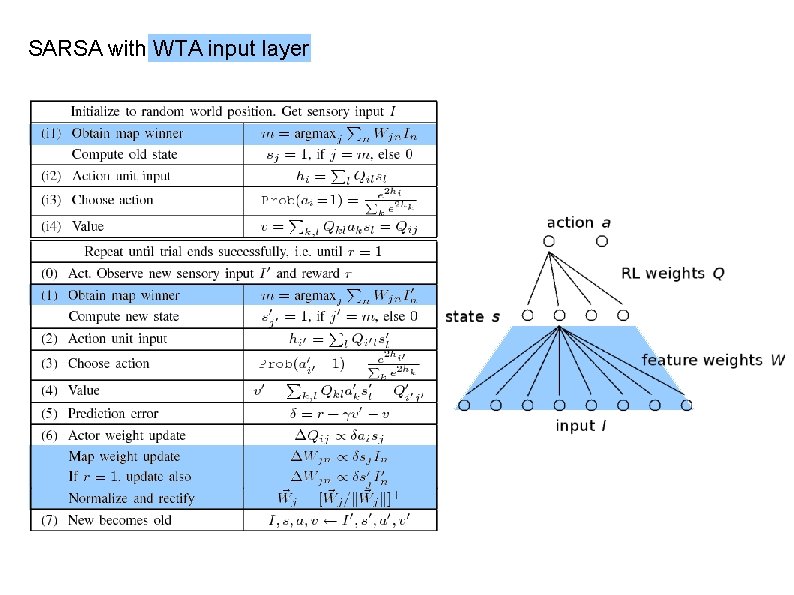
SARSA with WTA input layer
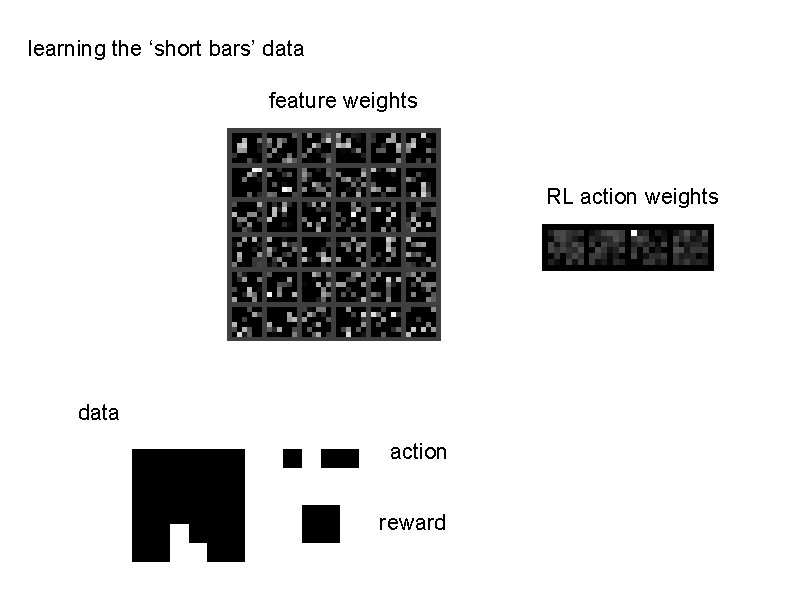
learning the ‘short bars’ data feature weights RL action weights data action reward
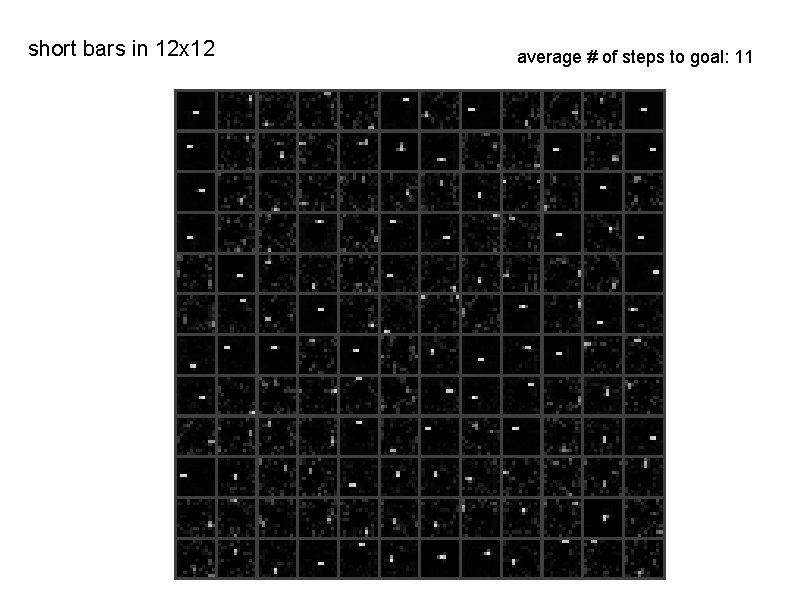
short bars in 12 x 12 average # of steps to goal: 11
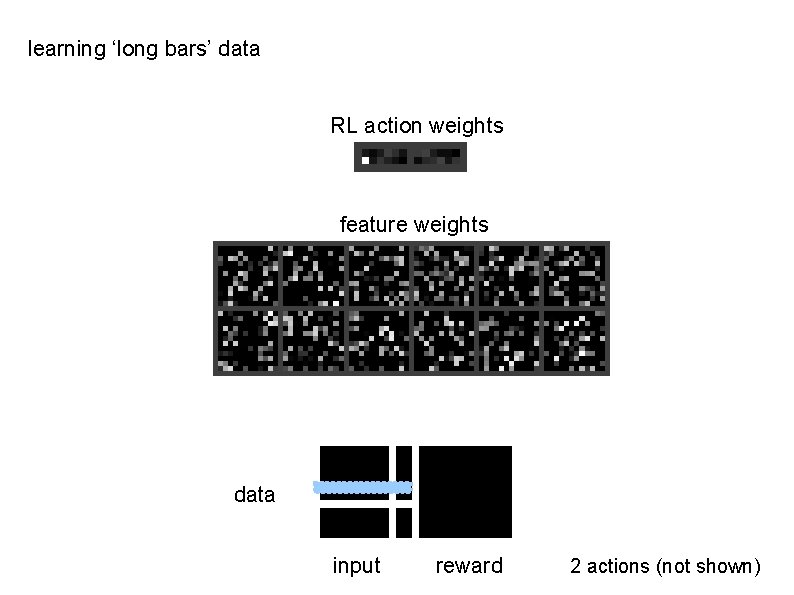
learning ‘long bars’ data RL action weights feature weights data input reward 2 actions (not shown)
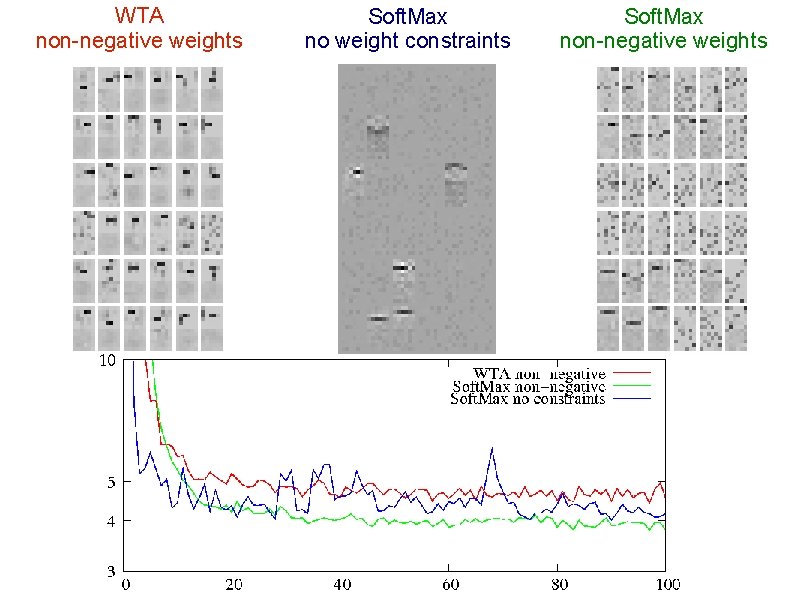
WTA non-negative weights Soft. Max no weight constraints Soft. Max non-negative weights
models’ background: - gradient descent methods generalize RL to several layers Sutton&Barto RL book (1998); Tesauro (1992; 1995) - reward-modulated Hebb Triesch, Neur Comp 19, 885 -909 (2007), Roelfsema & Ooyen, Neur Comp 17, 2176 -214 (2005); Franz & Triesch, ICDL (2007) - reward-modulated activity leads to input selection Nakahara, Neur Comp 14, 819 -44 (2002) - reward-modulated STDP Izhikevich, Cereb Cortex 17, 2443 -52 (2007), Florian, Neur Comp 19/6, 1468 -502 (2007); Farries & Fairhall, Neurophysiol 98, 3648 -65 (2007); . . . - RL models learn partitioning of input space e. g. Mc. Callum, Ph. D Thesis, Rochester, NY, USA (1996)
Discussion - two-layer SARSA RL performs gradient descent on value estimation error - approximation with winner-take-all leads to local rule with δ-feedback - learns only action-relevant features - non-negative coding aids feature extraction - link between unsupervised- and reinforcement learning - demonstration with more realistic data still needed Sponsors Bernstein Focus Neurotechnology, BMBF grant 01 GQ 0840 EU project 231722 “IM-CLe. Ve. R”, call FP 7 -ICT-2007 -3 Frankfurt Institute for Advanced Studies, FIAS

thank you. . . Sponsors Bernstein Focus Neurotechnology, BMBF grant 01 GQ 0840 EU project 231722 “IM-CLe. Ve. R”, call FP 7 -ICT-2007 -3 Frankfurt Institute for Advanced Studies, FIAS
- Slides: 21