
Goal To understand reflection and refraction Objectives 1
Goal: To understand reflection and refraction Objectives: 1) To understand Reflection off of a simple mirror 2) To learn about Scattering 3) To understand Refraction 4) To learn about Mirages 5) To explore Rainbows 6) To learn about Total Internal Reflection
When a photon meets a woman, err a surface • A few things can happen, and often times you will get all of these in different amounts. • 1) reflection – the light in essence bounces off of the surface. • In this case the angle which the light leaves is the same as it hits (θr = θi), as is the wavelength of light (in the perspective of the object it is hitting) • The % of light that gets reflected depends on the material it is hitting as well as the wavelength of light.
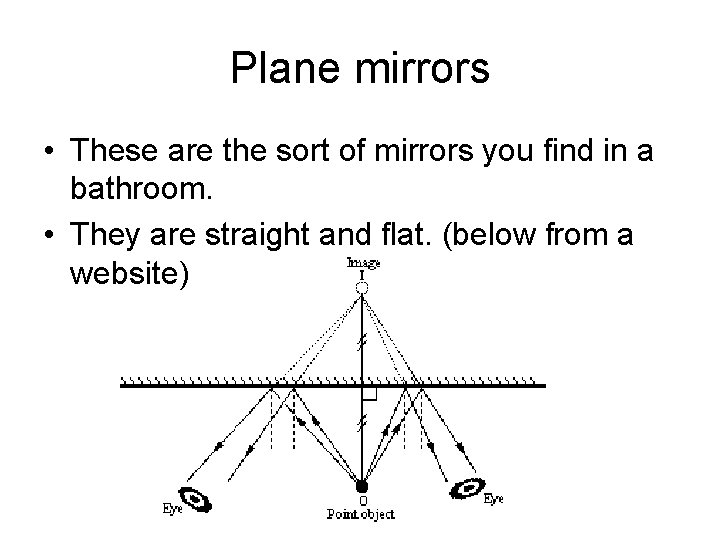
Plane mirrors • These are the sort of mirrors you find in a bathroom. • They are straight and flat. (below from a website)
Transmitted • 2) Some light will be transmitted. That is it will pass through the material. • This will also cause what is called refraction – but more on that later.
Absorption • 3) The material can absorb some of the energy. • The percentage it absorbs at some wavelength is called the albedo. • This can vary greatly with wavelength. • A thin layer of water, for example, does not absorb much light in the optical. • However, in the infrared it absorbs a LOT of energy. • Thus water vapor is a greenhouse gas (and the most abundant greenhouse gas in our atmosphere).
Scattering • • 4) Scattering. This is similar to reflection. However, most surfaces are not smooth. So, when the light hits the surface, it is not hitting a flat surface. • So, different light photons at slightly different positions can hit at a vastly different angle to the surface. • Therefore, they will reflect at a wide range of angles. • This is scattering. • Also, if light hits an electron the electron can absorb the photon and reemit in a random direction – thus scattering the light.
More on Refraction • A surface is defined to be a point where the index of refraction changes. • The most common form of this is when you have 2 different types of materials – such as air, glass, water, ect. • For each the speed of light is different. • When the light enters the material the speed changes but the rest of the wave which has not hit the surface is still going at the old pace. • This causes an accordion affect (like cyclists hitting a hill and piling up). • Also, the index of refraction depends on the wavelength of light – more on this at the end of class
Critical Angle • The most the refraction angle can be is 90 degrees (otherwise it would refract back into the substance, which does not make sense and is reflection) • That means that if you go from high index of refraction to low index of refraction there is a point where the refraction angle is 90 degrees. • This angle is called the Critical Angle. • If your initial angle is BIGGER than this, then there is NO refraction (this is called total internal reflection)! • Why would this be important?
Now for something completely different • But still the same. • RAINBOWS! • How are rainbows formed? • (a lot of scribbling on the board is about to come…)
Conclusion • We learned about what light does when it hits a surface or travels into another medium. • We now know how rainbows are created – sorry for ruining rainbows forever for all of you.
- Slides: 10