
Goal To enjoy particle physics Objectives Quarks neutrinos
Goal: To enjoy particle physics Objectives: Quarks, neutrinos, and Leptons – Oh my!
We have seen • How tiny a nucleus of an atom is, but what is a single proton or neutron made out of? • Lets dive in!
Contents of a proton • The only thing reselbling a particle inside a proton or a neutron is a quark. • A proton has 3 quarks. • The quark is only 0. 1 fm in size, so it does not take up much of the size. • It also does not take up much of the size either. • Also, the quark does not take up much of the energy (2%)

So, what makes up a proton? • Well, we don’t completely know, but most of it seems to be just energy in the form of Gluons. • Gluons sort of glue the quarks together. • But that isn’t all. • However, Gluons are really hard to observe, and everything else is even harder. • So, the simple proton isn’t quite so simple, and it will be a long time before we are able to unravel what protons are really made of.

Anti-particles (antimatter) • Before I talk about quarks I have to mention anti-particles. • Every particle type has an anti-particle. • If particle and anti-particle meet they destroy each other! • They will have the same mass and energy, but opposite charge. • So there anti-protons, anti-neutrons, positrons (anti-electrons), ect.
Quarks • • Each proton and neutron contains 3 quarks. Any object made of 3 quarks is called a Baryon. Any object made of 2 quarks is called a Meson. Objects probably not made of quarks are called Leptons. • Protons and Neutrons are Baryons. • The size of a quark is about 0. 1 fm. • Quarks never travel alone.
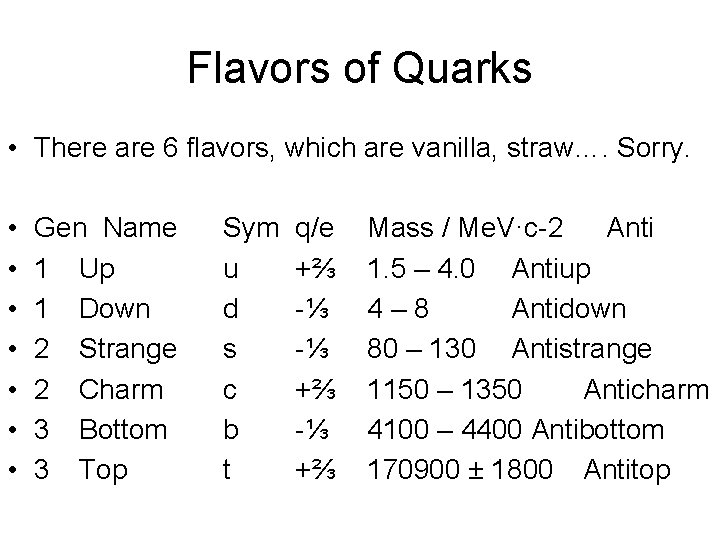
Flavors of Quarks • There are 6 flavors, which are vanilla, straw…. Sorry. • • Gen Name 1 Up 1 Down 2 Strange 2 Charm 3 Bottom 3 Top Sym u d s c b t q/e +⅔ -⅓ -⅓ +⅔ Mass / Me. V·c-2 Anti 1. 5 – 4. 0 Antiup 4– 8 Antidown 80 – 130 Antistrange 1150 – 1350 Anticharm 4100 – 4400 Antibottom 170900 ± 1800 Antitop
Other Baryons http: //en. wikipedia. org/wiki/List_of_baryons 21 different known particles + their anti particles Most found in collisions of atoms in a collider or cascades in atmosphere due to cosmic rays.
Mesons • • Have 2 quarks. http: //en. wikipedia. org/wiki/List_of_mesons Too boring to go to it though. The most famous are the Pions
Leptons • • • Notice I have not mentioned the electron yet. The electron is small. It is smaller than a quark. So, it probably does not have a quark. That makes it a Lepton. • The other Leptons are neutrinos, Muons, and Tau particles. • Neutrinos come in the flavors of all of the Lepton types (electron, Muon, Tau) • Neutrinos are formed during the fusion or fission process – so we get a lot of them from the sun, but they don’t interact with matter very well so are very hard to capture.
Other particles • There are particles which exchange energy. • The electromagnetic one is the photon. • For the strong force there is the Gluon (which has no mass, just energy). • The weak force uses quarks and leptons. • The only one we don’t know about is gravity. • That one is theoretically the “graviton” but it has not been observed.
Strong interaction • This is the force that holds the nucleus of an atom together. • If a quark gets pulled out of a proton the Gluons go with it. • That causes an increase in energy which causes the formation of a pair of quarks. • This gives the removed quark back to the atom it was taken from.
Conclusion • In the last 100 years we have gone from barely knowing the structure of an atom to having some really cool insight as to what atoms are made of. • However, this is still a lot to know and learn over the next 100 years!
- Slides: 13