
GOAL SETTING IN SPORT AND PHYSICAL ACTIVITY Damon



- Slides: 29
GOAL SETTING IN SPORT AND PHYSICAL ACTIVITY Damon Burton, Ph. D. University of Idaho
WHAT ARE GOALS? • Goals – are like magnets that attract us to higher ground and new horizons. They give our eyes a focus, our mind an aim, and our strength a purpose. Without their pull, we would remain forever stationary, incapable of moving forward. . . A goal is a possibility that fulfills a dream (Lessin, 1999)
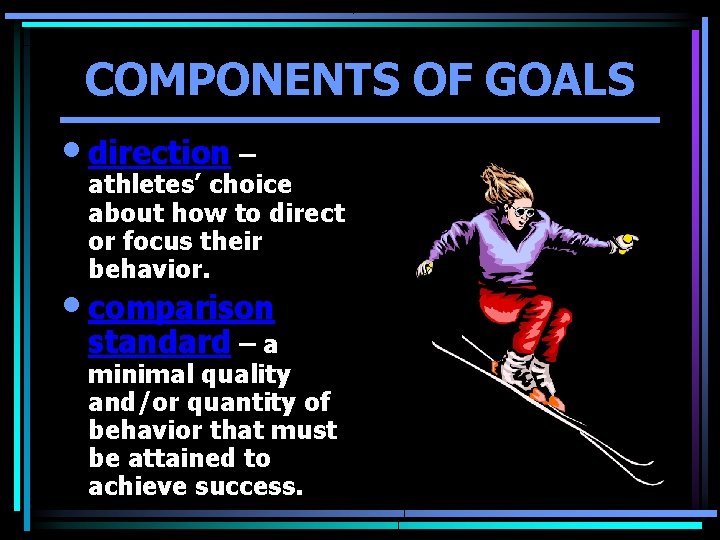
COMPONENTS OF GOALS • direction – athletes’ choice about how to direct or focus their behavior. • comparison standard – a minimal quality and/or quantity of behavior that must be attained to achieve success.
HOW GOALS WORK • • • Focus attention on specific tasks Increase effort and intensity Encourage persistence • Promote the development of new task strategies (e. g. , problemsolving strategies)
DO GOALS WORK? • Goal setting is the most popular and effective performanceenhancement technique used in sport psychology • Over 90% of all business studies and almost 80% of all sport studies demonstrate goal setting effects, normally in 6 weeks or less.
WHAT TYPES OF GOALS ARE MOST EFFECTIVE? • process, performance and/or outcome goals, • specific and/or general goals, • easy, moderate and/or difficult goals, • positive and/or negative goals, • practice and/or competitive goals, • short-term and/or long-term goals, and • individual and/or team goals.
GOAL FOCUS: PROCESS, PERFORMANCE & OUTCOME GOALS • • • Process goals focus on improving form, technique and strategies. Performance goals emphasize improving personal performance or attaining a particular performance standard. Outcome goals concentrate on winning and outperforming others.
GOAL FOCUS: PROCESS, PERFORMANCE & OUTCOME GOALS • Process/performance goals promote better performance than outcome goals because they are flexible & controllable. v. Controllability – athletes should control as much of their own success or goal attainment as possible. v. Flexibility – goals should be easy to raise and lower to ensure optimal goal difficulty in every situation.
GOAL DIFFICULTY: DIFFICULT, MODERATE OR EASY GOALS • • Research confirms that most athletes prefer moderately difficult goals that are 5 -15% above current performance capabilities, Orlick recommends 3 goal difficulty levels, v Dream Goals – level of performance possible if athletes experience Flow. v Realistic Goals – moderately difficult level of performance possible if the athlete performs well-- up to expectations. v Growth Goals – lowest level of performance that a competitor can achieve and still feel successful.
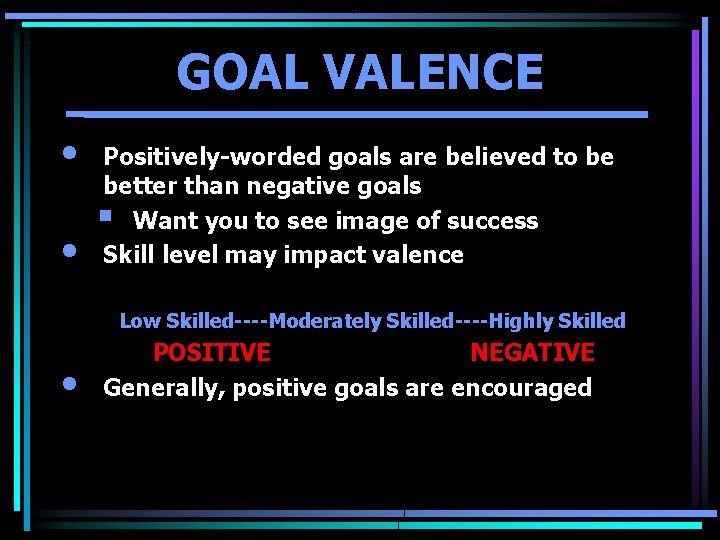
GOAL VALENCE • • Positively-worded goals are believed to be better than negative goals § Want you to see image of success Skill level may impact valence Low Skilled----Moderately Skilled----Highly Skilled • POSITIVE NEGATIVE Generally, positive goals are encouraged
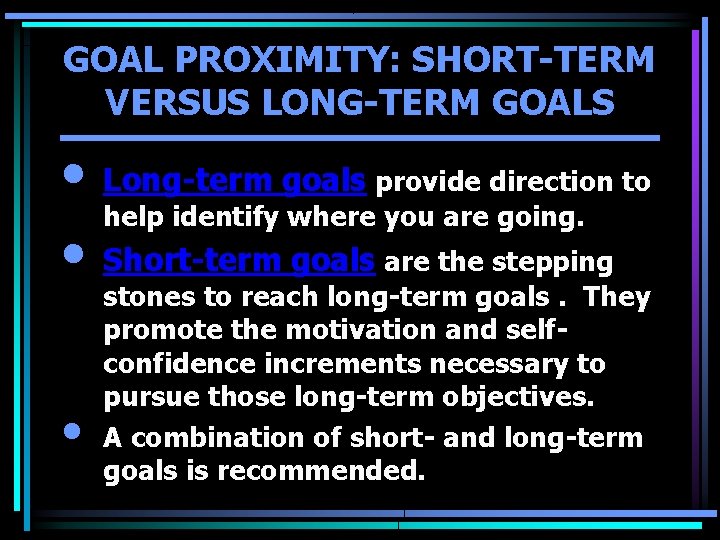
GOAL PROXIMITY: SHORT-TERM VERSUS LONG-TERM GOALS • • • Long-term goals provide direction to help identify where you are going. Short-term goals are the stepping stones to reach long-term goals. They promote the motivation and selfconfidence increments necessary to pursue those long-term objectives. A combination of short- and long-term goals is recommended.
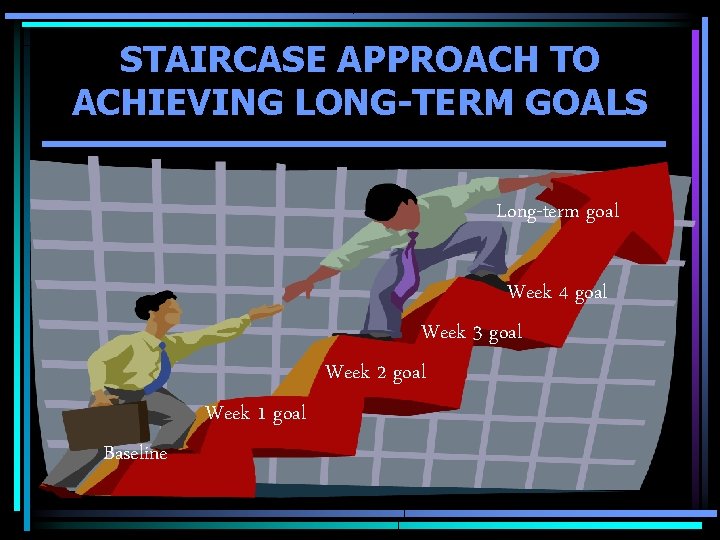
STAIRCASE APPROACH TO ACHIEVING LONG-TERM GOALS Long-term goal Week 4 goal Week 3 goal Week 2 goal Week 1 goal Baseline
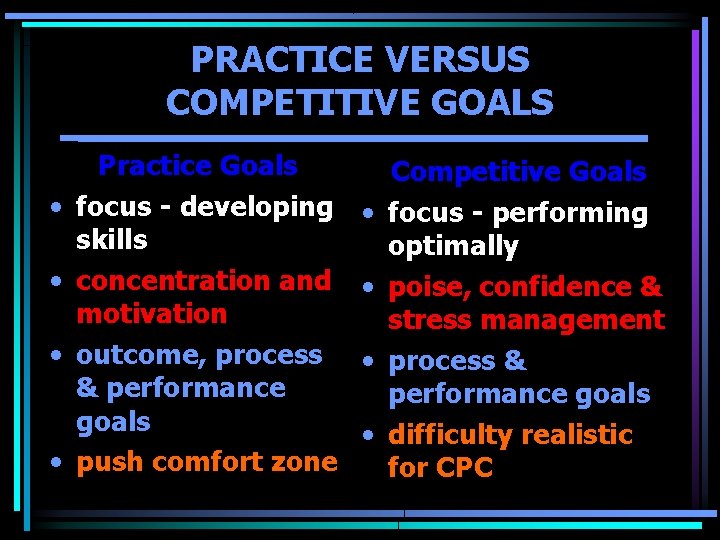
PRACTICE VERSUS COMPETITIVE GOALS • • Practice Goals focus - developing skills concentration and motivation outcome, process & performance goals push comfort zone • • Competitive Goals focus - performing optimally poise, confidence & stress management process & performance goals difficulty realistic for CPC
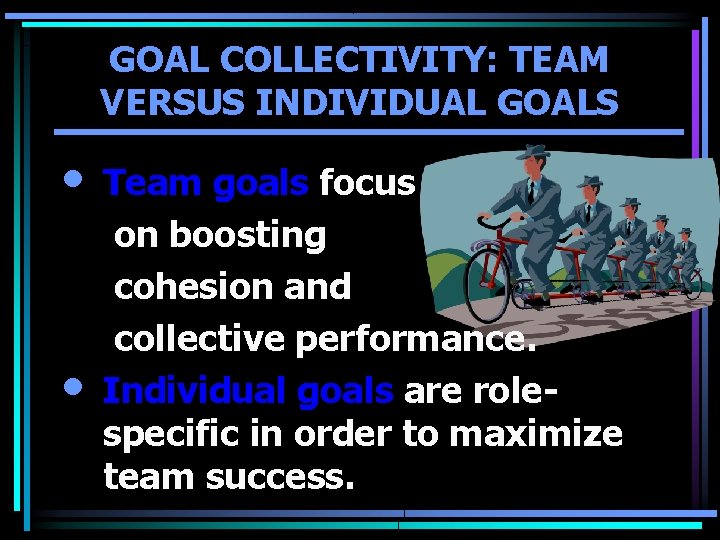
GOAL COLLECTIVITY: TEAM VERSUS INDIVIDUAL GOALS • • Team goals focus on boosting cohesion and collective performance. Individual goals are rolespecific in order to maximize team success.
WHY TEAM GOALS PROMOTE SOCIAL LOAFING? • The larger the number of team • • • members, the less effort each athlete expends. Social loafing declines when identifiability and accountability increase. Individual goals counter social loafing. A combination of team and individual goals is recommended.
CRITIQUE “SMART GOALS” S M A A R T pecific easurable ggressive & chievable elevant ime-bound
‘DRUM’ GOALS CREATE RHYTHM FOR IMPROVEMENT D R U M aily realistic rgent easurable
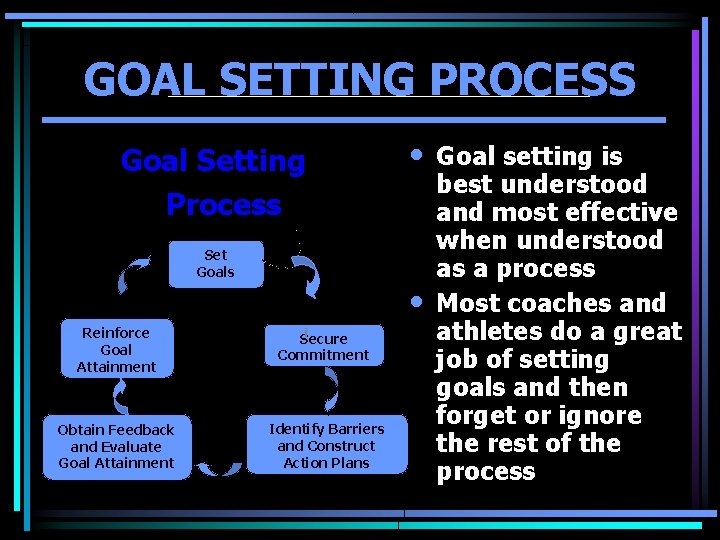
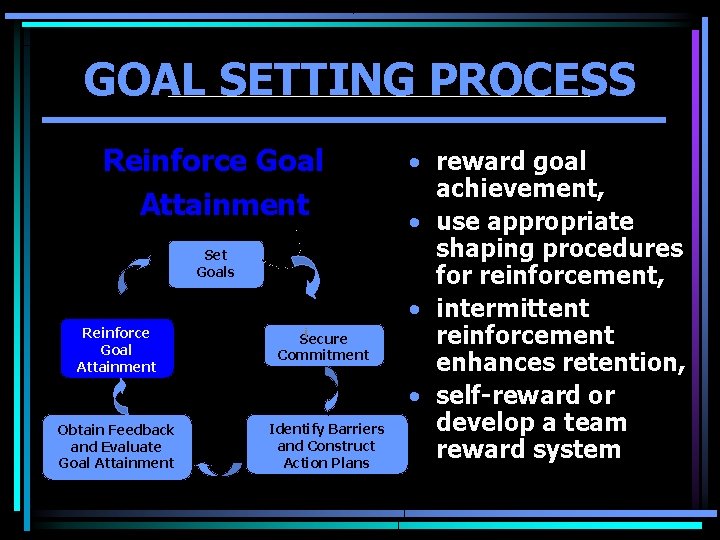
GOAL SETTING PROCESS Goal Setting Process • Goal setting is Set Goals • Reinforce Goal Attainment i Secure Commitment Obtain Feedback and Evaluate Goal Attainment Identify Barriers and Construct Action Plans best understood and most effective when understood as a process Most coaches and athletes do a great job of setting goals and then forget or ignore the rest of the process
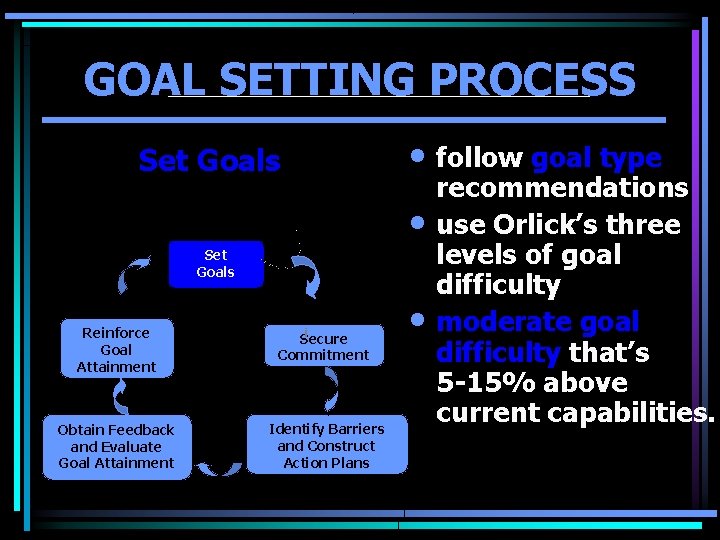
GOAL SETTING PROCESS Set Goals • follow goal type • Set Goals Reinforce Goal Attainment i Secure Commitment Obtain Feedback and Evaluate Goal Attainment Identify Barriers and Construct Action Plans • recommendations use Orlick’s three levels of goal difficulty moderate goal difficulty that’s 5 -15% above current capabilities.
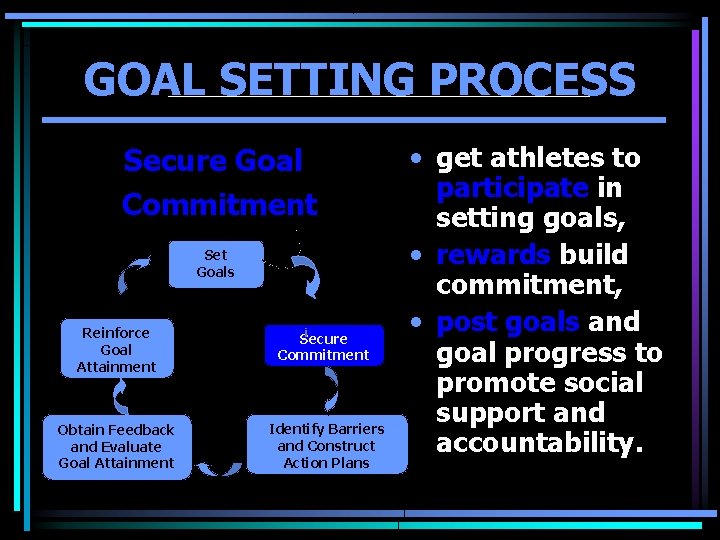
GOAL SETTING PROCESS Secure Goal Commitment Set Goals Reinforce Goal Attainment i Secure Commitment Obtain Feedback and Evaluate Goal Attainment Identify Barriers and Construct Action Plans • get athletes to participate in setting goals, • rewards build commitment, • post goals and goal progress to promote social support and accountability.
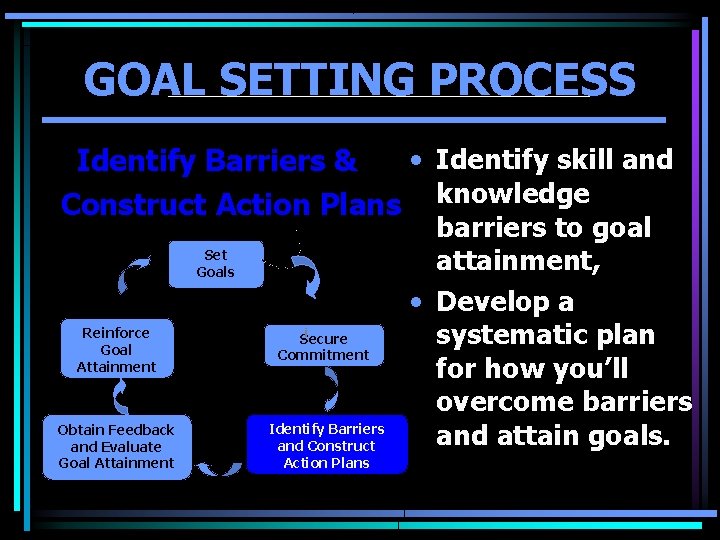
GOAL SETTING PROCESS • Identify skill and Identify Barriers & Construct Action Plans knowledge Set Goals Reinforce Goal Attainment i Secure Commitment Obtain Feedback and Evaluate Goal Attainment Identify Barriers and Construct Action Plans barriers to goal attainment, • Develop a systematic plan for how you’ll overcome barriers and attain goals.
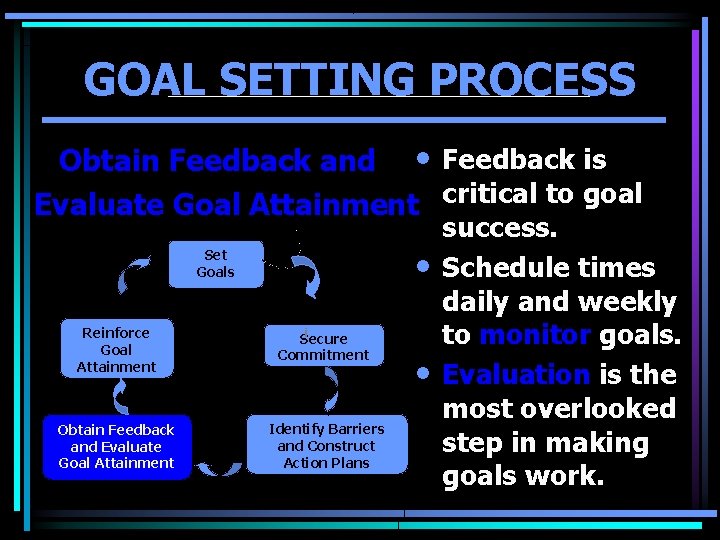
GOAL SETTING PROCESS Obtain Feedback and • Feedback is Evaluate Goal Attainment critical to goal • Set Goals Reinforce Goal Attainment i Secure Commitment Obtain Feedback and Evaluate Goal Attainment Identify Barriers and Construct Action Plans • success. Schedule times daily and weekly to monitor goals. Evaluation is the most overlooked step in making goals work.
GOAL SETTING PROCESS Reinforce Goal Attainment Set Goals Reinforce Goal Attainment i Secure Commitment Obtain Feedback and Evaluate Goal Attainment Identify Barriers and Construct Action Plans • reward goal achievement, • use appropriate shaping procedures for reinforcement, • intermittent reinforcement enhances retention, • self-reward or develop a team reward system
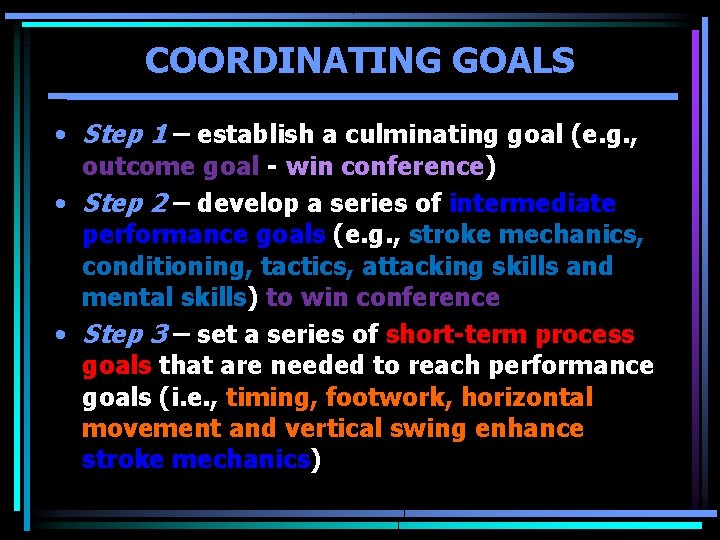
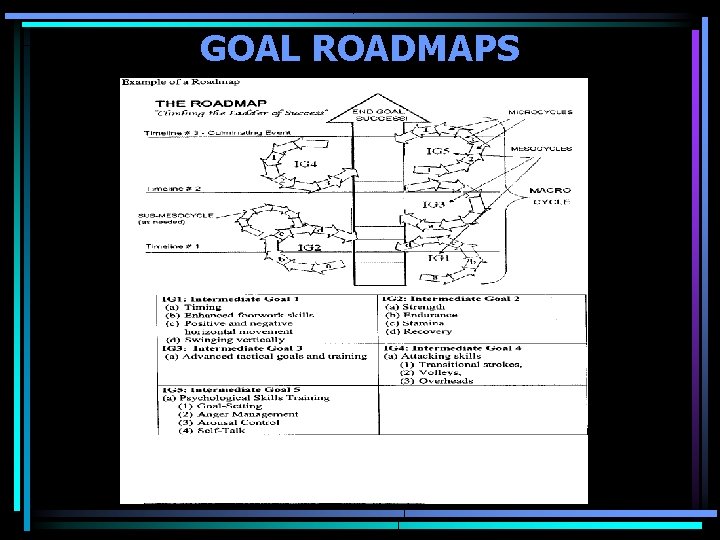
COORDINATING GOALS • Step 1 – establish a culminating goal (e. g. , outcome goal - win conference) • Step 2 – develop a series of intermediate performance goals (e. g. , stroke mechanics, conditioning, tactics, attacking skills and mental skills) to win conference • Step 3 – set a series of short-term process goals that are needed to reach performance goals (i. e. , timing, footwork, horizontal movement and vertical swing enhance stroke mechanics)
GOAL ROADMAPS
DEVELOPING A “GOAL MENTALITY” • “Goal Mentality” – is the mindset to love setting goals and set them spontaneously and systematically in everything you do. • Setting goals become self-fueling and increases intrinsic motivation and steadily enhances selfconfidence.
“GOAL MENTALITY” REQUIREMENTS • A minimum of 8 -12 weeks is necessary to create a “goal mentality” (GM) • The process requires setting daily goals and monitoring them closely while learning how to set goals effectively and building a history of success needed to optimize intrinsic motivation and self-confidence.
COMMON GOAL PROBLEMS • failure to sell practitioners on goal setting • • • to ensure commitment, setting goals that are not measurable and realistic, unwillingness to raise and lower goals to maintain optimal difficulty, setting too many goals, focusing too much on outcome goals, forgetting to monitor and evaluate goals. Develop a ”goal roadmap” to coordinate goals