
GOAL SETTING DELEGATION AND SUPERVISION Goals set direction









- Slides: 41
GOAL SETTING, DELEGATION AND SUPERVISION
� Goals set direction, provide purpose and accountability as well as outline a roadmap. They also provide direction and focus for the individuals as well as for the team buy-in.
� A goal is a destination. � It should answer the question of who we are and what we want to accomplish. � Goals are written, relevant, attainable, observable, broad statement of a desired end. � Goals reflect the mission of the group and give common focus to group’s efforts.
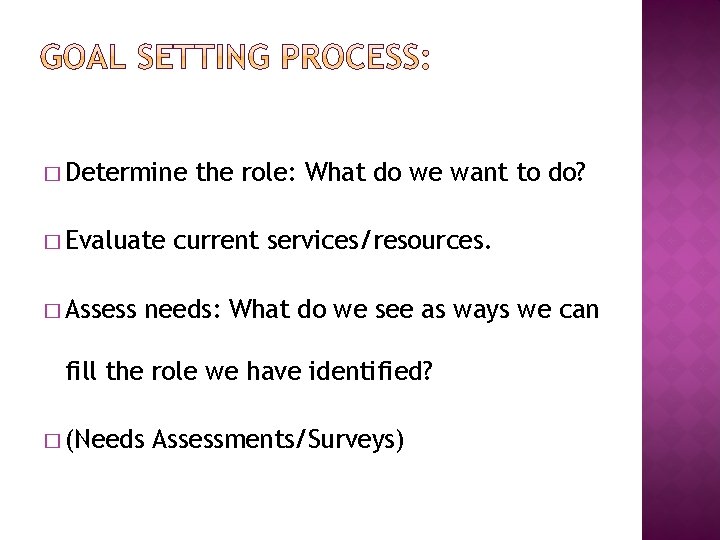
� Determine � Evaluate � Assess the role: What do we want to do? current services/resources. needs: What do we see as ways we can fill the role we have identified? � (Needs Assessments/Surveys)
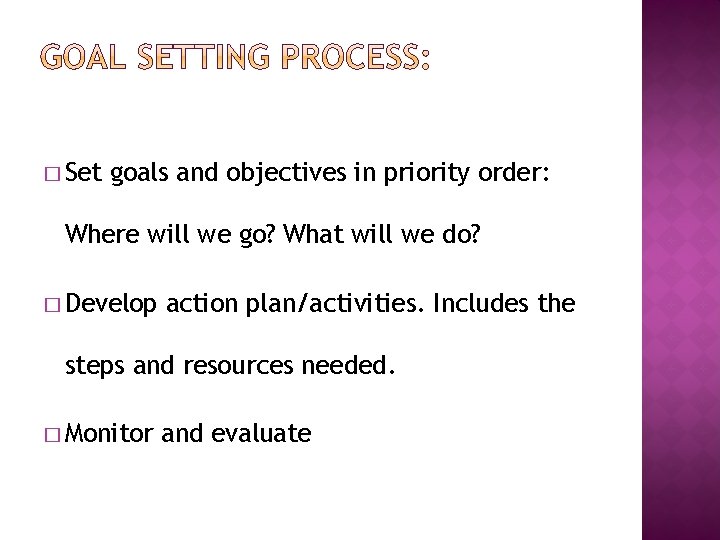
� Set goals and objectives in priority order: Where will we go? What will we do? � Develop action plan/activities. Includes the steps and resources needed. � Monitor and evaluate
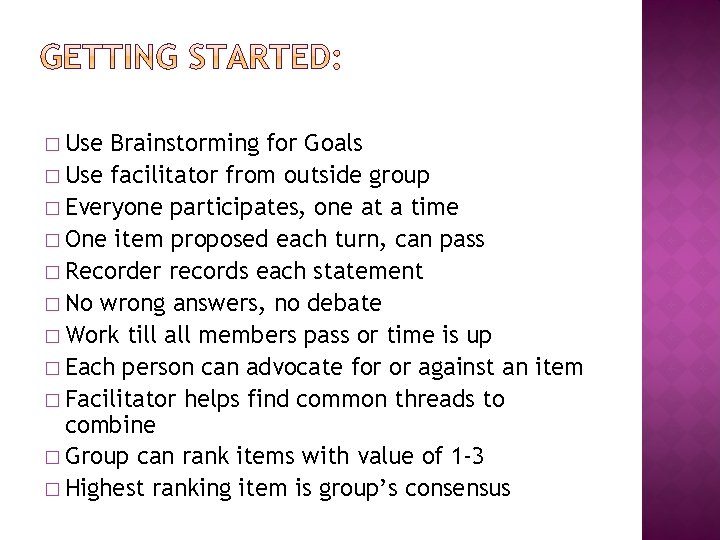
� Use Brainstorming for Goals � Use facilitator from outside group � Everyone participates, one at a time � One item proposed each turn, can pass � Recorder records each statement � No wrong answers, no debate � Work till all members pass or time is up � Each person can advocate for or against an item � Facilitator helps find common threads to combine � Group can rank items with value of 1 -3 � Highest ranking item is group’s consensus
LET GO BUT DON’T ABANDON
NEW MONTH NEW GOALS PURPOSE IN LIFE
� Delegation and goal setting are two of the most important tools at your disposal. � Leaders of organizations need to mobilize and organize their resources, especially the human ones, to get the job done
� Ask the following questions to help you decide whether or not to delegate something:
� Do I have sufficient time to complete the task properly? If the answer is no, delegate it! � Does the task specifically require my supervision or attention? If it doesn’t, assign it to someone else.
� Are my personal skills and expertise required to complete the task? If not, hand it off. � If I do not fulfill the assignment personally, will my reputation or the board’s be hurt? If the answer is still no, then delegate it.
� Is there a member of the board who would benefit from, and learn, new skills by handling the assignment? � If the answer is yes, offer him or her the gift of learning by doing. � Give him or her the opportunity to take on a
1. Review the tasks to be done; Determine which ones others should do. 2. Select the person best suited for the specific task. Encourage, train and motivate the person to accept the assignment.
3. Explain the task fully and then turn over the job and the authority to accomplish it to that person. Check to be certain that your expectations are clearly understood. 4. Ask questions to be certain that your expectations have been understood. Then step away and let the person complete the task
5. Provide support, encourage independence and develop confidence. ; Restrain from over checking on the progress of the task. 6. Keep supervisory control, because, ultimately, proper completion of the task is your responsibility.
� Definition: The assignment to others of the authority for particular functions, tasks and decisions
� It's easy to talk about delegation, but it's not so easy to do. And it's a critical decision, mainly because some tasks should be handled only by you but others, which take up your valuable time, can easily be handled by someone else
� There's no rule of thumb; let your instincts guide you. � You probably wouldn't want to delegate deciding what products your company will offer next year, but you might decide to delegate conducting a customer survey regarding improvements they'd like to see in your products.
� Either way, a building block for effective delegation is knowing what tasks are yours and yours alone.
� The next step is to determine the results you want to achieve. � That doesn't mean telling employees to make some phone calls about past-due invoices. � That's too vague. Be specific.
�A more defined goal might be to get customers with past-due bills to agree to a set payment schedule. � Knowing the results you want is your job, not the job of employees to whom you delegate.
� Next you must decide which person is right for the task. � A salesperson might not be the right person to make collection calls, but perhaps your bookkeeper is. � Either way, match skills and personality to the task-that will maximize productivity.
� The next step is to decide what controls and checkpoints you'll put on the person to whom you're delegating. � How often will the person report back to you?
� Under what circumstances should he or she shout for help? � Be very specific about these details because that will make delegation work smoothly, both for you and your employees.
� Next, motivate the person to whom you're delegating. � If you're handing off important work, you want your subordinate to be fired up to get results.
� If the employee is there to learn, present the task as a development opportunity �. If visibility is important to the employee, present it that way.
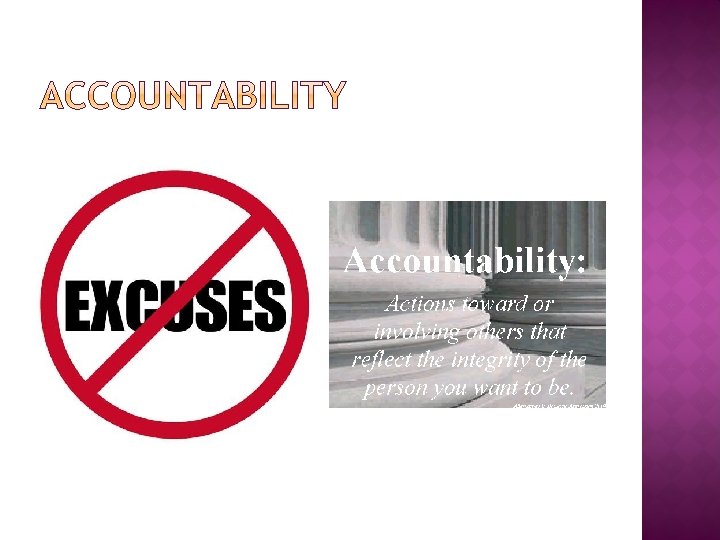
� The �A last step is accountability. common mistake among bosses is expecting the employee to fail--and readily taking the task back to handle yourself.
� Don't! � That's a quick way to undermine employee effectiveness and guarantee employees will never develop in the ways you need them to if your business is to reach its potential.
� Supervision is an intervention that is provided by a senior member of a profession to a junior members of that same profession.
� This relationship is evaluative, extends over time, and has the simultaneous purposes of enhancing the professional functioning of the junior member(s), monitoring the quality of professional services offered to the clients she, or they see(s), and serving as a gatekeeper of those who are to enter the particular profession.
� Supervision is an intervention � Supervision is provided by a senior member of a profession � Supervision over time is a relationship that extends
� The process of supervision occurs within the relationship established between the supervisor and supervisee. � It is important to keep in mind that both the supervisor and supervisee contribute to the relationship and have responsibilities within the process. As assumption of supervision is that it will last long enough for some developmental progress of the supervisee.
� The supervisor evaluates, monitors, and serves as a gatekeeper