
Goal Pole Placement of LEGO DCP via Simulink
![DCP Plant Model [deg] [%] [deg] [rad] [%] [deg] Used this TF initially](https://slidetodoc.com/presentation_image_h2/16da903a7473264a0c120757fd8c1d7b/image-3.jpg "DCP Plant Model [deg] [%] [deg] [rad] [%] [deg] Used this TF initially")
![[%] r u . x=F x+G u ol ol u = -Kx x y](https://slidetodoc.com/presentation_image_h2/16da903a7473264a0c120757fd8c1d7b/image-10.jpg "[%] r u . x=F x+G u ol ol u = -Kx x y")
![u + [%] [rad] - . x=F x+G u ol ol Kx x y](https://slidetodoc.com/presentation_image_h2/16da903a7473264a0c120757fd8c1d7b/image-11.jpg "u + [%] [rad] - . x=F x+G u ol ol Kx x y")



- Slides: 16
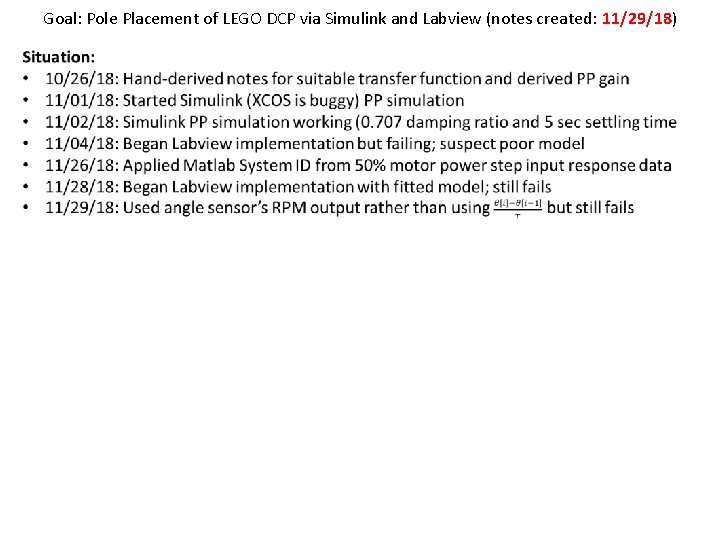
Goal: Pole Placement of LEGO DCP via Simulink and Labview (notes created: 11/29/18)
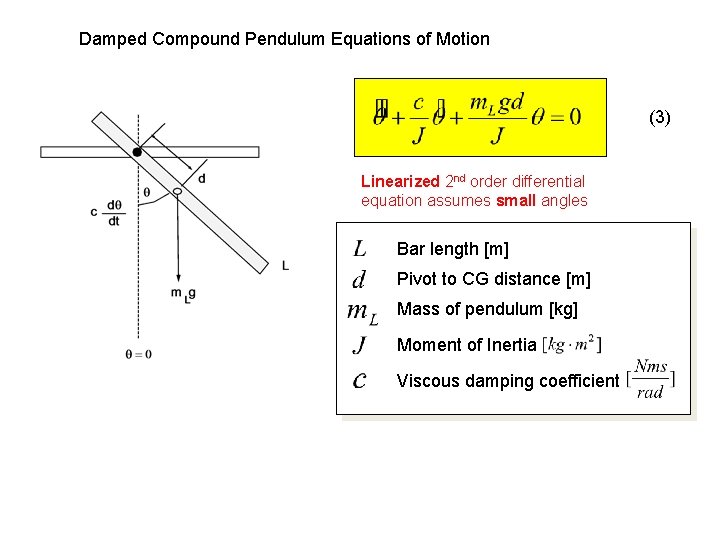
Damped Compound Pendulum Equations of Motion (3) Linearized 2 nd order differential equation assumes small angles Bar length [m] Pivot to CG distance [m] Mass of pendulum [kg] Moment of Inertia Viscous damping coefficient
DCP Plant Model [deg] [%] [deg] [rad] [%] [deg] Used this TF initially
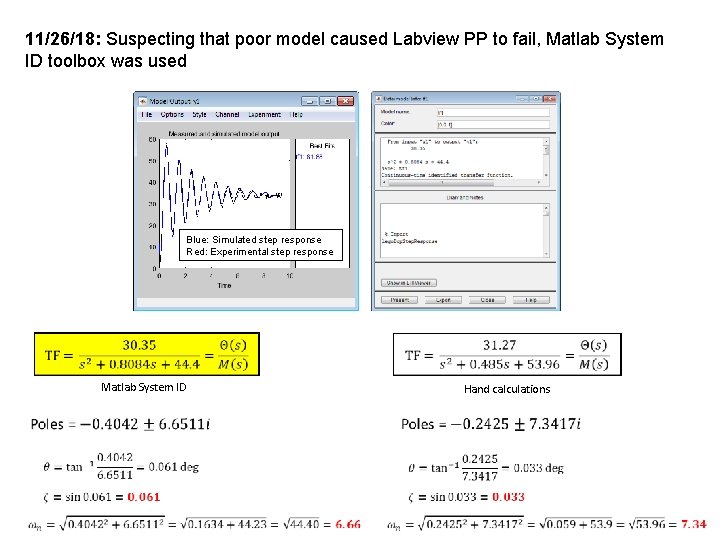
11/26/18: Suspecting that poor model caused Labview PP to fail, Matlab System ID toolbox was used Blue: Simulated step response Red: Experimental step response Matlab System ID Hand calculations
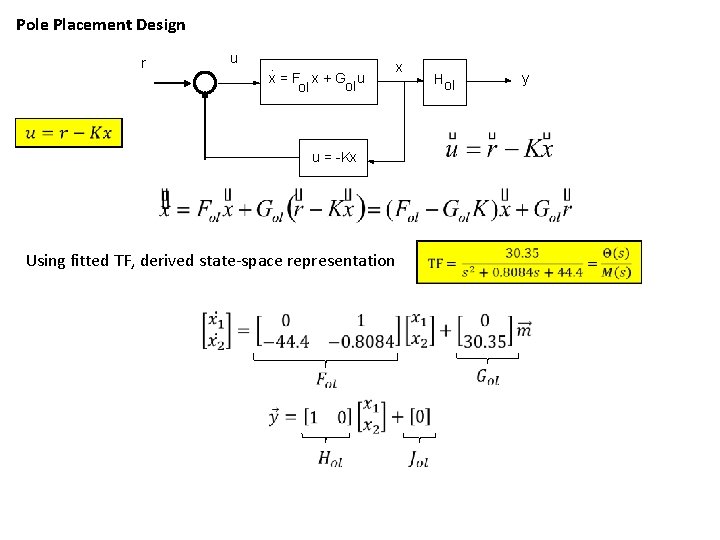
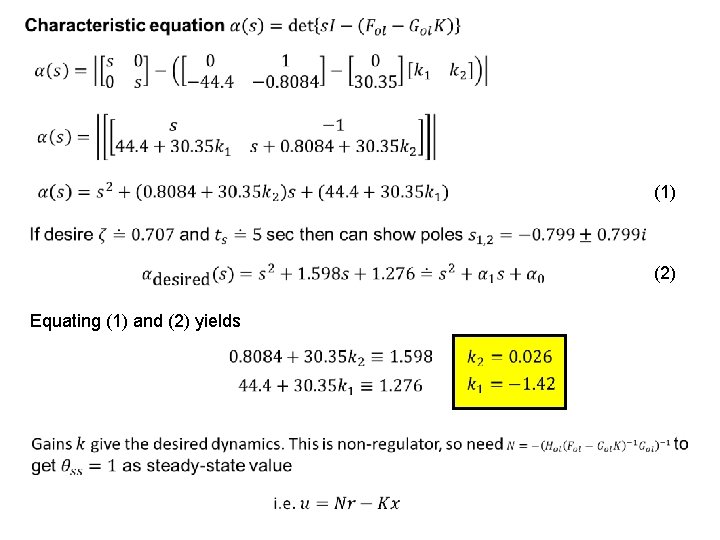
Pole Placement Design r u . x=F x+G u ol ol u = -Kx Using fitted TF, derived state-space representation x H ol y
(1) (2) Equating (1) and (2) yields
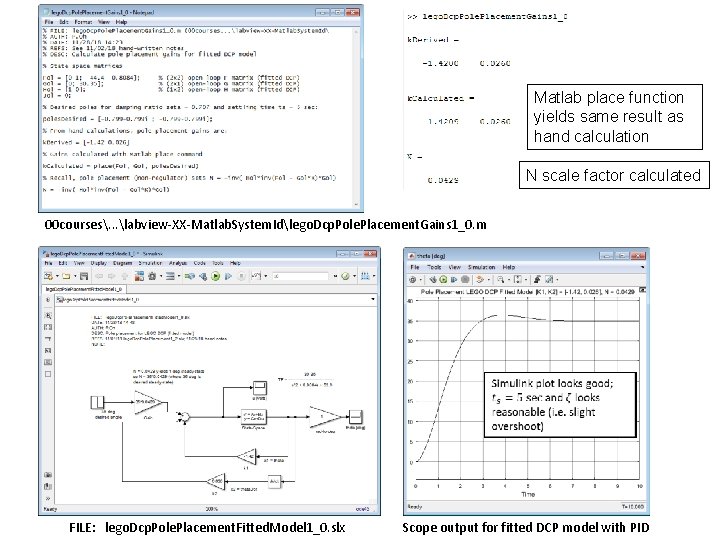
Matlab place function yields same result as hand calculation N scale factor calculated 00 courses. . . labview-XX-Matlab. System. Idlego. Dcp. Pole. Placement. Gains 1_0. m FILE: lego. Dcp. Pole. Placement. Fitted. Model 1_0. slx Scope output for fitted DCP model with PID
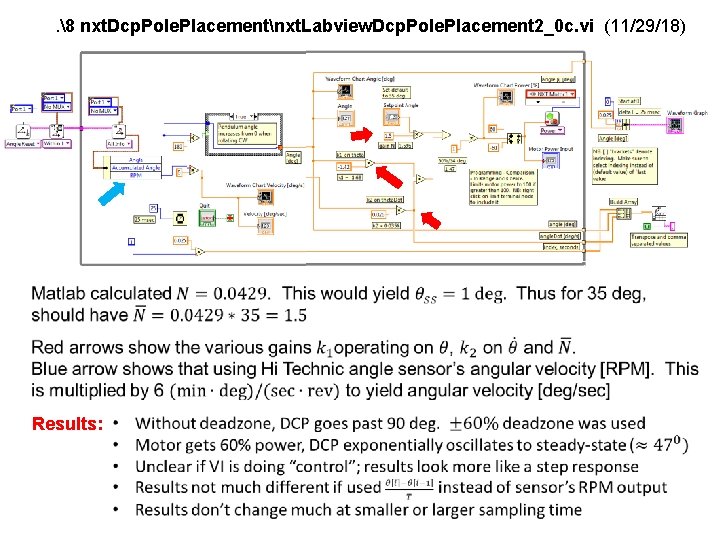
. 8 nxt. Dcp. Pole. Placementnxt. Labview. Dcp. Pole. Placement 2_0 c. vi (11/29/18) Results:
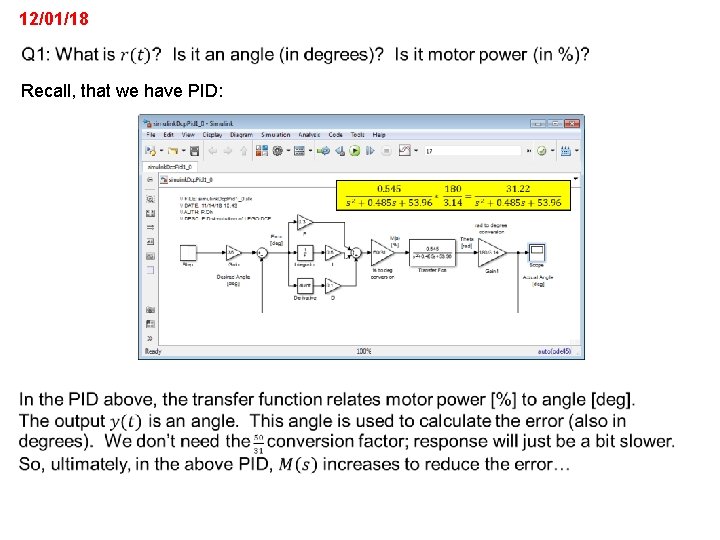
12/01/18 Recall, that we have PID:
[%] r u . x=F x+G u ol ol u = -Kx x y H ol [rad]
u + [%] [rad] - . x=F x+G u ol ol Kx x y H ol
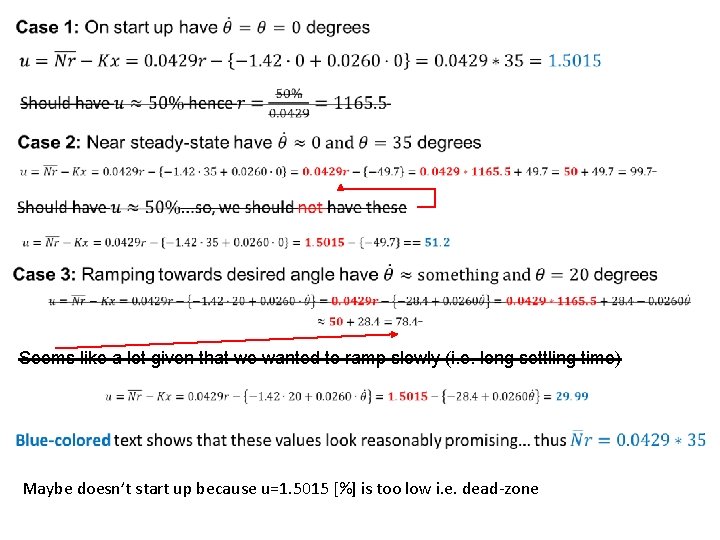
Seems like a lot given that we wanted to ramp slowly (i. e. long settling time) Maybe doesn’t start up because u=1. 5015 [%] is too low i. e. dead-zone
Extra Slides
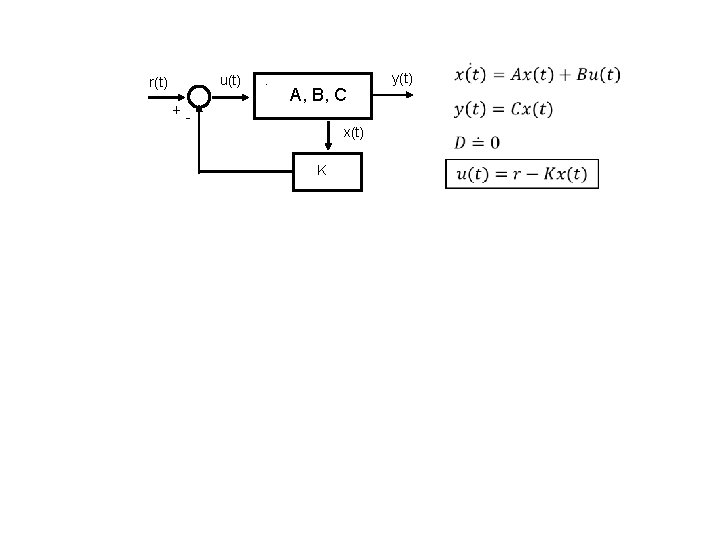
u(t) r(t) +- . A, B, C x(t) K y(t)