
GOAL 1 To provide clinicians and public health
GOAL 1 To provide clinicians and public health officials with the following information related to ricin: • • Background Clinical Presentation Recognition and Diagnosis Personal Protective Equipment Decontamination Management Reporting
GOAL 2 • To provide clinicians and public health officials with information on epidemiological clues that may suggest illness associated with ricin or another chemical or biological toxin in the correct clinical context.
Objectives • Describe the epidemiology of nonterrorism-associated ricin poisoning • Describe the epidemiology of terrorismassociated ricin poisoning
Objectives • Describe the clinical manifestations of oral, inhalational, and parenteral ricin poisoning • Describe differential diagnosis for ricin poisoning
Objectives • Explain the diagnosis of ricin poisoning • Identify epidemiological clues suggestive of a possible covert ricin (or other chemical/biological toxin) release • Describe the clinical management of ricin poisoning
Objectives • Describe the disposition of patients with ricin-associated illness • Identify the proper authorities for reporting of suspected or known ricinassociated illness
CDC/ATSDR Training and Continuing Education Online System www. phppo. cdc. gov/phtnonline
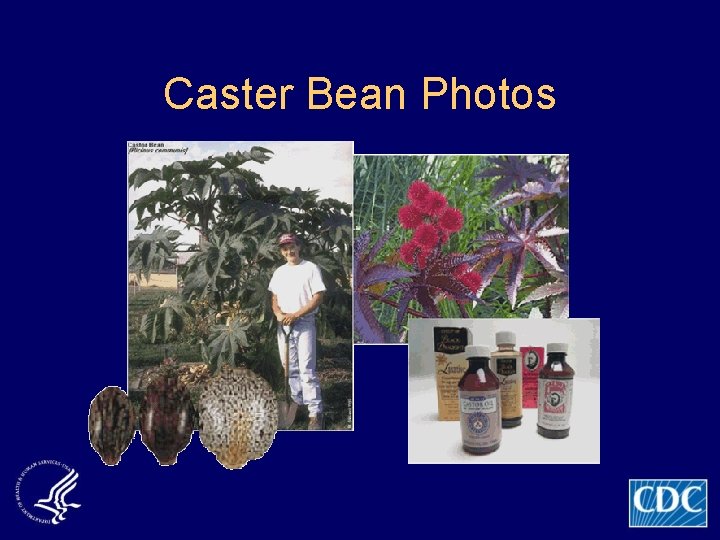
Caster Bean Photos
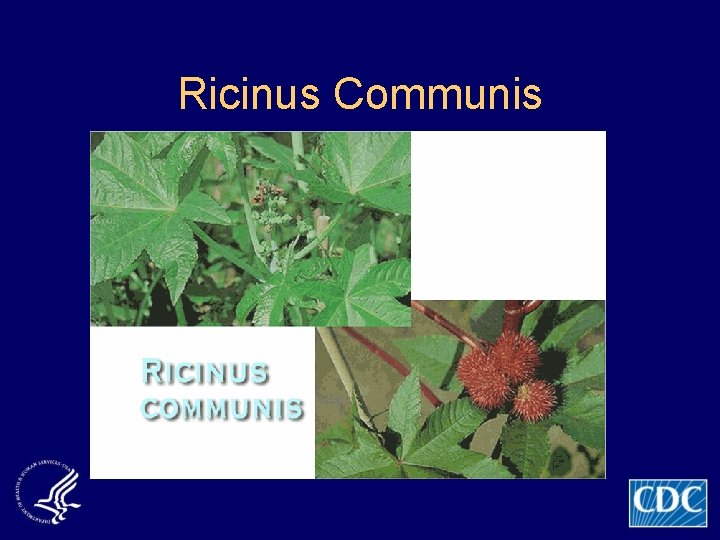
Ricinus Communis
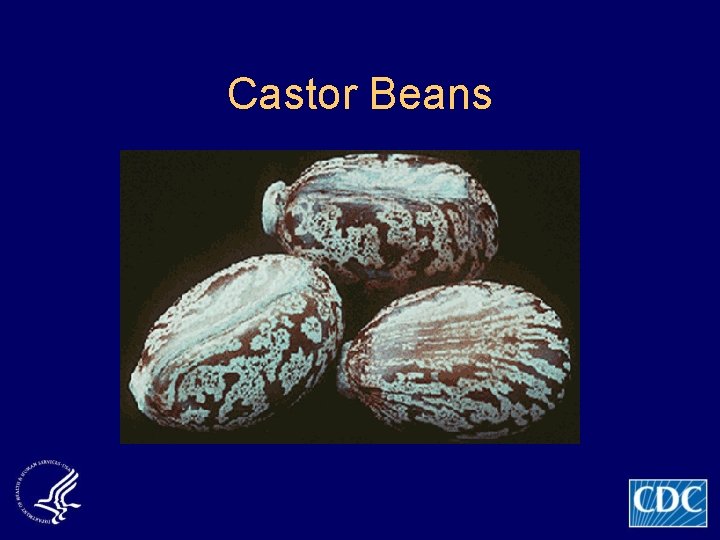
Castor Beans
Ricin Characteristics • Ricin can be prepared in a liquid, crystalline, or dry powder form • Ricin is water soluble, odorless, tasteless, and stable under ambient conditions
Mechanism of Action and Toxicity of Ricin
Biological Toxalbumins • • Abrus precatorius (contains abrin) Ricinus communis (contains ricin) Robinia pseudoacacia (contains robin and phasin) Hura crepitans Jatropha curcas Jatropha gossypifolia
Category B Diseases/Agents Second highest priority agents include those that • are moderately easy to disseminate; • result in moderate morbidity rates and low mortality rates; and • require specific enhancements of CDC's diagnostic capacity and enhanced disease surveillance.
Other Category B Bioterrorism Agents • • • Brucellosis Glanders Q Fever Typhus Fever Psittacosis Staphylococcal Enterotoxin B
Ricin Exposure • Inhalation and intravenous injection are the most lethal routes • Ricin is not well absorbed orally or dermally
Oral Administration • The absorption of orally administered ricin is poor, but if enough ricin is ingested, the potential for significant morbidity and mortality exists.
Ricin Absorbtion • Not likely to be absorbed through unabraded skin; however, there are no reported studies on the dermal toxicity of ricin • The effect of adding a carrier solvent to ricin to increase dermal absorption is unknown
Nonterroism Ricin Poisoning • Over 400 cases of poisoning by ingestion • 14 deaths (12 prior to 1930)
Ricin: Aerosol Exposure
Ricin: Parenteral Exposure
Ricin as a Chemotherapeutic Agent
Ricin and Terrorism • Properties make it a potential terrorist agent • Would need to be aerosolized, added to food, beverage or consumer products
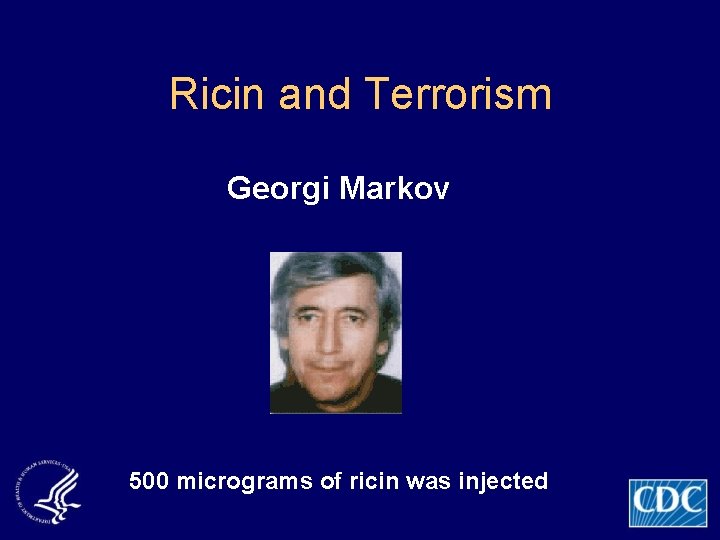
Ricin and Terrorism Georgi Markov 500 micrograms of ricin was injected
Ricin and Terrorism • 1991 - Unsuccessful dermal attack plan to kill 100 people • 1995 -Agents find 130 grams of ricin at Canadian border, enough to kill 10, 000 people.
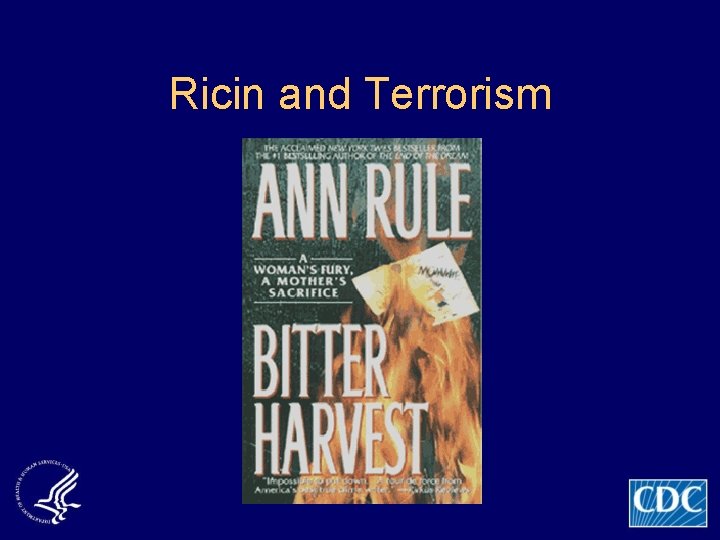
Ricin and Terrorism
Ricin and Terrorism • December 2002, six terrorist suspects were arrested in Manchester, England • January 2003, subtoxic quantities of ricin were found in the Paris Metro, leading to an investigation of a plan to attack the Russian embassy
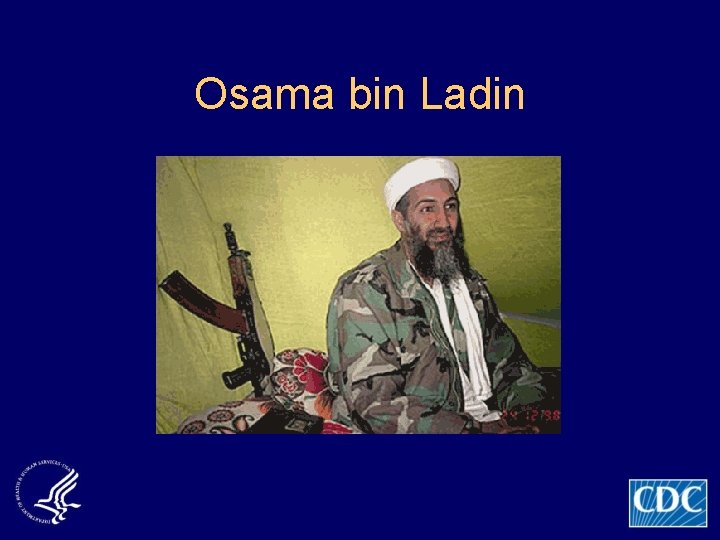
Osama bin Ladin
Clinical Manifestation
Route of Exposure • Inhalation • Ingestion • Parenteral
Aerosol Dispersion • Not considered persistent in the environment • Particles under 5 microns may stay suspended for many hours • Re-suspension of settled ricin may occur • Technologically difficult to produce particles of this small size
Systemic Toxicity • Severe systemic toxicity has been described in humans only following ingestion or injection of ricin into the body
Ricin Ingestion • Ricin release from beans requires mastication • Swallowing whole beans not likely to poison • Beans have bitter taste • No reports of people who have ingested purified ricin
Ricin Fatal Dose • Ingestion and mastication of 3 -6 beans is the estimated fatal dose in adults (presumed less in children)
Ricin: Mild Toxicity Symptoms of mild toxicity include: • • • Nausea Vomiting Diarrhea Abdominal cramping Oropharyngeal irritation
Onset of Gastrointestinal Symptoms • Typically occurs in less than 10 hours. • Delayed presentation of gastrointestinal symptoms, beyond ten hours of ingestion, is unlikely to occur.
Moderate to Severe Toxicity May Include: • Gastrointestinal symptoms persistent vomiting, voluminous diarrhea-bloody or nonbloody (which typically leads to significant fluid losses) May Result In: • Dehydration, hypovolemic shock, tachycardia, hypotension, decreased urine output, altered mental status (e. g. , confusion, disorientation).
Severe Poisoning • Hepatic and renal failure and death are possible within 36 – 72 hours of exposure
Ricin Inhalation • Very limited data in humans • Animal studies suggest it is the most lethal form of exposure.
Ricin Allergic Syndrome • • • Nasal and throat congestion Eye irritation Hives and other skin irritation Chest tightness Wheezing (severe cases)
1940’s : An Unintentional and Sublethal Aerosol Exposure • • Fever Chest tightness Cough Dyspnea Nausea Arthralgias Diaphoresis No reported progression
Progression • • Pulmonary edema and hemorrhage Hypotension Respiratory failure Death within 36 -72 hours
Parenteral Exposure
Clinical Trial • • Flu-like symptoms Fatique Myalgias Symptoms lasting 1 -2 days
Lethal Injection (Markov-1978) • • Immediate pain Weakness within 5 hours Fever Vomiting Shock Multi-organ failure Death in 3 days
Lethal Injection Example 2 • • Nausea Weakness Dizziness Myalgias Anuria Hypotension Hepatorenal and cardiorespiratory failure Death
Ricin: Clinical Course
Significant ricin poisoning through inhalation, ingestion and parenteral exposure would consist of progressive worsening of symptoms over approximately 4 -36 hours.
Early Ricin poisoning through ingestion may resemble typical gastroenteritis-type or a respiratory illness through inhalation
May be difficult to discern early poisoning from other common and less virulent illnesses such as an upper respiratory infection or gastroenteritis.
Cases should be deemed suspicious in conjunction with • A highly suspected or known exposure • A credible threat • An epidemiologic clue suggestive of a chemical release.
Differential Diagnosis
Inhalation: • Staphylococcal enterotoxin B • Exposure to pyrolysis by-products of organofluorines (Teflon, Kevlar) • Oxides of nitrogen • Phosgene • Influenza • Anthrax • Q-fever • Pneumonic plague
Ingestion: • Enteric pathogens (e. g. , salmonella, shigella) • Mushrooms • Caustics • Iron • Arsenic • Colchicine
Clinical Diagnosis
Overt Event • Letter identifying ricin in contents of package Covert Event • Restaurant patrons unknowingly consume food contaminated with ricin
Illness Resulting from Covert Event • Symptoms similar to flu or gastroenteritis • Early symptoms may be nonexistent or mild • Reports of illness may occur over a long period and in multiple locations
Illness Resulting from Covert Event • Symptoms may not suggest a single chemical • Healthcare providers may be less familiar with clinical presentations of chemical or biological-induced poisonings
Epidemiologic Clues Suggesting Covert Release of a Chemical or Biological toxin • Unusual increase in patients with possible chemical or biological toxin related illness • Unexplained deaths among healthy or young people • Unexplained odors on patients • Clusters of illness in people with common characteristics
Epidemiologic Clues Suggesting Covert Release of a chemical or biological toxin • Rapid onset of symptoms • Unexplained death of plants, fish, or animals • Presence of a particular syndrome associated with a chemical agent or biological toxin
• Clinical diagnosis largely depends on route of exposure • Clinical findings associated with ricin poisoning may be nonspecific and may mimic signs and symptoms of less virulent diseases
Confirmation of Ricin Poisoning • Clinical manifestations of illness • Laboratory detection of ricin in biological fluids or environmental samples
Laboratory Testing • No validated assays for detection of ricin in biologic fluids • Testing of environmental samples may not be immediately available to assist in clinical decision making
Suspicion and clinical diagnosis of ricin poisoning should occur when clinically compatible illness is present in conjunction with: • A highly suspected or known exposure, • A credible threat, OR • An applicable epidemiologic clue
Decontamination and Personal Protective Equipment
Patient Contaminated with Ricin • Provide gross decontamination at the scene unless medical condition dictates immediate transport to hospital
Gross Decontamination • Cut away/remove all suspected contaminated clothing • Remove jewelry and watches • Wash off obvious contamination with soap and copious amount of water • Shower with liquid soap and warm water
Gross Decontamination • Provide privacy • Secure personal belongings • Explain procedure to victims
Decontamination • Clean environmental surfaces or equipment with soap and water or 0. 1% sodium hypochlorite solution • Double bag, label and secure victims’ clothing
Decontamination of Nondisposable PPE • Thoroughly rinse with soap and water • Soak in 0. 1% sodium hypochlorite solution for 15 minutes • Rinse with water and air dry
PPE for First Responders • Determined by incident commander • Based on hazard assessment and site conditions • PPE should prevent droplets from contacting broken skin or mucosal membranes
PPE if Victims Inadequately Decontaminated at Scene • Chemical-resistant suit with gloves • Surgical mask • Eye/face protection
Decontamination • Should be done at scene or hospital but prior to entering emergency department • Removing contaminated clothing reduces contaminant 75%-90%
Standard Precautions • • • Scrubs or disposable gown Lab coat Disposable nitrile gloves Surgical mask Safety glasses, goggles, or face shield Good hand hygiene
Clinical Management
Primary Management • Supportive • No antidote • Dialysis ineffective
Standard Precautions Continue use: • After skin decontamination • With patient’s belongings • With patient’s secretions
Ricin Ingestion Consider gastric lavage if • Patient presents <1 hour after exposure • No vomiting • No contraindications If ricin powder ingested, may consider nasogastric tube

Ricin Ingestion • If no vomiting and airway is secure, give a single dose of activated charcoal
Ricin Ingestion • Administer intravenous fluids • Provide blood pressure support using intravenous vasopressors • Consider alternative diagnoses and treat appropriately (e. g. , antibiotics for possible infection)
Inhalational and Parenteral Poisoning • • Supplemental oxygen Pulmonary toilet Mechanical ventilation May require hemodialysis
National Poison Control Center Hotline 1 -800 -222 -1222
Disposition • Is there a highly suspected or known exposure? • Is there a credible threat? • Is there an applicable epidemiologic clue to suggest an illness potentially related to a chemical or biological toxin?
Disposition • Treat and admit patients with clinical findings consistent with ricin poisoning plus – A highly suspected or known exposure OR – Presentation occurs with a credible threat
Disposition • Due to limited experience with ricin poisoning, a definitive period of observation cannot be specified at this time
Disposition • Asymptomatic patients exposed to highly suspected or known ricincontaining compound should be observed for symptoms • Instruct patients sent home to return to hospital immediately if symptoms consistent with ricin poisoning develop
Contact the regional poison control center and the local and/or state public health agency in all cases of illness consistent with ricin poisoning in the presence of: • A suspected or known exposure • A credible threat OR • An applicable epidemiologic clue
National Poison Control Center Hotline 1 -800 -222 -1222
Public Health Surveillance and Reporting
Contact the regional poison control center and the local and/or state public health agency in all cases of illness consistent with ricin poisoning in the presence of: • A suspected or known exposure, • A credible threat, OR • An applicable epidemiologic clue
E-mail questions to: ricinquestions@cdc. gov
Course Overview www. phppo. cdc. gov/phtn/ricin
CDC Ricin Website www. bt. cdc. gov/agent/ricin
Public Health Foundation Phone: 1 -877 -252 -1200 Fax: 301 -843 -0159 Online: bookstore. phf. org
CDC Training and Continuing Education Online System www. phppo. cdc. gov/phtnonline
Course Numbers WC 0048 - webcast WD 0035 - web-on -demand CB 3093 - CD-ROM
Registration Questions: 800 -41 -TRAIN 404 -639 -1292 E-mail ce@cdc. gov
- Slides: 97