Go Figure Figurative Language Ms Wile 6 th
- Slides: 15
Go Figure! Figurative Language Ms. Wile 6 th Grade Language Arts
Recognizing Figurative Language n The opposite of literal language is figurative language. Figurative language is language that means more than what it says on the surface. n It usually gives us a feeling about its subject. n Poets use figurative language almost as frequently as literal language. When you read poetry, you must be conscious of the difference. Otherwise, a poem may make no sense at all.
Recognizing Literal Language “I’ve eaten so much I feel as if I could literally burst!” n In this case, the person is not using the word literally in its true meaning. Literal means "exact" or "not exaggerated. " By pretending that the statement is not exaggerated, the person stresses how much he has eaten. n Literal language is language that means exactly what is said.
What is figurative language? n Whenever you describe something by comparing it with something else, you are using figurative language.
Types of Figurative Language n Imagery n Simile n Metaphor n Alliteration n Personification n Onomatopoeia n Hyperbole n Idioms n Cliché n Symbols
Imagery n Language that appeals to the senses. Descriptions of people or objects stated in terms of our senses. • Sight • Hearing • Touch • Taste • Smell
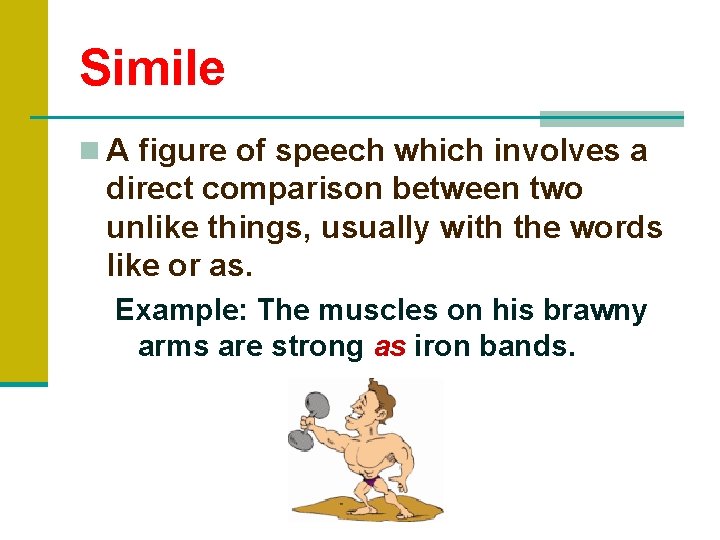
Simile n A figure of speech which involves a direct comparison between two unlike things, usually with the words like or as. Example: The muscles on his brawny arms are strong as iron bands.
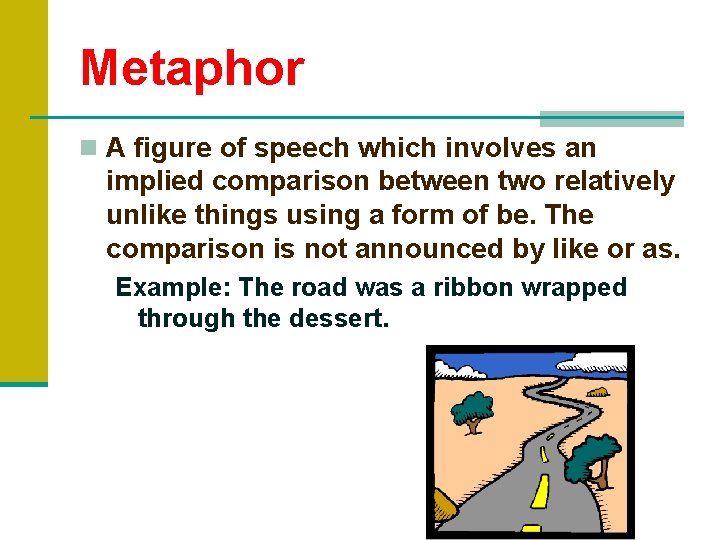
Metaphor n A figure of speech which involves an implied comparison between two relatively unlike things using a form of be. The comparison is not announced by like or as. Example: The road was a ribbon wrapped through the dessert.
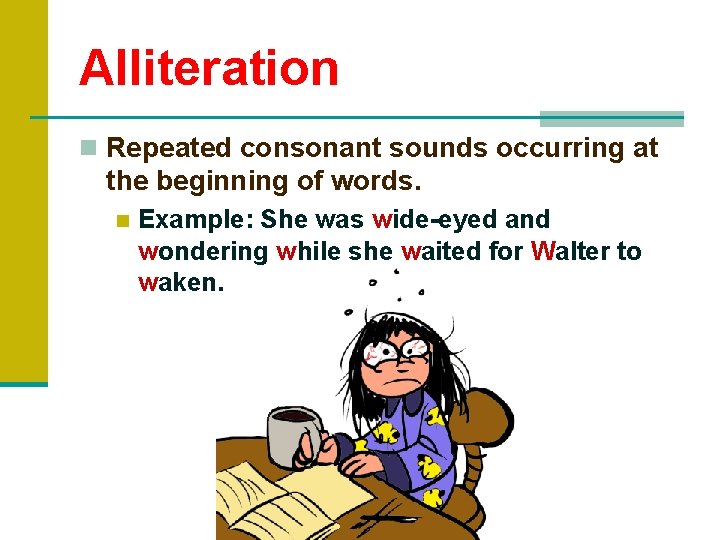
Alliteration n Repeated consonant sounds occurring at the beginning of words. n Example: She was wide-eyed and wondering while she waited for Walter to waken.
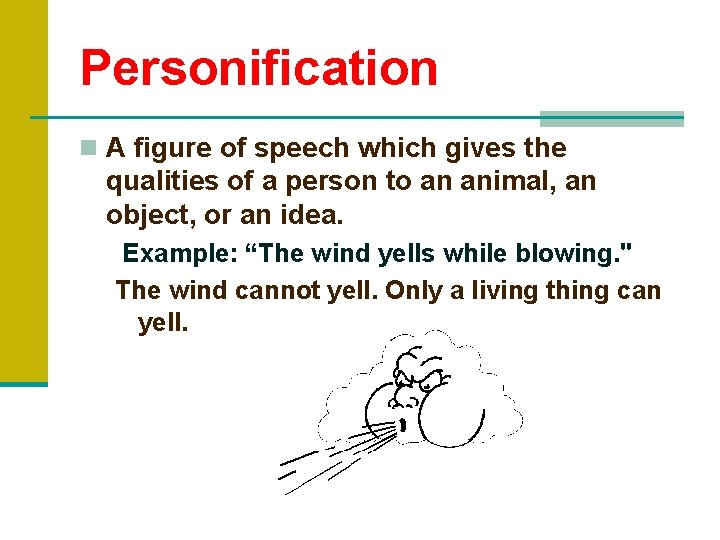
Personification n A figure of speech which gives the qualities of a person to an animal, an object, or an idea. Example: “The wind yells while blowing. " The wind cannot yell. Only a living thing can yell.
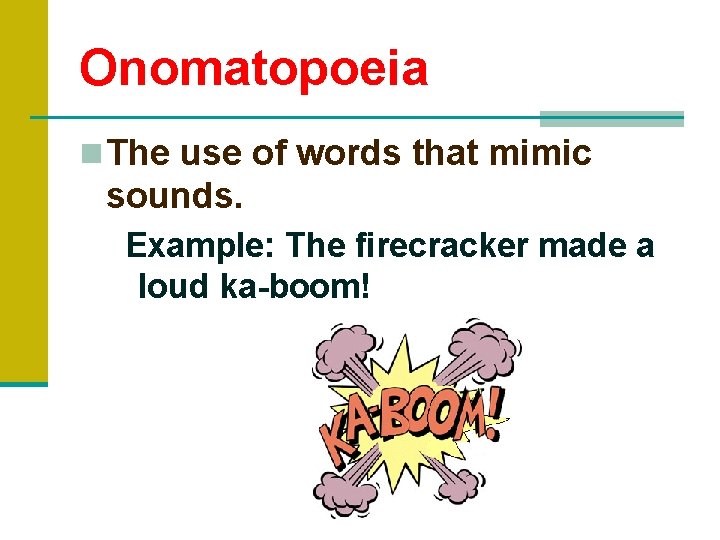
Onomatopoeia n The use of words that mimic sounds. Example: The firecracker made a loud ka-boom!
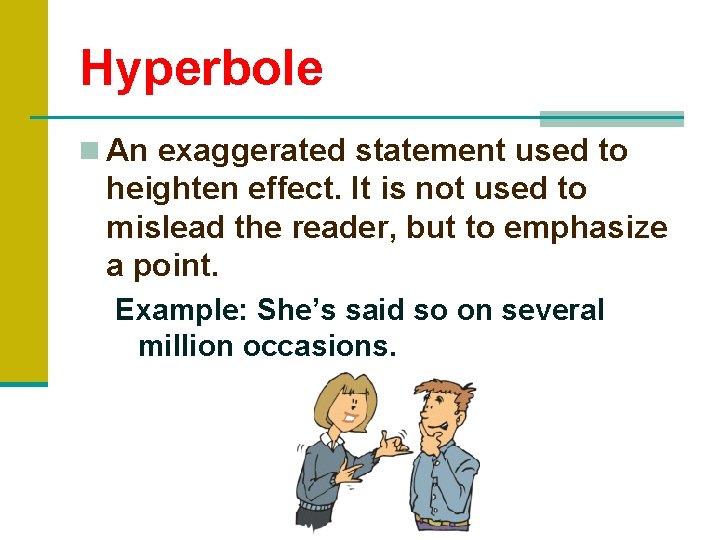
Hyperbole n An exaggerated statement used to heighten effect. It is not used to mislead the reader, but to emphasize a point. Example: She’s said so on several million occasions.
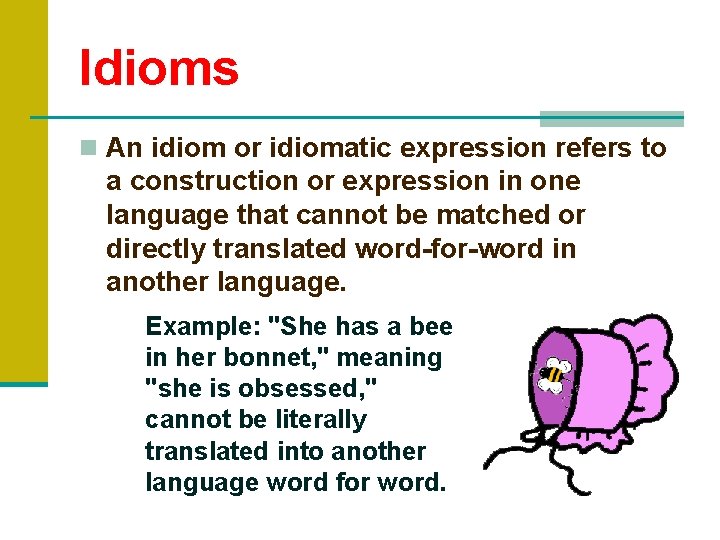
Idioms n An idiom or idiomatic expression refers to a construction or expression in one language that cannot be matched or directly translated word-for-word in another language. Example: "She has a bee in her bonnet, " meaning "she is obsessed, " cannot be literally translated into another language word for word.
Cliché n A figure of speech whose effectiveness has been worn out through overuse and excessive familiarity. n Woke up on the wrong side of the bed.
Symbols n Symbol - an image loaded with significance beyond literal definition; suggestive rather than definitive. n n natural symbols - symbols recognized as standing for something in particular even by people from different cultures. (Rain usually stands for fertility or the renewal of life; a forest--mental darkness or chaos; a mountain-stability). conventional symbols - symbols which people have agreed to accept as standing for something other than themselves (a poem about the cross would probably be about Christianity; similarly, the rose has long been a symbol for love).