
GNT block Dec 2019 Complications of liver cirrhosis
GNT block Dec 2019 Complications of liver cirrhosis
Complications of liver cirrhosis Objectives �Recognize the major complications of cirrhosis �Understand the pathogenetic mechanisms underlying the occurrence of the complications �Recognize the clinical features inherent to the above mentioned complications �Describe the pathological findings of the different complications

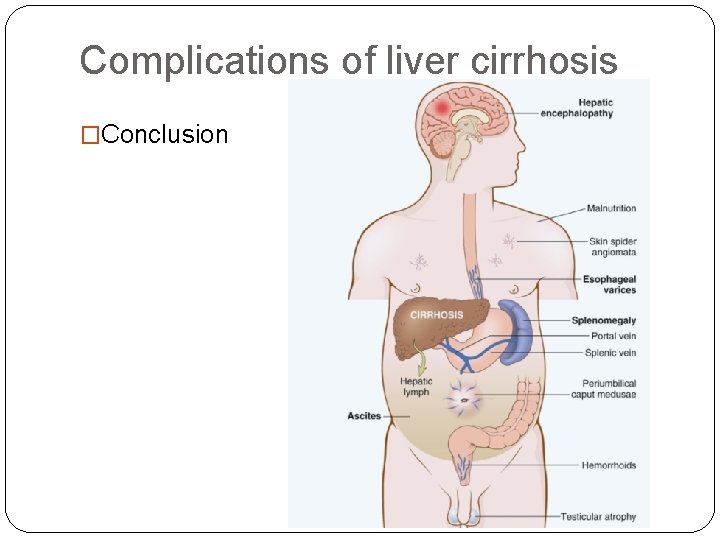
. Complications of liver cirrhosis 1. Portal hypertension: a. Splenomegaly b. Variceal bleeding c. Hemorrhoids d. Periumbilical venous collaterals (caput medusa) 2. Hepatic failure a. Coagulopathy b. Hypoalbuminemia c. Hepatic encephalopathy 3. Ascites 4. Spontaneous bacterial peritonitis 5. Jaundice and cholestasis 6. Hepatorenal syndrome 7. Hyperestrinism in males 8. Hepatocellular carcinoma
Complications of liver cirrhosis 1. PORTAL HYPERTENSION: 1. Splenomegaly 2. Portosystemic shunt: A. Variceal bleeding B. Hemorrhoids C. Periumbilical venous collaterals (caput medusa)
Complications of liver cirrhosis PORTAL HYPERTENSION: �Resistance to blood flow prehepatic, intrahepatic, and posthepatic Ø The dominant intrahepatic cause is cirrhosis (This is accounting for most cases of portal hypertension) Ø Portosystemic shunts develop when blood flow is reversed from the portal to systemic circulation. Ø due to intrasinusoidal hypertension from regenerative nodule compression
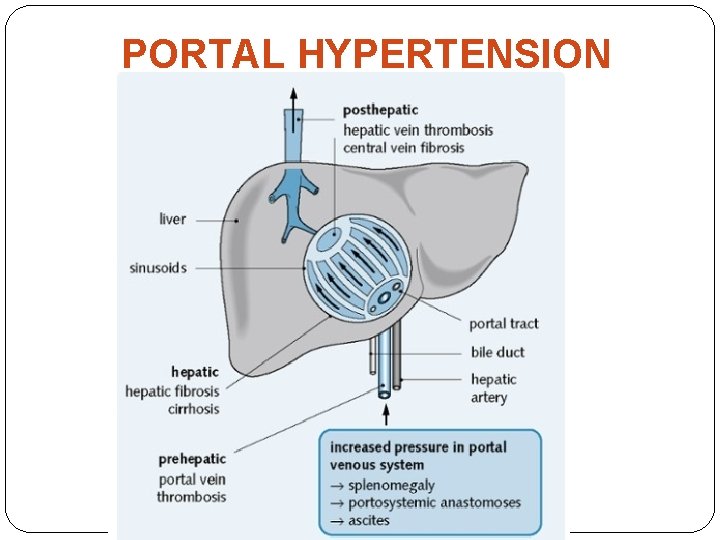
PORTAL HYPERTENSION
Complications of liver cirrhosis Splenomegaly: �Long-standing congestion may cause congestive splenomegaly (spleen weight may reach up to 1000 gm) �The massive splenomegaly may induce hematologic abnormalities attributable to hypersplenism, such as thrombocytopenia or pancytopenia
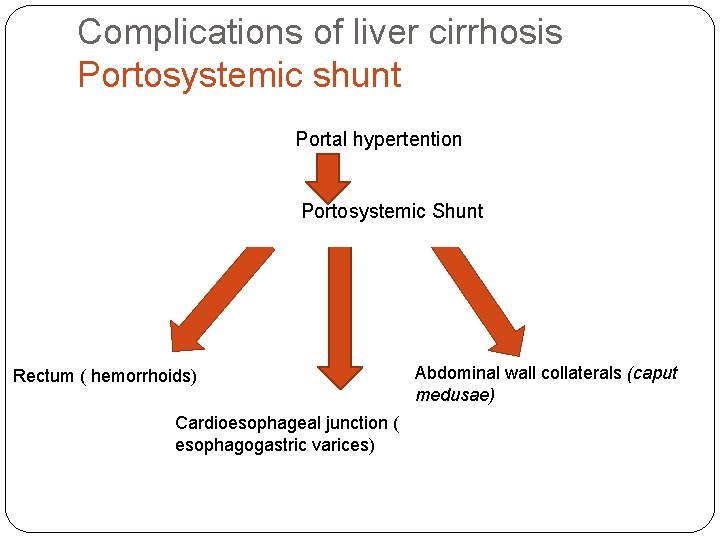
Complications of liver cirrhosis Portosystemic shunt Portal hypertention Portosystemic Shunt Rectum ( hemorrhoids) Cardioesophageal junction ( esophagogastric varices) Abdominal wall collaterals (caput medusae)
Complications of liver cirrhosis ESOPHAGEAL VARICES: �Venous blood from the GI tract is delivered to the liver via the portal vein before reaching the inferior vena cava. � This circulatory pattern is responsible for the first-pass effect in which drugs and other materials absorbed in the intestines are processed by the liver before entering the systemic circulation. �Diseases that impede this flow cause portal hypertension and can lead to the development of esophageal varices, an important cause of esophageal bleeding
Complications of liver cirrhosis ESOPHAGEAL VARICES: Pathogenesis � Portal hypertension results in the development of collateral channels at sites where the portal and caval systems communicate. Although these collateral veins allow some drainage to occur, they lead to development of a congested subepithelial and submucosal venous plexus within the distal esophagus (varices) � 90% of cirrhotic patients develop varices most commonly in association with alcoholic liver disease � Hepatic schistosomiasis
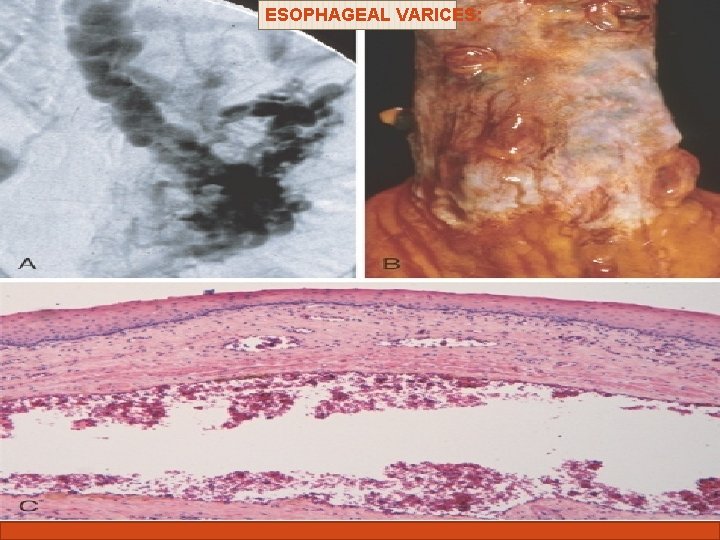
Complications of liver cirrhosis ESOPHAGEAL VARICES Morphology: � Varices can be detected by venogram: tortuous dilated veins lying primarily within the submucosa of the distal esophagus and proximal stomach. Venous channels directly beneath the esophageal epithelium may also become massively dilated. � Varices may not be grossly obvious in surgical or postmortem specimens, because they collapse in the absence of blood flow. � Variceal rupture results in hemorrhage into the lumen or esophageal wall, in which case the overlying mucosa appears ulcerated and necrotic. � If rupture has occurred in the past, venous thrombosis, inflammation, and evidence of prior therapy may also be present.

Complications of liver cirrhosis ESOPHAGEAL VARICES massively dilated venous channels Variceal rupture with hemorrhage
ESOPHAGEAL VARICES: Complications of liver cirrhosis
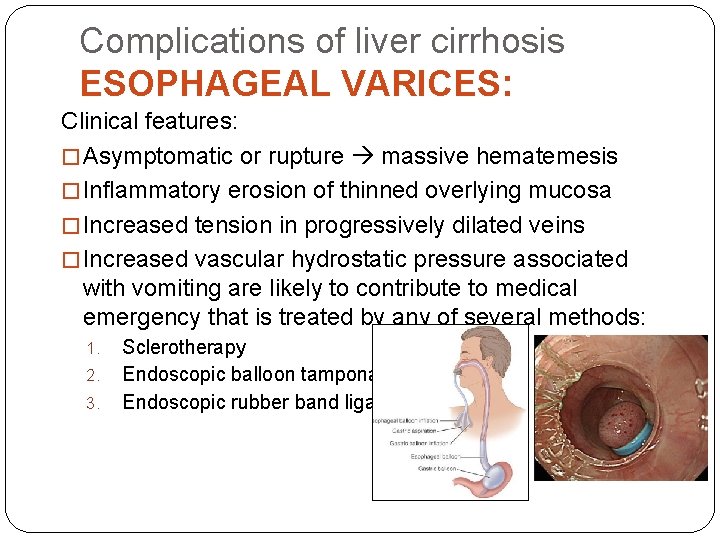
Complications of liver cirrhosis ESOPHAGEAL VARICES: Clinical features: � Asymptomatic or rupture massive hematemesis � Inflammatory erosion of thinned overlying mucosa � Increased tension in progressively dilated veins � Increased vascular hydrostatic pressure associated with vomiting are likely to contribute to medical emergency that is treated by any of several methods: 1. 2. 3. Sclerotherapy Endoscopic balloon tamponade Endoscopic rubber band ligation
Complications of liver cirrhosis ESOPHAGEAL VARICES: �Half of patients die from the first bleeding episode either as a direct consequence of hemorrhage or following hepatic coma triggered by hypovolemic shock. �Additional 50% within 1 year. �Each episode has a similar rate of mortality. �Over half of deaths among individuals with advanced cirrhosis result from variceal rupture.
2. Hepatic failure Definition: end-point of progressive damage to the liver a. Coagulopathy b. Hypoalbuminemia c. Hepatic encephalopathy
A. Coagulopathy �The liver is the source of a number of coagulation factors that decline in liver failure, leading to easy bruising and bleeding �Hypercoagulation state also may occur due to failure of the damaged liver to remove activated coagulation factors
B. Hypoalbuminemia �Hypoalbuminemia from decreased synthesis of albumin Ø Produces dependent pitting edema and ascites due to a decrease in plasma oncotic pressure
C. Hepatic encephalopathy �A spectrum of disturbances in consciousness ranging from subtle behavioral abnormalities, to confusion and stupor, to coma and death. �may develop over days, weeks, or a few months �Due to elevated ammonia levels in blood and the central nervous system and brain edema. �Protein from dietary sources or blood in gastrointestinal tract leads to increased bacterial conversion of urea into ammonia (cannot be metabolized in sick liver and with portosystemic shunts, ammonia go to brain)
Complications of liver cirrhosis 3. Ascites
Complications of liver cirrhosis Ascites �is the accumulation of excess fluid in the peritoneal cavity: � 85% of cases are caused by cirrhosis. �Serous: less than 3 gm/d. L of protein �Pathogenesis: �Increase in portal vein hydrostatic pressure �Decreases oncotic pressure �Liver is unable to metabolize aldosterone
Complications of liver cirrhosis 4. Spontaneous bacterial peritonitis Increased risk for spontaneous bacterial infection on top of ascites
Complications of liver cirrhosis 5. JAUNDICE AND CHOLESTASIS
Complications of liver cirrhosis JAUNDICE AND CHOLESTASIS: �Jaundice and icterus: a yellowish or greenish pigmentation of the skin and sclera of the eyes respectively due to high bilirubin levels. �Cholestasis, characterized by systemic retention of not only bilirubin but also other solutes eliminated in bile.
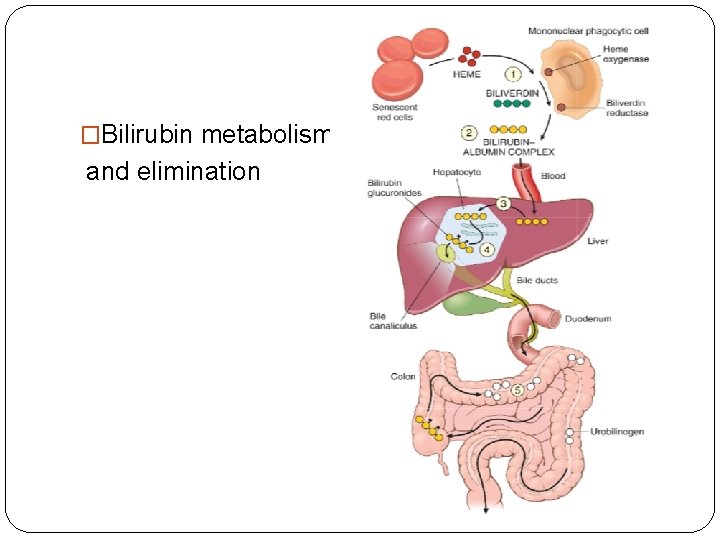
�Bilirubin metabolism and elimination
Complications of liver cirrhosis Cause of Jaundice 1. Prehepatic causes of jaundice: Bilirubin overproduction due to hemolysis and hematoma resorption, lead to elevated levels of unconjugated (indirect) bilirubin. 2. Intrahepatic disorders can lead to unconjugated or conjugated hyperbilirubinemia. The conjugated (direct) bilirubin level is often elevated by alcohol, infectious hepatitis, drug reactions, and autoimmune disorders. 3. Posthepatic disorders (Obstruction of the flow of bile) can cause conjugated hyperbilirubinemia. Gallstone formation is the most common posthepatic process that causes jaundice; however, the differential diagnosis also includes serious conditions such as biliary tract infection, pancreatitis, and malignancies
Complications of liver cirrhosis 6. Hepatorenal syndrome:
Complications of liver cirrhosis Hepatorenal syndrome: �Appearance of renal failure in individuals with severe chronic liver disease - no intrinsic morphologic or functional causes for the renal failure. �The incidence of this syndrome is about 8% per year among patients who have cirrhosis and ascites �Main renal functional abnormalities: �Sodium retention, impaired free-water excretion, and decreased renal perfusion and glomerular filtration rate �Lead to drop in urine output and rising blood urea nitrogen and creatinine levels
Complications of liver cirrhosis Hepatorenal syndrome: Causes: �Decreased renal perfusion pressure due to systemic vasodilation �Activation of the renal sympathetic nervous system with vasoconstriction of the afferent renal arterioles �Increased synthesis of renal vasoactive mediators (activation of the renin/angiotensin axis), that decrease glomerular filtration.
Complications of liver cirrhosis 7. Hyperestrinism in males Pathogenesis: � Liver cannot degrade estrogen and 17 -ketosteroids (Androstenedione) � Androstenedione is aromatized into estrogen in the adipose cells. Clinical findings: � Gynecomastia � Spider telangiectasia � Female distribution of hair � Impotence (due to increased estrogen, there will be increases synthesis of sex hormone–binding protein, which increases binding of free testosterone)
Complications of liver cirrhosis 8. Hepatocellular Carcinoma
Complications of liver cirrhosis �Conclusion
- Slides: 32