
GMP Training Program Module 16 CDC Hand Hygiene
- Slides: 34
GMP Training Program Module 16 CDC Hand Hygiene Guidelines This CDC Presentation has been modified for GMP’s use. 11/2007
So Why All the Fuss About Hand Hygiene? Most common mode of transmission of pathogens is via hands! Hand hygiene reduces infections acquired in healthcare, and Reduces the spread of antimicrobial resistance 05/2014
Reasons people do not have good Hand Hygiene § Handwashing agents cause irritation and dryness § Sinks are inconveniently located/lack of sinks § Lack of soap and paper towels § Too busy/insufficient time § They feel there is a low risk of acquiring infection from patients 05/2014
Don’t make excuses! Don’t let anything keep you from good hand hygiene! It protects you, your peers and our patients from infections 05/2014
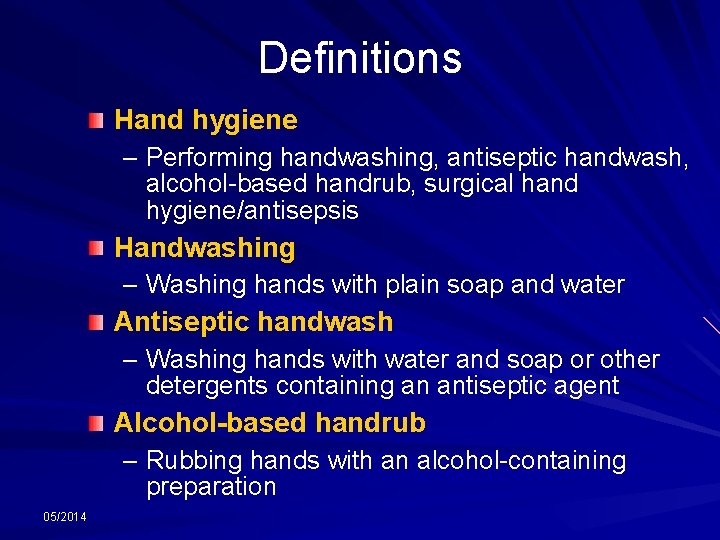
Definitions Hand hygiene – Performing handwashing, antiseptic handwash, alcohol-based handrub, surgical hand hygiene/antisepsis Handwashing – Washing hands with plain soap and water Antiseptic handwash – Washing hands with water and soap or other detergents containing an antiseptic agent Alcohol-based handrub – Rubbing hands with an alcohol-containing preparation 05/2014
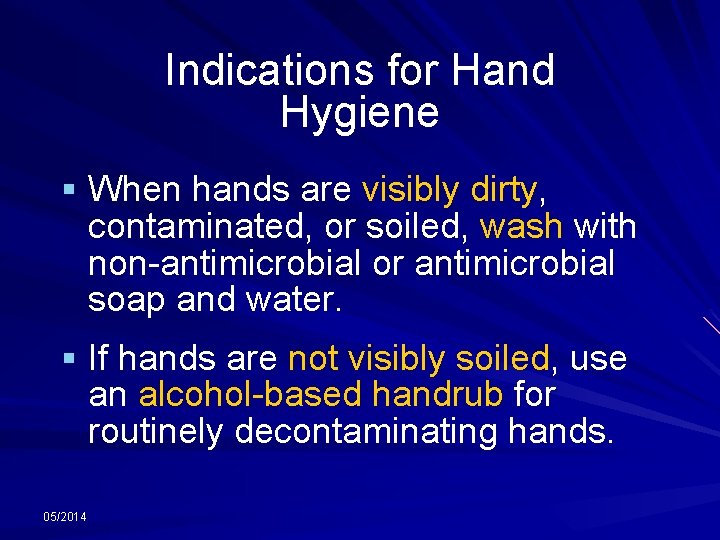
Indications for Hand Hygiene § When hands are visibly dirty, contaminated, or soiled, wash with non-antimicrobial or antimicrobial soap and water. § If hands are not visibly soiled, use an alcohol-based handrub for routinely decontaminating hands. 05/2014
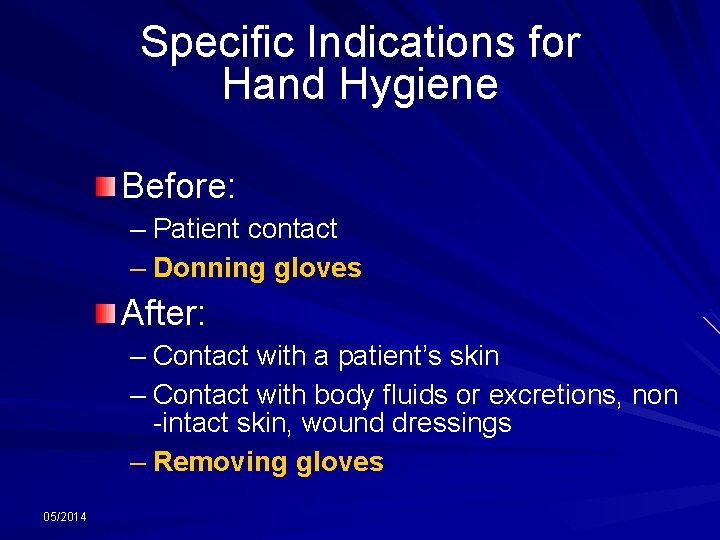
Specific Indications for Hand Hygiene Before: – Patient contact – Donning gloves After: – Contact with a patient’s skin – Contact with body fluids or excretions, non -intact skin, wound dressings – Removing gloves 05/2014
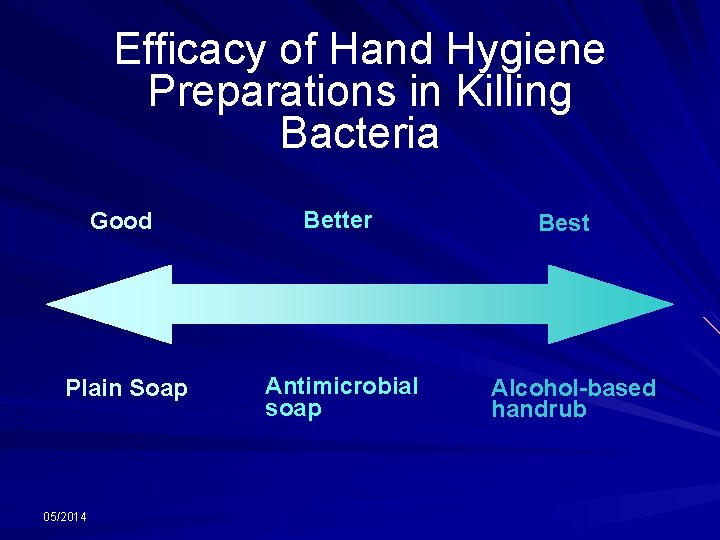
Efficacy of Hand Hygiene Preparations in Killing Bacteria Good Better Plain Soap Antimicrobial soap 05/2014 Best Alcohol-based handrub
Hand Hygiene Technique Alcohol-based Handrubs – Apply to palm of one hand, rub hands together covering all surfaces until dry – Volume: based on manufacturer guidelines Handwashing – Wet hands with water, apply soap, rub hands together (include back of hands and wrist area) for at least 15 seconds – Rinse and dry with disposable towel – Use towel to turn off faucet 05/2014
Alcohol-Based Handrubs: What benefits do they provide? Require less time More effective for standard handwashing than soap More accessible than sinks Reduce bacterial counts on hands Improve skin condition 05/2014
Alcohol and Flammability Alcohols are flammable Alcohol-based handrubs should be stored away from high temperatures or flames U. S. : one report of flash fire Application is key: Let the alcohol Dry! 05/2014
What is the Story on Moisturizers and Lotions? ONLY USE GMP approved and supplied lotions Because: Some lotions may make medicated soaps less effective Some lotions cause breakdown of latex gloves Lotions can become contaminated with bacteria if dispensers are refilled 05/2014
Fingernails and Artificial Nails Natural nail tips should be kept to ¼ inch in length. Artificial nails should not be worn when having direct contact with high-risk patients. 05/2014
Gloving Wear gloves when contact with blood or other potentially infectious materials is possible. Remove gloves after caring for a patient. Do not wear the same pair of gloves for the care of more than one patient. Do not wash gloves. Wash hands before and after donning gloves. 05/2014
SUMMERY Reason to practice good hand hygiene? 1. To remove visible soiling from hands. 2. To prevent transfer of bacteria. 3. To prevent Infection is the BEST ANSWER. 05/2014
PREVENTION IS PRIMARY! Study GMP’s Hand Hygiene Handout And Answer the following questions. 05/2014
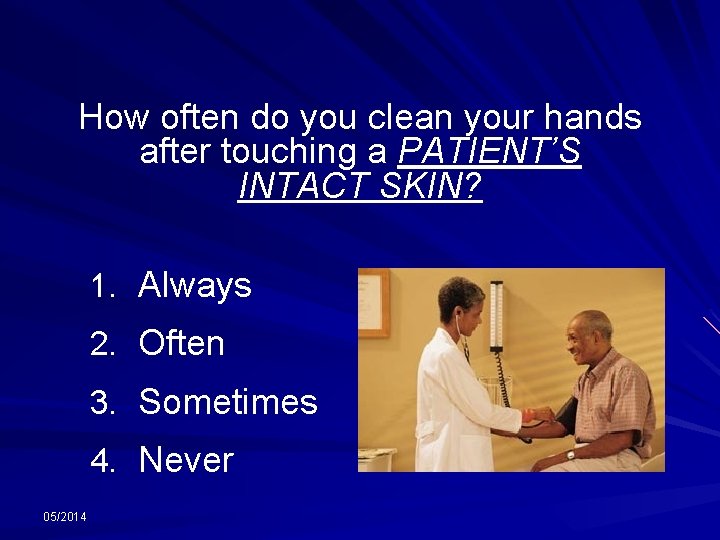
How often do you clean your hands after touching a PATIENT’S INTACT SKIN? 1. Always 2. Often 3. Sometimes 4. Never 05/2014
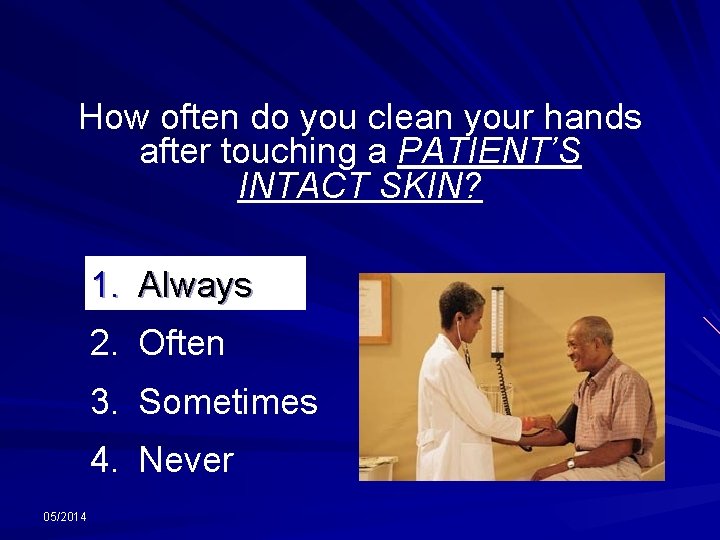
How often do you clean your hands after touching a PATIENT’S INTACT SKIN? 1. Always 2. Often 3. Sometimes 4. Never 05/2014
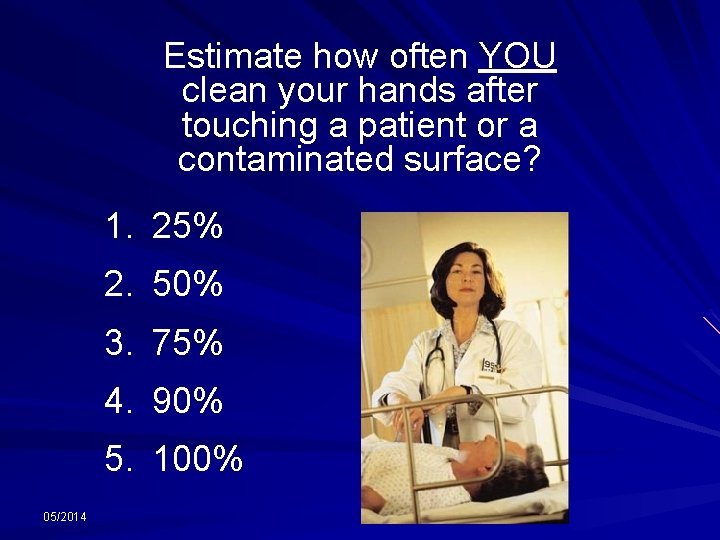
Estimate how often YOU clean your hands after touching a patient or a contaminated surface? 1. 25% 2. 50% 3. 75% 4. 90% 5. 100% 05/2014
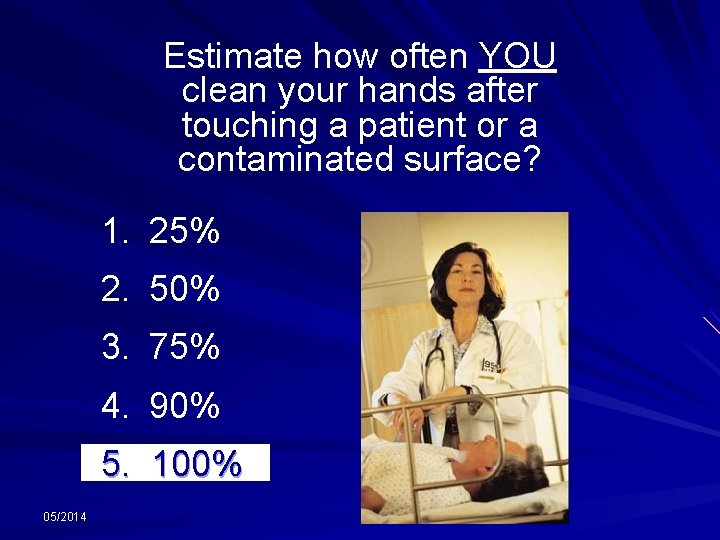
Estimate how often YOU clean your hands after touching a patient or a contaminated surface? 1. 25% 2. 50% 3. 75% 4. 90% 5. 100% 05/2014
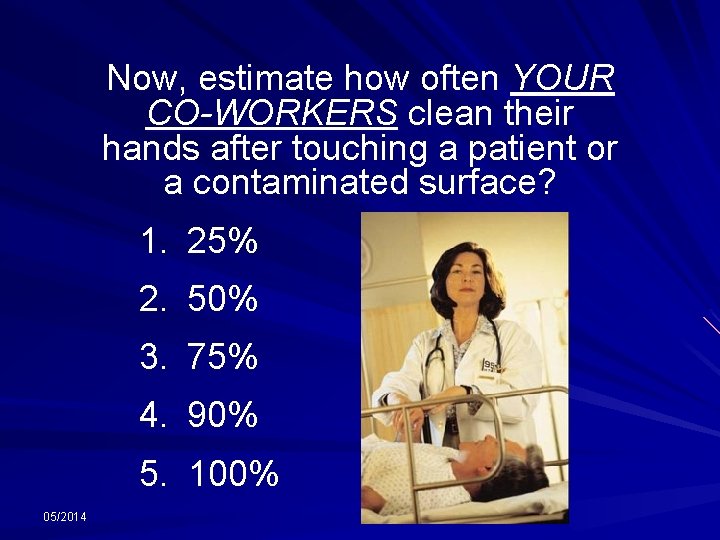
Now, estimate how often YOUR CO-WORKERS clean their hands after touching a patient or a contaminated surface? 1. 25% 2. 50% 3. 75% 4. 90% 5. 100% 05/2014
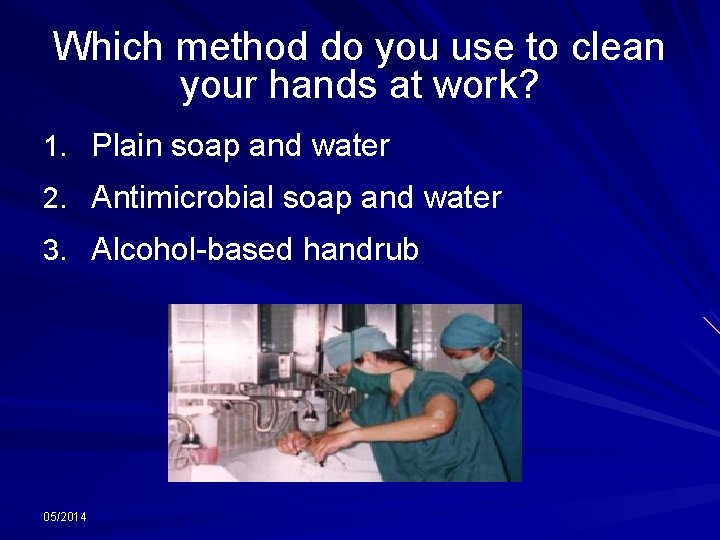
Which method do you use to clean your hands at work? 1. Plain soap and water 2. Antimicrobial soap and water 3. Alcohol-based handrub 05/2014
Which hand hygiene method is best at killing bacteria? 1. Plain soap and water 2. Antimicrobial soap and water 3. Alcohol-based handrub 05/2014
Which hand hygiene method is best at killing bacteria? 1. Plain soap and water 2. Antimicrobial soap and water 3. Alcohol-based handrub 05/2014
Which of the following hand hygiene agents is LEAST drying to your skin? 1. Plain soap and water 2. Antimicrobial soap and water 3. Alcohol-based handrub 05/2014
Which of the following hand hygiene agents is LEAST drying to your skin? 1. Plain soap and water 2. Antimicrobial soap and water 3. Alcohol-based handrub 05/2014
Healthcare-associated organisms are commonly resistant to alcohol. 1. Strongly agree 2. Agree 3. Don’t know 4. Disagree 5. Strongly disagree 05/2014
Healthcare-associated organisms are commonly resistant to alcohol. 1. Strongly agree 2. Agree 3. Don’t know 4. Disagree 5. Strongly disagree 05/2014
How often SHOULD you clean your hands after touching a CONTAMINATED SURFACE (for example, a countertop or bedrail)? 1. Always 2. Often 3. Sometimes 4. Never 05/2014
How often SHOULD you clean your hands after touching a CONTAMINATED SURFACE (for example, a countertop or bedrail)? 1. Always 2. Often 3. Sometimes 4. Never 05/2014
Glove use for all patient care contacts is a useful strategy for reducing risk of transmission of organisms. 1. Strongly agree 2. Agree 3. Don’t know 4. Disagree 5. Strongly disagree 05/2014
Glove use for all patient care contacts is a useful strategy for reducing risk of transmission of organisms. 1. Strongly agree 2. Agree 3. Don’t know 4. Disagree 5. Strongly disagree 05/2014
05/2014
Where to get more Information: CDC and OSHA Web sites GMP’s Hand Hygiene Procedures located in the P&P Manual. GMP Resource Library 05/2014