
GMP Inspection Process The Inspection Module 20 Slide
- Slides: 35
GMP Inspection Process The Inspection Module 20 | Slide 1 of 35 January 2006
The Inspection Objectives 1. To discuss the process of conducting an inspection 2. To review a number of inspection techniques 3. To discuss issues you may encounter when performing an inspection Module 20 | Slide 2 of 35 January 2006
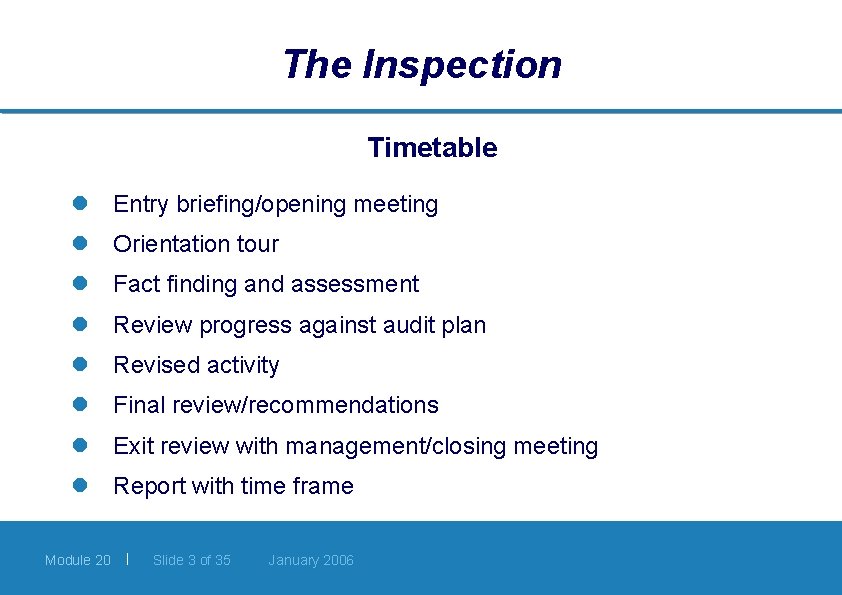
The Inspection Timetable l Entry briefing/opening meeting l Orientation tour l Fact finding and assessment l Review progress against audit plan l Revised activity l Final review/recommendations l Exit review with management/closing meeting l Report with time frame Module 20 | Slide 3 of 35 January 2006
The Inspection Getting Started l Location l Contact l Time l Introductions l Walk-round l Company escort Module 20 | Slide 4 of 35 January 2006
The Inspection Remember that an Inspection…. l Is a systematic approach l Involves interpersonal skills l Identifies deficiencies l Looks at what went wrong l Requires participation from both parties Module 20 | Slide 5 of 35 January 2006
The Inspection Methods of Fact-Finding l Trace forward l Trace backward l Random Module 20 | Slide 6 of 35 January 2006
The Inspection Asking Questions…. . Open questions starting with: l What l Why l When l How l Where l Who Silence can be very powerful Module 20 | Slide 7 of 35 January 2006
The Inspection Good Listening – I l Stop talking! l Help the speaker to feel free to talk l Be approachable l Show the speaker that you are interested l Remove distractions l Try to understand the speaker’s point of view Module 20 | Slide 8 of 35 January 2006
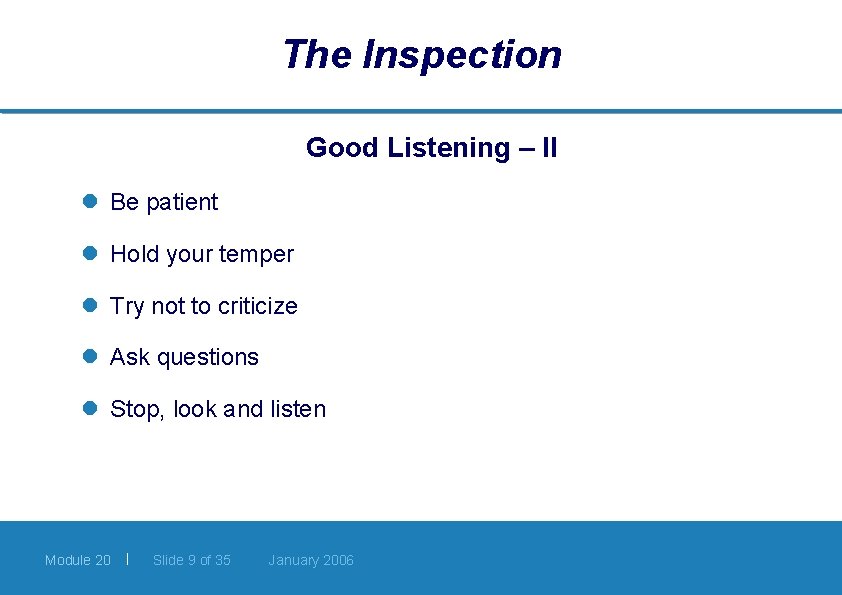
The Inspection Good Listening – II l Be patient l Hold your temper l Try not to criticize l Ask questions l Stop, look and listen Module 20 | Slide 9 of 35 January 2006
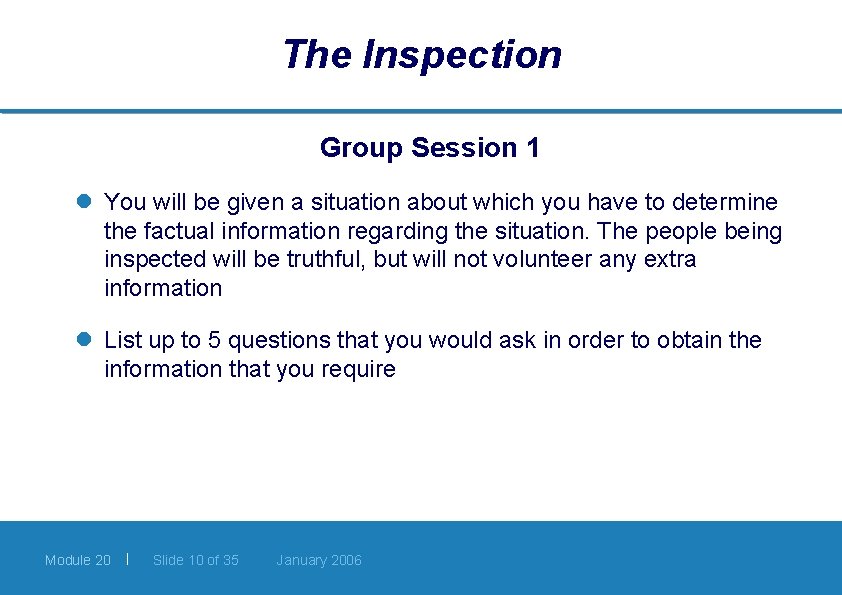
The Inspection Group Session 1 l You will be given a situation about which you have to determine the factual information regarding the situation. The people being inspected will be truthful, but will not volunteer any extra information l List up to 5 questions that you would ask in order to obtain the information that you require Module 20 | Slide 10 of 35 January 2006
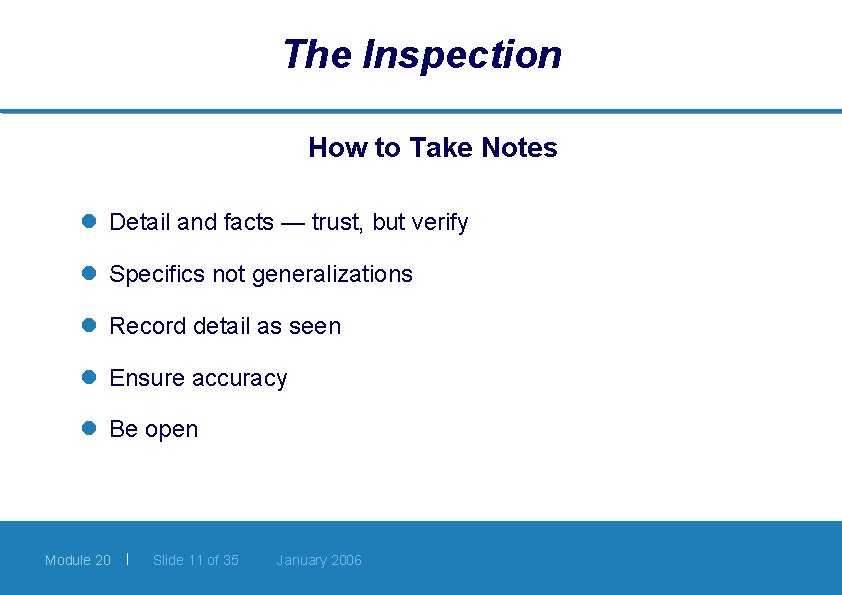
The Inspection How to Take Notes l Detail and facts — trust, but verify l Specifics not generalizations l Record detail as seen l Ensure accuracy l Be open Module 20 | Slide 11 of 35 January 2006
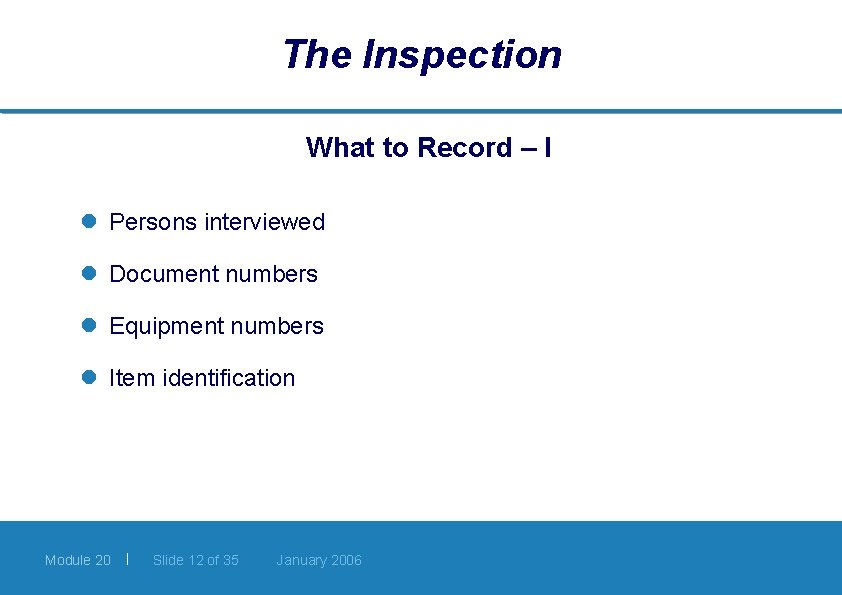
The Inspection What to Record – I l Persons interviewed l Document numbers l Equipment numbers l Item identification Module 20 | Slide 12 of 35 January 2006
The Inspection What to Record – II l Selection of document recipients l Condition of environment l Changes to facilities, equipment, etc. l Layout of area l Any obvious non-conformities Module 20 | Slide 13 of 35 January 2006
The Inspection How to Record – I l Checklists l Flowcharts/process charts l Symbols such as a star (*) or a tick l Checks and follow-up Module 20 | Slide 14 of 35 January 2006
The Inspection How to Record – II l Highlights l Short notes for the report (reminders) l Tape recorder l Video camera l Camera Module 20 | Slide 15 of 35 January 2006
The Inspection Checklists l Are structured l Detailed l Standard for all full inspections l Advantages ä Useful as reference ä Good for training inspectors l Disadvantages ä Can lead to overlooking vulnerable areas of QA Module 20 | Slide 16 of 35 January 2006
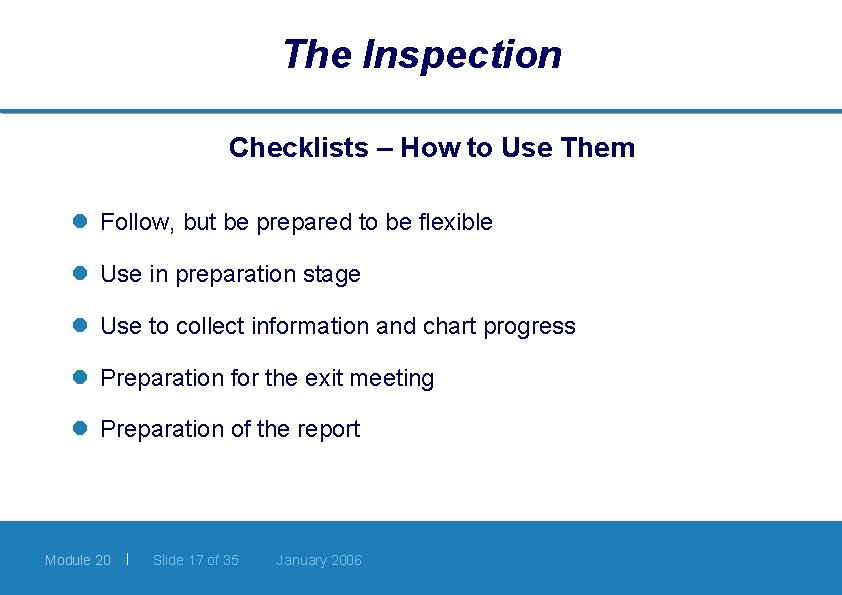
The Inspection Checklists – How to Use Them l Follow, but be prepared to be flexible l Use in preparation stage l Use to collect information and chart progress l Preparation for the exit meeting l Preparation of the report Module 20 | Slide 17 of 35 January 2006
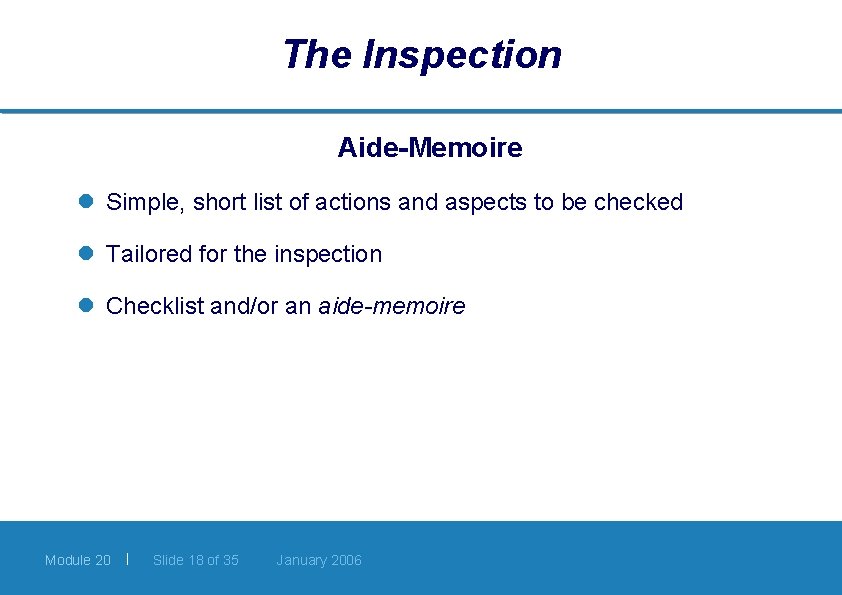
The Inspection Aide-Memoire l Simple, short list of actions and aspects to be checked l Tailored for the inspection l Checklist and/or an aide-memoire Module 20 | Slide 18 of 35 January 2006
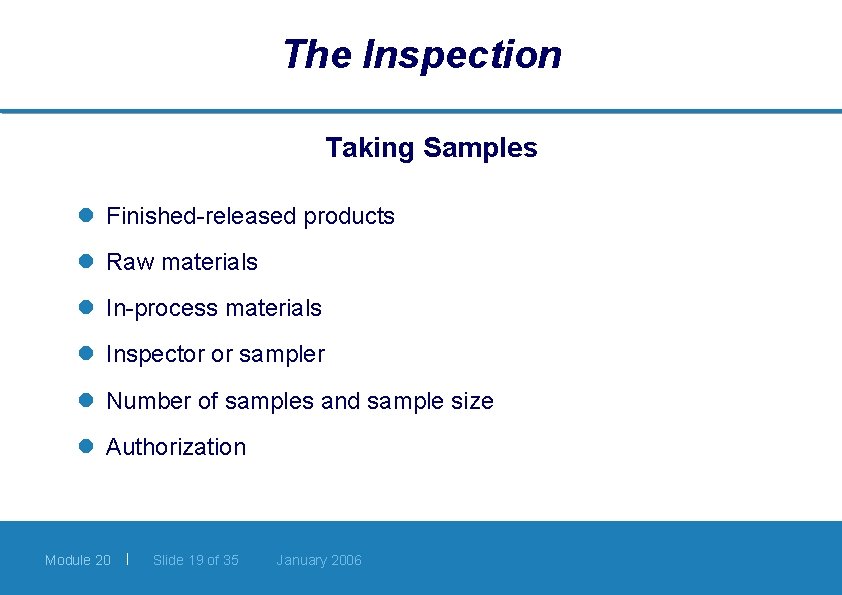
The Inspection Taking Samples l Finished-released products l Raw materials l In-process materials l Inspector or sampler l Number of samples and sample size l Authorization Module 20 | Slide 19 of 35 January 2006
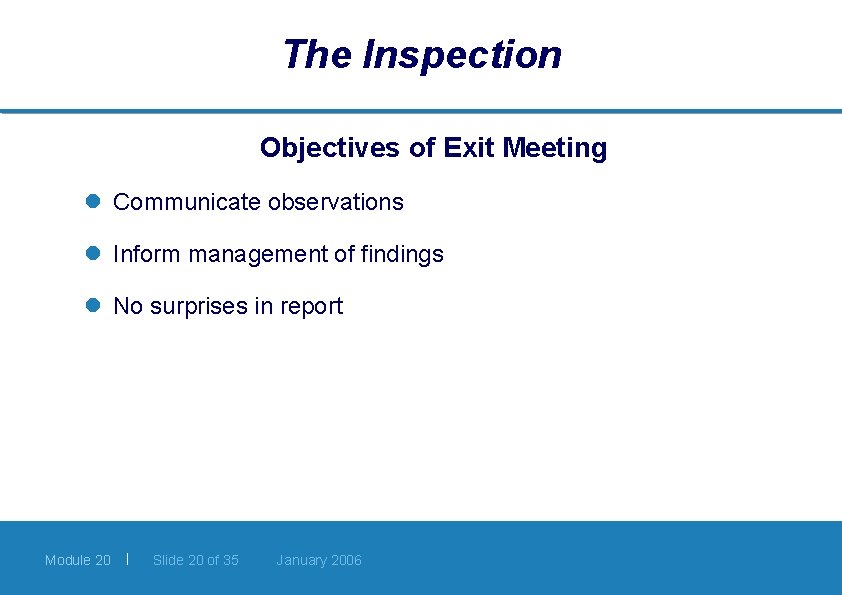
The Inspection Objectives of Exit Meeting l Communicate observations l Inform management of findings l No surprises in report Module 20 | Slide 20 of 35 January 2006
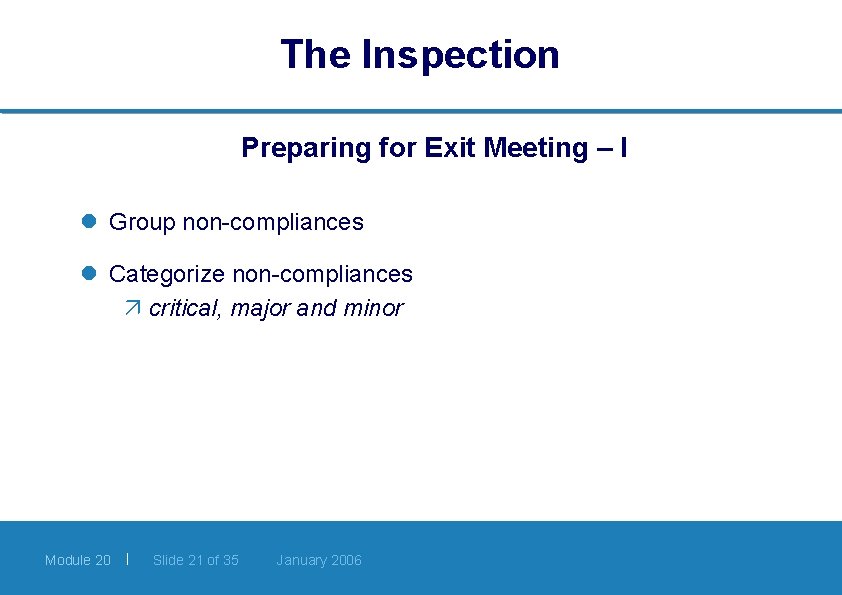
The Inspection Preparing for Exit Meeting – I l Group non-compliances l Categorize non-compliances ä critical, major and minor Module 20 | Slide 21 of 35 January 2006
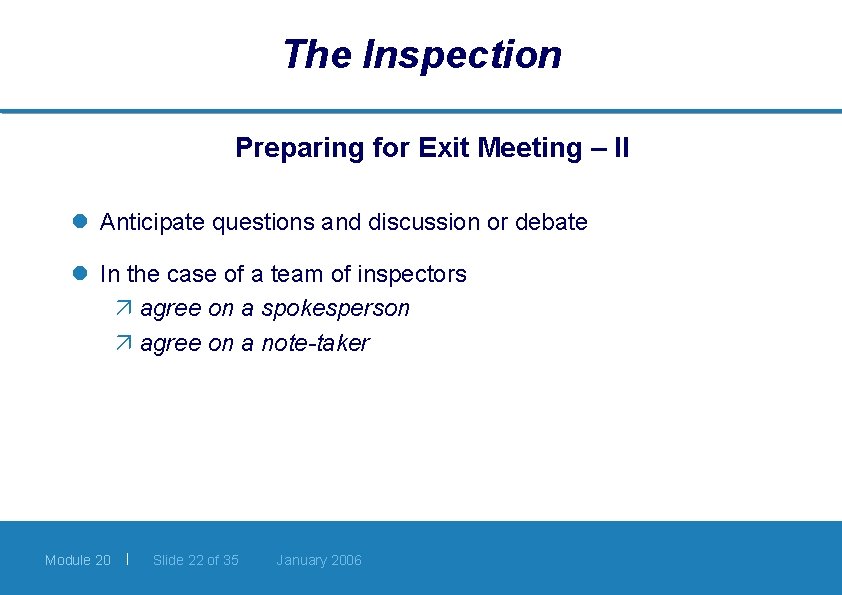
The Inspection Preparing for Exit Meeting – II l Anticipate questions and discussion or debate l In the case of a team of inspectors ä agree on a spokesperson ä agree on a note-taker Module 20 | Slide 22 of 35 January 2006
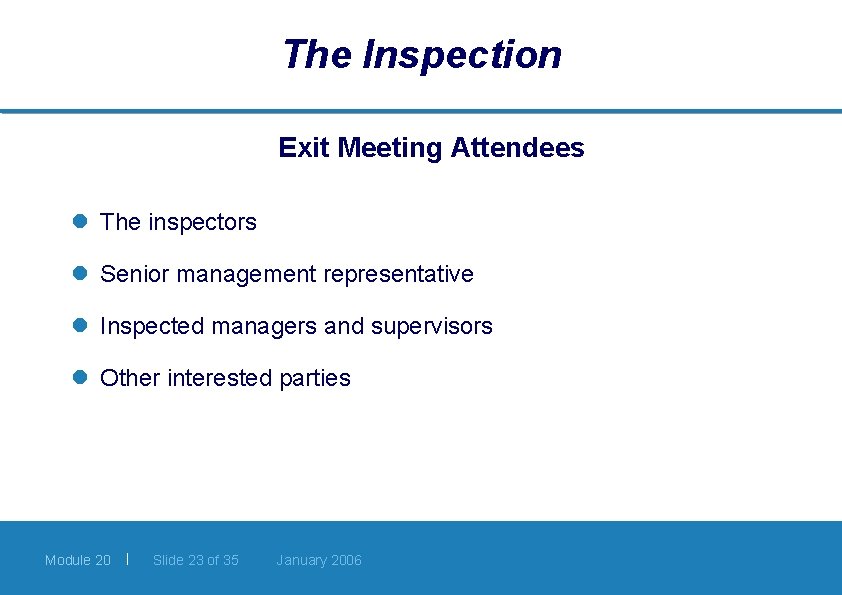
The Inspection Exit Meeting Attendees l The inspectors l Senior management representative l Inspected managers and supervisors l Other interested parties Module 20 | Slide 23 of 35 January 2006
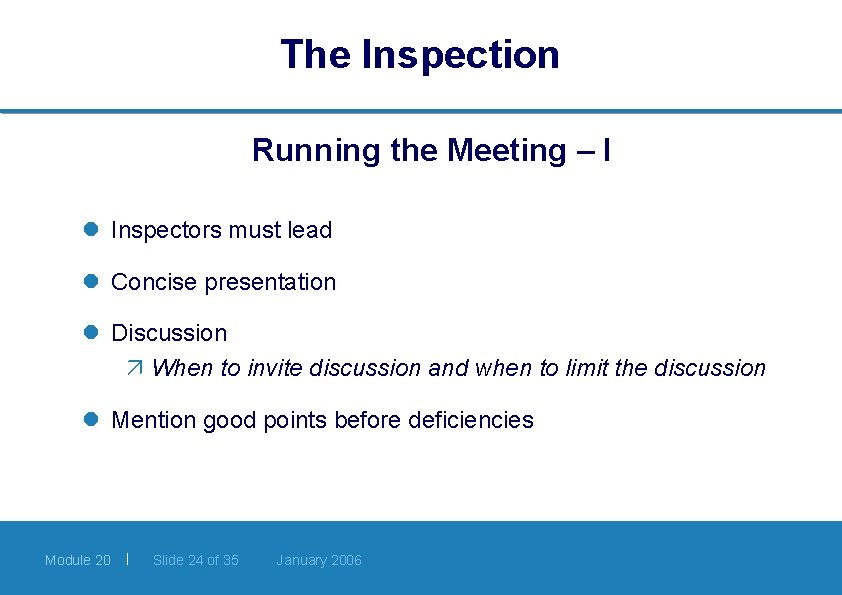
The Inspection Running the Meeting – I l Inspectors must lead l Concise presentation l Discussion ä When to invite discussion and when to limit the discussion l Mention good points before deficiencies Module 20 | Slide 24 of 35 January 2006
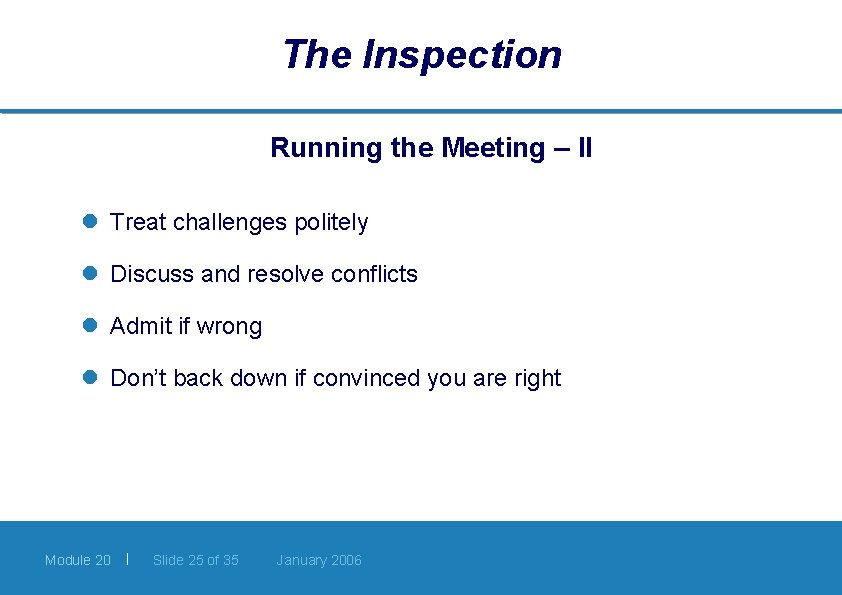
The Inspection Running the Meeting – II l Treat challenges politely l Discuss and resolve conflicts l Admit if wrong l Don’t back down if convinced you are right Module 20 | Slide 25 of 35 January 2006
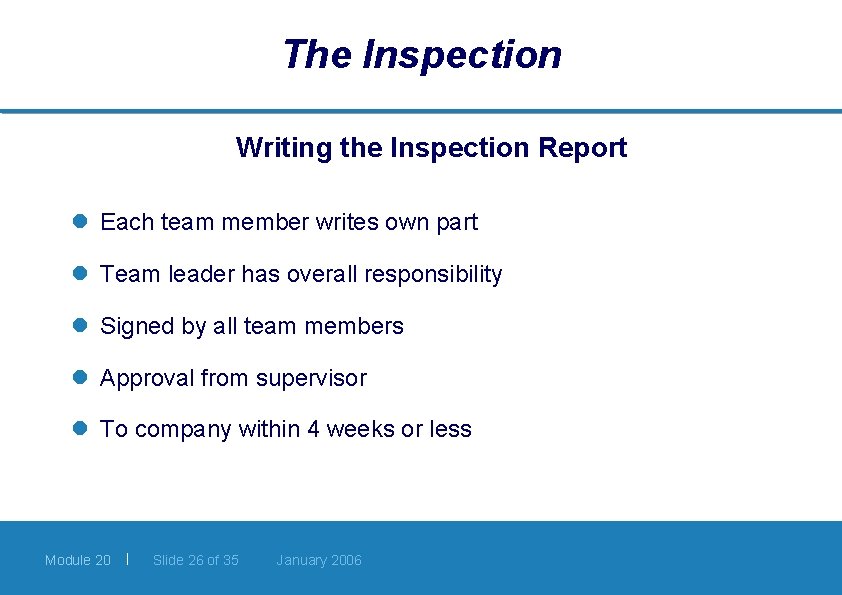
The Inspection Writing the Inspection Report l Each team member writes own part l Team leader has overall responsibility l Signed by all team members l Approval from supervisor l To company within 4 weeks or less Module 20 | Slide 26 of 35 January 2006
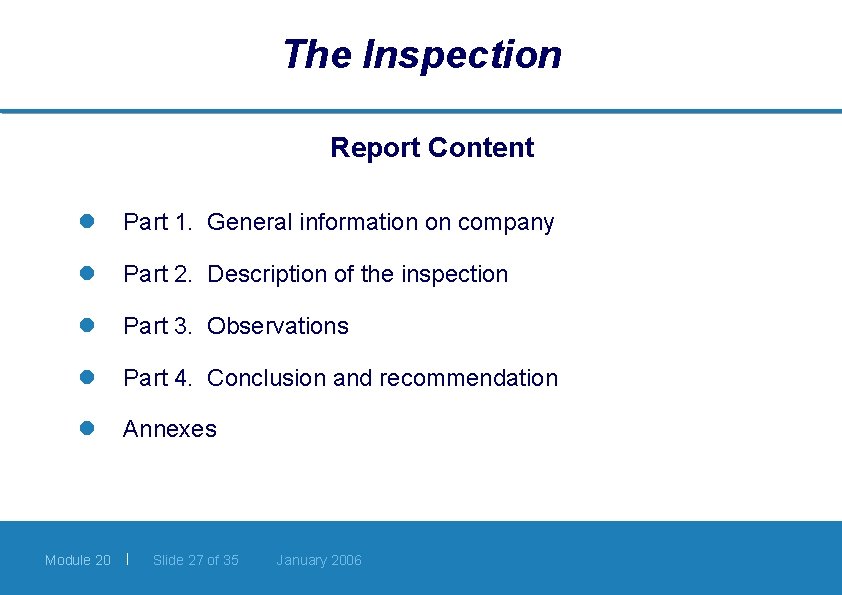
The Inspection Report Content l Part 1. General information on company l Part 2. Description of the inspection l Part 3. Observations l Part 4. Conclusion and recommendation l Annexes Module 20 | Slide 27 of 35 January 2006
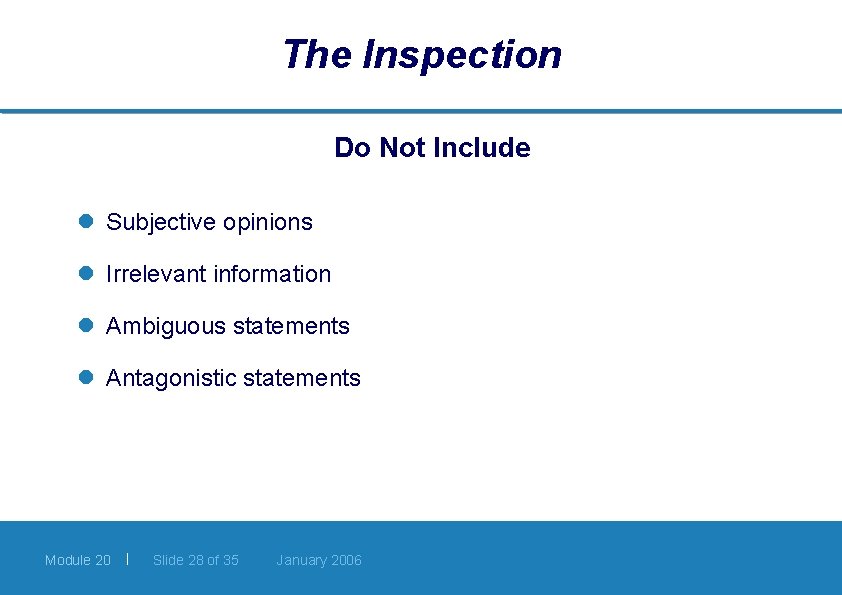
The Inspection Do Not Include l Subjective opinions l Irrelevant information l Ambiguous statements l Antagonistic statements Module 20 | Slide 28 of 35 January 2006
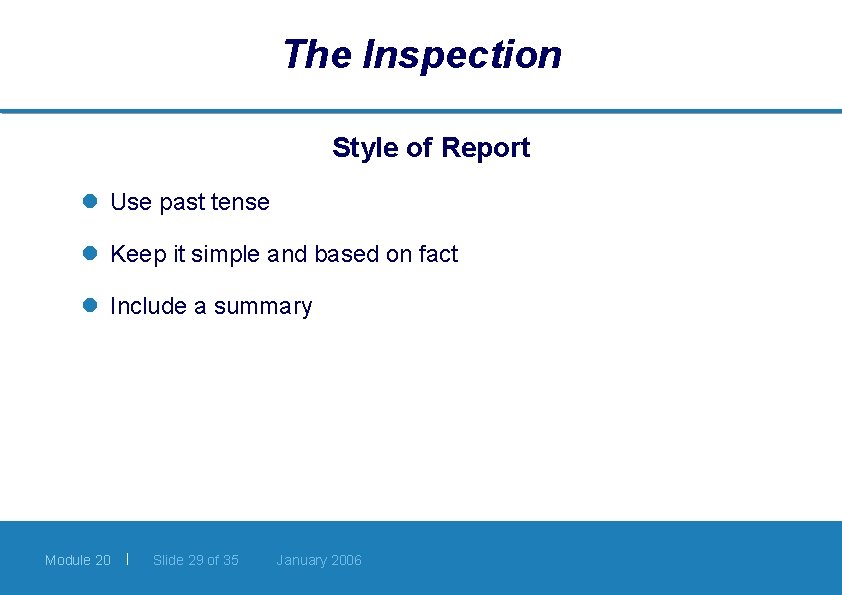
The Inspection Style of Report l Use past tense l Keep it simple and based on fact l Include a summary Module 20 | Slide 29 of 35 January 2006
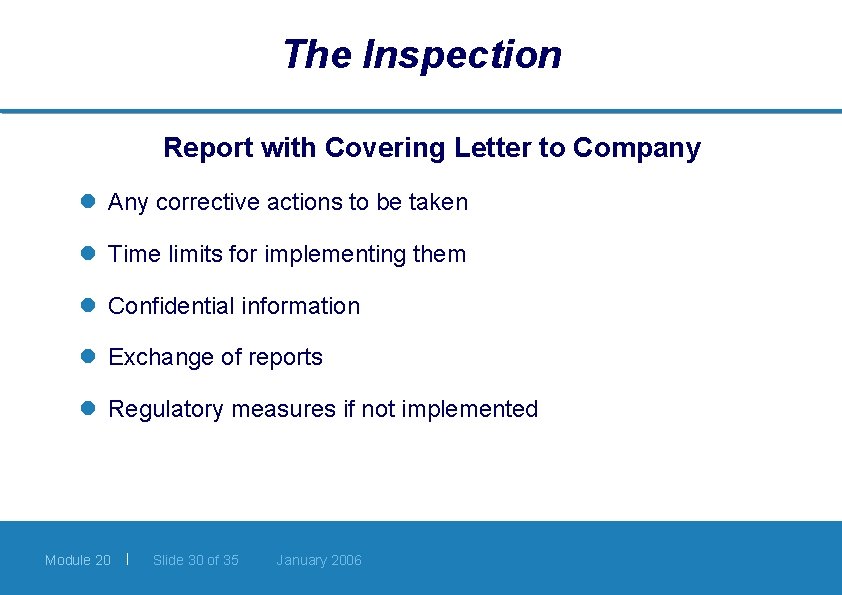
The Inspection Report with Covering Letter to Company l Any corrective actions to be taken l Time limits for implementing them l Confidential information l Exchange of reports l Regulatory measures if not implemented Module 20 | Slide 30 of 35 January 2006
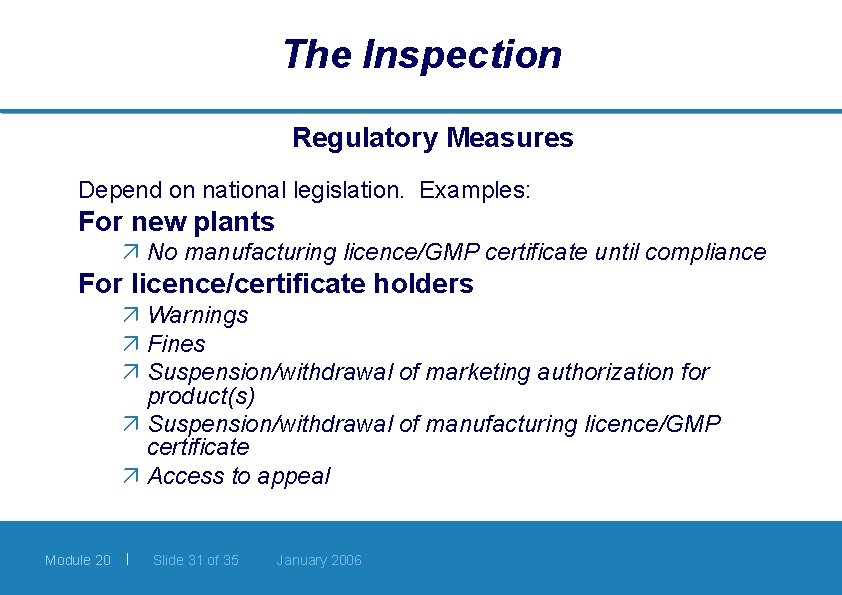
The Inspection Regulatory Measures Depend on national legislation. Examples: For new plants ä No manufacturing licence/GMP certificate until compliance For licence/certificate holders ä Warnings ä Fines ä Suspension/withdrawal of marketing authorization for product(s) ä Suspension/withdrawal of manufacturing licence/GMP certificate ä Access to appeal Module 20 | Slide 31 of 35 January 2006
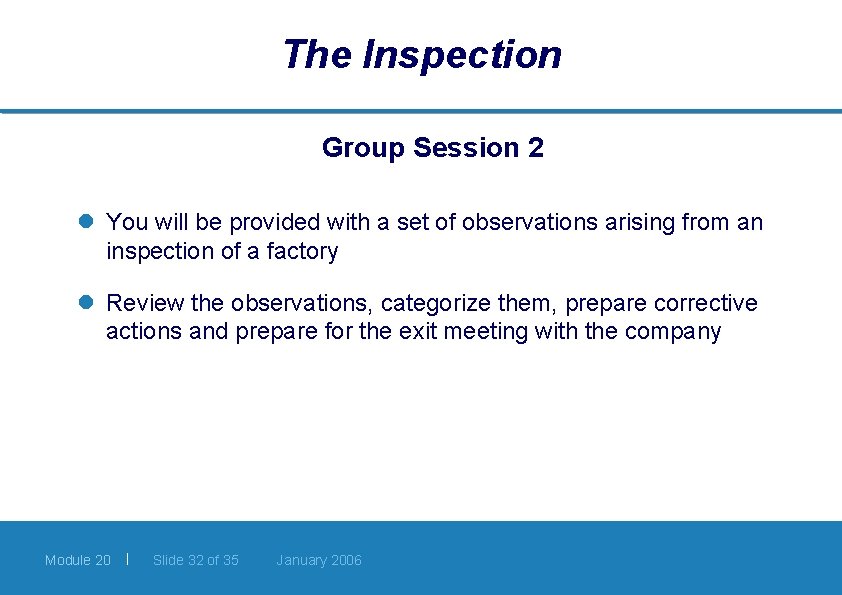
The Inspection Group Session 2 l You will be provided with a set of observations arising from an inspection of a factory l Review the observations, categorize them, prepare corrective actions and prepare for the exit meeting with the company Module 20 | Slide 32 of 35 January 2006
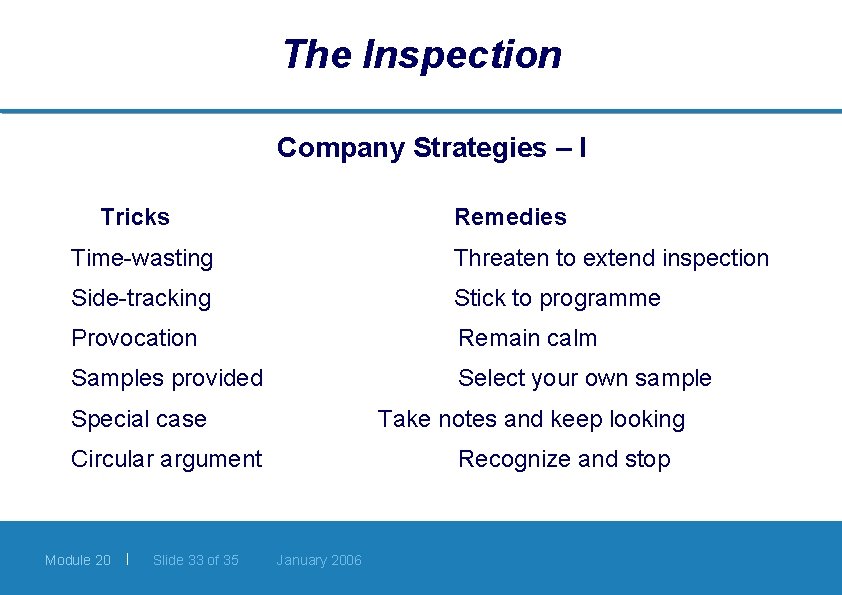
The Inspection Company Strategies – I Tricks Remedies Time-wasting Threaten to extend inspection Side-tracking Stick to programme Provocation Remain calm Samples provided Select your own sample Special case Take notes and keep looking Circular argument Module 20 | Slide 33 of 35 Recognize and stop January 2006
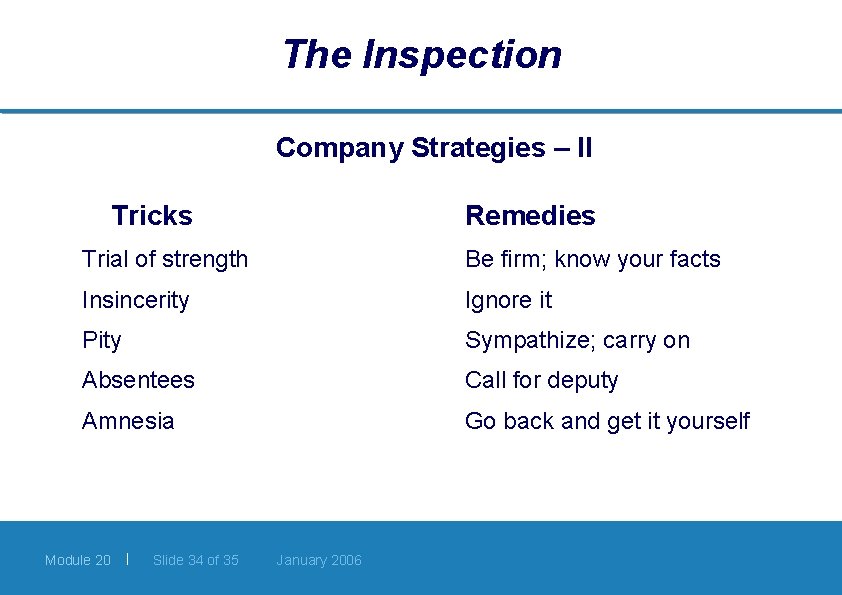
The Inspection Company Strategies – II Tricks Remedies Trial of strength Be firm; know your facts Insincerity Ignore it Pity Sympathize; carry on Absentees Call for deputy Amnesia Go back and get it yourself Module 20 | Slide 34 of 35 January 2006
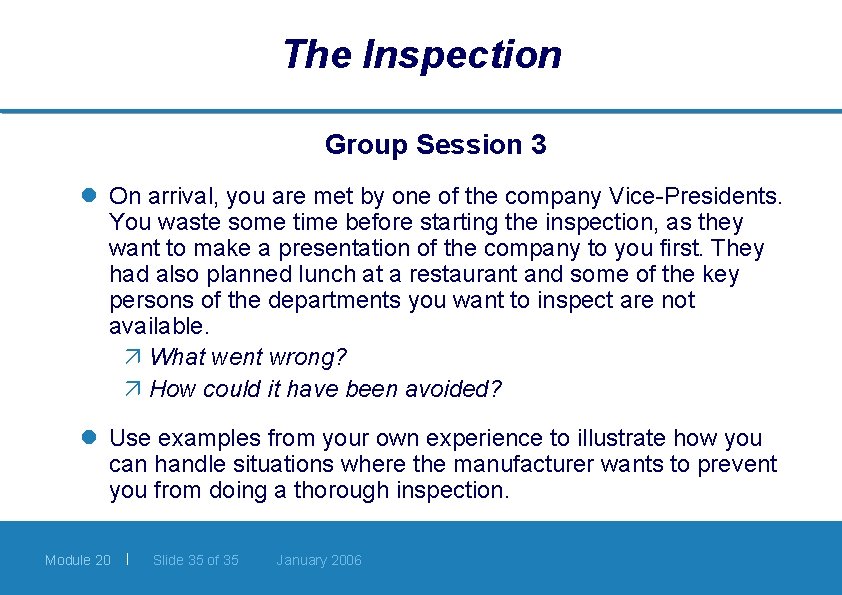
The Inspection Group Session 3 l On arrival, you are met by one of the company Vice-Presidents. You waste some time before starting the inspection, as they want to make a presentation of the company to you first. They had also planned lunch at a restaurant and some of the key persons of the departments you want to inspect are not available. ä What went wrong? ä How could it have been avoided? l Use examples from your own experience to illustrate how you can handle situations where the manufacturer wants to prevent you from doing a thorough inspection. Module 20 | Slide 35 of 35 January 2006