
GMACFOA Football Mechanic Training Session Line Judge Position
GMACFOA Football Mechanic Training Session Line Judge Position Line Judge Presented By Wanda Fort and Carlos Calveiro 7/22/20

Overview Pre-Season Preparation Getting to the field Pre-game Responsibilities Mechanics Game Clock
Pre-Season Preparation Take the time to study the Rule Book, review the Case Book, and refresh our memories with the Mechanics Guide. New rules for 2020 will affect Line Judges – the Head Coach will have to designate who will be the team representative for penalty decisions and timeouts.
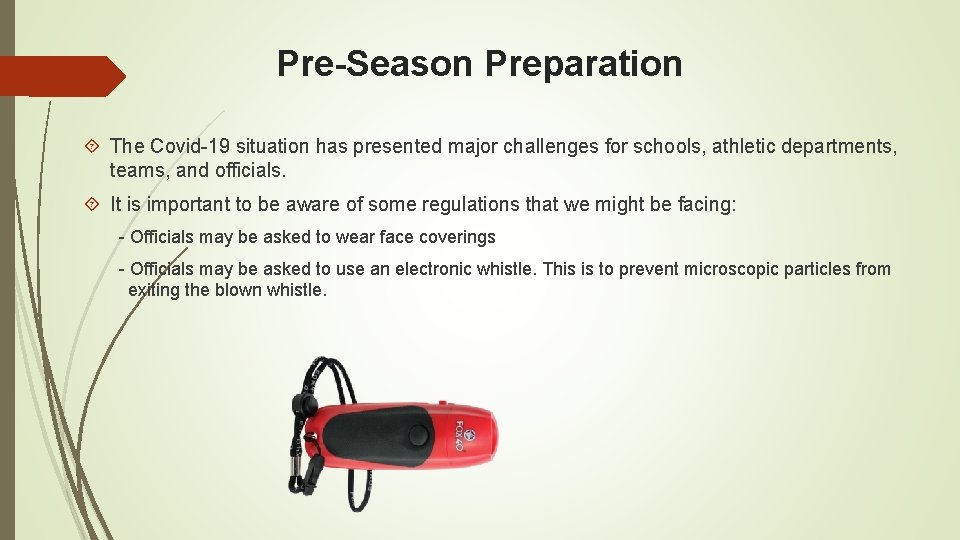
Pre-Season Preparation The Covid-19 situation has presented major challenges for schools, athletic departments, teams, and officials. It is important to be aware of some regulations that we might be facing: - Officials may be asked to wear face coverings - Officials may be asked to use an electronic whistle. This is to prevent microscopic particles from exiting the blown whistle.
Getting to the Field For night games (games beginning at 6: 00 pm or later) assignments arrive at the field at least 60 minutes prior to the scheduled kickoff time. This is very important because of the new pregame assignments. § 60 min – Arrive § 45 min – Inspect the field § 30 min – Ref pregame § 15 min – enter field (Meet with Ball Boys) § 5 min – Coin Toss If you are going to be running late you are expected to contact your Referee at your earliest convenience to let him/her know you will be running late.
Pre-Game - Field Inspection At 45 min mark before game time, the HL, LJ and BJ will need to inspect the field. - Observe any unusual markings. - Make sure the yard line markers are a safe distance from field - Look for holes or any other hazard on the field - Check padding on gold post - Know were the 9 yard marks are located - Check major marking(5 and 3 yard marks)
Referee’s Pre-Game Meeting At 30 min mark attend the Referee’s pregame meeting. - Alert the crew to any field issues on the home side of the field. - Be aware of any unusual plays or situations - Find out who is going to call time outs and decide penalties - Find out about ball handlers, - Line Judges need to understand they are responsible for monitoring the game clock. - Line Judges will also need to make sure they have a watch with a countdown mode in the event the game clock goes out - Check radios
Pre-Game – Meeting with Ball Boys Once the crew enters the field, the Line Judge needs to meet with the ball handers from each team. - Get their names and write them down. - Ball handlers may be expected to wear face coverings this season. If so, remind them of their responsibility. There is the possibility that an additional restraining line 4 -yards from the sideline may be in place. This is to protect the officials from people getting too close and will help to maintain social distancing. If the 4 -yard belt is in existence, - Remind the ball handlers that they are to remain behind that 4 -yard belt - Ball Handlers may come up to the sideline at the end of a play if a new ball is requested, but they must then stand behind the 4 -yard belt. Practice underhand tosses with the Ball Handlers.
Pre-Game Ball Handlers There was discussion by the Sports Medici Officiating” that the Advisory Sub-Committee on “Officials Safe Return to Ball Handlers may be asked to wear gloves during games. This has not been resolved at this time. If gloves are necessary, the home school is supposed to supply them to the Ball Handlers for both teams. This committee also discussed the possibility of having Ball Handlers “sanitize” the footballs not in play. This led to some concerns about how this would be done and the effect it might have on a football once it goes back in to the game. In addition, the medical expert on the committee is not convinced that a football would be a viable candidate for transferring the coronavirus to another person. One more item: there is also talk that officials may be required to wear protective gloves (also supplied by the home school). This is an ongoing topic of discussion.
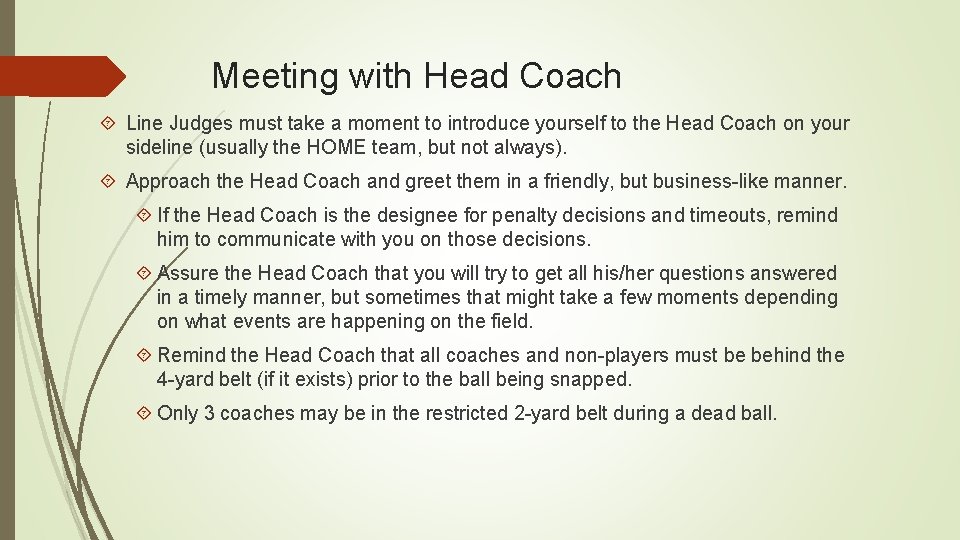
Meeting with Head Coach Line Judges must take a moment to introduce yourself to the Head Coach on your sideline (usually the HOME team, but not always). Approach the Head Coach and greet them in a friendly, but business-like manner. If the Head Coach is the designee for penalty decisions and timeouts, remind him to communicate with you on those decisions. Assure the Head Coach that you will try to get all his/her questions answered in a timely manner, but sometimes that might take a few moments depending on what events are happening on the field. Remind the Head Coach that all coaches and non-players must be behind the 4 -yard belt (if it exists) prior to the ball being snapped. Only 3 coaches may be in the restricted 2 -yard belt during a dead ball.
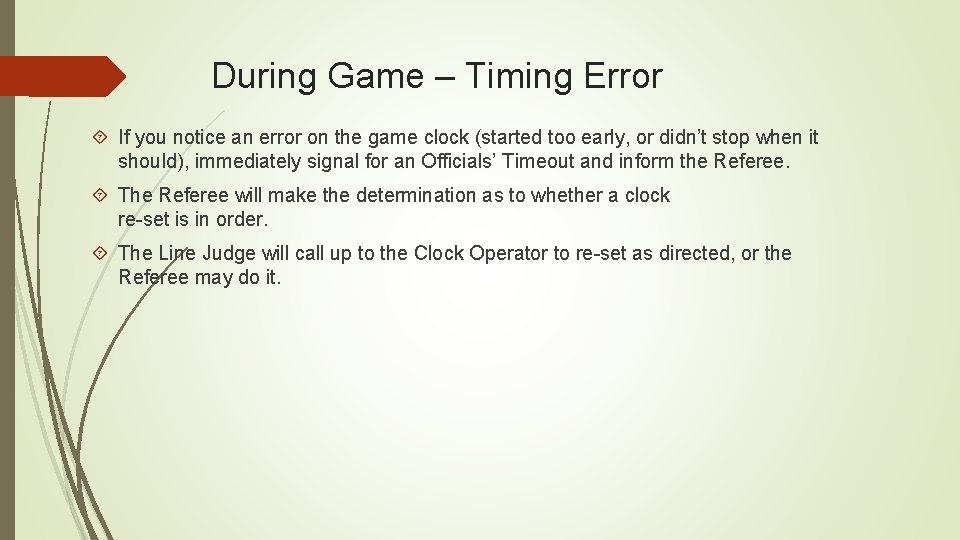
During Game – Timing Error If you notice an error on the game clock (started too early, or didn’t stop when it should), immediately signal for an Officials’ Timeout and inform the Referee. The Referee will make the determination as to whether a clock re-set is in order. The Line Judge will call up to the Clock Operator to re-set as directed, or the Referee may do it.
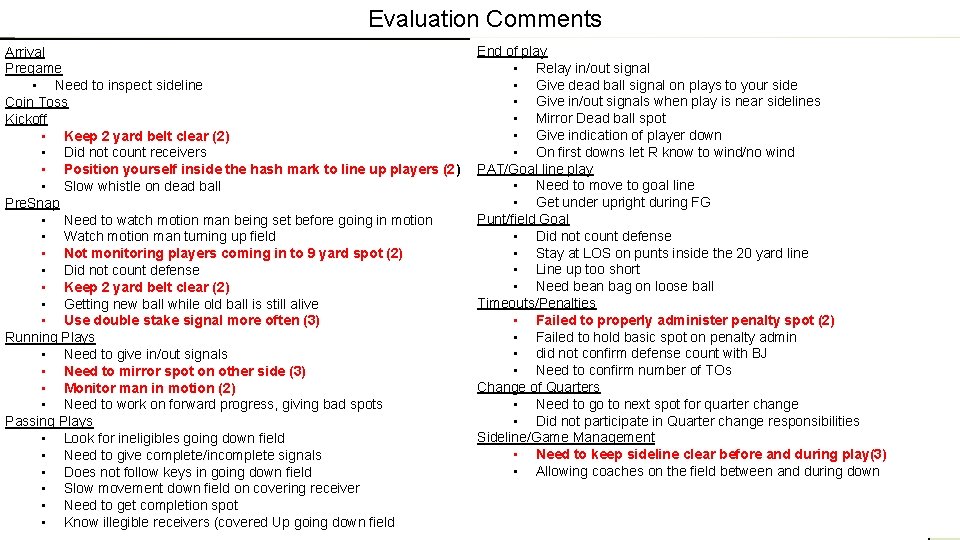
Evaluation Comments Arrival Pregame • Need to inspect sideline Coin Toss Kickoff • Keep 2 yard belt clear (2) • Did not count receivers • Position yourself inside the hash mark to line up players (2) • Slow whistle on dead ball Pre. Snap • Need to watch motion man being set before going in motion • Watch motion man turning up field • Not monitoring players coming in to 9 yard spot (2) • Did not count defense • Keep 2 yard belt clear (2) • Getting new ball while old ball is still alive • Use double stake signal more often (3) Running Plays • Need to give in/out signals • Need to mirror spot on other side (3) • Monitor man in motion (2) • Need to work on forward progress, giving bad spots Passing Plays • Look for ineligibles going down field • Need to give complete/incomplete signals • Does not follow keys in going down field • Slow movement down field on covering receiver • Need to get completion spot • Know illegible receivers (covered Up going down field End of play • Relay in/out signal • Give dead ball signal on plays to your side • Give in/out signals when play is near sidelines • Mirror Dead ball spot • Give indication of player down • On first downs let R know to wind/no wind PAT/Goal line play • Need to move to goal line • Get under upright during FG Punt/field Goal • Did not count defense • Stay at LOS on punts inside the 20 yard line • Line up too short • Need bean bag on loose ball Timeouts/Penalties • Failed to properly administer penalty spot (2) • Failed to hold basic spot on penalty admin • did not confirm defense count with BJ • Need to confirm number of TOs Change of Quarters • Need to go to next spot for quarter change • Did not participate in Quarter change responsibilities Sideline/Game Management • Need to keep sideline clear before and during play(3) • Allowing coaches on the field between and during down
Line Judge Position Mechanics
Mechanics Free Kicks 1. Position - R-50: free kick line out of bounds on your sideline (press box side) 2. Responsibility before kick - Count K players (don’t kick until you have 11) - Keep an eye on your sideline: coaches, players, substitutes, - Give ready signal to R after moving into position on sideline 3. Keys - Key on the front line blockers nearest you - Know the blocker’s numbers
Mechanics Free Kicks 4. What to look for during play - Be ready to rule on NZ infraction – DEAD BALL fouls - encroachment - Be ready to rule on kick not crossing R free kick line - Be ready to rule on first touching by K (mark with a beanbag) - Be ready to rule on kick catching interference for short kick - Watch initial blocks by R on your side of the field - Be ready to pick up runner when he enters your area of coverage 5. Dead Ball Mechanics - If a player goes out of bounds, mark the spot with your foot and turn out towards the sideline to watch the out of bounds players. - Do not drop a bean bag and leave that spot unless absolutely necessary
Mechanics Free Kicks after a Safety 1. Position (After Safety) - R-30: free kick line out of bounds on your sideline 2. Position (Obvious Onside Kick Situation) - R-30: free kick line out of bounds on your sideline - Watch for first touching - Ball crossing the 50 yard line - Have bean bag in your hand to help mark the spot
Mechanics Scrimmage Kicks - Punts 1. Position (Punts) - Out of bounds on your sideline at the LOS - Outside 20 -yard line – line up 20 yards deep. 2. Responsibility before kick - Count R players 3. Keys - The ‘Gunner’ on your side
Mechanics Scrimmage Kicks - Punts 4. What to look for during play - Assist coverage on your side - Kick Out of Bounds in flight • move past where it went out, walk back upfield, look at Referee for spot, mark spot (if Referee looks “unsure” stop on a painted yard line) - Kick Out of Bounds after hitting ground • mark out of bounds spot - Cover runner when he moves into your area - Watch signaler when fair catch signal is made (cannot block) 5. Dead Ball Mechanics - If a player goes out of bounds, mark the spot with your foot and turn out towards the sideline to watch the out of bounds players. - Do not drop a bean bag and leave that spot unless absolutely necessary
Mechanics Scrimmage Kicks – Field Goal, Try 1. Position (Field Goal, Try) - Upright on LJ side of field (if Referee’s back is to you and Referee is facing the kicker/holder. ) 2. Responsibility before kick - Count R players 3. Keys ‘Gunner’ 4. What to look for during play - Rule on your upright - Signal score or no-score - Be ready to cover sideline if blocked, fake or short FG
Mechanics Plays from Scrimmage (Run) 1. Position On the sideline at the line of scrimmage 2. Responsibility before snap Get into a routine. Do the same things on every play to get ready − Count the Defense − Communicate you count to the Back Judge − Count 4 in the backfield and give signal − Make decision on WR and T • are they on or off LOS − Give the WR an extended foot to let him know where the LOS is located − If the widest man on your side is in the backfield, extend arm out shoulder high towards the backfield. Hold this arm up until just before the snap. 3. At the Snap - Read the snap (legal? ). - Initial key is the Tackle/Tight End. Do you read pass or run? - Second key is the Back coming out of the backfield - Never make a decision on the status of a player on the HL side of field
Mechanics Plays from Scrimmage (Run) 4. Keys Initial key is the Tackle/Tight End. - If tackle move backward it is possibly a pass - If the tackle moves forward and blocks D, it is possibly a running play 5. Areas of coverage - Look at the initial block of the TE and/or T on your side - Stay with the TE/T until the ball carrier moves toward the LOS - It is better to pick up the runner too soon rather than too late - Once the ball has passed your position, follow the play. - When the play ends you are responsible forward progress – Do not angle in to the spot of progress, square off the progress at a 90 degree angle. 6. Point of attack - Fouls should occur at the where the ball carrier is/or will be soon. (A foul should have a direct impact on the outcome of the play. )
Mechanics Plays from Scrimmage (Run) 7. Dead Ball Mechanics - If a player goes out of bounds, mark the spot with your foot and turn out towards the sideline to watch the out of bounds players. - If covering official, signal start of 40 -second play clock - Do not drop a bean bag and leave that spot unless absolutely necessary
Mechanics Plays from Scrimmage (Pass) 1. Position - On the sideline in 2 yard belt at the line of scrimmage 2. Responsibility before snap - Count the Defense - Communicate you count to the Back Judge - Count 4 in the backfield. - Make decision on WR and T – are they on or off LOS - Give the WR an extended foot to let him know where the LOS is located - If the widest man on your side is in the backfield, extend arm out shoulder high towards the backfield. - Hold this arm up until just before the snap. - Watch man in motion going away from you 3. At the Snap - Read the snap (legal? ). - Initial key is the Tackle/Tight End. Do you read pass or run? - Second key is the Back coming out of the backfield - Never make a decision on the status of a player on the HL side of field
Mechanics Plays from Scrimmage (Pass) 4. Keys Initial key is the Tackle/Tight End. - If pass, go with receiver downfield 5. Areas of coverage - Look at the initial block of the TE and/or T on your side – know who you have initial responsibility to watch – cover receivers in your area – Know when the ball leaves the passer’s hand - Rule on completion 6. Point of attack - look for fouls on receiver/defender - A foul should have a direct impact on the outcome of the play. - Signal completion/not
Mechanics Plays from Scrimmage (Pass) 7. Dead Ball Mechanics - Mark completion spot if ball in your area - Mirror completion spot, if completion in other ‘s area - If a player goes out of bounds, mark the spot with your foot and turn out towards the sideline to watch the out of bounds players. - If covering official, signal start of 40 -second play clock - Do not drop a bean bag and leave that spot unless absolutely necessary
Mechanics Goal Line Mechanics 1. Position On the sideline at the line of scrimmage. 2. Responsibility before snap - Count the Defense - Communicate you count to the Back Judge - Count 4 in the backfield. - Make decision on WR and T. Are they on or off LOS - Give the WR an extended foot to let him know where the LOS is located - If the widest man on your side is in the backfield, extend arm out shoulder high towards the backfield. Hold this arm up until just before the snap. - Watch man in motion going away from you 3. Keys Same as above 4. Areas of coverage – When the ball is at the 10 -yard line, you are responsible for the goal line. Officiate the play from in front – When snapped at the 5 -yard line, move to the goal line when you read run
Mechanics Change of Possession 1. Reverse mechanics (Spots, Goal Line) Watch for illegal blocks 2. Beanbag usage, spot of catch, spot of fumble, player OB Measurements 1. Have the spot where the clip will be placed.
Post-Season: 7 -Person Mechanics Coin Toss Procedures and Responsibilities 1. Stay on your sideline at the 50 -yard line with a game ball (FJ will be at the numbers). 2. Meet with other officials at the center of the field, provide game ball to BJ if your team will be kicking, and then jog to kickoff positions. Free Kicks-Deep a. Starting position is on the sideline on the press box side at R’s goal line. You have goal line and pylon responsibility. Stay at the goal line until it is no longer threatened. 3. Count the receiving team and confirm with R. Signal accordingly for less than/greater than/or equal to 11 players. You are secondary for knowing if K has at least four players on both sides of the kicker. 4. Wind the clock when the ball is legally touched in the field of play, unless the ball is caught or recovered by a player who is legally down. 5. When the runner is on your side of the field, you are responsible for blocks at the point of attack and the runner. 6. When you do not have the ball, take a position to observe blocks on the backside of the runner. Free Kicks-Onside a. Starting position is on the sideline on the press box side, midway between the two restraining lines. Have bean bag in hand. 7. Observe blocking by both teams. Know if the ball was kicked into the ground. 8. Be alert for a fair-catch signal by R and be prepared to cover the play if a R player recovers the kick and attempts to advance the ball. 9. Running Plays a. Up the middle focus on blocks and the ball carrier. b. Toward your side of the field focus on blocks in front of the ball carrier, how did he turn the corner, forward progress. Close at a 90 -degree angle. c. Away from your side of field focus on back-side blocks (protect behind the R and U) and cross field spot for HL.
7 Man Mechanic Line Judge position
Post-Season: 7 -Person Mechanics Passing Plays Identify the receiver you will be responsible for based on a snap-shot at the snap of the ball. If balanced formation, your key is the back. If un-balanced formation and your side is weak side, your key is the back or 2 nd receiver in. If un-balanced formation and your side is strong side with 2 receivers, your key is the back. If un-balanced formation and your side is strong side with 3 -4 receivers, your key is the 2 nd receiver in. If quads to your side, let them declare after the snap. Stay at LOS until the ball crosses, then move to get progress SNAP-TACKLE-BACK - Is the pass behind the line of scrimmage thrown forward or backward? Must know if the pass is thrown from beyond the neutral zone. Must know if the pass crosses the line of scrimmage. Observe where ineligible linemen are at the time the passer releases the ball. Stay with your receiver as long as possible; until another receiver enters your area or the pass is thrown. Know where the ball is. Never guard air.
Post-Season: 7 -Person Mechanics Passing Plays You have progress to B’s 2 -yard line. Reverse fade on interception. Back pedal and give up progress to FJ. Observe blocks in front of the runner. Get to the goal line if necessary. You have progress inside the 2 -yard line. Clean up around the dead ball spot and out-of-bounds. Watch dead ball action. Punts - Same position as any scrimmage play. Stay at the line of scrimmage until the ball crosses, then move slowly downfield. Reverse fade on punt returns. Back pedal and give up progress to the SJ. Observe blocks in front of the runner. Get to the goal line if necessary. You have progress inside the 2 -yard line. Clean up around the dead ball spot and out-of-bounds. Watch dead ball action. Look for legal and illegal blocks into the kicker. On a bad snap/ blocked kick behind LOS, bracket the ball with the R if you are facing him. H L has the LOS. On fakes, know eligible receivers.
Post-Season: 7 -Person Mechanics Field Goals and Trys Same position as any scrimmage play. Know down & distance, count offense, signal with LJ, identify formation, identify eligible receivers, ensure legal snap, watch wing back, think kick rules, who’s facing R to help with blocked kick? Watch action of widest blocker on LOS. Help Referee if rusher is illegally blocked into the kicker. You have the goal line and must be at the pylon and ready to rule on a possible touchdown. If you are facing the referee, you will retreat on blocked kicks and snaps over the kicker/holder’s head and bracket the play with the referee to the opposite goal line. If you are not facing the referee, you will remain on line of scrimmage. You have sideline responsibility to the goal line on a runback. Goal Line Plays Goal line responsibility when the ball is snapped from the 7 yard-line and in. Same position as any scrimmage play. Get to the goal line immediately and officiate the play-rule on progress from there. Stay wide & know the location of the ball when it crosses the goal line.
Post-Season: 7 -Person Mechanics Reverse Goal Line Mechanics Goal line responsibility when the ball is snapped from the 5 yard-line back. Same position as any scrimmage play. Get to the goal line immediately and officiate the play, rule on progress from there. When the ball is snapped between Team A’s 5 and 10 yard lines, be prepared to move to the goal line if the play dictates. General Game Duties Be particularly aware of player and/or substitutes entering or leaving on your sideline. Be aware of substitutions to deceive. Must know down, distance and clock status every play.
Post-Season: 7 -Person Mechanics Penalty Enforcement Stay at the enforcement spot until the march-off is complete, then verify accuracy. All officials are responsible to verify that the penalty has been properly enforced. Measurements Provide the spot on the appropriate line to place the clip.
End of Game Thank your Ball Handlers for their efforts Meet up with entire crew and leave field together Check with Referee if there any situations that need to be brought up If possible, meet briefly with Clock Operator and thank him/her, and/or provide constructive criticism if it is warranted If you feel that the Clock Operator was either VERY GOOD and COMPETENT, or VERY BAD and incompetent let the Assigning Commissioner know. If we don’t provide feedback on the abilities of our Clock Operators, the Assigning Commissioner has no opportunity to make “corrective” actions.
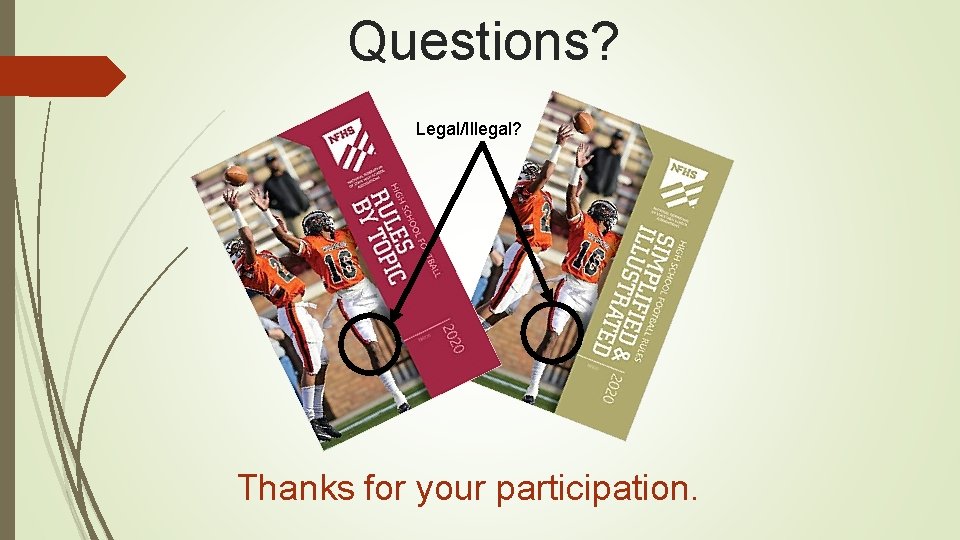
Questions? Legal/Illegal? Thanks for your participation.
- Slides: 36