
GLYCOPEPTIDE ANTIBIOTICS from Old Mississipi mud to new

GLYCOPEPTIDE ANTIBIOTICS from Old Mississipi mud … … to new derivatives: a critical appraisal F. Van Bambeke & P. M. Tulkens Pharmacologie cellulaire et moléculaire Université catholique de Louvain – Brussels - Belgium Presented at the 5 th European Congress of Chemotherapy, Rhodes, Greece, 17 -20 October 2003
Glycopeptide story: from natural to semi-synthetic derivatives ~ 1950 : discovery of vancomycin in Mississipi mud ~ 1985 : large clinical use in USA Gram(+) infections and digestive tract decontamination Problem: Ø toxicity of vancomycin due to impurities better purification procedures ~ 1980 : discovery of teicoplanin, as a natural GP with improved PK § largely used in Europe
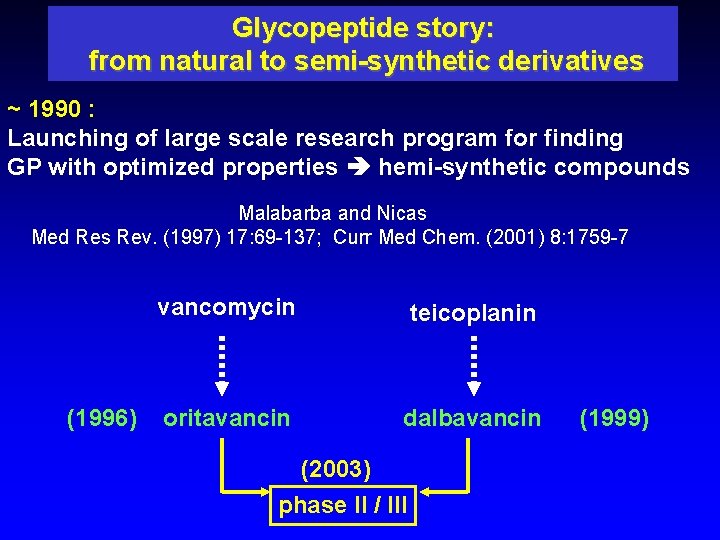
Glycopeptide story: from natural to semi-synthetic derivatives ~ 1990 : Launching of large scale research program for finding GP with optimized properties hemi-synthetic compounds Malabarba and Nicas Med Res Rev. (1997) 17: 69 -137; Curr Med Chem. (2001) 8: 1759 -7 (1996) vancomycin teicoplanin oritavancin dalbavancin (2003) phase II / III (1999)
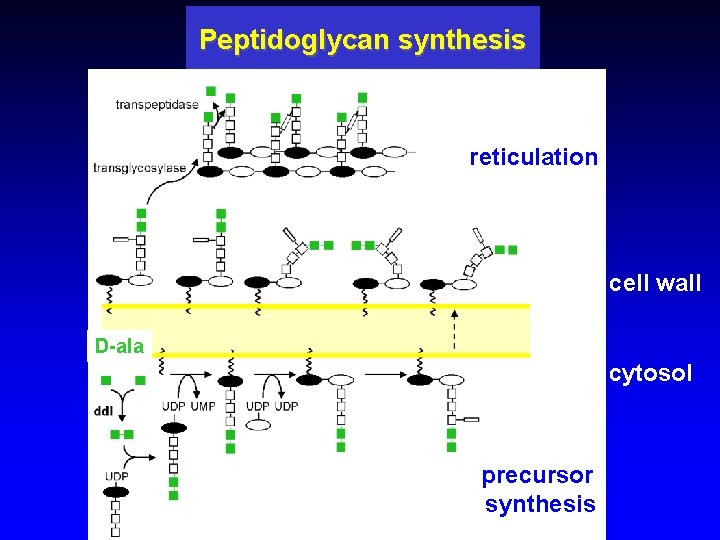
Peptidoglycan synthesis reticulation cell wall D-ala cytosol precursor synthesis
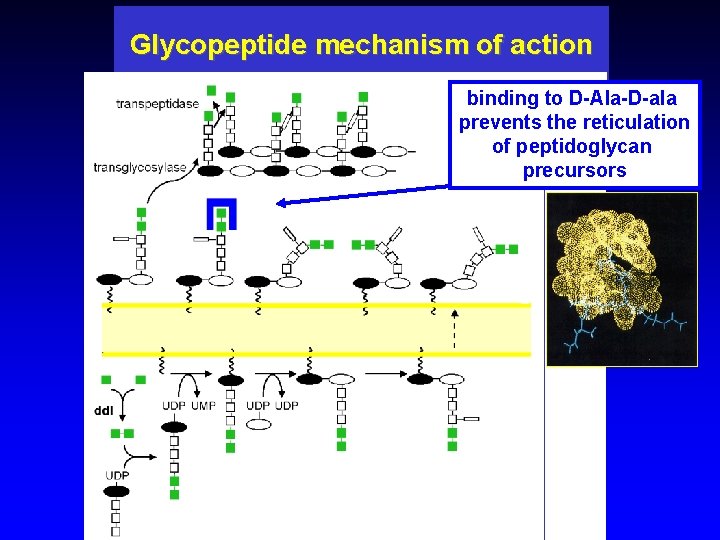
Glycopeptide mechanism of action binding to D-Ala-D-ala prevents the reticulation of peptidoglycan precursors

But resistance came in. . .
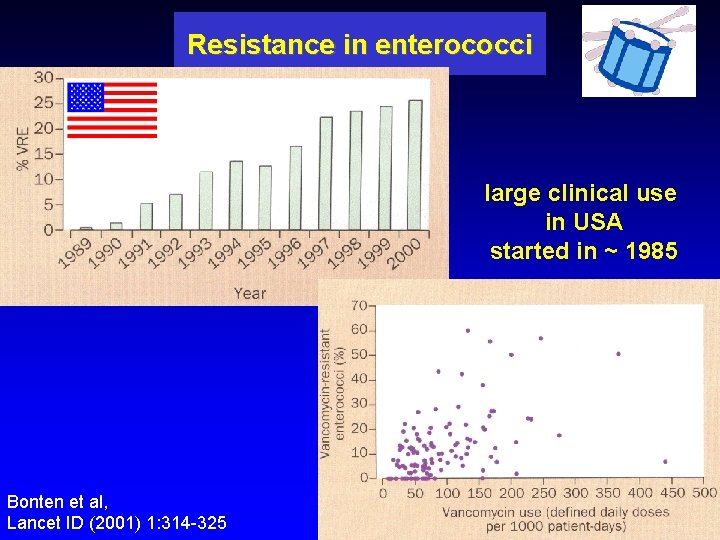
Resistance in enterococci large clinical use in USA started in ~ 1985 Bonten et al, Lancet ID (2001) 1: 314 -325
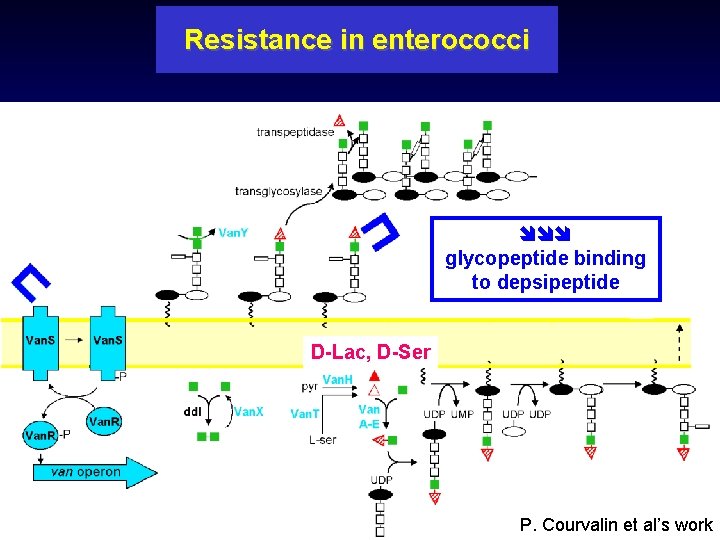
Resistance in enterococci glycopeptide binding to depsipeptide D-Lac, D-Ser P. Courvalin et al’s work
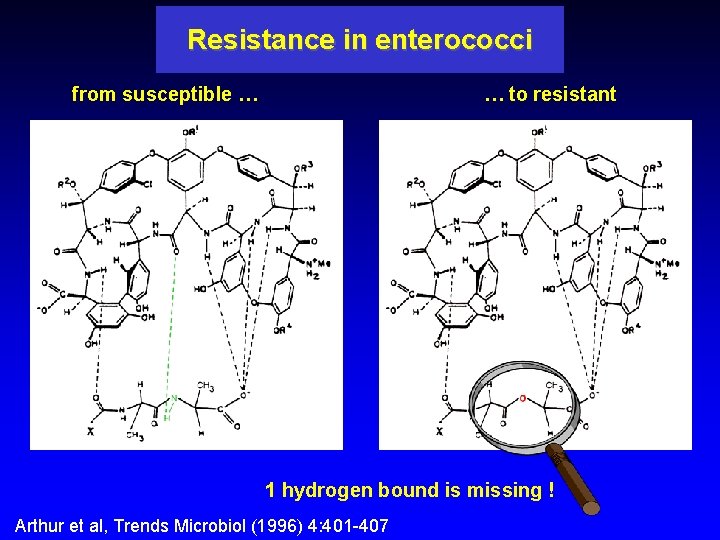
Resistance in enterococci from susceptible … … to resistant 1 hydrogen bound is missing ! Arthur et al, Trends Microbiol (1996) 4: 401 -407
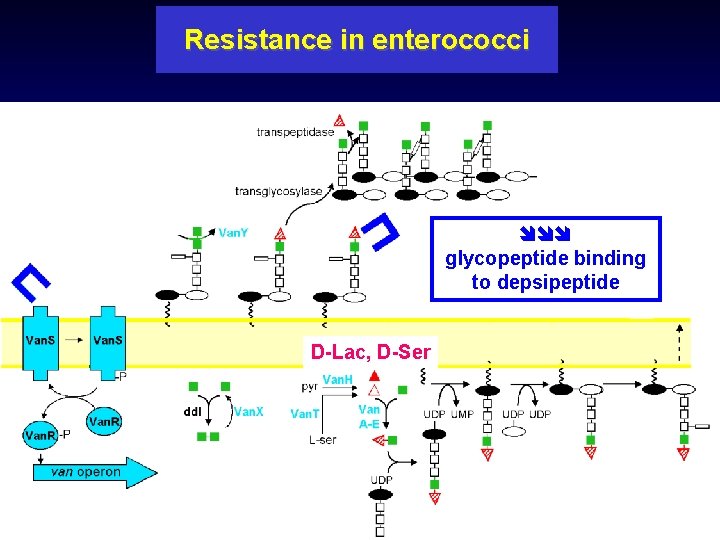
Resistance in enterococci glycopeptide binding to depsipeptide D-Lac, D-Ser
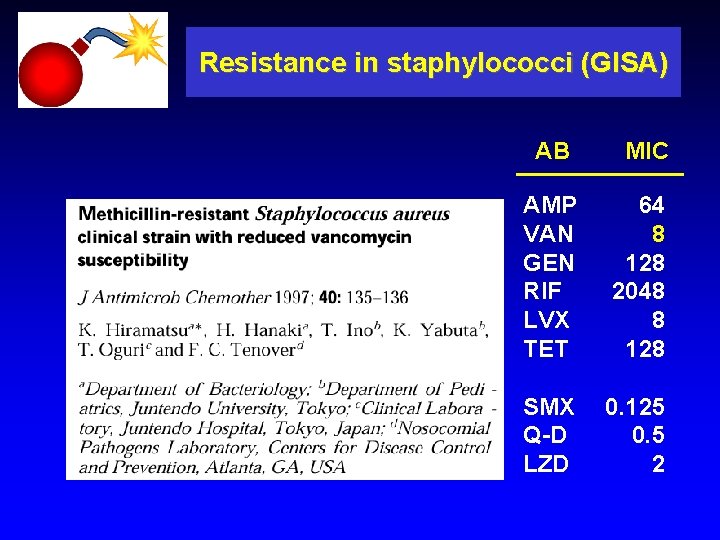
Resistance in staphylococci (GISA) AB MIC AMP VAN GEN RIF LVX TET 64 8 128 2048 8 128 SMX Q-D LZD 0. 125 0. 5 2

Resistance in staphylococci (GISA) multiplication of the target ! Hiramatsu Lancet ID (2001) 1: 147 -155 tickened Cell wall Cui et al J Clin Microbiol (2003) 41: 5 -14

Resistance in staphylococci (GRSA) AB MIC VAN TEC 32 4
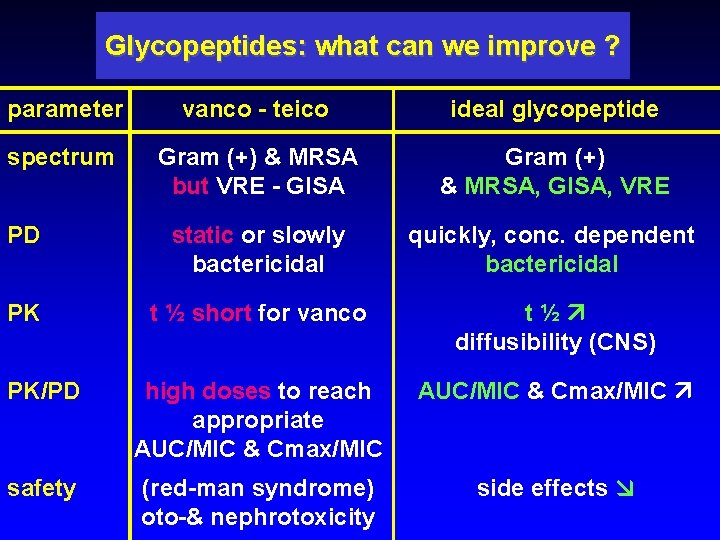
Glycopeptides: what can we improve ? parameter vanco - teico ideal glycopeptide spectrum Gram (+) & MRSA but VRE - GISA Gram (+) & MRSA, GISA, VRE PD static or slowly bactericidal quickly, conc. dependent bactericidal PK t ½ short for vanco t ½ diffusibility (CNS) PK/PD high doses to reach appropriate AUC/MIC & Cmax/MIC safety (red-man syndrome) oto-& nephrotoxicity side effects
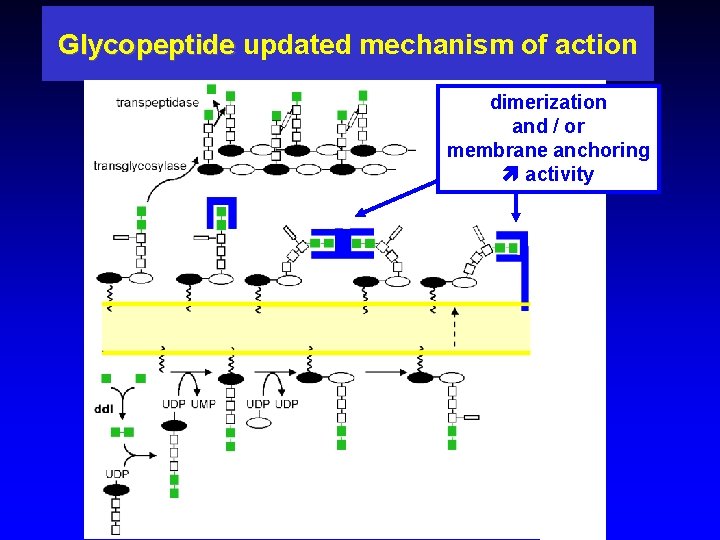
Glycopeptide updated mechanism of action Glycopeptide dimerization and / or membrane anchoring activity
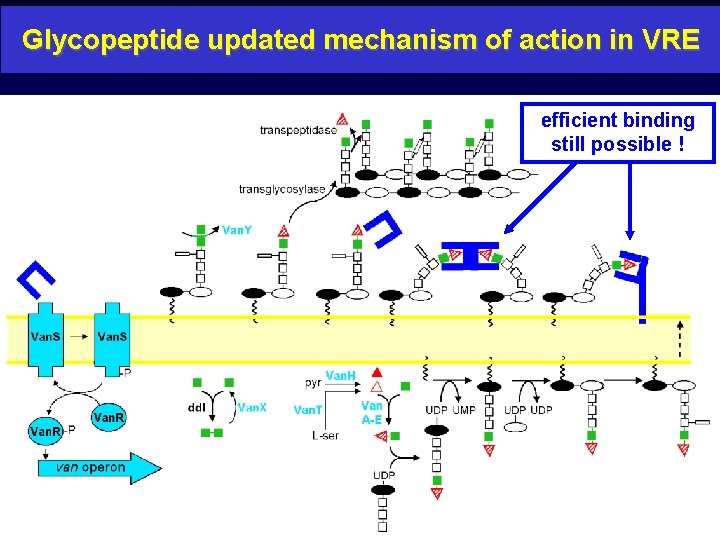
Glycopeptide updated mechanism of action in VRE efficient binding still possible !

Glycopeptides: how can we improve ? HOHO O H 2 N HO H 3 C CH 3 O O Cl O O O H N N H O HOOC HO Cl O HO HN O OH OH H N O CONH 2 O NH NH CH 3
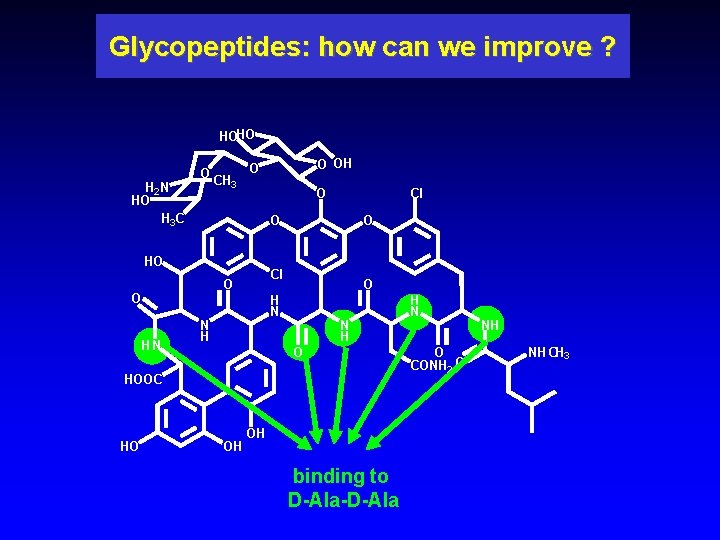
Glycopeptides: how can we improve ? HOHO O H 2 N HO H 3 C CH 3 O Cl O HO O O Cl O HN O OH O O H N N H O HOOC HO OH OH binding to D-Ala-D-Ala H N O CONH 2 O NH NH CH 3
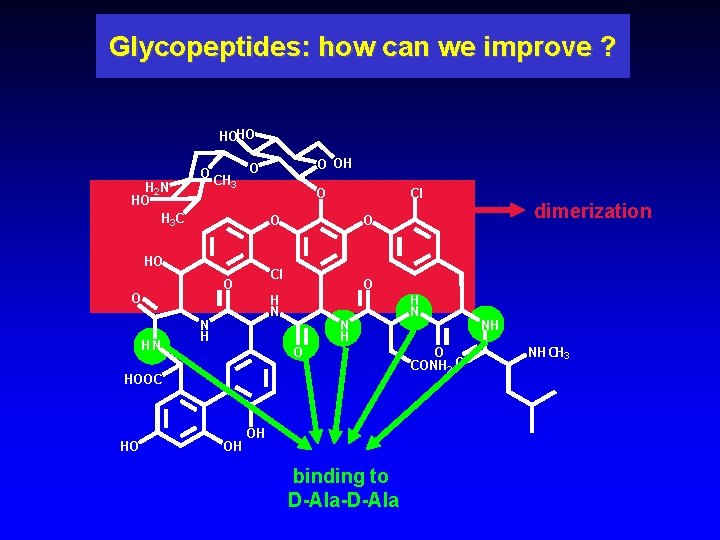
Glycopeptides: how can we improve ? HOHO O H 2 N HO H 3 C CH 3 O Cl O HO O O H N N H O HOOC HO OH dimerization O Cl O HN O OH binding to D-Ala-D-Ala H N O CONH 2 O NH NH CH 3
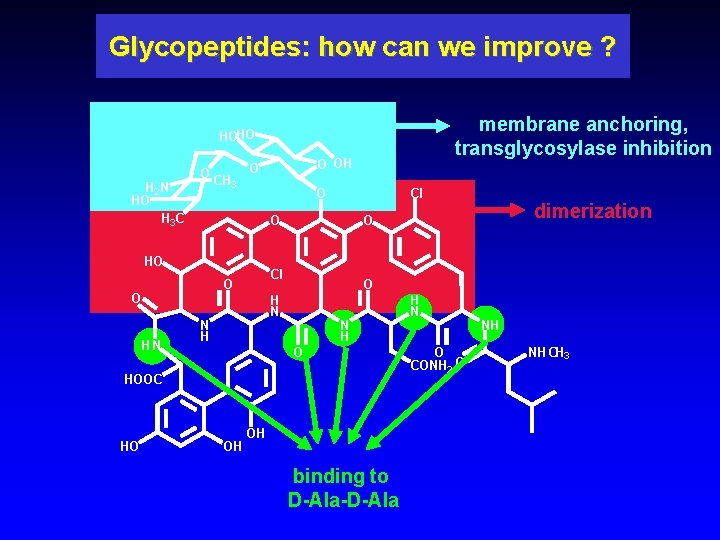
Glycopeptides: how can we improve ? membrane anchoring, transglycosylase inhibition HOHO O H 2 N HO H 3 C CH 3 O Cl O HO O O H N N H O HOOC HO OH dimerization O Cl O HN O OH binding to D-Ala-D-Ala H N O CONH 2 O NH NH CH 3
Molecules in clinical development: DESIGN

From vancomycin to oritavancin HOHO O H 2 N HO H 3 C CH 3 O O Cl O O O H N N H O HOOC HO Cl O HO HN O OH OH H N O CONH 2 O NH NH CH 3

From vancomycin to oritavancin HOHO O H 2 N epi-vancosamine CH 3 O OH H 3 C O Cl O O O H N N H O HOOC HO Cl O HO HN O OH OH H N O CONH 2 O NH NH CH 3

From vancomycin to oritavancin HOHO 4‑epi-vancosamine ì self-association capacity O H 2 N CH 3 O OH O O OH H 3 C Cl O O H 2 N HO H 3 C O CH 3 HO Cl O O HN H N N H LY 264626 N H O HOOC HO O OH OH H N O CONH 2 O NH NH CH 3

From vancomycin to oritavancin Cl lipophilic side chain ì activity including against resistant enterococci HOHO O H N O OH H 3 C H 2 N HO H 3 C CH 3 O Cl O O O H N N H O HOOC HO Cl O HO HN O OH OH H N O CONH 2 O NH NH CH 3
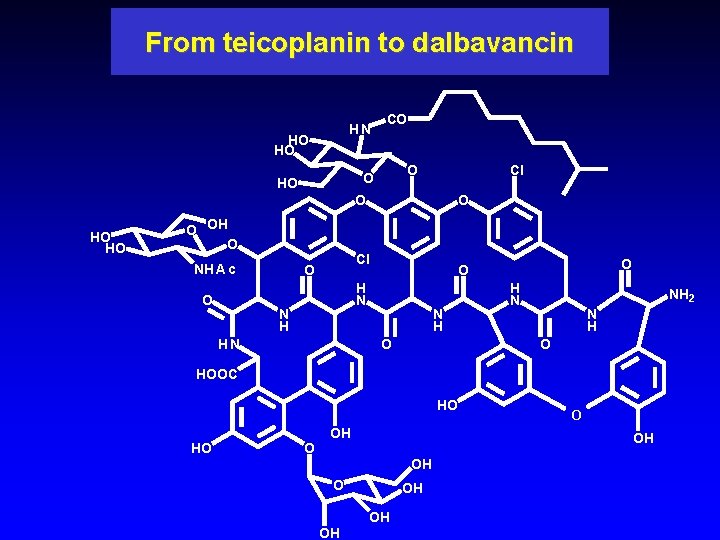
From teicoplanin to dalbavancin HN HO HO CO O O HO Cl O HO HO O OH O NH A c O O Cl O H N N H HN O O N H O H N NH 2 N H O HOOC HO HO O OH OH OH O
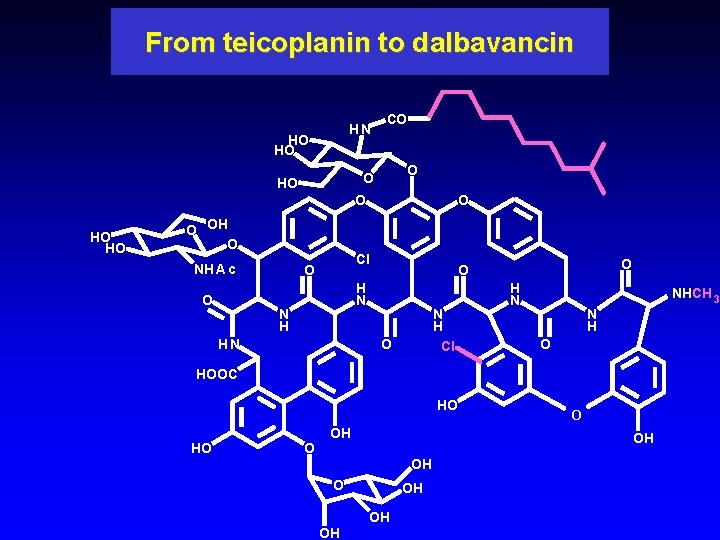
From teicoplanin to dalbavancin HN HO HO CO O O HO HO O OH O NH A c O O Cl O H N N H HN O O N H Cl O H N NHCH 3 N H O HOOC HO HO O OH OH OH O

From teicoplanin to dalbavancin HN HO removal of HO N-acetylglucosamine HO ì activity (against resistant enterococci) O O O HO O Cl O O CO H N N H HN O O N H Cl O H N NHCH 3 N H O HOOC HO HO O OH OH OH O A 40926 OH OH OH O

From teicoplanin to dalbavancin HN HO HO CO O O HO Cl O ì activity O N H O O H N HN N O N H Cl O H N NHCH 3 N H O NH- OC HO HO O OH OH OH O
Molecules in clinical development: IN VITRO DATA microbiology pharmacodynamics
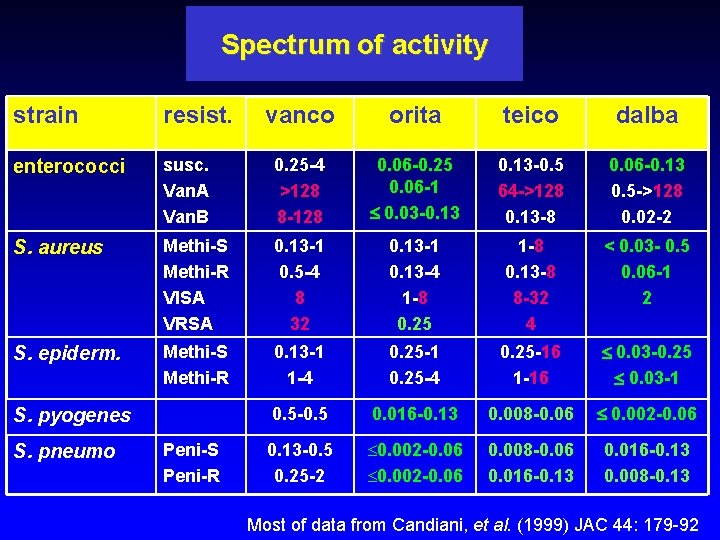
Spectrum of activity strain resist. vanco orita teico dalba enterococci susc. Van. A Van. B 0. 25 -4 >128 8 -128 0. 06 -0. 25 0. 06 -1 0. 03 -0. 13 -0. 5 64 ->128 0. 13 -8 0. 06 -0. 13 0. 5 ->128 0. 02 -2 S. aureus Methi-S Methi-R VISA VRSA 0. 13 -1 0. 5 -4 8 32 0. 13 -1 0. 13 -4 1 -8 0. 25 1 -8 0. 13 -8 8 -32 4 < 0. 03 - 0. 5 0. 06 -1 2 S. epiderm. Methi-S Methi-R 0. 13 -1 1 -4 0. 25 -1 0. 25 -4 0. 25 -16 1 -16 0. 03 -0. 25 0. 03 -1 0. 5 -0. 5 0. 016 -0. 13 0. 008 -0. 06 0. 002 -0. 06 0. 13 -0. 5 0. 25 -2 £ 0. 002 -0. 06 0. 008 -0. 06 0. 016 -0. 13 0. 008 -0. 13 S. pyogenes S. pneumo Peni-S Peni-R Most of data from Candiani, et al. (1999) JAC 44: 179 -92
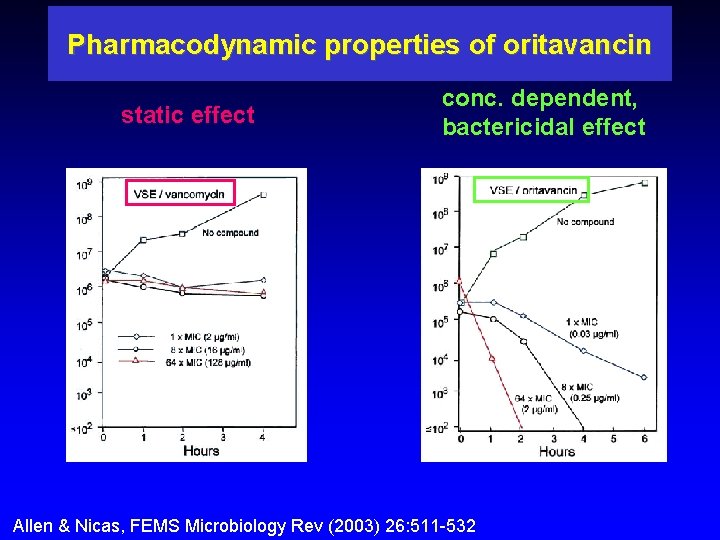
Pharmacodynamic properties of oritavancin static effect conc. dependent, bactericidal effect Allen & Nicas, FEMS Microbiology Rev (2003) 26: 511 -532
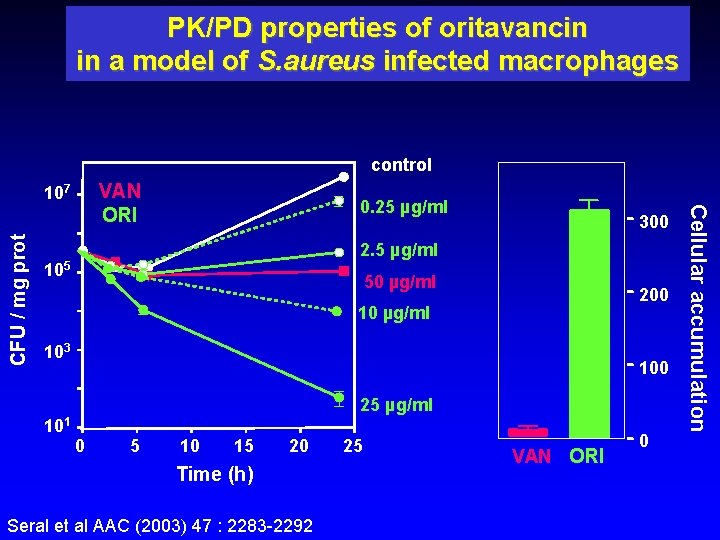
PK/PD properties of oritavancin in a model of S. aureus infected macrophages control CFU / mg prot 0. 25 µg/ml 300 2. 5 µg/ml 105 50 µg/ml 200 10 µg/ml 103 100 25 µg/ml 101 0 5 10 15 20 Time (h) Seral et al AAC (2003) 47 : 2283 -2292 25 VAN ORI 0 Cellular accumulation VAN ORI 107
Molecules in clinical development: IN VIVO DATA pharmacokinetics pharmacodynamics
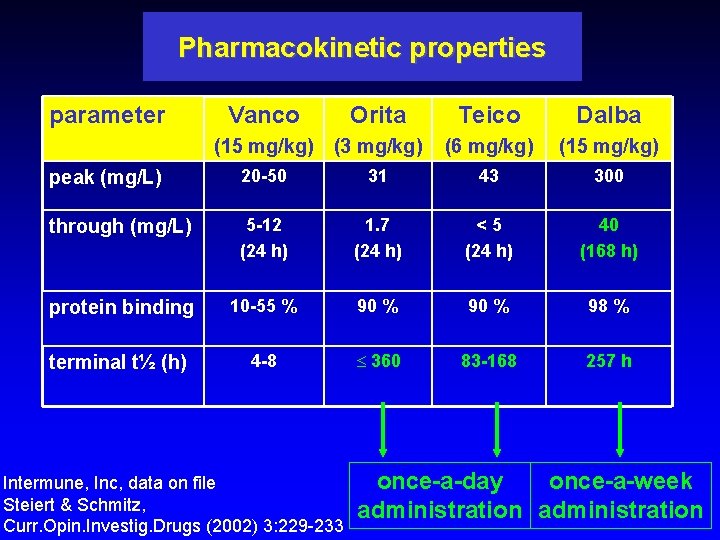
Pharmacokinetic properties parameter Vanco Orita (15 mg/kg) (3 mg/kg) Teico Dalba (6 mg/kg) (15 mg/kg) peak (mg/L) 20 -50 31 43 300 through (mg/L) 5 -12 (24 h) 1. 7 (24 h) < 5 (24 h) 40 (168 h) protein binding 10 -55 % 90 % 98 % terminal t½ (h) 4 -8 £ 360 83 -168 257 h Intermune, Inc, data on file Steiert & Schmitz, Curr. Opin. Investig. Drugs (2002) 3: 229 -233 once-a-day once-a-week administration
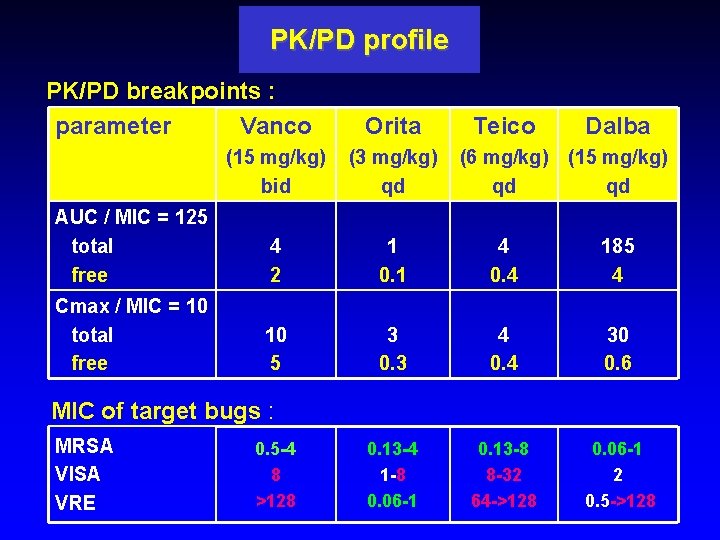
PK/PD profile PK/PD breakpoints : parameter Vanco Orita Teico Dalba (15 mg/kg) bid (3 mg/kg) qd (6 mg/kg) (15 mg/kg) qd qd AUC / MIC = 125 total free 4 2 1 0. 1 4 0. 4 185 4 Cmax / MIC = 10 total free 10 5 3 0. 3 4 0. 4 30 0. 6 0. 13 -4 1 -8 0. 06 -1 0. 13 -8 8 -32 64 ->128 0. 06 -1 2 0. 5 ->128 MIC of target bugs : MRSA VISA VRE 0. 5 -4 8 >128

Safety profile preclinical studies preliminary data from Phase I and Phase II oritavancin and dalbavancin well tolerated but more patients are needed …
Molecules in clinical development: IN VIVO DATA clinical studies
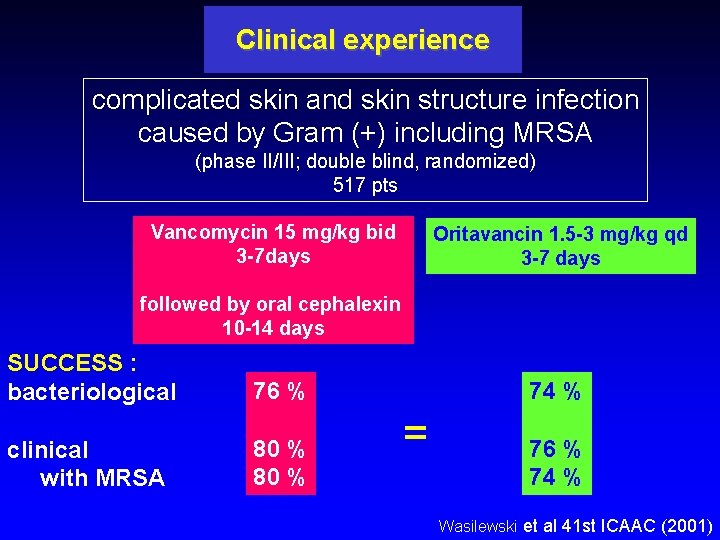
Clinical experience complicated skin and skin structure infection caused by Gram (+) including MRSA (phase II/III; double blind, randomized) 517 pts Vancomycin 15 mg/kg bid 3 -7 days Oritavancin 1. 5 -3 mg/kg qd 3 -7 days followed by oral cephalexin 10 -14 days SUCCESS : bacteriological 76 % clinical with MRSA 80 % 74 % = 76 % 74 % Wasilewski et al 41 st ICAAC (2001)
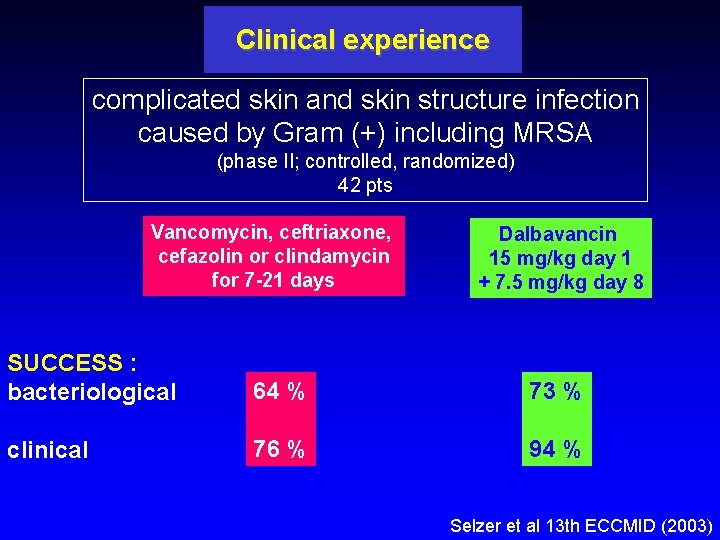
Clinical experience complicated skin and skin structure infection caused by Gram (+) including MRSA (phase II; controlled, randomized) 42 pts Vancomycin, ceftriaxone, cefazolin or clindamycin for 7 -21 days Dalbavancin 15 mg/kg day 1 + 7. 5 mg/kg day 8 SUCCESS : bacteriological 64 % 73 % clinical 76 % 94 % Selzer et al 13 th ECCMID (2003)
In which indications could they be useful ? § which organisms ? • MRSA certainly YES • VRE oritavancin only • VISA limited activity, … but synergy for dalba + -lactam • S. pneumo other alternatives § which organs ? • severe skin and soft tissues • septicemia / deep organs • endocarditis (combination ? ) • CNS infections (penetration ? )
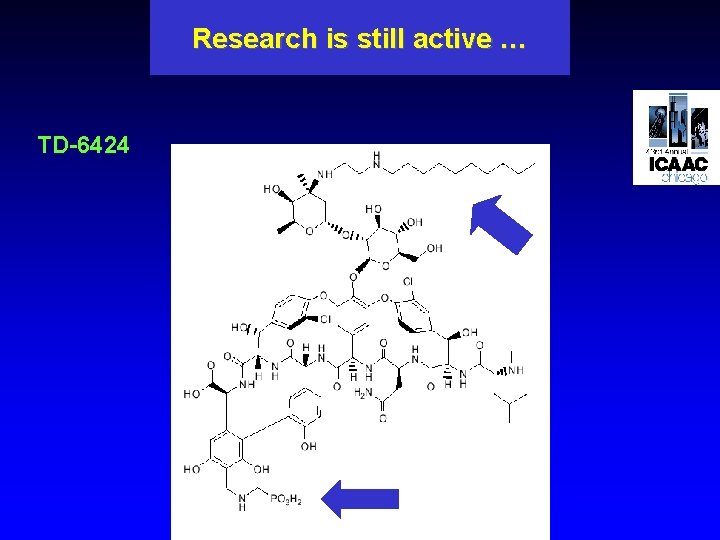
Research is still active … TD-6424
Research is still active … TD-6424 § in vitro data: MIC MRSA 1 µg/ml MIC VISA 4 µg/ml § antibacterial activity: bactericidal inhibitor of lipid synthesis § activity in animal models endocarditis subcutaneous infections § Phase I studies t ½ ~ 8 h once-a-day
We are looking forward these new antibiotics … … but how strong will they be ?
- Slides: 44