
Glycolysis concluded Gluconeogenesis Andy Howard Biochemistry Lectures Fall
Glycolysis, concluded; Gluconeogenesis Andy Howard Biochemistry Lectures, Fall 2010 20 October 2010 Glycolysis II, Gluconeogenesis I 10/20/2010
What we’ll discuss n Glycolysis n Pyruvate n Gluconeogenesis n Free energy n Regulation n Other sugars n Entner. Doudoroff Pathway 10/20/2010 Glycolysis II, Gluconeogenesis I 2
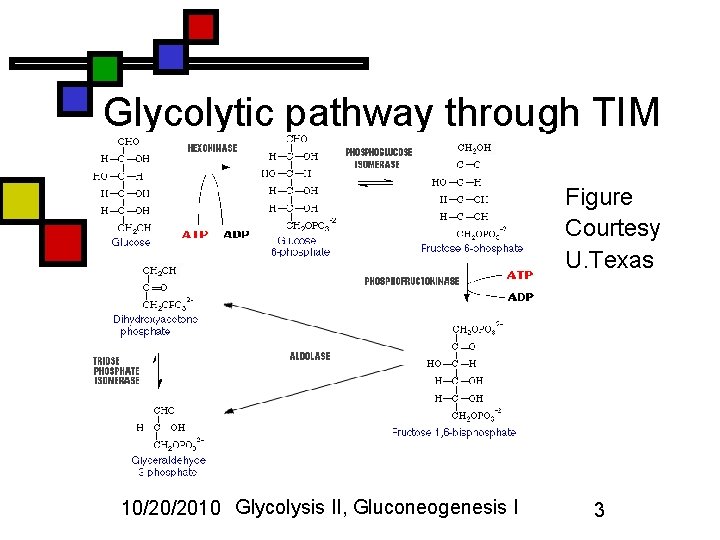
Glycolytic pathway through TIM Figure Courtesy U. Texas 10/20/2010 Glycolysis II, Gluconeogenesis I 3
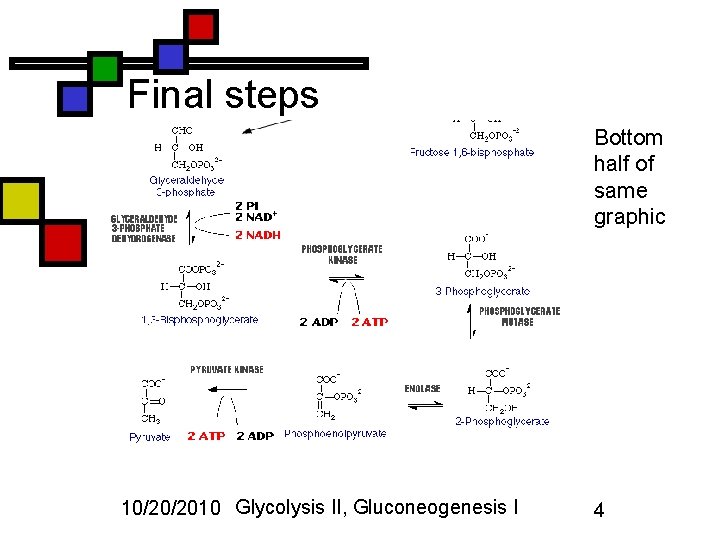
Final steps Bottom half of same graphic 10/20/2010 Glycolysis II, Gluconeogenesis I 4
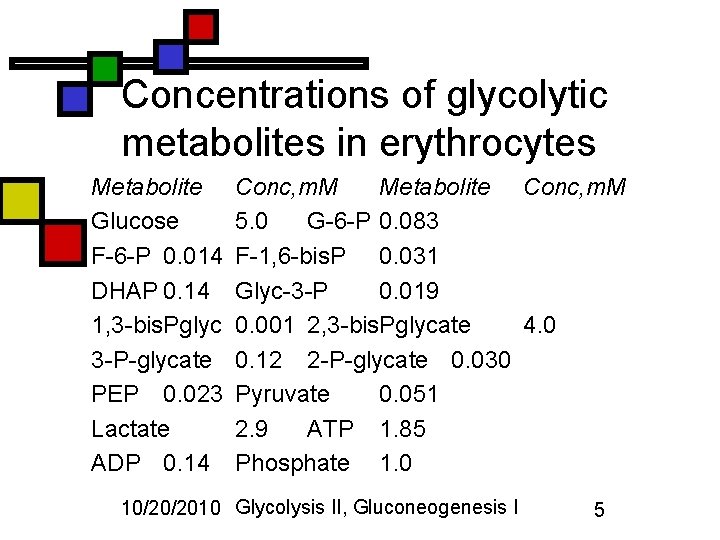
Concentrations of glycolytic metabolites in erythrocytes Metabolite Glucose F-6 -P 0. 014 DHAP 0. 14 1, 3 -bis. Pglyc 3 -P-glycate PEP 0. 023 Lactate ADP 0. 14 Conc, m. M Metabolite Conc, m. M 5. 0 G-6 -P 0. 083 F-1, 6 -bis. P 0. 031 Glyc-3 -P 0. 019 0. 001 2, 3 -bis. Pglycate 4. 0 0. 12 2 -P-glycate 0. 030 Pyruvate 0. 051 2. 9 ATP 1. 85 Phosphate 1. 0 10/20/2010 Glycolysis II, Gluconeogenesis I 5
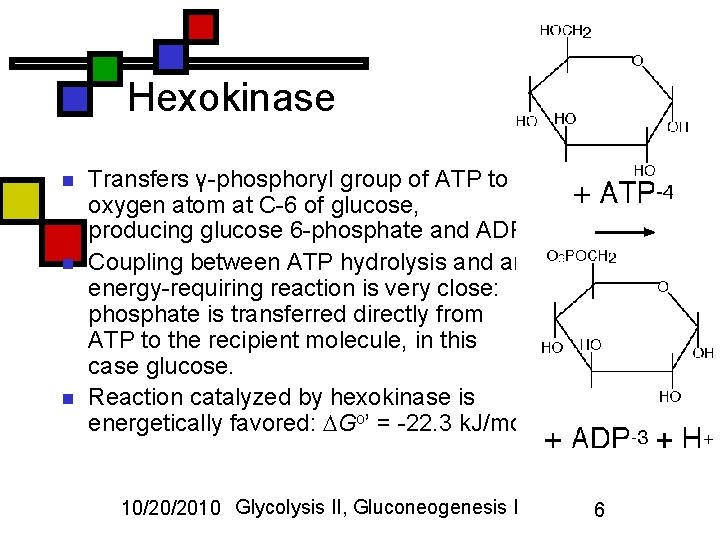
Hexokinase n n n Transfers γ-phosphoryl group of ATP to oxygen atom at C-6 of glucose, producing glucose 6 -phosphate and ADP. Coupling between ATP hydrolysis and an energy-requiring reaction is very close: phosphate is transferred directly from ATP to the recipient molecule, in this case glucose. Reaction catalyzed by hexokinase is energetically favored: Go’ = -22. 3 k. J/mol 10/20/2010 Glycolysis II, Gluconeogenesis I 6
Hexokinase isozymes n n n various isozymes (functionally related but structurally slightly distinct) forms of hexokinase in humans liver form (glucokinase -- see next slide) has Km in millimolar range, perhaps a factor of 1000 higher than the Km of hexokinase found in other tissue Liver form is therefore much less active than the other forms unless the liver glucose concentration is high 10/20/2010 Glycolysis II, Gluconeogenesis I 7
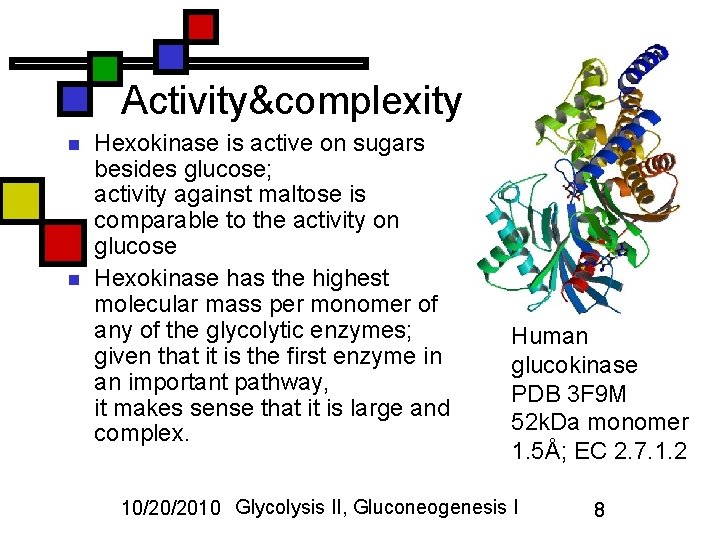
Activity&complexity n n Hexokinase is active on sugars besides glucose; activity against maltose is comparable to the activity on glucose Hexokinase has the highest molecular mass per monomer of any of the glycolytic enzymes; given that it is the first enzyme in an important pathway, it makes sense that it is large and complex. Human glucokinase PDB 3 F 9 M 52 k. Da monomer 1. 5Å; EC 2. 7. 1. 2 10/20/2010 Glycolysis II, Gluconeogenesis I 8
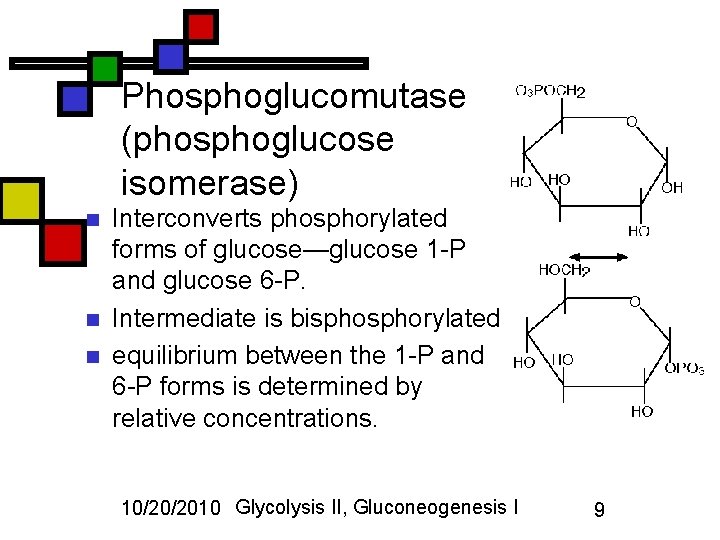
Phosphoglucomutase (phosphoglucose isomerase) n n n Interconverts phosphorylated forms of glucose—glucose 1 -P and glucose 6 -P. Intermediate is bisphorylated equilibrium between the 1 -P and 6 -P forms is determined by relative concentrations. 10/20/2010 Glycolysis II, Gluconeogenesis I 9
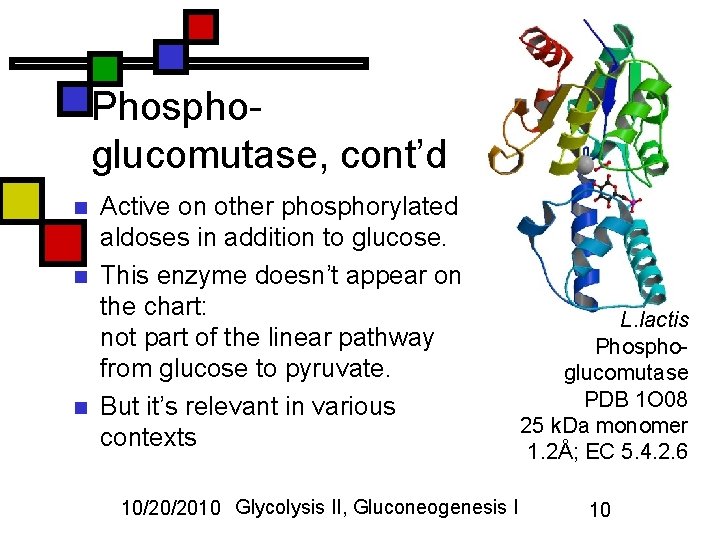
Phosphoglucomutase, cont’d n n n Active on other phosphorylated aldoses in addition to glucose. This enzyme doesn’t appear on the chart: not part of the linear pathway from glucose to pyruvate. But it’s relevant in various contexts 10/20/2010 Glycolysis II, Gluconeogenesis I L. lactis Phosphoglucomutase PDB 1 O 08 25 k. Da monomer 1. 2Å; EC 5. 4. 2. 6 10
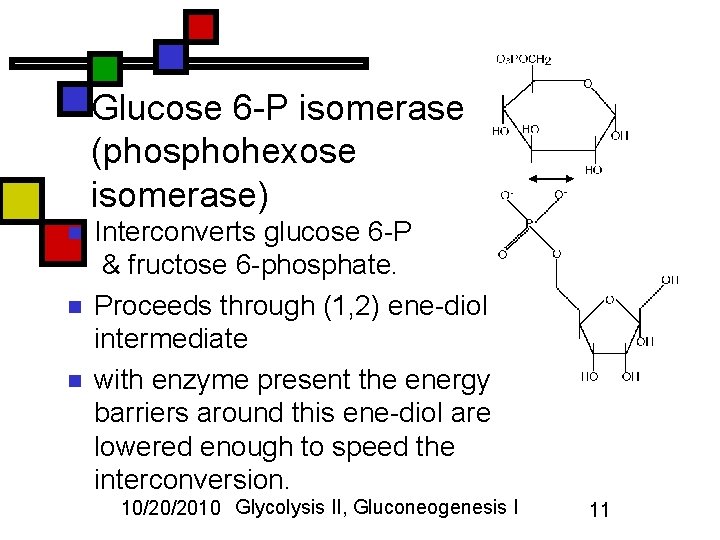
Glucose 6 -P isomerase (phosphohexose isomerase) n n n Interconverts glucose 6 -P & fructose 6 -phosphate. Proceeds through (1, 2) ene-diol intermediate with enzyme present the energy barriers around this ene-diol are lowered enough to speed the interconversion. 10/20/2010 Glycolysis II, Gluconeogenesis I 11
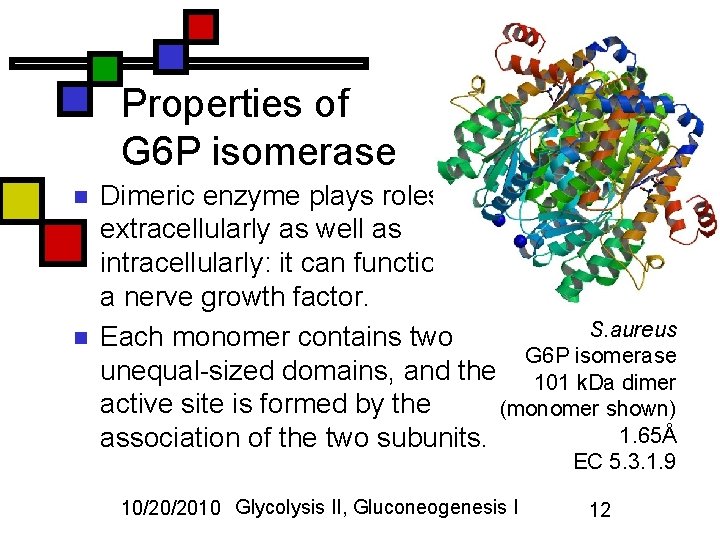
Properties of G 6 P isomerase n n Dimeric enzyme plays roles extracellularly as well as intracellularly: it can function as a nerve growth factor. S. aureus Each monomer contains two G 6 P isomerase unequal-sized domains, and the 101 k. Da dimer active site is formed by the (monomer shown) 1. 65Å association of the two subunits. EC 5. 3. 1. 9 10/20/2010 Glycolysis II, Gluconeogenesis I 12
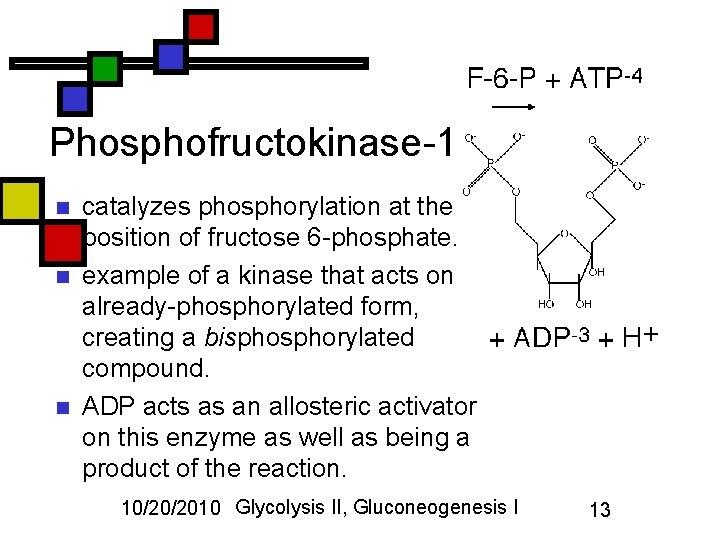
Phosphofructokinase-1 n n n catalyzes phosphorylation at the 1 position of fructose 6 -phosphate. example of a kinase that acts on an already-phosphorylated form, creating a bisphorylated compound. ADP acts as an allosteric activator on this enzyme as well as being a product of the reaction. 10/20/2010 Glycolysis II, Gluconeogenesis I 13
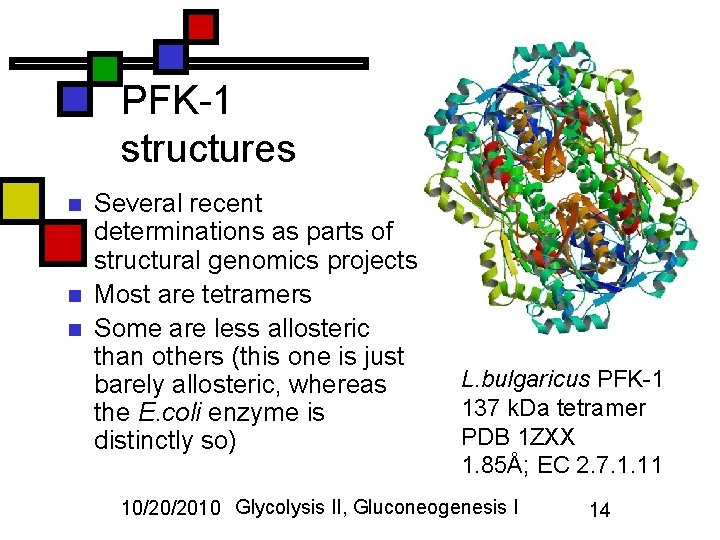
PFK-1 structures n n n Several recent determinations as parts of structural genomics projects Most are tetramers Some are less allosteric than others (this one is just barely allosteric, whereas the E. coli enzyme is distinctly so) L. bulgaricus PFK-1 137 k. Da tetramer PDB 1 ZXX 1. 85Å; EC 2. 7. 1. 11 10/20/2010 Glycolysis II, Gluconeogenesis I 14
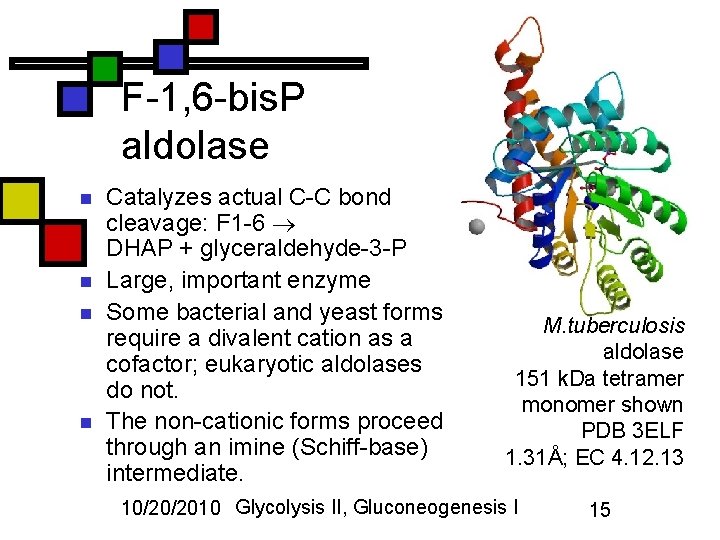
F-1, 6 -bis. P aldolase n n Catalyzes actual C-C bond cleavage: F 1 -6 DHAP + glyceraldehyde-3 -P Large, important enzyme Some bacterial and yeast forms require a divalent cation as a cofactor; eukaryotic aldolases do not. The non-cationic forms proceed through an imine (Schiff-base) intermediate. M. tuberculosis aldolase 151 k. Da tetramer monomer shown PDB 3 ELF 1. 31Å; EC 4. 12. 13 10/20/2010 Glycolysis II, Gluconeogenesis I 15
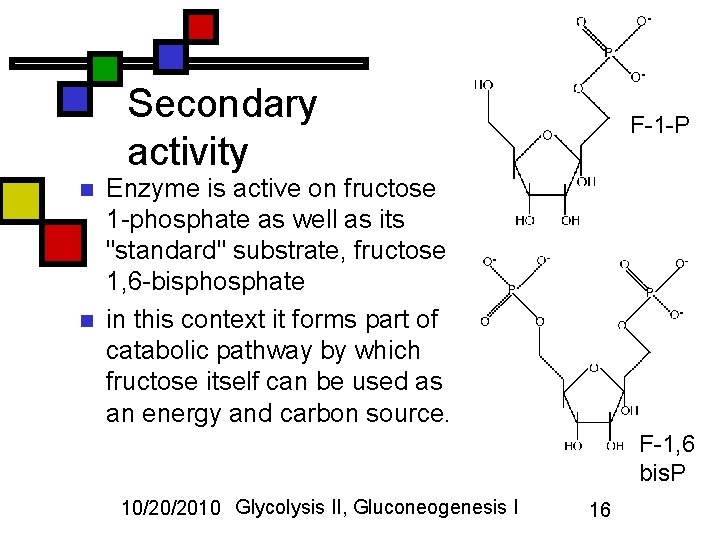
Secondary activity n n F-1 -P Enzyme is active on fructose 1 -phosphate as well as its "standard" substrate, fructose 1, 6 -bisphosphate in this context it forms part of catabolic pathway by which fructose itself can be used as an energy and carbon source. F-1, 6 bis. P 10/20/2010 Glycolysis II, Gluconeogenesis I 16
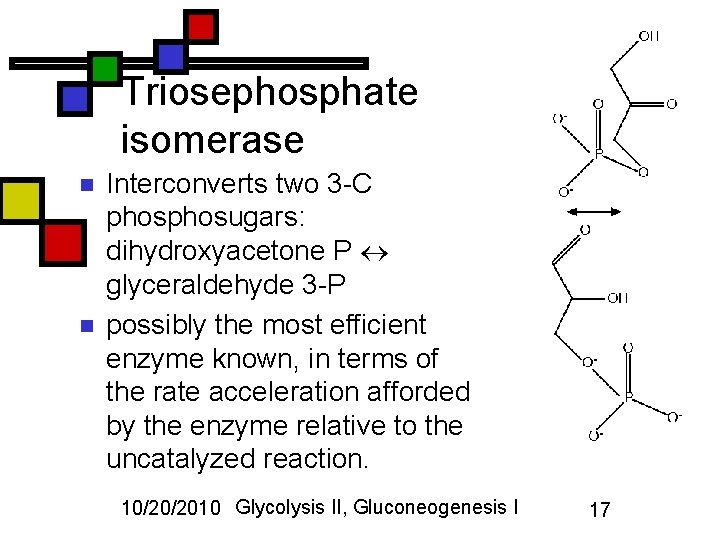
Triosephosphate isomerase n n Interconverts two 3 -C phosugars: dihydroxyacetone P glyceraldehyde 3 -P possibly the most efficient enzyme known, in terms of the rate acceleration afforded by the enzyme relative to the uncatalyzed reaction. 10/20/2010 Glycolysis II, Gluconeogenesis I 17
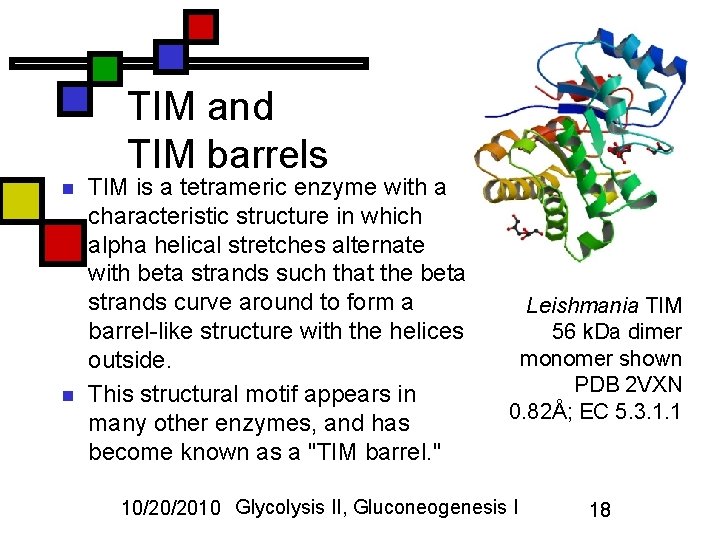
TIM and TIM barrels n n TIM is a tetrameric enzyme with a characteristic structure in which alpha helical stretches alternate with beta strands such that the beta strands curve around to form a barrel-like structure with the helices outside. This structural motif appears in many other enzymes, and has become known as a "TIM barrel. " Leishmania TIM 56 k. Da dimer monomer shown PDB 2 VXN 0. 82Å; EC 5. 3. 1. 1 10/20/2010 Glycolysis II, Gluconeogenesis I 18
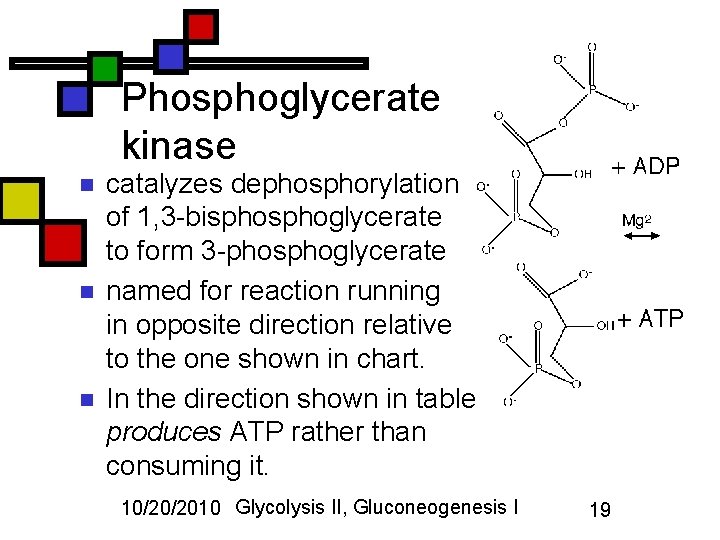
Phosphoglycerate kinase n n n catalyzes dephosphorylation of 1, 3 -bisphoglycerate to form 3 -phosphoglycerate named for reaction running in opposite direction relative to the one shown in chart. In the direction shown in table it produces ATP rather than consuming it. 10/20/2010 Glycolysis II, Gluconeogenesis I 19
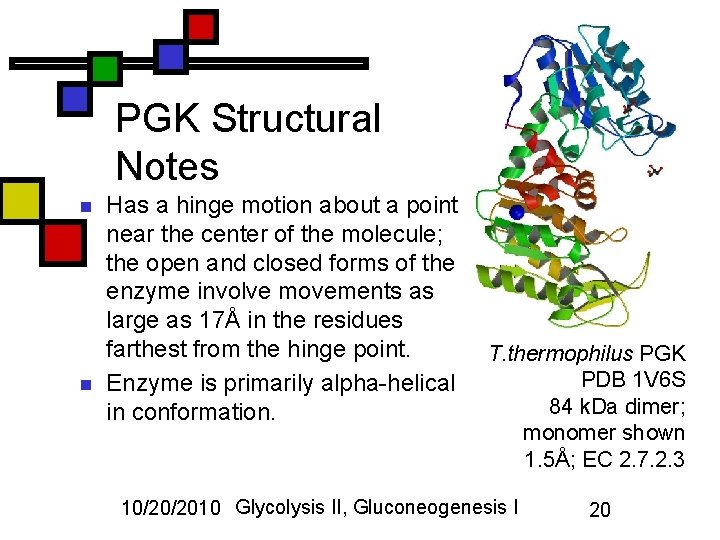
PGK Structural Notes n n Has a hinge motion about a point near the center of the molecule; the open and closed forms of the enzyme involve movements as large as 17Å in the residues farthest from the hinge point. Enzyme is primarily alpha-helical in conformation. T. thermophilus PGK PDB 1 V 6 S 84 k. Da dimer; monomer shown 1. 5Å; EC 2. 7. 2. 3 10/20/2010 Glycolysis II, Gluconeogenesis I 20
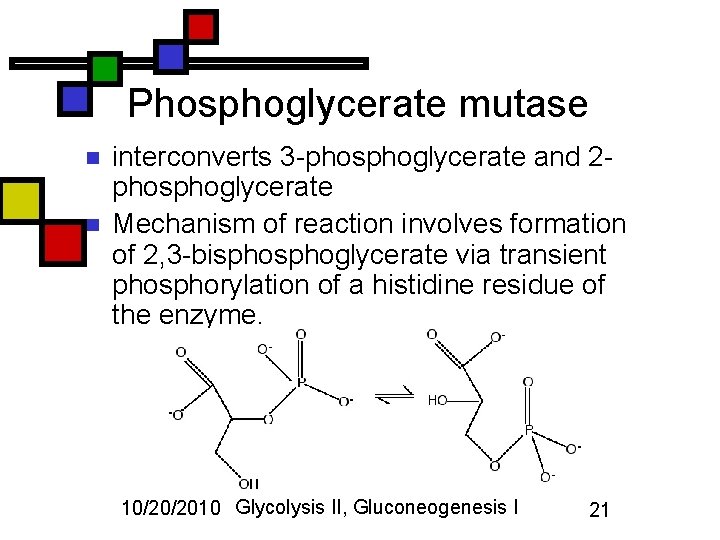
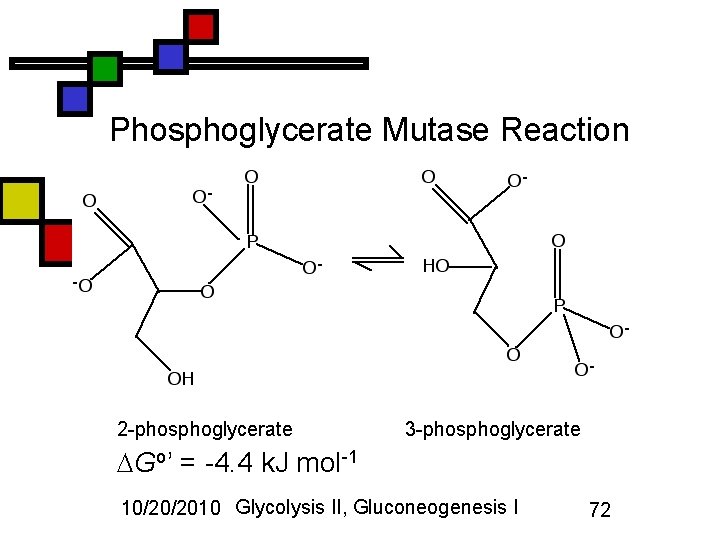
Phosphoglycerate mutase n n interconverts 3 -phosphoglycerate and 2 phosphoglycerate Mechanism of reaction involves formation of 2, 3 -bisphoglycerate via transient phosphorylation of a histidine residue of the enzyme. 10/20/2010 Glycolysis II, Gluconeogenesis I 21
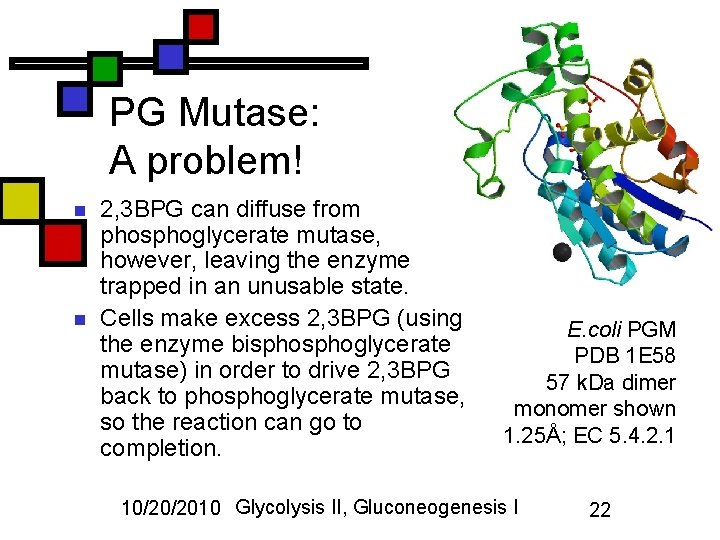
PG Mutase: A problem! n n 2, 3 BPG can diffuse from phosphoglycerate mutase, however, leaving the enzyme trapped in an unusable state. Cells make excess 2, 3 BPG (using the enzyme bisphoglycerate mutase) in order to drive 2, 3 BPG back to phosphoglycerate mutase, so the reaction can go to completion. E. coli PGM PDB 1 E 58 57 k. Da dimer monomer shown 1. 25Å; EC 5. 4. 2. 1 10/20/2010 Glycolysis II, Gluconeogenesis I 22
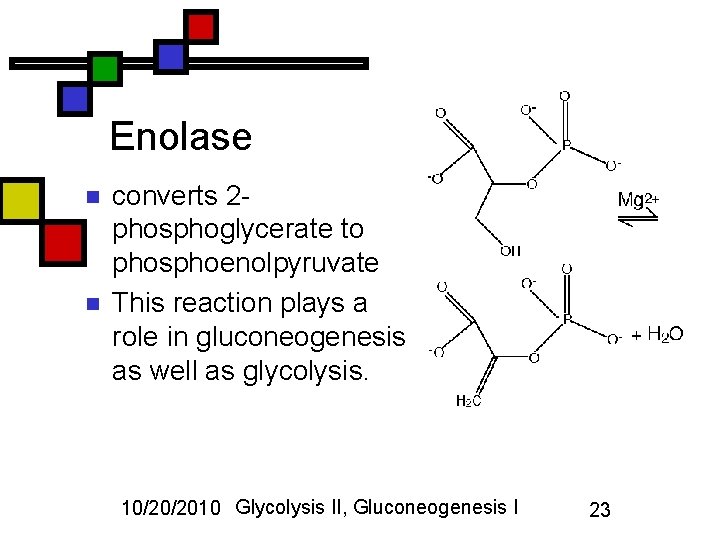
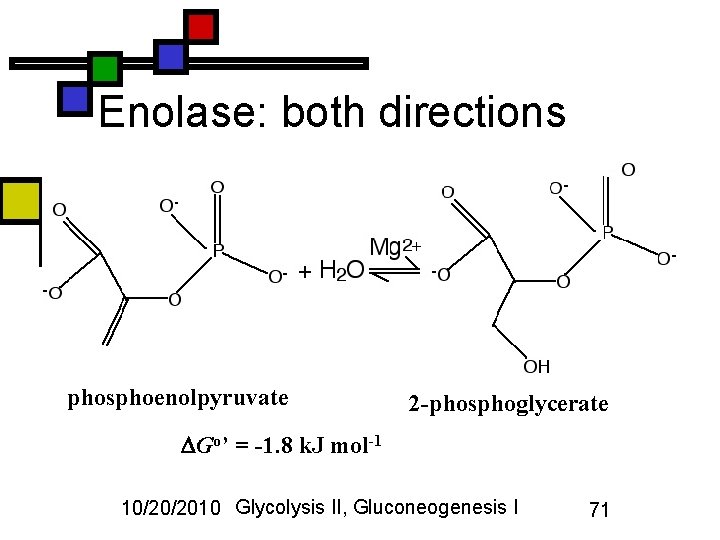
Enolase n n converts 2 phosphoglycerate to phosphoenolpyruvate This reaction plays a role in gluconeogenesis as well as glycolysis. 10/20/2010 Glycolysis II, Gluconeogenesis I 23
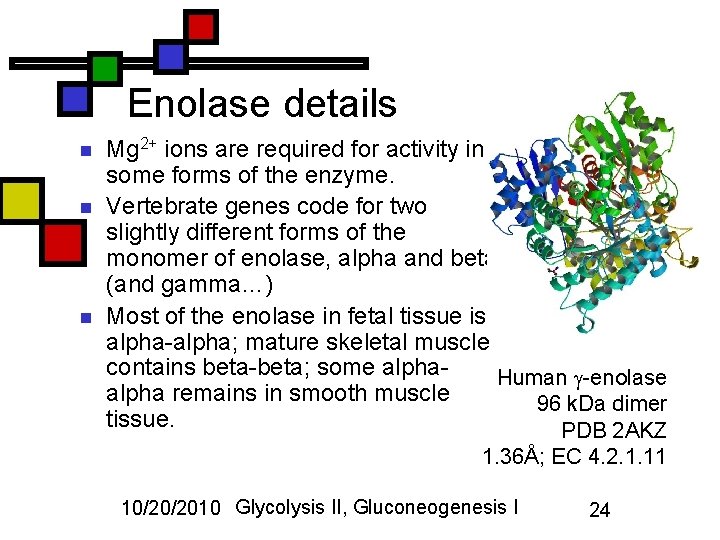
Enolase details n n n Mg 2+ ions are required for activity in some forms of the enzyme. Vertebrate genes code for two slightly different forms of the monomer of enolase, alpha and beta (and gamma…) Most of the enolase in fetal tissue is alpha-alpha; mature skeletal muscle contains beta-beta; some alpha. Human -enolase alpha remains in smooth muscle 96 k. Da dimer tissue. PDB 2 AKZ 1. 36Å; EC 4. 2. 1. 11 10/20/2010 Glycolysis II, Gluconeogenesis I 24
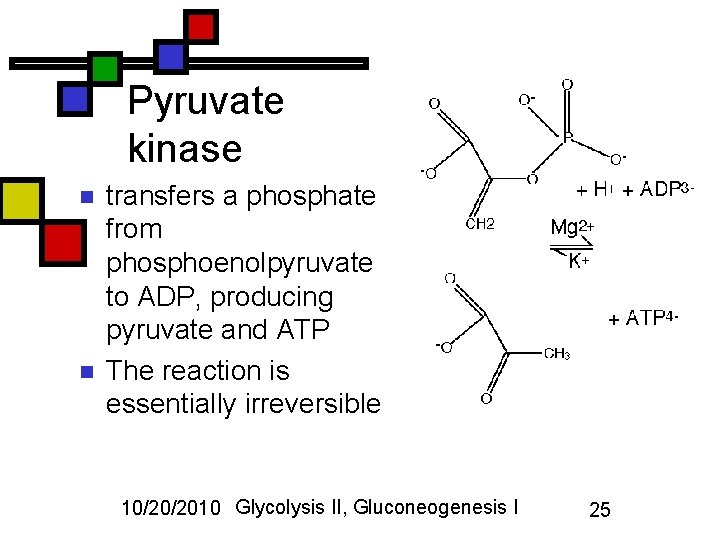
Pyruvate kinase n n transfers a phosphate from phosphoenolpyruvate to ADP, producing pyruvate and ATP The reaction is essentially irreversible 10/20/2010 Glycolysis II, Gluconeogenesis I 25
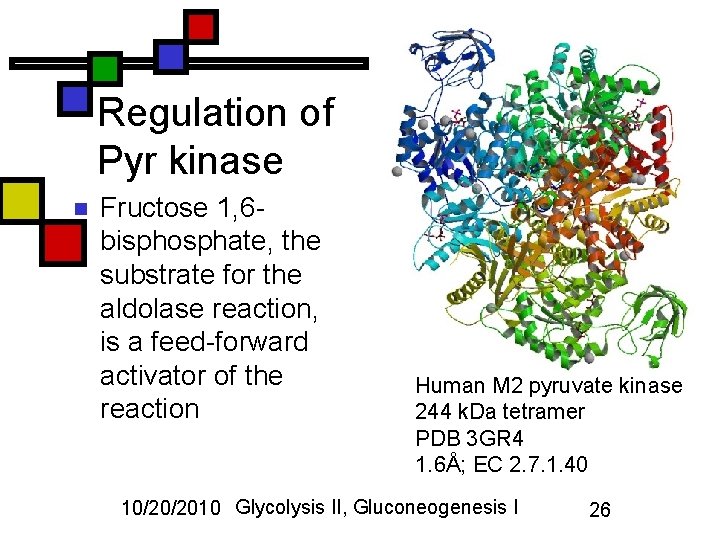
Regulation of Pyr kinase n Fructose 1, 6 bisphosphate, the substrate for the aldolase reaction, is a feed-forward activator of the reaction Human M 2 pyruvate kinase 244 k. Da tetramer PDB 3 GR 4 1. 6Å; EC 2. 7. 1. 40 10/20/2010 Glycolysis II, Gluconeogenesis I 26
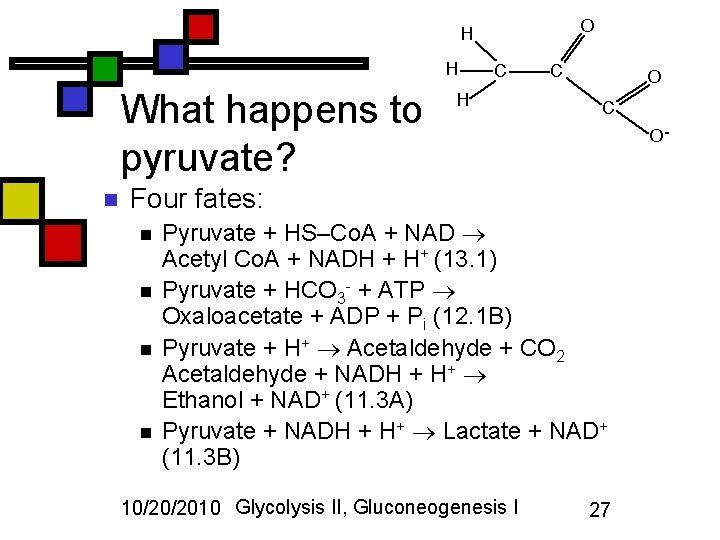
What happens to pyruvate? n Four fates: n n Pyruvate + HS–Co. A + NAD Acetyl Co. A + NADH + H+ (13. 1) Pyruvate + HCO 3 - + ATP Oxaloacetate + ADP + Pi (12. 1 B) Pyruvate + H+ Acetaldehyde + CO 2 Acetaldehyde + NADH + H+ Ethanol + NAD+ (11. 3 A) Pyruvate + NADH + H+ Lactate + NAD+ (11. 3 B) 10/20/2010 Glycolysis II, Gluconeogenesis I 27
Glycolysis and energy n n n General principle: For a reaction to move forward, G < 0. That doesn’t necessarily mean Go < 0. See fig. 11. 1: n n Irreversible steps 1, 3, 10 Other steps have G ≈ 0, so they’re reversible 10/20/2010 Glycolysis II, Gluconeogenesis I 28
G and Go 10/20/2010 Glycolysis II, Gluconeogenesis I 29
Regulation of glycolysis n n n Thoroughly studied Recently it’s been recognized that a compound isn’t really an effector if it modulates a reaction only when it’s much more concentrated than it ever gets in the cell So we need to know concentrations! 10/20/2010 Glycolysis II, Gluconeogenesis I 30
What does the cell want? n n n Glycolysis should be turned on when ATP is needed Usual arguments regarding products and downstream products See fig. 11. 12 Hexokinase is product-inhibited PFK 1 has up & down effectors Pyruvate kinase is: n n feed-forward activated by F-1, 6 -bis. P Inhibited by ATP 10/20/2010 Glycolysis II, Gluconeogenesis I 31
Regulation of transporters n n n Can’t metabolize glucose in a cell that doesn’t contain any glucose! [glucose]in cell < [glucose]blood so transporters are passive SGLT 1 in intestine & kidney—see ch. 9 10/20/2010 Glycolysis II, Gluconeogenesis I Diagram courtesy Steve Cook 32
GLUT transporters n n Six GLUT transporters with particular tasks Insulin turns on glucose uptake into skeletal and heart muscle cells via GLUT 4 (fig. 11. 13) 10/20/2010 Glycolysis II, Gluconeogenesis I 33
GLUT 4 activation Diagram courtesy Kobe University 10/20/2010 Glycolysis II, Gluconeogenesis I 34
Other GLUT transporters n n n Basal levels maintained by GLUT 1, 3 GLUT 2 moves glucose freely in and out of liver cells: therefore [glucose]cell = [glucose]blood in that particular organ GLUT 5 specific to small intestine GLUT 7: G 6 P from cytoplasm into ER Hexokinase acts quickly on glucose once it’s intracellular: G 6 P can’t pass outward 10/20/2010 Glycolysis II, Gluconeogenesis I 35
Hexokinase regulation n First step and it’s irreversible Product inhibits hexokinase I, III but not hexokinase IV (=glucokinase in liver, islet -cells of pancreas) Makes sense: remember [glucose] high in that environment 10/20/2010 Glycolysis II, Gluconeogenesis I 36
Glucokinase regulation n There’s a glucokinase regulatory protein (GKRP) that binds to glucokinase in the presence of fructose-6 -P and converts its hyperbolic kinetics into sigmoidal Raises apparent Km of glucokinase Glucokinase turned on after a meal because F 1 P relieves inhibition then 10/20/2010 Glycolysis II, Gluconeogenesis I Guessed structure of GKRP based on MODBASE model from G-6 -P isomerase 37
PFK-1 regulation by ATP, AMP n n ATP is substrate and allosteric inhibitor: Increases Kmeff for F 6 P AMP relieves inhibition by ATP Effect of ADP depends on species AMP is primary modulator because its concentration varies more than ATP 10/20/2010 Glycolysis II, Gluconeogenesis I 38
Other modulators of PFK-1 n n n Citrate inhibits: if [citrate] is high, then TCA cycle is probably blocked, so there’s no point in continuing making pyruvate p. H matters: PFK-1 inhibited by low p. H, so after exercise, PFK-1 activity decreases Fructose 2, 6 bisphosphate is a micromolar activator of PFK 1… it’s produced from F 6 P by action of PFK-2 10/20/2010 Glycolysis II, Gluconeogenesis I 39
F-2, 6 -BP as regulator • Potent allosteric regulatory molecule. • activates phosphofructokinase-1. • inhibits fructose-1, 6 bisphosphatase (enzyme in gluconeogenesis). • Its synthesis and degradation are catalyzed by the same bifunctional enzyme 10/20/2010 Glycolysis II, Gluconeogenesis I 40
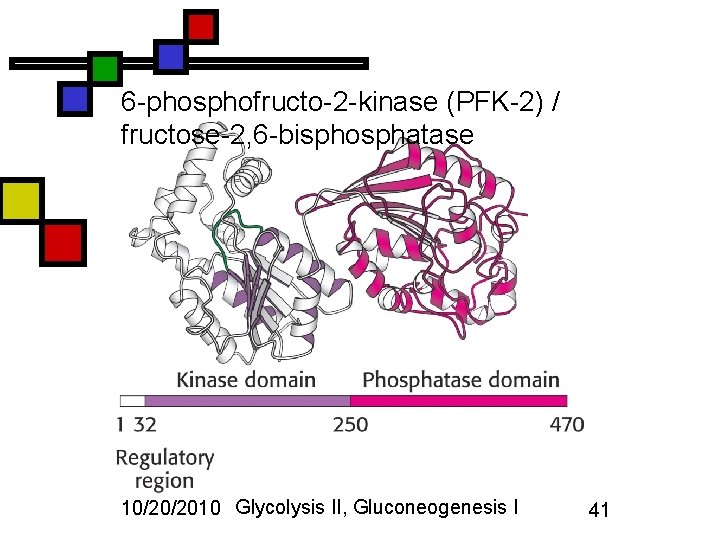
6 -phosphofructo-2 -kinase (PFK-2) / fructose-2, 6 -bisphosphatase 10/20/2010 Glycolysis II, Gluconeogenesis I 41
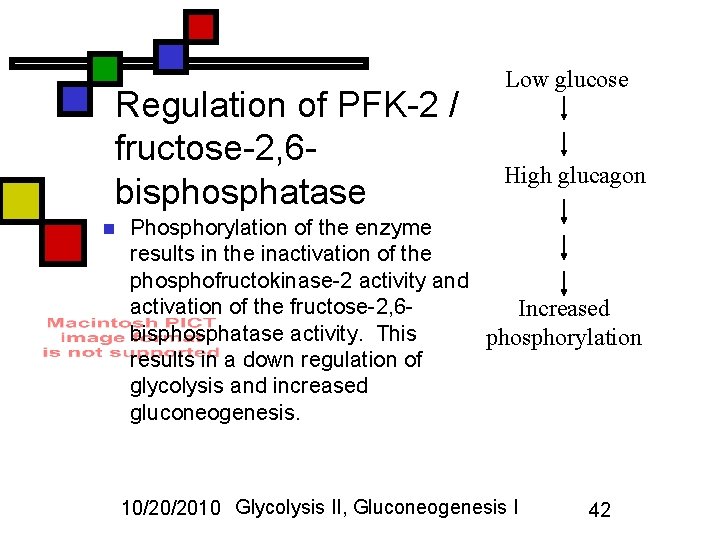
Regulation of PFK-2 / fructose-2, 6 bisphosphatase n Low glucose High glucagon Phosphorylation of the enzyme results in the inactivation of the phosphofructokinase-2 activity and activation of the fructose-2, 6 Increased bisphosphatase activity. This phosphorylation results in a down regulation of glycolysis and increased gluconeogenesis. 10/20/2010 Glycolysis II, Gluconeogenesis I 42
PFK-2 and glucagon n n In liver: low blood [glucose] triggers release of glucagon Glucagon activates adenylyl cyclase signaling in liver cells; that enables protein kinase A to phosphorylate a ser in PFK-2 That turns on the fructose 2, 6 -bisphosphatase activity and turns off PFK-2 activity Thus [F-2, 6 -bis. P] drops so PFK-1 activity drops See fig. 11. 17 10/20/2010 Glycolysis II, Gluconeogenesis I 43
Going the other way… n n n If there’s lots of glucose, [glucagon] falls At the same time, [F-1 -P] goes up because glycolysis has more fuel Therefore more F-2, 6 -P is made: n n F-1 -P is a substrate for the PFK-2 reaction F-1 -P is an inhibitor of the phosphatase activity of the bifunctional PFK-2 enzyme So that activates PFK-1 So more of the glucose gets processed into pyruvate 10/20/2010 Glycolysis II, Gluconeogenesis I 44
Pyruvate kinase regulation n n 4 isozymes in mammals Liver, kidney, erythrocyte versions: activated by F-1, 6 -bis. P, inhibited by ATP Liver, intestinal version: phosphorylated by protein kinase A in response to glucagon release (usually with low [glucose]); That inactivates pyruvate kinase Also regulated via transcriptional control: more pyruvate kinase made when diet contains a lot of carbohydrate 10/20/2010 Glycolysis II, Gluconeogenesis I 45
Pasteur effect n n Glycolysis slows down in the presence of oxygen in yeast This makes sense, since oxygen means we can use oxidative phosphorylation, which is much more efficient than anaerobic glycolysis How does it work? Several mechanisms, incl. : O 2 inactivates PFK-1 via decreases in AMP 10/20/2010 Glycolysis II, Gluconeogenesis I 46
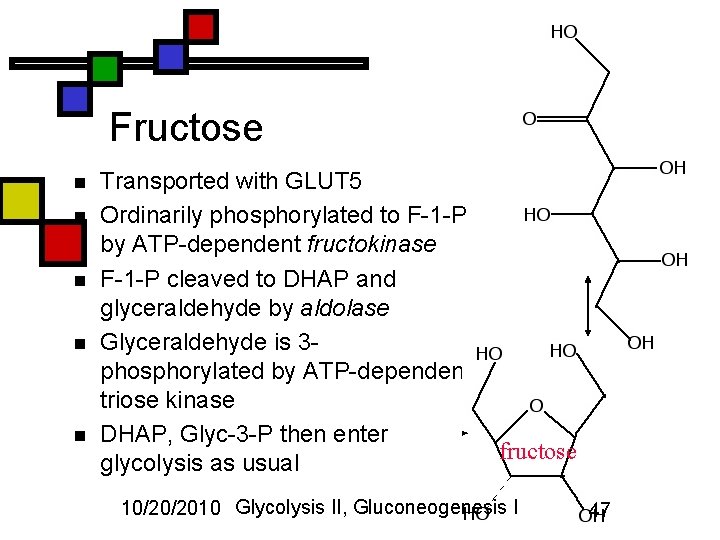
Fructose n n n Transported with GLUT 5 Ordinarily phosphorylated to F-1 -P by ATP-dependent fructokinase F-1 -P cleaved to DHAP and glyceraldehyde by aldolase Glyceraldehyde is 3 phosphorylated by ATP-dependent triose kinase DHAP, Glyc-3 -P then enter glycolysis as usual fructose 10/20/2010 Glycolysis II, Gluconeogenesis I 47
Fructosemetabolizing enzymes n n n Fructokinase F-1 P aldolase (now considered a subset of ordinary F-1, 6 -bis. P aldolase) Triose kinase (no structures yet!) Fructokinase PDB 2 hlz human 136 k. Da tetramer 10/20/2010 Glycolysis II, Gluconeogenesis I 48
Fructose: Energetics and regulation n Net energetics equivalent to glucose: net 2 ATPs + 2 NADHs per input C 6 sugar This pathway bypasses PFK-1 so it’s less carefully regulated Therefore diets high in fructose can give rise to fatty livers after accumulations of pyruvate 10/20/2010 Glycolysis II, Gluconeogenesis I 49
Sucrose’s fate n n In humans there are secreted invertases that split sucrose into fructose + glucose Plants have sucrose transporters and phosphorylases 10/20/2010 Glycolysis II, Gluconeogenesis I 50
Lactose n n Mammals: Lactose (glc-gal dimer) is the primary sugar in milk Nursing infants get 20% of caloric intake via galactose metabolism Lactose hydrolyzed extracellularly to glc + gal via lactase Many bacteria have galactosidase E. coli -galactosidase PDB 1 JZ 7 224 k. Da dimer 10/20/2010 Glycolysis II, Gluconeogenesis I 51
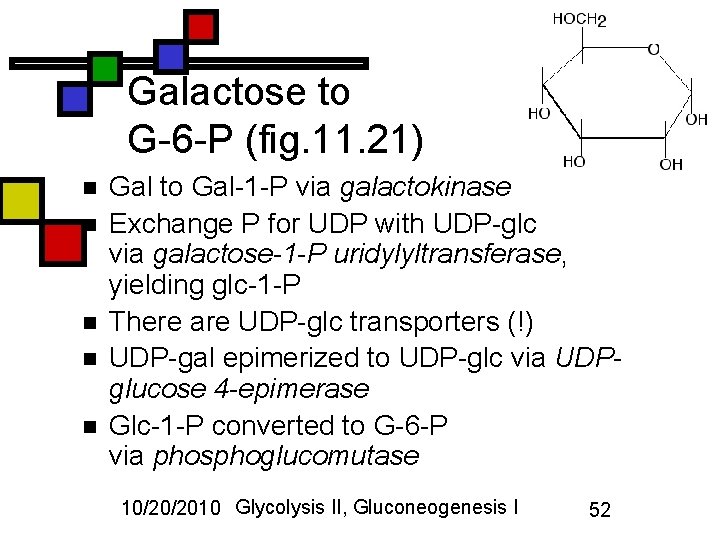
Galactose to G-6 -P (fig. 11. 21) n n n Gal to Gal-1 -P via galactokinase Exchange P for UDP with UDP-glc via galactose-1 -P uridylyltransferase, yielding glc-1 -P There are UDP-glc transporters (!) UDP-gal epimerized to UDP-glc via UDPglucose 4 -epimerase Glc-1 -P converted to G-6 -P via phosphoglucomutase 10/20/2010 Glycolysis II, Gluconeogenesis I 52
Galactosemia n Deficiency in galactose 1 -P uridylyltransferase n n Gal-1 -P accumulates in cells Leads to compromised liver function; accumulation of bilirubin turns skin yellow Can also lead to CNS damage Early diagnosis calling forth low-lactose diet can prevent problems 10/20/2010 Glycolysis II, Gluconeogenesis I 53
Lactase and development n n n Most mammals stop making lactase prior to puberty Some humans (mostly from N. European stock) have acquired mutant genes that continue to make lactase throughout life Lactose in lactate-deficient people is metabolized by gut bacteria, leading to gas (CO 2, H 2) and diarrhea (ionic strength ) 10/20/2010 Glycolysis II, Gluconeogenesis I 54
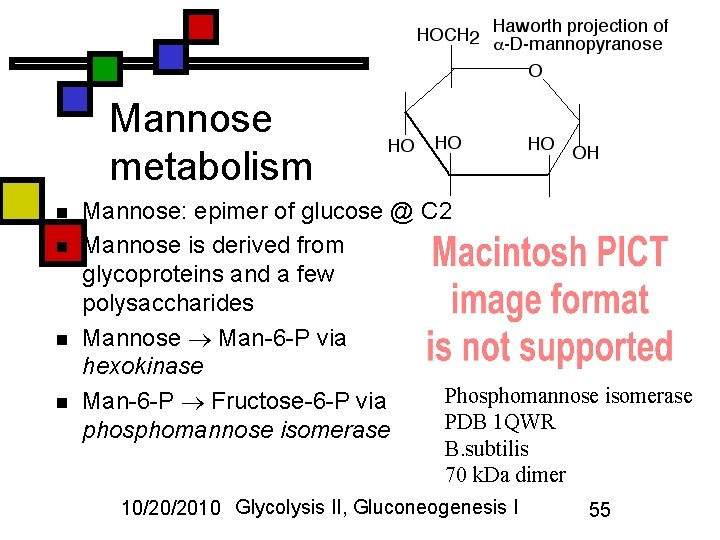
Mannose metabolism n n Mannose: epimer of glucose @ C 2 Mannose is derived from glycoproteins and a few polysaccharides Mannose Man-6 -P via hexokinase Phosphomannose isomerase Man-6 -P Fructose-6 -P via PDB 1 QWR phosphomannose isomerase B. subtilis 70 k. Da dimer 10/20/2010 Glycolysis II, Gluconeogenesis I 55
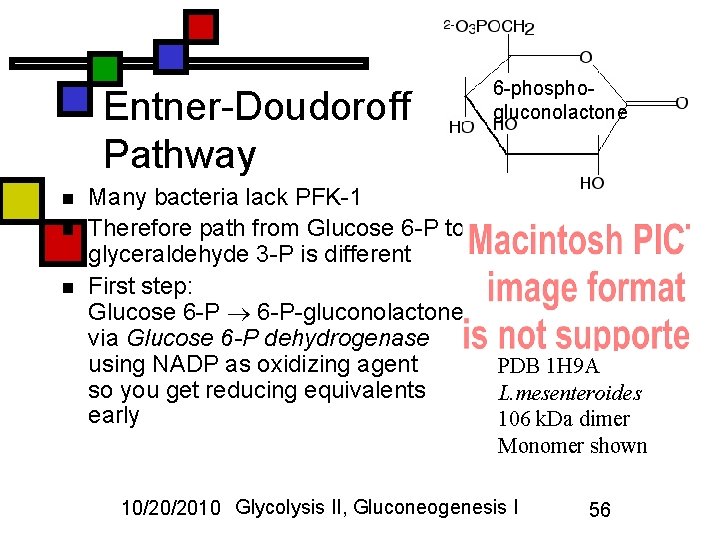
Entner-Doudoroff Pathway n n n Many bacteria lack PFK-1 Therefore path from Glucose 6 -P to glyceraldehyde 3 -P is different First step: Glucose 6 -P-gluconolactone via Glucose 6 -P dehydrogenase using NADP as oxidizing agent so you get reducing equivalents early 6 -phosphogluconolactone PDB 1 H 9 A L. mesenteroides 106 k. Da dimer Monomer shown 10/20/2010 Glycolysis II, Gluconeogenesis I 56
n n n 6 -P-gluconolactone to glyceraldehyde-3 -P (fig. 11. 23) Intermediates: hydration to 6 -P-gluconate via gluconolactonase Dehydration to 2 -keto-3 -deoxy-6 phosphogluconate via 6 -P-gluconate dehydratase Cleavage to pyruvate + Part of 6 -P gluconate dehydratase glyceraldehyde-3 Shewanella oneidensis phosphate via KDPG PDB 2 GP 4: 138 k. Da dimer aldolase 10/20/2010 Glycolysis II, Gluconeogenesis I 57
Entner-Doudoroff pathway: energetics and versatility n Energetics: n n n One ATP per glucose Two reducing equivalents Can handle input of gluconate and other sugar acids even in organisms that also have ordinary glycolysis 10/20/2010 Glycolysis II, Gluconeogenesis I 58
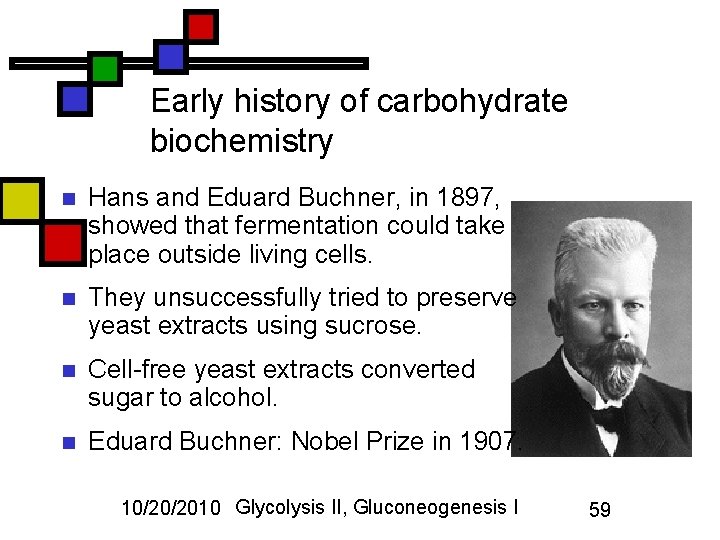
Early history of carbohydrate biochemistry n Hans and Eduard Buchner, in 1897, showed that fermentation could take place outside living cells. n They unsuccessfully tried to preserve yeast extracts using sucrose. n Cell-free yeast extracts converted sugar to alcohol. n Eduard Buchner: Nobel Prize in 1907. 10/20/2010 Glycolysis II, Gluconeogenesis I 59
History, continued n In 1905 Harden and Young found that inorganic phosphate was required for fermentation. n - also found that the phosphate became linked to a sugar. n - separated yeast extract into a nondialyzable fraction they called zymase and a dialyzable fraction called cozymase. n Others found that muscle extracts carried out almost identical reactions (except for the production of alcohol). 10/20/2010 Glycolysis II, Gluconeogenesis I 60
Glycolysis history n By 1940, Embden, Myerhof, and others had completely elucidated glycolysis. n Glycolysis is sometimes called the Embden. Myerhof pathway. 10/20/2010 Glycolysis II, Gluconeogenesis I 61
Gluconeogenesis • Synthesis of new glucose from common metabolites • Humans use ~160 g of glucose per day • 75% is used by the brain • Body fluids contain only 20 g of glucose • Glycogen stores yield 180 -200 g of glucose • So the body must be able to make its own glucose 10/20/2010 Glycolysis II, Gluconeogenesis I 62
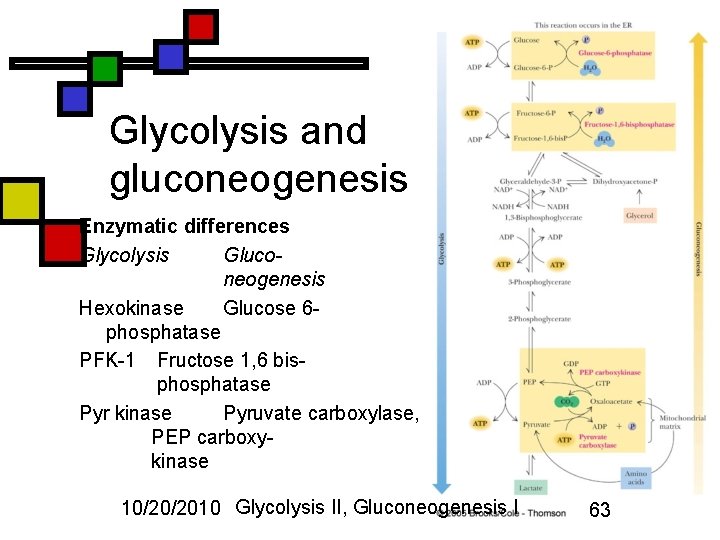
Glycolysis and gluconeogenesis Enzymatic differences Glycolysis Gluconeogenesis Hexokinase Glucose 6 phosphatase PFK-1 Fructose 1, 6 bisphosphatase Pyr kinase Pyruvate carboxylase, PEP carboxykinase 10/20/2010 Glycolysis II, Gluconeogenesis I 63
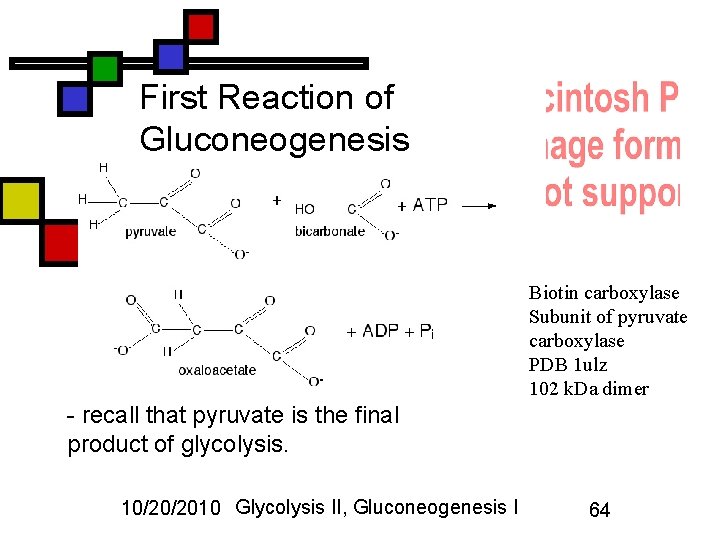
First Reaction of Gluconeogenesis Biotin carboxylase Subunit of pyruvate carboxylase PDB 1 ulz 102 k. Da dimer - recall that pyruvate is the final product of glycolysis. 10/20/2010 Glycolysis II, Gluconeogenesis I 64
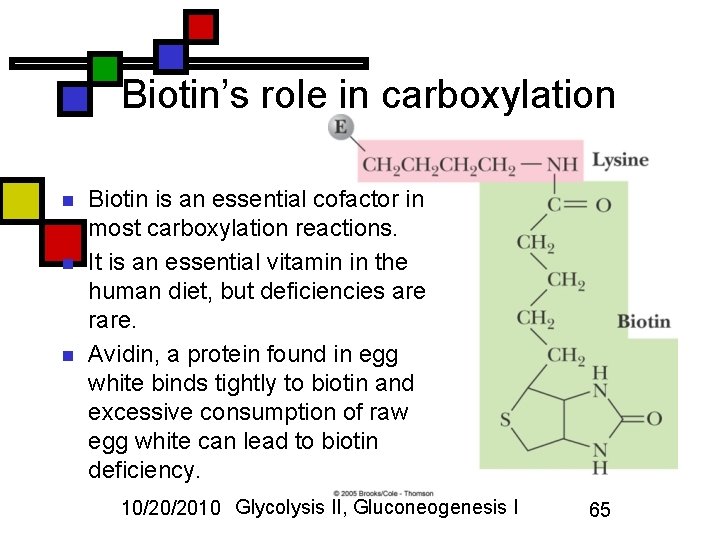
Biotin’s role in carboxylation n Biotin is an essential cofactor in most carboxylation reactions. It is an essential vitamin in the human diet, but deficiencies are rare. Avidin, a protein found in egg white binds tightly to biotin and excessive consumption of raw egg white can lead to biotin deficiency. 10/20/2010 Glycolysis II, Gluconeogenesis I 65
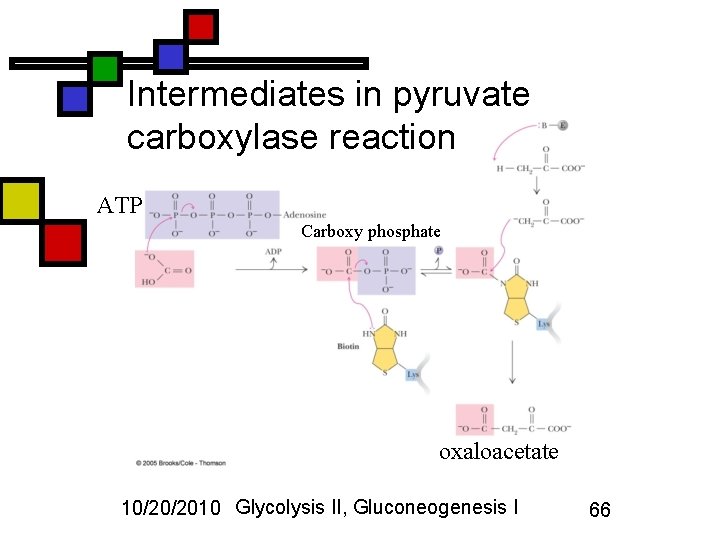
Intermediates in pyruvate carboxylase reaction ATP Carboxy phosphate oxaloacetate 10/20/2010 Glycolysis II, Gluconeogenesis I 66
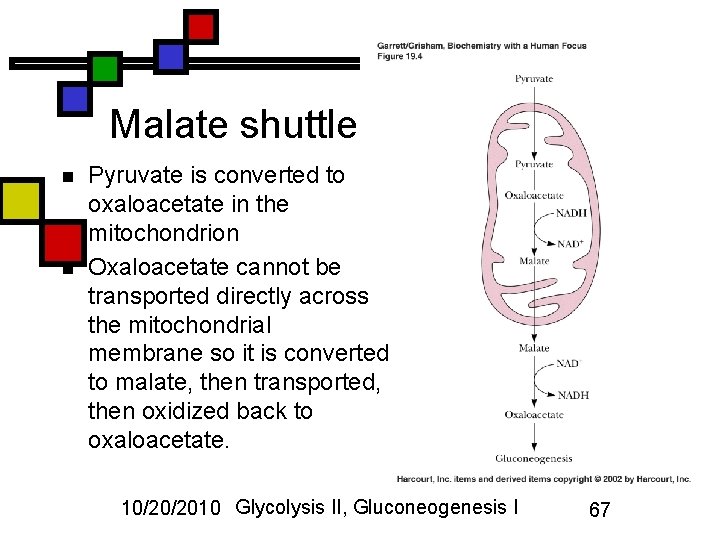
Malate shuttle n n Pyruvate is converted to oxaloacetate in the mitochondrion Oxaloacetate cannot be transported directly across the mitochondrial membrane so it is converted to malate, then transported, then oxidized back to oxaloacetate. 10/20/2010 Glycolysis II, Gluconeogenesis I 67
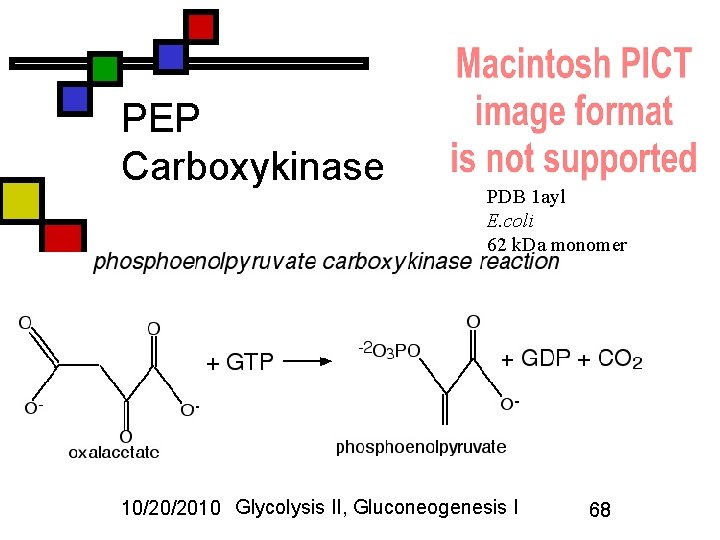
PEP Carboxykinase PDB 1 ayl E. coli 62 k. Da monomer 10/20/2010 Glycolysis II, Gluconeogenesis I 68
Electrons in PEPCK reaction 10/20/2010 Glycolysis II, Gluconeogenesis I 69
Reactions unique to gluconeogenesis 10/20/2010 Glycolysis II, Gluconeogenesis I 70
Enolase: both directions phosphoenolpyruvate 2 -phosphoglycerate Go’ = -1. 8 k. J mol-1 10/20/2010 Glycolysis II, Gluconeogenesis I 71
Phosphoglycerate Mutase Reaction 2 -phosphoglycerate 3 -phosphoglycerate Go’ = -4. 4 k. J mol-1 10/20/2010 Glycolysis II, Gluconeogenesis I 72
Enzyme-category definitions n Isomerase: An enzyme that catalyzes the transformation of compounds into their positional isomers. In the case of sugars this usually involves the interconversion of an aldose into a ketose, or vice versa. n Kinase: An enzyme that catalyzes the phosphorylation (or dephosphorylation) of a molecule using ATP (or GTP). n Mutase: An enzyme that catalyzes the transposition of functional groups, such as phosphates, sulfates. 10/20/2010 Glycolysis II, Gluconeogenesis I 73
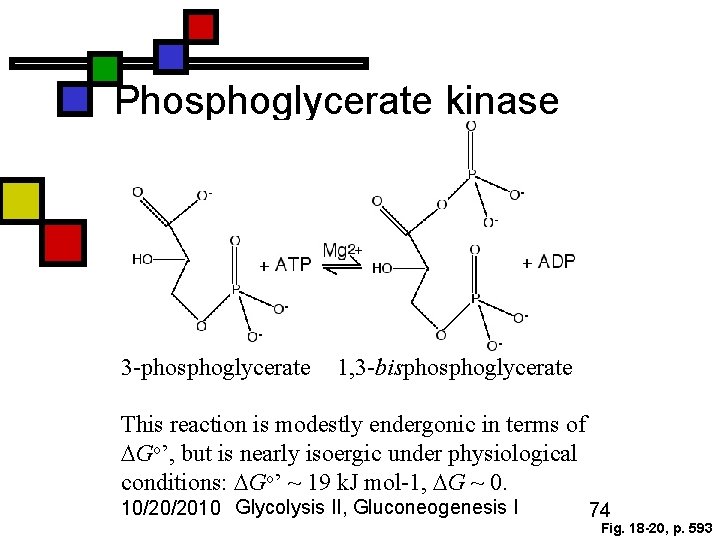
Phosphoglycerate kinase 3 -phosphoglycerate 1, 3 -bisphoglycerate This reaction is modestly endergonic in terms of Go’, but is nearly isoergic under physiological conditions: Go’ ~ 19 k. J mol-1, G ~ 0. 10/20/2010 Glycolysis II, Gluconeogenesis I 74 Fig. 18 -20, p. 593
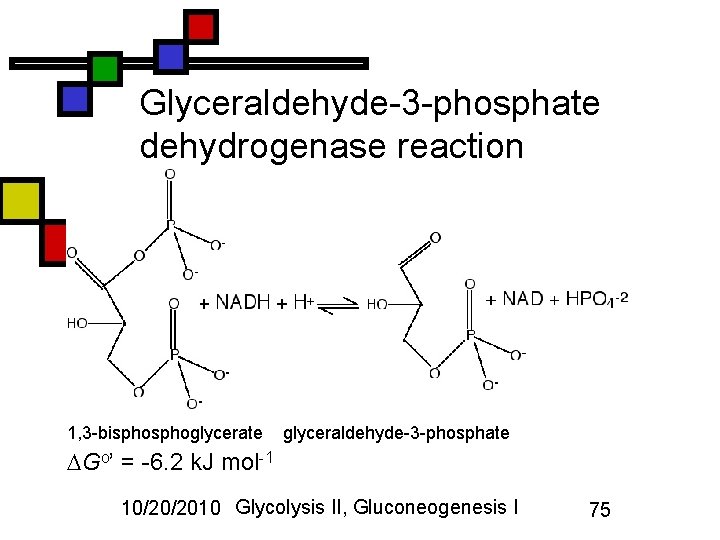
Glyceraldehyde-3 -phosphate dehydrogenase reaction 1, 3 -bisphoglycerate glyceraldehyde-3 -phosphate Go’ = -6. 2 k. J mol-1 10/20/2010 Glycolysis II, Gluconeogenesis I 75
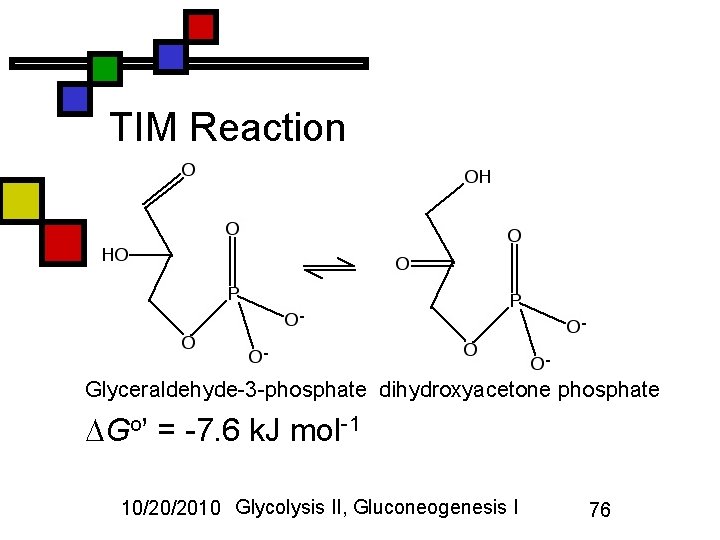
TIM Reaction Glyceraldehyde-3 -phosphate dihydroxyacetone phosphate Go’ = -7. 6 k. J mol-1 10/20/2010 Glycolysis II, Gluconeogenesis I 76
Reminder of reaction sequence 10/20/2010 Glycolysis II, Gluconeogenesis I 77
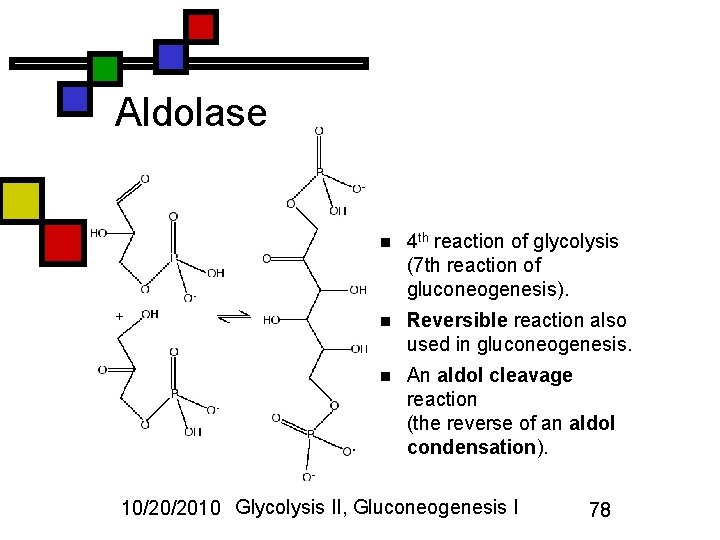
Aldolase n 4 th reaction of glycolysis (7 th reaction of gluconeogenesis). n Reversible reaction also used in gluconeogenesis. n An aldol cleavage reaction (the reverse of an aldol condensation). 10/20/2010 Glycolysis II, Gluconeogenesis I 78
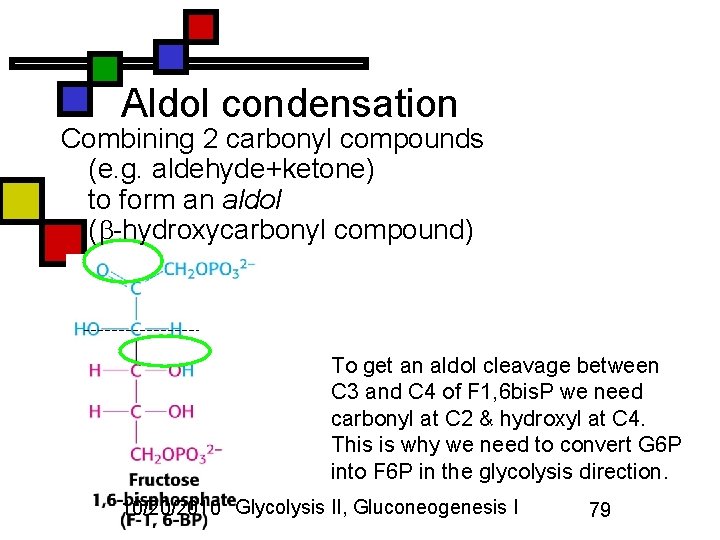
Aldol condensation Combining 2 carbonyl compounds (e. g. aldehyde+ketone) to form an aldol ( -hydroxycarbonyl compound) To get an aldol cleavage between C 3 and C 4 of F 1, 6 bis. P we need carbonyl at C 2 & hydroxyl at C 4. This is why we need to convert G 6 P into F 6 P in the glycolysis direction. 10/20/2010 Glycolysis II, Gluconeogenesis I 79
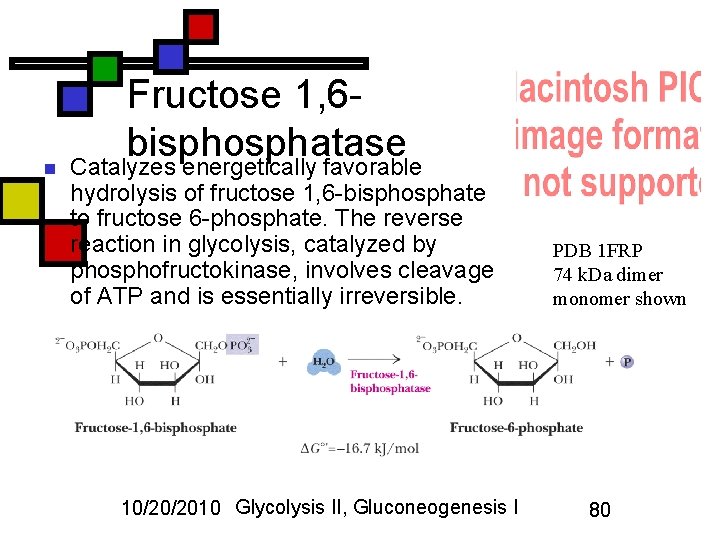
n Fructose 1, 6 bisphosphatase Catalyzes energetically favorable hydrolysis of fructose 1, 6 -bisphosphate to fructose 6 -phosphate. The reverse reaction in glycolysis, catalyzed by phosphofructokinase, involves cleavage of ATP and is essentially irreversible. 10/20/2010 Glycolysis II, Gluconeogenesis I PDB 1 FRP 74 k. Da dimer monomer shown 80
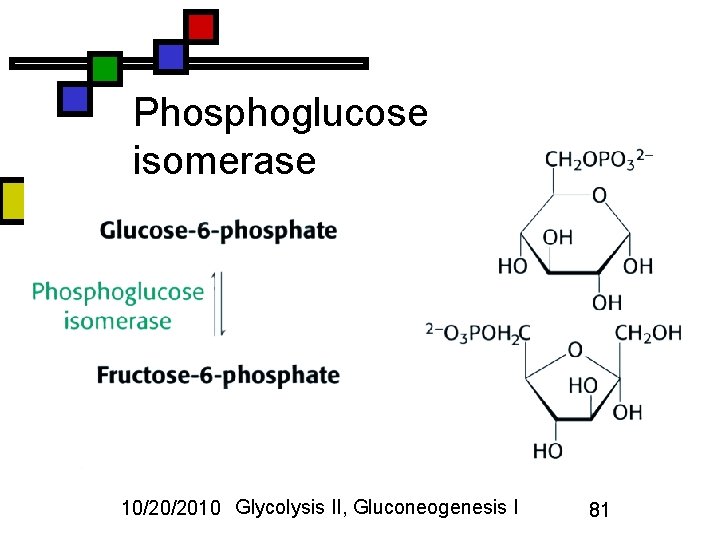
Phosphoglucose isomerase 10/20/2010 Glycolysis II, Gluconeogenesis I 81
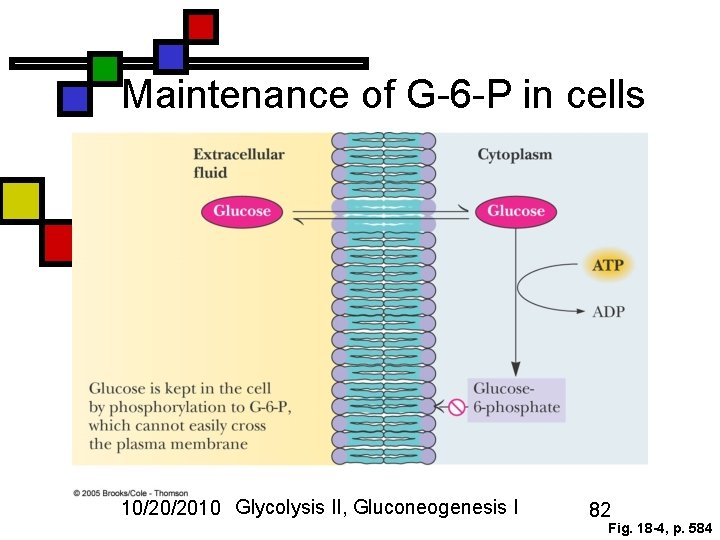
Maintenance of G-6 -P in cells 10/20/2010 Glycolysis II, Gluconeogenesis I 82 Fig. 18 -4, p. 584
Glucose 6 -phosphatase n enzyme unique to liver and kidney allowing them to supply glucose to other tissues. n G 6 P is transported into the lumen of the ER where it is hydrolyzed by membranebound enzyme. n ER vesicles filled with glucose diffuse to the plasma membrane, fuse with it and open, releasing glucose into the bloodstream. 10/20/2010 Glycolysis II, Gluconeogenesis I No structure available: Eeech. It’s a transmembrane protein. 83
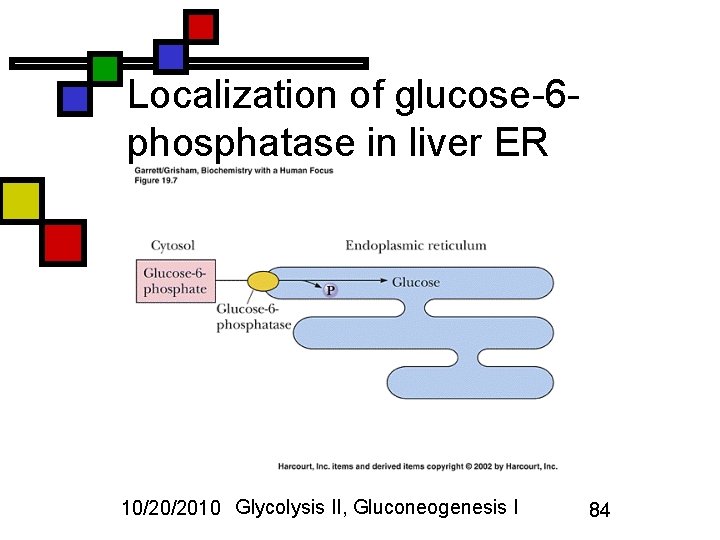
Localization of glucose-6 phosphatase in liver ER 10/20/2010 Glycolysis II, Gluconeogenesis I 84
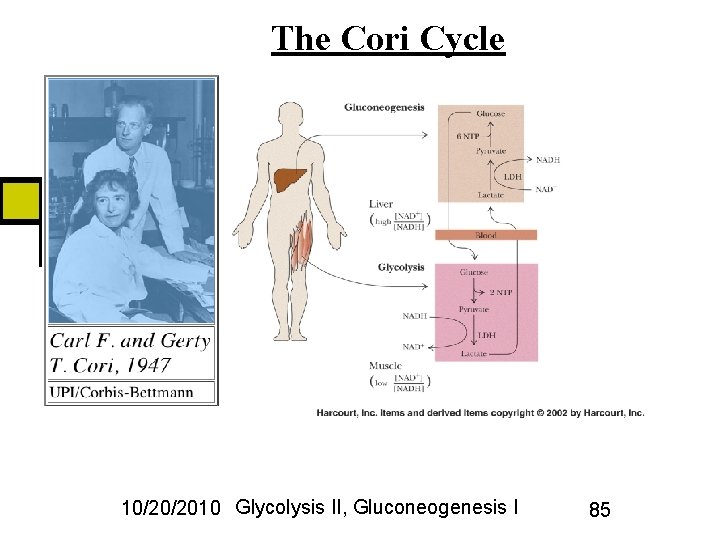
The Cori Cycle 10/20/2010 Glycolysis II, Gluconeogenesis I 85
Regulation of gluconeogenesis n Glycolysis and gluconeogenesis are reciprocally regulated. n In the fasted state the liver maintains blood glucose levels by breaking down glycogen and by gluconeogenesis - mainly from protein degradation products - cannot use fat to make glucose. n Remember the fructose 2, 6 -bisphosphate control system in glycolysis: it is relevant in this direction also! 10/20/2010 Glycolysis II, Gluconeogenesis I 86
Regulation of glucose 6 phosphatase n Glucose-6 -phosphatase is subject to substrate level control. n At higher G 6 P concentrations reaction rate increases n Recall, this happens in the liver. Other tissues do not hydrolyze their G 6 P, thereby trapping it in the cells. 10/20/2010 Glycolysis II, Gluconeogenesis I 87
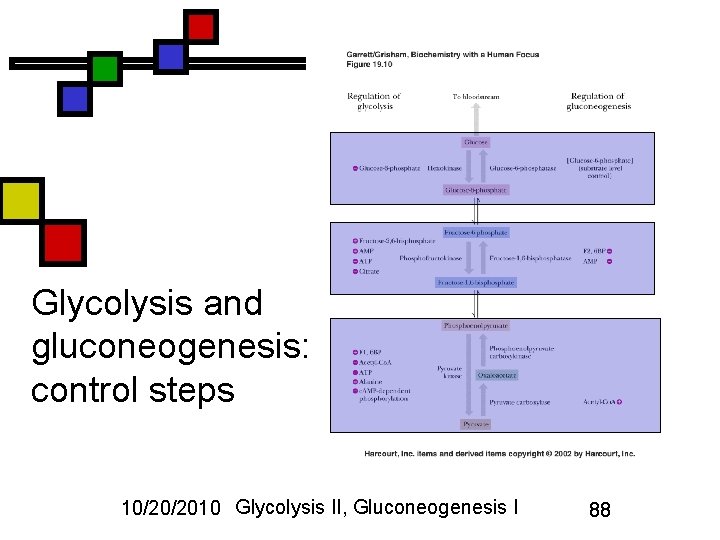
Glycolysis and gluconeogenesis: control steps 10/20/2010 Glycolysis II, Gluconeogenesis I 88
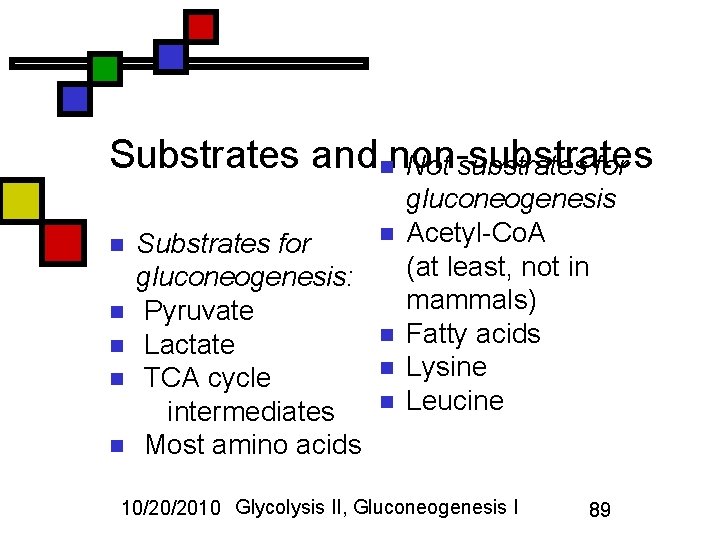
Substrates andnnon-substrates Not substrates for n n n Substrates for gluconeogenesis: Pyruvate Lactate TCA cycle intermediates Most amino acids n n gluconeogenesis Acetyl-Co. A (at least, not in mammals) Fatty acids Lysine Leucine 10/20/2010 Glycolysis II, Gluconeogenesis I 89
- Slides: 89