
Glycol Recovery for Airport Deicer Operations Cost Analysis
- Slides: 1
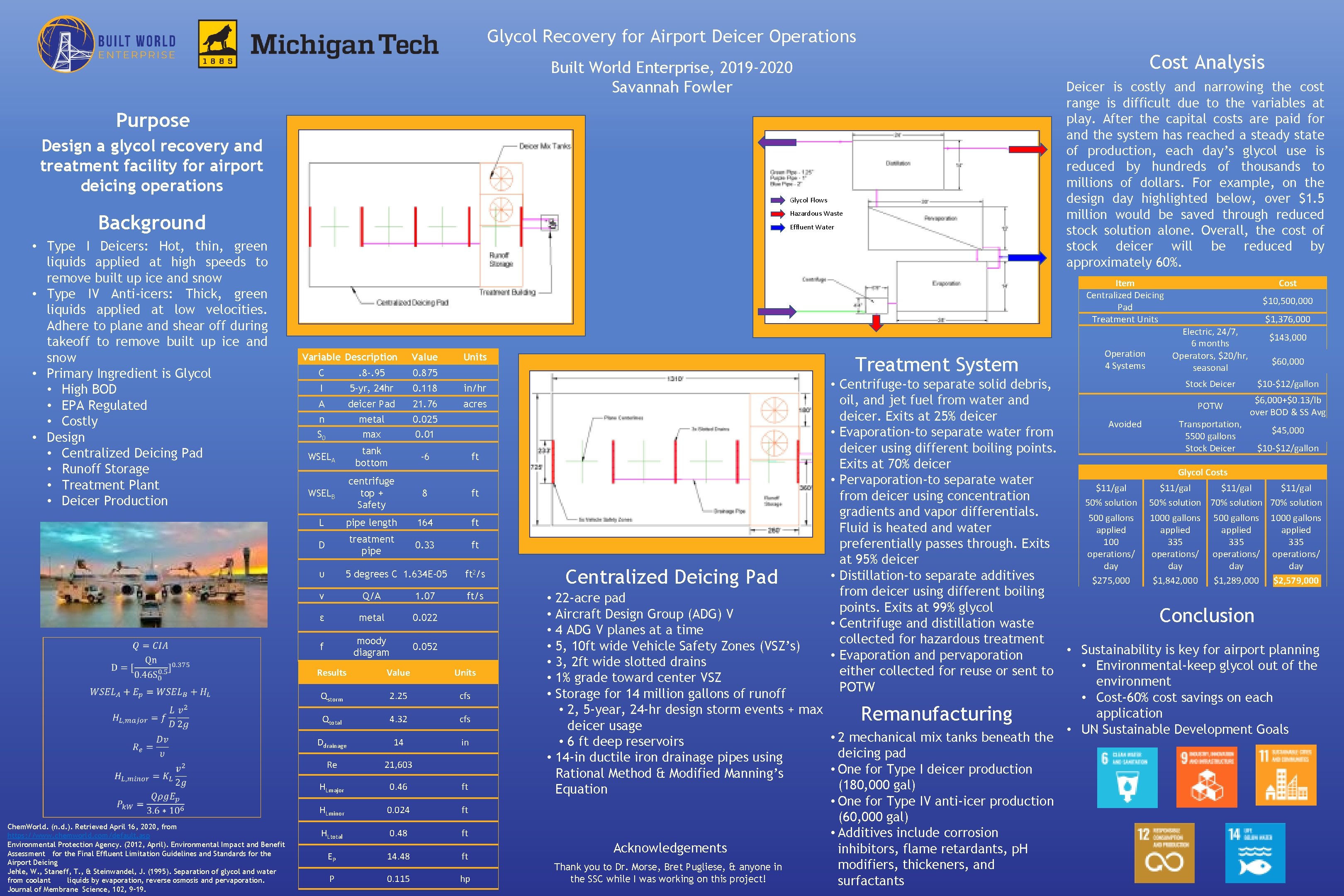
Glycol Recovery for Airport Deicer Operations Cost Analysis Built World Enterprise, 2019 -2020 Savannah Fowler Deicer is costly and narrowing the cost range is difficult due to the variables at play. After the capital costs are paid for and the system has reached a steady state of production, each day’s glycol use is reduced by hundreds of thousands to millions of dollars. For example, on the design day highlighted below, over $1. 5 million would be saved through reduced stock solution alone. Overall, the cost of stock deicer will be reduced by approximately 60%. Purpose Design a glycol recovery and treatment facility for airport deicing operations Glycol Flows Hazardous Waste Background • Type I Deicers: Hot, thin, green liquids applied at high speeds to remove built up ice and snow • Type IV Anti-icers: Thick, green liquids applied at low velocities. Adhere to plane and shear off during takeoff to remove built up ice and snow • Primary Ingredient is Glycol • High BOD • EPA Regulated • Costly • Design • Centralized Deicing Pad • Runoff Storage • Treatment Plant • Deicer Production Effluent Water Item Centralized Deicing Pad Treatment Units Variable Description Units C . 8 -. 95 0. 875 I 5 -yr, 24 hr 0. 118 in/hr A deicer Pad 21. 76 acres n metal 0. 025 S 0 max 0. 01 WSELA tank bottom -6 ft WSELB centrifuge top + Safety 8 ft L pipe length 164 ft D treatment pipe 0. 33 ft υ Chem. World. (n. d. ). Retrieved April 16, 2020, from https: //www. chemworld. com/default. asp Environmental Protection Agency. (2012, April). Environmental Impact and Benefit Assessment for the Final Effluent Limitation Guidelines and Standards for the Airport Deicing Jehle, W. , Staneff, T. , & Steinwandel, J. (1995). Separation of glycol and water from coolant liquids by evaporation, reverse osmosis and pervaporation. Journal of Membrane Science, 102, 9– 19. Value 5 degrees C 1. 634 E-05 v Q/A 1. 07 ε metal 0. 022 f moody diagram 0. 052 ft 2/s ft/s Results Value Units Qstorm 2. 25 cfs Qtotal 4. 32 cfs Ddrainage 14 in Re 21, 603 HLmajor 0. 46 ft HLminor 0. 024 ft HLtotal 0. 48 ft EP 14. 48 ft P 0. 115 hp Treatment System Operation 4 Systems Cost $10, 500, 000 $1, 376, 000 Electric, 24/7, 6 months Operators, $20/hr, seasonal $143, 000 $60, 000 Stock Deicer $10 -$12/gallon • Centrifuge-to separate solid debris, $6, 000+$0. 13/lb oil, and jet fuel from water and POTW over BOD & SS Avg deicer. Exits at 25% deicer Transportation, Avoided $45, 000 • Evaporation-to separate water from 5500 gallons Stock Deicer $10 -$12/gallon deicer using different boiling points. Exits at 70% deicer Glycol Costs • Pervaporation-to separate water $11/gal from deicer using concentration 50% solution 70% solution gradients and vapor differentials. 500 gallons 1000 gallons Fluid is heated and water applied 100 335 335 preferentially passes through. Exits operations/ at 95% deicer day day • Distillation-to separate additives $275, 000 $1, 842, 000 $1, 289, 000 $2, 579, 000 Centralized Deicing Pad from deicer using different boiling • 22 -acre pad points. Exits at 99% glycol • Aircraft Design Group (ADG) V Conclusion • Centrifuge and distillation waste • 4 ADG V planes at a time collected for hazardous treatment • 5, 10 ft wide Vehicle Safety Zones (VSZ’s) • Sustainability is key for airport planning • Evaporation and pervaporation • 3, 2 ft wide slotted drains • Environmental-keep glycol out of the either collected for reuse or sent to • 1% grade toward center VSZ environment POTW • Storage for 14 million gallons of runoff • Cost-60% cost savings on each • 2, 5 -year, 24 -hr design storm events + max application Remanufacturing deicer usage • UN Sustainable Development Goals • 2 mechanical mix tanks beneath the • 6 ft deep reservoirs deicing pad • 14 -in ductile iron drainage pipes using • One for Type I deicer production Rational Method & Modified Manning’s (180, 000 gal) Equation • One for Type IV anti-icer production (60, 000 gal) • Additives include corrosion Acknowledgements inhibitors, flame retardants, p. H modifiers, thickeners, and Thank you to Dr. Morse, Bret Pugliese, & anyone in the SSC while I was working on this project! surfactants