
Glucose Detection using Nanosensor Team May 1721 Members
Glucose Detection using Nanosensor Team May 1721 Members: Shir Linn Tan, Dalton Strauser, Xiong. Sheng Yi, Wai Hang Kong Lecturer: Professor Long Que Subject: EE 49 I
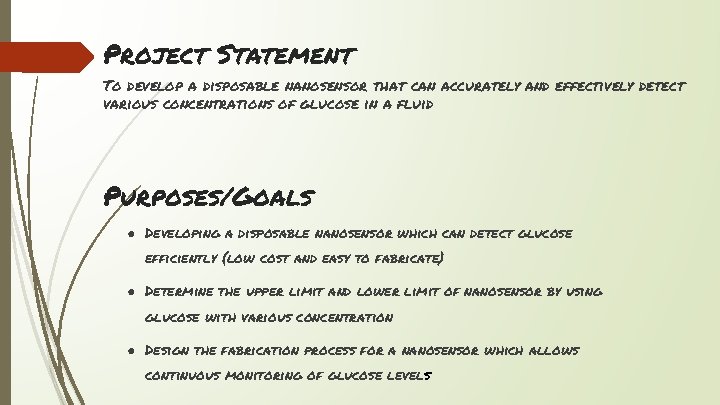
Project Statement To develop a disposable nanosensor that can accurately and effectively detect various concentrations of glucose in a fluid Purposes/Goals ● Developing a disposable nanosensor which can detect glucose efficiently (low cost and easy to fabricate) ● Determine the upper limit and lower limit of nanosensor by using glucose with various concentration ● Design the fabrication process for a nanosensor which allows continuous monitoring of glucose levels
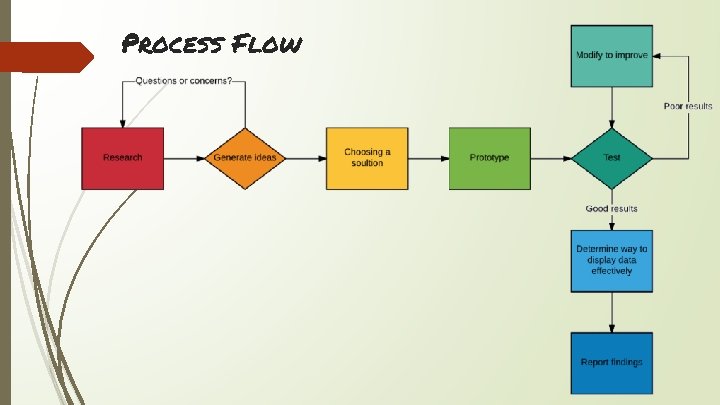
Process Flow

Project Timeline • Semester 1 • • Review multiple methods for detecting glucose using a nanosensor Choose a method which best fits our requirements • Easy to fabricate • Easy to test • Able to produce consistent results Design the fabrication process for the biosensor Plan for semester 2 • • • Fabricate the prototype Conduct tests with prototype Modify the device or testing method accordingly Develop final product Report on findings
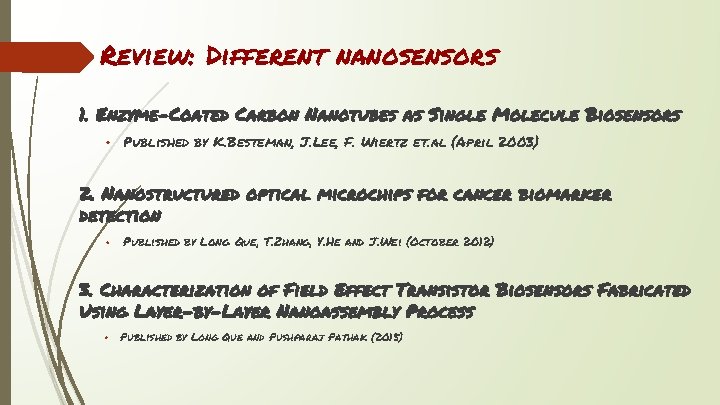
Review: Different nanosensors 1. Enzyme-Coated Carbon Nanotubes as Single Molecule Biosensors • Published by K. Besteman, J. Lee, F. Wiertz et. al (April 2003) 2. Nanostructured optical microchips for cancer biomarker detection • Published by Long Que, T. Zhang, Y. He and J. Wei (October 2012) 3. Characterization of Field Effect Transistor Biosensors Fabricated Using Layer-by-Layer Nanoassembly Process • Published by Long Que and Pushparaj Pathak (2015)
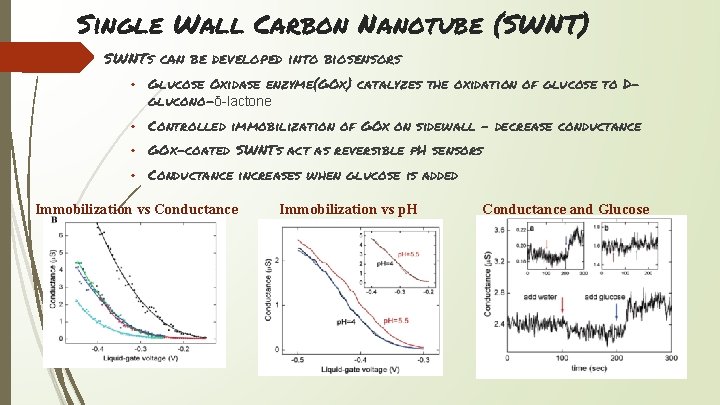
Single Wall Carbon Nanotube (SWNT) SWNTs can be developed into biosensors • Glucose Oxidase enzyme(GOx) catalyzes the oxidation of glucose to Dglucono-δ-lactone • Controlled immobilization of GOx on sidewall – decrease conductance • GOx-coated SWNTs act as reversible p. H sensors • Conductance increases when glucose is added Immobilization vs Conductance Immobilization vs p. H Conductance and Glucose

Glucose Oxidase The reaction process of GOx ● GOx enzyme is an oxidoreductase ○ Catalyzes electron transfer from one molecule to another ○ Glucose is oxidized - loss of electrons ● Electron transference changes conductivity ○ GOx has a different charge state after reaction ○ Change in conductivity can be measured
Findings of SWNT report • Laser-ablated and CVD-grown tubes allow proper immobilisation of GOx • Demonstrates ability to create a nanosensor from a single nanotube • Easily measurable changes in conductance Limitations • Complicated fabrication process • Difficult to create consistent SWNTs • No uniform surface oxide after performing oxidation process
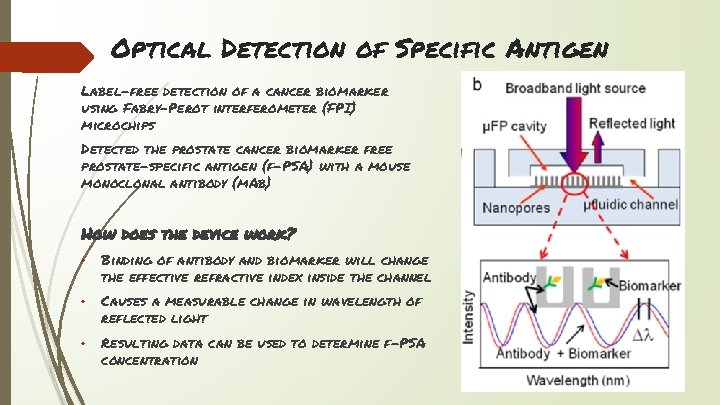
Optical Detection of Specific Antigen Label-free detection of a cancer biomarker using Fabry–Perot interferometer (FPI) microchips Detected the prostate cancer biomarker free prostate-specific antigen (f-PSA) with a mouse monoclonal antibody (m. Ab) How does the device work? • Binding of antibody and biomarker will change the effective refractive index inside the channel • Causes a measurable change in wavelength of reflected light • Resulting data can be used to determine f-PSA concentration
Benefits and Limitations Advantages: • Arrayed microchips can be batch fabricated inexpensively • Fluorescent dyes not needed • Biomolecules undisturbed by testing Difficulties: • May be unsuitable for glucose detection
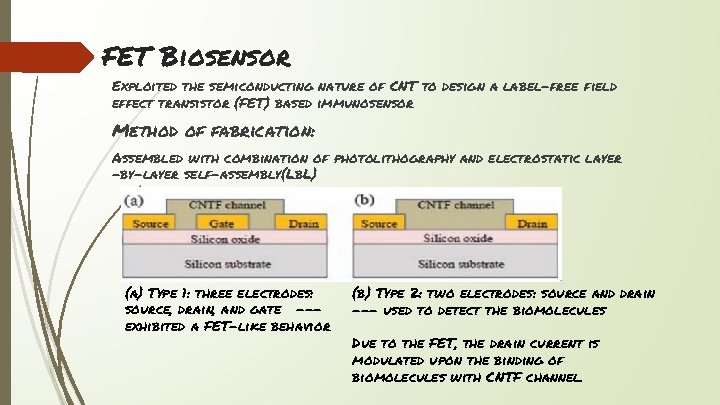
FET Biosensor Exploited the semiconducting nature of CNT to design a label-free field effect transistor (FET) based immunosensor Method of fabrication: Assembled with combination of photolithography and electrostatic layer -by-layer self-assembly(Lb. L) (a) Type 1: three electrodes: source, drain, and gate --exhibited a FET-like behavior (b) Type 2: two electrodes: source and drain --- used to detect the biomolecules Due to the FET, the drain current is modulated upon the binding of biomolecules with CNTF channel.
Findings of CNTF FET Biosensor Advantages • More uniform device • Less variation compared to single CNT • Easier to integrate as sensor • Cheaper to fabricate than SWNT Limitations • Uncertain whether detection capability will work for glucose
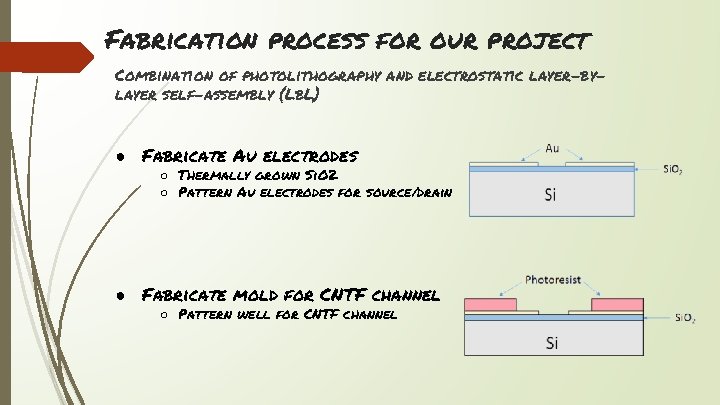
Fabrication process for our project Combination of photolithography and electrostatic layer-bylayer self-assembly (Lb. L) ● Fabricate Au electrodes ○ Thermally grown Si. O 2 ○ Pattern Au electrodes for source/drain ● Fabricate mold for CNTF channel ○ Pattern well for CNTF channel
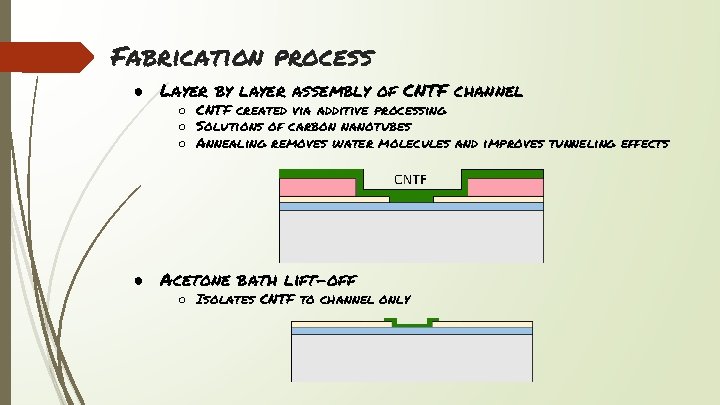
Fabrication process ● Layer by layer assembly of CNTF channel ○ CNTF created via additive processing ○ Solutions of carbon nanotubes ○ Annealing removes water molecules and improves tunneling effects ● Acetone bath lift-off ○ Isolates CNTF to channel only
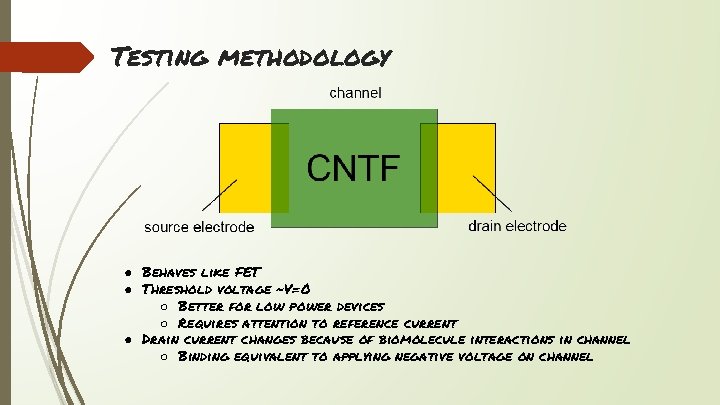
Testing methodology ● Behaves like FET ● Threshold voltage ~V=0 ○ Better for low power devices ○ Requires attention to reference current ● Drain current changes because of biomolecule interactions in channel ○ Binding equivalent to applying negative voltage on channel

Plan for the next semester • Fabricate the prototype • Conduct tests on the prototype • Modify the device or testing method accordingly • Report on findings
References • K. Besteman, et al. , “Enzyme-Coated Carbon Nanotubes as Single. Molecule Biosensors, ” Nano Letters, vol. 3, no. 6, 727 -730, Mar. 2003. • T. Zhang et al, “Nanostructured optical microchips for cancer biomarker detection, ” Biosensors and Bioelectronics, vol. 38, no. 1, 382 -388, Oct. 2012. • P. Pathank and L. Que, “Characterization of field effect transistor biosensors fabricated using layer-by-layer nanoassembly process, ” Journal of Nanoscience and Nanotechnology, vol. 15, no. 12, 9689 -9692, 2015.

You!! Thank
- Slides: 18