
GLUCONEOGENESIS 2 Dr AQSA MALIK Biochemistry STEPS A

GLUCONEOGENESIS 2 Dr AQSA MALIK Biochemistry
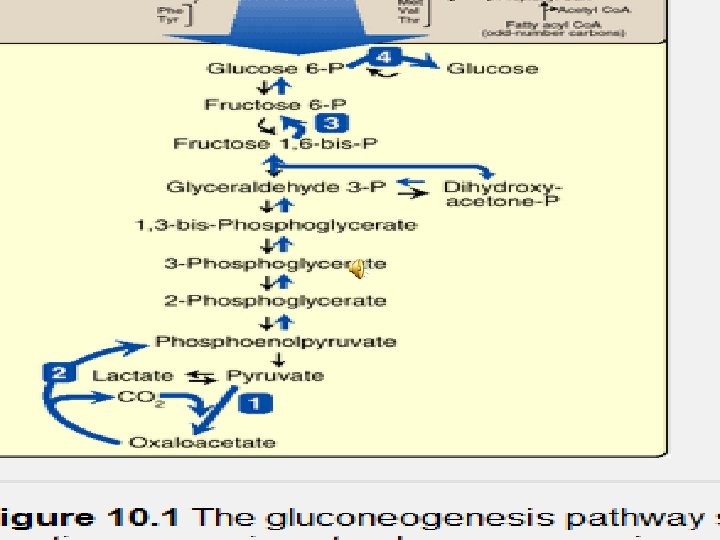
STEPS �A. Carboxylation of pyruvate �The first “roadblock” to overcome in the synthesis of glucose from pyruvate is the irreversible conversion in glycolysis of PEP to pyruvate by pyruvate kinase (PK). � In gluconeogenesis , pyruvate is first carboxylated by pyruvate carboxylase to OAA, which is then converted to PEP by the action of PEPcarboxykinase

Biotin, a coenzyme: � Pyruvate carboxylase requires biotin covalently bound to the amino group of a lysine residue in the enzyme. �Hydrolys is of ATP drives the formation of an enzyme –biotin–CO 2 intermediate, which subsquently carboxylates pyruvate to form OAA. The pyruvate carboxylase reaction occurs in the mitochondria of liver and kidney cells.
Allosteric regulation: �Pyruvate carboxylase � Allosterically activated by acetyl Co. A. �Elevated levels of acetyl Co. A in mitochondria signal a metabolic state in which the increased synthesis of OAA is required.
�For example , this occurs during fasting, when OAA is used for the synthesis of glucose by gluconeogenesis in the liver and kidney. � Conversely, at low levels of acetyl Co. A, pyruvate carboxylase is largely inactive, and pyruvate is primarily oxidized by the PDH complex to produce a cetyl Co. A that can be further oxidized by the TCA cycle
B. Transport of oxaloacetate to the cytosol � OAA is unable to be transported across the inner mitochondrial membrane, so it must first be reduced to malate by mitochondrial malate dehydrogenase (MD). �Malate can be transported from the mitochondria to the cytosol, where it is reoxidized to OAA by cytosolic MD and (NAD+) is reduced
�The NADH is used in the reduction of 1, 3 bisphoglycerate to glyceraldehyde 3 phosphate � A step common to both glycolysis and gluconeogenesis.
C. Decarboxylation of cytosolic oxaloacetate �OAA is decarboxylated and phosphorylated to PEP by PEP-carboxykinase, hydrolys GTP � PEP is then acted on by the reactions of glycolysis running in the reverse direction until it becomes fructose 1, 6 bisphosphate.

D. Dephosphorylation of fructose 1, 6 -bis phosphate �Hydrolysis of fructose 1, 6 bisphosphate by fructose 1, 6 bisphosphatase, bypasses the irreversible phosphofructokinas e -1 (PFK-1) reaction, and provides a favorable pathway for the formation of fructose 6 phosphate � This reaction is an important regulatory site of gluconeogenesis.
Regulation by energy levels within the cell: �Fructose 1, 6 -bisphosphatase is inhibited by elevated levels of (AMP), which signal an “energy poor” state in the cell. �Conversely, high levels of ATP and low concentrations of AMP stimulate gluconeogenesis , an energy requiring pathway.
2. Regulation by fructose 2, 6 bisphosphate: �Fructose 1, 6 -bisphosphatase is inhibited by fructose 2, 6 bisphosphate, an allosteric effector whose concentration is influenced by the insulin to glucagon ratio: when glucagon is high, the phosphatase is active. � The signals that inhibit (low energy, high fructose 2, 6 bisphosphate) or activate(high energy, low fructose 2, 6 bisphosphate ) gluconeogenesis have the opposite effect on glycolysis, providing reciprocal control of the pathways that synthesize and oxidize glucose
E. Dephosphorylation of glucose 6 -phosphate �Hydrolys is of glucose 6 phosphate by glucose 6 -phosphatase bypasses the irreversible hexokinase reaction and the formation of free glucose. � Liver & kidney are only organs release free glucose from glucose 6 phosphate. � Require two enzymes � Glucose 6 -phosphate translocase (transport glucose 6 phosphate across ER membrane) � glucose 6 phosphatase found in gluconeogenic cell remove phosphate , prducing free glucose. �Specific glucose transporters(GLUTs) are responsible for moving free glucose into the cytosol and then into blood

- Slides: 14