
Glomerulus Afferent Arteriole and the Efferent Arteriole Brenna
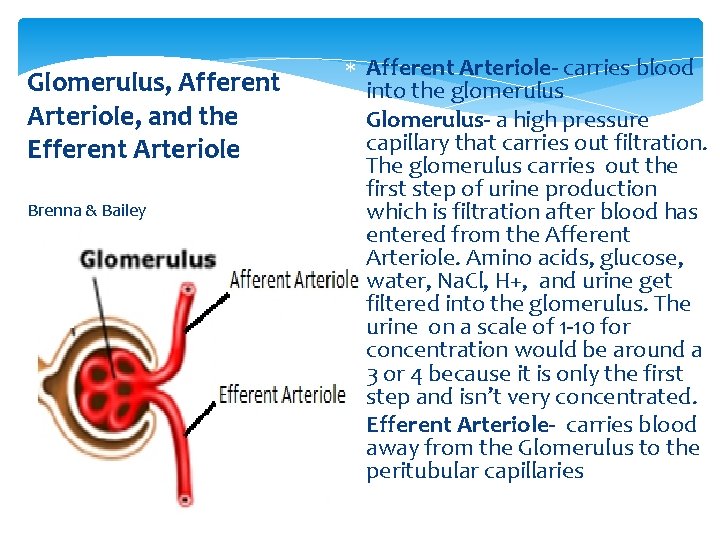
Glomerulus, Afferent Arteriole, and the Efferent Arteriole Brenna & Bailey Afferent Arteriole- carries blood into the glomerulus Glomerulus- a high pressure capillary that carries out filtration. The glomerulus carries out the first step of urine production which is filtration after blood has entered from the Afferent Arteriole. Amino acids, glucose, water, Na. Cl, H+, and urine get filtered into the glomerulus. The urine on a scale of 1 -10 for concentration would be around a 3 or 4 because it is only the first step and isn’t very concentrated. Efferent Arteriole- carries blood away from the Glomerulus to the peritubular capillaries
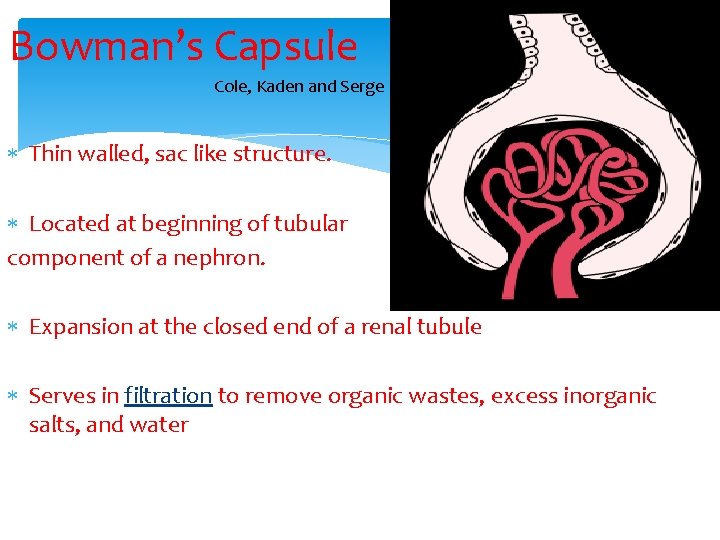
Bowman’s Capsule Cole, Kaden and Serge Thin walled, sac like structure. Located at beginning of tubular component of a nephron. Expansion at the closed end of a renal tubule Serves in filtration to remove organic wastes, excess inorganic salts, and water
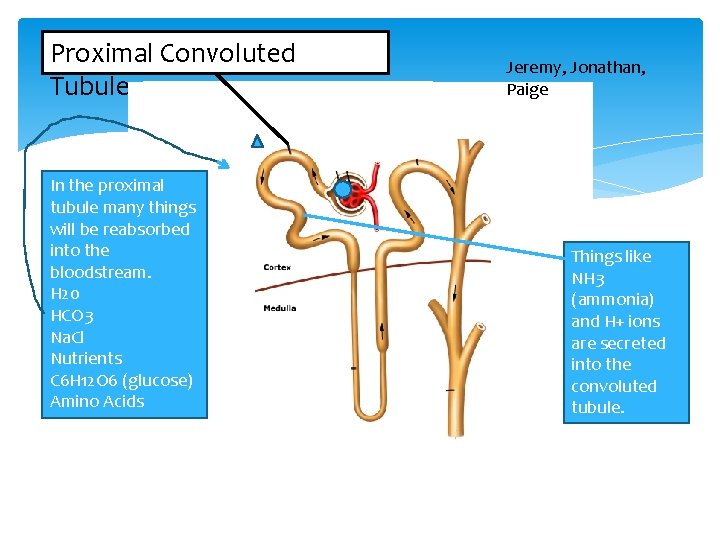
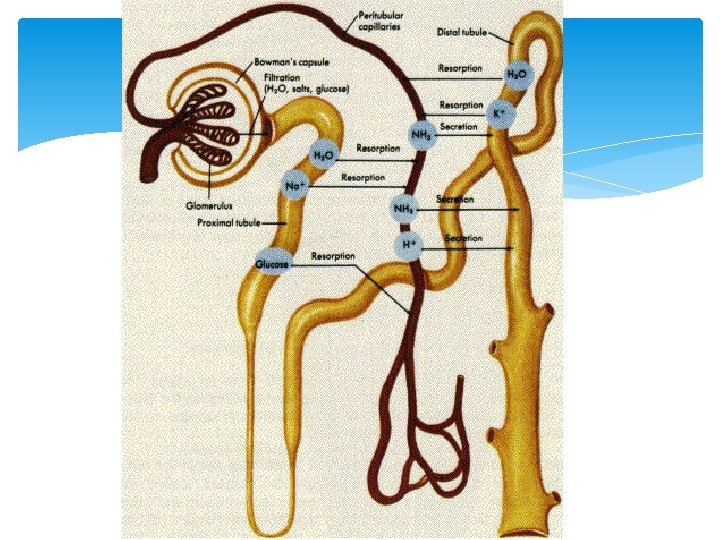
Proximal Convoluted Tubule In the proximal tubule many things will be reabsorbed into the bloodstream. H 20 HCO 3 Na. Cl Nutrients C 6 H 12 O 6 (glucose) Amino Acids Jeremy, Jonathan, Paige Things like NH 3 (ammonia) and H+ ions are secreted into the convoluted tubule.
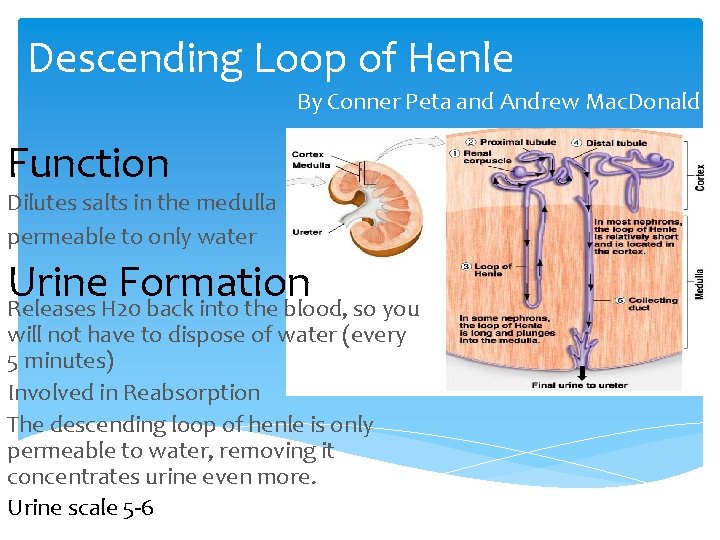
Descending Loop of Henle By Conner Peta and Andrew Mac. Donald Function Dilutes salts in the medulla permeable to only water Urine Formation Releases H 20 back into the blood, so you will not have to dispose of water (every 5 minutes) Involved in Reabsorption The descending loop of henle is only permeable to water, removing it concentrates urine even more. Urine scale 5 -6
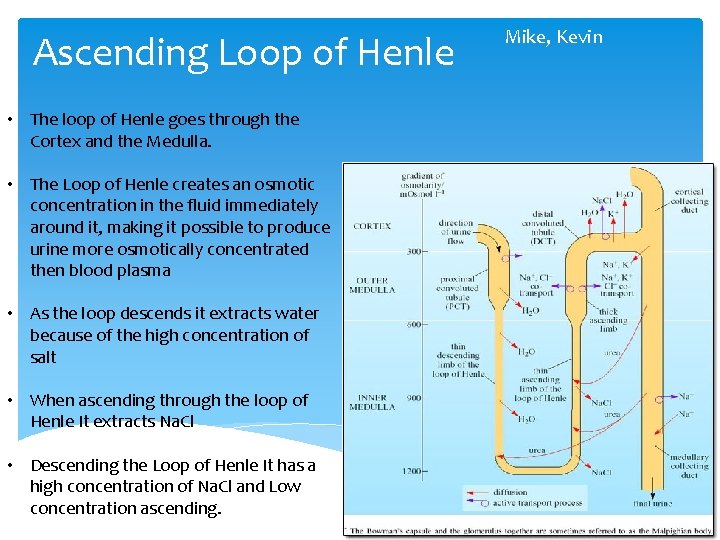
Ascending Loop of Henle • The loop of Henle goes through the Cortex and the Medulla. • The Loop of Henle creates an osmotic concentration in the fluid immediately around it, making it possible to produce urine more osmotically concentrated then blood plasma • As the loop descends it extracts water because of the high concentration of salt • When ascending through the loop of Henle It extracts Na. Cl • Descending the Loop of Henle It has a high concentration of Na. Cl and Low concentration ascending. Mike, Kevin
Distal Tubule Attalia, Caley, Cecilia • Found between the Loop of Henle and Collecting Duct • It is partially responsible for regulating Potassium, Sodium, Calcium and p. H • It regulates p. H by absorbing bicarbonate and secreting protons (H+) into the filtrate, or by absorbing protons and secreting bicarbonate into the filtrate. • Sodium and potassium levels are controlled by secreting K+ and absorbing Na+. • It also participates in calcium regulation by reabsorbing Ca 2+
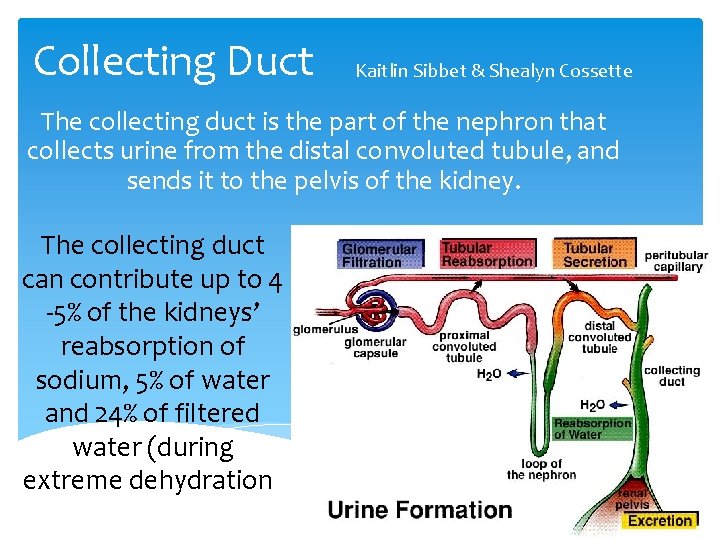
Collecting Duct Kaitlin Sibbet & Shealyn Cossette The collecting duct is the part of the nephron that collects urine from the distal convoluted tubule, and sends it to the pelvis of the kidney. The collecting duct can contribute up to 4 -5% of the kidneys’ reabsorption of sodium, 5% of water and 24% of filtered water (during extreme dehydration)
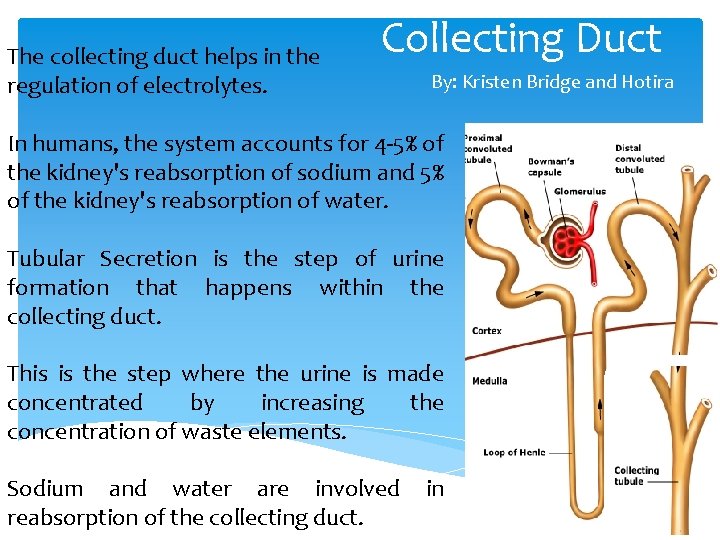
The collecting duct helps in the regulation of electrolytes. Collecting Duct By: Kristen Bridge and Hotira In humans, the system accounts for 4 -5% of the kidney's reabsorption of sodium and 5% of the kidney's reabsorption of water. Tubular Secretion is the step of urine formation that happens within the collecting duct. This is the step where the urine is made concentrated by increasing the concentration of waste elements. Sodium and water are involved reabsorption of the collecting duct. in
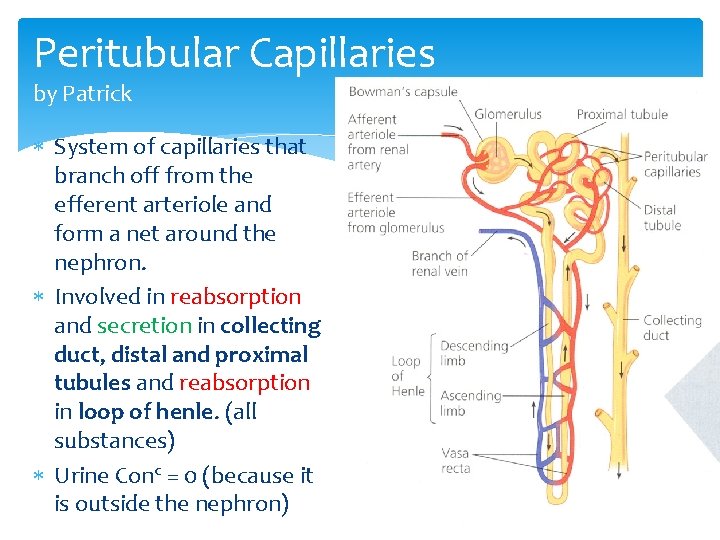
Peritubular Capillaries by Patrick System of capillaries that branch off from the efferent arteriole and form a net around the nephron. Involved in reabsorption and secretion in collecting duct, distal and proximal tubules and reabsorption in loop of henle. (all substances) Urine Conc = 0 (because it is outside the nephron)
- Slides: 10