
Globalization What it is and what it isnt
Globalization: What it is and what it isn’t
Definition • One of the most fashionable buzzwords of contemporary political and academic debate • It is used as a synonym for one or more of the following phenomena: – Free markets – Economic liberalization – Growing dominance of western (or Euro American) forms of political, economic and cultural life (Westernization or Americanization) – Global integration – The proliferation of new information technologies (internet revolution)
What is Globalization? 4 dimensions: – Space - extensiveness of global networks – Regularity - intensity of global interactions – Speed - velocity of global flows – Depth – impact of global interconnections on quality of life
Is Globalization a New Phenomenon? • Portugal’s global expansion in the 16 th century, linked continents, economies and cultures to a massive extent. • Muslim traders and the Silk Road • Dutch East India Company – 1 st Multinational Corporation • 19 th century is sometimes called “the First Era of Globalization”
Globalization: The Pro Argument • The global economy delivers markets that operate with maximum efficiency • Globalization is the only way to bring prosperity to the developing world • Globalization is inevitable and should be embraced
Globalization: The Con Argument • The global economy is an untamed juggernaut that rewards the few and impoverishes the many • Globalization is neither inevitable nor desirable • It diminishes the sovereignty of local and national governments and transfers the power to shape economic and political destinies to transnational corporations and global institutions • It is responsible for the destruction of the environment, the widening gap between rich and poor societies, and the world-wide homogenization of local, diverse, and indigenous cultures
Globalization Summary of Key Ideas
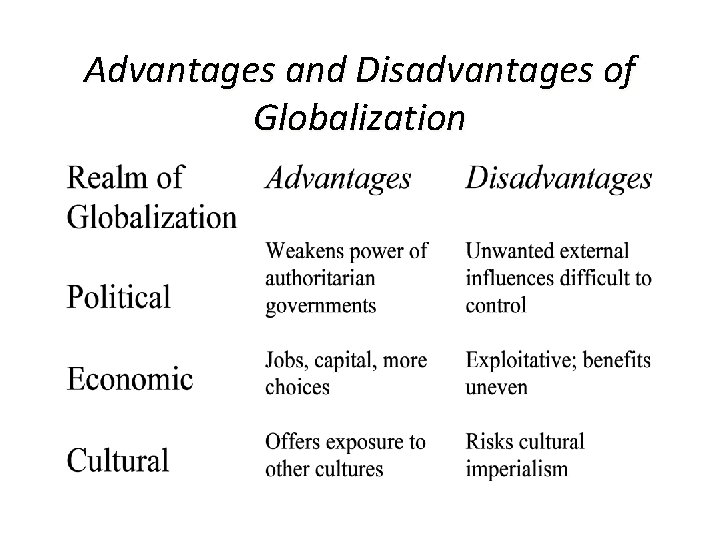
Advantages and Disadvantages of Globalization
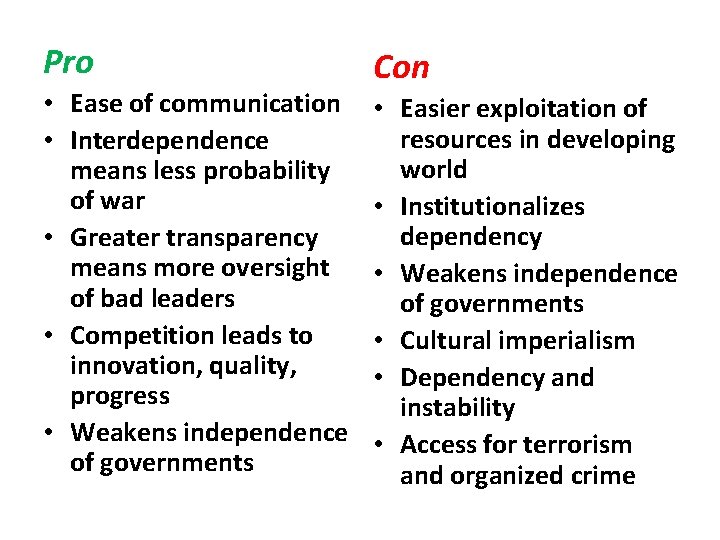
Pro • Ease of communication • Interdependence means less probability of war • Greater transparency means more oversight of bad leaders • Competition leads to innovation, quality, progress • Weakens independence of governments Con • Easier exploitation of resources in developing world • Institutionalizes dependency • Weakens independence of governments • Cultural imperialism • Dependency and instability • Access for terrorism and organized crime
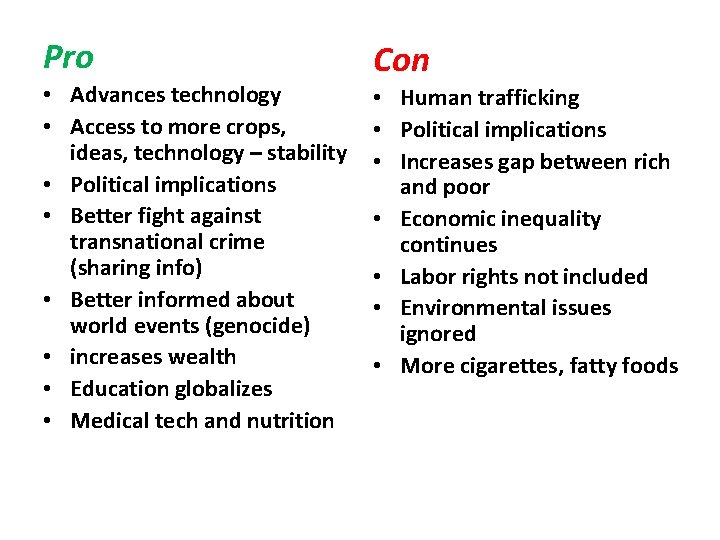
Pro • Advances technology • Access to more crops, ideas, technology – stability • Political implications • Better fight against transnational crime (sharing info) • Better informed about world events (genocide) • increases wealth • Education globalizes • Medical tech and nutrition Con • Human trafficking • Political implications • Increases gap between rich and poor • Economic inequality continues • Labor rights not included • Environmental issues ignored • More cigarettes, fatty foods
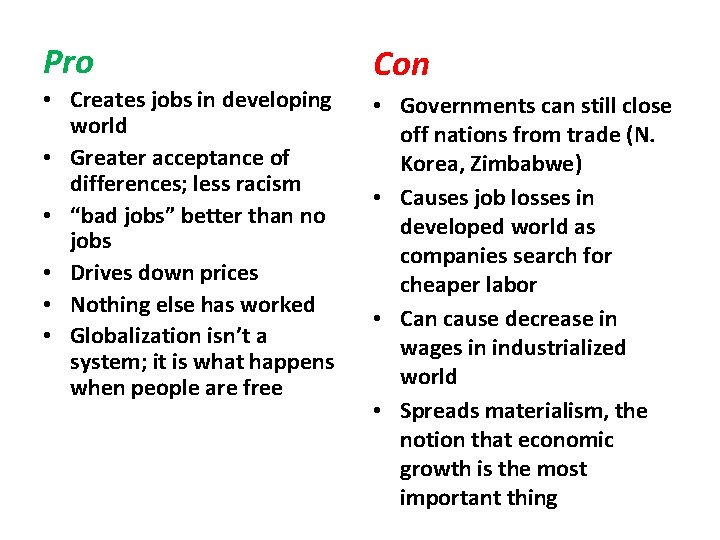
Pro • Creates jobs in developing world • Greater acceptance of differences; less racism • “bad jobs” better than no jobs • Drives down prices • Nothing else has worked • Globalization isn’t a system; it is what happens when people are free Con • Governments can still close off nations from trade (N. Korea, Zimbabwe) • Causes job losses in developed world as companies search for cheaper labor • Can cause decrease in wages in industrialized world • Spreads materialism, the notion that economic growth is the most important thing
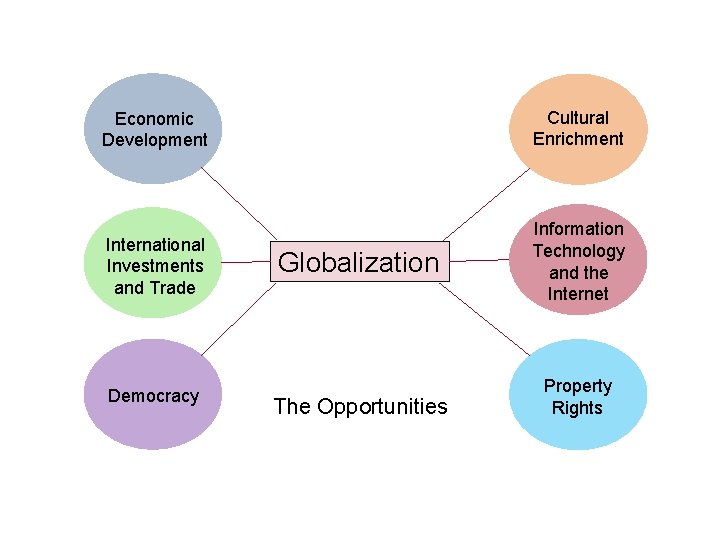
Economic Development Cultural Enrichment International Investments and Trade Information Technology and the Internet Democracy Globalization The Opportunities Property Rights
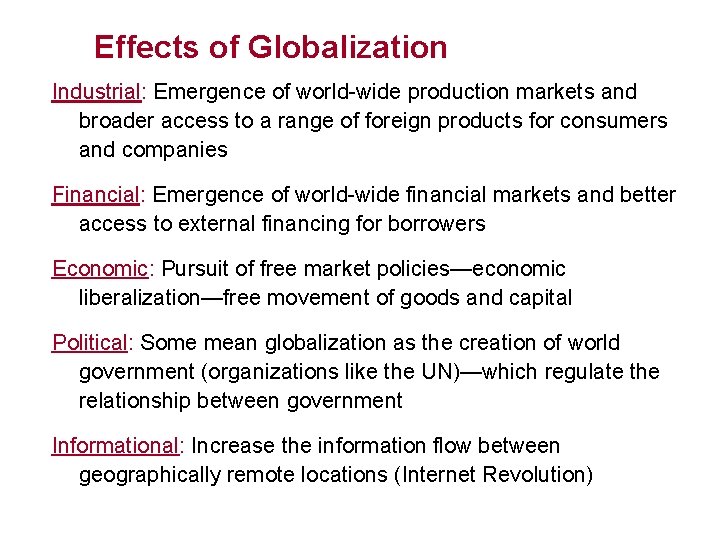
Effects of Globalization Industrial: Emergence of world-wide production markets and broader access to a range of foreign products for consumers and companies Financial: Emergence of world-wide financial markets and better access to external financing for borrowers Economic: Pursuit of free market policies—economic liberalization—free movement of goods and capital Political: Some mean globalization as the creation of world government (organizations like the UN)—which regulate the relationship between government Informational: Increase the information flow between geographically remote locations (Internet Revolution)
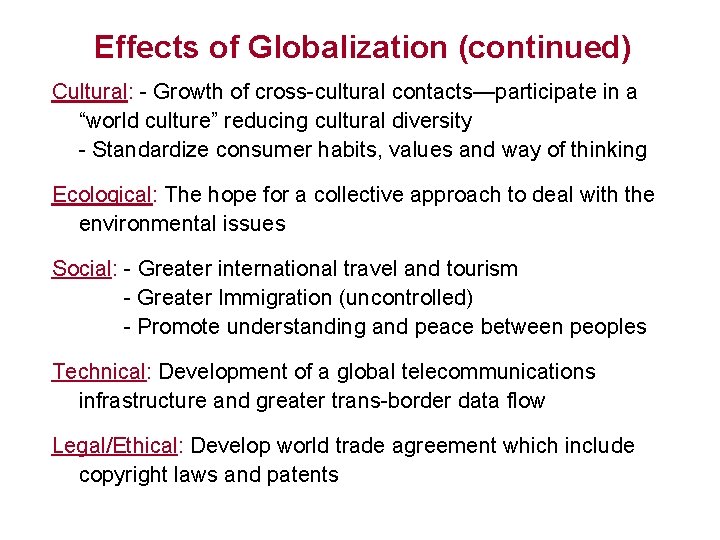
Effects of Globalization (continued) Cultural: - Growth of cross-cultural contacts—participate in a “world culture” reducing cultural diversity - Standardize consumer habits, values and way of thinking Ecological: The hope for a collective approach to deal with the environmental issues Social: - Greater international travel and tourism - Greater Immigration (uncontrolled) - Promote understanding and peace between peoples Technical: Development of a global telecommunications infrastructure and greater trans-border data flow Legal/Ethical: Develop world trade agreement which include copyright laws and patents
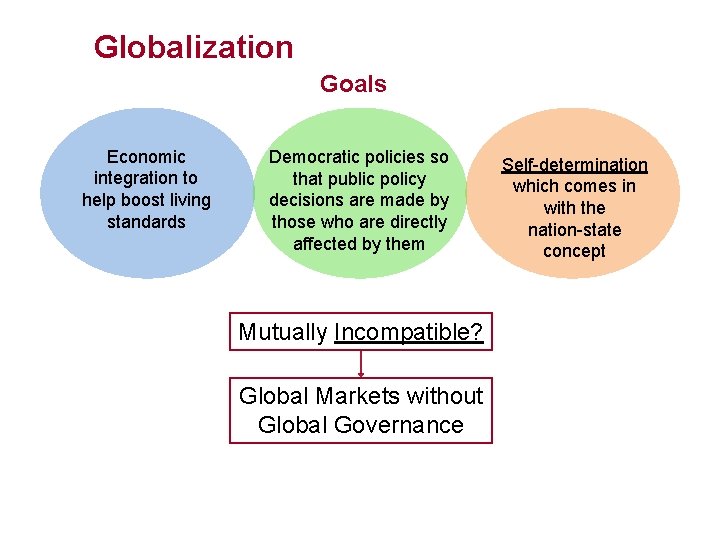
Globalization Goals Economic integration to help boost living standards Democratic policies so that public policy decisions are made by those who are directly affected by them Mutually Incompatible? Global Markets without Global Governance Self-determination which comes in with the nation-state concept
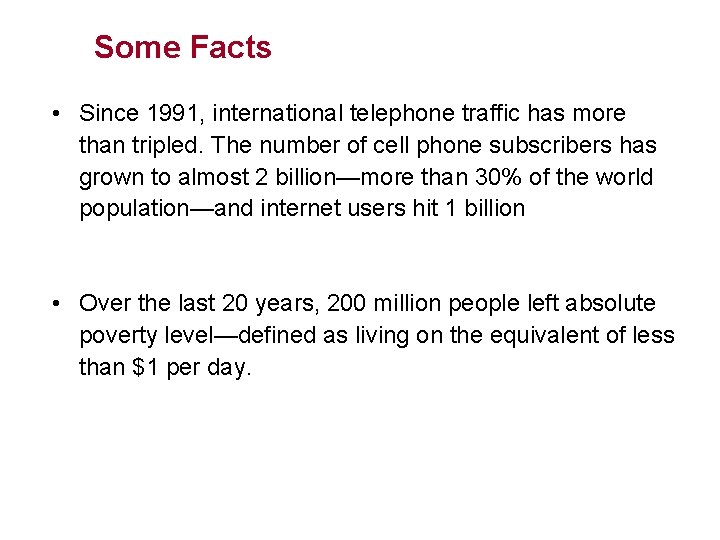
Some Facts • Since 1991, international telephone traffic has more than tripled. The number of cell phone subscribers has grown to almost 2 billion—more than 30% of the world population—and internet users hit 1 billion • Over the last 20 years, 200 million people left absolute poverty level—defined as living on the equivalent of less than $1 per day.
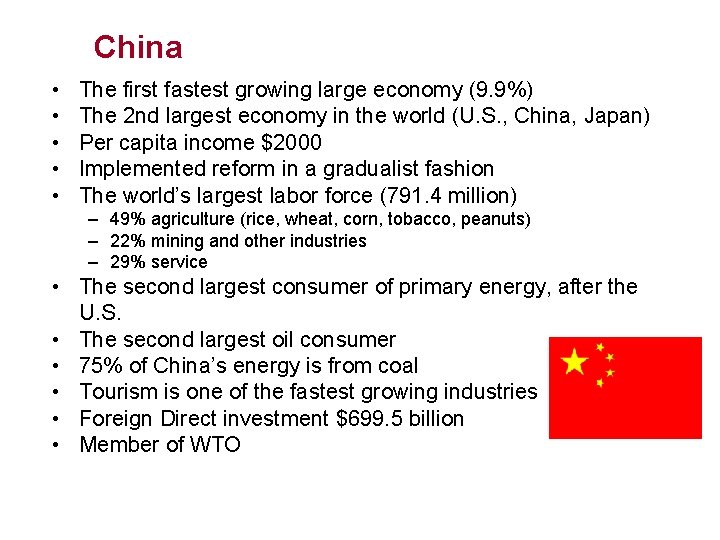
China • • • The first fastest growing large economy (9. 9%) The 2 nd largest economy in the world (U. S. , China, Japan) Per capita income $2000 Implemented reform in a gradualist fashion The world’s largest labor force (791. 4 million) – 49% agriculture (rice, wheat, corn, tobacco, peanuts) – 22% mining and other industries – 29% service • The second largest consumer of primary energy, after the U. S. • The second largest oil consumer • 75% of China’s energy is from coal • Tourism is one of the fastest growing industries • Foreign Direct investment $699. 5 billion • Member of WTO
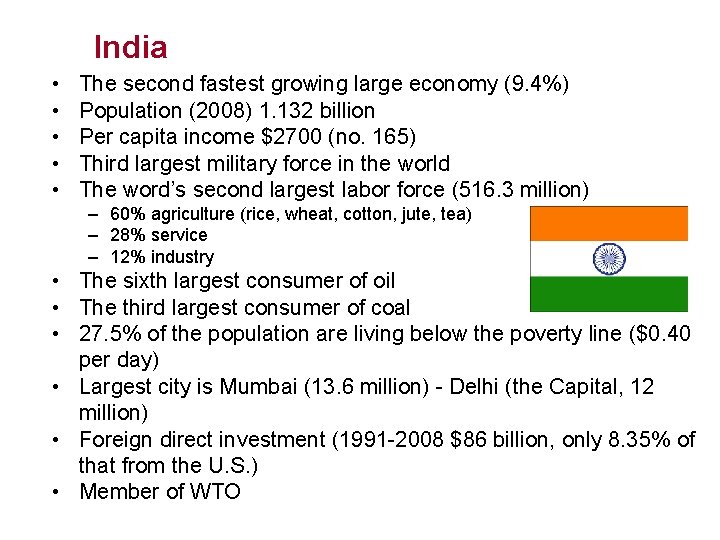
India • • • The second fastest growing large economy (9. 4%) Population (2008) 1. 132 billion Per capita income $2700 (no. 165) Third largest military force in the world The word’s second largest labor force (516. 3 million) – 60% agriculture (rice, wheat, cotton, jute, tea) – 28% service – 12% industry • The sixth largest consumer of oil • The third largest consumer of coal • 27. 5% of the population are living below the poverty line ($0. 40 per day) • Largest city is Mumbai (13. 6 million) - Delhi (the Capital, 12 million) • Foreign direct investment (1991 -2008 $86 billion, only 8. 35% of that from the U. S. ) • Member of WTO
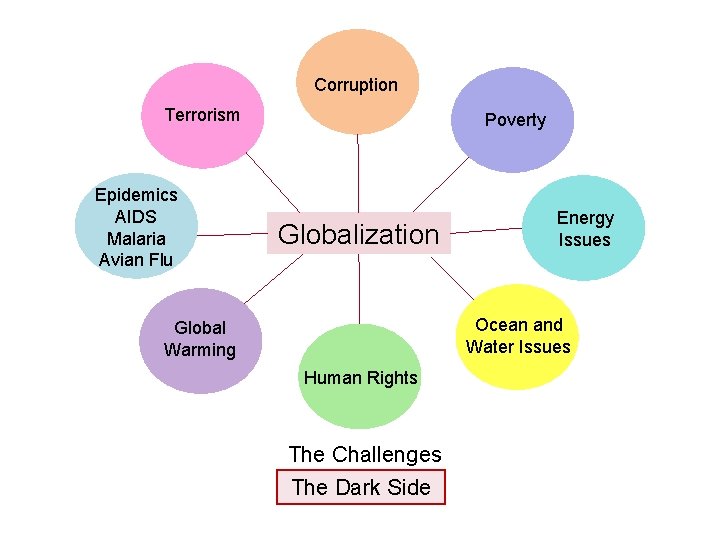
Corruption Terrorism Epidemics AIDS Malaria Avian Flu Poverty Globalization Energy Issues Ocean and Water Issues Global Warming Human Rights The Challenges The Dark Side
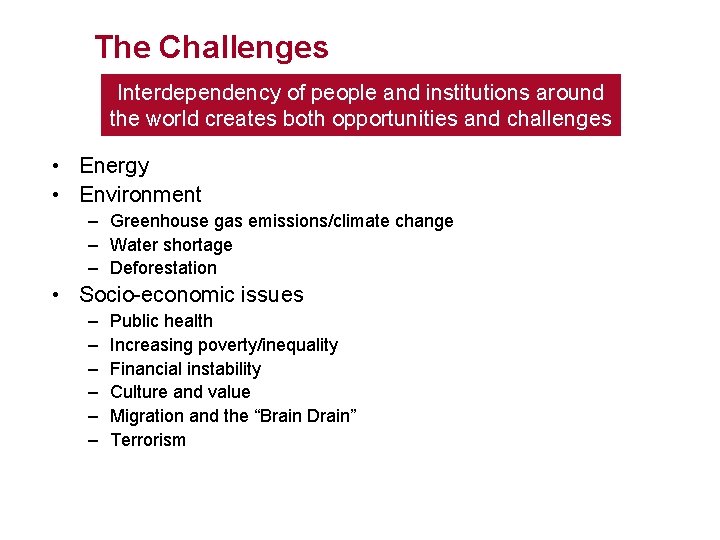
The Challenges Interdependency of people and institutions around the world creates both opportunities and challenges • Energy • Environment – Greenhouse gas emissions/climate change – Water shortage – Deforestation • Socio-economic issues – – – Public health Increasing poverty/inequality Financial instability Culture and value Migration and the “Brain Drain” Terrorism
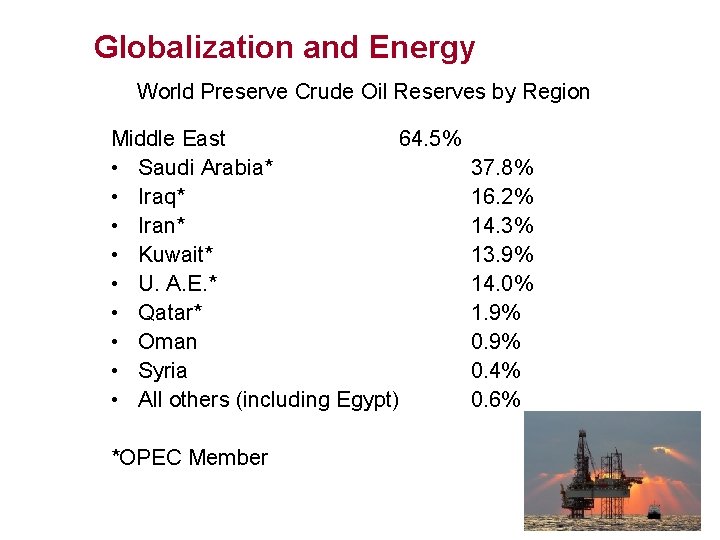
Globalization and Energy World Preserve Crude Oil Reserves by Region Middle East 64. 5% • Saudi Arabia* • Iraq* • Iran* • Kuwait* • U. A. E. * • Qatar* • Oman • Syria • All others (including Egypt) *OPEC Member 37. 8% 16. 2% 14. 3% 13. 9% 14. 0% 1. 9% 0. 4% 0. 6%
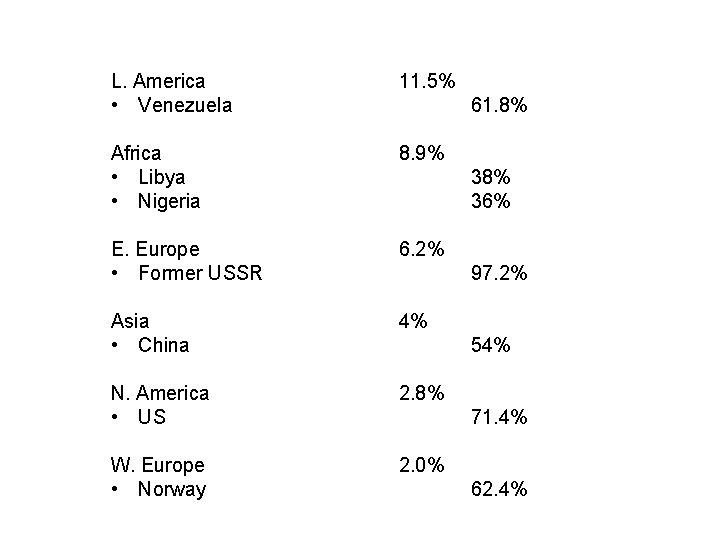
L. America • Venezuela 11. 5% Africa • Libya • Nigeria 8. 9% E. Europe • Former USSR 6. 2% Asia • China 4% N. America • US 2. 8% W. Europe • Norway 2. 0% 61. 8% 36% 97. 2% 54% 71. 4% 62. 4%
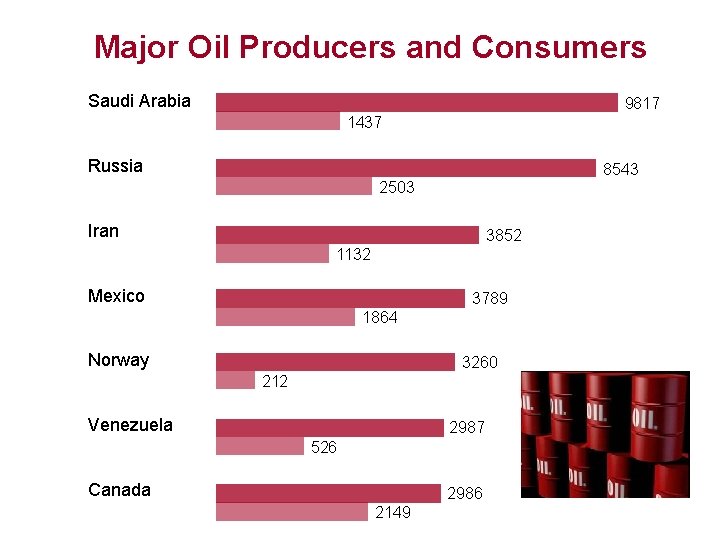
Major Oil Producers and Consumers Saudi Arabia 9817 1437 Russia 8543 2503 Iran 3852 1132 Mexico 3789 1864 Norway 3260 212 Venezuela 2987 526 Canada 2986 2149
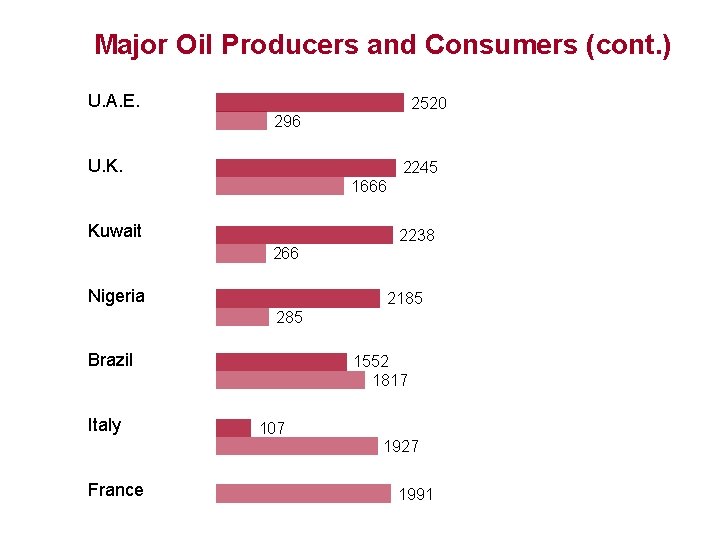
Major Oil Producers and Consumers (cont. ) U. A. E. 2520 296 U. K. 2245 1666 Kuwait 266 Nigeria 2238 2185 285 Brazil Italy 1552 1817 107 1927 France 1991
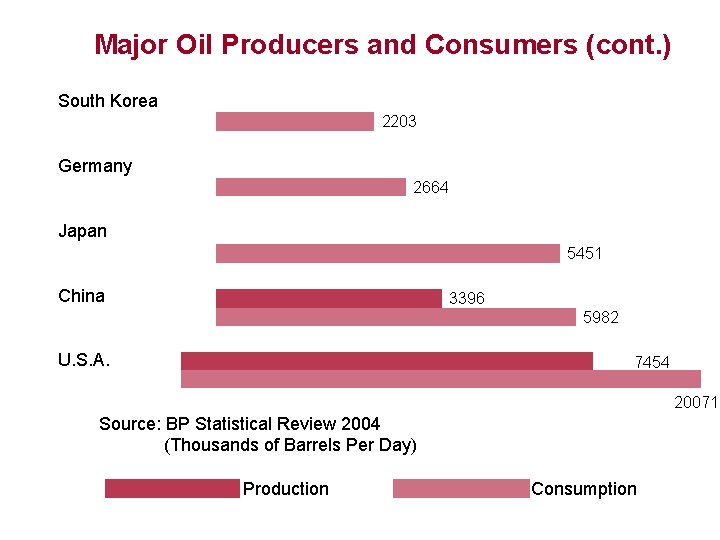
Major Oil Producers and Consumers (cont. ) South Korea 2203 Germany 2664 Japan 5451 China 3396 5982 U. S. A. 7454 20071 Source: BP Statistical Review 2004 (Thousands of Barrels Per Day) Production Consumption
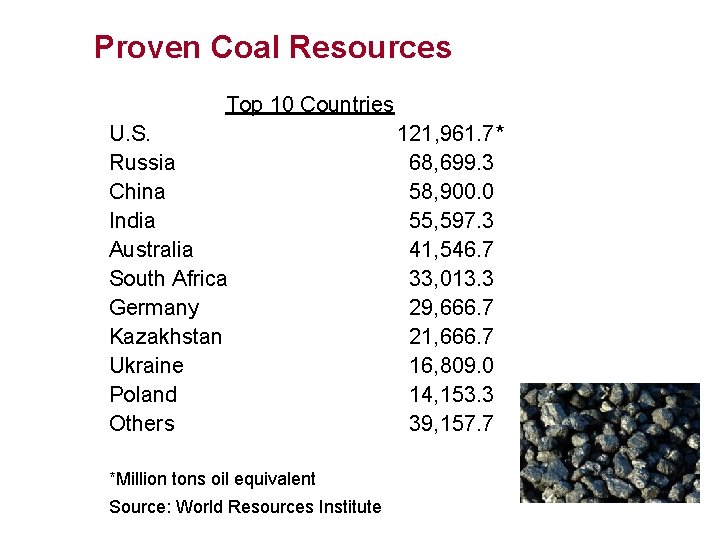
Proven Coal Resources Top 10 Countries U. S. Russia China India Australia South Africa Germany Kazakhstan Ukraine Poland Others *Million tons oil equivalent Source: World Resources Institute 121, 961. 7* 68, 699. 3 58, 900. 0 55, 597. 3 41, 546. 7 33, 013. 3 29, 666. 7 21, 666. 7 16, 809. 0 14, 153. 3 39, 157. 7
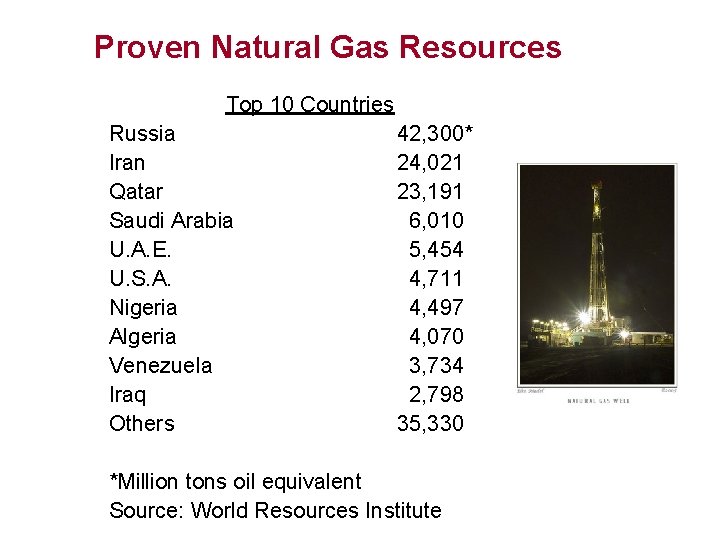
Proven Natural Gas Resources Top 10 Countries Russia Iran Qatar Saudi Arabia U. A. E. U. S. A. Nigeria Algeria Venezuela Iraq Others 42, 300* 24, 021 23, 191 6, 010 5, 454 4, 711 4, 497 4, 070 3, 734 2, 798 35, 330 *Million tons oil equivalent Source: World Resources Institute
Globalization and Water Facts • Agriculture is the main user/consumer of water • 31 countries are facing water stress and scarcity • Over one billion people lack adequate access to clean drinking water • Food and Agriculture Organization (FAO) reported “By 2025, 1. 8 billion people will be living in countries or regions with absolute water scarcity and 2/3 of the world population could be living under water stress conditions” • 1. 1 billion people in developing countries have inadequate access to water and 2. 6 billion don’t have proper sanitation (WHO) • 1. 8 billion people who have access to a water source within 1 km, but not in their house, or yard consume 20 liters per day, Americans consume an average of 600 liters everyday!
Globalization and Water • ½ of the people in developing countries suffering at any given time from a health problem caused by water and sanitation deficits • 12% of world population use 85% of the water and they don’t live in developing countries • 1. 4 million children die of diarrhea every year because of a lack in hygiene and sanitation (WB) • Water shortage is a global problem that touches the lives of people in developed and developing countries-many states have water shortage
Globalization and Water • A recent report by the National Intelligence Council, a group that reports to the CIA found that: – “The main resource problem in 2015 will be water and that the instability created by shortages of water, will increasingly affect the national security of the U. S. ” • The Global Water Corporation, a Canadian water company, put this way: – “Water has moved from being an endless commodity that may be taken for granted to a rationed necessity that maybe taken by force. ”
Globalization and Water • With all these facts, we humans are diverting, polluting and depleting our waters at an astonishing rate! • Many will argue the imperatives of economic globalization— unlimited growth, a seamless global consumer market, corporate rule, deregulation, privatization and free trade—are the driving forces behind the destruction of our water system.
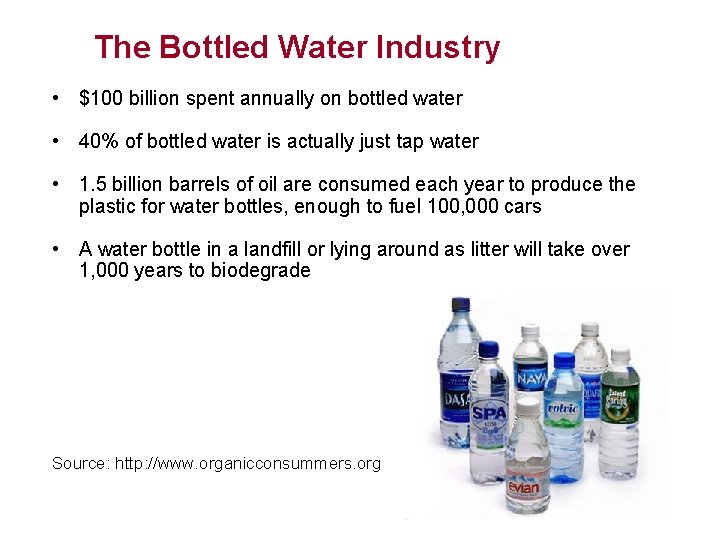
The Bottled Water Industry • $100 billion spent annually on bottled water • 40% of bottled water is actually just tap water • 1. 5 billion barrels of oil are consumed each year to produce the plastic for water bottles, enough to fuel 100, 000 cars • A water bottle in a landfill or lying around as litter will take over 1, 000 years to biodegrade Source: http: //www. organicconsummers. org
Globalization and Risks to Health • Increasing trade is certainly good for economies, it also leads to globalization of health risks. • As the industrialized countries increasingly ban cigarette advertisement, sales go down. Tobacco companies intentionally target people in poor nations. • 10 million died from tobacco abuse— 70% of these deaths are in developing countries. • The increase in global food trade, and its domination by large transnational companies that have developed global brand names such as popular beverages and fast food have contributed to the global epidemic of obesity.
Globalization and Risks to Health • Trade and movement of infected cattle and poultry across national borders have contributed to recent outbreaks of mad cow disease in the northern hemisphere and avian influenza in Asia. • SARS (Severe Acute Respiratory Syndrome) is the best contemporary example of the rapid spread of a hitherto unknown and virulent viral pathogen through travel of infected humans. • SARS was first recognized in Vietnam in Feb. 2003. By the first week of May 2003, 30 countries on six continents has reported a total of more than 7000 cases.
Poverty • 2. 6 billion people live on less than $2 per day. • 1 billion people entered the 21 st century unable to read or sign their names. • 640 million children live without adequate shelter. • 400 million children have no access to safe water. • Poorest 40% of the world population account for 5% of global income. • The richest 20% account for 75% of the world income.
Different Realities “People in the West may regard lowpaying jobs at Nike as exploitation, but for many people in the developing world, working in a factory is a far better option than staying down on the farm and growing rice. ” –Joseph Stiglitz, Discontents, p. 4
Globalization and Culture • Culture is the way of life to a group of people. It includes code of manners, dress, language, religion, rituals, and norms of behavior. • The drives of today’s rapid globalization are improving methods and systems of international transportation, devising revolutionary and innovative information technologies and services, and dominating the international commerce in services and ideas. • Some believe that globalization brings the decay of social values, culture and the environment.
Mc. Donaldization “…. America’s enormous cultural vitality and technological creativity, combined with hegemonic status in world politics, make her a net exporter of culture, giving her therefore no sense of threat from that direction either: it is her culture that spreads. But this spread of American culture threatens others to whom it goes. ” – Jagdish Bagwati, Defense, p. 120
American Culture in Numbers • Number of types of packaged bread available at typical US supermarket 104 • Amount of money spent by the fast food industry on television advertising per year $3 billion • Number of “coffee drinks” available at Starbucks, whose stores accommodate a stream over 5 million customers every day 26 • Number of new models of cars available to suburban residents 197 • Number of hours the average American spends watching television per week 28
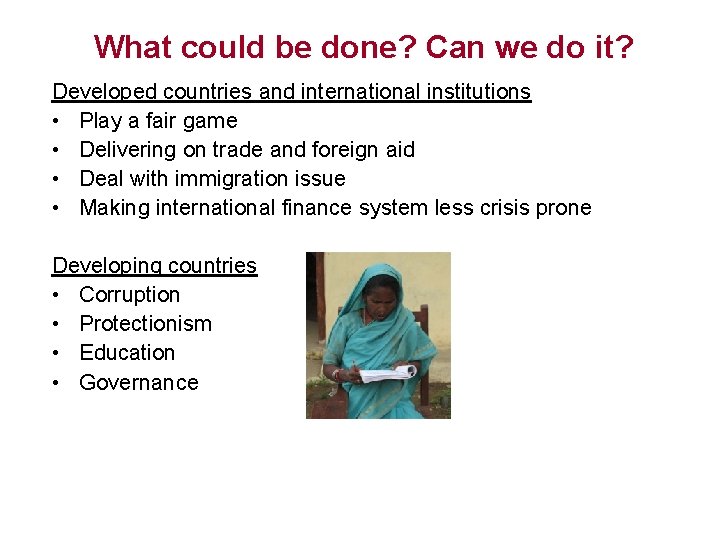
What could be done? Can we do it? Developed countries and international institutions • Play a fair game • Delivering on trade and foreign aid • Deal with immigration issue • Making international finance system less crisis prone Developing countries • Corruption • Protectionism • Education • Governance
A Concern and Warning In the new economy, everything is for sale, even those areas of life once considered sacred, like seeds and genes, culture and heritage, food, air and water. As never before in history, the public space, the vital commons of knowledge and our natural heritage, has been hijacked by the forces of private greed!!! However, the question isn’t whether globalization is good or bad, but rather to ensure that a “borderless world” provides more fulfilled lives for all. What we really need is a healthy global polity!
The Last Word “The current process of globalization is generating unbalanced outcomes, both between and within countries. Wealth is being created, but too many countries and people are not sharing in its benefits. They also have little or no voice in shaping the process. Seen through the eyes of the vast majority of women and men, globalization has not met their simple and legitimate aspirations for decent jobs and a better future for their children. . Even in economically successful countries, some workers and communities have been adversely affected by globalization. Meanwhile the revolution in global communications heightens awareness of these disparities—these global imbalances are morally unacceptable and politically unsustainable. ” Source: “World Commission on the Social Dimensions of Globalization” 2004
- Slides: 42